
Pine Mountain Settlement School
Series 13: EDUCATION
Glyn Morris [?]
Everett Wilson [?]
Arthur Dodd [?]
Outline of Possible Education
for 1937-1938
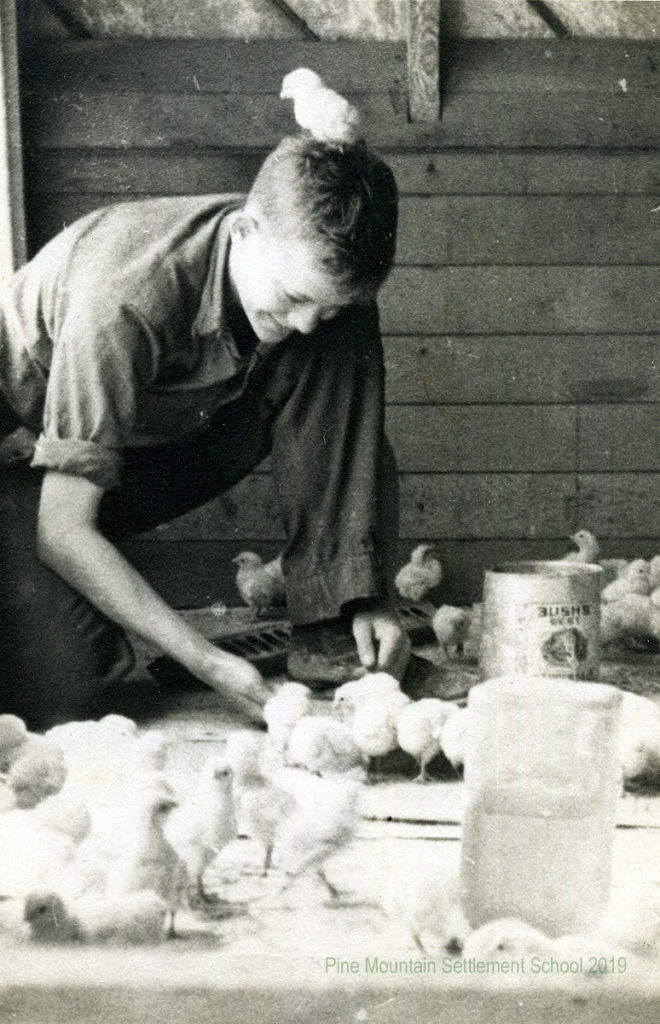
53 Student working with chicks in hen house, c.1935-1940. [burk_people_053 .jpg]
EDUCATION 1937 Outline of Possible Education 1937-1938
OUTLINE OF POSSIBLE EDUCATION FOR 1937-1938
The following outline is not conclusively attributed. It has elements of the Director, Glyn Morris’ perspective but could also be Everret Wilson, the Counselor, or possibly Arthur Dodd, the Principal, who freely weighed in on educational matters. As there is no signature, the writing style may guide in a later identification of the author, or not. It may also represent the final draft of an Education Committee, but the use of “I” suggests it represents elements of one person’s thoughts regarding the educational programming at Pine Mountain Settlement. It is rich with concepts favored by Morris, Wilson, Dodd, and others during the late 1930s to the mid-1940s. It was also a period of educational reform across the country and many experimental educational programs were evolving, such as Antioch in Ohio and Black Mountain College in North Carolina, where discontent with traditional educational paths sent institutions on a search of viable student driven and self-motivated educational programs that would meet the growing industrial world. Malcolm Ross’s new book, Machine Age in the Hills (1933), was one of several thoughtful efforts aimed at reforming education to meet the growing need for industrial training in a new age. It was a book well-known and admired by Morris and shows up frequently in his writing.
A point of certainty within many educational institutions of the times was the call for re-thinking of the educational models available to the youth of the day. That education was rapidly finding itself out of step with the work-force and the rapidly expanding industrial world and broader social needs were glaringly obvious in the coal fields of eastern Kentucky. In re-designing the educational programming at Pine Mountain, Morris often used a collaborative approach and the ideas and experiments of his staff were often called upon. This is just one document that reflects the growing institutional introspection.
Biology and baby chickens have much to inspire.
TRANSCRIPTION: OUTLINE OF POSSIBLE EDUCATION FOR 1937-1938
Our program has not gone far enough in the direction of making education life-like…. It is not meeting individual needs adequately. The child has not been liberated from external pressure and teacher-imposed tasks. For the most part, the grouping has been arbitrary, and a prescribed course of study has been followed, that is the group comes before an instructor at certain time intervals by coertion [sic, coercion], to be taught as a group certain facts skills and appreciation that he may or may not be interested in. Efforts are still being made to stimulate these interests, but our progressivism is still struggling in the same old frame of traditionalism. At the beginning of the next year, the same old problems of grouping will come up. But it is not necessary to go that far ahead. In any of the groups from the Senior Class down we have individuals who are either above or below the intellectual and educational level of the group, some who are completely indifferent to the course in spite of having elected to take it, some who are indifferent and even antagonistic to the personality directing the group, some who will have learned nothing that can be tangibly measured, and if objective tests run true to form we will have that sensation of defeat when they reveal that the child has retained only a minimum of what we “set out” to teach him
Now there will always be a certain amount of inefficiency or lost motion, in an educational organization, and I believe that important steps have been taken at Pine Mountain toward eliminating inefficiency and that many of the old barriers have been removed. But, if the analysis just given is correct, or even moderately correct it seems that we are challenged to further experimentation. In view of this, I would like to submit a skeleton outline of a program to the staff for consideration and criticism.
The program I have in mind would turn the teachers into guides
p.2
and counselors, instead of authorities who see that certain things must be learned by a certain time. It would substitute in place of our somewhat arbitrary curriculum, a child-centered curriculum with educational goals planned by the student and executed by the student within the bounds of wise educational procedure as determined by his elders and guides, the teachers. The work would be absolutely individual except in instances where small groups volunteered to work together for a common goal, or where it was thought wise to bring certain groups together for discussion of a common problem. This would wipe out completely any sense of class or grade and would mean the end of homogeneous grouping with its accompanying evils of wide intellectual differences. Social maladjustment would decrease. The problem of promotion to the next rung of a prescribed curriculum of a child not equipped even to maintain a credible showing at his present level, would be removed. The non-bookish child’s sense of inferiority and failure would be minimized because the only sense in which he could fail would be failure to measure up to tasks and projects that he had planned and promised himself to complete.
Compartmentalization would be swept away entirely. Graduation would not be contingent upon so many years work, or sitting placidly through so many courses but might occur at the end of two or even six years depending upon whether the school had discharged its obligation to the child and whether the child had fulfilled his obligation toward the school. In some instances, just when a student begins to show signs of intelligent growth, and just when he might become of service to the community in school, he’s given a diploma and dismissed. At other times, students are kept on long after they have reached the point of educational saturation.
In the evening program, when it is functioning smoothly, we see the children doing things with abandon, a sense of enjoyment, and satisfaction that is not present at the more formal program during the day
Why not enlarge upon this general philosophy in the academic and vocational program during the day? Working within the same time interval with possible minor changes, a homeroom with an instructor in charge, would be set up for the following fields of study: Art, Science, Manual Training, Printing, English, Mathematics, Social Studies, Cooking, and Sewing, Commercial Class, Weaving, Agriculture, Forestry, Auto Mechanics; this would leave two other classrooms available for overflow and group discussions. This provides fifteen meeting places with a student body limited to 90 or 100, the groups would, theoretically, run less than ten in number. The instructor in charge of the homeroom would be on duty for advice and counsel throughout the day. The entry of a student into that room would be volitional, and the length of time he remained in the room would be volitional, except that he would be required to spend a minimum time of say, an hour unless he came with special permission to get a specific piece of information concerning another task that he was busy on. It is conceivable that a student might spend several days or even a week in the social science laboratory or the art room provided his plans and project met the approval of the instructor in charge. The plan would demand a decentralized library to the extent that many books relating to a certain field might become a part of the homeroom equipment.
The formal academic appearance of the homeroom would be changed to a room with a homey appearance — many books, a few comfortable chairs, pictures, curtains on the windows, bulletin boards, round tables, a decent desk for the person in charge, and a glass panel door that could be locked at the end of the day.
The Student Counselor would be free in most cases to have student conferences at any time during the day without feeling that the youngster was being taken from a discussion, or that the instructor would miss him when the roll was taken. There would be no roll. Instructors who vitalized
p. 4.
their work, and most nearly fulfilled the needs of their charges, would doubtless, have larger attendance than those who didn’t. There would be no place for an instructor who does not have a keen interest in his profession, who does not make a point of keeping abreast of the best methods in that profession, and who cannot bring some freshness and creativity to his work as [a] guide and educational counselor, to those who come seeking help and information of their own free will.
The instructor, with the student, would keep a record of the individual’s achievements. These would be available to the Principal and Counselor at any time so that checks could be made upon whether or not the student was pursuing a well-rounded program. At the end of each semester duplicates of these sheets would be sent to the Counselor’s office to become a part of the individual’s permanent record. At the beginning of a new year a student would actually begin at the level of his past educational experience, and proceed along the lines of his greatest interest and ability under the counsel of an older guide who would know exactly what experiences he had had to date. This would make it imperative that the guide use the past records in the Counselor’s office in order to avoid repetition and intelligently help a student plan projects and educational goals.
There would be no signing up, but participation in the daily program would be compulsory, and infractions of attendance regulations would be severely penalized. The principal would act as coordinator of the program spending all of his time visiting when not in use as a guide and teacher.
I judge that it would require nearly a month to get such a program underway, and running smoothly. To initiate new students would require the cooperation and help of the old students, and careful planning ahead by the teacher guides. The first week or ten days would perhaps be an orientation week in which the teachers might use assembly periods to give
p. 5
outlines of some of the projects or courses of study that are possible under their guidance.
It is apparent that such a program, with its functional concept of learning, is not an educational panacea or cure-all. Even a cursory glance or hasty consideration of it reveals advantages and disadvantages. But if it is true that “The human being is too intelligent an animal to remember facts that he has no use for,” and if it is true that humans learn effectively only those things that they consciously feel the need of, and initiate themselves, it would seem to have the advantage of greater efficiency to the individual, over the present program.
end
GALLERY: OUTLINE OF POSSIBLE EDUCATION FOR 1937-1938
-
- 01 morris_1937_edu_outline_001
-
- 02 morris_1937_edu_outline_002
-
- 03 morris_1937_edu_outline_003
-
- 04 morris_1937_edu_outline_004
-
- 05 morris_1937_edu_outline_005
See Also:
EDUCATION
Return To:
EDUCATION Guide