Pine Mountain Settlement School
FLAX, HEMP AND SILK
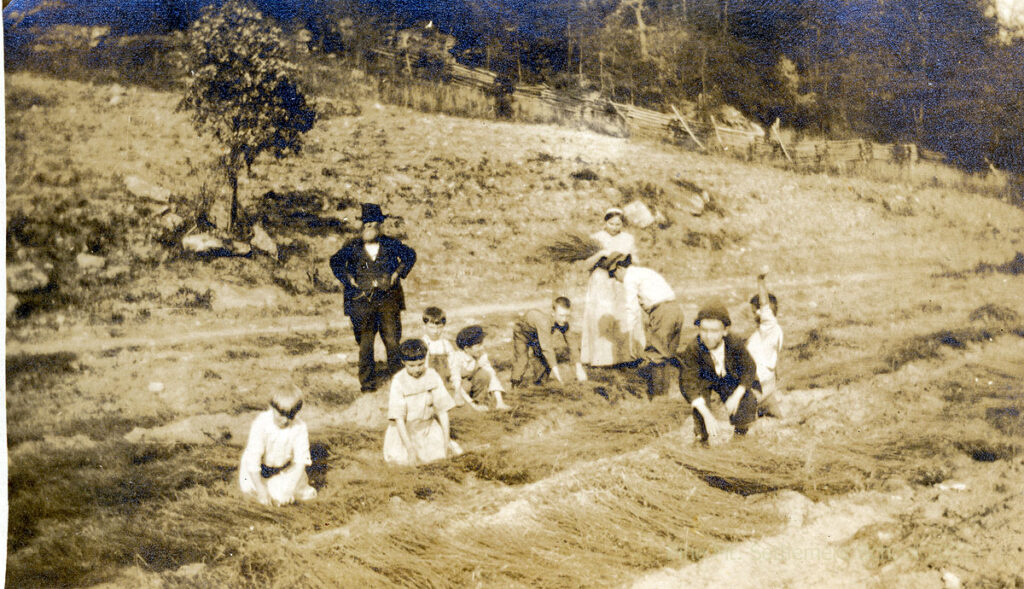
373 [Uncle William Creech with children from Pine Mountain School retting flax.]
Flax, Hemp and Silk
notes for flax article BELOW.
1913
By Lyster H. Dewey — Botanist in Charge of Fiber Plant Investigations, Bureau of Plant Industry. United States Department of Agriculture, Bureau of Plant Industry – Circular No. 57. Author: Lyster H. Dewey, Botanist in Charge of Fiber Investigations, Bureau of Plant Industry Pages: 1 – 7. THE CULTIVATION OF HEMP IN THE UNITED STATES. INTRODUCTION. ?? 1910
1910 INTRODUCTION
In 1910 Lyster H. Dewey, a botanist in charge of Fiber Plant Investigations for the Bureau of Plant Industry in the U.S. Department of Agriculture, wrote a small circular (No. 57) called “The cultivation of Hemp in the United States…” He noted that the two plants that were most promising for cultivation were hemp and flax. Kentucky became an optimum environment for the cultivation of these two plants.
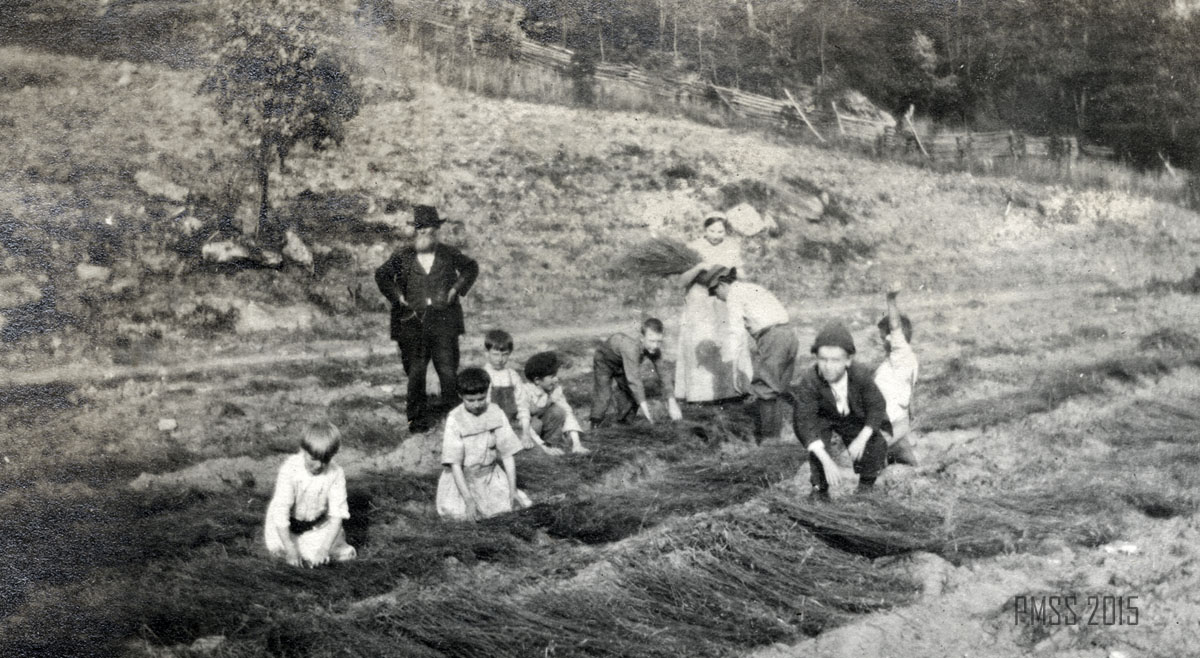
018a P. Roettinger Album. “Uncle William giving a lesson in spreading flax.” [William Creech, standing in back, and 9 children in the field.]
In one of the earliest photographs made at Pine Mountain Settlement School, William Creech, one of the founders of the settlement in Harlan County in eastern Kentucky, is shown with a group of children laying out cut flax on the hillside near his home. The Pine Mountain valley with its rich soil and long East to West orientation was, like the rest of the state “as favorable as anywhere in the world”, said Lyster Dewey of the growth of this friendly plant, particularly, its cousin, hemp.
HEMP
Hemp is one of the oldest fiber-producing plants and examples of the durable homespun fabrics and ropes and cords derived from hemp have been found in the archaeological remains of some of the world’s earliest civilizations.
Hemp is a member of the mulberry family, Moraceae which includes the Osage orange, the paper mulberry and the common mulberry trees. It is also a relative of the nettle family from which ramie, a strong bast fiber, is derived. Anyone who has ever painted or produced fine art prints knows that mulberry paper is some of the best support for paints and inks and its strong and very white surface retains its purity through time.
What Dewey fails to tell us in this government publication is the history of the notorious side of the family of hemp, the genus Cannabis. Instead, he notes that the genus Cannabis
… is generally regarded by botanists as monotypic, and the one species Cannabis sativa is now held to include the half dozen forms which have been described under different names … and which are cultivated for different purposes.
It has been asked which came first, the discovery of the narcotic properties of the plant or its usefulness as a fiber-producing plant. In China, one of the earliest civilizations to produce textiles of hemp, the people called the plant “ma” and the cloth became known as hempen cloth. Further, Chinese writings tell of the use of the hemps seeds and the oil from the seeds as central to their foodways. There does not appear to be any use of the plant for what the Chinese called bhang, charas, and ganga the common names of their narcotic drugs. “The production and use of these drugs were developed farther west,” says Dewey.
Hemp did come west but it was a variety that was first cultivated by the Puritans for its fiber-producing qualities. The early farming of hemp in New England was not nearly so successful as it became further South. For example, in Virginia the soil and longer growing season produced a robust plant but the industry failed to thrive as tobacco filled the fields. (For discussion see: Moore, Brent. A Study of the Past, the Present, and the Possibilities of the Hemp Industry in Kentucky, 1905.)
It was in Pennsylvania and in Kentucky that the industry thrived. Dewey describes the origins
The cultivation of hemp seems to have been a flourishing industry in Lancaster County, Pa., before the Revolution. An elaborate account of the methods then employed in growing hemp, written about 1775 by James Wright, of Columbia, Pa., (New Era, Lancaster, Pa., June 25, 1905.) was recently published as an historical document. The methods described for preparing the land were equal to the best modern practice, but the hemp was pulled by hand instead of cut. Various kinds of machine brakes had been tried, but the had all “given Way to one simple Break of a particular Construction, which was first invented & made Use of in this country.” The brief description indicates the common hand brake still in use in Kentucky.
By 1910, when Dewey’s circular was published, hemp was grown and harvested mainly for the production of commercial twine, a staple for tying just about anything together.
The first crop of hemp in Kentucky was raised by Mr. Archibald McNeil, near Danville, in 1775. (Moore, Brent. A Study of the Past, the Present, and the Possibilities of the Hemp Industry in Kentucky, p. 16, 1905.) It was found that hemp grew well in the fertile soils of the bluegrass country, and the industry was developed there to a greater extent than it had been in the eastern colonies. While it was discontinued in Massachusetts, Virginia, and Pennsylvania, it has continued in Kentucky to the present time. In the early days of this industry in Kentucky, fiber was produced for the homespun cloth woven by the wives and daughters of the pioneer settlers, and an export trade by way of New Orleans was developed. In 1802 there were two extensive ropewalks in Lexington, Ky., and there was announced “a machine, moved by a horse or a current of water, capable, according to what the inventor said, to break and clean eight thousand weight of hemp per day.” (Michaux, F. Andre. Travels to the west of the Alleghanies, p. 152, 1805. In Thwaites, Early Western Travels, v. 3, p. 200, 1904.) Hemp was later extensively used for making cotton-bale covering. Cotton bales were also bound with hemp rope until iron ties were introduced, about 1865. There was a demand for the better grades of hemp for sailcloth and for cordage for the Navy, and the industry was carried on more extensively from 1840 to 1860 than it has been since.
ITALY.
The highest-priced hemp fiber in the markets of either America or Europe is produced in Italy (Bruck, Werner F. Studien uber den Hanfbau in Italien, p. 7, 1911), but it is obtained from plants similar to those in Kentucky. The higher price of the fiber is due not to superior plants, but to water retting and to increased care and labor in the preparation of the fiber. Four varieties are cultivated in Italy:
The two varieties of Neapolitan hemp are cultivated in the vicinity of Naples, and even so far up on the sides of Vesuvius that fields of hemp are occasionally destroyed by the eruptions of that volcano. Seed of each of these Italian varieties has been grown in trial plots at Washington, D.C., and Lexington, Ky. The Bologna, or Piedmont, hemp in seed rows attained a height of 8 to 11 feet, nearly as tall as Kentucky seed hemp grown for comparison, but with thicker stalks, shorter and more rigid branches, and smaller and more densely clustered leaves. The small hemp, cannapa picola, was only 4 to 6 feet high. The large-seeded Neapolitan was 7 to 10 feet high, smaller than the Bologna, but otherwise more like Kentucky hemp, with more slender stalks and more open foliage. The small-seeded Neapolitan, with seeds weighing less than 1 gram per 100, rarely exceeded 4 feet in height in the series of plots where all were tried.
FRANCE.
Hemp is cultivated in France chiefly in the departments of Sarthe and Ille-et-Vilaine, in the valley of the Loire River. Two varieties are grown, the Piedmont, from Italian seed, and the common hemp of Europe. The former grows large and coarse, though not as tall as in the Bologna region, and it produces a rather coarse fiber suitable for coarse twines. The latter, seed of which is sown at the rate of 1 1/2 to 2 bushels per acre, has a very slender stalk, rarely more than 4 or 5 feet high, producing a fine flax-like fiber that is largely used in woven hemp linens. The common hemp of Europe, which includes the short hemp of France, is also cultivated to a limited extent in Spain, Belgium, and Germany. It grows taller and coarser when sown less thickly on rich land, but it never attains the size of the Bologna type.
(1) “Bologna,” or great hemp, called in France “chanvre de Piedmont,” is grown in northern Italy in the provinces of Bologna, Ferrara, Rovigo, and Modena. In the rich alluvial soils and under the intensive cultivation, this variety averages nearly 12 feet in height, but it is said to deteriorate rapidly when cultivated elsewhere. (2) “Cannapa picola,” small hemp, attaining a height of 4 to 7 feet, with a rather slender reddish stalk, is cultivated in the valley of the Arno in the department of Tuscany. (Dodge, Charles Richards. Culture of hemp in Europe. U.S. Department of Agriculture, Fiber Investigations, Report No. 11, p. 5, 1898.) (3) “Neapolitan,” large-seeded. (4) “Neapolitan,” small-seeded.
ITALY.
The two varieties of Neapolitan hemp are cultivated in the vicinity of Naples, and even so far up on the sides of Vesuvius that fields of hemp are occasionally destroyed by the eruptions of that volcano. Seed of each of these Italian varieties has been grown in trial plots at Washington, D.C., and Lexington, Ky. The Bologna, or Piedmont, hemp in seed rows attained a height of 8 to 11 feet, nearly as tall as Kentucky seed hemp grown for comparison, but with thicker stalks, shorter and more rigid branches, and smaller and more densely clustered leaves. The small hemp, cannapa picola, was only 4 to 6 feet high. The large-seeded Neapolitan was 7 to 10 feet high, smaller than the Bologna, but otherwise more like Kentucky hemp, with more slender stalks and more open foliage. The small-seeded Neapolitan, with seeds weighing less than 1 gram per 100, rarely exceeded 4 feet in height in the series of plots where all were tried.
SOILS SUITED TO HEMP.
Hemp requires for the best development of the plant, and also for the production of a large quantity and good quality of fiber, a rich, moist soil with good natural drainage, yet not subject to severe drought at any time during the growing season. A clay loam of rather loose texture and containing a plentiful supply of decaying vegetable matter or an alluvial deposit, alkaline and not acid in reaction, should be chosen for this crop.
SOILS TO BE AVOIDED.
Hemp will not grow well on stiff, impervious, clay soils, or on light sandy or gravelly soils. It will not grow well on soils that in their wild state, are overgrown with either sedges or huckleberry bushes. These plants usually indicate acid soils. It will make only poor growth on soils with a hardpan near the surface or in fields worn out by long cultivation. Clay loams or heavier soils give heavier yields of strong but coarser fiber than are obtained on sandy loams and lighter soils.
EFFECT OF HEMP ON THE LAND.
Hemp cultivated for the production of fiber, cut before the seeds are formed and retted on the land where it has been grown, tends to improve rather than injure the soil. It improves its physical condition, destroys weeds, and does not exhaust its fertility.
PHYSICAL CONDITION.
Hemp loosens the soil and makes it more mellow. The soil is shaded by hemp more than by any other crop. The foliage at the top of the growing plants makes a dense shade, and, in addition, all of the leaves below the top fall off, forming a mulch on the ground, so that the surface of the soil remains moist and in better condition for the action of soil bacteria. The rather coarse taproots (Pl. XLI, fig. 3), penetrating deeply and bringing up plant food from the subsoil, decay quickly after the crop is harvested and tend to loosen the soil more than do the fibrous roots of wheat, oats, and similar broadcast crops. Land is more easily plowed after hemp than after corn or small grain.
HEMP DESTROYS WEEDS.
Very few of the common weeds troublesome on the farm can survive the dense shade of a good crop of hemp. If the hemp makes a short, weak growth, owing to unsuitable soil, drought, or other causes, it will have little effect in checking the growth of weeds, but a good, dense crop, 6 feet or more in height, will leave the ground practically free from weeds at harvest time. In Wisconsin, Canada thistle has been completely killed, and quack-grass severely checked by one crop of hemp. In one 4-acre field in Vernon County, Wis., where Canada thistles were very thick, fully 95 per cent of the thistles were killed where the hemp attained a height of 5 feet or more, but on a dry, gravelly hillside in this same field where it grew only 2 to 3 feet high, the thistles were checked no more than they would have been in a grain crop. Some vines, like the wild morning-glory and bindweed, climb up the hemp stalks and secure light enough for growth, but low-growing weeds can not live in a hemp field.
HEMP DOES NOT EXHAUST THE FERTILITY OF THE SOIL.
An abundant supply of plant food is required by hemp, but most of it is merely borrowed during development and returned to the soil at the close of the season. The amounts of the principal fertilizing elements contained in mature crops of hemp, as compared with other crops, are shown in the accompanying table.
Amounts of principal fertilizing elements in an acre of hemp, corn, wheat, oats, sugar beets, and cotton. (Insert first table from p. 310 here)
The data in the table indicate that hemp requires for its best development a richer soil than any of the other crops mentioned except sugar beets. These other crops, except the stalks of corn and the tops of beets, are entirely removed from the land, thus taking away nearly all the plant food consumed in their growth. Only the fiber of hemp is taken away from the farm, and this is mostly cellulose, composed of water and carbonic acid. The relative proportions by weight of the different parts of the hemp plant, thoroughly air dried, are approximately as follows: Roots 10 per cent, stems 60 per cent, and leaves 30 per cent. The mineral ingredients of these different parts of the hemp plant are shown in the following table:
p. 310 here.Peter, Robert. Chemical Examination of the Ash of Hemp and Buckwheat Plants. Kentucky Geological Survey, p. 12, 1884. )
Hemp leaves the ground mellow and free from weeds and is therefore recommended to precede sugar beets, onions, celery, and similar crops, which require hand weeding. If hemp is grown primarily to kill Canada thistle, quack-grass, or similar perennial weeds, it may be grown repeatedly on the same land until the weeds are subdued.
BARNYARD MANURE.—The best single fertilizer for hemp is undoubtedly barnyard manure. It supplies the three important plant foods, nitrogen, potash, and phosphoric acid, and it also adds to the store of humus, which appears to be more necessary for hemp than for most other farm crops. If other fertilizers are used, it is well to apply barnyard manure also, but it should be applied to the preceding crop, or, at the latest, in the fall before the hemp is sown. It must be well rotted and thoroughly mixed with the soil before the hemp seed is sown, so as to promote a uniform growth of the hemp stalks. Uniformity in the size of the plants of other crops is of little consequence, but in hemp, it is a matter of prime importance. An application of coarse manure in the spring, just before sowing, is likely to result in more injury than benefit. The amount that may be applied profitably will vary with different soils. There is little danger, however, of inducing too rank a growth of hemp on upland soils, provided the plants are uniform, for it must be borne in mind that stalk and not fruit is desired. On soils deficient in humus as a result of long cultivation, the increased growth of hemp may well repay for the application of 15 to 20 tons of barnyard manure per acre. It would be unwise to sow hemp on such soils until they had been heavily fertilized with barnyard manure.
RETTING.
Retting is a process in which the gums surrounding the fibers and binding them together are partly dissolved and removed. It permits the fiber to be separated from the woody inner portion of the stalk and from the thin outer bark, and it also removes soluble materials that would cause rapid decomposition if left with the fiber. Two methods of retting are practiced commercially, viz, dew retting and water retting.
DEW RETTING.
In this country, dew retting is practiced almost exclusively. The hemp is spread on the ground in thin, even rows, so that it will all be uniformly exposed to the weather. In spreading hemp, the workman takes an armful of stalks and, walking backward, slides them sidewise from his knee, so that the butts are all even in one direction and the layer is not more than three stalks in thickness. (Pl. XLIV, fig. 3.) This work is usually paid for at the rate of $1 per acre, and experienced hands will average more than 1 acre per day. The hemp is left on the ground for four weeks to four months. Warm, moist weather promotes the retting process, and cold or dry weather retards it. Hemp rets rapidly if spread during early fall, provided there are rains, but it is likely to be less uniform than if retted during the colder months. It should not be spread early enough to be exposed to the sun in hot, dry weather. Alternate freezing and thawing or light snows melting on the hemp give the most desirable results in retting. Slender stalks one-fourth inch in diameter or less, ret more slowly than coarse stalks, and such stalks are usually not overretted if left on the ground all winter. Hemp rets well in young wheat or rye, which hold the moisture about the stalks. In Kentucky, most of the hemp is spread in December. A protracted January thaw with comparatively warm, rainy weather occasionally results in overretting. While this does not destroy the crop, it weakens the fiber and causes much loss. When retted sufficiently, so that the fiber can be easily separated from the hurds, or woody portion, the stalks are raked up and set up in shocks, care being exercised to keep them straight and with the butts even. They are not bound in bundles, but a band is sometimes put around the shock near the top. The work of taking up the stalks after retting is usually done by piecework at the rate of $1 per acre.
WATER RETTING.
Water retting is practiced in Italy, France, Belgium, Germany, Japan, and China, and in some localities in Russia. It consists of immersing the hemp stalks in water in streams, ponds, or artificial tanks. In Italy, where the whitest and softest hemp fiber is produced, the stalks are placed in tanks of soft water for a few days, then taken out and dried, and returned to the tanks for a second retting. Usually, the stalks remain in the water for about eight days, and the second time a little longer. In either dew retting or water retting, the process is complete when the bark, including the fiber, readily separates from the stalks. The solution of the gums is accomplished chiefly by certain bacteria. If the retting process is allowed to go too far, other bacteria attack the fiber. The development of these different bacteria depends to a large extent upon the temperature. Processes have been devised for placing pure cultures of specific bacteria in the retting tanks and then keeping the temperature and air supply at the best for their development. (Rossi, Giacomo.) Macerazione della Canapa. Annali della Regia Scuola Superiore di Agricultura di Portici, s.2, v. 7, p. 1-148, 1907. These methods, which seem to give promise of success, have not been adopted in commercial work.
BREAKING.
Breaking is a process by means of which the inner, woody shell is broken in pieces and removed, leaving the clean, long, straight fiber. Strictly speaking, the breaking process merely breaks in pieces the woody portions, while their removal is a second operation properly called scutching. In Italy and in some other parts of Europe, the stalks are broken by one machine or device, and afterwards scutched by another. In this country, the two are usually combined in one operation.
HAND BRAKES.
Hand brakes (Pl. XLVI, fig. 1), with little change or modification, have been in use for many generations, and even yet more than three-fourths of the hemp fiber produced in Kentucky is broken out on the hand brake. This simple device consists of three boards about 5 feet long set edgewise, wider apart at one end than the other, and with the upper edges somewhat sharpened. Above this, a framework, with two boards sharpened on the lower edges, is hinged near the wide end of the lower frame, so that when worked up and down by means of the handle along the back, these upper boards pass midway in the spaces between the lower ones. A carpenter or wagon maker can easily make one of these hand brakes, and they are sold in Kentucky for about $5.
The operator takes an armful of hemp under his left arm, places the butts across the wide end of the brake near the hinged upper part, which is raised with his right hand, and crunches the upper part down, breaking the stalks. This operation is repeated several times, moving the stalks along toward the narrow end so as to break the shorter pieces, and when the hemp appears pretty well broken, the operator takes the armful in both hands and whips it across the brake to remove the loosened hurds. He then reverses the bundle, breaks the tops, and cleans the fiber in the same manner. The usual charge for breaking hemp on the hand brake in this manner is 1 cent to 1 1/2 cents per pound. There are records of 400 pounds being broken by one man in a day, but the average day’s work, counting six days in a week, is rarely more than 75 pounds. In a good crop, therefore, it would require 10 to 15 days for one man to break an acre of hemp. The work requires skill, strength, and endurance, and for many years, there has been increasing difficulty in securing laborers for it. It is plainly evident that the hemp industry can not increase in this country unless some method is used for preparing the fiber requiring less hand labor than the hand brake.
MACHINE BRAKES.
Several years ago, a brake was built at Rantoul, Ill., for breaking and cleaning the fiber rapidly, but producing tow or tangled fiber instead of clean, straight, line fiber, such as is obtained by the hand brake. This machine consisted essentially of a series of fluted rollers followed by a series of beating wheels. Machines designed after this type, but improved in many respects, have been in use for several years at Havelock, Nebr., and first at Gridley, then at Courtland and Rio Vista, Cal. These machines have sufficient capacity and are operated at comparatively small cost, the hurds furnishing more than sufficient fuel for the steam power required, but the condition of the fiber produced is not satisfactory for high-class twines and it commands a lower price than clean, long, straight fiber.
The Sanford-Mallory flax brake, consisting essentially of five fluted rollers with an interrupted motion, producing a rubbing effect, has been used to a limited extent for breaking hemp. This machine, as ordinarily made for breaking flax, is too light and its capacity is insufficient for the work of breaking hemp.
A portable machine brake (Pl. XLVI, fig. 4) has been used successfully in Kentucky during the past two years. It has a series of crushing and breaking rollers, beating and scutching devices, and a novel application of suction to aid in separating hurds and tow. The stalks are fed endwise. The long fiber, scutched and clean, leaves the machine at one point, the tow, nearly clean, at another, and the hurds, entirely free from fiber, at another. It has a capacity of about 1 ton of clean fiber per day.
Another portable machine brake has been in use in California during the past two years, chiefly breaking hemp that has been thoroughly air dried but not retted. This hemp, grown with irrigation, becomes dry enough in that arid climate to break well, but this method is not practicable in humid climates without artificial drying. The stalks, fed endwise, pass first through a series of fluted or grooved rollers and then through a pair of beating wheels, removing most of the hurds, and the fiber, passing between three pairs of moving scutching aprons, each pair followed by rollers, finally leaves the machine in a kind of continuous lap folded back and forth in the baling box.
A larger machine (Pl. XLVI, fig. 3), having the greatest capacity and turning out the cleanest and most uniform fiber of any of the brakes thus far brought out, has been used to a limited extent during the past eight years in Kentucky, California, Indiana, and Wisconsin. This machine weighs about 7 tons, but it is mounted on wheels and is drawn about by a traction farm engine, which also furnishes power for operating it. The stalks are fed sidewise in a continuous layer 1 to 3 inches thick, and carried along so that the ends, forced through slits, are broken and scutched simultaneously by converging revolving cylinders about 12 and 16 feet long. One cylinder, extending beyond the end of the other, cleans the middle portion of the stalks, the grasping mechanism carrying them forward being shifted to the fiber cleaned by the shorter cylinder. The cylinders break the stalks and scutch the fiber on the underside of the layer as it is carried along, and the loosened hurds on the upper side are scutched by two large beating wheels just as it leaves the machine. The fiber leaves the machine sidewise, thoroughly cleaned and ready to be twisted into heads and packed in bales. This machine, with a full crew of 15 men, including men to haul stalks from the field and others to tie up the fiber for baling, has a capacity of 1,000 pounds of clean, straight fiber of good hemp per hour. The tow is thrown out with the hurds, and until recent improvements, it has produced too large a percentage of tow. It does good work with hemp retted somewhat less than is necessary for the hand brake, and it turns out more uniform and cleaner fiber. For good work, it requires, as do all the machines and also the hand brakes, that the hemp stalks be dry. If the atmosphere is dry at the time of breaking, the hemp may be broken directly from the shocks in the field, but in regions with a moist atmosphere, or with much rainy weather, it would be best to store the stalks in sheds or under cover, and with a stationary plant it might be economical to dr them artificially, using the hurds for fuel. Extreme care must be exercised in artificial drying, however, to avoid injury to the fiber.
IMPROVEMENT NEEDED IN HEMP-BREAKING MACHINES.
While hemp-breaking machines have now reached a degree of perfection at which they are successfully replacing the hand brakes, as the thrashing machines half a century ago began replacing the flail, there is still room for improvement. This needed improvement may be expected as soon as hemp is grown more extensively, so as to make a sufficient demand for machinery to induce manufacturers to invest capital in this line. For small and scattered crops, a comparatively light, portable machine is desirable, requiring not more than 10 horsepower and not more than four or five laborers of average skill for its operation. It should prepare the fiber clean and straight, ready to be tied in hanks for baling, and should have a capacity of at least 1,000 pounds of clean fiber per day. For localities where hemp is grown more abundantly, so as to furnish a large supply of stalks within short hauling distance, a larger machine operated in a stationary central plant by a crew of men trained to their respective duties, like workers in a textile mill, will doubtless be found more economical. Artificial retting and drying may also be used to good advantage in a central plant. The hemp growers of Europe have adopted machine brakes more readily than the farmers in this country, and the hemp industry in Europe is most flourishing and most profitable where the machines are used. Most of the hemp in northern Italy is broken and scutched by portable machines. Machines are also used in Hungary, and the machine-scutched hemp of Hungary is regularly quoted at $10 to $15 per ton, higher than that prepared by hand. These European machines may not be adapted to American conditions, but, together with American machines which are doing successful work, they sufficiently contradict the frequent assertion of hemp growers and dealers that “no machine can ever equal the hand brake.”
MARKET.
All of the hemp produced in this country is used in American spinning mills, and it is not sufficient to supply one-half of the demand. The importations have been increasing slightly during the past 20 years, while there has been a decided increase in values. The average declared value of imported hemp, including all grades, for the 4,817 tons imported in 1893, was $142.31 per ton, while in the fiscal year 1913, the importations amounted to 7,663 tons with an average declared value of $193.67 per ton. There have been some fluctuations in quotations, but the general tendency of prices of both imported and American hemp has been upward. (Fig. 19.) The quotations for Kentucky rough prime, since October 1912, have been the highest recorded for this standard grade. Furthermore, the increasing demand for this fiber, together with the scarcity of competing fibers in the world’s markets, indicates a continuation of prices at high levels.