Tag Archives: weaving

Sheep Shearing and Cecil Sharp

Pine Mountain Settlement School
DANCING IN THE CABBAGE PATCH
Sheep Shearing and Cecil Sharp

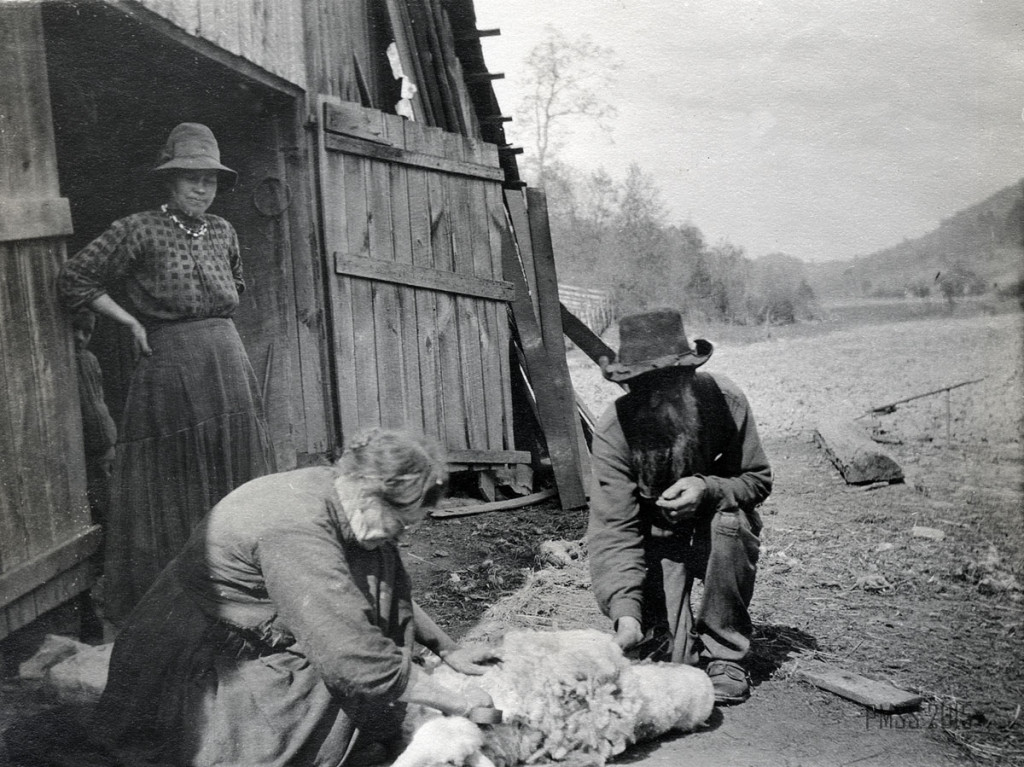
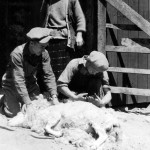
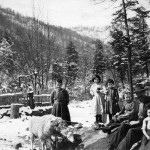
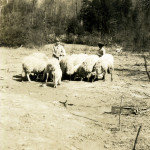
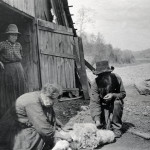
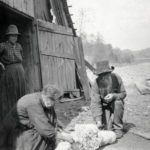
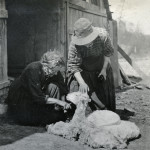
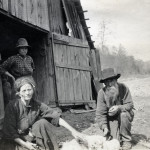
0046a P. Roettinger Album.”Sheep Shearing, Uncle John Shell, Aunt Sis Shell, and Mrs. Joe Day.” c.1920s  [Woman standing next to a barn on left, watching man and woman sheer a sheep.]

TAGS: sheep shearing, Cecil Sharp, sheep, sheep flocks, dreaming of sheep, sheep in history, sheep in song, Uncle John Shell, Aunt Sis Shell, Mrs. Joe Day, George Pullen Jackson


SHEEP SHEARING and CECIL SHARP (Say that fast!)

It is not likely that Cecil Sharp (1859-1924), the British musicologist, ever sheared a sheep. But, he was, in any case, a close observer of the ruminants and probably an even closer critic of their bleets and baahs! Nonetheless, what Cecil Sharp has left to the history of sheep is a unique auditory trail that helps to re-trace the prevalence of sheep within the rich agrarian history of Great Britain and in the American Appalachian mountains.

When musicologist Sharp sat on the porch of Old Far House at Pine Mountain Settlement School in Kentucky and watched the Kentucky Running Set as it was performed by students and staff, he was watching the well-trained legs that probably had chased a sheep or two up the Pine Mountain and down. Tending sheep is an active job and the energy of that Kentucky Running set is just a short measure of the energy that is needed to maintain a sheep flock in the mountains of Eastern Kentucky.

SHEEP IN APPALACHIA AND BORDERLAND CULTURE

in the early years of the Central Appalachians, in the small hillside farms, it was a celebration when lambs arrived and again when wool was sheared.  In the far-off “lands across the sea,” as Uncle William Creech, a founder of Pine Mountain Settlement used to say, many Europeans were continuing similar agrarian practices, particularly those people of the so-called “Borderlands,” that narrow bridge of land between Scotland and England. This region has long been associated with the early settlers of the Central Appalachians. The European Borderland customs and agrarian practices lingered on in many of the immigrant ancestors found in the Appalachians. In fact, they formed one of the largest immigrant groups living deep in the Appalachian mountains.

The raising of sheep was built into the early Appalachian pioneer imperative. Like so many of the customs familiar to the European immigrants from England, Scotland, Wales, and Ireland, and also those from other points of origin with agrarian roots, sheep were fundamental to survival. As an international livelihood, sheep flocks and along with those of goats are closely tied to the stories of agrarian cultures.

CECIL SHARP, SHEEP, AND SONGS

What Cecil Sharp added to sheep history was the discovery and transcription of an English folk song that no doubt flowed from the music and lives of early sheep farmers. While his discovery was not in the Borderlands but was probably in the Norfolk area of England, it captured the centrality of sheep to everyday agrarian life. 

When Cecil Sharp made his journey to America and eventually to Appalachia he wove the common elements together. Other song and ballad collectors preceded Cecil Sharp, but few had his broad recognition. When Sharp identified the British elements found in Appalachian songs and ballads he opened the flood-gates to other musicologists to marry Appalachia to “Merri Old England.” 

While Sharp was interested in the music, the music held a history that was less obvious. This is the relationship of the music to agrarian practice. While the growing obsession with “Merri Old England” in early twentieth-century America assured a close historical musical bond it also revealed something of the common agrarian practices. The catchy alliteration of Sharp’s collected songs underlines the importance of sheep in the daily lives of agrarian Europeans and their ancestors in the Appalachians.  Alliteration and all its musical overtones came naturally to the early oral culture of England and Appalachia. Mother Goose rhymes such as “Peter Piper picked a peck of pickled peppers … etc. ” is well known on both sides of the Atlantic as are many other ditties. But, just try saying “Cecil Sharp and sheep-shearing,” and see what lyrical lapses leap from your tongue and fix on your memory. Songs of shearing sheep are not at all uncommon, especially in families with a weaving willfulness — a trait that springs from sheep-herders and that abounds in the mountains of the Central Appalachians and across the world. Our first school yards were the pastures of the world.

COUNTING SHEEP AND DREAMING

Even as we sleep, we are not far from the sheep pasture. It is no small wonder that when we speak of dreaming, we also often speak of “counting sheep.” There is a very practical origin for that numerical association. It was the duty of the herdsman to know the number of sheep in his herd. It was a daily practice.  Counting sheep is deeply etched into the fabric of descendants of sheep-herders and deep in the historical agrarian psyche. We have been counting sheep for as long as we have joined our lives with the practice of raising sheep and other herds of animals. Sheep have been a part of our history as a country from the beginning of European settlement and have had considerable influence on our practical and formal education.  At one time Kentucky led the nation in the number of sheep. For Kentuckians, that is a lot of counting and a lot of dreaming.

Yet, Cecil Sharp was a collector of songs, not sheep, nor wool though he shows all the instincts of a weaver, dreamer, and numerator. He began his collecting of folk ballads in the English countryside. There, it was inevitable that he would encounter a myriad of sheep and those who tended them. Those country sheep herders had a deep association with alliterative language and ballads and ditties. Some references to sheep were sure to appear, and they did.

The song that Sharp recorded on his journey to Norfolk was one that succinctly captures sheep and their shepherds. That ballad from his song-gathering encounters, was published in a small book he edited called 100 English Folk Songs [ published by Oliver Ditson Co., Theo. Presser Co. Distributors, Philadelphia, 1916].

SONGS FOR ALL TIME [Songs of All Time]

One of the songs in Sharp’s collection found its way into another small book of collected folk songs. The Songs for All Time printed at Pine Mountain Settlement School was issued by the Council of Southern Mountain Workers c. 1946, and was intended to be a resource for “recreation material in the Highland [Appalachian Highlands] area.” It was a utilitarian collection of songs for social gatherings that is largely dependent on the rich oral tradition of the Appalachian region and that contained many familiar tropes that would be recognized in Great Britain. The Foreword tells us that

The contents, folk songs for the most part, were compiled by a committee which has made practical use of them with singing groups. Where tunes and words depend on oral tradition, innumerable versions usually exist — some of them perhaps better than [the] variants included. There is no version which can be called the correct one, but the committee has chosen those which it has found satisfactory in the light of their lasting qualities and the ease with which they can be learned. Modal melodies are not always easy to introduce to those unfamiliar with such music, but practically all songs included have been put to the proof: given a little time and repetition they “sing well” and become dear to the heart of the singer.

Song For All Times [Songs of All Time], Copyright, 1946, by Cooperative Recreation Service, (Forward). [4 editions published in 1946 in English and Undetermined and held by 29 WorldCat member libraries worldwide.]

On the back of the booklet, Songs For All times, there appears a short essay by George Pullen Jackson, an American musicologist, and educator. Pullen was a pioneer in the field of Southern (U.S.) hymnody and popularized the spurious term “white spirituals” to describe “fasola“* singing. [*fasola= harp singing or shape-note singing] Pullen says

…Sing, preferably your own songs, brother. Live your own song life and be proud of it. Don’t let the I-dont’-know-a-thing-about-music complex trouble you. Don’t let the processed and canned music lower your musical morale. If you are a mature person, re-learn and re-sing the songs of your childhood and youth. (You’ll be surprised at the large admixture of genuine folk songs among your remembered ditties.)

George Pullen Jackson, comment from Songs for All Times [Songs of All Time]

What George Pullen Jackson sensed was the power of music to heal and make joyful the day when it is pulled from routine experiences and even more when it is derived from a shared experience. The shearing of sheep and other communal activities of pioneer families brings home the satisfaction of sharing with neighbors the sometimes daunting tasks that an agrarian life demanded. Further,  Jackson in his remarks shares with Cecil Sharp the understanding of the healing power of song as it is remembered across all time and as it derives from the common stories of living.

While there is no direct knowledge of the following song appearing in the original musical repertoire of the Central Appalachians, the sentiment would clearly have resonated with the mountaineers. The Sheep-Shearing, was collected by Cecil Sharp in his 100 English Folk Songs for a good reason. He described it as “very popular among English country folk” and “in existence before 1760.” His sensitive ear could also, no doubt, frame the picture evoked by the lyrics in this and in his other collected songs

THE SHEEP-SHEARING

How delightful to see,
In these evenings in Spring,
The sheep going home to the fold.

The master doth sing,
As he views everything,
And his dog goes before him where told,
And his dog goes before him where told.

The sixth month of the year,
In the month called June,
When the weather’s too hot to be borne,
The master doth say,
As he goeth on his way:
“Tomorrow my sheep shall be shorn,
“Tomorrow my sheep shall be shorn.”

Now as for those sheep,
They’re delightful to see,
They’re a blessing to a man on his farm.
For the flesh it is good,
It’s the best of all food,
And the wool it will clothe us up warm,
And the wool it will clothe us up warm.

Now the sheep they are all shorn,
And the wool carried home,
Here’s a health to our master and flock:
And if we should stay,
Until the last go away,
I’m afraid ’twill be past twelve o’clock,
I’m afraid t’will be past twelve o’clock.

Cecil Sharp, 100 English Folk Songs, …”In existence before 1760.”

SEE ALSO

CECIL SHARP AND MAUDE KARPELES Visit to Pine Mountain Settlement School

JAMES GREENE ACCOUNT OF CECIL SHARP and MAUDE KARPELES at PMSS

PETER ROGERS’ ACCOUNT OF CECIL SHARP AND MAUDE KARPELES Visit to Pine Mountain 

DANCING IN THE CABBAGE PATCH Sheep

FARM GUIDE to Sheep Goats Weaving and Dyeing

Sheep in the Pine Mountain Community

Pine Mountain Settlement School
POST: DANCING IN THE CABBAGE PATCH
Sheep


“‘Aunt Jude’ Turner, Big Laurel, about 1925” feeding sheep. [nace_II_album_010.jpg]

TAGS: sheep, agriculture, livestock, shearing, sheep shearing, wool, spinning, carding, weaving, dyeing, shepherds, textiles, looms, pastures, mutton, Thomas D. Clark, Aunt Jude Turner, Southeast Kentucky Sheep Producers Association, Patrick Angel, Merino sheep, Shetland sheep, Kentucky Sheep and Goat Development Office (KSGDO), Sarabeth Parido, sheep consultants, The Woolery


SHEEP

“The hills shall skip like lambs,” she sang
Of the mountain scallops ‘gainst the sky engraved.
Anew with gushing torrents laved
Were the mountain sides, and gay
With sarvice and red maples braved.

Sarah Marcia Loomis, Staff PMSS  c. 1928

SHEEP THROUGH THE YEARS

The photograph of Aunt Jude Turner feeding her sheep, seen above, is one of the most iconic photographs in the Pine Mountain Settlement School collections. Scattered throughout the early photographs taken at the School there are images of sheep, suggesting that they were an integral part of the landscape and life in the early years of the north side of the Pine Mountain. This image captures the essence of “romantic” sheep raising. But, was it all bucolic?

Bucolic, serene, and pastoral, are all words often used to describe sheep at pasture, Sometimes these words are found on early Pine Mountain Settlement photographs or on notes that refer to them. These are words that conjure up years gone by and times when many farms in Kentucky had flocks of sheep. But how many sheep were there? And, where do sheep figure into the agrarian life of Kentucky, and particularly into the life of eastern Kentucky? A historical review is revealing and surprising.

THOMAS D. CALRK AND Agrarian Kentucky (1977)

Thomas D. Clark, one of the most esteemed of Kentucky’s historians tackles some of those questions in his small but important book, Agrarian Kentucky, (1977). He tells us that

“The rolling country hills and valleys of Kentucky present a massive and alluring canvas. Dotted with peaceful farmsteads and modest cabins, the land collectively represents the substance and spirit of home. Its rurality has been the womb of a nostalgic history into which Kentuckians have often retreated …

Clark, Thomas D. Agrarian Kentucky, University of Kentucky Press, 1977, p.x. (Kentucky Bicentennial Bookshelf).

Clark’s history of Kentucky’s agrarian past can be eye-opening to those who choose to only give singular recognition to one Kentucky herbivorous animal — and that, the horse. The Kentucky horse was important, but what Clark makes clear in his little book on agrarian life is that along with the horse came a myriad of other farm animals that formed the backbone of rural life and, ultimately, industrial life in early Kentucky.

Agrarian Kentucky Clark tells us, is much more complex than the culture that has grown up around horses and crafts and memories of early pioneers. The common cattle, turkeys, hogs, chickens, goats, and sheep followed the early pioneers as they wagoned — or walked into the western wilderness. Often with possessions slung across the back of a horse or mule, the early pioneers traveled down the Great Wagon Road that ran through the Shenandoah Valley, and as they looked out on the great virgin forests of North Carolina, the great green valleys carved by meandering rivers in southwestern Virginia, and the vast game-lands of what was to become Kentucky, it must have looked like paradise.

As the migrations of settlers and their livestock increased into North Carolina and then back up to southwestern Virginia and into what is now eastern Kentucky, the pioneers were awed to see a wilderness dotted with herbivores —with buffalo, deer, and herds of elk. As they crossed over the Cumberland Gap and the mountains opened gradually into plains, there were even larger herds of buffalo and elk. It was a land ready for settlement and herbivores of all varieties.

What is little recognized is how quickly non-native farm animal species of almost every variety flowed into the state following the early arrival of the pioneers. Large numbers of European sheep were among the earliest arrivals. The livestock that came down the Wilderness Road and on the many flatboats floated down the Ohio was not a trickle. It was a torrent. The animals came, into the broad, sweeping landscape of Kentucky and they quickly adapted and grew strong.

As the pioneers settled in they added the animals that had remained for many of them a part of the nostalgic and bucolic memories of their life in other times and other countries. As wealth began to grow, the animals they owned became, for the settlers a symbol of new-found wealth in a conquered paradise. The scrub cow, mule, nag, sheep, and goats thrived on the lush forage of Kentucky. The evident health and strength of the animal caught the imagination of the early pioneer and began to give way to a sensitivity to the breed of their animals. Breeding began to grow in importance, and with it, the ferocious art of livestock trading.

The many early settlers who came down the Ohio on their flatboats also floated their sparse but precious cargo on the Kentucky, the Cumberland, and the Rockcastle rivers in the mid-eighteenth century. One of the earliest incursions was that represented by the party of the pioneer settler Benjamin Logan, known as “St. Asaph.” He settled in the area of Stanford, then called Logan’s Fort, in what later became Lincoln County. The year was 1775. The later settlements of Lexington, 42 miles north, and Somerset, 32 miles south, placed Logan’s Fort in a critical position for shaping agrarian practice in the heart of Kentucky’s lush grasslands — the Bluegrass.

THE WILDERNESS ROAD

A second route of the pioneer into the wilderness of Kentucky was along what is now known as the Wilderness Road. This primary “road” followed the well-used Indian trails that came from Virginia and that passed through the Cumberland Gap where Kentucky now touches the border of Tennessee. It is this more southern route that is central to an understanding of the early Central Appalachian pioneer family. This growing population of both early-comers and late-comers found the close mountains and private lifestyle of the terrain comforting — and cheap.  They comprised the early settlers of eastern Kentucky and it is not surprising to find names today of the common ancestor who first settled the land. Nolans, Turners, Metcalfs, Boggs, and others formed a closely bonded origin and lifestyle. Sheep were very much a part of their history. 

The Wilderness Road was the route taken by Daniel Boone and his party that eventually led the famous party to their settlement at Boonesboro Fort on the banks of the Kentucky River. When Daniel Boone and his party settled into Boonesboro Fort, it was the same year that the Benjamin Logan party settled near Stanford, or Logan’s Fort, not far away. The magical year for both was 1775.

These two 1775 primary settlements introduced many of the herbivores that became an integral force in growing Kentucky agriculture and that today continue to be foundational to farming in Kentucky. For example, the number of livestock accompanying the early migrants was generally dependent on the number of family members. Historian Clark gives us an interesting formula for dependency. He tells us that a family of four would most likely have brought with them, “... a horse and a mule, a bull, three cows, a ram and three ewes, four boars, five sows and fifteen pigs, a rooster, and two hens.” This estimate is based on what is known about the settlement patterns of the earliest pioneers. But by 1860, this generous allotment of livestock per family of four (an uncommonly low number for Kentucky families of that time) was curtailed by the dwindling supply of pasture. The decrease in pasture, says Clark, changes the estimated distribution of livestock to the family size and is far less generous. He writes

In 1860, by comparison, 21 persons would have had to depend on a horse and a mule; 6 1/2 would have looked to a single cow for milk; 2 would have had a single pig to satisfy their needs for pork; and 1 1/2 persons would have fared better sharing a single beef cow.

Clark, Agrarian … p.37.

However, not all things were equal in the early settlements when it came to sheep. Clark fails to mention sheep in the 1860 picture. By that year the gentle herbivore had already run up against some obstacles. The pioneers who took up settlement in the mountainous regions of eastern Kentucky soon found that sheep needed extra attention. Unlike the hardy hogs that were left to their own devices to forage, mate, give birth, and fatten, did not easily fill the smokehouses of the settlers. The sheep were higher maintenance. They needed to be monitored and protected from cougars and other predators, particularly the growing packs of roaming settler dogs that found the docile sheep an easy target. Further, there were few flat grasslands in the mountains and the uneven uncultivated terrain readily grew the most bothersome cockles, briars, beggers lice, and many prickly burrs that tangled the rich fleece of the sheep and refused to be easily coaxed from their thick coats.

Nevertheless, the early pioneers of eastern Kentucky persisted. While they reduced the number of sheep in their flock according to their household number, they did so thoughtfully. They often measured the flock number against the amount of wool that might come from each sheep sheared and how much could be traded and how much spun into wool for their large families. They grew adept at determining how many skeins of wool could be spun from the pounds of wool on each sheep. It was estimated that one adult sheep could produce about twenty pounds of fleece. It was a good educational mathematical exercise the maintenance of their household “budgets.” It was this simple mathematical formula and others that pointed to a growing disparity in agrarian practice in the two states of Kentucky. Geography had begun to define the distribution of agrarian wealth throughout the Blue Grass and in the eastern regions of Kentucky and it was increasingly uneven.

IN THE 19th CENTURY

While the migration of early settlers had slowed by the turn of the nineteenth century, the traffic across the Cumberland Gap had picked up. But, this traffic was largely going East. The new Eastward traffic was the surge of drovers pushing their livestock along the Wilderness Road to a growing livestock market in cities such as Philadelphia, Baltimore, Richmond, and south to Charleston. It’s estimated that while both the eastern mountain migrations and the Blue Grass migrations of settlers were staggering in their rapid rise during the last half of the eighteenth century, the livestock traffic exporting out of the two areas until the middle of the nineteenth century, was far greater.

Pioneer migrations clearly shaped the future of domestic herbivores, while they also reflected the role that choice played in the formation of distinct cultural lifestyles in Kentucky. The introduction of domestic herbivores into Kentucky defined the two migrant cultures. Where the two cultures met was in their adept dialog at “horse-trading.” The success of both highlanders and lowlanders in managing their livestock wisely and becoming clever “horse-traders” and drovers, kept agrarian life vital in the Blue Grass and all along the Wilderness Road for well over a century. The vibrant trade in livestock was an economic stream as critical to the economy of Kentucky as was the later lumber and coal boom. In the two latter economies, eastern Kentucky excelled…. and not. Neither coal nor trees could quickly be replenished in the market.

Yet, not all was rosy in the livestock trade, either. Thomas Clark, tells us a cautionary tale about the meteoric rise of the Kentucky livestock trade. He describes what he calls the “greatest tragedy” of the boom in livestock production in Kentucky. That was the tragic loss of the state’s lead in sheep production to the poor control of vagrant dogs. It was a loss of control that was both a civic and a political tragedy.

The story goes that because of the dominant political party’s fear of alienating their voter base, legislative action to restrain canines from marauding sheepfolds was never taken. The dogs won over the sheep. Today we train dogs to watch over sheep and goats, but in the earlier years, dogs often ran wild in a pack, much like wolves, that were even more destructive. During the early eras of Pine Mountain Settlement School, the various Directors struggled with similar agrarian tragedies. The early agrarian tragedies were also educational tragedies.

FARM LIFE IN THE PINE MOUNTAIN VALLEY

When Uncle William Creech married Aunt Sal in 1866 they struck out on their own to shape a life for themselves in the Pine Mountain Valley. Like so many pioneers before him, Uncle William brought the necessary sheep along with his new family to the Pine Mountain Valley. Uncle William wrote about the early years in his brief autobiography

“I will now get back to my subject of farm work. So early the next spring my wife children and myself went to getting ready for another crop, them to burning logs and brush and me plowing the ground and planting corn, which we worked hard until the first of August, Clearing land was the greatest industry for the fall and winter for several years until we had enough for what we needed for wheat, corn, rye and flax and buckwheat. In the dry season of the year we had to grind our meal on a hand mill which was very hard work. By raising flax and sheep my wife carded and spun and wove cloth to make clothes for us all while I tanned leather and made all the shoes that we wore. While the days was warm and dry we plowed and hoed corn and wet days and by night I worked in my blacksmith shop and my wife knit and spun. But when the children got large enough to do work the boys helped me and girls helped their mother. But all worked to gather in the cornfield.”

William Creech. A Short Sketch of My Life, after 1913 (written for Ethel de Long)

It is education we now know to be the backbone of successful agrarian practice and few schools have worked harder to integrate the two. At Pine Mountain Katherine Pettit, one of the co-founders of the School, shaped the idea of agrarian training as a kind of “Industrial training” in which she championed both formal education, civic education, and indirectly, political education. In her agrarian “classroom” she aimed to take her passion for the agrarian life and shape students into new citizens who could help shape a new social and civil society in the mountains. Agriculture was a persuasive model and not, as some have claimed, a prop for a cultural agenda. Like the later Ayrshire herd, sheep make for beautiful pictures, but farming sheep and milk cows makes for a marvelous education.

Pettit has been accused of being driven by her cultural interests and her desire to foster cultural programs at Pine Mountain to the exclusion of other needs at the School — particularly agricultural needs. Certainly, weaving and Appalachian weavers were never far from Pettit’s eye, but it was the land and its agricultural and educational potential that drove the bulk of her agendas.

“KIVERS”

In her quest to understand the richness of the Central Appalachians, Pettit discovered “kivers” and they became the focus of her collecting instincts. In a personal letter that Pettit wrote to a friend in 1911, she outlines her fascination with “kivers,” the woven bed covers, the products of many mountain looms. Generally woven of wool raised by the family, spun, and then dyed with natural plants, these “kivers” or coverlets were prized possessions in the mountain families. Katherine Pettit had a passion for “kivers.” She certainly traveled miles to go see and seek her “kivers” but it soon became the “kivers” connection to the educational process of arriving at a “kiver” that held her attention and later her crusade. In instinct, she was a farmer in training and an educator before she was a collector.

… we had to hurry up to the head of Greasy to see Mrs. Shell and her coverlids [weavings]. She is over sixty years old and had just finished shearing her 100 sheep. Then we walked four miles along the foot of Pine Mountain down to Mr. [William] Creech‘s where they had looms, spinning wheels, hackles, etc., and had been longing for years for somebody to come along and tell them where they could get some flax seed to plant. They had been hoping for a school for 30 years and offered 100 acres of land.

Page 8 – [1911_pettit_ltr_0008-1.jpg]

Evelyn K. Wells captures another part of the Pettit-sheep story in a letter home to her family in 1918, in which she again describes the Shell family

https://pinemountainsettlement.net/?page_id=56474 Picture of Shell sheep. Sheep eating neighbor’s corn … “The other day I called on Aunt Sis Shell [Mary Elizabeth Nolan Shell]. She took me into the bedroom to see her wool, the fleeces of 50 sheep, black, Southdown and white, piled high on three feather beds, we have picked out some fleeces — mine, a lovely Southdown, gray-brown, to be woven into a linsey skirt for next winter.”

EVELYN K. WELLS 1918 Excerpts From Letters Home.
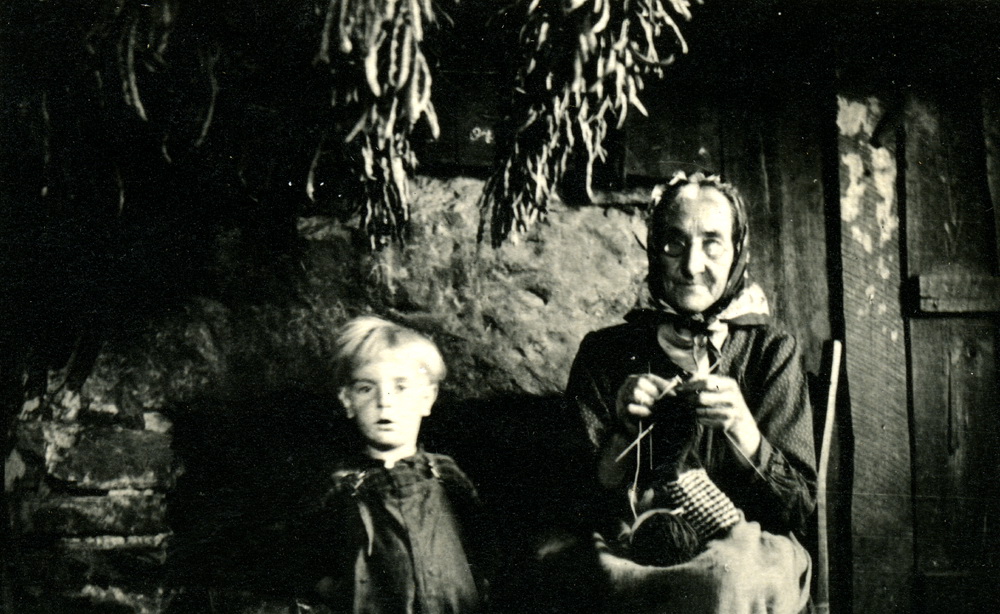
Aunt “Polly” Mary Ann Shell Day knitting, and Josiah (?) with dried “shucky” beans and peppers above their head and fireplace behind them. [hook_album_2blk__014.jpg]

Writing to her family two years earlier in 1916, Evelyn Wells again singles out the Shell family whom she had just visited and suggests that not all sheep farming was bucolic. She describes the visit, “He was most entertaining, telling us all about the game one used to be able to catch, and conditions when the country was really wild.” ….. Later, in her letter, she describes another visit to the Shell home where

“I saw a quaint procession passing, through the bottomland. Aunt Sis stalking along, behind her Uncle John with his beard and slouch hat, and after them a boy driving a sledge drawn by a team of oxen. They are getting in their corn because the sheep are eating it….” 

EVELYN K. WELLS 1916 Excerpts From Letters Home.

It is the agriculture that sits behind each “coverlid” that became a primary concern to Pettit and her community of subsistence farmers.

SHEEP ALONG THE PINE MOUNTAIN

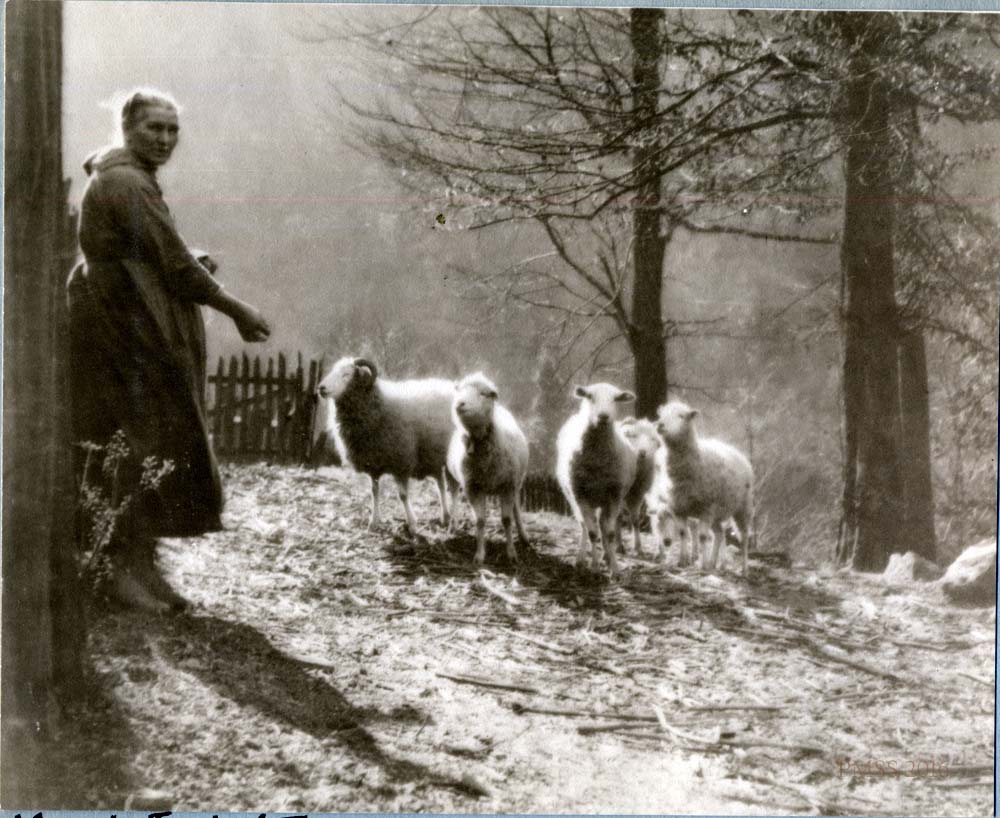
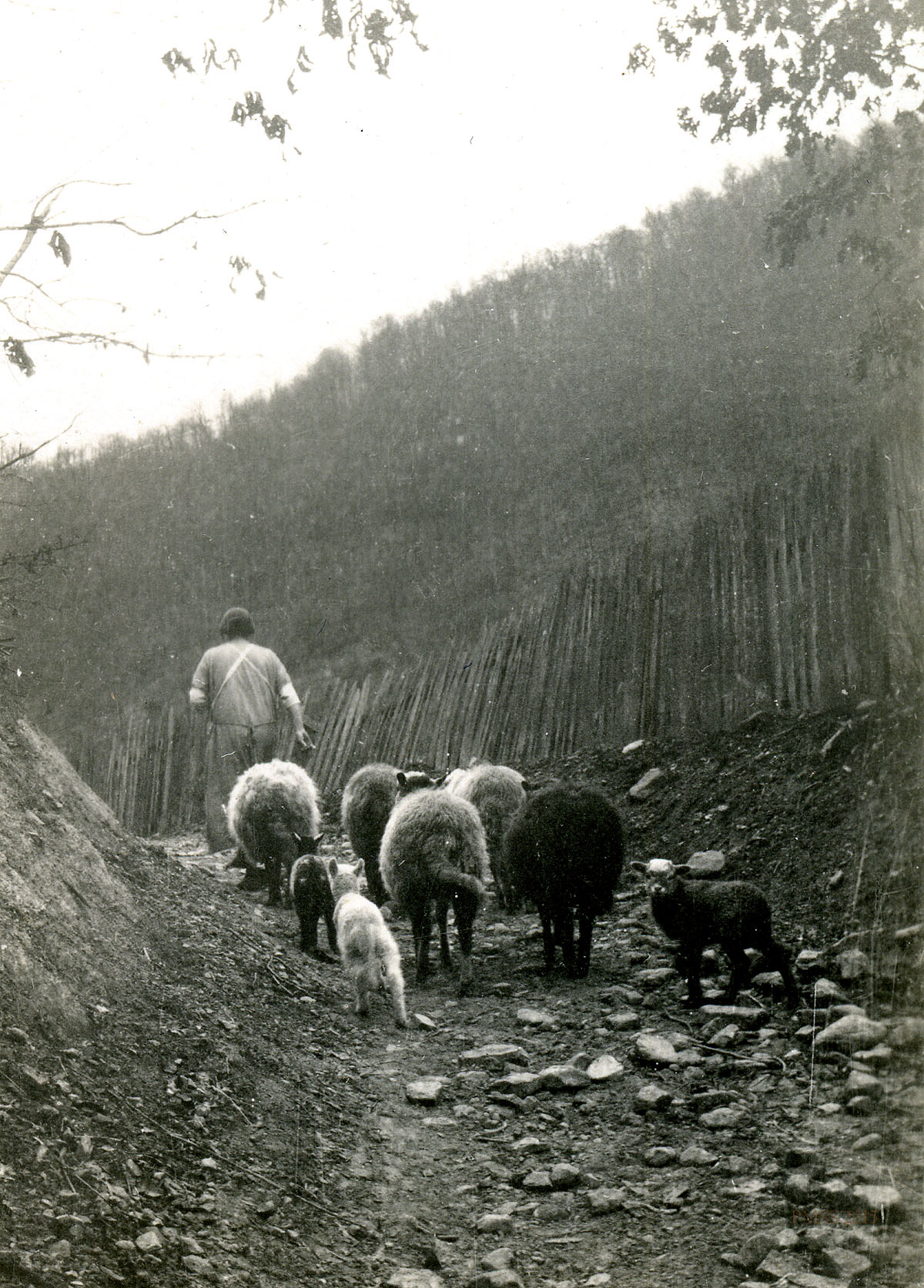
Kingman Album. Woman with sheep following her. [c. 1920’s]  [kingman_021d]

The raising of sheep and the issues of negotiating the open pastures in the first decades of the twentieth century were a source of constant contestation. Usually, disputes were worked out neighbor to neighbor but sometimes — not. Pigs were of the greatest concern as they were often the most destructive farm animal on the loose. Sheep, it appears, could also create issues, such as foraging in a neighbor’s corn patch. One story relayed by Pine Mountain staff member Alice Cobb describes the common incident in which sheep eat a neighbor’s corn crop.

Another incident, also described by Alice Cobb in her brief vignettes of life in the Pine Mountain valley, is more serious and ends up in court but as the incident is re-told it becomes a story of “clever justice”.

All evidence in the Pine Mountain Valley shows that the raising of sheep and the shearing of the sheep for wool was persistent and intermittently practiced in dwindling numbers until the late 1980s. Again Pine Mountain staff member Alice Cobb describes her observations as an “outsider” of a household that is “too evasive to be captured”

There are fifty million “schoolhouses in the foothills” stories to be dramatized, published, gobbled and washed down with laughter and tears. The truth is that the situation is too evasive to be captured except in a net of romance or a mire of realism, and every small incident has its share of both. We from the outside come down to the hills. Many of us see the quaint picture of Mag shearing her sheep and spinning the wool, Grannie Hall dipping vegetable dyes and weaving rare patterns in rare colors; ….

Alice Cobb, Letters

What Cobb does in her insightful and graphic descriptions of life in the Pine Mountain Valley is capture and explode the romantic notion of culture as a singularity only recognized in the photograph or romantic or picturesque story posed to inform the outsider. What she draws our attention to is the pervasive and often grinding agrarian labor of most all life in the Pine Mountain Valley. The multitude of hours it takes to raise sheep, goats, and cows; the back-breaking labor of farming a steep hillside; the desire for education that is devoured by the hours at the simple tasks of making a life. Maintaining a mountain home is an education, but not of the schoolhouse type. The maintenance of that education was not bucolic or picturesque until its conversion into memories and reverie.

The tasks associated with an agrarian life are labor-intensive and demanding on every member of the family. A subsistence farm is not so much a culture as it is a composite of the family’s relationship to the land, their husbandry of their animals, and their household skills in managing their small plots of land and large families. An agrarian existence is often centered on the success or failure of the agriculture skill of the family. The enhancement of this life and the preservation of the memories were at the heart of Pettit’s mission. The “kivers” were her “school books”.

Even earlier, in 1911, three years before Pine Mountain was founded, Katherine Pettit and a large group from Berea traveled to eastern Kentucky. A companion on the journey, Maria McVay [McVey ?], described the trip in a serialized diary published in a major Cincinnati newspaper. Pettit mentions the trip briefly in an early 1911 letter to potential donors for a new mountain School in Harlan County. Written while she was still at Hindman she recalled her first impression of the mountainous eastern region.

Writing from Hindman, she describes the life of families in the Pine Mountain Valley that she witnessed on her very first long trip to the region in 1899. With that group gathered by Berea faculty member Henry Mixter Penniman and other travelers, she was clearly moved by the beauty and the deprivation of the area. Surrounded by kindred spirits, including the suffragist Madeline McDowell Breckenridge,, and the outspoken geographer, “Nellie” Semple [Ellen Churchill Semple], who all had their views about the skills of farming, Pettit began to shape her plans for a school in the Pine Mountain valley.

In her Letter to Friends, she describes the remote valley and with a reflection of deep regret, she also describes the push and pull of industrialization that was manifested in the railroad then entering the mountains. In an effort to prepare mountain communities for the coming industrialization, she began to form a vision that would take native craft and mix it with informed industrial training and traditional educational coursework much like the program she had initiated at Hindman Settlement.

Pettit writes

” …. we had to hurry up to the head of Greasy to see Mrs. Shell and her coverlids [weavings]. She is over sixty years old and had just finished shearing her 100 sheep. Then we walked four miles along the foot of Pine Mountain down to Mr. [William] Creech‘s where they had looms, spinning wheels, hackles, etc., and had been longing for years for somebody to come along and tell them where they could get some flax seed to plant. They had been hoping for a school for 30 years and offered 100 acres of land.….

While we were lying there in those cliffs, looking up at the sky and the eagles soaring above us, we heard the whistle of the locomotive and then [(strike through) our guide] Christopher Columbus [Creech] told us it was the first passenger train going up the Cumberland River twenty miles above Harlan Town to Looney Creek on the Black Mountain and Wasioto Railroad. You can imagine the shock I had when I realized that near this remote mountain region where I stood twelve [(striike-through) eleven] years ago was the railroad. 

Katherine Pettit. Correspondence n.d. (describes an 1899 trip) https://pinemountainsettlement.net/?page_id=39951

There, on that mountain cliff, it seemed, the dream she held for the region merged with that of Aunt Louize in Sally Loomis’ poem, Neverstill, “The hills shall skip like lambs,” she sang —- Of the mountain scallops ‘gainst the sky engraved.

SHEEP IN THE PINE MOUNTAIN VALLEY

Along the Pine Mountain valley sheep were found on many early subsistence farms. In 1918, there is evidence that the Shell’s relationship with sheep was one that was long and deep as found in their knowledge of sheep raising and of weaving. It is probable that the Shell family had one of the earliest sheep flocks in the Pine Mountain Valley.


Emblematic of the return to models of an earlier time was the institution of the Community Farmer’s Day, later called “Fair Day. ” It was a day when the community could come together to show their skills in agriculture practice and animal husbandry. Community Day (Fair Day) was a time when students competed for prizes as the best hog-caller, and, yes, sheep-caller. Fair Day is a day that is still celebrated at Pine Mountain. Does anyone know how to call a sheep, today?

“How many of you ever heard hog calling? After some persuasion by Mr. Morris, the audience warmed up to the occasion and, with Old Aunt Till leading, half a dozen, one of them, little four-year-old Barbara Wilder [Brit and Ella Wilder’s daughter], filed up onto the porch and called the hogs or called the sheep, each in his or her own peculiar idiom. I know now why Mrs. [Alice Joy] Keith, when she first came, wondered what that train was that whistled down the valley at a certain time early each morning.” Community Day 1938

https://pinemountainsettlement.net/?page_id=46476 

The stories of farming sheep were not all joy and bliss. At Pine Mountain, the stories of dogs and sheep also took a darkly humerous turn in a well-known local feud. The story of that feud told by staff member Alice Cobb is about the uneasy relationship of dogs to sheep and the “price” paid for allowing one to dominate the other. Alice tells of an incident in the Pine Mountain valley that resulted in a trial and a long-lived but — on the face of it — amusing animosity. The story revolves around the famous trial of Jim Boggs’ dogs killing Abner’s (Abner Boggs) sheep) https://pinemountainsettlement.net/?page_id=49255 

Bish is the father of Jim Boggs [see Boggs Family], whom we visit at Turkey Fork occasionally. One time I asked Jim what relation he was to Abner, and he said, “He’s my half uncle, but we don’t claim no kin”. That was my first realization that the disagreement was really serious, so after that I avoided the subject in both homes. But the other night Abner brought it up himself. He asked me if I read the papers, and I confessed that I didn’t as much as I should. “Well,” he said, “Miss Cobbs, you’re going to be a reading even in the Indiana papers, some of these days, about little old Abner Bogg a shootin’ Jim Boggs. Cause as sure as that feller steps acrosst my paths a aimin’ to inconvenience me, I’m agoin’ to take a shot right for his heart. Of course I wasn’t alarmed, because Abner wouldn’t hurt anything — he just talks all the time. But he went on to tell us about the famous dog trial at Big Laurel, which seemed to be one of his quarrels with Jim. It seems that Jim’s dogs had killed Abner’s sheep — at least Abner thought they had, and he went and got a warrant, and arrested the dogs, brought them up to Big Laurel to the magistrate (that was Clarence Patterson), and they had a trial, with Bish BoggsSilus [Silas ?] TurnerJohn Lewis, and someone else as the jury. Well the end of it was that they indicted the dogs for murder, and the jury voted for them to be sentenced, and then Jim Boggs went over to Harlan and got himself appointed a Deputy Sherriff and that gave him some influence with Clarence Patterson, and so the dogs were let out on good behaviour, and Abner’s lawsuit came to nothing.

Now if that isn’t real artistry, I don’t know what it is. Nobody but Abner Boggs would have had sufficient imagination to do a thing like that — he is truly an artist.

ALICE COBB STORIES Farewell Trip to Line Fork June 14, 1937 https://pinemountainsettlement.net/?page_id=49255 

AGRARIAN-INDUSTRIAL EDUCATION “Sheep Calling” and the Community Fair

How did Pettit’s vision of a new agrarian-industrial education in the mountains begin? It began with an old set of customs married to a new and human-level industrial vision and idea in the mind of the Pettit, her co-founder, Ethel de Long, and her mentor, William Creech. Agriculture was an opportunity for social reconstruction and if a cultural re-birth of skilled craft could be interwoven — all the better. Agriculture and the raising of sheep were given a fervent push by the forceful personality of Katherine Pettit and those who were inspired by her and who followed her.

In 1941, the announcement of the Community Fair called forward a past more than a century old and a past that had a tradition at the Fair. But one that held promise for future centuries.

ANNUAL COMMUNITY DAY TO BE HELD OCTOBER 11 — HOST JUNIOR CLASS to dance and sing, eat ice cream, watch the set running and dramatization, practice sheep and hog calling; hosted by the Junior class; entertainment by five rural schools in the surrounding community. “Pine Mountain is keeping alive folk ways that are in danger of being lost or forgotten in the swift pace of the machine age, which is even now finding its way into the most remote sections of the Kentucky mountains.”

Volume 6 Pine Mountain Settlement School, September 1941
Harlan County, Kentucky, No. 1

As they did so many times, Pine Mountain looked to earlier practices of agrarian ways to enhance their current practice and to offset the growing cultural, social, and environmental impact of coal mining on the region. During both wars coal mining camps were springing up all over Harlan County and in the surrounding counties. Enormous loads of coal and young men were leaving the mountains to satisfy the war need. The reference to “machine age” is an indirect reference to a pre-war popular book by Malcolm Ross, The Machine Age in the Hills, 1933 — a favorite of Glyn Morris, director during the 1930s and early 40s.

While the School was lamenting the passing of earlier times and struggling with the ravages of mining, the number of sheep in Kentucky had been growing. The 2013 issue of the UK School of Agriculture Magazine, “No Business Like Sheep Business,” tells us that in 1942 the number of sheep in Kentucky had grown to over 1.4 million sheep. In the United States, there were 56.2 million sheep. Kentucky held the record for the most sheep per square mile of any state east of the Mississippi, according to the article.

THE PINE MOUNTAIN SETTLEMENT SHEEP EXPERIMENT

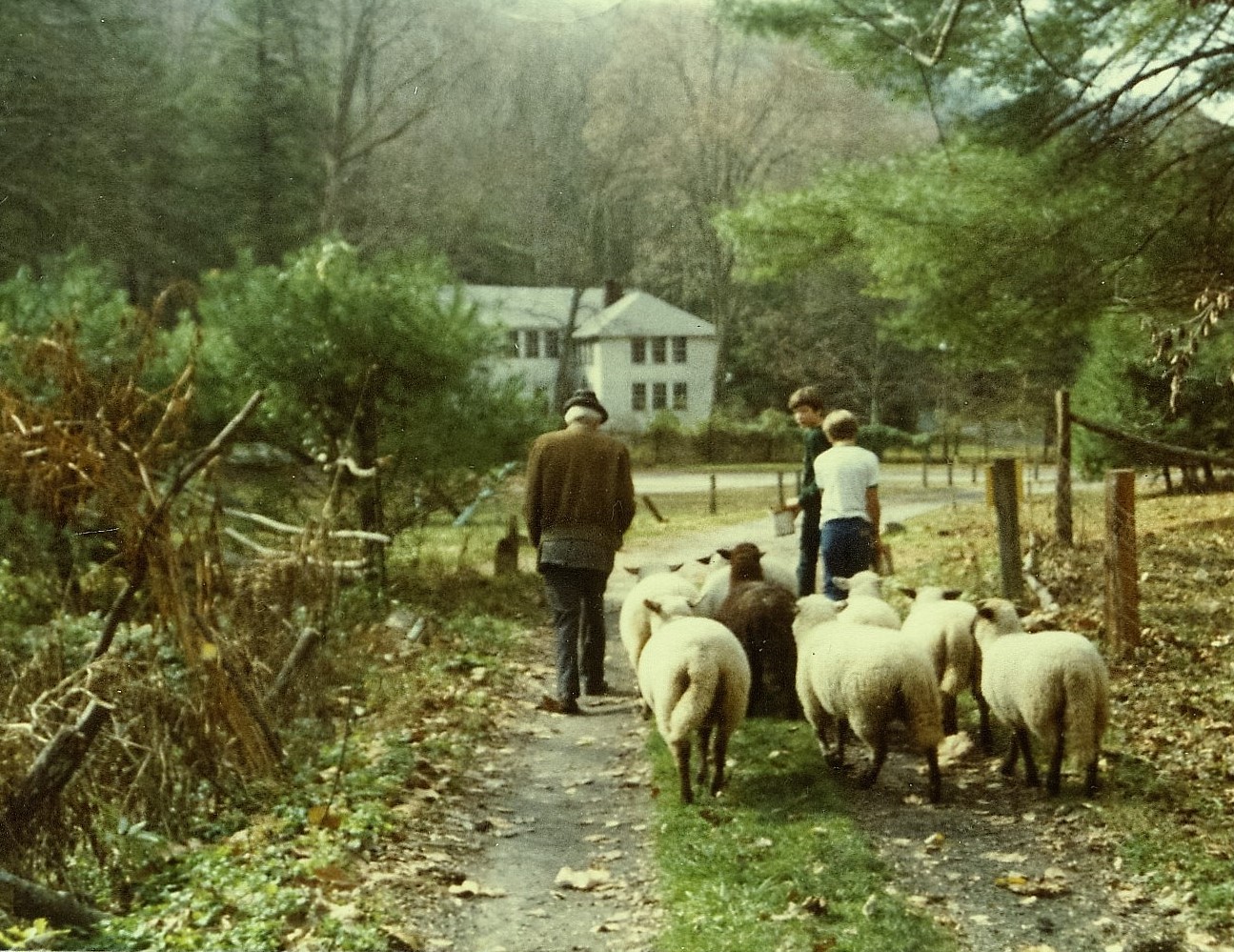
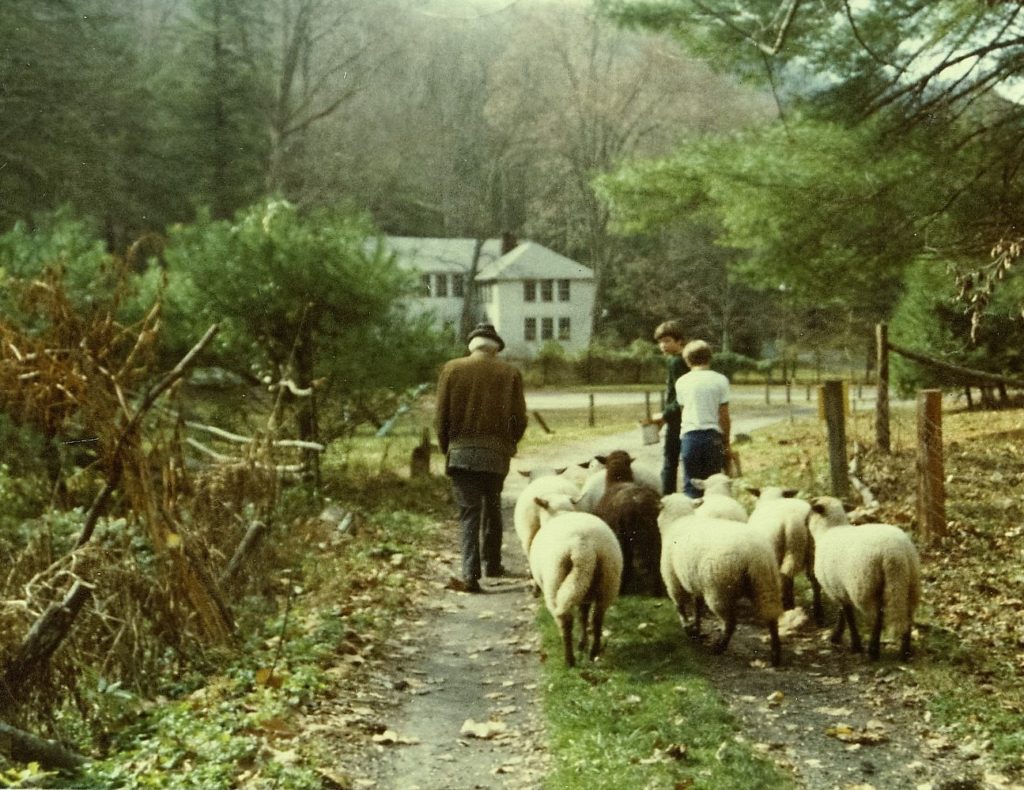
Malcolm Army’s grandsons, Michael and Eric with Burton Rogers and the sheep, 1980s. Photo courtesy of Suzanne Arny Fullar. [pmss_archives_arny_ photo1.jpg]

In the early 1950s there was an attempt to bring sheep back to the Pine Mountain Valley at the School. Sometime in 1953-54 a small flock of Merino sheep was purchased and was placed in the fields of the school. The Ayrshire herd had been sold and five beef cattle were purchased and they accompanied the sheep. The long-time farmer, William Hayes, had moved across the mountain to a new job as the Forest Ranger for the Kentenia Ranger Station and Brit Wilder, who carried many responsibilities on the farm, was assigned as acting head of Maintenance and the direction of the reduced farm. Brit was given sheep duty.

The School was slowly adjusting to cooperation with Harlan County Schools in the new Community School and everything was focused on making that educational experience work and the livestock were not high on the school’s radar. Pulled in many directions at once, in 1958-1959 the pilot trial of sheep at Pine Mountain ended, most likely due to the over-extension of staff to provide for their care. Brit Wilder was clearly over-committed by his responsibility to the farm and to maintenance.

In the 1970s there were intermittent attempts to bring back sheep and to re-focus on weaving. The period was marked by brief programs as the School that attempted to integrate sheep into the new Environmental Education offerings, Further, it was believed that the sheep could add to the new community Intervention program which also used weaving as an integrated part of its educational programming. It was during this time that community artisan, Sarah Bailey, led the School back to sheep.

SARAH BAILEY

Sarah Bailey was one of the most dedicated of the later crafts persons to work at the School and her efforts to bring natural dyeing back to the program and to maintain a weaving studio is fondly remembered by those who were privileged to work with her. Her full biography charts the important work she did for the School and chronicles her deep commitment to the craft of weaving and so many other mountain crafts. Her recommendations for a craft program are sound and still consulted but her reflections on sheep are not known.

SHEEP and PINE MOUNTAIN TODAY

Sheep have again entered into the Pine Mountain Settlement School conversation. Under the new direction of Preston Jones, the School has re-focused on the richness of the School’s agricultural heritage and married that to his skills and knowledge of agriculture. Preston’s years of outstanding work with Grow Appalachia and the recent enthusiasm of Patrick Angel, a former Pine Mountain Board member and sheep farmer, have led to new agrarian interests. The interests center on sheep and goat farming and a series of conversations have revitalized ideas around a demonstration project of sheep raising.

On August 13, 2020 a meeting was held via ZOOM to discuss the possibilities of a collaboration that would bring sheep back to Pine Mountain and would again link the agrarian past with a craft future. In attendance were Preston Jones, PMSS Executive Director, Patrick Angel, a sheep farmer and President of the Southeast Kentucky Sheep Growers Association [SEKSPA], Sarabeth Parido, a sheep farmer, wool producer, and craft workshop organizer, Ann Angel Eberhardt,co-editor of this website, and Helen Wykle, PMSS Board member and co-editor of the PMSS Archive web site.

Sheep and Malcolm Army’s grandsons, Michael and Eric with Burton Rogers, 1980s. Photo courtesy of Suzanne Arny Fullar. [pmss_archives_arny_ photo1.jpg]

UPDATE:  In the Fall of 2022 sheep returned to the campus of Pine Mountain in a cooperative project with Southeast Kentucky Sheep Growers Association [SEKSPA]

The group discussed resources and options that could be exercised under COVID restrictions. Also discussed were a range of options for the types of sheep and institutional needs and the economic impact of new directions. The two options of raising sheep for meat or for wool were discussed. Both the agrarian idea and the craft focus were seen to have good instructional potential for the School as well as a revenue stream. The various programs that might be developed around a small demonstration sheep project at the School were extensive but seen to be very feasible based on models offered by PMSS and by Patrick and Sarabeth.

If there is interest in exploring this path of returning sheep to the School and building workshops around this new farm/craft direction, please contact the PMSS office and schedule time to speak with Jason Brashear, Interim Director. It is important that all interested parties explore all the options this opportunity provides. 

Working with the Kentucky Sheep and Goat Development Office (KSGDO) in Frankfort and their craft consultant, Sarabeth Parido, is available to provide multiple educational workshops (small and COVID-safe) and/or virtual classes filmed at PMSS for distribution. Other options proposed in the meeting focused on the use of local and regional resources. Craft sessions were proposed as 3-5 hour sessions for very reasonable fees that would encompass a materials fee, registration fee, and cost of lodging and meals and that could be extended to seminar weekends, and other time frames, depending on COVID guidelines and enrollment. Pine Mountain is ideally suited for small groups and “distancing.” The large weaving studio at the school has 24 operational looms of variable size and a small stockpile of supplies. Examples of possible instruction workshops follow

  • weaving instruction classes (based on levels)
  • natural fiber workshops
  • natural dye workshops
  • felting workshop
  • raising sheep and managing small sheep farms, how-to and hands-on
  • various highly skilled artisans offering weaving and wool craft classes
  • basket weaving with wool
  • knitting worshops
  • instruction and guidelines for establishing a small sheep-centered business
  • goat cheese
  • goat soap
  • goat milk processing
0046a P. Roettinger Album.”Sheep Shearing, Uncle John Shell, Aunt Sis Shell, and Mrs. Joe Day.” [Woman standing next to a barn on left, watching man and woman sheer a sheep.]

SEE – RELATED MATERIAL

FARM GUIDE TO SHEEP, GOATS, CRAFT, WEAVING

http://www2.ca.uky.edu/agcomm/Magazine/2013/Summer2013/story3.html The Magazine, Univ. of KY Sheep article –excellent
No Business Like Sheep Business – UK College of Agriculturewww2.ca.uky.edu › Magazine › Summer2013 › story3

https://pinemountainsettlement.net/?page_id=62470 Describes Wildflower and Bird Weekends, Summer Spinning Bee, led by local craftswoman Sarah Bailey and members of the Kentucky Weaver’s Guild. 119 attenders went through all the old-time intricate processes of shearing the sheep, carding and spinning the wool into yarn, dyeing yarn with vegetable dyes, and finally weaving the patterns. Textile Workshop. 1974-75

https://pinemountainsettlement.net/?page_id=61483 Pictures of sheep … 1970s

https://pinemountainsettlement.net/?page_id=53122 Aunt Jude Turner picture with sheep. (008) 1925

https://pinemountainsettlement.net/?page_id=52294 Shearing sheep (Shell family)

https://pinemountainsettlement.net/?page_id=48966 Alice Cobb Story of raising sheep and living off the land.

https://pinemountainsettlement.net/?page_id=48730 Florence Reeves story about Aunt Phronie .. describes her “pre delight” the care of sheep and took peace ad quiet as she carded ad spun the wool….

https://pinemountainsettlement.net/?page_id=47705 Mary Rogers subject directory: weaving of sheep wool

https://pinemountainsettlement.net/?page_id=15574 Sarah Bailey 5 entries …as she demonstrated how to shear, card, dye, and spin sheep’s wool. “THE COMMUNITY. Old friends of the School would have especially enjoyed the Spinning Bee held last summer under the direction of Mrs. Sarah Bailey, neighbor and well-known craftswoman. She and members of the Kentucky Weaver’s Guild led the 119 attendees through all the old-time intricate processes of shearing the sheep, carding and spinning the wool into yarn, dyeing the yarn with vegetable dyes, and finally weaving the patterns. It was three days out of history!” On July 13, 1935, Sarah married Frank Bailey. The couple built their own house on a small farm where they raised a variety of farm animals, including sheep which provided the wool for Sarah’s spinning, weaving and knitting. Sarah was known for her excellent cooking skills, using produce grown in her enormous garden…”

https://pinemountainsettlement.net/?page_id=41225 Aunt Nance Templeton. Great story on shearing and weaving with sheep wool….Alice Cobb as told by Pettit.

https://pinemountainsettlement.net/?page_id=41126 Uncle Wiliam raising sheep before PMSS created…

BIBLIOGRAPHY

No Business Like Sheep Business – UK College of Agriculturewww2.ca.uky.edu › Magazine › SUMMER2013 › story3

  • Jul 1, 2013 – Kentucky sheep producers are tapping into a rich history. Stone Age humans domesticated sheep 10,000 years ago in Asia Minor—the first farm animals on record. They were easy to handle, and they produced meat, milk, fiber, and shelter.

Weaving, Natural Talents, and Natural Dyes and Becky Mae Huff

Pine Mountain Settlement School
DANCING IN THE CABBAGE PATCH
Weaving and Natural Dyes and Natural Talents and Becky Huff

Weaving, Natural Talents, and Natural Dyes and Becky Mae Huff

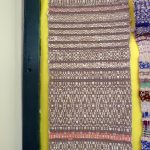
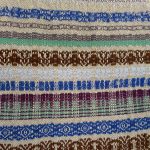
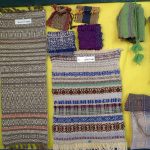
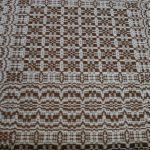
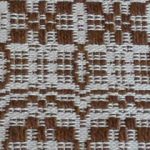
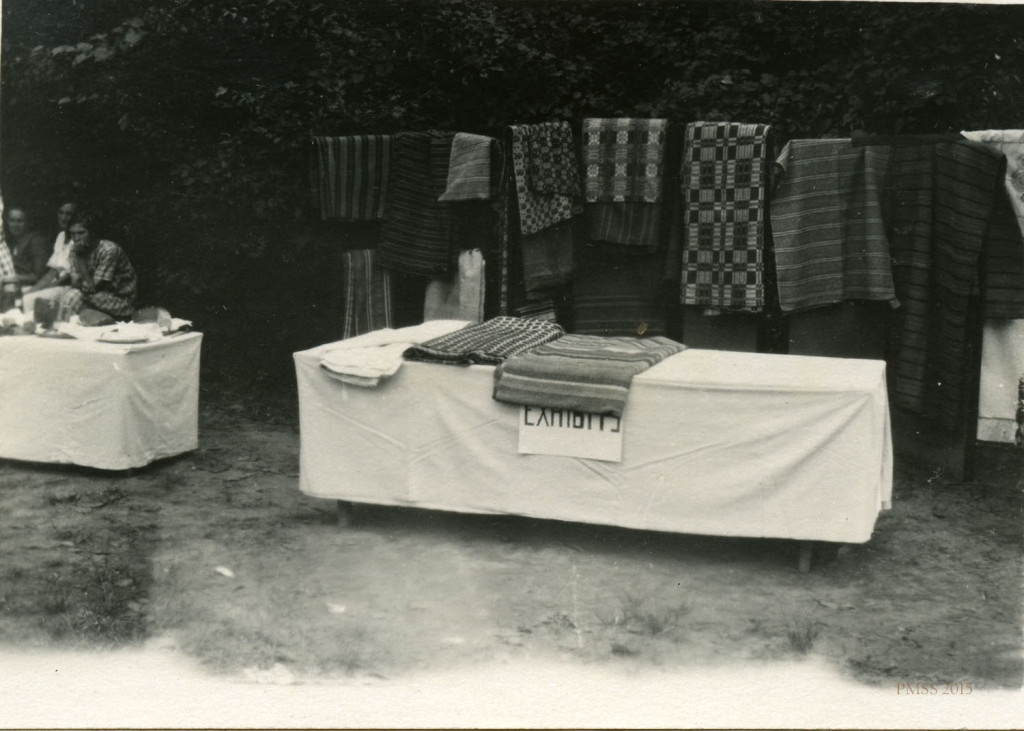
Exhibit of weaving and woven craft. [norton_021.jpg]

WEAVING WOES

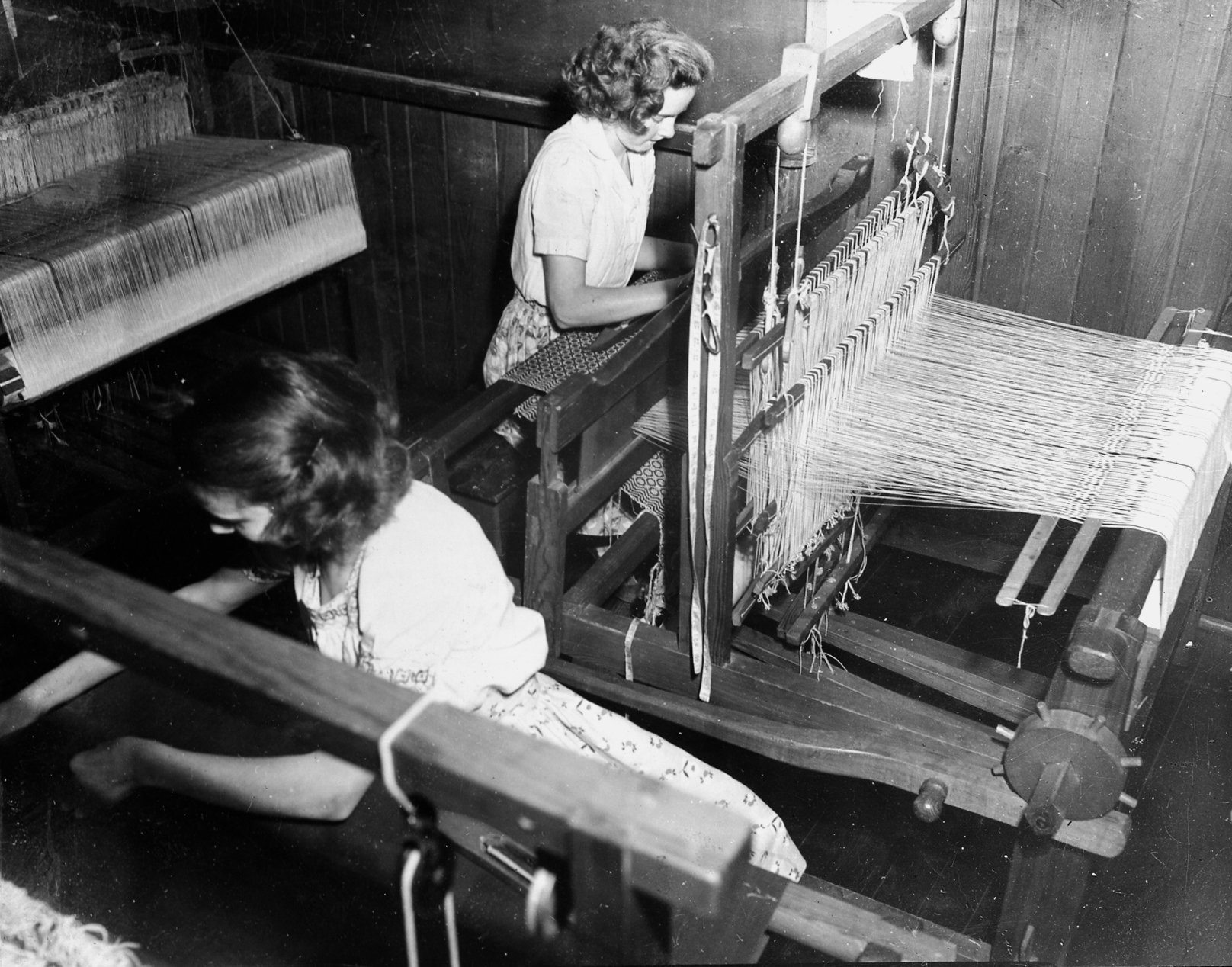
Weaving may look very easy. Back and forth, back and forth, and voila! a lovely “runner” for the chest of drawers. But neither life nor weaving is that simple. The most exquisite weavings come from those weavers with natural talents, diligence, and a strong sense of self-worth and a designer’s eye. Becky Huff was one of those weavers of both cloth and life. She was one of the first children to attend Pine Mountain Settlement School c. 1914.

By 1930, shortly before Katherine Pettit’s retirement, she {Pettit} tried to recruit Becky back to Pine Mountain as one of Pine Mountain’s most talented weavers.  She had been trained by Pettit and others and was an expert weaver, dancer, and institutional historian. Pettit wanted her to come back to the school and mainly resurrect the weaving program but there were other assignments. The letter, a full pleading page from Katherine Pettit, lays out the generous terms of employment if “Beckie” [Becky] would return to Pine Mountain to develop a weaving program, teach a few dance classes, and possibly perform several other tasks as required, she would be housed, salaried, and back among friends.

It is uncertain where the plea originated, but clearly it points to Katherine Pettit trying at the end of her life to bring back the craft on which she founded the School headed by one of her favorite students. But it was also more than that. Becky had been there with her as a child in her first years at the School in 1914 and forward.  Becky, while remembering those Pine Mountain first years to her family noted that as a child she was charged with bringing Pettit her breakfast each morning. Pettit and many others also remember Becky as the sister of Almon Huff. Almon was one of the students killed when the new School House caught fire and burned to the ground, killing Almon,  three other students, and one teacher. Miss Pettit and Becky shared many memories.

Pettit’s letter was written as she was preparing for retirement and her final days with the School. Pettit continued to center weaving at the height of the Depression — at the center of a  era unlikely to want to spend precious dollars on craft.  Her actions are difficult to asses — to explain her belief in a market that could balance the full throttle of Depression with craft sales and a School charging ahead into a new educational mode that did not place craft on the front line. In some ways Pettit’s plea captures the tension, desperation, and confusion of the 1930s across the country.— The Great Depression is still bearing down on the country following the 1929 crash, unemployment is rising and unstable, the Smoot-Hawley Tariff passes, the Dust Bowl is ravaging the agricultural centers of the country, and poverty is everywhere, and Pettit wants to teach weaving.

The country was desperately searching for solutions as Americans desperately searched for work.  The new discovery of the planet  Pluto diverts attention for a brief time as the newly abandoned populace looks to the planet and wishes they could escape there. But there are no easy answers. Somehow, this all sounds all too familiar.

The Smoot-Hawley Tarriff initiated during the early years of the Depression — the economic down-turn was a disaster.  It raised import duties on over 20,000 goods by roughly 20% to 50–100% in some cases. While it aimed to protect agriculture, the farmers of America and related industries tanked, and the Great Depression ravaged the country as so well described by Steinbeck in The Grapes of Wrath.  As a result of Smoot-Hawley the  country’s trade partners retaliated, and the trade battles caused a 66%  decline in world trade for nearly five years and the retaliatory tarriff on the USA — on Harlan County and its coal. The tariffs set off the Great Depression, and in an area that could little afford further declines in its near-poverty living standards.

Did Katherine Pettit win Becky back to Pine Mountain? Was this the end of the weaving program? Read on. See BECKY MAY HUFF Student Staff

THE LETTER    (Katherine Pettit to Beckie Huff)
April 2, 1930

My dear Beckie [Becky].

I have been wondering what you’re going to do about your job next winter? Miss Gaines  [RUTH B. GAINES] says that you are expecting  to come here. Although I have not received any word in reply to my last letter. Asking you definitely about it. Now, won’t you tell me very definitely? if you would like to come to take charge of the [weaving] department. Although I will not be here. Miss Gaines will be here to carry the ideals and standards that we have set. I should like to know if you are interested in our plans for this department and if you will help me to carry them out. Will you fill out the enclosed questionnaire that I may have it for our files as we require it of all our workers.

Did you know that, Mrs. Wilmer Stone is just getting published her [Katherinde Pettit book ] book on vegetable dyes. I saw an exhibition of her weaving. In Knoxville last week, where there were many very beautiful things, and hers was the most beautiful. Again, she told me if you could  do so next year, she would be so glad to have you come to North Carolina and teach you all she knows about vegetable dyes as many people think she is wonderful at that.  It seems to me it would be a great chance for you. Miss Ruth B. Gaines thought that you would also be interested in helping out with the country dancing, gymnastics, and singing games. Mrs. [John C.] Campbell, and Miss Butler have offered to take any people who worked in the mountains there for 10 days and let them have special instructions from their [John C. Campbell’s] Danish gymn teacher, and if you go to Miss Stone in Saluda, NC. would you not like to go to Mrs. Campbell’s [John C. Campbell Folk School] while you are there, for those special lessons?

We have a chance to get a wonderful weaving teacher — 35 years old. She would like to have a permanent job, and if you know positively you do not want to take this job, we shall certainly take her, for we are so anxious to get it [weaving] on a permanent basis. Run year by year by the same person. Now, Beckie May, if you are likely to get married within a year or so, as most young girls do, we want to tell us very frankly so that we may know how to plan for the future of this department. Miss Gaines is so eager to have you come and I think you could have an awful good time living at Laurel House with her and Emily.

Saturday is Aunt Sal’s Day, and all her family and friends are coming here for dinner with us in her little cabin and to see her great-granddaughter weave on her loom the same kind of a blanket that her great-grandmother taught her. Now I wish you could be here for such an interesting occasion.

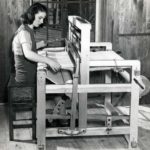
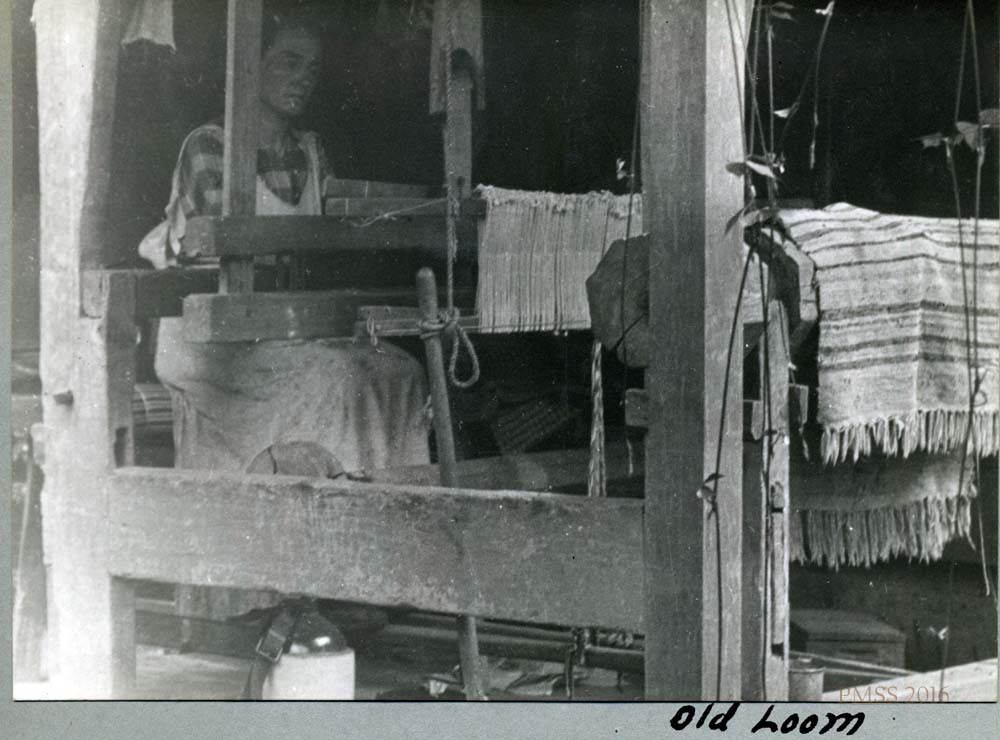
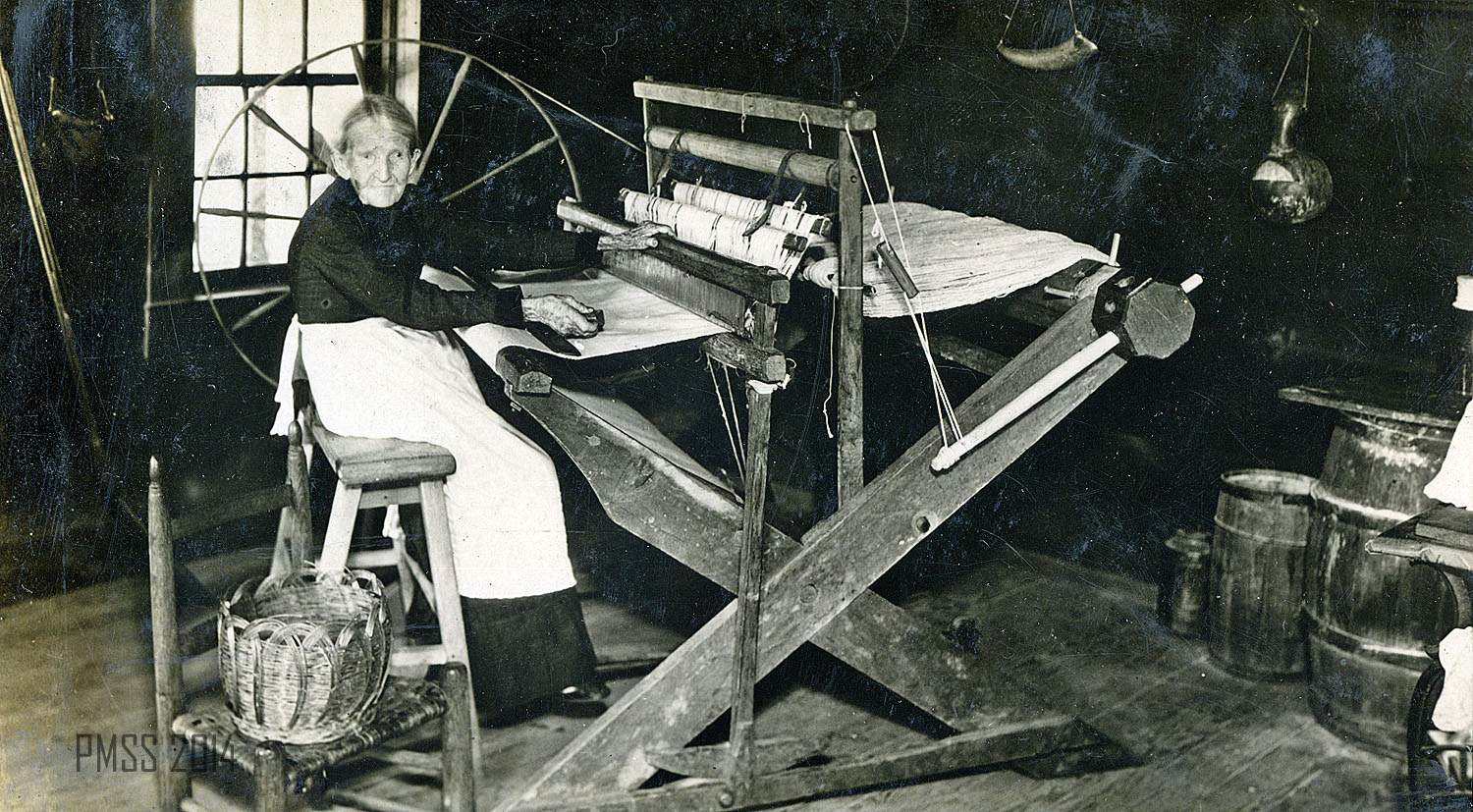
Woman weaving at “Old Loom.” [nace_II_album_020.jpg]

Now tell me about yourself and what you had been up to all this time and if you really think this is what you want to do next year? Are you coming to see us as soon as school is out …
p.2
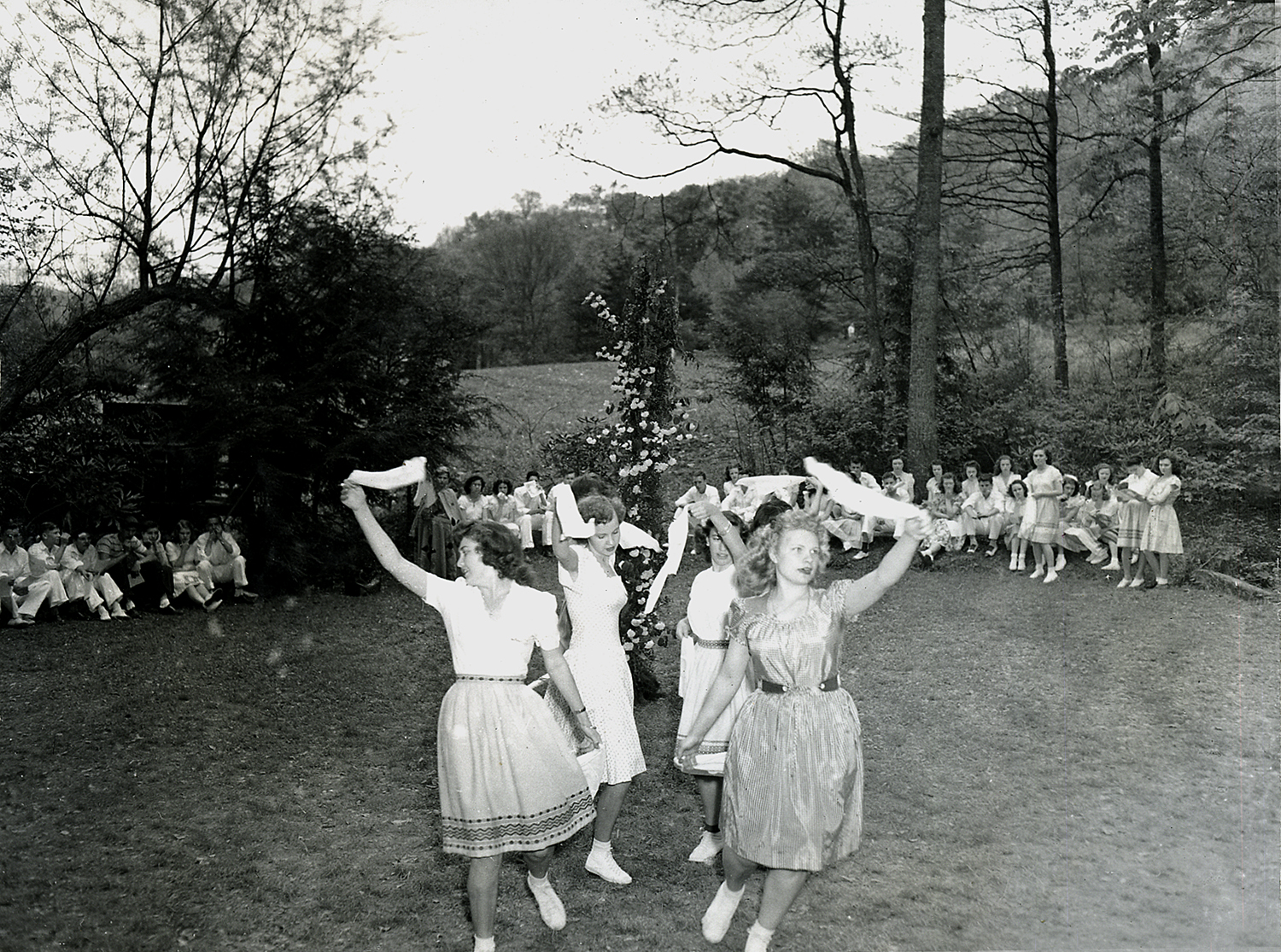
… and will you be here for our Mayday and pageant of olden days? Miss Bolles is coming soon, and I wish you could be here all the Spring with us as we dance.

Yours sincerely.

Miss Becky May Huff
Methodist School
Olive Hill, KY
KP/B


1930 saw the initiation of  the  high-school boarding program just one year before the arrival of Glyn Morris and his Progressive Educational agenda that set a new course for the School from 1932- 1940 and just two years following the death of Ethel de Long Zande on 1928 from cancer.

Pettit’s letter captures the void left by Ethel de Long’s death and the uncertainty of the world between the Wars, the Coal Wars raging on the other side of the mountain, and the slowly healing Great Depression. It was one of the most fragile times at the School as it struggled to find its educational direction.

Becky Huff

Flax, Hemp and Silk

Pine Mountain Settlement School
DANCING IN THE CABBAGE PATCH
FLAX, HEMP, AND SILK

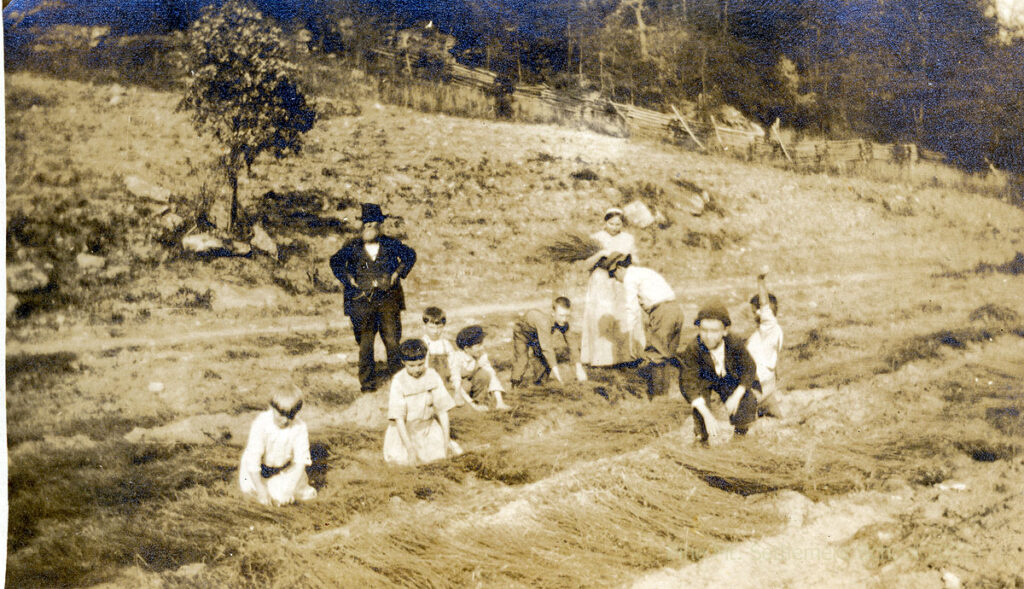
373 [Uncle William Creech with children from Pine Mountain School retting flax.]

notes for flax article BELOW.

1913

By Lyster H. Dewey–Botanist in Charge of Fiber Plant Investigations, Bureau of Plant Industry.  United States Department of Agriculture, Bureau of Plant Industry – Circular No. 57. Author: Lyster HDeweyBotanist in Charge of Fiber InvestigationsBureau of Plant Industry Pages: 1 – 7. THE CULTIVATION OF HEMP IN THE UNITED STATES. INTRODUCTION. ??  1910

1910 INTRODUCTION.

In 1910 Lyster H. Dewey, a botanist in charge of Fiber Plant Investigations for the Bureau of Plant Industry in the U.S. Department of Agriculture, wrote a small circular (No. 57) called “The cultivation of Hemp in the United States…” He noted that the two plants that were most promising for cultivation were hemp and flax. Kentucky became an optimum environment for the cultivation of these two plants.
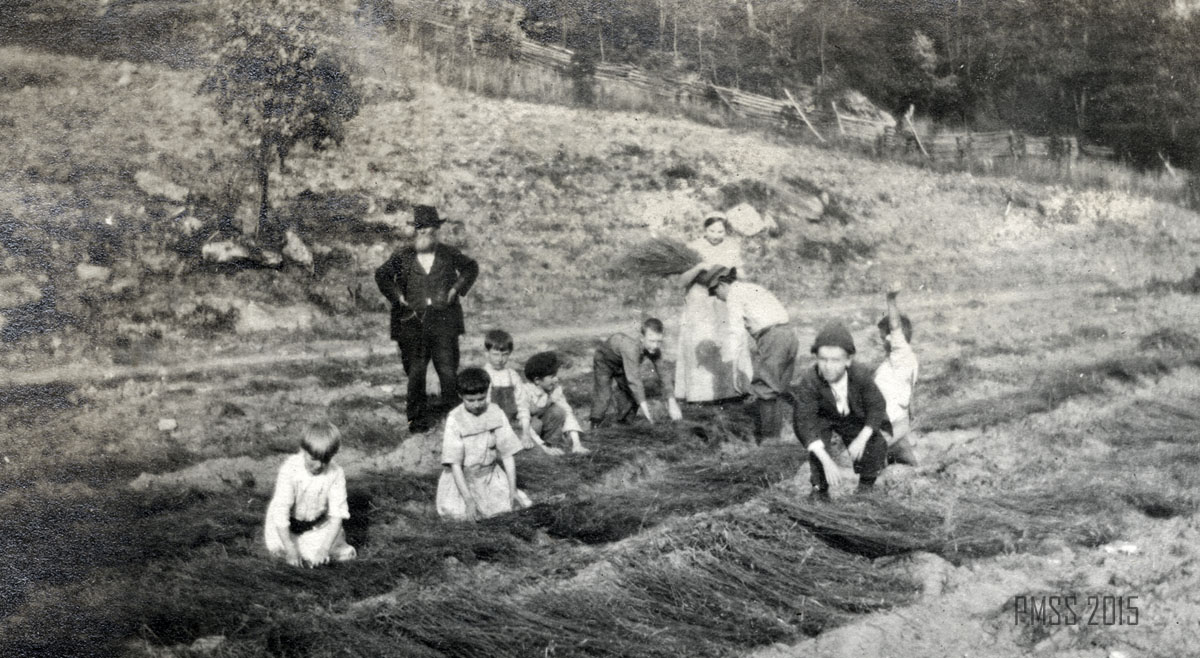
018a P. Roettinger Album. “Uncle William giving a lesson in spreading flax.” [William Creech, standing in back, and 9 children in the field.]

FLAX

In one of the earliest photographs made at Pine Mountain Settlement School, William Creech, one of the founders of the settlement in Harlan County in eastern Kentucky, is shown with a group of children laying out cut flax on the hillside near his home. The Pine Mountain valley with its rich soil and long East to West orientation was, like the rest of the state “as favorable as anywhere in the world”, said Lyster Dewey of the growth of this friendly plant, particularly, its cousin, hemp.

HEMP

Hemp is one of the oldest fiber-producing plants and examples of the durable homespun fabrics and ropes and cords derived from hemp have been found in the archaeological remains of some of the world’s earliest civilizations.

Hemp is a member of the mulberry family, Moraceae which includes the Osage orange, the paper mulberry and the common mulberry trees.  It is also a relative of the nettle family from which ramie, a strong bast fiber, is derived. Anyone who has ever painted or produced fine art prints knows that mulberry paper is some of the best support for paints and inks and its strong and very white surface retains its purity through time.

What Dewey fails to tell us in this government publication is the history of the notorious side of the family of hemp, the genus Cannabis. Instead, he notes that the genus Cannabis

… is generally regarded by botanists as monotypic, and the one species Cannabis sativa is now held to include the half dozen forms which have been described under different names …  and which are cultivated for different purposes.

It has been asked which came first, the discovery of the narcotic properties of the plant or its usefulness as a fiber-producing plant. In China, one of the earliest civilizations to produce textiles of hemp, the people called the plant “ma” and the cloth became known as hempen cloth. Further, Chinese writings tell of the use of the hemps seeds and the oil from the seeds as central to their foodways. There does not appear to be any use of the plant for what the Chinese called bhang, charas, and ganga the common names of their narcotic drugs. “The production and use of these drugs were developed farther west,” says Dewey.

Hemp did come west but it was a variety that was first cultivated by the Puritans for its fiber-producing qualities. The early farming of hemp in New England was not nearly so successful as it became further South. For example, in Virginia the soil and longer growing season produced a robust plant but the industry failed to thrive as tobacco filled the fields.  (For discussion see: Moore, Brent. A Study of the Past, the Present, and the Possibilities of the Hemp Industry in Kentucky, 1905.)

It was in Pennsylvania and in Kentucky that the industry thrived. Dewey describes the origins

The cultivation of hemp seems to have been a flourishing industry in Lancaster County, Pa., before the Revolution. An elaborate account of the methods then employed in growing hemp, written about 1775 by James Wright, of Columbia, Pa., (New Era, Lancaster, Pa., June 25, 1905.) was recently published as an historical document. The methods described for preparing the land were equal to the best modern practice, but the hemp was pulled by hand instead of cut. Various kinds of machine brakes had been tried, but the had all “given Way to one simple Break of a particular Construction, which was first invented & made Use of in this country.” The brief description indicates the common hand brake still in use in Kentucky.

By 1910, when Dewey’s circular was published, hemp was grown and harvested mainly for the production of commercial twine, a staple for tying just about anything together.

The first crop of hemp in Kentucky was raised by Mr. Archibald McNeil, near Danville, in 1775. (Moore, Brent. A Study of the Past, the Present, and the Possibilities of the Hemp Industry in Kentucky, p. 16, 1905.) It was found that hemp grew well in the fertile soils of the bluegrass country, and the industry was developed there to a greater extent than it had been in the eastern colonies. While it was discontinued in Massachusetts, Virginia, and Pennsylvania, it has continued in Kentucky to the present time. In the early days of this industry in Kentucky, fiber was produced for the homespun cloth woven by the wives and daughters of the pioneer settlers, and an export trade by way of New Orleans was developed. In 1802 there were two extensive ropewalks in Lexington, Ky., and there was announced “a machine, moved by a horse or a current of water, capable, according to what the inventor said, to break and clean eight thousand weight of hemp per day.” (Michaux, F. Andre. Travels to the west of the Alleghanies, p. 152, 1805. In Thwaites, Early Western Travels, v. 3, p. 200, 1904.) Hemp was later extensively used for making cotton-bale covering. Cotton bales were also bound with hemp rope until iron ties were introduced, about 1865. There was a demand for the better grades of hemp for sailcloth and for cordage for the Navy, and the industry was carried on more extensively from 1840 to 1860 than it has been since.

ITALY.

The highest-priced hemp fiber in the markets of either America or Europe is produced in Italy (Bruck, Werner F. Studien uber den Hanfbau in Italien, p. 7, 1911), but it is obtained from plants similar to those in Kentucky. The higher price of the fiber is due not to superior plants, but to water retting and to increased care and labor in the preparation of the fiber. Four varieties are cultivated in Italy:

(1) “Bologna,” or great hemp, called in France “chanvre de Piedmont,” is grown in northern Italy in the provinces of Bologna, Ferrara, Rovigo, and Modena. In the rich alluvial soils and under intensive cultivation, this variety averages nearly 12 feet in height, but it is said to deteriorate rapidly when cultivated elsewhere. (2) “Cannapa picola,” small hemp, attaining a height of 4 to 7 feet, with a rather slender reddish stalk, is cultivated in the valley of the Arno in the department of Tuscany. (Dodge, Charles Richards. Culture of hemp in Europe. U.S. Department of Agriculture, Fiber Investigations, Report No. 11, p. 5, 1898.) (3) “Neapolitan,” large-seeded. (4) “Neapolitan,” small-seeded.

The two varieties of Neapolitan hemp are cultivated in the vicinity of Naples, and even so far up on the sides of Vesuvius that fields of hemp are occasionally destroyed by the eruptions of that volcano. Seed of each of these Italian varieties has been grown in trial plots at Washington, D.C., and Lexington, Ky. The Bologna, or Piedmont, hemp in seed rows attained a height of 8 to 11 feet, nearly as tall as Kentucky seed hemp grown for comparison, but with thicker stalks, shorter and more rigid branches, and smaller and more densely clustered leaves. The small hemp, cannapa picola, was only 4 to 6 feet high. The large-seeded Neapolitan was 7 to 10 feet high, smaller than the Bologna, but otherwise more like Kentucky hemp, with more slender stalks and more open foliage. The small-seeded Neapolitan, with seeds weighing less than 1 gram per 100, rarely exceeded 4 feet in height in the series of plots where all were tried.

FRANCE.

Hemp is cultivated in France chiefly in the departments of Sarthe and Ille-et-Vilaine, in the valley of the Loire River. Two varieties are grown, the Piedmont, from Italian seed, and the common hemp of Europe. The former grows large and coarse, though not as tall as in the Bologna region, and it produces a rather coarse fiber suitable for coarse twines. The latter, seed of which is sown at the rate of 1 1/2 to 2 bushels per acre, has a very slender stalk, rarely more than 4 or 5 feet high, producing a fine flax-like fiber that is largely used in woven hemp linens. The common hemp of Europe, which includes the short hemp of France, is also cultivated to a limited extent in Spain, Belgium, and Germany. It grows taller and coarser when sown less thickly on rich land, but it never attains the size of the Bologna type.

ITALY.

The highest-priced hemp fiber in the markets of either America or Europe is produced in Italy (Bruck, Werner F. Studien uber den Hanfbau in Italien, p. 7, 1911), but it is obtained from plants similar to those in Kentucky. The higher price of the fiber is due not to superior plants, but to water retting and to increased care and labor in the preparation of the fiber. Four varieties are cultivated in Italy:

(1) “Bologna,” or great hemp, called in France “chanvre de Piedmont,” is grown in northern Italy in the provinces of Bologna, Ferrara, Rovigo, and Modena. In the rich alluvial soils and under intensive cultivation, this variety averages nearly 12 feet in height, but it is said to deteriorate rapidly when cultivated elsewhere. (2) “Cannapa picola,” small hemp, attaining a height of 4 to 7 feet, with a rather slender reddish stalk, is cultivated in the valley of the Arno in the department of Tuscany. (Dodge, Charles Richards. Culture of hemp in Europe. U.S. Department of Agriculture, Fiber Investigations, Report No. 11, p. 5, 1898.) (3) “Neapolitan,” large-seeded. (4) “Neapolitan,” small-seeded.

The two varieties of Neapolitan hemp are cultivated in the vicinity of Naples, and even so far up on the sides of Vesuvius that fields of hemp are occasionally destroyed by the eruptions of that volcano. Seed of each of these Italian varieties has been grown in trial plots at Washington, D.C., and Lexington, Ky. The Bologna, or Piedmont, hemp in seed rows attained a height of 8 to 11 feet, nearly as tall as Kentucky seed hemp grown for comparison, but with thicker stalks,

ITALY.

The highest-priced hemp fiber in the markets of either America or Europe is produced in Italy (Bruck, Werner F. Studien uber den Hanfbau in Italien, p. 7, 1911), but it is obtained from plants similar to those in Kentucky. The higher price of the fiber is due not to superior plants, but to water retting and to increased care and labor in the preparation of the fiber. Four varieties are cultivated in Italy:

(1) “Bologna,” or great hemp, called in France “chanvre de Piedmont,” is grown in northern Italy in the provinces of Bologna, Ferrara, Rovigo, and Modena. In the rich alluvial soils and under the intensive cultivation, this variety averages nearly 12 feet in height, but it is said to deteriorate rapidly when cultivated elsewhere. (2) “Cannapa picola,” small hemp, attaining a height of 4 to 7 feet, with a rather slender reddish stalk, is cultivated in the valley of the Arno in the department of Tuscany. (Dodge, Charles Richards. Culture of hemp in Europe. U.S. Department of Agriculture, Fiber Investigations, Report No. 11, p. 5, 1898.) (3) “Neapolitan,” large-seeded. (4) “Neapolitan,” small-seeded.

The two varieties of Neapolitan hemp are cultivated in the vicinity of Naples, and even so far up on the sides of Vesuvius that fields of hemp are occasionally destroyed by the eruptions of that volcano. Seed of each of these Italian varieties has been grown in trial plots at Washington, D.C., and Lexington, Ky. The Bologna, or Piedmont, hemp in seed rows attained a height of 8 to 11 feet, nearly as tall as Kentucky seed hemp grown for comparison, but with thicker stalks, shorter and more rigid branches, and smaller and more densely clustered leaves. The small hemp, cannapa picola, was only 4 to 6 feet high. The large-seeded Neapolitan was 7 to 10 feet high, smaller than the Bologna, but otherwise more like Kentucky hemp, with more slender stalks and more open foliage. The small-seeded Neapolitan, with seeds weighing less than 1 gram per 100, rarely exceeded 4 feet in height in the series of plots where all were tried.

FRANCE.

Hemp is cultivated in France chiefly in the departments of Sarthe and Ille-et-Vilaine, in the valley of the Loire River. Two varieties are grown, the Piedmont, from Italian seed, and the common hemp of Europe. The former grows large and coarse, though not as tall as in the Bologna region, and it produces a rather coarse fiber suitable for coarse twines. The latter, seed of which is sown at the rate of 1 1/2 to 2 bushels per acre, has a very slender stalk, rarely more than 4 or 5 feet high, producing a fine flax-like fiber that is largely used in woven hemp linens. The common hemp of Europe, which includes the short hemp of France, is also cultivated to a limited extent in Spain, Belgium, and Germany. It grows taller and coarser when sown less thickly on rich land, but it never attains the size of the Bologna type.

SOILS SUITED TO HEMP.

Hemp requires for the best development of the plant, and also for the production of a large quantity and good quality of fiber, a rich, moist soil with good natural drainage, yet not subject to severe drought at any time during the growing season. A clay loam of rather loose texture and containing a plentiful supply of decaying vegetable matter or an alluvial deposit, alkaline and not acid in reaction, should be chosen for this crop.

SOILS TO BE AVOIDED.

Hemp will not grow well on stiff, impervious, clay soils, or on light sandy or gravelly soils. It will not grow well on soils that in their wild state, are overgrown with either sedges or huckleberry bushes. These plants usually indicate acid soils. It will make only poor growth on soils with a hardpan near the surface or in fields worn out by long cultivation. Clay loams or heavier soils give heavier yields of strong but coarser fiber than are obtained on sandy loams and lighter soils.

EFFECT OF HEMP ON THE LAND.

Hemp cultivated for the production of fiber, cut before the seeds are formed and retted on the land where it has been grown, tends to improve rather than injure the soil. It improves its physical condition, destroys weeds, and does not exhaust its fertility.

PHYSICAL CONDITION.

Hemp loosens the soil and makes it more mellow. The soil is shaded by hemp more than by any other crop. The foliage at the top of the growing plants makes a dense shade, and, in addition, all of the leaves below the top fall off, forming a mulch on the ground, so that the surface of the soil remains moist and in better condition for the action of soil bacteria. The rather coarse taproots (Pl. XLI, fig. 3), penetrating deeply and bringing up plant food from the subsoil, decay quickly after the crop is harvested and tend to loosen the soil more than do the fibrous roots of wheat, oats, and similar broadcast crops. Land is more easily plowed after hemp than after corn or small grain.

HEMP DESTROYS WEEDS.

Very few of the common weeds troublesome on the farm can survive the dense shade of a good crop of hemp. If the hemp makes a short, weak growth, owing to unsuitable soil, drought, or other causes, it will have little effect in checking the growth of weeds, but a good, dense crop, 6 feet or more in height, will leave the ground practically free from weeds at harvest time. In Wisconsin, Canada thistle has been completely killed, and quack-grass severely checked by one crop of hemp. In one 4-acre field in Vernon County, Wis., where Canada thistles were very thick, fully 95 per cent of the thistles were killed where the hemp attained a height of 5 feet or more, but on a dry, gravelly hillside in this same field where it grew only 2 to 3 feet high, the thistles were checked no more than they would have been in a grain crop. Some vines, like the wild morning-glory and bindweed, climb up the hemp stalks and secure light enough for growth, but low-growing weeds can not live in a hemp field.

HEMP DOES NOT EXHAUST THE FERTILITY OF THE SOIL.

An abundant supply of plant food is required by hemp, but most of it is merely borrowed during development and returned to the soil at the close of the season. The amounts of the principal fertilizing elements contained in mature crops of hemp, as compared with other crops, are shown in the accompanying table.

Amounts of principal fertilizing elements in an acre of hemp, corn, wheat, oats, sugar beets, and cotton. (Insert first table from p. 310 here)

The data in the table indicate that hemp requires for its best development a richer soil than any of the other crops mentioned except sugar beets. These other crops, except the stalks of corn and the tops of beets, are entirely removed from the land, thus taking away nearly all the plant food consumed in their growth. Only the fiber of hemp is taken away from the farm, and this is mostly cellulose, composed of water and carbonic acid. The relative proportions by weight of the different parts of the hemp plant, thoroughly air dried, are approximately as follows: Roots 10 per cent, stems 60 per cent, and leaves 30 per cent. The mineral ingredients of these different parts of the hemp plant are shown in the following table:

p. 310 here.Peter, Robert. Chemical Examination of the Ash of Hemp and Buckwheat Plants. Kentucky Geological Survey, p. 12, 1884. )

Hemp leaves the ground mellow and free from weeds and is therefore recommended to precede sugar beets, onions, celery, and similar crops, which require hand weeding. If hemp is grown primarily to kill Canada thistle, quack-grass, or similar perennial weeds, it may be grown repeatedly on the same land until the weeds are subdued.

BARNYARD MANURE.—The best single fertilizer for hemp is undoubtedly barnyard manure. It supplies the three important plant foods, nitrogen, potash, and phosphoric acid, and it also adds to the store of humus, which appears to be more necessary for hemp than for most other farm crops. If other fertilizers are used, it is well to apply barnyard manure also, but it should be applied to the preceding crop, or, at the latest, in the fall before the hemp is sown. It must be well rotted and thoroughly mixed with the soil before the hemp seed is sown, so as to promote a uniform growth of the hemp stalks. Uniformity in the size of the plants of other crops is of little consequence, but in hemp, it is a matter of prime importance. An application of coarse manure in the spring, just before sowing, is likely to result in more injury than benefit. The amount that may be applied profitably will vary with different soils. There is little danger, however, of inducing too rank a growth of hemp on upland soils, provided the plants are uniform, for it must be borne in mind that stalk and not fruit is desired. On soils deficient in humus as a result of long cultivation, the increased growth of hemp may well repay for the application of 15 to 20 tons of barnyard manure per acre. It would be unwise to sow hemp on such soils until they had been heavily fertilized with barnyard manure.

RETTING.

Retting is a process in which the gums surrounding the fibers and binding them together are partly dissolved and removed. It permits the fiber to be separated from the woody inner portion of the stalk and from the thin outer bark, and it also removes soluble materials that would cause rapid decomposition if left with the fiber. Two methods of retting are practiced commercially, viz, dew retting and water retting.

DEW RETTING.

In this country, dew retting is practiced almost exclusively. The hemp is spread on the ground in thin, even rows, so that it will all be uniformly exposed to the weather. In spreading hemp, the workman takes an armful of stalks and, walking backward, slides them sidewise from his knee, so that the butts are all even in one direction and the layer is not more than three stalks in thickness. (Pl. XLIV, fig. 3.) This work is usually paid for at the rate of $1 per acre, and experienced hands will average more than 1 acre per day. The hemp is left on the ground for four weeks to four months. Warm, moist weather promotes the retting process, and cold or dry weather retards it. Hemp rets rapidly if spread during early fall, provided there are rains, but it is likely to be less uniform than if retted during the colder months. It should not be spread early enough to be exposed to the sun in hot, dry weather. Alternate freezing and thawing or light snows melting on the hemp give the most desirable results in retting. Slender stalks one-fourth inch in diameter or less, ret more slowly than coarse stalks, and such stalks are usually not overretted if left on the ground all winter. Hemp rets well in young wheat or rye, which hold the moisture about the stalks. In Kentucky, most of the hemp is spread in December. A protracted January thaw with comparatively warm, rainy weather occasionally results in overretting. While this does not destroy the crop, it weakens the fiber and causes much loss. When retted sufficiently, so that the fiber can be easily separated from the hurds, or woody portion, the stalks are raked up and set up in shocks, care being exercised to keep them straight and with the butts even. They are not bound in bundles, but a band is sometimes put around the shock near the top. The work of taking up the stalks after retting is usually done by piecework at the rate of $1 per acre.

WATER RETTING.

Water retting is practiced in Italy, France, Belgium, Germany, Japan, and China, and in some localities in Russia. It consists of immersing the hemp stalks in water in streams, ponds, or artificial tanks. In Italy, where the whitest and softest hemp fiber is produced, the stalks are placed in tanks of soft water for a few days, then taken out and dried, and returned to the tanks for a second retting. Usually, the stalks remain in the water for about eight days, and the second time a little longer. In either dew retting or water retting, the process is complete when the bark, including the fiber, readily separates from the stalks. The solution of the gums is accomplished chiefly by certain bacteria. If the retting process is allowed to go too far, other bacteria attack the fiber. The development of these different bacteria depends to a large extent upon the temperature. Processes have been devised for placing pure cultures of specific bacteria in the retting tanks and then keeping the temperature and air supply at the best for their development. (Rossi, Giacomo.) Macerazione della Canapa. Annali della Regia Scuola Superiore di Agricultura di Portici, s.2, v. 7, p. 1-148, 1907. These methods, which seem to give promise of success, have not been adopted in commercial work.

BREAKING.

Breaking is a process by means of which the inner, woody shell is broken in pieces and removed, leaving the clean, long, straight fiber. Strictly speaking, the breaking process merely breaks in pieces the woody portions, while their removal is a second operation properly called scutching. In Italy and in some other parts of Europe, the stalks are broken by one machine or device, and afterwards scutched by another. In this country, the two are usually combined in one operation.

HAND BRAKES.

Hand brakes (Pl. XLVI, fig. 1), with little change or modification, have been in use for many generations, and even yet more than three-fourths of the hemp fiber produced in Kentucky is broken out on the hand brake. This simple device consists of three boards about 5 feet long set edgewise, wider apart at one end than the other, and with the upper edges somewhat sharpened. Above this, a framework, with two boards sharpened on the lower edges, is hinged near the wide end of the lower frame, so that when worked up and down by means of the handle along the back, these upper boards pass midway in the spaces between the lower ones. A carpenter or wagon maker can easily make one of these hand brakes, and they are sold in Kentucky for about $5.

The operator takes an armful of hemp under his left arm, places the butts across the wide end of the brake near the hinged upper part, which is raised with his right hand, and crunches the upper part down, breaking the stalks. This operation is repeated several times, moving the stalks along toward the narrow end so as to break the shorter pieces, and when the hemp appears pretty well broken, the operator takes the armful in both hands and whips it across the brake to remove the loosened hurds. He then reverses the bundle, breaks the tops, and cleans the fiber in the same manner. The usual charge for breaking hemp on the hand brake in this manner is 1 cent to 1 1/2 cents per pound. There are records of 400 pounds being broken by one man in a day, but the average day’s work, counting six days in a week, is rarely more than 75 pounds. In a good crop, therefore, it would require 10 to 15 days for one man to break an acre of hemp. The work requires skill, strength, and endurance, and for many years, there has been increasing difficulty in securing laborers for it. It is plainly evident that the hemp industry can not increase in this country unless some method is used for preparing the fiber requiring less hand labor than the hand brake.

MACHINE BRAKES.

Several years ago, a brake was built at Rantoul, Ill., for breaking and cleaning the fiber rapidly, but producing tow or tangled fiber instead of clean, straight, line fiber, such as is obtained by the hand brake. This machine consisted essentially of a series of fluted rollers followed by a series of beating wheels. Machines designed after this type, but improved in many respects, have been in use for several years at Havelock, Nebr., and first at Gridley, then at Courtland and Rio Vista, Cal. These machines have sufficient capacity and are operated at comparatively small cost, the hurds furnishing more than sufficient fuel for the steam power required, but the condition of the fiber produced is not satisfactory for high-class twines and it commands a lower price than clean, long, straight fiber.

The Sanford-Mallory flax brake, consisting essentially of five fluted rollers with an interrupted motion, producing a rubbing effect, has been used to a limited extent for breaking hemp. This machine, as ordinarily made for breaking flax, is too light and its capacity is insufficient for the work of breaking hemp.

A portable machine brake (Pl. XLVI, fig. 4) has been used successfully in Kentucky during the past two years. It has a series of crushing and breaking rollers, beating and scutching devices, and a novel application of suction to aid in separating hurds and tow. The stalks are fed endwise. The long fiber, scutched and clean, leaves the machine at one point, the tow, nearly clean, at another, and the hurds, entirely free from fiber, at another. It has a capacity of about 1 ton of clean fiber per day.

Another portable machine brake has been in use in California during the past two years, chiefly breaking hemp that has been thoroughly air dried but not retted. This hemp, grown with irrigation, becomes dry enough in that arid climate to break well, but this method is not practicable in humid climates without artificial drying. The stalks, fed endwise, pass first through a series of fluted or grooved rollers and then through a pair of beating wheels, removing most of the hurds, and the fiber, passing between three pairs of moving scutching aprons, each pair followed by rollers, finally leaves the machine in a kind of continuous lap folded back and forth in the baling box.

A larger machine (Pl. XLVI, fig. 3), having the greatest capacity and turning out the cleanest and most uniform fiber of any of the brakes thus far brought out, has been used to a limited extent during the past eight years in Kentucky, California, Indiana, and Wisconsin. This machine weighs about 7 tons, but it is mounted on wheels and is drawn about by a traction farm engine, which also furnishes power for operating it. The stalks are fed sidewise in a continuous layer 1 to 3 inches thick, and carried along so that the ends, forced through slits, are broken and scutched simultaneously by converging revolving cylinders about 12 and 16 feet long. One cylinder, extending beyond the end of the other, cleans the middle portion of the stalks, the grasping mechanism carrying them forward being shifted to the fiber cleaned by the shorter cylinder. The cylinders break the stalks and scutch the fiber on the underside of the layer as it is carried along, and the loosened hurds on the upper side are scutched by two large beating wheels just as it leaves the machine. The fiber leaves the machine sidewise, thoroughly cleaned and ready to be twisted into heads and packed in bales. This machine, with a full crew of 15 men, including men to haul stalks from the field and others to tie up the fiber for baling, has a capacity of 1,000 pounds of clean, straight fiber of good hemp per hour. The tow is thrown out with the hurds, and until recent improvements, it has produced too large a percentage of tow. It does good work with hemp retted somewhat less than is necessary for the hand brake, and it turns out more uniform and cleaner fiber. For good work, it requires, as do all the machines and also the hand brakes, that the hemp stalks be dry. If the atmosphere is dry at the time of breaking, the hemp may be broken directly from the shocks in the field, but in regions with a moist atmosphere, or with much rainy weather, it would be best to store the stalks in sheds or under cover, and with a stationary plant it might be economical to dr them artificially, using the hurds for fuel. Extreme care must be exercised in artificial drying, however, to avoid injury to the fiber.

IMPROVEMENT NEEDED IN HEMP-BREAKING MACHINES.

While hemp-breaking machines have now reached a degree of perfection at which they are successfully replacing the hand brakes, as the thrashing machines half a century ago began replacing the flail, there is still room for improvement. This needed improvement may be expected as soon as hemp is grown more extensively, so as to make a sufficient demand for machinery to induce manufacturers to invest capital in this line. For small and scattered crops, a comparatively light, portable machine is desirable, requiring not more than 10 horsepower and not more than four or five laborers of average skill for its operation. It should prepare the fiber clean and straight, ready to be tied in hanks for baling, and should have a capacity of at least 1,000 pounds of clean fiber per day. For localities where hemp is grown more abundantly, so as to furnish a large supply of stalks within short hauling distance, a larger machine operated in a stationary central plant by a crew of men trained to their respective duties, like workers in a textile mill, will doubtless be found more economical. Artificial retting and drying may also be used to good advantage in a central plant. The hemp growers of Europe have adopted machine brakes more readily than the farmers in this country, and the hemp industry in Europe is most flourishing and most profitable where the machines are used. Most of the hemp in northern Italy is broken and scutched by portable machines. Machines are also used in Hungary, and the machine-scutched hemp of Hungary is regularly quoted at $10 to $15 per ton, higher than that prepared by hand. These European machines may not be adapted to American conditions, but, together with American machines which are doing successful work, they sufficiently contradict the frequent assertion of hemp growers and dealers that “no machine can ever equal the hand brake.”

MARKET.

All of the hemp produced in this country is used in American spinning mills, and it is not sufficient to supply one-half of the demand. The importations have been increasing slightly during the past 20 years, while there has been a decided increase in values. The average declared value of imported hemp, including all grades, for the 4,817 tons imported in 1893, was $142.31 per ton, while in the fiscal year 1913, the importations amounted to 7,663 tons with an average declared value of $193.67 per ton. There have been some fluctuations in quotations, but the general tendency of prices of both imported and American hemp has been upward. (Fig. 19.) The quotations for Kentucky rough prime, since October 1912, have been the highest recorded for this standard grade. Furthermore, the increasing demand for this fiber, together with the scarcity of competing fibers in the world’s markets, indicates a continuation of prices at high levels.

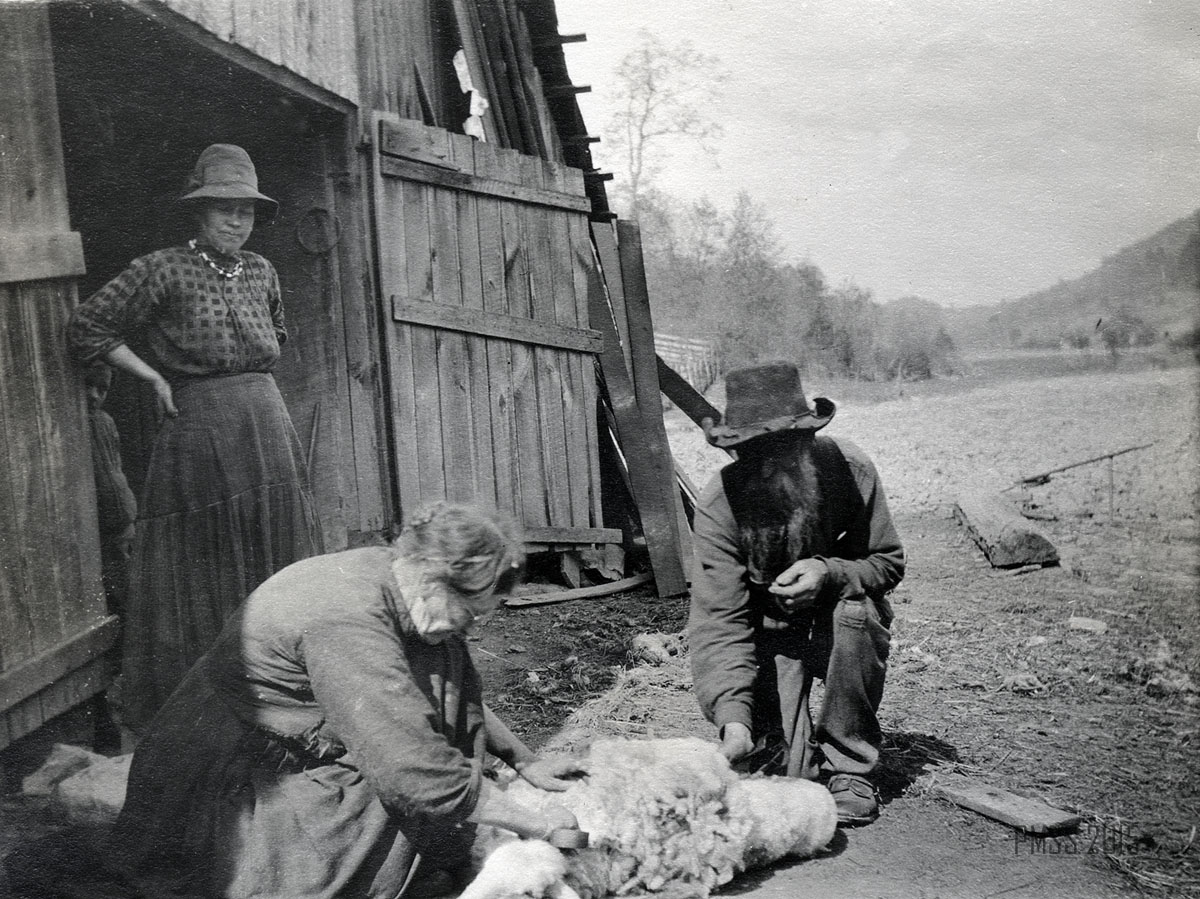
Weaving at PMSS 1930s-1940s

Pine Mountain Settlement School
DANCING IN THE CABBAGE PATCH
Series: BY TOPIC – Arts & Crafts
Weaving
Weaving at PMSS 1930s-1940s

Girl’s Industrial. Interior view of weaving room.

Weaving at PMSS 1930s-1940s

MARGARET MOTTER AND THE COLONIAL COVERLET GUILD

Margaret Motter was a worker at Pine Mountain Settlement School in the 1920s and 30s and again in the 1940s. She served as Principal and teacher from 1928 until 1938, and as the Publicity Representative and Head of the English Department from 1946 until 1949.  She was a prolific writer and a clever and persuasive speaker.  Associated with those skills, was her importance to the School as a fund-raiser.  Many times she was asked to represent the Pine Mountain Settlement and to travel to distant cities to speak to special audiences that might find the programs at Pine Mountain worthy of support. Many times she managed to bring her favorite subject into the talk. In one instance she found the perfect audience for her interests and for those of Pine Mountain the Colonial Coverlet Guild of Chicago, Illinois.

Weaving had long been one of Miss Motter’s favorite crafts and she found many ways to integrate comments on the weaving program at Pine Mountain into her public speaking tours.  When she shared her interests with the Colonial Coverlet Guild* in  Chicago, Illinois, where she spoke on November 10, 1948, it was clear that her enthusiasm captured her audience. Miss Motter enjoyed this talk and so did her audience.

To accompany the talk to some 80 members of the Guild, she brought along many of the coverlets and weaving samples from Pine Mountain.  She described the origins of the patterns, dyes, and some of the stories that came along with the individual pieces. She was able to build a picture of the community of mountain weavers. She described how for many years weaving was a household necessity for mountain families and how that skill had been adopted by the School as part of the curriculum to ensure the continuation of the craft.  For many children in the community, weaving was even a new art as commercial fabrics began to dominate wardrobes by the turn of the century.

Motter emphasized how the art stayed with a number of the graduates from Pine Mountain and in some homes in the Pine Mountain valley, families established their own looms and weaving as a cottage industry to provide additional income for the family. Pine Mountain’s efforts to encourage weaving were shared by the organized cottage industry known as the Fireside Industries which broadly supported craft in the Appalachian mountains.

When Margaret Motter addressed the Colonial Coverlet Guild* she wrote out her talk in her unique abbreviated form and years later left Pine Mountain a copy of this talk and others, as well. Her talk is transcribed below.  Many of the abbreviations have been expanded in this version and individuals are identified, where known.  The talk is a window into weaving activity at the School and the role Miss Motter and others had in encouraging the continuation of this mountain traditional craft by integrating the craft into the Pine Mountain educational programs and offering it as a part of their Industrial Training program.  Further, the focus on weaving was melded to the social outreach of the School and was used to engage the broader community and to stimulate the potential for economic independence for many women in the community. In many ways weaving and the values of the settlement movement were well paired.


TRANSCRIPTION OF MOTTER TALK

MESSAGE TO COLONIAL COVERLET GUILD
November 10th 1948
By Margaret Motter

Many of you are familiar I am sure with the institution and the dramatic beginnings of Pine Mountain Settlement School, but any sort of message about our school is incomplete without mentioning the name of William Creech, affectionately  known as “Uncle William.” Here was a man with a 3rd-grade education but with great vision who dreamed for 30 years of a school that would “holp” his people.

When he gave his land (all he had) [not quite!] he wrote some men in his un-lettered hand which we treasure. I want to give you the closing paragraph to remind you of the ever-recurring challenge from Uncle William to carry on —

“I don’t look for wealth for them ….

So through the years Pine Mountain has been serving an isolated rural community as an extension, housing a secondary and a vocational high school and as a center of culture, and social and economic welfare.

Uncle William believed it was “better for folkes children to learn how to work with their hands…”  In following this advice of Uncle William Pine Mountain has had from the beginning what we call a work program. Pupils pay $10.00 – $15.00 per month if they can afford it and work 2 1/2 hrs. per day and longer on Saturday.  This work program serves a dual purpose.  Children are made to feel the value of the education that they are earning thru work.  [It] keeps [their] self-respect, values and dignity of work itself and besides, through the work program the school is kept going. The children learn over a period of years and do all kinds of work connected with homemaking, farming, and some trades or vocations.  All work is done under supervision and changed every 9 weeks.  Children have on [the] whole a fine attitude ….

“One thing I don’t like is learnin’ but I like what hit makes you be…….”   [Comment by Brit Wilder one of the youngest students and the first to come to the school]

Now, a very popular part of our work program as well as an elective study during school hours is our weaving. I want to give you a few details about this department since you have been good enough to share in making this department function.

Our weaving room has recently been enlarged and we have space for more looms and better looms.  We have by no means enough to meet the demand.  We have 9 looms and one small one owned by the teacher.  6 of these were made at Berea, one at Pine Mountain after the Berea Style — 5 of the looms are 40″ and 4 are 22″-24″.  Since 6 of the looms were at Pine Mountain before 1924, I guess it is not an understatement [page 3] to say they have not the latest improvements!

Weaving Room: Bess Taylor, Reba Blevins nace_1_061a.jpg

Weaving Room: Bess Taylor, Reba Blevins c. late 1940s. nace_1_061a.jpg

Our teacher informed me that a Swedish weaver told her we are doing very well indeed with the equipment we have.  So you can see as time goes on we shall need to replace these older looms with better ones and to purchase a pair of badly-needed scales [?] for the weaving room.

I have brought you some samples of weaving done by our girls. We use rags from feed-sacks which are dyed at the school and woven into rugs.  Old rayon stock and any kind of woven underwear can be transformed in the weaving room into lovely bags.  We have a neighbor who does some spinning for us and [the] other yarns we buy.
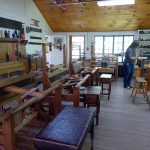
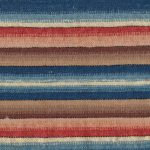
I mentioned that our weaving is very popular.  Some girls who learned to weave have been able to get a loom at home and have continued in their work.  Two of the senior girls have been especially interested “in weaving and confided in the teacher that they hope they’ll get a loom as a graduation gift from their home folks.  The girls love to weave a skirt to wear on May Day and have a chance to participate in the colorful “Weaver’s Dance”.

Weaving class in hand-woven skirts. Pearl Taylor, Ernestine Vitatoe, Bess Taylor, Jolene Lucas, Gladys Carroll, Reba Blevins, Margaret Slusher, Betty Huff -- 1946. nace_1_022b.jpg

Weaving class in hand-woven skirts. Pearl Taylor, Ernestine Vitatoe, Bess Taylor, Jolene Lucas, Gladys Carroll, Reba Blevins, Margaret Slusher, Betty Huff — 1946. nace_1_022b.jpg

"Glorishears" Morris Dance -- 1946. Shirley Holbrook and Delores Scott in lead. nace_1_021a.jpg

“Glorishears” Morris Dance — 1946. Shirley Holbrook and Delores Scott in lead.  nace_1_021a.jpg

Weaving does go on in some of the homes (as I mentioned), i.e., sample curtain [cur. ?] material [mat.?] woven by one of our neighbors. [The] Swedish pattern sells for $1.95 a yard.  I am reminded at this point of the way I happened to get one of my coverlets when I was at Pine Mountain in the fall of 1928.  In the office welcoming children as they arrived — In came last years student with a younger sister by hand and [a] coverlet over [the] other arm.  “I brung —–[?] “

fireside_indust_pg_001a_mod

Della Hayes weaving at Pine Mountain. Probably in Old Log, c. 1940s.

That coverlet was definitely a home product, brown from walnut hulls and dusty rose from madder.  Just as lovely today as when I bought it and I love to think that little Della [Hayes] — now a successful nurse — had her start at Pine Mountain because her sister had learned to weave at our school and had a loom at home.

P1050096Walnut and madder dye weaving

[page 5] I am sure you are familiar with Dr. Allen Eaton’s book, Handmade in the Southern Mountains. [this should read, Allen H. Eaton. Handicrafts of the Southern Highlands], One of the colored illustrations shows a striped blanket that we call Pine Mountain Blanket #16. I have one of these made by a mountain woman who was taught to weave by our teacher — wool from her own sheep and vegetable dye used. This is the type of blanket we always use for our prophets in the Nativity Play.  You can see that the weaving even goes into something special like that.  *[Note: This same Pine Mountain Blanket #16 was used as a cover for the plaque which was un-veiled at the Pine Mountain Settlement School Centennial celebration in August 2013.]

P1050415

I say something special, Christmas at Pine Mountain is an occasion that one never forgets.  With our sacrificial meals for our Charity Fund now we’ll have something to share with others; with our appealing drama of lovely carols in [Laurel House] dining room while decorated with garlands, wreaths, and tree; with our gay Mummer’s Play ; with our charming Nativity Play in the Chapel, it is an occasion for happy activity — [a] genuine pleasure.  It has its effect upon children “Love and joy …” —“Hit’s peacefulest –” [Motter probably describes the change from the earlier celebrations of Christmas that were known for their liquor and guns.]

Boy's House Wassailers and Lords and Ladies -- 1946. [Good King Wenselaus ?] [In Laurel House] nace_1_025b.jpg

Boy’s House Wassailers and Lords and Ladies — 1946. [Good King Wenselaus ?] [In Laurel House] nace_1_025b.jpg

Your share in our work is indeed heartwarming to the staff and the trustees.  May we ask for your continued interest so that we may not fail to make Uncle William’s dream come true  — I don’t want hit to be for this local. only —-”  ——

*Swygert, Mrs. Luther M.  Heirlooms from Old Looms A Catalogue of Coverlets Owned By the Colonial Coverlet Guild of America and Its Members – R.R. Donnelley and Sons : 1940 (1955).


FIRESIDE INDUSTRIES

Through Pine Mountain’s efforts and the support of the broad-ranging Fireside Industries, a strong program of support for the Appalachian craft of weaving was developed and the practice was strongly revitalized in the 1930s and 40s. In many environments, during the 1930s and 1940s the idea of a “cottage industry” which is characterized by contracted work completed at home and then marketed through a central agency, was a developed and viable economic venture.  In the case of Pine Mountain, the idea was not new and was not exploited by the school so much for commercial reasons, but was incorporated into the educational program and into their primary goal of building “community.”

The idea of weaving at home was not unique to families in the Pine Mountain community but with Pine Mountain’s encouragement, it began to follow the model put forward by the Fireside Industries which flourished at centers such as Berea College, long a source of inspiration and support for the School’s weaving enterprises.

Pine Mountain’s interest was also shared by many other rural settlement schools in the region, particularly in the early settlements institutions in Western North Carolina.  What was unique at Pine Mountain was the early adoption of weaving and the measure of enthusiasm in the community for such work and the persistence of weaving as part of the educational program at the school.

Weaving has been an activity that has found a place at the School for over 100 years and more of its history. Through the enthusiasm of Katherine Pettit and her “kivers” and those like Margaret Motter, who followed her,  Pine Mountain has maintained it’s interest this this unique craft and in the long family traditions attached to weaving in the Central and Southern Appalachians. This long mountain family history led to the introduction of weaving and dying in the first decade of the school and maintained it through the years.

Katherine Pettit’s Dye Book written by Helen Wilmer Stone, a staff member at Pine Mountain, is a classic in the genre of vegetable dying of fiber. Under Katherine Pettit, Helen Wilmer Stone, Margaret Motter, Florence Daniels, Abbie Winch Christensen, Becky May Huff, and others, weaving and spinning, and the use of native plants for dyes later found a place in the curriculum of the Pine Mountain and other schools as a vocational tract.  When a more normalized curriculum was mandated by public instructions guidelines, weaving still remained as an elective at many of these schools, and often as an after-school program. Yet, in most schools and homes, weaving had gone away by the late 1940s.  Few instructors could be found to maintain the craft in schools other than arts and crafts schools and the maintenance f the equipment was high.

Unlike many regions of the Central and Southern Appalachians in the 1940s,  the Pine Mountain Valley had not fully abandoned weaving in some households.  In many homes in the mountains, and in the Pine Mountain region particularly, many families still maintained their old looms and many of the unique patterns continued their persistence through many generations of family weavers.  Some of the old patterns can still be found in mountain homes scratched out on rolled strips of cloth or on long scrolls of paper.  Like some ancient runes, these patterns are family treasures.

https://pinemountainsettlement.net/wp-content/uploads/2014/08/fireside_indust_pg_002a_mod.jpg

https://pinemountainsettlement.net/wp-content/uploads/2014/08/fireside_indust_pg_002a_mod.jpg

What Pine Mountain brought to the Fireside Industries or the “cottage industry” model, was a renewal or revival of the long-standing culture of eager mountain weavers.  Margaret Motter moved this enthusiasm along by carrying examples of weaving with her on almost every talk she gave outside the School.  Through Katherine Pettit’s early enthusiasm for collecting mountain “kivers” the attention to the beauty and skill of mountain weaving moved among the staff of the School like an aesthetic mantra.  Workers discovered in weaving sophisticated and beautiful local craftsmanship that utilized skill, intelligence, and tenacity — qualities that the community weavers had in abundance.  The education that occurred between the workers and the community was mutual — and it continues to be mutual today, even as the “community” of Pine Mountain has continued to expand outward to meet the demands of the industrial world and a more diverse public.


WEAVING IN 1949

A short piece written by Freshman student Mattie Mae Adams in the February 1949 PINE CONE, the student newsletter, describes a weaving experience at the School.  1949 was the last year the boarding school was in operation.

WEAVING

On my entrance to Pine Mountain I had a choice between science and weaving. I took weaving.  At first I was afraid to weave. I was afraid I would make a mistake. It seemed hard for me to remember all of the names of the parts of the loom, and it was still harder to wind a bobbin. But it didn’t take me long as I have Miss Christensen for a teacher.

She started me off on a rug that she had already started herself. Afterward, I thought I wanted to make one for myself. Now we have started on our May Day skirts, which are very difficult, because I get my threads crossed and have to take them out. Then I have to re-wind a bobbin. The next thing I know I’m using the wrong treadles or mending a broken heddle.  Broken threads are another difficulty.  I have just mended a broken thread when I discover a mistake which has to be taken out. Then I usually take out two to that four.

Now all of these things don’t happen every day; but when one happens it seems as if they all happen at once. Even in spite of these hard tasks, I am glad I made the choice of weaving. 

Mattie Mae Adams, Freshman


P1050033

Ccropped image of weaving held in the Katherine Pettit Collection in the Bodley-Bullock House, Bodley-Bullock House. Sorority House for Transylvania College. 200 Market St, Lexington, KY 40507.

SEE ALSO:

KATHERINE PETTIT – WEAVING

BECKY MAY HUFF

FLORENCE DANIELS

ABBIE WINCH CHRSTENSEN

HELEN WILMER STONE

KATHERINE PETTIT DYE BOOK

WEAVING at PMSS BEGINNINGS

WEAVING DRAPER LOOM STUDIO

WEAVING AT PMSS SAMPLES I

WEAVING AT PMSS SAMPLES II