Pine Mountain Settlement School
ROSE PETAL SANDWICHES AND OTHER FLORAL FANCIES
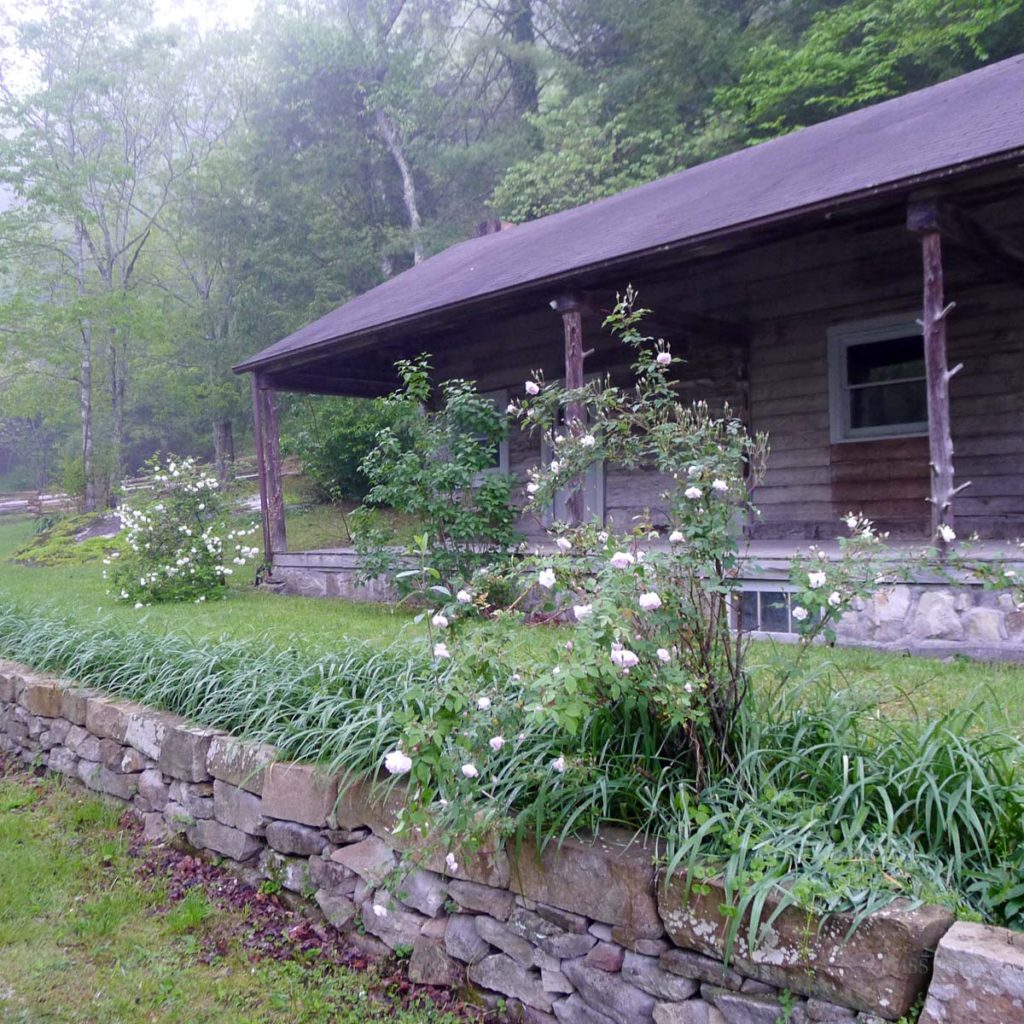
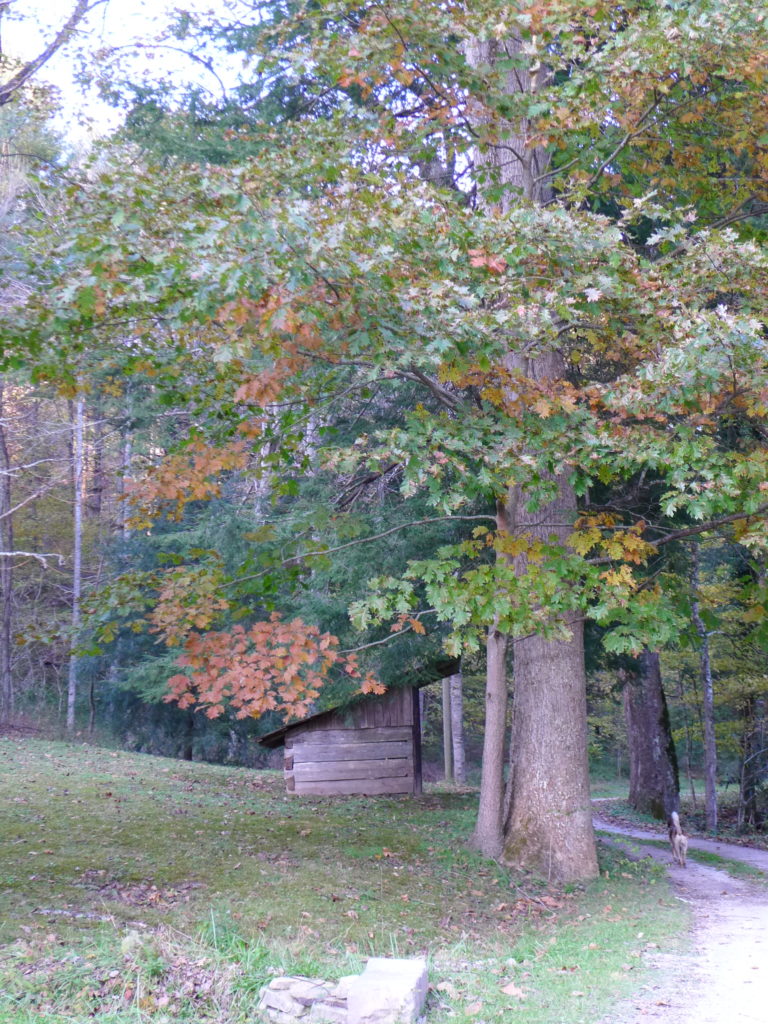
Old Log at PMSS with drystack wall, May roses. Photo HW. [P1130854.jpg]
Tags: rose petal sandwiches, roses, flowers, menus, ramps, bear’s lettuce, snapping turtle stew, Poke Sallet, Bear’s Lettuce, Appalachian dining, Buckner Hollingsworth, groundhogs, Maude Grieve’s Modern Herbal
ROSE PETAL SANDWICHES AND OTHER FLORAL FANCIES
ROSE PETAL SANDWICHES – FOOD and FORAGE
A recipe for “Rose Petal Sandwiches” I recently encountered while browsing Buckner Hollingsworth’s Flower Chronicles (1931) intrigued me. Hollingsworth suggests it is probably taken from Maude Grieve’s Modern Herbal, in which the recipe is briefly described. I was directed to Hollingsworth through my mother’s fascination with flora and food and her extensive clippings. I did not have occassion to find the sandwich on my childhood plate, but, like many of my mother’s collected recipes, I found it fascinating … particularly intriguing … as in, “Now that is pretty novel! I think I could eat that! It even sounds palatable.”
While growing up there were many curious dishes that my Mother tried on the family, but this was not one of them. This rosey recipe, this strange combination, evoked for me the simple elegance of an English Tea party, my childhood mock tea parties, and the reward of fresh butter on toast rounds we nibbled as children with the haughty doll’s’ at the tea parties. The scent of roses even visited me for an instant. But the unusual elegance of the recipe also reminded me of the many peculiar meals our Mother tried on us. But, let’s start with the roses.
In Appalachia, many ingredients in recipes can strike the observer as “peculiar”. Ramps, Bear’s Lettuce, and Poke Sallet evoke curiosity and, for many, that “peculiar look”. Yet, there are so many plants and herbals in the Appalachian region that deserve a closer look. Among the rich trove of Appalachian plants and animals, there are many that are edible and some that are quite tasty. However, rose-petal sandwiches caught my attention.
Essentially, the recipe calls for the following ingredients and actions:
red rose petals
fresh butter
bread slices
Put a layer of red rose petals in the bottom of a jar or a covered dish. Putting four ounces of fresh butter wrapped in waxed paper over [top]. Cover with a thick layer of rose petals. Cover closely and move into a cool place overnight. The more fragrant the roses, the finer the flavor imparted. Spread each [bread slice] with the perfumed butter and place several petals from fresh red roses between the slices allowing the edges to show.
Hollingsworth, Buckner. Flower Chronicles, p.52
There it was, perhaps, this tempting and dainty little sandwich with delicate rose petals sitting at the center of the food interest…. if not on the main table, certainly in the parlor. The roses could be plucked from the garden. So many mountain women cherished their roses, and their rose stories, always retold with pride, traced back many generations in the family. Roses joined the lasting pride of family heritage and in many gardens other heritage plants were proudly shared and planted in the mountains of Kentucky. But, rose petal sandwiches?
Would Katherine Pettit, the first Pine Mountain School Director, have approved of rose petal sandwiches? She certainly entertained other floral fancies ……. A little more time might surprise us and reveal rose petal-embellished foods in Appalachia and a host of other “dainty” plants added to parlor and home fare … well, maybe not so many parlors.
The author Hollingsworth suggests that this simple rose petal sandwich could take the edge off calf’s brain pudding or other adventuresome early “foods”. I certainly hope so, for now, my peculiar food memories had begun to emerge and they were not of parlors and dainty teas. I can remember at least one encounter with the brain of some animal. I have managed to suppress just what animal that was, and perhaps the lapse is due to that early introduction of a “brain” meal. And, no, it was not squirrel brains and it was probably delicately disguised. But, it was not “dainty”.
HISTORIC COOKS AND COOKBOOKS
The deep roots of Appalachian families and often their Scots-Irish-English ancestry seem to easily pull forward stories and songs that discuss peculiar [to our current tastes] eating habits. Roses were frequently woven into early mountain family stories but no edible roses leap from memory. Ancestral roses were often affectionate gifts and accompanied funerals, weddings, a hopeful suitor, and sometimes a murder or two. This deep and rosey and not so rosey history suggests the broad reach of the rose, [Latin: rosa] in particular, how the rose played a role in shaping native habits and habitats. The characteristics seem to shift with the geography.
Roses belong to the plant family Rosaceae. As a species, the rose offers over 100 wild species. In Appalachia one of the most favored roses was the Rosa gallica, or the Gallic rose. The rosa gallica is (strangely) French, but the varieties of European roses are many and were carefully guarded with the belongings of European families when they settled this country and Appalachia.
In Appalachia, while the early oral histories frequently point to Europe, many early floral gardens, plant foods, and medicines, mixed with native species, and grew their own nostalgic stories and eventually their own history as the years went by. The rose appears in many of the Appalachian ballads and the legends that draw political distinction between the white rose and the red rose in English royal history, is well known. Roses have thorns. The English ballad builds many somber songs around the rose.
Roses in song are a’plenty, but in the food chain? Katherine M. Kolassa did not add them to her dissertation, Foodways of Selected Mothers and Their Adult Daughters in Upper East Tennessee, 1974. She stresses that the media and other current cultural transmissions today fail to tell us much about foodways in Appalachia but the mother’s kitchen may not have been as important as first suspected in recipe transmission.
BEYOND THE ROSE
My memories are then a little peculiar. May roses seem to have stirred up memories of the less rosy foods of my childhood. For example, I had a mother who delighted in feeding us foraged local flora and fauna, and most times it was not roses but may have been other delicate floral plants. The violet comes quickly to mind. That lovely little flower always topped my brother’s June Birthday cake. Cress from cold small streams, and wild purple violets were scattered on most of my brother’s June Birthday cakes, and were familiar garnishes on our other table desserts. My December arrival did not afford violets for my birthday unless the violet house-plant was flourishing and offered a few. Also, a favorite in our house, the fuzzy Bear’s Leaf Lettuce, showed up frequently on our table. But, it carried no floral memories. I always regretted that December had no flowers, as they never appeared when needed the most.
Mother’s other peculiar floral offerings included dandelions. They were frequently turned into wine. Possum Grape and Fall Grape fruit followed to Mother’s vintner skills in the Fall. While wine was a great cooking aide, ramps, and poke-sallet (my least favorite), were two of the least favored Spring additions to the table and were not put to the wine test. Many dishes were enhanced by stream mint with flowers attached, nuts (mainly hickory and walnut), and the lemons that she nurtured in her sunny windows and her small greenhouse were welcomed surprises. My mother often identified and enjoyed edible plants by their taste, but she also relied on historical uses of the plants passed down in the family lore and gathered from her deep reading interests. She seemed to always have Gray’s Manual of Botany handy (not researched for recipes but handy to check if the plants were safe!
It was not just my Mother, but many of the staff at Pine Mountain who inspired my Mother to always eagerly seek out new and native plants that were edible. An Appalachian and Pine Mountain School ritual included the Spring de-tox that was comprised of early Spring greens that “cleansed” the gut and was dutifully practiced by many of the staff and families in the Pine Mountain valley. The offerings were many and included fresh shoots of dandelions, cress, and wild onions— ramps — and poke sallat but not necessarily together. Salads were not a regular in most Appalachian homes. Often, spring greens went into a frying pan with bacon grease and cabbage was shredded into kraut. However, my Mother regularly fed us fresh Bear’s lettuce in salads with grape vinegar and Worcestershire sauce, and a myriad of other un-remembered and leafy things — green, but still unknown to me at this late date. I do remember that some of her combinations often produced the expected emetic. They were intended to cleanse the gut and were offered as “garanteeed to clean yer gut.”
Greenery was not the only adventure in eating. The main course could also surprise (and disgust), and I now suspect that for very early Appalachian families, the greenery took the edge off the disgust of some of the “main” dishes. I vividly remember the groundhog and one winter meal when there was little greenery to garnish the meat. When the critter came out of the oven rolling in grease, the house door had to be opened to air out the stench of the roasting male groundhog. His glands had failed to be removed … at least that is what I remember of the discussion about that stench and that grand roasting failure.
Another experiment was Mother’s snapping turtle soup. Many families, especially those near streams and rivers, still treasure the tough but usually tasty meat of the snapping turtle. As I recall, it took a full day to prepare the turtle for cooking and another full day to cook the meat to tenderness. Vividly, I remember watching the heart being cut from the turtle and being placed in a bowl. My brother and I sat close to the vessel, waiting for the heart to stop throbbing as it sat muscle-spasming in the bowl. We watched as the heart continued to ‘beat’ for what seemed to be an eternity. (Certainly enough time to contemplate how our own hearts might beat if removed.) As I recall, we pleaded that the noble heart not join the stew. The stew was a hearty broth and tasty and frequented by unchewable chunks of turtle. The small slivers of turtle meat — as I remember — though likened to rubber bands — were nearly unchewable. I believe we may have slurped the stew, though I recall being unable to forget the heart that insisted on beating and ate very little. No one volunteered to eat the groundhog — even our dog was disinclined, but the turtle was an OK critter for several in the family. I will spare you the rabbits and the squirrels …. and no squirrel brains were ever eaten in our household. Mother ate fish eyes once. She denied it until her last days. We were all appalled and amused to repeat the story.
THE MEAT OF THE MATTER
Pork, beef, and chicken were the most common meats in our home and many of the nearby families, and they were in good supply as our father, William Hayes, was the Farm Manager at Pine Mountain (1939-1953). He often instructed students in the proper butchering and storing of pig and steer. Like my mother, he had an early introduction to hunting and living off the land as a child. The coal camps at Stearns and later in Harlan County at Coxton Coal Camp had a few over-worked small plots of garden land next to the coal company houses, but it was never enough to satisfy large families. The overused plots were often subject to poor yield or theft by hungry neighbors. Most meats, if available, or caught in “Hoover boxes”, were fried, generally in bacon grease, or baked. Fried chicken was by far the Sunday favorite.
My maternal Grandmother, like so many mountain women, was charged with “wringing the necks off her yard chickens.” There were also the chickens that got the hatchet. My Grandmother Hall was a chicken wringer, and my Grandmother Hayes was a “chopper.” I remember crying after witnessing a decapitation on a long summer visit. Strange that I can remember the joy of eating chicken as a child in our home, but I don’t remember being put out by the animal’s demise or how they made their journey to the frying pan.
On Sunday at our house at Pine Mountain, there was, almost always, a small roast, usually beef, with one of Mother’s invented “natural” and seasonal salads, part garden and part nature, and the Longines-Wittnauer Watch Hour or the Longines Symphonette playing in the background on the radio. Longines was a renowned American radio program that broadcast classical and “light classical” music from 1941 through 1958, the years that formed a peculiar musical taste in the homes of many of the students who went to the Pine Mountain Settlement School. Growing up was a process in learned tastes and musical taste was learned taste, just as was food and the two melded together in memory. For the students at the school, Arthur Dodd would often put a stack of classical records on the player, including the “Whipped Cream Waltz” by Strauss, for students and workers. The practice of mixing the extraordinary and the ordinary was a practice that many students and staff at the School learned and hold dear. The playful learning seems to have stuck with many of the students, and it stuck with me. While the teachers and PMSS School Principal, Arthur Dodd helped shape a taste for the classics for many who passed through the School, the echoes of ballads and “mountain music” deepened but rattlesnake meat never caught on for student or staff.
RATTLESNAKE SALAD
Many workers at the School during the boarding school years when “Dodd”, as he was known, was on the staff, will remember his memorable “chicken” salad. As told by many who knew Arthur Dodd, he took delight in surprise and when charged with providing a pot-luck dish, he prepared the meat of a large “rattler” killed that day. The meat of rattlesnakes is actually quite edible and the taste not far off from that of chicken, as my Mother told the tale. The “faux chicken”, according to my mother, was quite tasty, but the reveal did not sit well with some of the staff who were sure they had been poisoned.
When queried about going to school at the Settlement, many students and workers have a book-full of stories connected with food and with music, and with theater and holidays that carry their own menus. These celebratory events and conversations were often far from rose petal sandwiches and often stretched the sensibilities and tastes of all who ate and listened. While a taste for Rose Petal Sandwiches, and the taste for male groundhogs or rattlesnake, to my knowledge, never caught on except for the delight of the “telling’ —- the yarn.
To further explore the adventures of foraging and eating from the wild, see the work of the Naturalist E.J. Carr whose adventures in foraging and exploring food combinations and herbal remedies significantly expanded the tastes and medical possibilities of his large following in Eastern Kentucky and throughout the state of Kentucky. Carr generously shared his collection with the School and his specimens and the careful recording of his “edible” foraging dipped into both his botanical fascinations as well as his adventures of living off the land.
See, for example the many recipes of E.J. Carr found in the following:
E. J. CARR PLANT CENTER Edible Plant Workshop Narrative
Found in the E. J. CARR PLANT CENTER Herbary of Carr
See
DANCING IN THE CABBAGE PATCH Guide
Other Food Ways
Community Farming – Beans, A Goose, a Sassy Lady, and Leather Britches
The Gospel of the Clean Plate
Stones, More Stones and Scalloped Potatoes
In the Kitchen With Pots and Pans I
In The Dining Room – Manners and Etiquette
Poultry and Chicken n’ Dumplings
THE STIR-OFF Sorghum Molasses
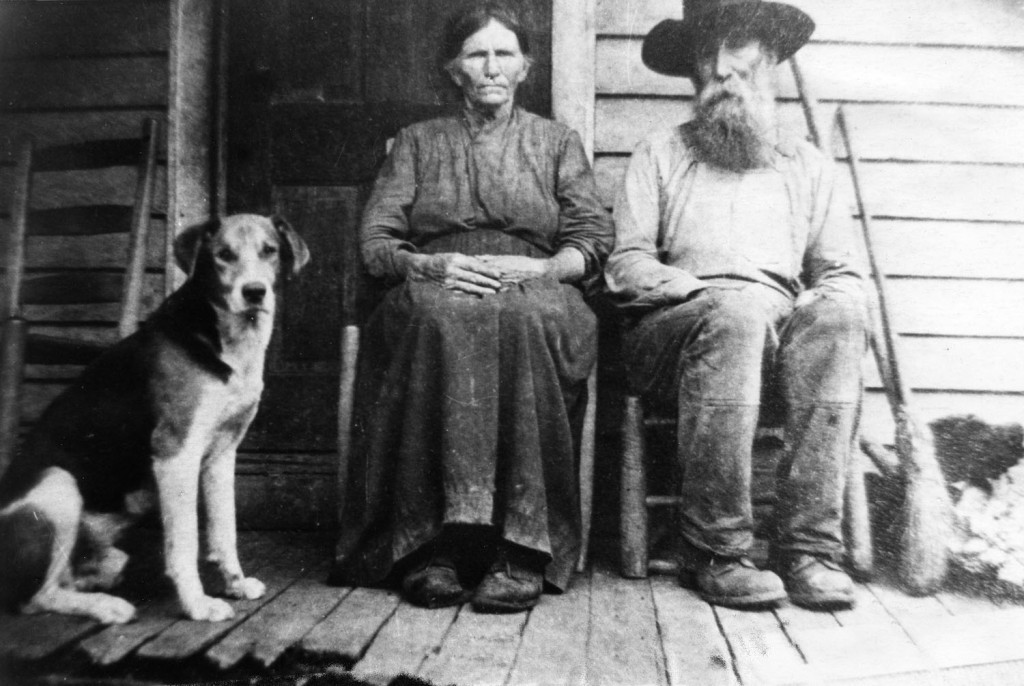
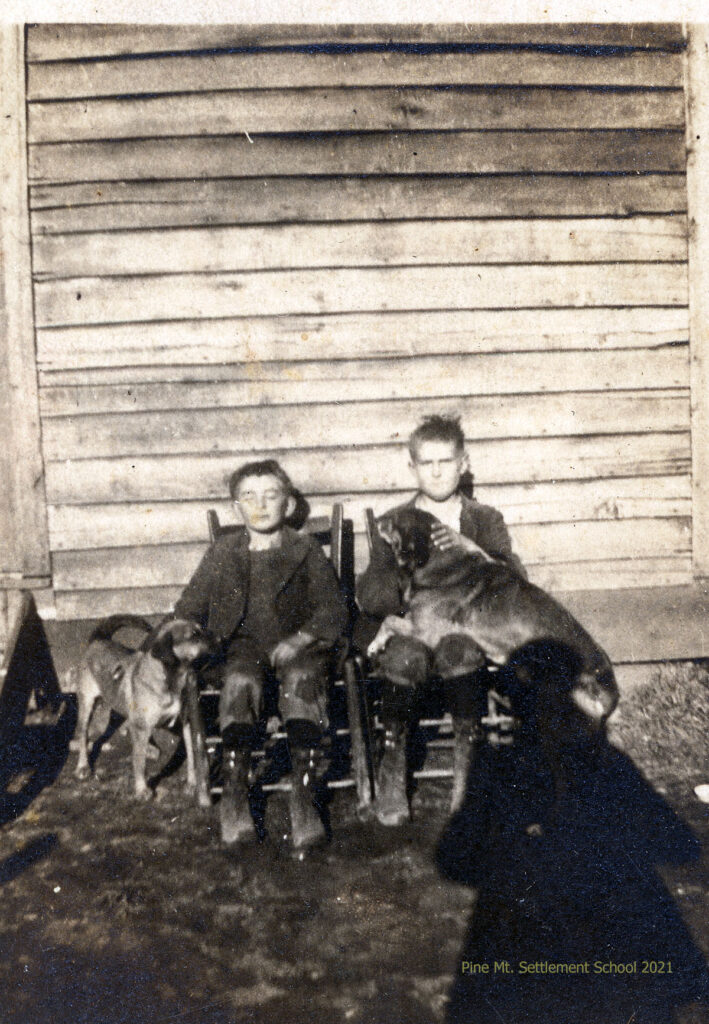 HOUNDS 418 Boy and young man seated with two hunting dogs. Ship-lap wall behind them.