Category Archives: ARTS AND CRAFTS

Describes all aspects of art and craft at Pine Mountain Settlement School. Included are categories such as: WEAVING ; CERAMICS ; BROOM-MAKING ; CHAIR-MAKING ; FURNITURE ; CORN-SHUCK DOLLS ; SEWING ; QUILTING ; FIRESIDE INDUSTRIES ; PAINTING ; PRINTMAKING ; PHOTOGRAPHY ; etc.

Weaving, Natural Talents, and Natural Dyes and Becky Mae Huff

Pine Mountain Settlement School
DANCING IN THE CABBAGE PATCH
Weaving and Natural Dyes and Natural Talents and Becky Huff

Weaving, Natural Talents, and Natural Dyes and Becky Mae Huff

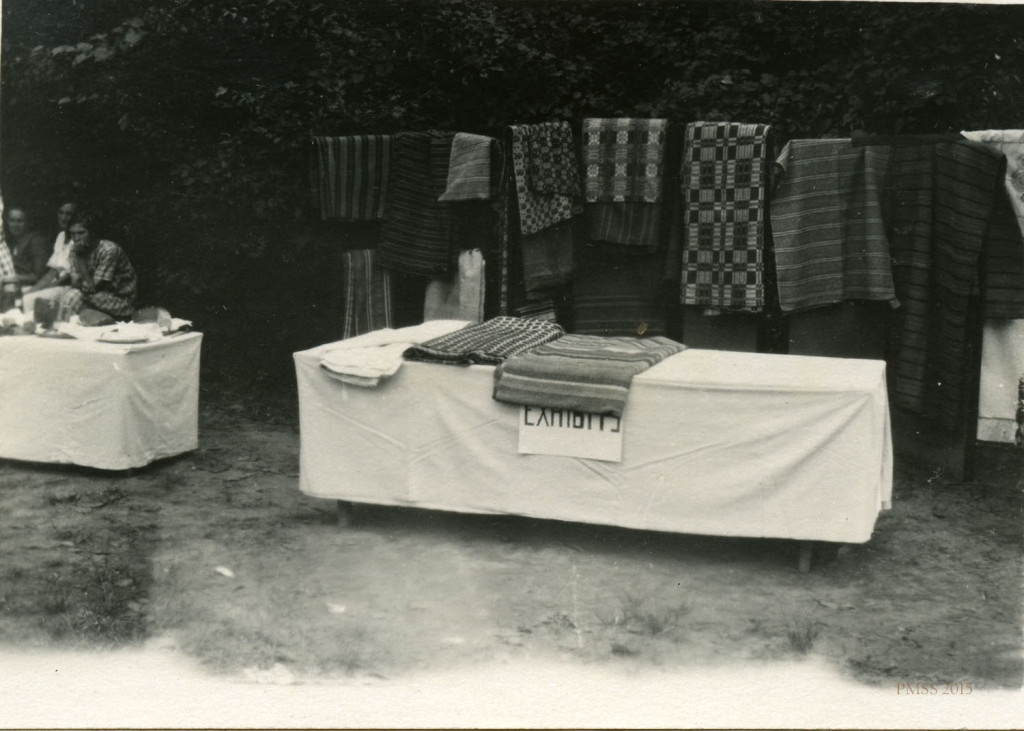
Exhibit of weaving and woven craft. [norton_021.jpg]

WEAVING WOES

Weaving may look very easy. Back and forth, back and forth, and voila! a lovely “runner” for the chest of drawers. But neither life nor weaving is that simple. The most exquisite weavings come from those weavers with natural talents, diligence, and a strong sense of self-worth and a designer’s eye. Becky Huff was one of those weavers of both cloth and life. She was one of the first children to attend Pine Mountain Settlement School c. 1914.

By 1930, shortly before Katherine Pettit’s retirement, she {Pettit} tried to recruit Becky back to Pine Mountain as one of Pine Mountain’s most talented weavers.  She had been trained by Pettit and others and was an expert weaver, dancer, and institutional historian. Pettit wanted her to come back to the school and mainly resurrect the weaving program but there were other assignments. The letter, a full pleading page from Katherine Pettit, lays out the generous terms of employment if “Beckie” [Becky] would return to Pine Mountain to develop a weaving program, teach a few dance classes, and possibly perform several other tasks as required, she would be housed, salaried, and back among friends.

It is uncertain where the plea originated, but clearly it points to Katherine Pettit trying at the end of her life to bring back the craft on which she founded the School headed by one of her favorite students. But it was also more than that. Becky had been there with her as a child in her first years at the School in 1914 and forward.  Becky, while remembering those Pine Mountain first years to her family noted that as a child she was charged with bringing Pettit her breakfast each morning. Pettit and many others also remember Becky as the sister of Almon Huff. Almon was one of the students killed when the new School House caught fire and burned to the ground, killing Almon,  three other students, and one teacher. Miss Pettit and Becky shared many memories.

Pettit’s letter was written as she was preparing for retirement and her final days with the School. Pettit continued to center weaving at the height of the Depression — at the center of a  era unlikely to want to spend precious dollars on craft.  Her actions are difficult to asses — to explain her belief in a market that could balance the full throttle of Depression with craft sales and a School charging ahead into a new educational mode that did not place craft on the front line. In some ways Pettit’s plea captures the tension, desperation, and confusion of the 1930s across the country.— The Great Depression is still bearing down on the country following the 1929 crash, unemployment is rising and unstable, the Smoot-Hawley Tariff passes, the Dust Bowl is ravaging the agricultural centers of the country, and poverty is everywhere, and Pettit wants to teach weaving.

The country was desperately searching for solutions as Americans desperately searched for work.  The new discovery of the planet  Pluto diverts attention for a brief time as the newly abandoned populace looks to the planet and wishes they could escape there. But there are no easy answers. Somehow, this all sounds all too familiar.

The Smoot-Hawley Tarriff initiated during the early years of the Depression — the economic down-turn was a disaster.  It raised import duties on over 20,000 goods by roughly 20% to 50–100% in some cases. While it aimed to protect agriculture, the farmers of America and related industries tanked, and the Great Depression ravaged the country as so well described by Steinbeck in The Grapes of Wrath.  As a result of Smoot-Hawley the  country’s trade partners retaliated, and the trade battles caused a 66%  decline in world trade for nearly five years and the retaliatory tarriff on the USA — on Harlan County and its coal. The tariffs set off the Great Depression, and in an area that could little afford further declines in its near-poverty living standards.

Did Katherine Pettit win Becky back to Pine Mountain? Was this the end of the weaving program? Read on. See BECKY MAY HUFF Student Staff

THE LETTER    (Katherine Pettit to Beckie Huff)
April 2, 1930

My dear Beckie [Becky].

I have been wondering what you’re going to do about your job next winter? Miss Gaines  [RUTH B. GAINES] says that you are expecting  to come here. Although I have not received any word in reply to my last letter. Asking you definitely about it. Now, won’t you tell me very definitely? if you would like to come to take charge of the [weaving] department. Although I will not be here. Miss Gaines will be here to carry the ideals and standards that we have set. I should like to know if you are interested in our plans for this department and if you will help me to carry them out. Will you fill out the enclosed questionnaire that I may have it for our files as we require it of all our workers.

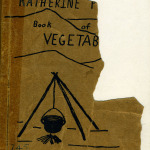
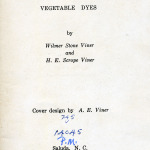
Did you know that, Mrs. Wilmer Stone is just getting published her [Katherinde Pettit book ] book on vegetable dyes. I saw an exhibition of her weaving. In Knoxville last week, where there were many very beautiful things, and hers was the most beautiful. Again, she told me if you could  do so next year, she would be so glad to have you come to North Carolina and teach you all she knows about vegetable dyes as many people think she is wonderful at that.  It seems to me it would be a great chance for you. Miss Ruth B. Gaines thought that you would also be interested in helping out with the country dancing, gymnastics, and singing games. Mrs. [John C.] Campbell, and Miss Butler have offered to take any people who worked in the mountains there for 10 days and let them have special instructions from their [John C. Campbell’s] Danish gymn teacher, and if you go to Miss Stone in Saluda, NC. would you not like to go to Mrs. Campbell’s [John C. Campbell Folk School] while you are there, for those special lessons?

We have a chance to get a wonderful weaving teacher — 35 years old. She would like to have a permanent job, and if you know positively you do not want to take this job, we shall certainly take her, for we are so anxious to get it [weaving] on a permanent basis. Run year by year by the same person. Now, Beckie May, if you are likely to get married within a year or so, as most young girls do, we want to tell us very frankly so that we may know how to plan for the future of this department. Miss Gaines is so eager to have you come and I think you could have an awful good time living at Laurel House with her and Emily.

Saturday is Aunt Sal’s Day, and all her family and friends are coming here for dinner with us in her little cabin and to see her great-granddaughter weave on her loom the same kind of a blanket that her great-grandmother taught her. Now I wish you could be here for such an interesting occasion.

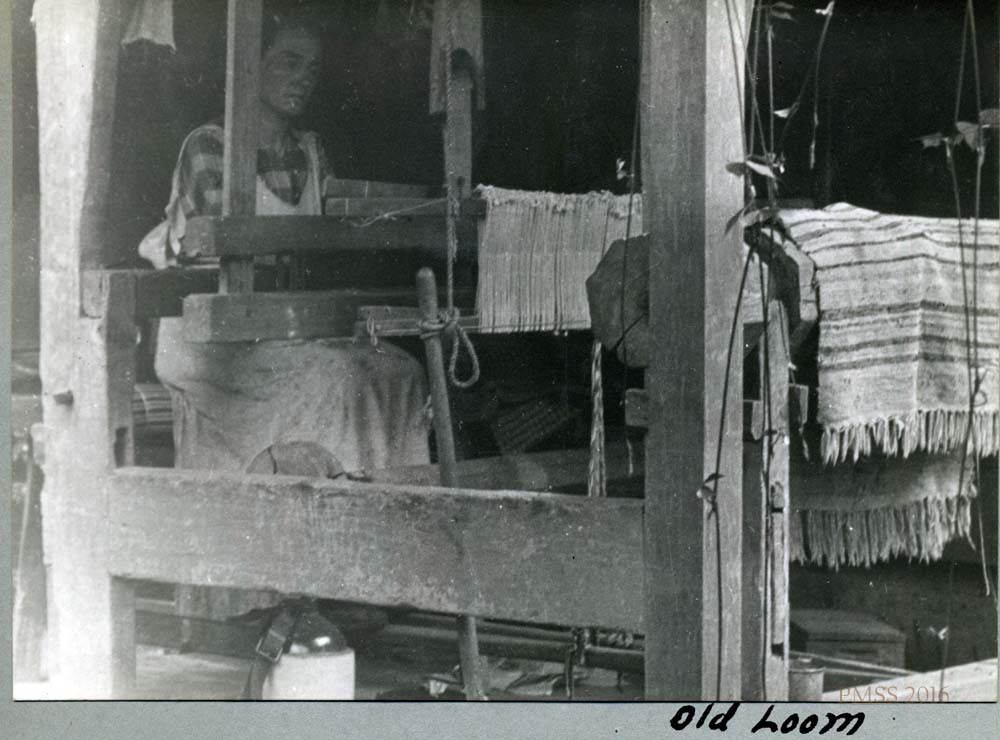
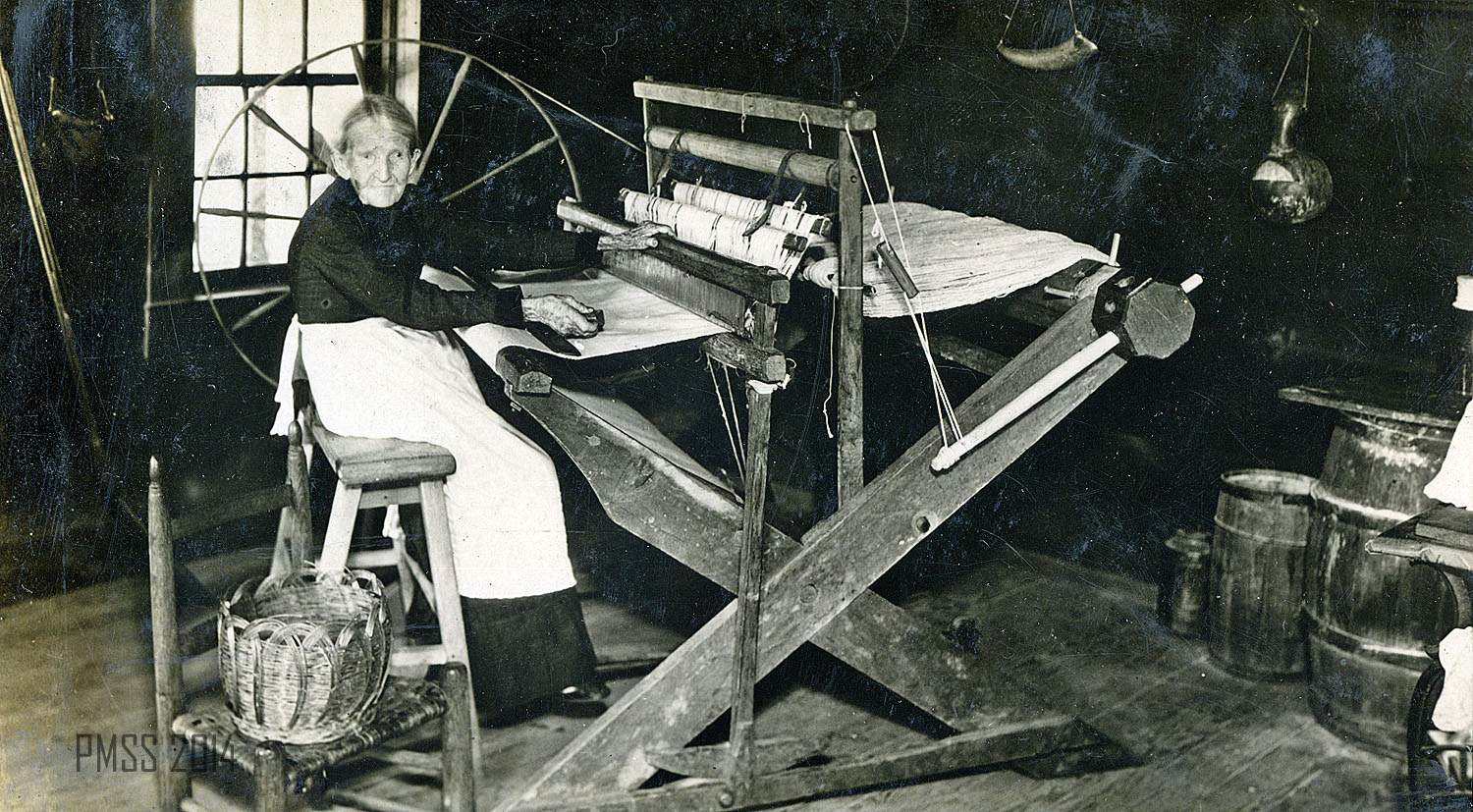
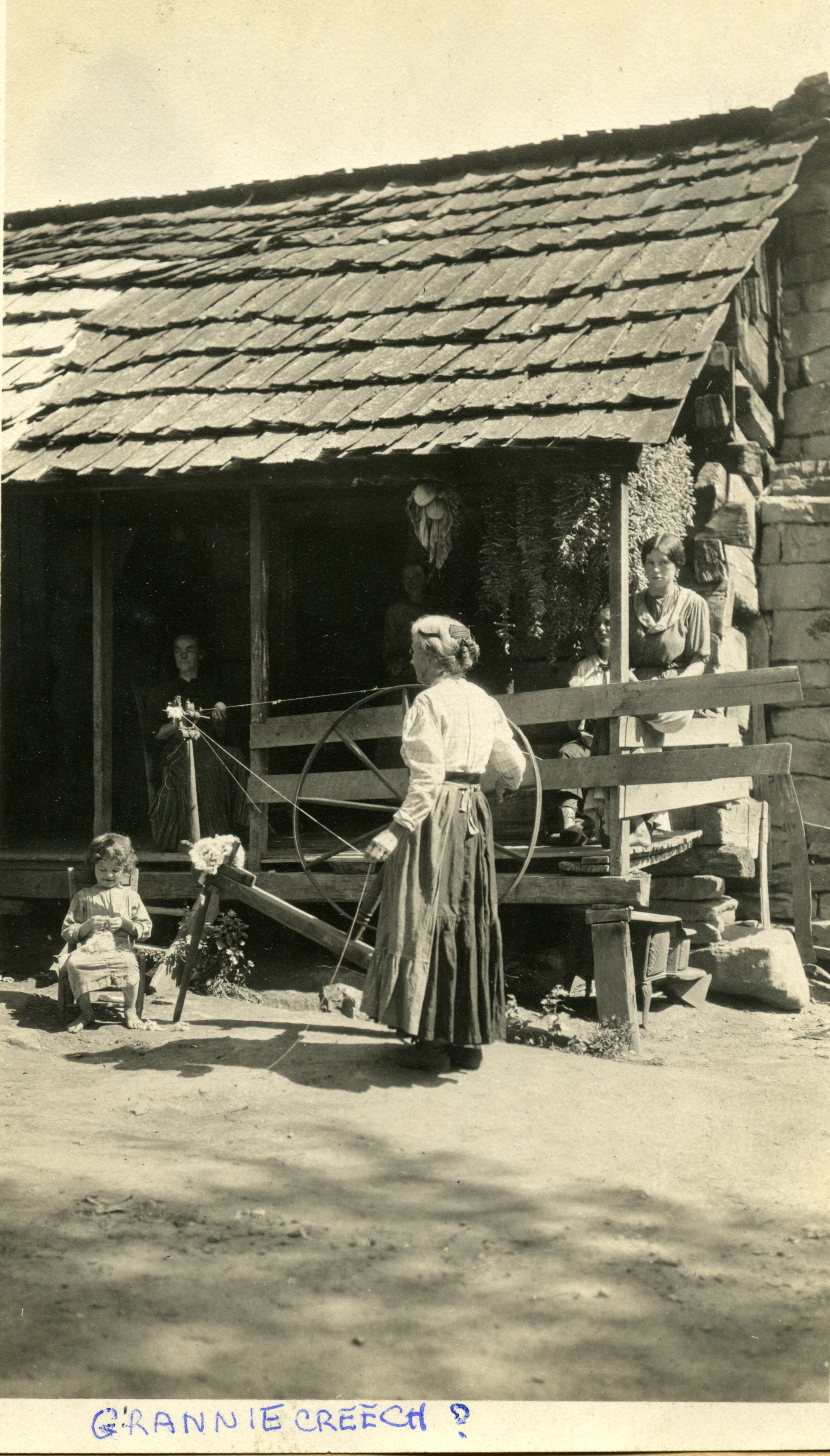
Woman weaving at “Old Loom.” [nace_II_album_020.jpg]

Now tell me about yourself and what you had been up to all this time and if you really think this is what you want to do next year? Are you coming to see us as soon as school is out …
p.2
… and will you be here for our Mayday and pageant of olden days? Miss Bolles is coming soon, and I wish you could be here all the Spring with us as we dance.

Yours sincerely.

Miss Becky May Huff
Methodist School
Olive Hill, KY
KP/B


1930 saw the initiation of  the  high-school boarding program just one year before the arrival of Glyn Morris and his Progressive Educational agenda that set a new course for the School from 1932- 1940 and just two years following the death of Ethel de Long Zande on 1928 from cancer.

Pettit’s letter captures the void left by Ethel de Long’s death and the uncertainty of the world between the Wars, the Coal Wars raging on the other side of the mountain, and the slowly healing Great Depression. It was one of the most fragile times at the School as it struggled to find its educational direction.

Becky Huff

Flax, Hemp and Silk

Pine Mountain Settlement School
DANCING IN THE CABBAGE PATCH
FLAX, HEMP, AND SILK

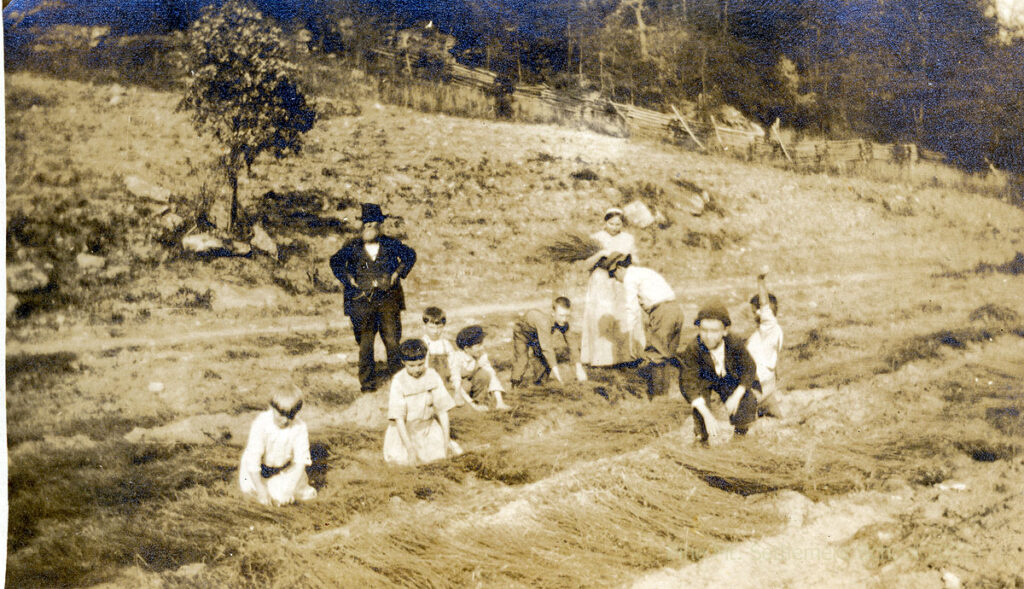
373 [Uncle William Creech with children from Pine Mountain School retting flax.]

notes for flax article BELOW.

1913

By Lyster H. Dewey–Botanist in Charge of Fiber Plant Investigations, Bureau of Plant Industry.  United States Department of Agriculture, Bureau of Plant Industry – Circular No. 57. Author: Lyster HDeweyBotanist in Charge of Fiber InvestigationsBureau of Plant Industry Pages: 1 – 7. THE CULTIVATION OF HEMP IN THE UNITED STATES. INTRODUCTION. ??  1910

1910 INTRODUCTION.

In 1910 Lyster H. Dewey, a botanist in charge of Fiber Plant Investigations for the Bureau of Plant Industry in the U.S. Department of Agriculture, wrote a small circular (No. 57) called “The cultivation of Hemp in the United States…” He noted that the two plants that were most promising for cultivation were hemp and flax. Kentucky became an optimum environment for the cultivation of these two plants.
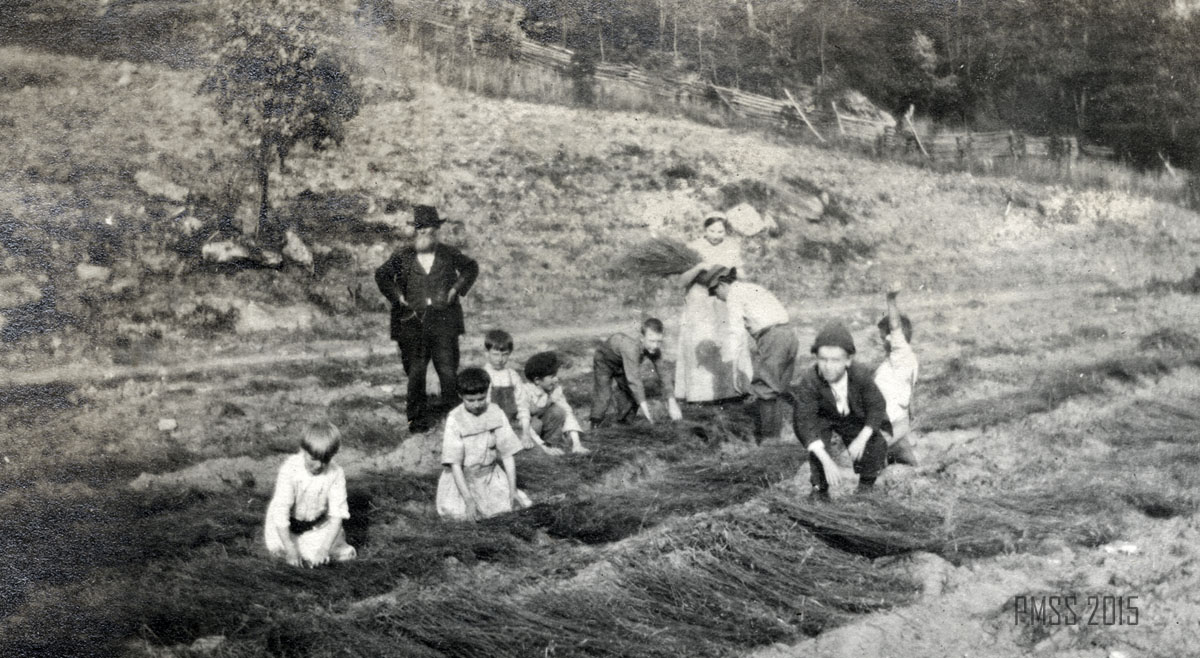
018a P. Roettinger Album. “Uncle William giving a lesson in spreading flax.” [William Creech, standing in back, and 9 children in the field.]

FLAX

In one of the earliest photographs made at Pine Mountain Settlement School, William Creech, one of the founders of the settlement in Harlan County in eastern Kentucky, is shown with a group of children laying out cut flax on the hillside near his home. The Pine Mountain valley with its rich soil and long East to West orientation was, like the rest of the state “as favorable as anywhere in the world”, said Lyster Dewey of the growth of this friendly plant, particularly, its cousin, hemp.

HEMP

Hemp is one of the oldest fiber-producing plants and examples of the durable homespun fabrics and ropes and cords derived from hemp have been found in the archaeological remains of some of the world’s earliest civilizations.

Hemp is a member of the mulberry family, Moraceae which includes the Osage orange, the paper mulberry and the common mulberry trees.  It is also a relative of the nettle family from which ramie, a strong bast fiber, is derived. Anyone who has ever painted or produced fine art prints knows that mulberry paper is some of the best support for paints and inks and its strong and very white surface retains its purity through time.

What Dewey fails to tell us in this government publication is the history of the notorious side of the family of hemp, the genus Cannabis. Instead, he notes that the genus Cannabis

… is generally regarded by botanists as monotypic, and the one species Cannabis sativa is now held to include the half dozen forms which have been described under different names …  and which are cultivated for different purposes.

It has been asked which came first, the discovery of the narcotic properties of the plant or its usefulness as a fiber-producing plant. In China, one of the earliest civilizations to produce textiles of hemp, the people called the plant “ma” and the cloth became known as hempen cloth. Further, Chinese writings tell of the use of the hemps seeds and the oil from the seeds as central to their foodways. There does not appear to be any use of the plant for what the Chinese called bhang, charas, and ganga the common names of their narcotic drugs. “The production and use of these drugs were developed farther west,” says Dewey.

Hemp did come west but it was a variety that was first cultivated by the Puritans for its fiber-producing qualities. The early farming of hemp in New England was not nearly so successful as it became further South. For example, in Virginia the soil and longer growing season produced a robust plant but the industry failed to thrive as tobacco filled the fields.  (For discussion see: Moore, Brent. A Study of the Past, the Present, and the Possibilities of the Hemp Industry in Kentucky, 1905.)

It was in Pennsylvania and in Kentucky that the industry thrived. Dewey describes the origins

The cultivation of hemp seems to have been a flourishing industry in Lancaster County, Pa., before the Revolution. An elaborate account of the methods then employed in growing hemp, written about 1775 by James Wright, of Columbia, Pa., (New Era, Lancaster, Pa., June 25, 1905.) was recently published as an historical document. The methods described for preparing the land were equal to the best modern practice, but the hemp was pulled by hand instead of cut. Various kinds of machine brakes had been tried, but the had all “given Way to one simple Break of a particular Construction, which was first invented & made Use of in this country.” The brief description indicates the common hand brake still in use in Kentucky.

By 1910, when Dewey’s circular was published, hemp was grown and harvested mainly for the production of commercial twine, a staple for tying just about anything together.

The first crop of hemp in Kentucky was raised by Mr. Archibald McNeil, near Danville, in 1775. (Moore, Brent. A Study of the Past, the Present, and the Possibilities of the Hemp Industry in Kentucky, p. 16, 1905.) It was found that hemp grew well in the fertile soils of the bluegrass country, and the industry was developed there to a greater extent than it had been in the eastern colonies. While it was discontinued in Massachusetts, Virginia, and Pennsylvania, it has continued in Kentucky to the present time. In the early days of this industry in Kentucky, fiber was produced for the homespun cloth woven by the wives and daughters of the pioneer settlers, and an export trade by way of New Orleans was developed. In 1802 there were two extensive ropewalks in Lexington, Ky., and there was announced “a machine, moved by a horse or a current of water, capable, according to what the inventor said, to break and clean eight thousand weight of hemp per day.” (Michaux, F. Andre. Travels to the west of the Alleghanies, p. 152, 1805. In Thwaites, Early Western Travels, v. 3, p. 200, 1904.) Hemp was later extensively used for making cotton-bale covering. Cotton bales were also bound with hemp rope until iron ties were introduced, about 1865. There was a demand for the better grades of hemp for sailcloth and for cordage for the Navy, and the industry was carried on more extensively from 1840 to 1860 than it has been since.

ITALY.

The highest-priced hemp fiber in the markets of either America or Europe is produced in Italy (Bruck, Werner F. Studien uber den Hanfbau in Italien, p. 7, 1911), but it is obtained from plants similar to those in Kentucky. The higher price of the fiber is due not to superior plants, but to water retting and to increased care and labor in the preparation of the fiber. Four varieties are cultivated in Italy:

(1) “Bologna,” or great hemp, called in France “chanvre de Piedmont,” is grown in northern Italy in the provinces of Bologna, Ferrara, Rovigo, and Modena. In the rich alluvial soils and under intensive cultivation, this variety averages nearly 12 feet in height, but it is said to deteriorate rapidly when cultivated elsewhere. (2) “Cannapa picola,” small hemp, attaining a height of 4 to 7 feet, with a rather slender reddish stalk, is cultivated in the valley of the Arno in the department of Tuscany. (Dodge, Charles Richards. Culture of hemp in Europe. U.S. Department of Agriculture, Fiber Investigations, Report No. 11, p. 5, 1898.) (3) “Neapolitan,” large-seeded. (4) “Neapolitan,” small-seeded.

The two varieties of Neapolitan hemp are cultivated in the vicinity of Naples, and even so far up on the sides of Vesuvius that fields of hemp are occasionally destroyed by the eruptions of that volcano. Seed of each of these Italian varieties has been grown in trial plots at Washington, D.C., and Lexington, Ky. The Bologna, or Piedmont, hemp in seed rows attained a height of 8 to 11 feet, nearly as tall as Kentucky seed hemp grown for comparison, but with thicker stalks, shorter and more rigid branches, and smaller and more densely clustered leaves. The small hemp, cannapa picola, was only 4 to 6 feet high. The large-seeded Neapolitan was 7 to 10 feet high, smaller than the Bologna, but otherwise more like Kentucky hemp, with more slender stalks and more open foliage. The small-seeded Neapolitan, with seeds weighing less than 1 gram per 100, rarely exceeded 4 feet in height in the series of plots where all were tried.

FRANCE.

Hemp is cultivated in France chiefly in the departments of Sarthe and Ille-et-Vilaine, in the valley of the Loire River. Two varieties are grown, the Piedmont, from Italian seed, and the common hemp of Europe. The former grows large and coarse, though not as tall as in the Bologna region, and it produces a rather coarse fiber suitable for coarse twines. The latter, seed of which is sown at the rate of 1 1/2 to 2 bushels per acre, has a very slender stalk, rarely more than 4 or 5 feet high, producing a fine flax-like fiber that is largely used in woven hemp linens. The common hemp of Europe, which includes the short hemp of France, is also cultivated to a limited extent in Spain, Belgium, and Germany. It grows taller and coarser when sown less thickly on rich land, but it never attains the size of the Bologna type.

ITALY.

The highest-priced hemp fiber in the markets of either America or Europe is produced in Italy (Bruck, Werner F. Studien uber den Hanfbau in Italien, p. 7, 1911), but it is obtained from plants similar to those in Kentucky. The higher price of the fiber is due not to superior plants, but to water retting and to increased care and labor in the preparation of the fiber. Four varieties are cultivated in Italy:

(1) “Bologna,” or great hemp, called in France “chanvre de Piedmont,” is grown in northern Italy in the provinces of Bologna, Ferrara, Rovigo, and Modena. In the rich alluvial soils and under intensive cultivation, this variety averages nearly 12 feet in height, but it is said to deteriorate rapidly when cultivated elsewhere. (2) “Cannapa picola,” small hemp, attaining a height of 4 to 7 feet, with a rather slender reddish stalk, is cultivated in the valley of the Arno in the department of Tuscany. (Dodge, Charles Richards. Culture of hemp in Europe. U.S. Department of Agriculture, Fiber Investigations, Report No. 11, p. 5, 1898.) (3) “Neapolitan,” large-seeded. (4) “Neapolitan,” small-seeded.

The two varieties of Neapolitan hemp are cultivated in the vicinity of Naples, and even so far up on the sides of Vesuvius that fields of hemp are occasionally destroyed by the eruptions of that volcano. Seed of each of these Italian varieties has been grown in trial plots at Washington, D.C., and Lexington, Ky. The Bologna, or Piedmont, hemp in seed rows attained a height of 8 to 11 feet, nearly as tall as Kentucky seed hemp grown for comparison, but with thicker stalks,

ITALY.

The highest-priced hemp fiber in the markets of either America or Europe is produced in Italy (Bruck, Werner F. Studien uber den Hanfbau in Italien, p. 7, 1911), but it is obtained from plants similar to those in Kentucky. The higher price of the fiber is due not to superior plants, but to water retting and to increased care and labor in the preparation of the fiber. Four varieties are cultivated in Italy:

(1) “Bologna,” or great hemp, called in France “chanvre de Piedmont,” is grown in northern Italy in the provinces of Bologna, Ferrara, Rovigo, and Modena. In the rich alluvial soils and under the intensive cultivation, this variety averages nearly 12 feet in height, but it is said to deteriorate rapidly when cultivated elsewhere. (2) “Cannapa picola,” small hemp, attaining a height of 4 to 7 feet, with a rather slender reddish stalk, is cultivated in the valley of the Arno in the department of Tuscany. (Dodge, Charles Richards. Culture of hemp in Europe. U.S. Department of Agriculture, Fiber Investigations, Report No. 11, p. 5, 1898.) (3) “Neapolitan,” large-seeded. (4) “Neapolitan,” small-seeded.

The two varieties of Neapolitan hemp are cultivated in the vicinity of Naples, and even so far up on the sides of Vesuvius that fields of hemp are occasionally destroyed by the eruptions of that volcano. Seed of each of these Italian varieties has been grown in trial plots at Washington, D.C., and Lexington, Ky. The Bologna, or Piedmont, hemp in seed rows attained a height of 8 to 11 feet, nearly as tall as Kentucky seed hemp grown for comparison, but with thicker stalks, shorter and more rigid branches, and smaller and more densely clustered leaves. The small hemp, cannapa picola, was only 4 to 6 feet high. The large-seeded Neapolitan was 7 to 10 feet high, smaller than the Bologna, but otherwise more like Kentucky hemp, with more slender stalks and more open foliage. The small-seeded Neapolitan, with seeds weighing less than 1 gram per 100, rarely exceeded 4 feet in height in the series of plots where all were tried.

FRANCE.

Hemp is cultivated in France chiefly in the departments of Sarthe and Ille-et-Vilaine, in the valley of the Loire River. Two varieties are grown, the Piedmont, from Italian seed, and the common hemp of Europe. The former grows large and coarse, though not as tall as in the Bologna region, and it produces a rather coarse fiber suitable for coarse twines. The latter, seed of which is sown at the rate of 1 1/2 to 2 bushels per acre, has a very slender stalk, rarely more than 4 or 5 feet high, producing a fine flax-like fiber that is largely used in woven hemp linens. The common hemp of Europe, which includes the short hemp of France, is also cultivated to a limited extent in Spain, Belgium, and Germany. It grows taller and coarser when sown less thickly on rich land, but it never attains the size of the Bologna type.

SOILS SUITED TO HEMP.

Hemp requires for the best development of the plant, and also for the production of a large quantity and good quality of fiber, a rich, moist soil with good natural drainage, yet not subject to severe drought at any time during the growing season. A clay loam of rather loose texture and containing a plentiful supply of decaying vegetable matter or an alluvial deposit, alkaline and not acid in reaction, should be chosen for this crop.

SOILS TO BE AVOIDED.

Hemp will not grow well on stiff, impervious, clay soils, or on light sandy or gravelly soils. It will not grow well on soils that in their wild state, are overgrown with either sedges or huckleberry bushes. These plants usually indicate acid soils. It will make only poor growth on soils with a hardpan near the surface or in fields worn out by long cultivation. Clay loams or heavier soils give heavier yields of strong but coarser fiber than are obtained on sandy loams and lighter soils.

EFFECT OF HEMP ON THE LAND.

Hemp cultivated for the production of fiber, cut before the seeds are formed and retted on the land where it has been grown, tends to improve rather than injure the soil. It improves its physical condition, destroys weeds, and does not exhaust its fertility.

PHYSICAL CONDITION.

Hemp loosens the soil and makes it more mellow. The soil is shaded by hemp more than by any other crop. The foliage at the top of the growing plants makes a dense shade, and, in addition, all of the leaves below the top fall off, forming a mulch on the ground, so that the surface of the soil remains moist and in better condition for the action of soil bacteria. The rather coarse taproots (Pl. XLI, fig. 3), penetrating deeply and bringing up plant food from the subsoil, decay quickly after the crop is harvested and tend to loosen the soil more than do the fibrous roots of wheat, oats, and similar broadcast crops. Land is more easily plowed after hemp than after corn or small grain.

HEMP DESTROYS WEEDS.

Very few of the common weeds troublesome on the farm can survive the dense shade of a good crop of hemp. If the hemp makes a short, weak growth, owing to unsuitable soil, drought, or other causes, it will have little effect in checking the growth of weeds, but a good, dense crop, 6 feet or more in height, will leave the ground practically free from weeds at harvest time. In Wisconsin, Canada thistle has been completely killed, and quack-grass severely checked by one crop of hemp. In one 4-acre field in Vernon County, Wis., where Canada thistles were very thick, fully 95 per cent of the thistles were killed where the hemp attained a height of 5 feet or more, but on a dry, gravelly hillside in this same field where it grew only 2 to 3 feet high, the thistles were checked no more than they would have been in a grain crop. Some vines, like the wild morning-glory and bindweed, climb up the hemp stalks and secure light enough for growth, but low-growing weeds can not live in a hemp field.

HEMP DOES NOT EXHAUST THE FERTILITY OF THE SOIL.

An abundant supply of plant food is required by hemp, but most of it is merely borrowed during development and returned to the soil at the close of the season. The amounts of the principal fertilizing elements contained in mature crops of hemp, as compared with other crops, are shown in the accompanying table.

Amounts of principal fertilizing elements in an acre of hemp, corn, wheat, oats, sugar beets, and cotton. (Insert first table from p. 310 here)

The data in the table indicate that hemp requires for its best development a richer soil than any of the other crops mentioned except sugar beets. These other crops, except the stalks of corn and the tops of beets, are entirely removed from the land, thus taking away nearly all the plant food consumed in their growth. Only the fiber of hemp is taken away from the farm, and this is mostly cellulose, composed of water and carbonic acid. The relative proportions by weight of the different parts of the hemp plant, thoroughly air dried, are approximately as follows: Roots 10 per cent, stems 60 per cent, and leaves 30 per cent. The mineral ingredients of these different parts of the hemp plant are shown in the following table:

p. 310 here.Peter, Robert. Chemical Examination of the Ash of Hemp and Buckwheat Plants. Kentucky Geological Survey, p. 12, 1884. )

Hemp leaves the ground mellow and free from weeds and is therefore recommended to precede sugar beets, onions, celery, and similar crops, which require hand weeding. If hemp is grown primarily to kill Canada thistle, quack-grass, or similar perennial weeds, it may be grown repeatedly on the same land until the weeds are subdued.

BARNYARD MANURE.—The best single fertilizer for hemp is undoubtedly barnyard manure. It supplies the three important plant foods, nitrogen, potash, and phosphoric acid, and it also adds to the store of humus, which appears to be more necessary for hemp than for most other farm crops. If other fertilizers are used, it is well to apply barnyard manure also, but it should be applied to the preceding crop, or, at the latest, in the fall before the hemp is sown. It must be well rotted and thoroughly mixed with the soil before the hemp seed is sown, so as to promote a uniform growth of the hemp stalks. Uniformity in the size of the plants of other crops is of little consequence, but in hemp, it is a matter of prime importance. An application of coarse manure in the spring, just before sowing, is likely to result in more injury than benefit. The amount that may be applied profitably will vary with different soils. There is little danger, however, of inducing too rank a growth of hemp on upland soils, provided the plants are uniform, for it must be borne in mind that stalk and not fruit is desired. On soils deficient in humus as a result of long cultivation, the increased growth of hemp may well repay for the application of 15 to 20 tons of barnyard manure per acre. It would be unwise to sow hemp on such soils until they had been heavily fertilized with barnyard manure.

RETTING.

Retting is a process in which the gums surrounding the fibers and binding them together are partly dissolved and removed. It permits the fiber to be separated from the woody inner portion of the stalk and from the thin outer bark, and it also removes soluble materials that would cause rapid decomposition if left with the fiber. Two methods of retting are practiced commercially, viz, dew retting and water retting.

DEW RETTING.

In this country, dew retting is practiced almost exclusively. The hemp is spread on the ground in thin, even rows, so that it will all be uniformly exposed to the weather. In spreading hemp, the workman takes an armful of stalks and, walking backward, slides them sidewise from his knee, so that the butts are all even in one direction and the layer is not more than three stalks in thickness. (Pl. XLIV, fig. 3.) This work is usually paid for at the rate of $1 per acre, and experienced hands will average more than 1 acre per day. The hemp is left on the ground for four weeks to four months. Warm, moist weather promotes the retting process, and cold or dry weather retards it. Hemp rets rapidly if spread during early fall, provided there are rains, but it is likely to be less uniform than if retted during the colder months. It should not be spread early enough to be exposed to the sun in hot, dry weather. Alternate freezing and thawing or light snows melting on the hemp give the most desirable results in retting. Slender stalks one-fourth inch in diameter or less, ret more slowly than coarse stalks, and such stalks are usually not overretted if left on the ground all winter. Hemp rets well in young wheat or rye, which hold the moisture about the stalks. In Kentucky, most of the hemp is spread in December. A protracted January thaw with comparatively warm, rainy weather occasionally results in overretting. While this does not destroy the crop, it weakens the fiber and causes much loss. When retted sufficiently, so that the fiber can be easily separated from the hurds, or woody portion, the stalks are raked up and set up in shocks, care being exercised to keep them straight and with the butts even. They are not bound in bundles, but a band is sometimes put around the shock near the top. The work of taking up the stalks after retting is usually done by piecework at the rate of $1 per acre.

WATER RETTING.

Water retting is practiced in Italy, France, Belgium, Germany, Japan, and China, and in some localities in Russia. It consists of immersing the hemp stalks in water in streams, ponds, or artificial tanks. In Italy, where the whitest and softest hemp fiber is produced, the stalks are placed in tanks of soft water for a few days, then taken out and dried, and returned to the tanks for a second retting. Usually, the stalks remain in the water for about eight days, and the second time a little longer. In either dew retting or water retting, the process is complete when the bark, including the fiber, readily separates from the stalks. The solution of the gums is accomplished chiefly by certain bacteria. If the retting process is allowed to go too far, other bacteria attack the fiber. The development of these different bacteria depends to a large extent upon the temperature. Processes have been devised for placing pure cultures of specific bacteria in the retting tanks and then keeping the temperature and air supply at the best for their development. (Rossi, Giacomo.) Macerazione della Canapa. Annali della Regia Scuola Superiore di Agricultura di Portici, s.2, v. 7, p. 1-148, 1907. These methods, which seem to give promise of success, have not been adopted in commercial work.

BREAKING.

Breaking is a process by means of which the inner, woody shell is broken in pieces and removed, leaving the clean, long, straight fiber. Strictly speaking, the breaking process merely breaks in pieces the woody portions, while their removal is a second operation properly called scutching. In Italy and in some other parts of Europe, the stalks are broken by one machine or device, and afterwards scutched by another. In this country, the two are usually combined in one operation.

HAND BRAKES.

Hand brakes (Pl. XLVI, fig. 1), with little change or modification, have been in use for many generations, and even yet more than three-fourths of the hemp fiber produced in Kentucky is broken out on the hand brake. This simple device consists of three boards about 5 feet long set edgewise, wider apart at one end than the other, and with the upper edges somewhat sharpened. Above this, a framework, with two boards sharpened on the lower edges, is hinged near the wide end of the lower frame, so that when worked up and down by means of the handle along the back, these upper boards pass midway in the spaces between the lower ones. A carpenter or wagon maker can easily make one of these hand brakes, and they are sold in Kentucky for about $5.

The operator takes an armful of hemp under his left arm, places the butts across the wide end of the brake near the hinged upper part, which is raised with his right hand, and crunches the upper part down, breaking the stalks. This operation is repeated several times, moving the stalks along toward the narrow end so as to break the shorter pieces, and when the hemp appears pretty well broken, the operator takes the armful in both hands and whips it across the brake to remove the loosened hurds. He then reverses the bundle, breaks the tops, and cleans the fiber in the same manner. The usual charge for breaking hemp on the hand brake in this manner is 1 cent to 1 1/2 cents per pound. There are records of 400 pounds being broken by one man in a day, but the average day’s work, counting six days in a week, is rarely more than 75 pounds. In a good crop, therefore, it would require 10 to 15 days for one man to break an acre of hemp. The work requires skill, strength, and endurance, and for many years, there has been increasing difficulty in securing laborers for it. It is plainly evident that the hemp industry can not increase in this country unless some method is used for preparing the fiber requiring less hand labor than the hand brake.

MACHINE BRAKES.

Several years ago, a brake was built at Rantoul, Ill., for breaking and cleaning the fiber rapidly, but producing tow or tangled fiber instead of clean, straight, line fiber, such as is obtained by the hand brake. This machine consisted essentially of a series of fluted rollers followed by a series of beating wheels. Machines designed after this type, but improved in many respects, have been in use for several years at Havelock, Nebr., and first at Gridley, then at Courtland and Rio Vista, Cal. These machines have sufficient capacity and are operated at comparatively small cost, the hurds furnishing more than sufficient fuel for the steam power required, but the condition of the fiber produced is not satisfactory for high-class twines and it commands a lower price than clean, long, straight fiber.

The Sanford-Mallory flax brake, consisting essentially of five fluted rollers with an interrupted motion, producing a rubbing effect, has been used to a limited extent for breaking hemp. This machine, as ordinarily made for breaking flax, is too light and its capacity is insufficient for the work of breaking hemp.

A portable machine brake (Pl. XLVI, fig. 4) has been used successfully in Kentucky during the past two years. It has a series of crushing and breaking rollers, beating and scutching devices, and a novel application of suction to aid in separating hurds and tow. The stalks are fed endwise. The long fiber, scutched and clean, leaves the machine at one point, the tow, nearly clean, at another, and the hurds, entirely free from fiber, at another. It has a capacity of about 1 ton of clean fiber per day.

Another portable machine brake has been in use in California during the past two years, chiefly breaking hemp that has been thoroughly air dried but not retted. This hemp, grown with irrigation, becomes dry enough in that arid climate to break well, but this method is not practicable in humid climates without artificial drying. The stalks, fed endwise, pass first through a series of fluted or grooved rollers and then through a pair of beating wheels, removing most of the hurds, and the fiber, passing between three pairs of moving scutching aprons, each pair followed by rollers, finally leaves the machine in a kind of continuous lap folded back and forth in the baling box.

A larger machine (Pl. XLVI, fig. 3), having the greatest capacity and turning out the cleanest and most uniform fiber of any of the brakes thus far brought out, has been used to a limited extent during the past eight years in Kentucky, California, Indiana, and Wisconsin. This machine weighs about 7 tons, but it is mounted on wheels and is drawn about by a traction farm engine, which also furnishes power for operating it. The stalks are fed sidewise in a continuous layer 1 to 3 inches thick, and carried along so that the ends, forced through slits, are broken and scutched simultaneously by converging revolving cylinders about 12 and 16 feet long. One cylinder, extending beyond the end of the other, cleans the middle portion of the stalks, the grasping mechanism carrying them forward being shifted to the fiber cleaned by the shorter cylinder. The cylinders break the stalks and scutch the fiber on the underside of the layer as it is carried along, and the loosened hurds on the upper side are scutched by two large beating wheels just as it leaves the machine. The fiber leaves the machine sidewise, thoroughly cleaned and ready to be twisted into heads and packed in bales. This machine, with a full crew of 15 men, including men to haul stalks from the field and others to tie up the fiber for baling, has a capacity of 1,000 pounds of clean, straight fiber of good hemp per hour. The tow is thrown out with the hurds, and until recent improvements, it has produced too large a percentage of tow. It does good work with hemp retted somewhat less than is necessary for the hand brake, and it turns out more uniform and cleaner fiber. For good work, it requires, as do all the machines and also the hand brakes, that the hemp stalks be dry. If the atmosphere is dry at the time of breaking, the hemp may be broken directly from the shocks in the field, but in regions with a moist atmosphere, or with much rainy weather, it would be best to store the stalks in sheds or under cover, and with a stationary plant it might be economical to dr them artificially, using the hurds for fuel. Extreme care must be exercised in artificial drying, however, to avoid injury to the fiber.

IMPROVEMENT NEEDED IN HEMP-BREAKING MACHINES.

While hemp-breaking machines have now reached a degree of perfection at which they are successfully replacing the hand brakes, as the thrashing machines half a century ago began replacing the flail, there is still room for improvement. This needed improvement may be expected as soon as hemp is grown more extensively, so as to make a sufficient demand for machinery to induce manufacturers to invest capital in this line. For small and scattered crops, a comparatively light, portable machine is desirable, requiring not more than 10 horsepower and not more than four or five laborers of average skill for its operation. It should prepare the fiber clean and straight, ready to be tied in hanks for baling, and should have a capacity of at least 1,000 pounds of clean fiber per day. For localities where hemp is grown more abundantly, so as to furnish a large supply of stalks within short hauling distance, a larger machine operated in a stationary central plant by a crew of men trained to their respective duties, like workers in a textile mill, will doubtless be found more economical. Artificial retting and drying may also be used to good advantage in a central plant. The hemp growers of Europe have adopted machine brakes more readily than the farmers in this country, and the hemp industry in Europe is most flourishing and most profitable where the machines are used. Most of the hemp in northern Italy is broken and scutched by portable machines. Machines are also used in Hungary, and the machine-scutched hemp of Hungary is regularly quoted at $10 to $15 per ton, higher than that prepared by hand. These European machines may not be adapted to American conditions, but, together with American machines which are doing successful work, they sufficiently contradict the frequent assertion of hemp growers and dealers that “no machine can ever equal the hand brake.”

MARKET.

All of the hemp produced in this country is used in American spinning mills, and it is not sufficient to supply one-half of the demand. The importations have been increasing slightly during the past 20 years, while there has been a decided increase in values. The average declared value of imported hemp, including all grades, for the 4,817 tons imported in 1893, was $142.31 per ton, while in the fiscal year 1913, the importations amounted to 7,663 tons with an average declared value of $193.67 per ton. There have been some fluctuations in quotations, but the general tendency of prices of both imported and American hemp has been upward. (Fig. 19.) The quotations for Kentucky rough prime, since October 1912, have been the highest recorded for this standard grade. Furthermore, the increasing demand for this fiber, together with the scarcity of competing fibers in the world’s markets, indicates a continuation of prices at high levels.

Weaving at PMSS 1930s-1940s

Pine Mountain Settlement School
DANCING IN THE CABBAGE PATCH
Series: BY TOPIC – Arts & Crafts
Weaving
Weaving at PMSS 1930s-1940s

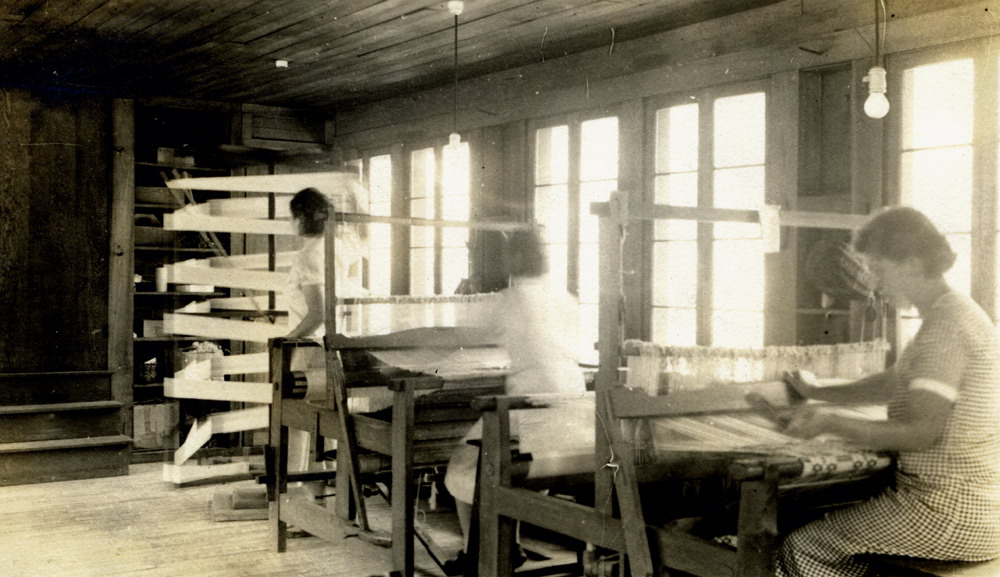
Girl’s Industrial. Interior view of weaving room.

Weaving at PMSS 1930s-1940s

MARGARET MOTTER AND THE COLONIAL COVERLET GUILD

Margaret Motter was a worker at Pine Mountain Settlement School in the 1920s and 30s and again in the 1940s. She served as Principal and teacher from 1928 until 1938, and as the Publicity Representative and Head of the English Department from 1946 until 1949.  She was a prolific writer and a clever and persuasive speaker.  Associated with those skills, was her importance to the School as a fund-raiser.  Many times she was asked to represent the Pine Mountain Settlement and to travel to distant cities to speak to special audiences that might find the programs at Pine Mountain worthy of support. Many times she managed to bring her favorite subject into the talk. In one instance she found the perfect audience for her interests and for those of Pine Mountain the Colonial Coverlet Guild of Chicago, Illinois.

Weaving had long been one of Miss Motter’s favorite crafts and she found many ways to integrate comments on the weaving program at Pine Mountain into her public speaking tours.  When she shared her interests with the Colonial Coverlet Guild* in  Chicago, Illinois, where she spoke on November 10, 1948, it was clear that her enthusiasm captured her audience. Miss Motter enjoyed this talk and so did her audience.

To accompany the talk to some 80 members of the Guild, she brought along many of the coverlets and weaving samples from Pine Mountain.  She described the origins of the patterns, dyes, and some of the stories that came along with the individual pieces. She was able to build a picture of the community of mountain weavers. She described how for many years weaving was a household necessity for mountain families and how that skill had been adopted by the School as part of the curriculum to ensure the continuation of the craft.  For many children in the community, weaving was even a new art as commercial fabrics began to dominate wardrobes by the turn of the century.

Motter emphasized how the art stayed with a number of the graduates from Pine Mountain and in some homes in the Pine Mountain valley, families established their own looms and weaving as a cottage industry to provide additional income for the family. Pine Mountain’s efforts to encourage weaving were shared by the organized cottage industry known as the Fireside Industries which broadly supported craft in the Appalachian mountains.

When Margaret Motter addressed the Colonial Coverlet Guild* she wrote out her talk in her unique abbreviated form and years later left Pine Mountain a copy of this talk and others, as well. Her talk is transcribed below.  Many of the abbreviations have been expanded in this version and individuals are identified, where known.  The talk is a window into weaving activity at the School and the role Miss Motter and others had in encouraging the continuation of this mountain traditional craft by integrating the craft into the Pine Mountain educational programs and offering it as a part of their Industrial Training program.  Further, the focus on weaving was melded to the social outreach of the School and was used to engage the broader community and to stimulate the potential for economic independence for many women in the community. In many ways weaving and the values of the settlement movement were well paired.


TRANSCRIPTION OF MOTTER TALK

MESSAGE TO COLONIAL COVERLET GUILD
November 10th 1948
By Margaret Motter

Many of you are familiar I am sure with the institution and the dramatic beginnings of Pine Mountain Settlement School, but any sort of message about our school is incomplete without mentioning the name of William Creech, affectionately  known as “Uncle William.” Here was a man with a 3rd-grade education but with great vision who dreamed for 30 years of a school that would “holp” his people.

When he gave his land (all he had) [not quite!] he wrote some men in his un-lettered hand which we treasure. I want to give you the closing paragraph to remind you of the ever-recurring challenge from Uncle William to carry on —

“I don’t look for wealth for them ….

So through the years Pine Mountain has been serving an isolated rural community as an extension, housing a secondary and a vocational high school and as a center of culture, and social and economic welfare.

Uncle William believed it was “better for folkes children to learn how to work with their hands…”  In following this advice of Uncle William Pine Mountain has had from the beginning what we call a work program. Pupils pay $10.00 – $15.00 per month if they can afford it and work 2 1/2 hrs. per day and longer on Saturday.  This work program serves a dual purpose.  Children are made to feel the value of the education that they are earning thru work.  [It] keeps [their] self-respect, values and dignity of work itself and besides, through the work program the school is kept going. The children learn over a period of years and do all kinds of work connected with homemaking, farming, and some trades or vocations.  All work is done under supervision and changed every 9 weeks.  Children have on [the] whole a fine attitude ….

“One thing I don’t like is learnin’ but I like what hit makes you be…….”   [Comment by Brit Wilder one of the youngest students and the first to come to the school]

Now, a very popular part of our work program as well as an elective study during school hours is our weaving. I want to give you a few details about this department since you have been good enough to share in making this department function.

Our weaving room has recently been enlarged and we have space for more looms and better looms.  We have by no means enough to meet the demand.  We have 9 looms and one small one owned by the teacher.  6 of these were made at Berea, one at Pine Mountain after the Berea Style — 5 of the looms are 40″ and 4 are 22″-24″.  Since 6 of the looms were at Pine Mountain before 1924, I guess it is not an understatement [page 3] to say they have not the latest improvements!

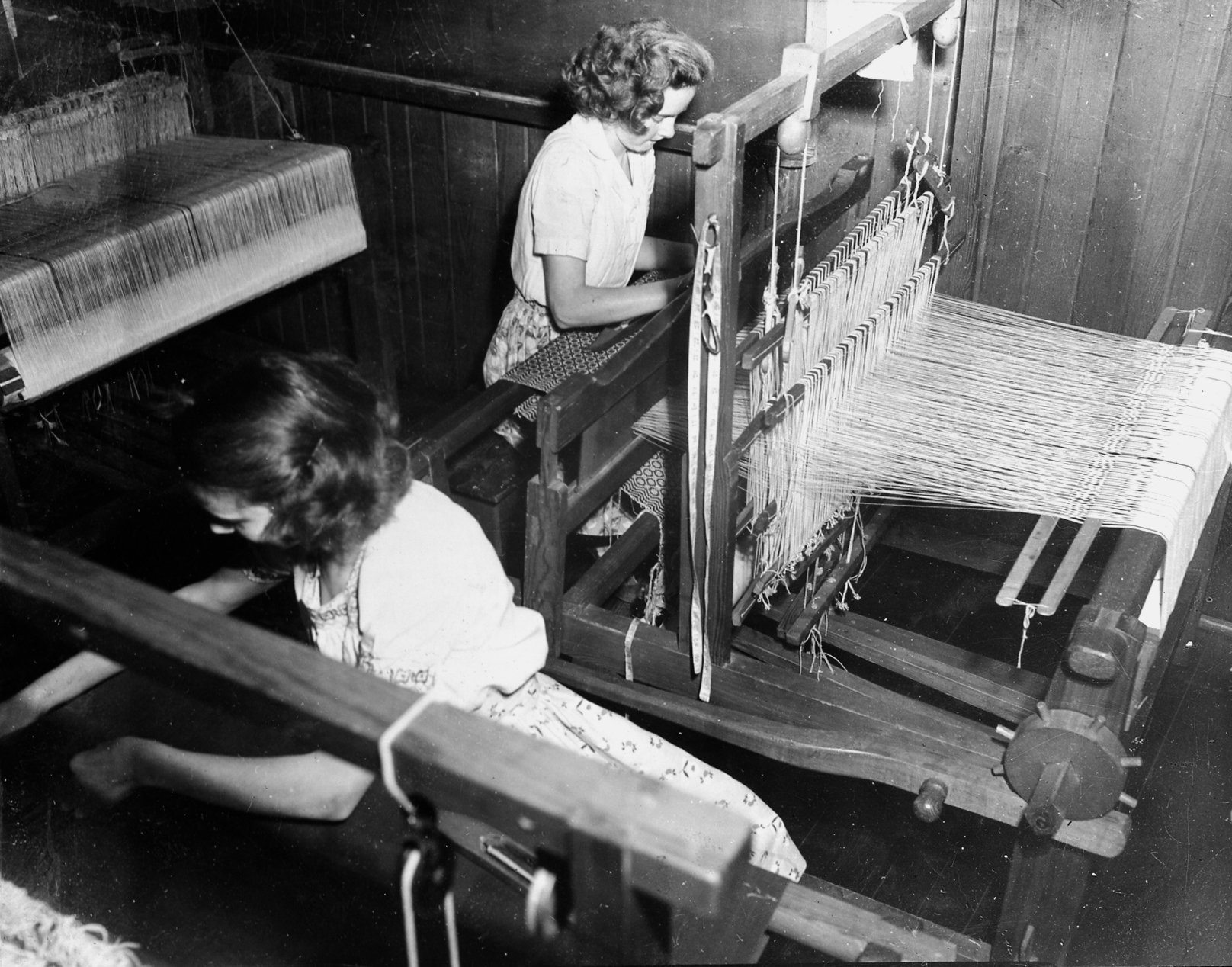
Weaving Room: Bess Taylor, Reba Blevins nace_1_061a.jpg

Weaving Room: Bess Taylor, Reba Blevins c. late 1940s. nace_1_061a.jpg

Our teacher informed me that a Swedish weaver told her we are doing very well indeed with the equipment we have.  So you can see as time goes on we shall need to replace these older looms with better ones and to purchase a pair of badly-needed scales [?] for the weaving room.

I have brought you some samples of weaving done by our girls. We use rags from feed-sacks which are dyed at the school and woven into rugs.  Old rayon stock and any kind of woven underwear can be transformed in the weaving room into lovely bags.  We have a neighbor who does some spinning for us and [the] other yarns we buy.

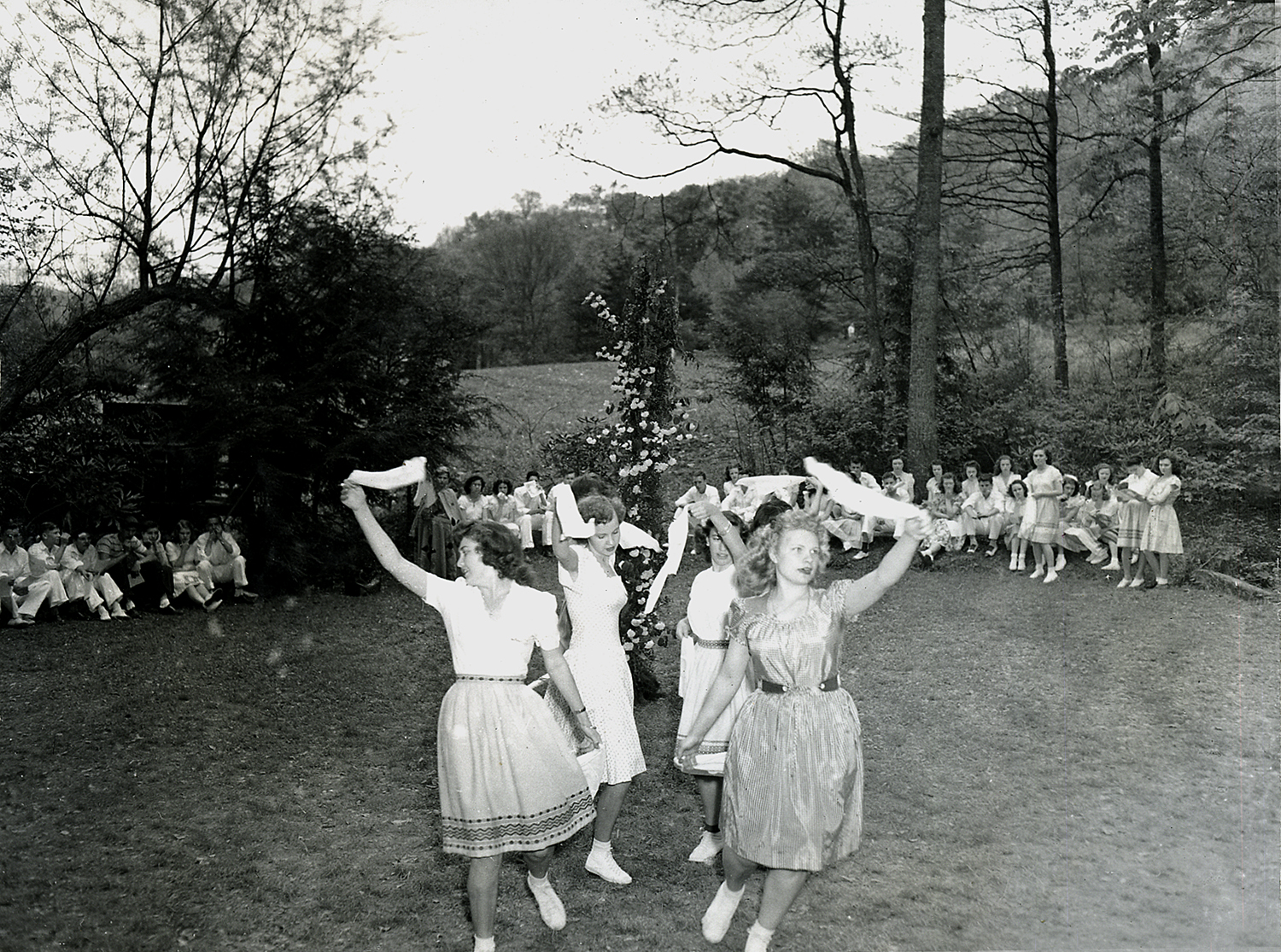
I mentioned that our weaving is very popular.  Some girls who learned to weave have been able to get a loom at home and have continued in their work.  Two of the senior girls have been especially interested “in weaving and confided in the teacher that they hope they’ll get a loom as a graduation gift from their home folks.  The girls love to weave a skirt to wear on May Day and have a chance to participate in the colorful “Weaver’s Dance”.

Weaving class in hand-woven skirts. Pearl Taylor, Ernestine Vitatoe, Bess Taylor, Jolene Lucas, Gladys Carroll, Reba Blevins, Margaret Slusher, Betty Huff -- 1946. nace_1_022b.jpg

Weaving class in hand-woven skirts. Pearl Taylor, Ernestine Vitatoe, Bess Taylor, Jolene Lucas, Gladys Carroll, Reba Blevins, Margaret Slusher, Betty Huff — 1946. nace_1_022b.jpg

"Glorishears" Morris Dance -- 1946. Shirley Holbrook and Delores Scott in lead. nace_1_021a.jpg

“Glorishears” Morris Dance — 1946. Shirley Holbrook and Delores Scott in lead.  nace_1_021a.jpg

Weaving does go on in some of the homes (as I mentioned), i.e., sample curtain [cur. ?] material [mat.?] woven by one of our neighbors. [The] Swedish pattern sells for $1.95 a yard.  I am reminded at this point of the way I happened to get one of my coverlets when I was at Pine Mountain in the fall of 1928.  In the office welcoming children as they arrived — In came last years student with a younger sister by hand and [a] coverlet over [the] other arm.  “I brung —–[?] “

fireside_indust_pg_001a_mod

Della Hayes weaving at Pine Mountain. Probably in Old Log, c. 1940s.

That coverlet was definitely a home product, brown from walnut hulls and dusty rose from madder.  Just as lovely today as when I bought it and I love to think that little Della [Hayes] — now a successful nurse — had her start at Pine Mountain because her sister had learned to weave at our school and had a loom at home.

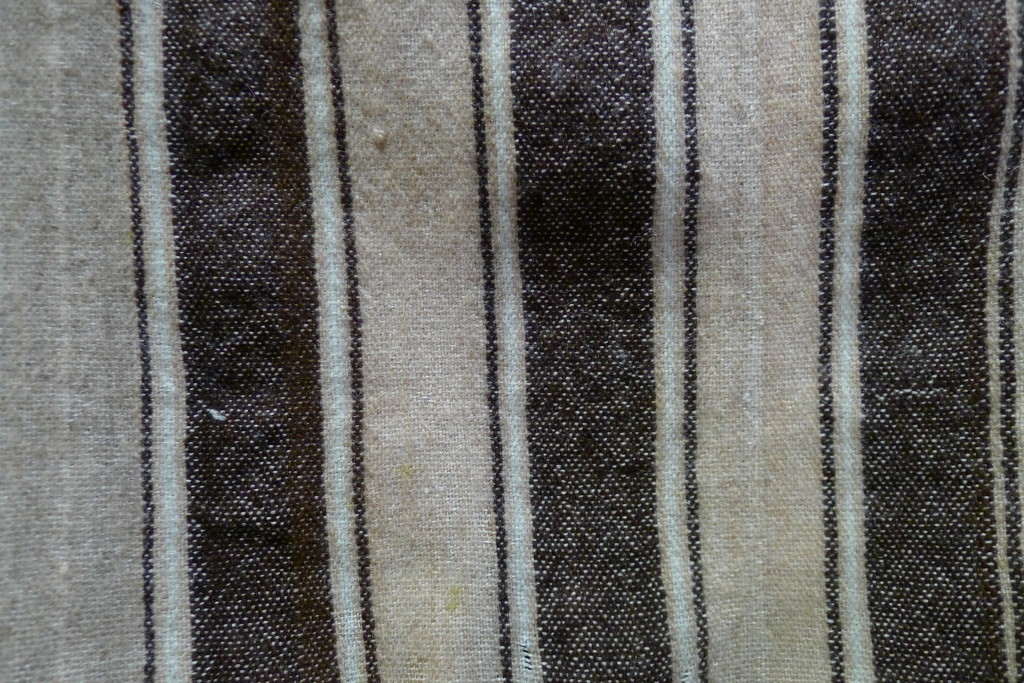
P1050096Walnut and madder dye weaving

[page 5] I am sure you are familiar with Dr. Allen Eaton’s book, Handmade in the Southern Mountains. [this should read, Allen H. Eaton. Handicrafts of the Southern Highlands], One of the colored illustrations shows a striped blanket that we call Pine Mountain Blanket #16. I have one of these made by a mountain woman who was taught to weave by our teacher — wool from her own sheep and vegetable dye used. This is the type of blanket we always use for our prophets in the Nativity Play.  You can see that the weaving even goes into something special like that.  *[Note: This same Pine Mountain Blanket #16 was used as a cover for the plaque which was un-veiled at the Pine Mountain Settlement School Centennial celebration in August 2013.]

P1050415

I say something special, Christmas at Pine Mountain is an occasion that one never forgets.  With our sacrificial meals for our Charity Fund now we’ll have something to share with others; with our appealing drama of lovely carols in [Laurel House] dining room while decorated with garlands, wreaths, and tree; with our gay Mummer’s Play ; with our charming Nativity Play in the Chapel, it is an occasion for happy activity — [a] genuine pleasure.  It has its effect upon children “Love and joy …” —“Hit’s peacefulest –” [Motter probably describes the change from the earlier celebrations of Christmas that were known for their liquor and guns.]

Boy's House Wassailers and Lords and Ladies -- 1946. [Good King Wenselaus ?] [In Laurel House] nace_1_025b.jpg

Boy’s House Wassailers and Lords and Ladies — 1946. [Good King Wenselaus ?] [In Laurel House] nace_1_025b.jpg

Your share in our work is indeed heartwarming to the staff and the trustees.  May we ask for your continued interest so that we may not fail to make Uncle William’s dream come true  — I don’t want hit to be for this local. only —-”  ——

*Swygert, Mrs. Luther M.  Heirlooms from Old Looms A Catalogue of Coverlets Owned By the Colonial Coverlet Guild of America and Its Members – R.R. Donnelley and Sons : 1940 (1955).


FIRESIDE INDUSTRIES

Through Pine Mountain’s efforts and the support of the broad-ranging Fireside Industries, a strong program of support for the Appalachian craft of weaving was developed and the practice was strongly revitalized in the 1930s and 40s. In many environments, during the 1930s and 1940s the idea of a “cottage industry” which is characterized by contracted work completed at home and then marketed through a central agency, was a developed and viable economic venture.  In the case of Pine Mountain, the idea was not new and was not exploited by the school so much for commercial reasons, but was incorporated into the educational program and into their primary goal of building “community.”

The idea of weaving at home was not unique to families in the Pine Mountain community but with Pine Mountain’s encouragement, it began to follow the model put forward by the Fireside Industries which flourished at centers such as Berea College, long a source of inspiration and support for the School’s weaving enterprises.

Pine Mountain’s interest was also shared by many other rural settlement schools in the region, particularly in the early settlements institutions in Western North Carolina.  What was unique at Pine Mountain was the early adoption of weaving and the measure of enthusiasm in the community for such work and the persistence of weaving as part of the educational program at the school.

Weaving has been an activity that has found a place at the School for over 100 years and more of its history. Through the enthusiasm of Katherine Pettit and her “kivers” and those like Margaret Motter, who followed her,  Pine Mountain has maintained it’s interest this this unique craft and in the long family traditions attached to weaving in the Central and Southern Appalachians. This long mountain family history led to the introduction of weaving and dying in the first decade of the school and maintained it through the years.

Katherine Pettit’s Dye Book written by Helen Wilmer Stone, a staff member at Pine Mountain, is a classic in the genre of vegetable dying of fiber. Under Katherine Pettit, Helen Wilmer Stone, Margaret Motter, Florence Daniels, Abbie Winch Christensen, Becky May Huff, and others, weaving and spinning, and the use of native plants for dyes later found a place in the curriculum of the Pine Mountain and other schools as a vocational tract.  When a more normalized curriculum was mandated by public instructions guidelines, weaving still remained as an elective at many of these schools, and often as an after-school program. Yet, in most schools and homes, weaving had gone away by the late 1940s.  Few instructors could be found to maintain the craft in schools other than arts and crafts schools and the maintenance f the equipment was high.

Unlike many regions of the Central and Southern Appalachians in the 1940s,  the Pine Mountain Valley had not fully abandoned weaving in some households.  In many homes in the mountains, and in the Pine Mountain region particularly, many families still maintained their old looms and many of the unique patterns continued their persistence through many generations of family weavers.  Some of the old patterns can still be found in mountain homes scratched out on rolled strips of cloth or on long scrolls of paper.  Like some ancient runes, these patterns are family treasures.

https://pinemountainsettlement.net/wp-content/uploads/2014/08/fireside_indust_pg_002a_mod.jpg

https://pinemountainsettlement.net/wp-content/uploads/2014/08/fireside_indust_pg_002a_mod.jpg

What Pine Mountain brought to the Fireside Industries or the “cottage industry” model, was a renewal or revival of the long-standing culture of eager mountain weavers.  Margaret Motter moved this enthusiasm along by carrying examples of weaving with her on almost every talk she gave outside the School.  Through Katherine Pettit’s early enthusiasm for collecting mountain “kivers” the attention to the beauty and skill of mountain weaving moved among the staff of the School like an aesthetic mantra.  Workers discovered in weaving sophisticated and beautiful local craftsmanship that utilized skill, intelligence, and tenacity — qualities that the community weavers had in abundance.  The education that occurred between the workers and the community was mutual — and it continues to be mutual today, even as the “community” of Pine Mountain has continued to expand outward to meet the demands of the industrial world and a more diverse public.


WEAVING IN 1949

A short piece written by Freshman student Mattie Mae Adams in the February 1949 PINE CONE, the student newsletter, describes a weaving experience at the School.  1949 was the last year the boarding school was in operation.

WEAVING

On my entrance to Pine Mountain I had a choice between science and weaving. I took weaving.  At first I was afraid to weave. I was afraid I would make a mistake. It seemed hard for me to remember all of the names of the parts of the loom, and it was still harder to wind a bobbin. But it didn’t take me long as I have Miss Christensen for a teacher.

She started me off on a rug that she had already started herself. Afterward, I thought I wanted to make one for myself. Now we have started on our May Day skirts, which are very difficult, because I get my threads crossed and have to take them out. Then I have to re-wind a bobbin. The next thing I know I’m using the wrong treadles or mending a broken heddle.  Broken threads are another difficulty.  I have just mended a broken thread when I discover a mistake which has to be taken out. Then I usually take out two to that four.

Now all of these things don’t happen every day; but when one happens it seems as if they all happen at once. Even in spite of these hard tasks, I am glad I made the choice of weaving. 

Mattie Mae Adams, Freshman


P1050033

Ccropped image of weaving held in the Katherine Pettit Collection in the Bodley-Bullock House, Bodley-Bullock House. Sorority House for Transylvania College. 200 Market St, Lexington, KY 40507.

SEE ALSO:

KATHERINE PETTIT – WEAVING

BECKY MAY HUFF

FLORENCE DANIELS

ABBIE WINCH CHRSTENSEN

HELEN WILMER STONE

KATHERINE PETTIT DYE BOOK

WEAVING at PMSS BEGINNINGS

WEAVING DRAPER LOOM STUDIO

WEAVING AT PMSS SAMPLES I

WEAVING AT PMSS SAMPLES II


DANCING Conceived Among the Coverlets – Weaving at Pine Mountain Settlement – Beginnings

DANCING – CONCEIVED AMONG THE COVERLETS
WEAVING AT PINE MOUNTAIN SETTLEMENT – BEGINNINGS

Exhibit of weaving and woven craft. 1920’s [?] [norton_021.jpg]

One might say that Pine Mountain was conceived among coverlets.  Weaving at Pine Mountain Settlement School certainly was encouraged by the rediscovery of the craft of weaving and the enthusiastic collecting of mountain weavings near the turn of the last century.  Katherine Pettit, Director and founder of Pine Mountain Settlement School and earlier of Hindman Settlement School, was an avid collector of “kivers.”  Her interest in the exquisite craft of coverlet weaving kept her roaming the mountains in the early years of the twentieth century in search of new patterns and techniques.   It was the search for beautiful mountain “kivers” that kept Pettit journeying across the Eastern Kentucky region and eventually to the Pine Mountain valley in Harlan County, Kentucky.  There, in the long valley on the north side of the Pine Mountain, she plotted to establish one of the most unique Appalachian settlement schools amd from this base she gathered some of the most remarkable early weavings in Kentucky.

Vl_34_1099a_mod

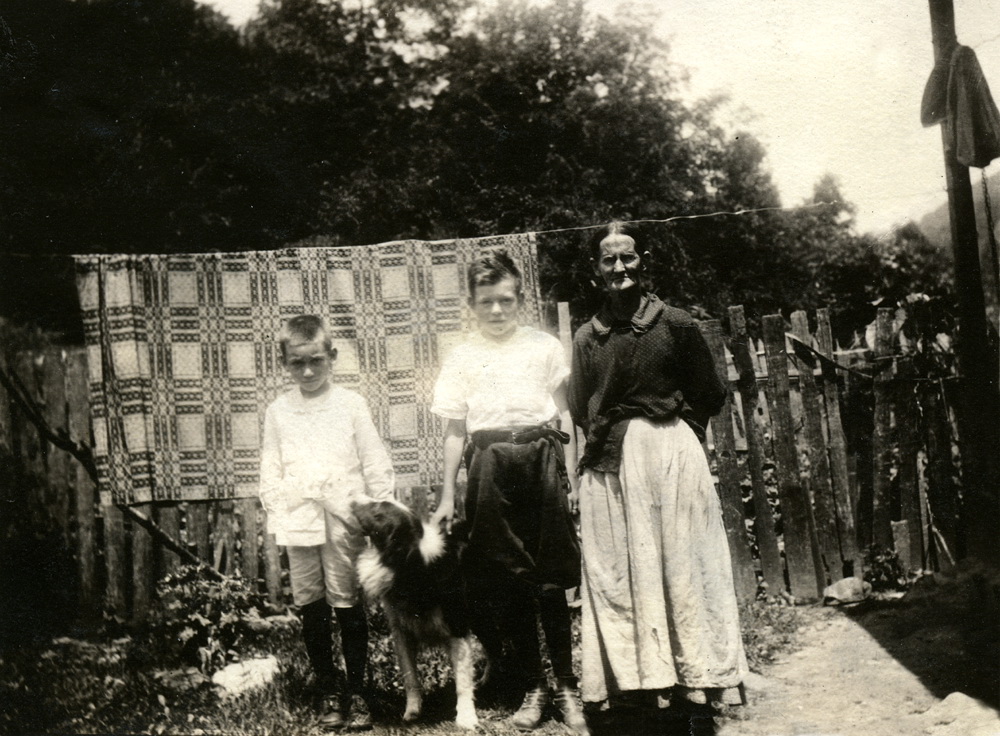
Neighbors in the Pine Mountain Valley with a coverlet hanging behind the mother, two children, and a dog. c. 1920s.

Pettit often traveled into the community from Hindman in Knott County, Kentucky where she had established her first school in the early years of the twentieth century.  Even before the founding of Hindman, in 1901, Pettit was into her third summer season in the eastern Kentucky mountains at a location known as “Sassafrass” and later at Hindman. She and her adventuresome colleagues had already journeyed to many of the remote valleys and hollows of nearby Harlan, Perry, and Letcher counties, where she frequently came into contact with mountain weavers.  She soon began to search for coverlets to purchase, and also found her interest in the craft gave her a sound introduction to many mountain families. While looking for homespun coverlets, she soon discovered more than the coverlet.  She discovered the weavers and their humble but rich skills, their ancient culture, and their stoic resourcefulness. Theirs was a lifestyle that she would soon come to cherish, partially adopt, and commit to “raising up.”

Vl_34_1089c_mod

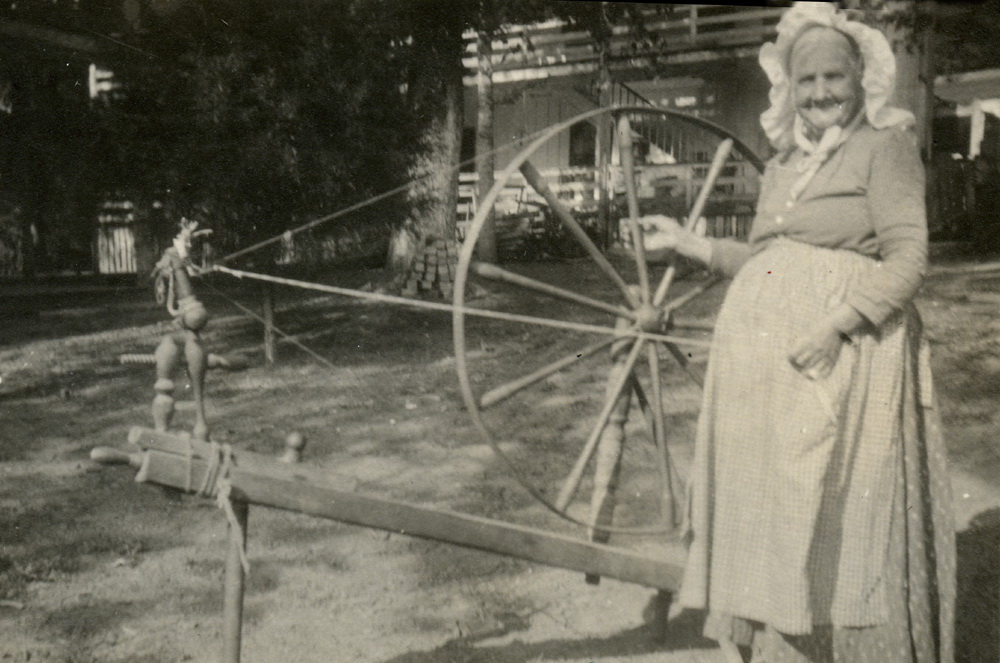
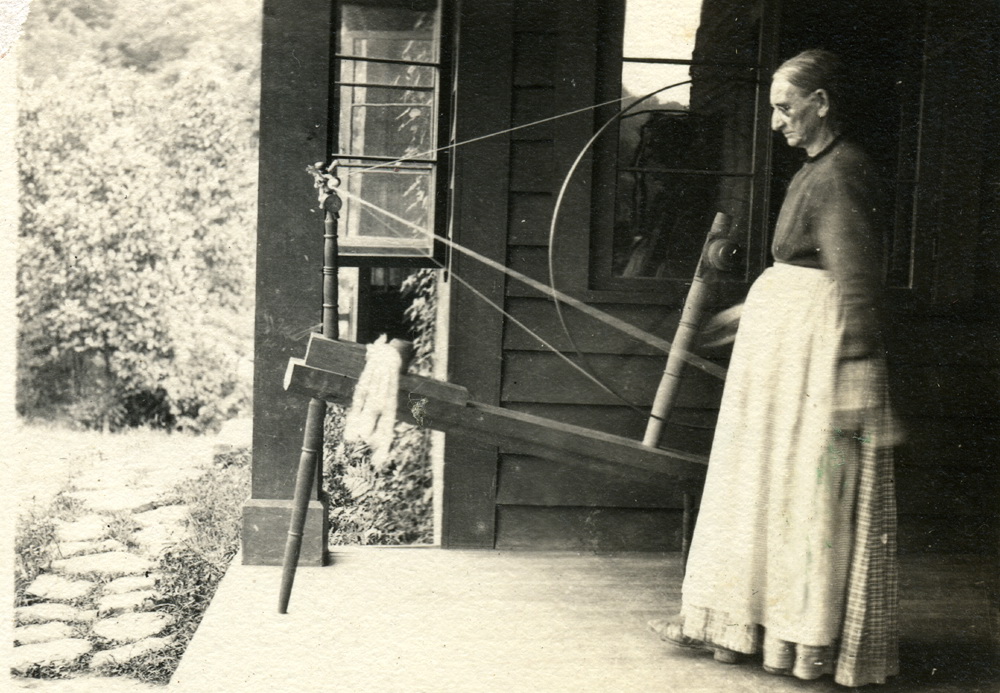
A Pine Mountain neighbor with her spinning wheel. c. 1915.

In Harlan County, Katherine Pettit found the distance from the rapidly industrializing world she desired, and she expanded her Hindman experiences.  She rapidly reached out to her many contacts, established a rustic home, and began to build a school dedicated to serving the people of the remote Pine Mountain valley and the nearby hollows. She did not, however, become a recluse.

When she came to Pine Mountain in 1913, and with the help of William Creech and the families living in the valley, Pettit established a school founded on the principles of the more urban settlement houses found in Chicago, New York, Boston, and other locations. She recruited educators and workers from those early urban settlement schools and women’s colleges and sowed the seeds of a progressive educational program.  What she created was a settlement school that adopted a unique response to the urban settlement house ethos.  While weaving in the urban settlements had often depended on teaching weaving that was modeled on practices found in the Arts and Crafts Movement and in Scandinavian models, Pettit’s models were already established in the mountains of Kentucky and other areas of the Southern Appalachians.   Weaving for Pettit and for the Pine Mountain community was an integral part of a response to the legacy of many families and the demands of a rural environment that was still in a pioneering and subsistence mode.

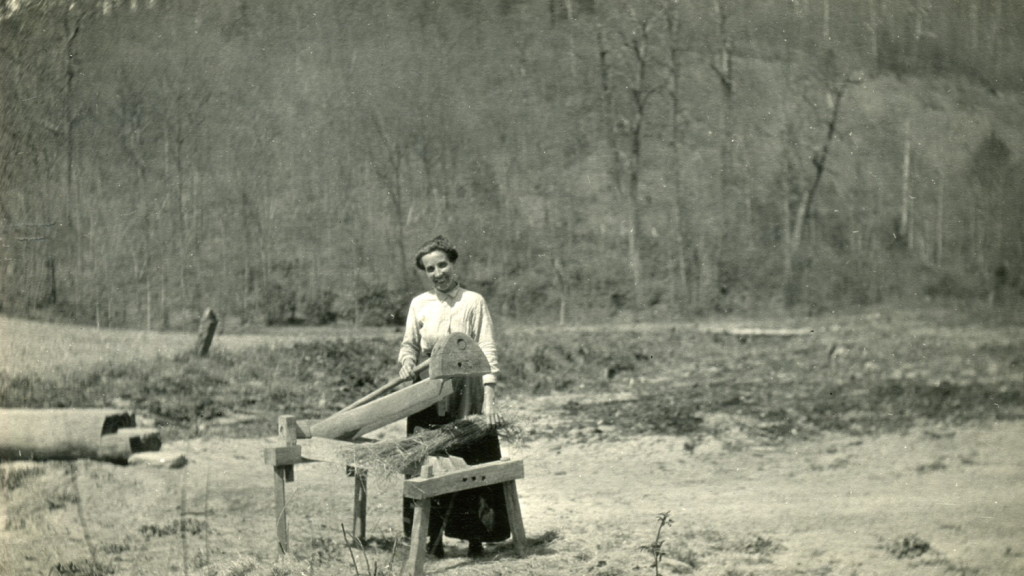
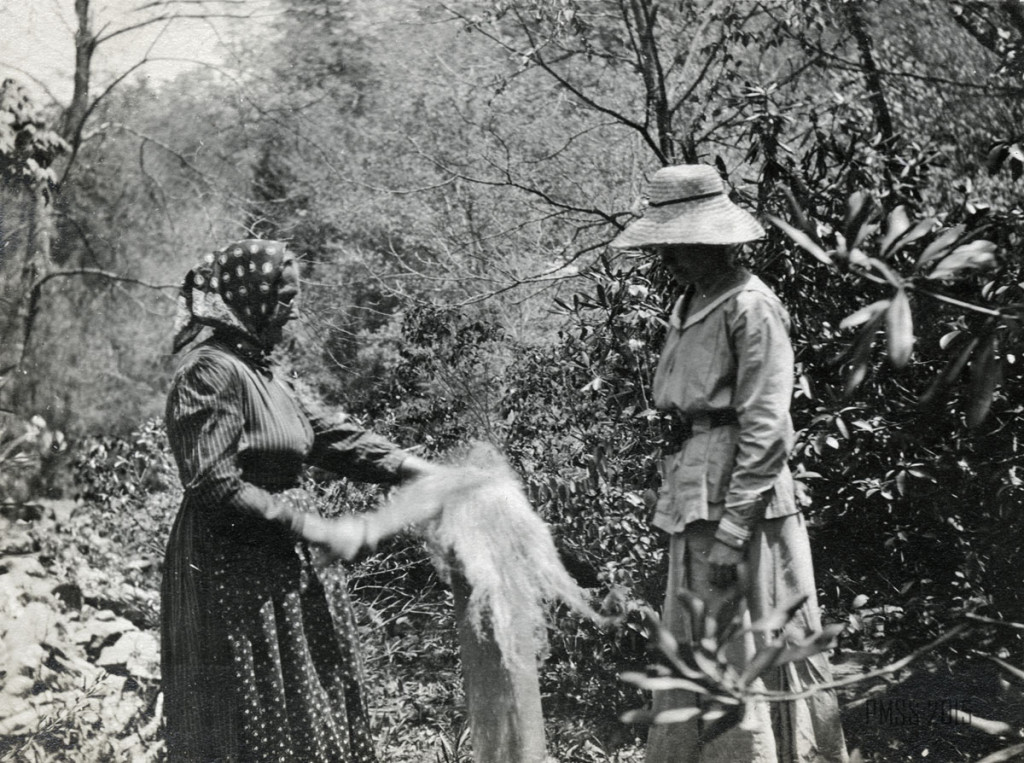
Beating flax using a wooden flax beater. Ethel de Long [?] X_099_workers_2527l_mod.jpg

Farming was the other foundational principle she integrated into the school’s core mission. Weaving and farming go together well, and well they served Pine Mountain for many years.  Pettit’s interest and promotion of weaving pre-dates the important work of Eliza Calvert Hall and her 1912, A Book of Hand-Woven Coverlets.  There is no doubt, however, that Pettit was strongly influenced and informed by Hall’s book, which she owned. She was also influenced by the work of the Swedish weaver Anna Ernberg, who had assumed the position of superintendent of the Fireside Industries at Berea College, Kentucky, in 1911.

It appears, however, that she was embedded in the idea of weaving and settlement-work much earlier and had many early connections with women associated with the Kentucky Women’s Clubs and their Arts and Crafts Movement interests.  The Settlement Movement in Kentucky followed the establishment of the rural founding of The Log Cabin Settlement in North Carolina, but there appears to be little direct influence drawn from the North Carolina Settlements. Chicago’s well-known Hull House and the work of Jane Addams, however, appear to be strong influences on Pettit’s intense early efforts to bring the Settlement House movement to rural Appalachia.

Pettit’s strong and early personal interests in weaving and her broad connection with craft-lovers in the urban Settlement House craft movement and the earlier Arts and Crafts Movement encouraged Pettit. She also found encouragement and support from the progressive women in the Kentucky Women’s Club. Many factors were at play in her lifelong love of weaving, and were all among the many factors that shaped Pettit’s energetic and influential work to highlight weaving in rural Eastern Kentucky. The North Carolina Settlement locations engaged in weaving are indebted to North Carolina’s long craft history, fed by the European migrants whose history was linked to the textile trades in Ireland and in the Borderland of England. In the mountains, the textile skills persisted and provided a growing market for weavings in the bustling Asheville Arts and Crafts scene.

The years Pettit spent with Hindman Settlement School building relationships with the surrounding Arts and Crafts community and the wide variety of weaving she encountered in her early rambling in the mountains of Eastern Kentucky, continually fed her interests in “kivers” and coverlets. It was Pettit who founded the weaving interests at Pine Mountain, but it was women of like mind who kept those interests alive through the years.  As part of Fireside Industries, the weaving interests of Pine Mountain were sustained through most of its early history.

VI_36_1184c_mod

Pettit made the Pine Mountain valley and the Settlement School her home, and along with Ethel de Long, whom she had recruited away from Hindman Settlement School, she began to grow her ideas for the second of her schools in the region.  Pine Mountain soon became one of the most unique and viable of the Southern Appalachian rural settlement schools. In that school, the sound of the spinning wheel and, even more, the batten of the loom, weaving away, has rarely ceased its tempo.

Vl_35_1127a

At Pine Mountain, Pettit and her staff did not live in isolation but challenged the people of the region to look beyond the walls of the mountains surrounding their valley, to the flood of ideas, economies, and beliefs that would prepare the people of the region for the inevitable changes coming to the mountains.  Following the turn of the century, industrialization was moving ever closer to the Pine Mountain Valley, and Pettit recognized the need to develop a marketing strategy for the mountain crafts to bring money into the area.  Weaving was part of her plan at “raising up” the mountain people, and she set about finding looms, building looms, and establishing weaving as part of the school program.

0050b P. Roettinger Album. “Swinging flax. Aunt Sal and Lizzie [Elisabeth Roettinger on right.]” [roe_017a.jpg]

Founded in 1913, Pine Mountain is now celebrating its 100th year of existence.  Katherine Pettit retired from the School in 1936, but the school archive contains numerous directives, letters, invectives, and suggestions that show her connected to the School until she died in 1938. The models of education, farming, health care, and civic responsibility that Pettit and others at the school provided the people of this long valley, to Eastern Kentucky and to the state, promised a rich future while preserving the best of the earlier cultural legacy. Weaving at Pine Mountain has had a continuous association with the school since its founding, and today it continues to inspire ideas and pride in its weavers.

The beautiful homespun coverlets discovered by Pettit on her mountain rambles became a visual passion for Pettit and for others who saw them.  It is impossible not to have a deep appreciation for the skill and artistry of the craft of weaving and for the women and men who wove the exquisite and complicated patterns found in Pettit’s collection of coverlets. The mountain coverlet in all its complexity and subtle colors has a deep and extended history in the lives of mountain families, with a weft that stretches back to Ireland and to Scotland, to France and to England.   The coverlet is a visual testimony to the people’s deep intelligence, creativity, and manual skills. Often described as “asleep”, “apart”, “lazy”, “dull”, or worse, the early mountain weavers produced some of the most elegant, complex, and extensive repertoires of coverlets.  The Pine Mountain archive has long been the keeper of much of the history that documents the exquisite legacy of weaving in the Kentucky mountains.

From booklets that detail vegetable dying, such as the Katherine Pettit Dye Book, to implements that can convey the tactile activity of the weaver’s art, to correspondence related to the marketing of mountain craft by novel cooperatives such as Fireside Industries, to the intimate stories of times spent in homes where weaving was done,  — the archives at the School are rich in weaving lore.

Shortly before Katherine Pettit died, she left some of her weaving collections to Pine Mountain Settlement School, but donated the bulk of her collection in May of 1936 to the Bradford Club of Lexington, Kentucky.  Eventually, this large collection found its way into the holdings of Transylvania College by way of the historic home owned by the college, the Bodley-Bullock House, and under the care of the Junior League.

The Bullock’s were Pettit’s family. The home was obviously an active intellectual scene, filled with books and art, enjoyed by the patriarch, Waller O. Bullock, his wife, and children. Bullock, a physician and a sculptor, knew well the education of joining head and hand and heart, and no doubt passed that along to his children, one of whom was Clara, the mother of Katherine Pettit.  The home, located adjacent to one of Lexington’s most impressive parks, Gratz Park,  is surrounded by the homes of Lexington’s creative and intellectual elite, such as Henry Clay, the early entrepreneur William Gratz,  John Wesley Hunt, the first millionaire west of the Alleghenies,  and others.

Many of Pettit’s coverlets and textile fragments in both the Pine Mountain collection and the Bodley-Bullock collection have, histories that go back some 200 years.  Some have stories, and others have their provenance waiting to be discovered by researchers.  But, all have a visual presence that cannot be denied and names that suggest ties with life in the family, region, and country as well as hints of ancient balladry and dance in the British Isles.

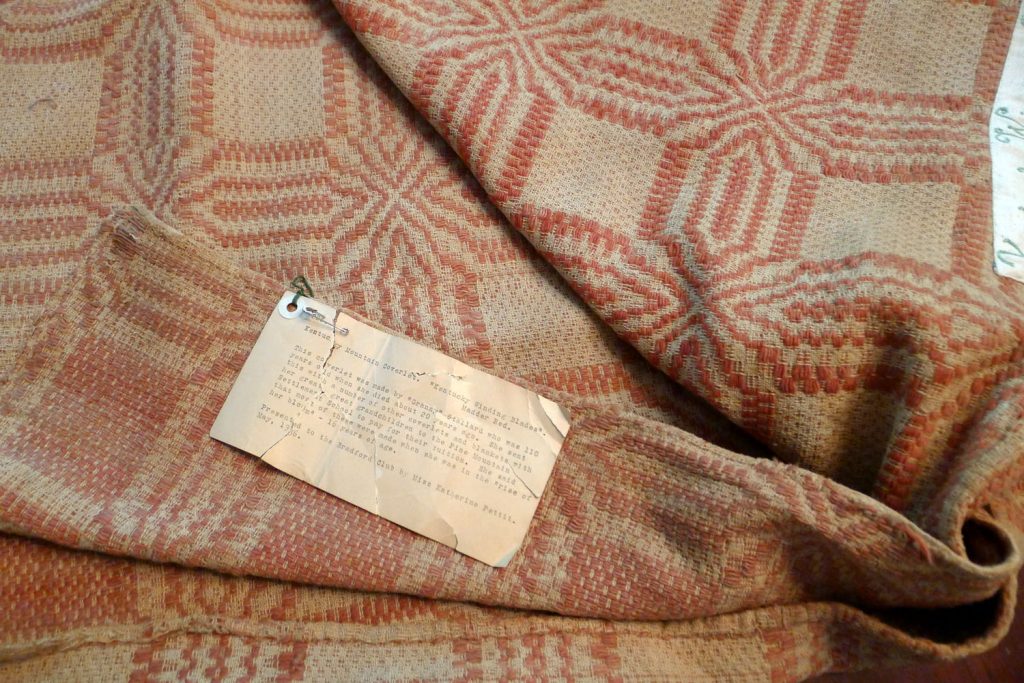
For example a beautiful peach and vanilla coverlet with a pattern called “Kentucky Winding Blades” in the Lexington collection, has the following attached note and hints at the healthful exercise of weaving:

“This coverlet was made by Granny Stallard who was 110 years old when she died about 20 years ago [note:1936].  She sent this with a number of other coverlets and blankets with her great, great grandchildren to the Pine Mountain Settlement School to pay for their tuition.  She said that most of these were made when she was in the “rise of her bloom” — sixteen years old.”

Another textile, unnamed, a very worn and modified blanket/shawl, has a badly damaged note that reads:

“This shawl was willed to … Uncle Enoch Combs, when he was a young man, not quite 20. [When he was] starting [for war] his sweetheart Nancy St … him and gave him this shawl [to ….] him.  She told him to f… [when the] war was over.  This he [did ?] … Uncle Enoch wore the shawl [until he was] an old man with long white [hair].”

Even this fragmented note tells of a very precious warp that is woven with the weft of memories, love, and loss and return and loss, again.  So many of the weavings of Appalachia have these stories. They speak to what Eliza Calvert Hall calls the “Time Spirit” in her important 1912 book, The Book of Handwoven Coverlets. [1]  The “time spirit” is found in that object that cannot be handled without recalling the life of the past. Many of the names of the coverlets speak to the past times.  Stories, such as “Young Lady’s Perplexiuty,” [sic] “Lonley Heart,” “Youth and Beauty,” “Catch Me If You Can,” and “Lasting Beauty.”   “… the rise of her bloom”  is a mountain colloquial reference to the early adolescence of girls.  It was often in early years that girls began to learn to weave and to assemble their house-hold textiles for later marriage and their own homes.  It can quickly be deduced that coverlets were often seen as the dowry of young girls.  Certainly, they were the offerings that she carried into her marriage in her “Hope Chest”.

Eliza Calvert Hall has pointed out that the naming of coverlet patterns is a very imprecise practice. She says, ” … a design may have one name in North Carolina another in Kentucky, another in Tennessee, and still another in Virginia as if it were a criminal fleeing from justice.”

Enoch Combs [the same as mentioned earlier] and his wife Mary were a childless couple who lived at Sassafras, near Hindman.  They were the hosts for a group of young women who came to the third and final summer camp in Knott county prior to the establishment of Hindman Settlement by Pettit and Stone.  Katherine Pettit, of Lexington; Mary E. McCartney, of Louisville;  May Stone, of Louisville;  and Rae M. McNab, also of Louisville, traveled into what had become familiar, but still, very rugged mountains of eastern Kentucky.   Their summer school at Sassafrass in 1901 was the last of a series of summer camps that were established to serve the literacy-poor hollows in Knott County. The success of these summer camps and the enthusiasm of Pettit and Stone led them to the foundation of a permanent school at Hindman in the following year.

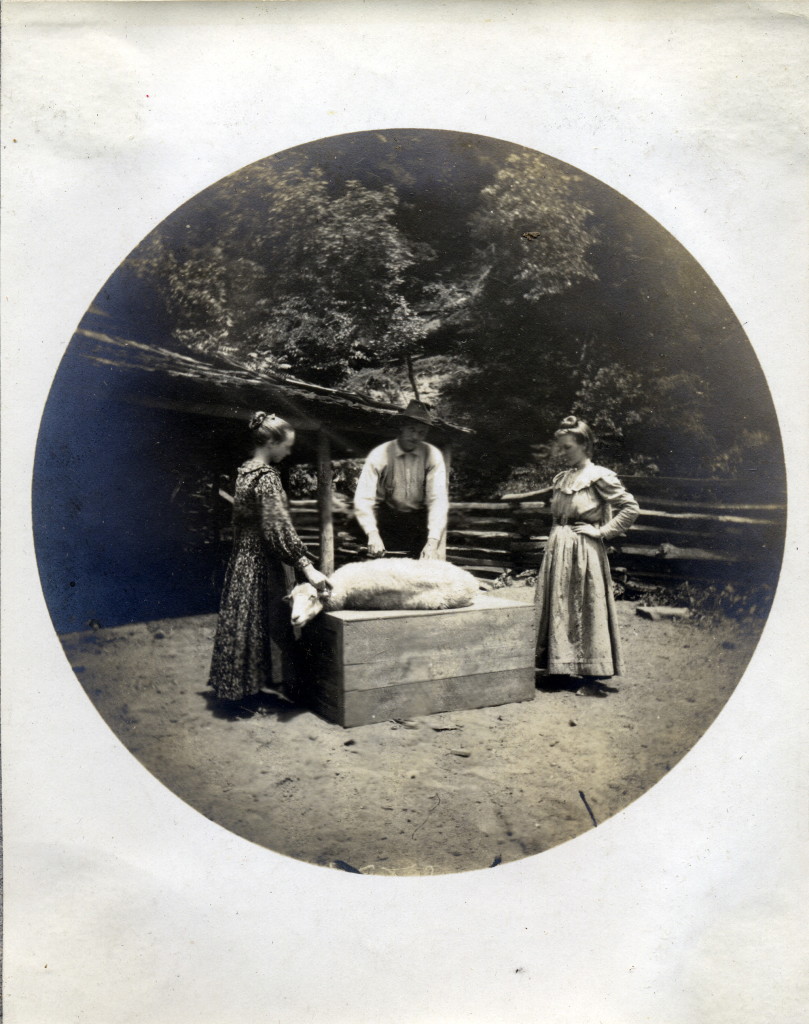
The life of the Combs family and their weaving skills were captured in a small album of photographs belonging to Katherine Pettit, which she titled “Sassafrass 1901.”   In the small and fragile album, held in the Pine Mountain archive, members of the family and a young lady who was living with the Combs are shown shearing their sheep, washing the wool, drying the wool, picking and carding, dying the “hanks”,  and finally spinning the wool to be placed on spindles.  The images freeze this valuable pioneer process in time and allow the viewer to understand the many complex tasks associated with the manufacture of textiles in the Appalachians.

FLAX

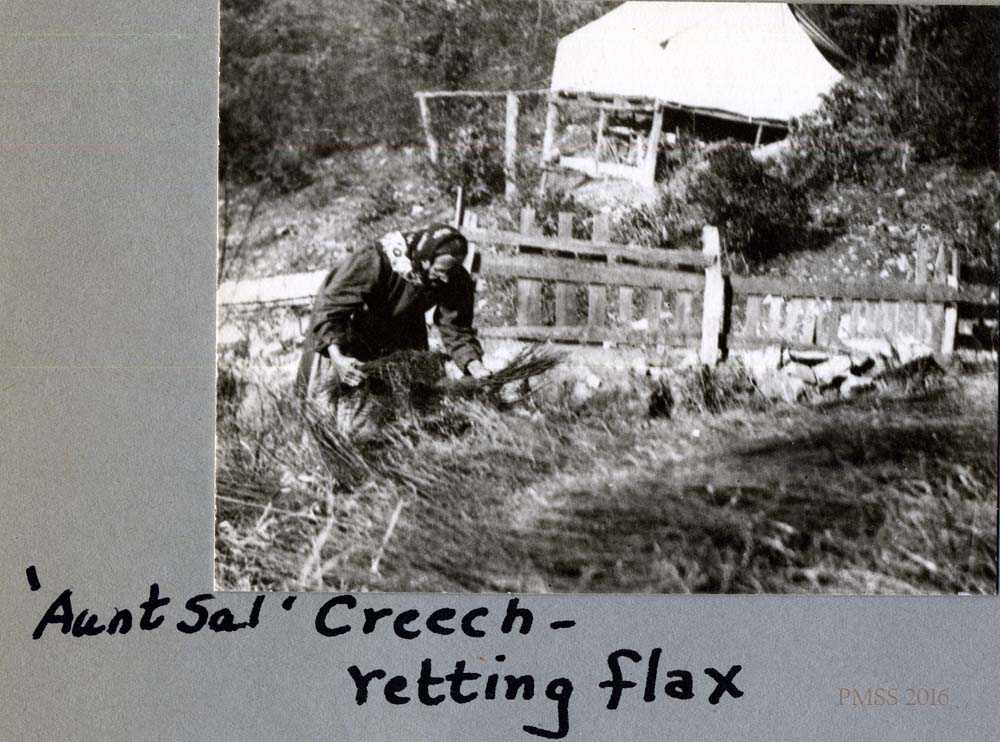
The processing of wool is just one of the complex tasks involved with Appalachian textiles.  There is another even more arduous series of processes associated with the flax plant. When Katherine Pettit came to Pine Mountain, she met “Aunt” Sally Dixon Creech. In Aunt Sal she had one of the finest weavers and spinners as an accomplice in her search for “kivers.”  But she also had a consummate teacher.  Aunt Sal was the wife of William Creech, the farmer whose vision of a school caught the imagination of Pettit and whose land formed the basis of the physical site for the Pine Mountain Settlement School. Uncle William grew flax and harvested it to process linen thread.  Katherine Pettit provided him with the seeds.

“‘Aunt Sal Creech – retting flax.” [nace_II_album_059.jpg]

The elaborate process of turning flax into thread was a process learned by many of the Appalachian families whose origins reached back to an Ulster-Scot ancestry. Many of the people of the Southern Appalachians had this ancestry. Ulster, in Ireland, was a center of linen production in Europe, and many of the immigrants brought their knowledge of flax farming and linen creation to the New World. It continued as a viable occupation for the many Scots-Irish-English-French-Cherokee-German and African American families who lived deep in the Appalachian mountains.

At Pine Mountain, farmers who maintained subsistence farms in the small valley and hollows and on the steep slopes near the School sometimes found ways to extend their incomes by engaging in flax farming.  Flax was one of the crops that could be turned into income.  But by the turn of the twentieth century, few of these resourceful farmers remained. Pine Mountain was fortunate that some of these flax farmers had passed down their knowledge in the family, and there were families that were still growing and weaving with flax.

373 [Uncle William Creech with children from Pine Mountain School retting flax.]

When Pettit arrived in the valley, she met families with names like Creech, Boggs, Turner, Couch, Combs, Coots, Day, Hall, and more, suggesting that the population was heavily indebted to England in its origins. A study of family names could shed light on possible English, Irish, or Scottish origins of textile practice, but unlike tracing ballads or dances or pageants, the trail for textile arts is not well developed. English families migrated to all areas of the British Isles, but it is well-known that many Scots migrated to Ulster, where they took up the practice of flax farming and production.  However, the practice arrived in the Appalachians, the production of linen thread, an enormously labor-intensive and complex process, was passed along to Uncle William and Aunt Sal.  They knew the processes, but the depth of their knowledge is difficult to determine.  Just how their processes compare to European practice invites further study.

Certainly, Uncle William saw an opportunity to pursue his farming interests and to combine this with the practice of weaving, an art his wife Sally knew well.  Labor in the nearby school was available to him, but he also had a sincere desire to improve the production of farmland, to educate, generally, and he, like Aunt Sal, was a consummate teacher.  It is also clear that he shared these interests in flax farming with Katherine Pettit.

The raising of flax and its processing for the weaving of linen cloth is another long weaving story. It is evident, however, that farming, weaving, and education all make good partners. Whether wool, flax, or cotton, “Summer Weave”, “Snail’s Trail,” or “Virgil” or “Longfellow”, the threads come together.  The partnership of farming and weaving can indeed be found repeated throughout the world, but the patterns derived from those partnerships are as diverse as the cultures that created them. Pine Mountain’s contributions to a weaving history are many, and the contributions of Appalachia have their roots firmly planted in the long histories of the earliest families brought to the region, whether European, African, American Indian, or South American, or other cultures. There is strong evidence of cultural mixing in both practice and patterns, and the research field waits for those who want a rich research project.

____________________________________

WEAVING
KATHERINE PETTIT Weaving at PMSS Beginnings
WEAVING at Pine Mountain Settlement and Fireside Industries Guide
WEAVING Samples at Pine Mountain Settlement School I
ARTS AND CRAFTS WEAVING Samples at PMSS II (Blue Tub)
OBJECT COLLECTIONS Weaving Draper Loom Studio
FARM and FARMING Sheep, Goats, Weaving, Natural Dyes
DANCING IN THE CABBAGE PATCH Weaving at PMSS 1930s-1940s
WEAVING About the Red Woven Coverlet and Alice Cobb

See also

CRAFT WORKSHOPS AT PINE MOUNTAIN SETTLEMENT SCHOOL

For a schedule of events at the school , see:

http://www.pinemountainsettlementschool.com/events.php