
CONCEIVED AMONG THE COVERLETS
KATHERINE PETTIT and WEAVING AT PINE MOUNTAIN SETTLEMENT
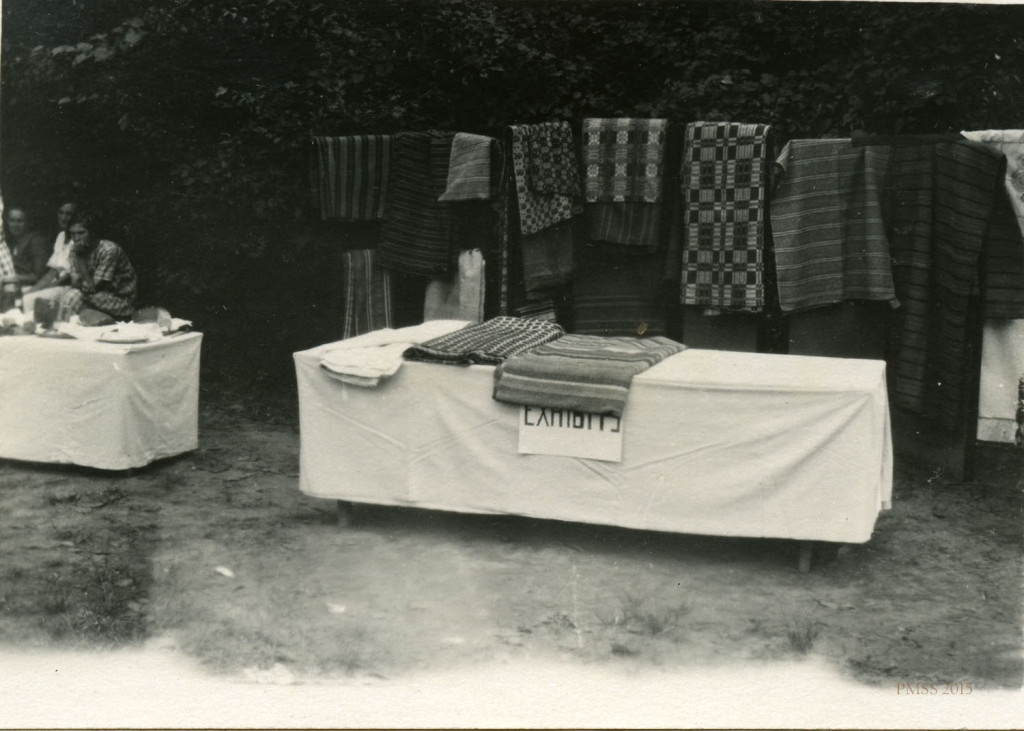
Exhibit of weaving and woven craft. 1920’s [?] [norton_021.jpg]
One might say that Pine Mountain was conceived among the coverlets gathered around Katherine Pettit’s deep interest in weaving and collected by Pettit, the primary founder of Pine Mountain Settlement School and the co-founder of Hindman Settlement School. Encounters with weaving in and around the two Schools was a factor that both enchanted Pettit and distressed her. When she first ventured into the far Eastern corners of Kentucky she had encountered homes where weaving was still underway but was distressed that the quality of the weaving was deteriorating with younger generations.
When she began to consider a second Settlement School in Harlan County near the Hindman Settlement School, she already had shown a deep interest in collecting weaving patterns. Under Pettit’s direction, the new Pine Mountain Settlement School was encouraged to “rediscover” the elegance and the beauty of the craft of weaving. Her enthusiastic collecting of mountain weavings near the turn of the last century had provided her with examples of what good weavings could look like and teach weavers the elements of good design and good practice.
Katherine Pettit, Director and founder of Pine Mountain Settlement School and earlier of Hindman Settlement School, was an avid collector of “kivers.” Her interest in the exquisite craft of coverlet weaving had kept her roaming the mountains in the early years of the twentieth century in search of new patterns and techniques. It was the search for beautiful mountain “kivers” that led Pettit to integrate weaving into the earliest education at the new Harlan County site. There, in the long valley on the north side of the Pine Mountain, she plotted to establish one of the most unique Appalachian settlement schools and to reform the downward spiral of textile craft modlled on the craft seen in some of the most remarkable early weavings in Kentucky in her weaving collection.
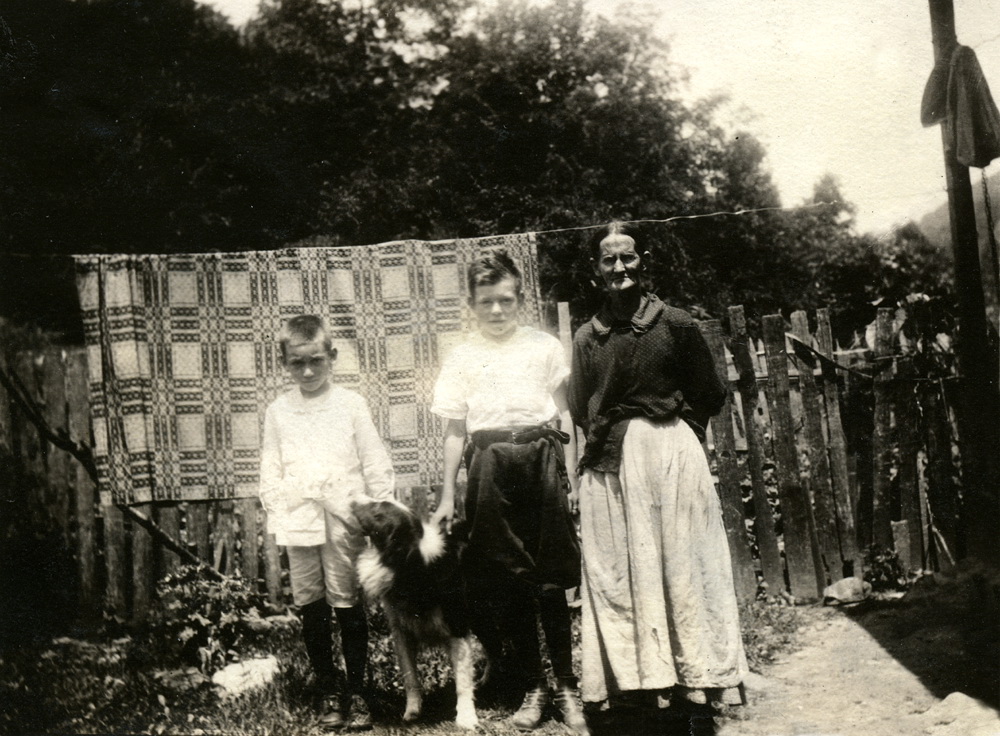
Neighbors in the Pine Mountain Valley with a coverlet hanging behind the mother, two children, and a dog. c. 1920s.
Pettit often traveled into the far eastern communities from Hindman in Knott County, Kentucky where she had established her first school in the early years of the twentieth century. Even before the founding of Hindman, in 1901, Pettit was into her third summer season in the eastern Kentucky mountains. At a location known as “Sassafrass” and later at Hindman, she and her adventuresome colleagues had already journeyed to many of the remote valleys and hollows of nearby Harlan, Perry, and Letcher counties, where she frequently came into contact and conversation with mountain weavers. Even in these very early years she began to search for coverlets to purchase, and also found her interest in the craft gave her a sound introduction to the historic origins many mountain families. While looking for homespun coverlets, she soon discovered more than the coverlets. She discovered the weavers and their humble but rich heritage and skills, their ancient culture, and their stoic resourcefulness. Theirs was a lifestyle that she would soon come to cherish, partially adopt, and commit to “raising up.” She saw weaving as part of that sought-after discipline that would lead to education.
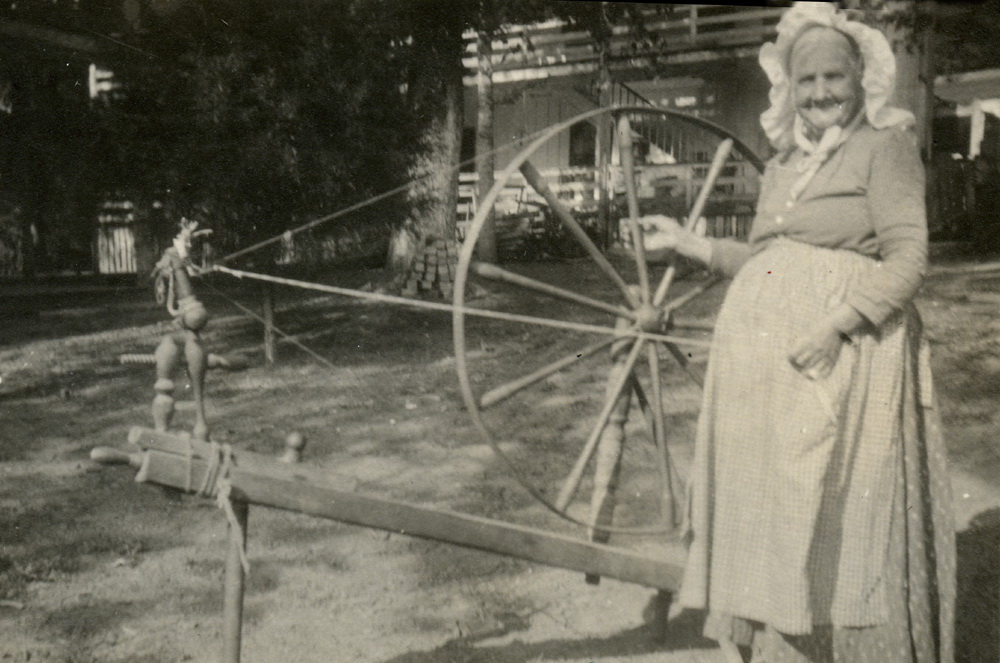
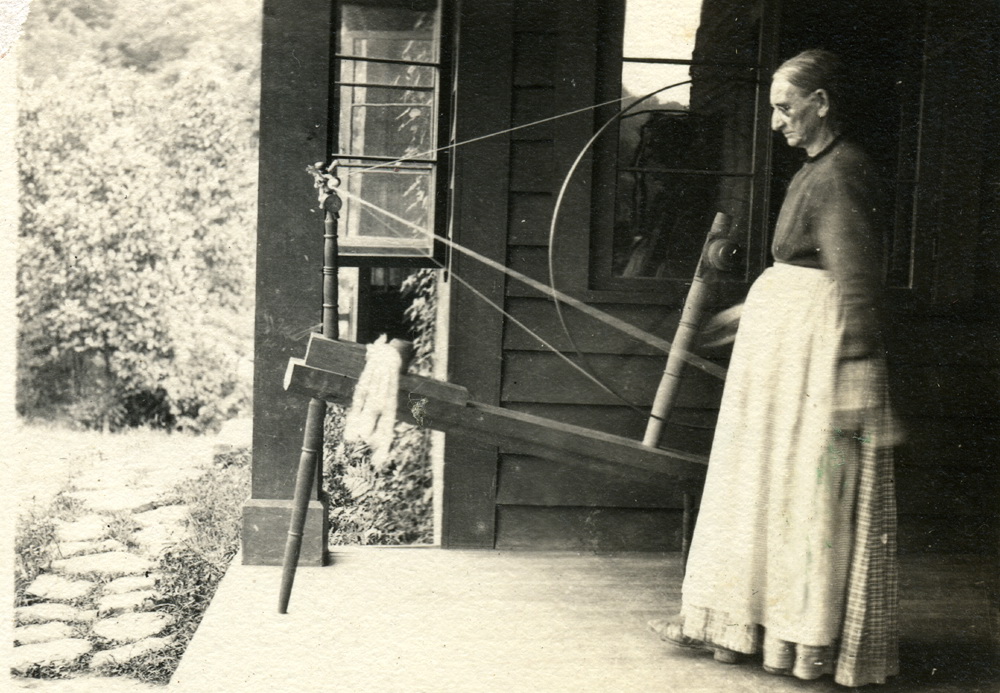
A Pine Mountain neighbor with her spinning wheel. c. 1915.
In Harlan County, Katherine Pettit found the distance from the rapidly industrializing world she held at a distance and she expanded her Hindman experiences that had proved educational. She rapidly reached out to her many contacts. She established a rustic home, and began to build a school dedicated to serving the people of the remote Pine Mountain valley and the nearby hollows. She did not, however, become a recluse wrapped in her coveted coverlets.
ARRIVAL AT PINE MOUNTAIN
When she came to Pine Mountain in 1913, and with the help of William Creech and the families living in the valley, Pettit established a school founded on the principles of the more urban settlement houses found in Chicago, New York, Boston, and other locations. She recruited educators and workers from those early urban settlement schools and women’s colleges and sowed the seeds of a progressive educational program but clung fast to the early skills and beauty of hand-crafted work. What she created was a settlement school that adopted a unique response to the urban settlement house ethos but a sensitive arts and crafts conscience.
While weaving in the urban settlements often depended on teaching weaving that was modeled on practices found in the Arts and Crafts Movement and on Scandinavian models, Pettit’s models were already established in the mountains of Kentucky and other areas of the Southern Appalachians. Weaving for Pettit and for the Pine Mountain community was an integral part of a response to the legacy of many families and the grinding demands of a rural environment that was still in a pioneering and subsistence mode.
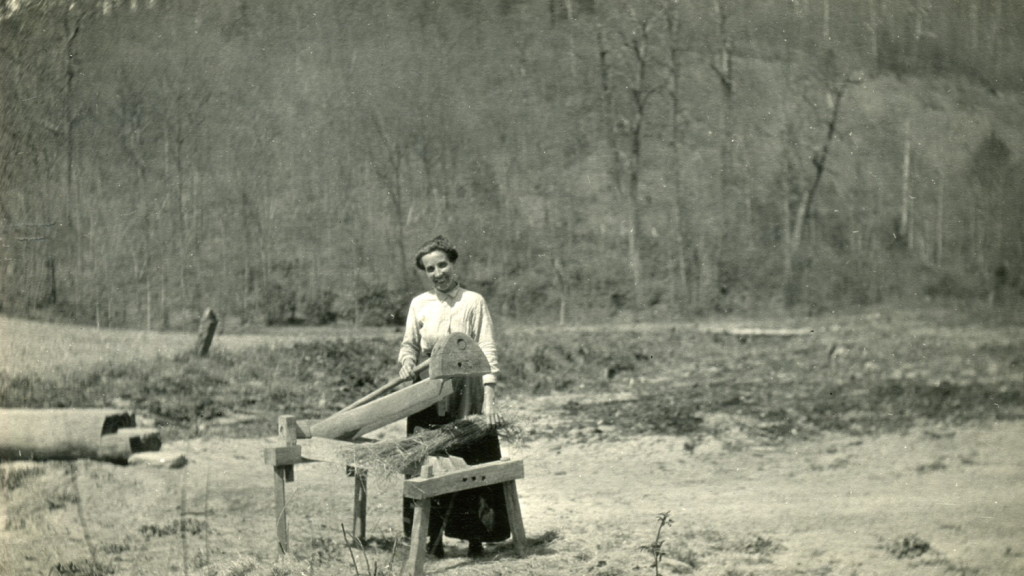
Beating flax using a wooden flax beater. Ethel de Long [?] X_099_workers_2527l_mod.jpg
Pettit was embedded in the idea that weaving and settlement-work go together. Much earlier through her many early connections with women associated with the Kentucky Women’s Clubs and their Arts and Crafts Movement interests, the Settlement Movement in Kentucky followed the establishment of the rural founding seen in the Log Cabin Settlement in North Carolina, but there appears to be little direct influence drawn from the North Carolina Settlement models that had an equally strong rural base. Instead, she shows signs of the influence of Chicago’s well-known and very pragmatic Hull House and the work of Jane Addams. It was a , however, the remnants of the European migrant weavers that shaped many of the households in Appalachia. These appear to be the strong influences on Pettit’s intense early efforts to bring the Settlement House movement to rural Appalachia. It also brought her closer to her own family origins.
EARLY INFLUENCERS
The first United States Census, taken in 1790, revealed that the population in the new United States was less than 200,000 in the Southern Appalachians and most of those folk were in Virginia. History tells us that by 1800 the population took a leap to around 118,000 persons. From there the population shows a continuing upward spiral every decade of around 160,000 and this continued for the next half-century. [Appalachian Images in Folk and Popular Culture, 2nd ed., W.K. McNeil, editor]. Also, the popular belief that this large population was a Scotch-Irish/Anglo-Saxon population, has been contested numerous times. The Southern Appalachians is comprised of a mixture of nationalities and indigenous Native American Indians. In some minds it was better to described the population as an assembly of “peculiar people.”
Pettit’s strong and early personal interests in weaving and her broad connection with craft-lovers in the urban Settlement House craft movement and the earlier Arts and Crafts Movement were prescient. In fact the first organized meeting to bring weaving and other Appalachian crafts into the consciousness of the country did not occur until much later. For example, the first gathering to discuss the possibility of a cooperative association for weavers did not occur until around 1928 when Penland, a newly formed craft school in North Carolina, held a meeting to try to form a cooperative association for weavers.
Pettit, however, found encouragement and support from her association with the progressive women in the Kentucky Women’s Club. Many factors were at play in her lifelong love of weaving, and not all the influences are clear. What Pettit realized early-on was that creating a large and diverse network was one of the most effective methods for building out an idea. Beginnings are often hard to isolate and there were many factors that shaped Pettit’s energetic and influential work to highlight weaving and restore weaving in rural Eastern Kentucky. The North Carolina Settlement locations engaged in weaving were also very early and they used similar tactics to expand their weaver networks. What may be found in North Carolina’s long craft history, is also fed by the European migrants whose history is similar to that found in the Kentucky mountains and reflected in the early migrations West. Many of the same populations are shared throughout the region.
Pine Mountain Settlement is just across the Big Black Mountain and the Pine Mountain, both mountains parallel the Wilderness Road that led to the settlement of much of the land on Appalachia and west to contemporary Arkansas and Missouri. Families linked to the textile trades in Ireland and in the Borderland of England, the skills of these migrating early pioneers carried many weaving talents. In the mountains, the textile skills persisted longer and provided a growing source and interest in weaving and textiles for the growing commercial markets. The later resurgence of weaving in the expanding settlement areas appears to be part nostalgia as well as a growing middle class that could afford to purchase the cloth.
ARTS AND CRAFTS MOVEMENTS
The years Pettit spent with Hindman Settlement School building relationships with the surrounding community and the wide variety of weaving she encountered in her early rambling in the mountains of Eastern Kentucky, and her deep interest in the early Arts and Crafts movement, continually fed her interests in “kivers” and coverlets. It was Pettit who founded the weaving interests at Pine Mountain, but it was women of like mind who kept those interests alive through the years. As a cooperative partner with the early Fireside Industries, and promoted by Berea and other craft centers, the weaving interests of Pine Mountain were sustained and grew.
PETTIT AND HER PINE MOUNTAIN ARTISANS
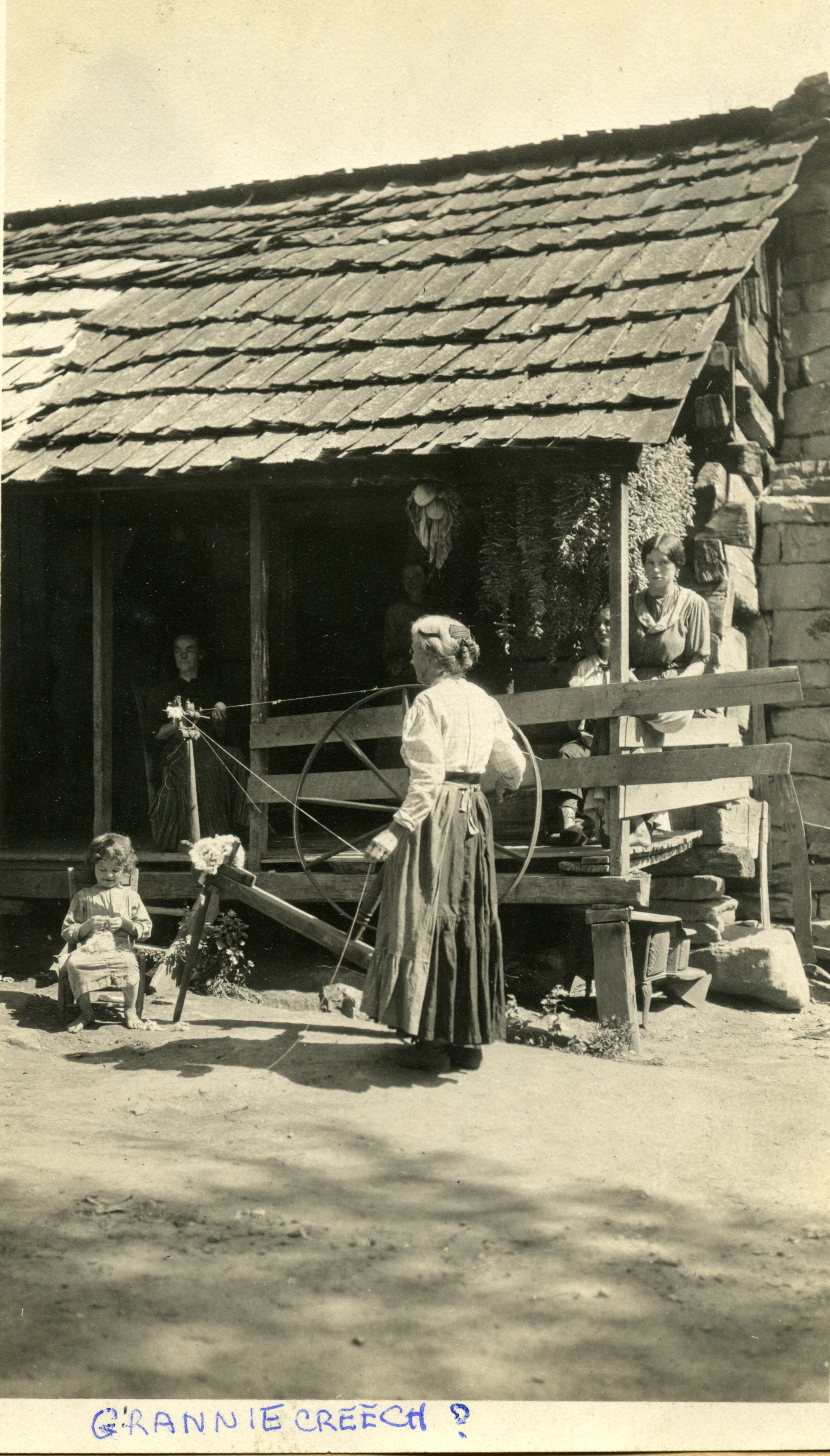
Pettit made the Pine Mountain valley and the Settlement School her home, and along with Ethel de Long, whom she had recruited away from Hindman Settlement School, she began to grow her ideas for the second of her schools in the region. Pine Mountain soon became one of the most unique and viable of the Southern Appalachian rural settlement schools. In that school, the sound of the spinning wheel and, even more, the batten of the loom, weaving away, has rarely ceased its tempo.
At Pine Mountain, Pettit and her staff did not live in isolation but challenged the people of the region to look beyond the walls of the mountains surrounding their valley, to the flood of ideas, economies, and beliefs that would prepare the people of the region for the inevitable changes coming to the mountains and to their way of life. Following the turn of the century, industrialization and the hunger for wealth found in the developing coal fields, was moving ever closer to the Pine Mountain Valley, and Pettit recognized the need to develop a marketing strategy for the mountain crafts to bring money into the area. Weaving was part of her plan of “raising up” the mountain people, and she set about finding looms, building looms, and establishing weaving as part of the earliest school program. Uncle William was a master flax farmer and Aunt Sal was a mistress of the flax beater and the spinning wheel.
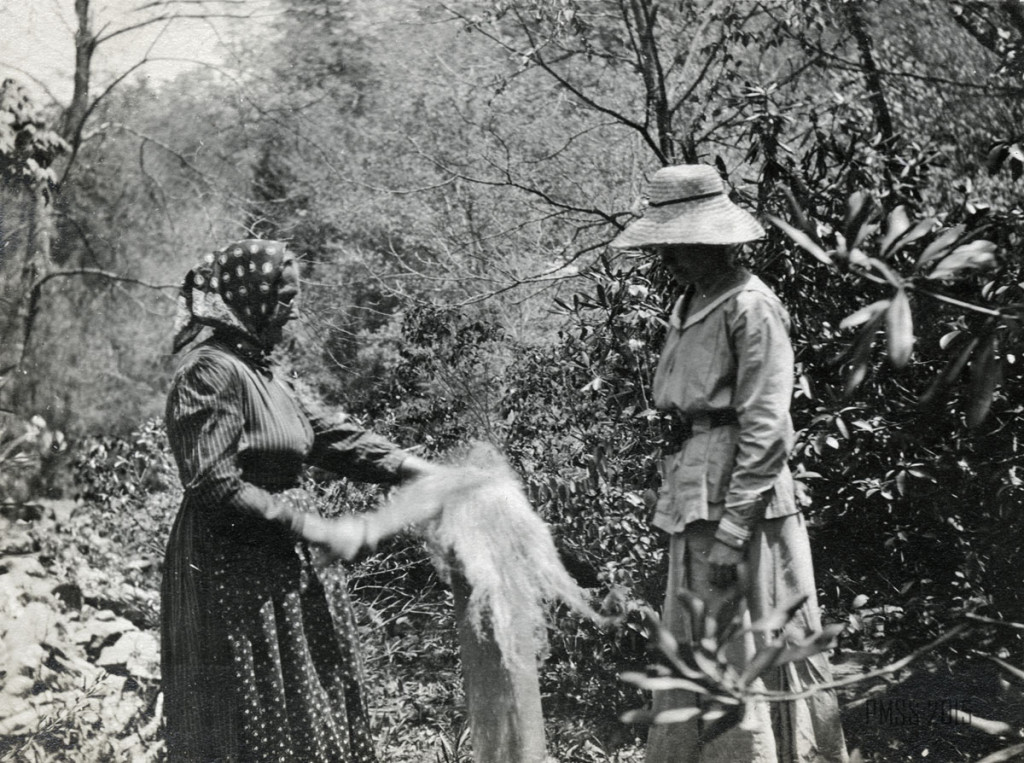
0050b P. Roettinger Album. “Swinging flax. Aunt Sal and Lizzie [Elisabeth Roettinger on right.]” [roe_017a.jpg]
THE ‘KIVERS’
The beautiful homespun coverlets, the ‘kivers’, discovered by Pettit on her mountain rambles became a visual passion for Pettit and for others who saw them. It is impossible not to have a deep visual and visceral appreciation for the skill and artistry of the craft of weaving and for the women and men who wove the exquisite and complicated patterns found in Pettit’s Collection of Weavings. The mountain coverlet in all its complexity and subtle colors has a deep and extended history in the lives of mountain families, with a weft that stretches back to Ireland and to Scotland, to France and to England. The coverlet is a visual testimony to the people’s deep intelligence, creativity, and manual skills. Often described as “asleep”, “apart”, “lazy”, “dull”, or worse, the early mountain weavers produced some of the most elegant, complex, and extensive repertoires of coverlets. The Pine Mountain archive has long been the keeper of much of the history that documents the exquisite legacy of weaving in the Kentucky mountains.
From booklets that detail vegetable dying, such as the Katherine Pettit Dye Book, to implements that can convey the tactile activity of the weaver’s art, to correspondence related to the marketing of mountain craft by novel cooperatives such as Fireside Industries, to the intimate stories of times spent in homes where weaving was done, — the archives at the School are rich in weaving lore.
-
- The Katherine Pettit Book of Vegetable Dyes. pettit_dye_book_001.jpg
-

- The Katherine Pettit Book of Vegetable Dyes. pettit_dye_book_003.jpg
-
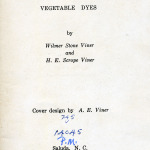
- The Katherine Pettit Book of Vegetable Dyes.pettit_dye_book_002.jpg
Shortly before Katherine Pettit died, she left some of her weaving collections to Pine Mountain Settlement School, but donated the bulk of her collection in May of 1936 to the Bradford Club of Lexington, Kentucky. Eventually, this large collection found its way into the holdings of Transylvania College by way of the historic home owned by the college, the Bodley-Bullock House, in Gratz Park, which is now under the care of the Junior League.
The Bullock’s were Pettit’s long-term family. The home was obviously an active intellectual scene, filled with books and art, that were enjoyed by the patriarch, Waller O. Bullock, his Pettit wife, and children. Bullock, a physician and a sculptor, knew well the education of joining head and hand and heart, and no doubt passed that along to his children, one of whom was Clara, the mother of Katherine Pettit. The home, located adjacent to one of Lexington’s most impressive parks, Gratz Park, is surrounded by the homes of Lexington’s creative and intellectual elite, such as Henry Clay, statesman and the early entrepreneur William Gratz, a well–known and wealthy hemp grower, and John Wesley Hunt, the first millionaire west of the Alleghenies, and others. The Bodley-Bullock House on the edge of Gratz Park was purchased by Dr. Bullock, Pettit’s sister’s husband who purchased the house in the 1920’s. Dr. Bullock was the founder of the Lexington Clinic, and bought the house from Bodley in the early 20th century.
NAMING THE COVERLETS
Many of Pettit’s coverlets and textile fragments in both the Pine Mountain collection and the Bodley-Bullock House collection have, histories that go back some 200 years. Some have stories, and others have their provenance waiting to be discovered by researchers. But, all have a visual presence that cannot be denied and names that suggest ties with life in the family, the region, and the country as well as hints of ancient balladry and dance in the British Isles.
For example a beautiful peach and vanilla coverlet with a pattern called “Kentucky Winding Blades” in the Lexington collection, has the following attached note and hints at the healthful exercise of weaving:
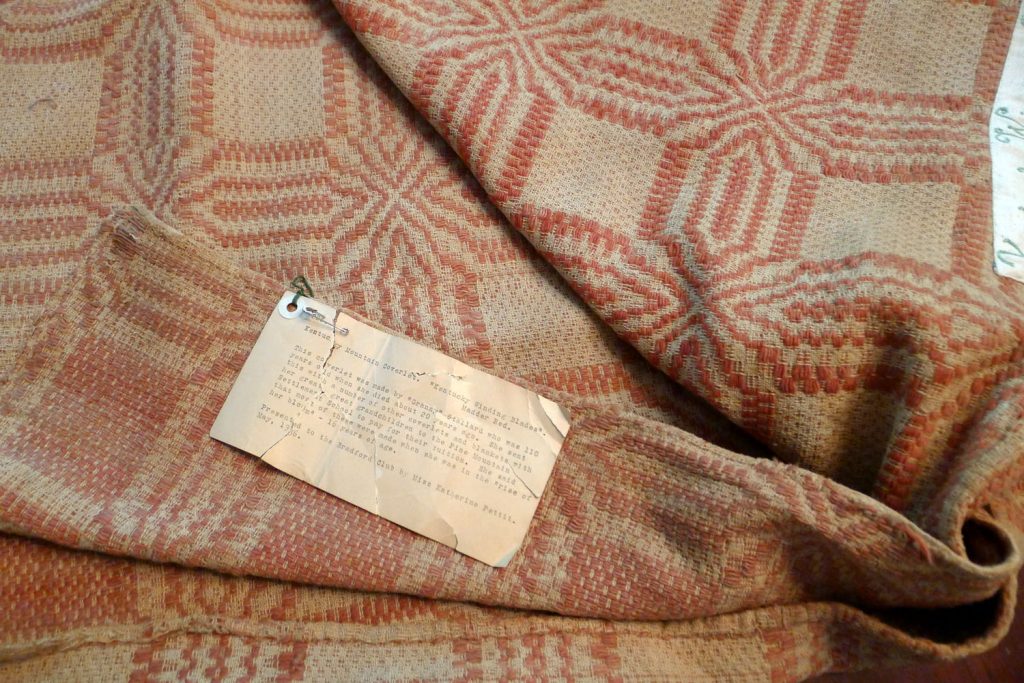
“This coverlet was made by Granny Stallard who was 110 years old when she died about 20 years ago [note:1936]. She sent this with a number of other coverlets and blankets with her great, great grandchildren to the Pine Mountain Settlement School to pay for their tuition. She said that most of these were made when she was in the “rise of her bloom” — sixteen years old.”
Another textile, unnamed, a very worn and a modified blanket/shawl, has a badly damaged note that reads:
“This shawl was willed to … Uncle Enoch Combs, when he was a young man, not quite 20. [When he was] starting [for war] his sweetheart Nancy St … him and gave him this shawl [to ….] him. She told him to f… [when the] war was over. This he [did ?] … Uncle Enoch wore the shawl [until he was] an old man with long white [hair].”
Even this fragmented note tells of a very precious warp that is woven with the weft of memories, love, and loss and return and loss, again. So many of the weavings of Appalachia have these stories. They speak to what Eliza Calvert Hall calls the “Time Spirit” in her important 1912 book, The Book of Handwoven Coverlets. [1] The “time spirit” is found in that object that cannot be handled without recalling the life of the past. Many of the names of the coverlets speak to the past times. Stories, such as “Young Lady’s Perplexiuty,” [sic] “Lonely Heart,” “Youth and Beauty,” “Catch Me If You Can,” and “Lasting Beauty.” “… the Rise of Her Bloom” is a mountain colloquial reference to the early adolescence of girls. It was often in early years that girls began to learn to weave and to assemble their house-hold textiles for later marriage and their own homes. It can quickly be deduced that coverlets were often seen as the dowry of young girls. Certainly, they were the offerings carried into marriage in a “Hope Chest”.
Eliza Calvert Hall has pointed out that the naming of coverlet patterns is a very imprecise practice. She says, ” … a design may have one name in North Carolina another in Kentucky, another in Tennessee, and still another in Virginia as if it were a criminal fleeing from justice.”
Enoch Combs [the same as mentioned earlier] and his wife Mary were a childless couple who lived at Sassafras, near Hindman. They were the hosts for the group of young women (incuding Pettit) who came to the third and final summer camp in Knott county prior to the establishment of Hindman Settlement by Pettit and Stone. Katherine Pettit, of Lexington; Mary E. McCartney, of Louisville; May Stone, of Louisville; and Rae M. McNab, also of Louisville, traveled into what had become familiar, but still, very rugged mountains of eastern Kentucky. Their summer school at Sassafras in 1901 was the last of a series of summer camps that were established to serve the literacy-poor hollows in Knott County. The success of these summer camps and the enthusiasm of Pettit and Stone led them to the foundation of a permanent school at Hindman in the following year (1902). [Note: Pettit spells Sassafras with two ss’s at end]
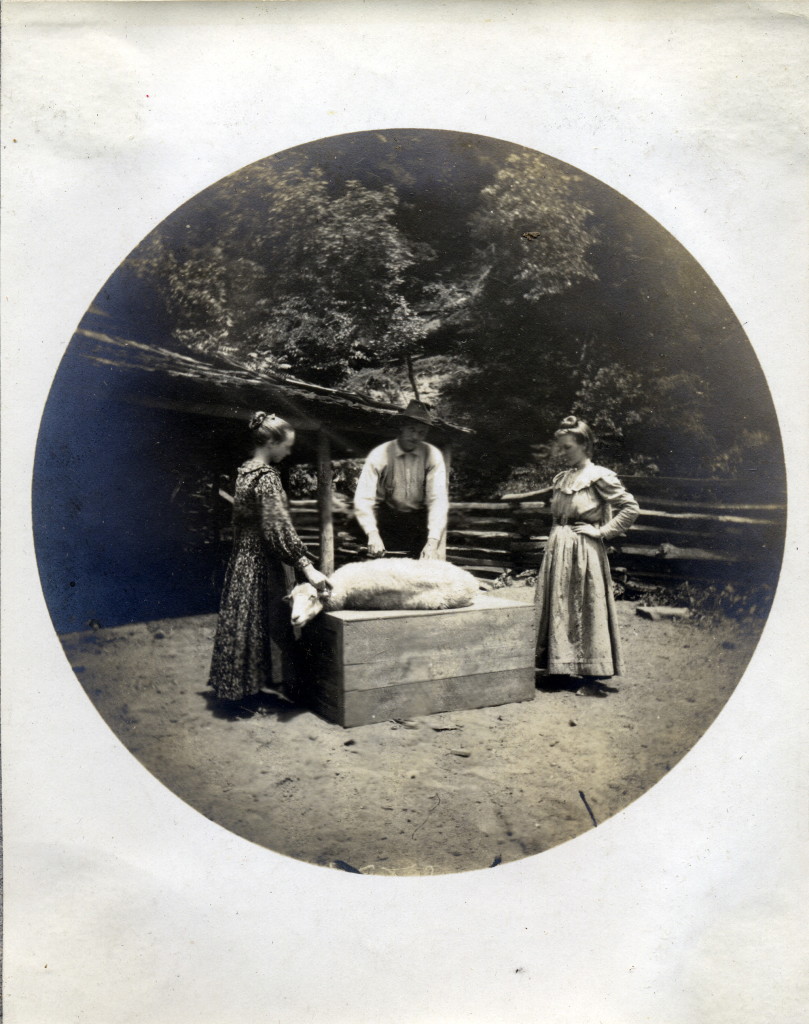
The life of the Combs family and their weaving skills were captured in a small album of photographs belonging to Katherine Pettit, which she titled “Sassafrass 1901.” In the small and fragile album, held in the Pine Mountain archive, members of the family and a young lady who was living with the Combs are shown shearing their sheep, washing the wool, drying the wool, picking and carding, dying the “hanks”, and finally spinning the wool to be placed on spindles. The images freeze this valuable pioneer process in time and allow the viewer to understand the many complex tasks associated with the manufacture of textiles in the Appalachians.
FLAX
The processing of wool is just one of the complex tasks involved with Appalachian textiles. There is another even more arduous series of processes associated with the flax plant. When Katherine Pettit came to Pine Mountain, she met “Aunt” Sally Dixon Creech. In Aunt Sal she had one of the finest weavers and spinners as an accomplice in her search for “kivers.” But she also had a consummate teacher. Aunt Sal was the wife of William Creech, the farmer whose vision of a school caught the imagination of Pettit and whose land formed the basis of the physical site for the Pine Mountain Settlement School. Uncle William grew flax and harvested it to process linen thread. Katherine Pettit provided him with the seeds.
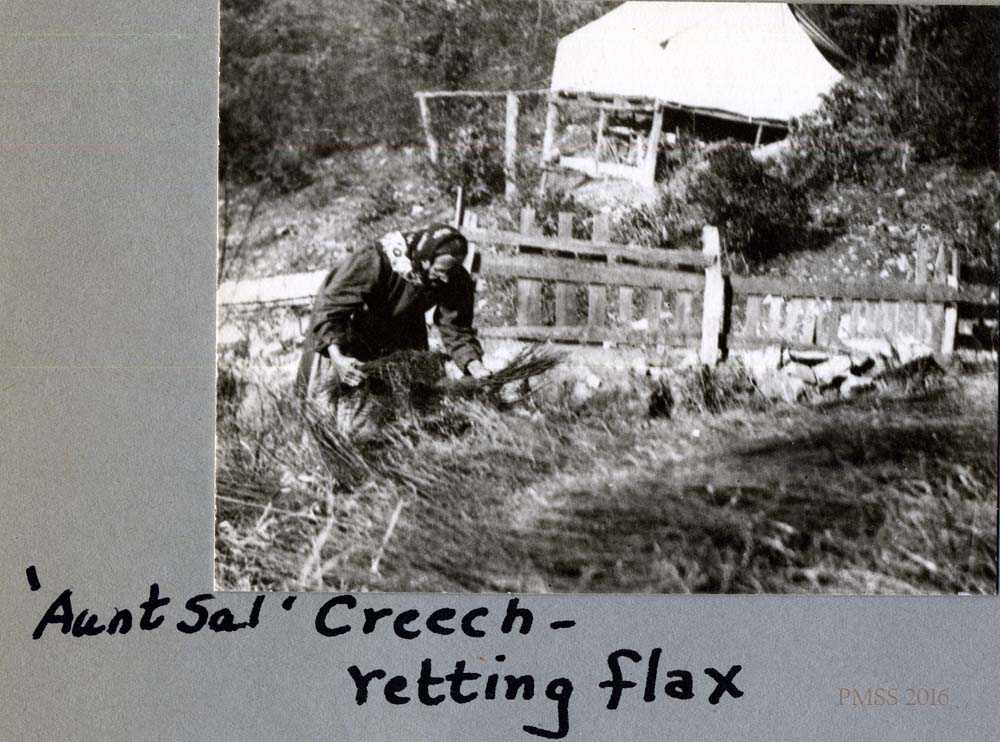
“‘Aunt Sal Creech – retting flax.” [nace_II_album_059.jpg]
At Pine Mountain, farmers who maintained subsistence farms in the small valley and hollows and on the steep slopes near the School sometimes found ways to extend their incomes by engaging in flax farming. Flax was one of the crops that could be turned into income. But by the turn of the twentieth century, few of these resourceful farmers remained. Pine Mountain was fortunate that some of these flax farmers had passed down their knowledge in the family, and there were families that were still growing and weaving with flax. The Creech family was one of the families who still grew flax and harvested it for weaving.
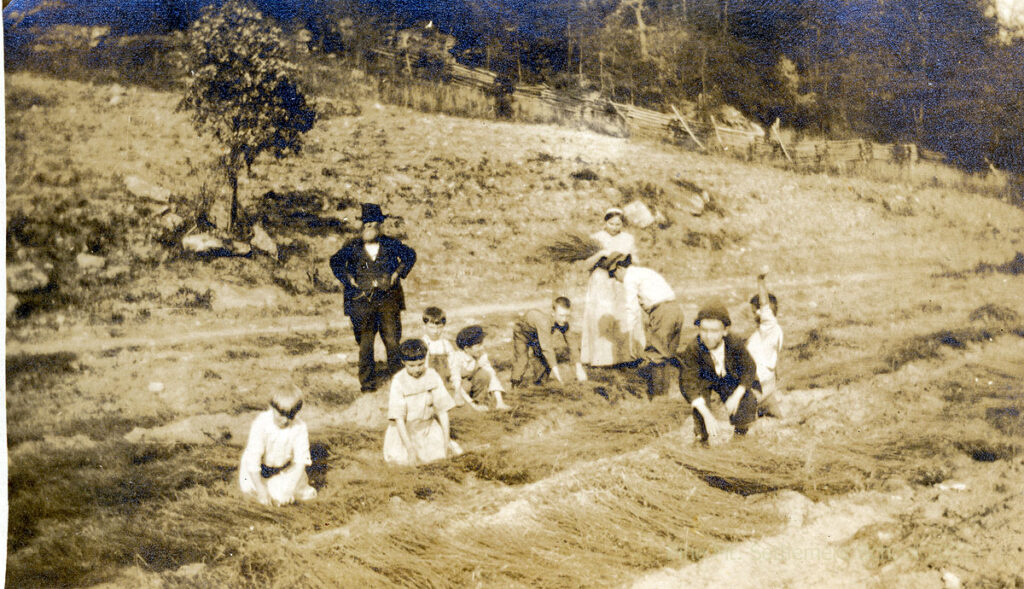
373 [Uncle William Creech with children from Pine Mountain School retting flax.]
When Pettit arrived in the Pine Mountain valley, she met families with names like Creech, Boggs, Turner, Couch, Coots, Day, Hall, and more, suggesting that the population was heavily indebted to England in its origins. A study of family names could shed light on possible English, Irish, or Scottish origins of textile practice, but unlike tracing ballads or dances or pageants, the trail for textile arts is not well developed. English families migrated to all areas of the British Isles, but it is well-known that many Scots migrated to Ulster, where they took up the practice of flax farming and production. However, the practice arrived in the Appalachians, the production of linen thread, an enormously labor-intensive and complex process, was passed along to Uncle William and Aunt Sal. They knew the processes, but the depth of their knowledge is difficult to determine. Just how their processes compare to European practice invites further study.
Certainly, Uncle William saw an opportunity to pursue his farming interests and to combine this with the practice of weaving, an art his wife Sally knew well. Labor in the nearby school was available to him, but he also had a sincere desire to improve the production of farmland, to educate, generally, and he, like Aunt Sal, was a consummate teacher. It is also clear that he shared these interests in flax farming with Katherine Pettit.
The raising of flax and its processing for the weaving of linen cloth is another long weaving story. It is evident, however, that farming, weaving, and education all make good partners. Whether wool, flax, or cotton, “Summer Weave”, “Snail’s Trail,” or “Virgil” or “Longfellow”, the threads come together. The partnership of farming and weaving can indeed be found repeated throughout the world, but the patterns derived from those partnerships are as diverse as the cultures that created them. Pine Mountain’s contributions to a weaving history are many, and the contributions of Appalachia have their roots firmly planted in the long histories of the earliest families brought to the region, whether European, African, American Indian, or South American, or other cultures. There is strong evidence of cultural mixing in both practice and patterns, and the research field waits for those who want a rich research project.
____________________________________
WEAVING
KATHERINE PETTIT Weaving at PMSS Beginnings
WEAVING at Pine Mountain Settlement and Fireside Industries Guide
WEAVING Samples at Pine Mountain Settlement School I
ARTS AND CRAFTS WEAVING Samples at PMSS II (Blue Tub)
OBJECT COLLECTIONS Weaving Draper Loom Studio
FARM and FARMING Sheep, Goats, Weaving, Natural Dyes
DANCING IN THE CABBAGE PATCH Weaving at PMSS 1930s-1940s
WEAVING About the Red Woven Coverlet and Alice Cobb
See also
CRAFT WORKSHOPS AT PINE MOUNTAIN SETTLEMENT SCHOOL
For a schedule of events at the school , see:
http://www.pinemountainsettlementschool.com/events.php