
Pine Mountain Settlement School
Series 09: BIOGRAPHY
William Hayes (1914-2006)++
1938 Graduating Senior Address
The Future and Our Mountain Heritage
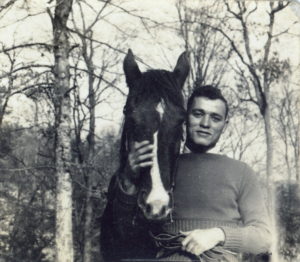
William Hayes with “Jim” at Pine Mountain Settlement School., c, 1939
TAGS: William Hayes, 1938 Senior Address, The Future and Our Mountain Heritage, Appalachian heritage, Pine Mountain Settlement School Graduation, agrarian perspectives, agricultural heritage, mountains, mountain people, mountain life, timber harvesting, natural resources, soils, coal, environmental education, farms, farmers, farming, Kentucky history, WWII, PMSS military service list,
WILLIAM HAYES 1938 PMSS Graduating Senior Address
“THE FUTURE and OUR MOUNTAIN HERITAGE”
[text]
Around the year 1774 a group of settlers swarmed across the Cumberland Mountains into what is now known as the eastern part of Kentucky, each family bringing with them their simple household equipment. Some of the families moved farther west to the rich limestone region of what is now called the Blue Grass region. Others moved up the narrow valley[s] to fertile river bottoms between towering mountains; still, others settled on the rich hillsides of the mountains, tending the land that was very fertile.
Most of the articles in these early homes were of domestic manufacture. The foods were of the most wholesome and nutritive kind; the richest meat, the finest butter, and best meal that ever delighted man’s palate were eaten here with a relish [and] with health and labor only known. With all their rudeness these people were hospitable freely dividing their rough fare with neighbor or stranger and would have been offended at the offer of pay in return. In their small settlements they worked, fought, and feasted or suffered together in cordial harmony. They were warm and constant in their friendships, but bitter and revengeful in their resentments.
From these early families, our own mountain people originated. Out of the early homes came many crude ideas which were handed down from [one] generation to the next. Gradually have these ideas worked themselves into the lives of the mountain people. Back of these early beliefs and ideas were men who had seen the …
p.2
… unbroken paths of mountain hardships —men who had fought for what they owned and guarded it from the early Indian attacks. They were the ones who made our mountain life as it stands.
The mountain life as it stands seems to be a very simple one. Out of the two million people in Kentucky today, the majority of them live by tending the soil. Out of the 40,000 square miles of land, two thirds of this [land] is under cultivation, altho’ the mountain area constitutes only a small part of the farming section. Stretched along the narrow valleys and rugged hillsides are homes of the farmers who by much hard labor manage to bring by a good harvest each year. Far back in the deep hollows and in the small plots of rich bottom lands are seen the ripening cornfields which comprise the biggest crop and the only dependable one in the mountains.
Each season the soil is turned again for a new crop. As the fields become too poor, a new field is cleared on the hillside where the soil seems to be rich. Small vegetables are raised in the very small plots of land washed up by the many creeks. Large fields are left standing each year with only corn stubble, to hold back the soil.
From the beautiful hills, the unripened timber is stripped away. Day in and day out men haul the Jack-props which are made from the smaller trees. Whole areas are left with brush and stumps strewn around. Nothing is left but briar fields to come later.
Fields that have been abandoned are gradually wearing away as nature takes her hold on the barren hill- sides. Corn has …
p.3
… thrived there [for] many years but finally failes to pay out as the food is taken from the soil. Fields lay over from year to year, growing nothing but weeds and young tree sprouts.
Today, we see the destruction all about us –the washing away of rich soil the cutting down of the beautiful forests and land laying idle from year to year. We are becoming land conscious. The country itself has begun to recognize the soil in its fertility as our most valuable possession. But in some poor land areas, some farmers have developed rich pastures. Such farmers as these have learned what conservation means to a profit-making farm. They cultivate only a small portion of the land and live prosperously. These farmers are trying out some of the experiments that [have] proved satisfactory to the large Experiment Stations. They have followed demonstrations based on results of experiments by the University of Kentucky and have enriched their lands with artificial applications of phosphate and lime.
We have seen the forest stripped away but nothing has been done to build it back. The people are beginning to recognize fully the value of woodland in a system of making each farm acre produce a pay crop. Nature’s woodlands give the best protection against erosion. When we strip away our forests that means we’re taking away the moisture from the soil. The force of falling water is first checked by the dense forest growth of trees and lower vegetation. A thick carpet of leaves and twigs slowly filters the water down into the soil anchored to the rocks below by a labyrinth of interlocking roots. Well-sodded land is indeed nature’s storage reservoir.
p.4
Why do these fields lay barren every year? Why doesn’t someone wake up to see the ruin it is causing? This [practice] all lies back to the methods used in the early days. No new ideas are being introduced: all we want to do is stick to what our ancestors have done. We say, “What they do is good enough for us so why should we try some of these new ideas: all we want is a good crop each year.”
All of these things must [now] be dawning upon the mountain farmer of today. The day has come in which we no longer want to carry on some of these early ideas. We want to venture on into a large experimental field, — a field in which we can experiment with our ideas. As the world advances around us, we too want to keep in touch with her upgrowing problems. We explore some of the fast rising problems and try to thrash out the ones in which we can make the simple life of ours more pleasant and worth living for.
What we need today is more schools in which we can carry on these experiments –schools which meet the problems of the rural neighborhood. Examples are being set up all through the mountain areas. Our own institution, tucked away among the isolated hills meets some of the trying problems of the purer mountain heritage. With our equipment and our original setup, we are making steps toward future agricultural and economic development in our own county. Since the school was founded twenty-five years ago, several hundreds of our students have been turned out into the world, some with jobs outside of the mountains and some going back to their mountain homes. Those who go back …
p.5
to the mountains carry with them the spirit of Pine Mountain; they carry back to their homes many new ideas which they put to work.
What the future holds for us will eventually spring forth in a creative and building community. We have long wanted to see our mountain homes accomplish something where the steep hills will be made to bring forth the best of fruits and the rich river bottoms be made to raise the finest of vegetables, the barren forest to be transplanted in young trees for future generations, then, we shall want good roads to carry our produce out to the markets.
Let us picture life in our own community some years hence. A new paved road has been constructed up and down the branches s of the small creeks; a connecting highway has been put through to the state road; new homes have been erected down Laurel [Big Laurel and Little Laurel] way; the homes are built from nice split stones from the hillsides; electricity has been introduced into every home for there has been cooperation among the neighbors to bring it about.
On the once barren hillsides are now heavy, yielding vineyards. There has been some talk of a small factory that will take care of the surplus fruit and turn out a good grade of canned goods. More men of the community are employed, for the government has taken over the forest land, and heavy reforestation is taking place.
p.6
Green fields are everywhere noticeable, for farmers have found a need for more and better cover crops. Purebred cattle are seen grazing on the once rough hillsides that are now in permanent pastures. A new store has been erected on a cooperative basis [the Co-op] in which all of the people of the community have a part.
Pine Mountain School has been enlarged for more people are sending their children to school there. More land has been purchased and [is] being used for experimental bases for the community’s use. Out into the community, students are sent, who work with the neighborly farmers. With the experience and experiments the school has carried on, it has solved the problems of the isolated mountain homes. The wealth that created this [new vision] came directly from the soil. By finding the one key to it all, you merely had to turn to a cooperative and experimental basis. This seems to be the whole problem of today and as long as this [lack of cooperation and experimentation] stands unsolved, the mountain life will carry on its living heritage.
So, at last, let us look back to the findings of our forefathers. They were the ones who gave us this beautiful state; they were the ones who placed the whole problem before us to solve in our own human way.
Kentucky, as she is today, presents attractions which are found in but few, if any other regions in the world. She is situated beyond the reach of foreign intrusion. She is rich in a genial climate, rich in prolific soil, rich in her agricultural products, [and] rich in her beautiful farms and grazing …
p.7
… lands. rich in magnificent scenery and the abundant ores of her mountains, and, above all and beyond all, rich in a population at once industrious, enterprising, hospitable, intelligent, and patriotic.
WILLIAM HAYES
[NOTE: WILLIAM HAYES (1914-2006) is the father of the Editor, Helen Wykle]
GALLERY – WILLIAM HAYES SENIOR ADDRESS
-

- 01 hayes_w_1938_sr_address_001
-
- 02 hayes_w_1938_sr_address_002
-
- 03 hayes_w_1938_sr_address_003
-
- 04 hayes_w_1938_sr_address_004
-
- 05 hayes_w_1938_sr_address_005
-
- 06 hayes_w_1938_sr_address_006
-

- 07 hayes_w_1938_sr_address_007
SEE
SEE ALSO:
WILIAM HAYES Cabin
WILLIAM HAYES Kentucky Guild of Artists and Craftsmen …..
WILLIAM HAYES Native American Collection
WILLIAM HAYES Family Photograph Collection
RELIGION Vespers Service William Hayes 1942
FARM and FARMING Guide
DANCING IN THE CABBAGE PATCH Farm and Dairy Morris Years 1931-1942