
Pine Mountain Settlement School
Series 13: ENVIRONMENTAL EDUCATION
Split Rock Nature Loop
Trail Guide
Pine Mountain, KY
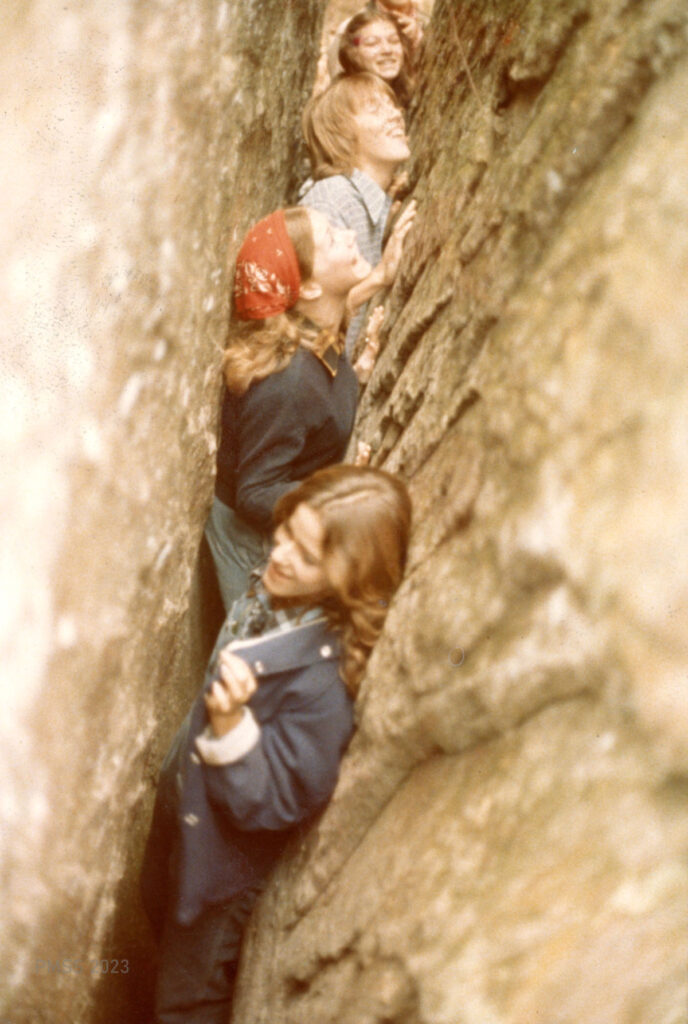
Split-Rock. ee_photos_27_3_02
TAGS: Split Rock Nature Loop, trails, Pine Mountain Settlement School, environmental education, trail guides, flora, fauna, botany, walking trails at Pine Mountain Settlement School
ENVIRONMENTAL EDUCATION Split Rock Nature Loop Trail Guide
The 18 page trail guide’s author is unknown as is the date it was prepared. Produced in the early years of the development of the Environmental Education Program at Pine Mountain Settlement School, the narrative captures many of the important trees and plants that can be found today as this trail is explored. The GUIDE captures the science but also the joy of the author in exploring a familiar landscape and sharing it with visitors at the School. The author is unknown.
(Transcription. Lightly edited)
SPLIT ROCK NATURE LOOP TRAIL GUIDE
On the Split Rock Trail, you will wind through the forest that typifies the lower levels of the cool , North-facing side of the Pine Mountain. This forest represents a dramatic difference from the drier, warmer, thinner-soiled slopes of the Cumberland Plateau on the opposite side of the valley.
Please stay on the trail to avoid trampling on plants. We also ask you not to pick or deface any of the things you find as you walk.
The Split Rock Nature Loop is 1/3 mile long, and takes you over both steep and level ground. Follow the yellow circles and the numbered posts. Listed at the back of this guide are scientific names of species mentioned.
1. Squeeze between the rocks and you enter the forest. As you walk through these woods, try to find evidence of man’s past presence in the Pine Mountain area. The valley has been settled by immigrant families since about 1875, and is the site of many earlier Indian campsites.
The trees around you here — the straight, almost smooth-barked tulip trees (or yellow poplars) and the shaggy-barked white oaks — were used by the pioneers in building their cabins.
The poplars were hewn square with broadaxes for the structure’s main exterior. The oaks were split with mallet and froe to make the roof shingles, or boards.
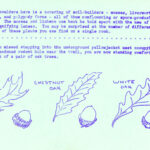
On the boulders here is a covering of soil-builders – mosses, liverworts, lichens, polypody ferns — all of them nonflowering or spore-producing plants. The mosses and lichens can best be told apart with the use of hand magnifying lenses. You may be surprised at the number of different species of plants you can find on a single rock.
2. If you missed stepping into the underground yellow-jacket nest occupying an abandoned rodent hole near the trail, you are now standing comfortably in front of a pair of oak trees
BLACK OAK
CHESTNUT OAK ?
WHITE OAK
The Black Oak, on the left, with ridged dark gray bark and bristle -tipped leaves with fancy veins on their undersides, has heavy , hard wood that is often used in furniture. The White Oak,, with blunt-tipped leaf lobes and scaly, light gray bark is among the largest and longest-lived trees in Kentucky. Indians and early settlers used white oak acorns for food after boiling out the tannic acid.
3. This section of Split Rock Trail follows a path that during Pine Mountain’s boarding school days was a high school nature trail — in the 1930’s and 1960’s — and later became a corduroy skid-road for logging by mule in the late 1950’s. This type of logging was slow but could be done with almost no soil erosion because of the lack of heavy machinery and the soil-holding construction of the road.
Why are the woods to the right of the trail above this point darker than the woods on the left? The cool, shadowed hollows of this side of Pine Mountain typically invite heavy growths of shade-loving plants.
4. The broadleaf evergreen shrubs are big leaf rhododendrons of great laurels. Producing dense thickets of vegetation., rhododendron requires more moisture than its relative. The mountain laurel. Although locally it is often called Laurel Rhododendron should not be confused with the true mountain Laurel. In late June, clusters of white flowers emerge from buds that started forming the previous year.
A purple – flowering relative of this plant, called Catawba Rhododendron grows in this area only in certain locations along the crest of Pine Mountain.
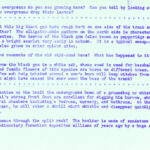
What other evergreens do you see growing here? Can you tell by looking at the ground when evergreens drop their leaves?
5. Why might this big Black Gum have rough bark on one side of the trunk and smooth on the other? The alligator – skin pattern on the north side is characteristic of this species. (The leaves of the Black Gum. Also known as a Pepperidge tree and Tupelo tree) turns a bright scarlet very early in Autumn. It is a typical swamp forest tree, but also grows on drier upland sights.
Can you find remnants of the old skid – road here? What happened to it?
Upstream from the Black Gum is a White Ash, whose wood is used for baseball bats. The male and female flowers of this species are born on different trees.. Legend says that ” An ash twig twisted around a cow’s horn, will keep witches from milking her?” What might have caused the scar near the base of the trunk?
6. Did you notice on the trail the underground home of a groundhog or whistle pig? The animal’s strong front feet are excellent for digging his borough, which contains several chambers, including a bedroom, nursery, and bathroom. At the first sign of danger, he will utter a shrill, short whistle and disappear quickly into his burrow.
Can you squeeze through the split rock? The Boulder is made of sandstone conglomerate, a sedimentary formation deposited millions of years ago by a huge sea that covered the mountain area. The formation is characterized by fragments varying in size from small pebbles to large boulders in a. cement of hardened clay. These strata are easily distinguished by the white quartz pebbles.
This particular rock was not split with chisels to be used in building, as were many of the boulders in this valley, but was probably cracked and separated by the action of water freezing and thawing over a period of hundreds of years.
How does the local or microclimate inside the crack differ from that on the outside surface of the rock? What difference do you see in the plants?
Near the split rock, you may be able to find the black – stemmed maidenhair fern, broad beach fern, rock polypody, walking fern, silvery spleen wart, and others, pinch a leaf of the nearby Spice Bush plants to get a whiff of their pungent, spicy, scent.
[image]
7. Can you hear the mountain from here?
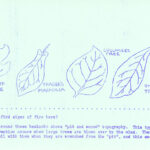
Here, among the many young hardwoods, or deciduous (summer-green) trees are two members of the Magnolia family. They are the cucumber tree, so called because the un-ripened fruit has the shape of a small pickle, and the Fraser Magnolia. whose leaves have two small ears on their lower ends. Can you find them?
The tinder twigs of these trees are often eaten by deer.
[Drawings of leaves: Tulip Tree. Fraser’s Magnolia, Cucumber Tree, Umbrella Tree]
8. Can you find signs of fire here?
” The area around these hemlocks show.” pit and mound” topography. This type of ground formation occurs when large trees are blown over by the wind. their roots pull up soil with them when they are wrenched from the “pit”, in this mass of soil and rot material forms the mound.
Next to the post is Partridge. Partridge Berry, a favorite food of the rough grouse or Partridge. This small, vine – like evergreen ground plant, a member of the matter family, can often be found in moist and on damp mossy overhangs of cliffs as well as in the deep shade of rhododendrons and hemlocks. If not eaten, the bright red berries remain on the plant all winter.
9. Picture the tree that this stump and section of the trunk. Were once part of. until the 1930s?, chestnuts this size made up a large proportion of the Pine Mountain Forest.. Then the trees were attacked by a parasite fungus that arrived from Japan on a shipment of nursery stock of the Oriental Chestnut. The first attack was in New York City. From there, the fungus was spread by Spores adhering to the feet of birds. the. disease spread several miles each year in an ever – widening circle., killing chestnut trees by the thousands.
Today, the American Chestnut is almost extinct. Sprouts still come up from some of the old roots that have not yet decayed and since they are already old plants, they sometimes bear a few nuts. Each successive year brings fewer such sprouts, and we may expect that the American Chestnut may soon be gone forever. [2024 – The American Chestnut Society has changed that projection.]
As you walk on through these woods, keep your eyes open for the skeletons of other chestnut trees.
10. Notice the sod stump. Over the years, Pine Mountain Settlement School has selectively cut small quantities of timber for the construction of school buildings, fences, and furniture. Back in the 1870s, William Creech, who later donated 600 acres to be used for the establishment of the settlement school, cut and burned. What he himself estimated as $50,000 of timber in the clearing of the valley bottom for field and pasture. At current prices, the value [today] would be closer to 20 times this amount.
11. “Near where you are standing, a chestnut stump has acted as a nurse” to the seeds of a hemlock, a sweet birch, and two red Maples, all of them now passed sapling age. Decaying sturdy nurse stumps and logs — usually provide a sponge like combination of moss and log — and are ideal for seed germination. Look for others as you walk on.
Notice how rock – strewn the forest becomes as you continue down the trail. These jumbled boulders have been pried from a ridge of bedrock by freezing and thawing. They might have come from the very crest of the mountain, which, on this side of Pine Mountain is steep, almost overhanging because of the high resistance to weathering of the Lee Conglomerate sandstone. Gravity and the churning and heaving of frost gradually brought the rocks down to this level.
12. Can you climb the face of this rock? What kind of tree once grew where you now see a huge stump?
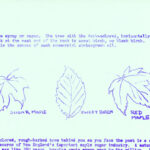
Two big trees near this rock are commonly used for food. Their sap is boiled down to make syrup or sugar. The tree with the dark – colored, horizontally – striped bark at the east end of the rock is sweet birch, or black birch. Its inner bark is the source of most commercial wintergreen oil.
[images] 1. Sugar Maple 2. Sweet Birch 3. Red Maple
The light – colored, rough – barked tree behind you as you face the post is a Sugar Maple, the source of New England’s important maple sugar industry. A mature sugar maple may live 350 years bearing seeds every year by the million. Each season as many as 4000 maple seedlings may spring up beneath it. On the average, of the perhaps 1,400,000 seeds that may sprout during the tree’s lifetime, the vast majority succumbed during or at the end of their first year. Only perhaps 70,000 persist during the second year; 1400 lived to be ten years old; 35 grew to be tall, slender, saplings, badly suppressed by the dense shade and dying at about 50 years of age, Even when still barely more than an inch in diameter [they grow] to attain an age of 150 to 200 years and a height of sixty to 80 feet, And one of these becomes a forest veteran. Can you find offspring of this tree in each different age group?
13. The boulders here form an amphitheater from which you can look up at the tops of the trees in the sky. But watch for poison ivy on the boulder tops and briars along the ground.
The hardwoods.(Hickory, Oak, Tulip Poplar) A good example of the mountains fast growing “second growth” Forest., which has arisen to replace the trees that were logged along the entire 150 mile length of Pine Mountain during the early 1900s. Pine Mountain Schools 800 acres are now protected. From logging to allow the forest to regain its original size.
The telephone – pole – like poplars that dominate this stand show their tropical ancestry by continuing to produce new leaves throughout the growing season, In the manner of tropical trees, shedding the older leaves as they do so.
14. How does the area downhill from here differ from the woods that you have been walking through? Can you tell anything about the history of this area?
The jungle – like tangle of plants.- wild rose, locust, greenbrier, and other small hardwoods – Indicates that not long ago this was a pasture or field. And has since been abandoned. among this vegetation is a stand of white pines that were planted when the area was still a field. At first, it seemed that the White Pines would not survive because of the competition from the vines.- – Greenbrier, Saw-briar, Multiflora Rose, Blackberry – But now they have grown to sufficient size to shade the Breyers and keep them down.
Count the number of whorls of branches on each white pine to tell how many years ago it was planted.
15. This Chestnut Oak, with its sweet acorns and thick – ridged bark, is almost out of its element here in the mountain’s north side. Chestnut Oaks commonly thrive on dry sunny, rocky habitats such as the slope on the opposite side of the valley, and on ridges. The wood of chestnut oak, or “” rock oak, as it is called in some places, makes fine firewood.
16. Look for plants growing beneath this Eastern Hemlock, you will not find many, as there are very few that will tolerate the trees deep shade. The tree is characterized by short, flat needles arranged in two flattened rows, and small numerous cones.
Because Hemlock itself is a shade – loving tree its seedlings are able to survive under an existing mature forest, and eventually to replace the trees in that forest when they die. Although it is locally called Spruce Pine, Eastern Hemlock differs from the true Spruce Pine, whose natural range covers only a small section of the deep south. You might be able to find Pine Mountain’s only Spruce Pine, a planted specimen located among some eastern hemlocks, between the Laurel House car shed and the Chapel.
17. Eastern White Pine is the only five – needled pine in the eastern United States. At the close of the glacial. some 13,000 years ago, the eastern forests began a rapid migration to the north. during this time, Colonies of the northern conifers were isolated from the main body and left behind. among. those were Frazier Fir and red spruce, Now found at high altitudes in the Smoky Mountain Range, and eastern white pine, usually growing on sandstone rock in parts of Kentucky and Tennessee. Pine mountain settlement school is now just out of White Pines natural range, although natural pockets still exist as far south as Georgia.
In Pennsylvania, especially from 1840 to 1860, special rafts of great white pine Timbers to be used for ships masts, each raft 90 feet long, and often 40 feet wide, were floated down the Susquehanna River through Rapids where the water, in some places, drops 400 feet per mile. Since the mast spars could have no holes in them, they were bound together with Hickory withes instead of being pinned as were squared timbers. Such spar rafts were steered with great oars or sweeps, fore and aft and skipper’d by men who knew every whirlpool and cross – current for 200 miles of river.
18. Does the old fence tell you anything about the chain of events in this area? Or on which side of the fence is the woods [woodland] younger?
You are now starting down a lane that was. Once used as a wagon road. To your left is a clump of Sourwood trees, members of the Heath family of plants that includes Rhododendron, Blueberry, and Mountain Laurel. The curved trunks of sour wood trees have long been used for sled runners in the Appalachians. Bees use the nectar of this tree’s flowers to make what, many consider, to be the finest honey in the world.
19. Beneath this old beach are. Lowbush Blueberry and Mountain Laurel. Although they are related, Mountain Laurel is an evergreen and blueberry is deciduous – its leaves fall each autumn.
The Laurel, locally often called Ivy, produces in late May, clusters of small bell – shaped, pinkish white flowers. Like the Chestnut Oak, it usually prefers drier sights than this one, and thrives on the South – facing slopes across the valley. Its leaves are poisonous to grazing animals, but its wood is not poisonous and was used by pioneers for spoons and [?] skewers.
TURN TO THE NEXT PAGE FOR A LIST OF SPECIES SEEN
CHARACTERS IN THE ORDER OF THEIR APPEARANCE
[With links to resources] *pending
| Tulip tree | Liriodendron tulipifera | Partridgeberry | |
| White Oak | American Chestnut | ||
| Polypody fern. | Black Birch | ||
| Black oak. | Red Maple | ||
| Rhododendron. | Sugar Maple | ||
| Mountain Laurel. | Poison Ivy | ||
| Black gum. | Greenbriar | ||
| White ash. | Sawbriar | ||
| Spicebush. | Blackberry | ||
| Maidenhair Fern. | Hickory | ||
| Broad Beech Fern | Black Locust | ||
| Ebony Spleenwort | White Pine | ||
| Walking Fern | Chestnut Oak | ||
| Silvery Spleenwort | Sourwood | ||
| Cucumber Tree | Beech | ||
| Fraser’s Magnolia | Lowbush | ||
| Umbrella Tree | Wild Rose | ||
| Eastern Hemlock |
GALLERY – ENVIRONMENTAL EDUCATION Split Rock Nature Loop Trail Guide
-
- Cover ee_split-rock_nature_guide_cover
-
- 001 ee_split-rock_nature_guide_001
-
- 002 ee_split-rock_nature_guide_002
-

- 003 ee_split-rock_nature_guide_003
-
- 004 ee_split-rock_nature_guide_004
-

- 005 ee_split-rock_nature_guide_005
-
- 006 ee_split-rock_nature_guide_006
-

- 007 ee_split-rock_nature_guide_007
-

- 008 ee_split-rock_nature_guide_008
-
- 009 ee_split-rock_nature_guide_009
-

- 010 ee_split-rock_nature_guide_010
-

- 011 ee_split-rock_nature_guide_011
-

- 012 ee_split-rock_nature_guide_012
-

- 013 ee_split-rock_nature_guide_013
-

- 014 ee_split-rock_nature_guide_014
-

- 015 ee_split-rock_nature_guide_015
-

- 016 ee_split-rock_nature_guide_016
-

- 017 ee_split-rock_nature_guide_017
SEE
ENVIRONMENTAL EDUCATION Trail Guides