Pine Mountain Settlement School
Series 09: BIOGRAPHY – Staff
Stuyvesant “Peter” Barry, Teacher 1944-1947
Alice Trumbull Barry, Community School Supervisor 1944-1947
STUYVESANT PETER AND ALICE BARRY Autobiographical Notes
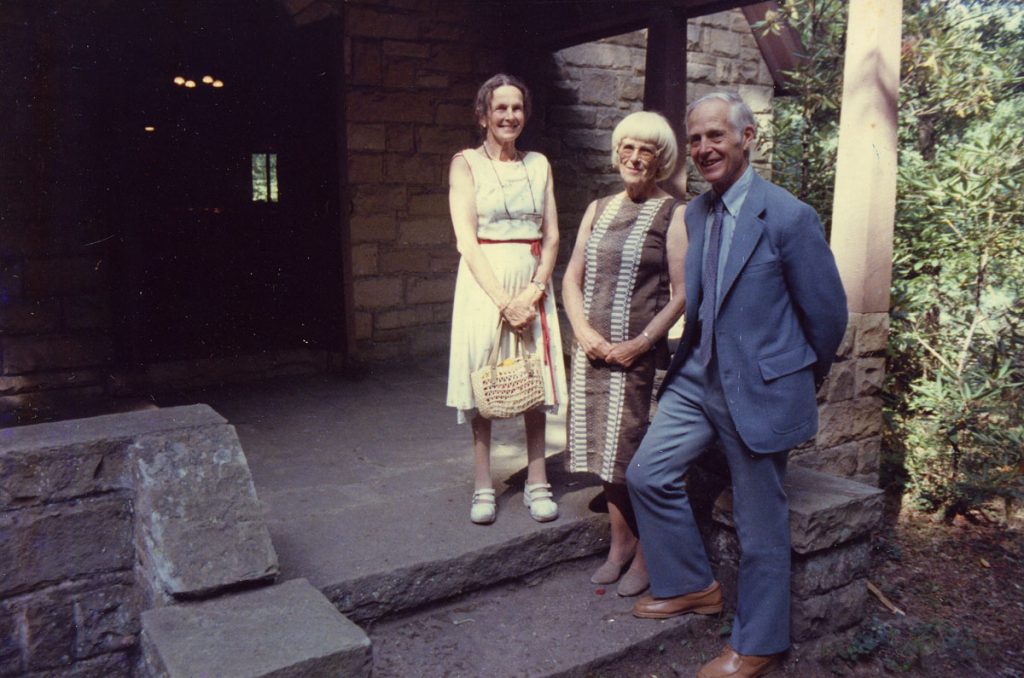
Alice Barry, Mary Rogers, and Peter Barry at the Chapel. Homecoming at PMSS 1997(?) [barry_peter_mary_rogers_003.jpg]
TAGS: Stuyvesant Peter Barry, Alice Barry, PMSS workers, teachers, students, summer work camps, privies, Old Log, schoolhouses, primitive churches, work/study program, railroad, WWII, dancing green, plays, singing, dancing the minuet, pronunciations, PMSS directors, coal mine strikes, moonshiners, Infirmary, graduation, PMSS Elementary School, WWII
STUYVESANT PETER AND ALICE BARRY Autobiographical Notes
STUYVESANT “PETER” BARRY, Teacher 1944-1947
ALICE (Allie) TRUMBULL (SCOVILLE) BARRY, Community School Supervisor 1944-1947
This page features images and transcriptions of excerpts from Peter Barry’s autobiography dated August 11, 1997, covering his time at PMSS from 1944 to 1947. His narrative begins with notes concerning PMSS staff during that time.
Introduction
Email dated September 15, 2017, to Helen Hayes Wykle from Frank Barry, Peter’s brother:
…I remember you! You were very small then — I remember Steve somewhat better, although even he was younger than me. And I especially remember your Father — serious, businesslike and very competent. I went by the farm occasionally, though did not spend much time there. However, I do remember well the mules that pulled the mower, plows, and other equipment, often maneuvered by students, who we often passed on our way to and from Laurel House for meals. It’s odd now to think that students then were trained in cultivation with animal power. By the time I got old enough to work on farms, the pulling was always done by a tractor.
One incident involving the animals comes back to mind — it involved my Mother and Davey, who was then very small. They were walking in the woods in an area we did not frequent, when suddenly several large hogs came rushing toward them, squealing vociferously. My mother, who had polio when she was an infant, could not walk easily, and certainly could not run. She thought they were about to be attacked and perhaps devoured! But when the hogs reached them, they stopped and looked up expectantly. Then Mother noticed there were traces of food around, and realized they had inadvertently arrived at the point where scraps from the kitchen were routinely dumped! The hogs finally wandered away disappointed, and Mother and Davey returned with a story to tell and glad not to have been eaten.
I think several of us, probably including you, appear in a photograph taken by Mr. Dodd at the special natural amphitheater below Westwind where May Day was celebrated.
Frank Barry
Notes from a follow-up email dated September 15, 2017, to Helen Hayes Wykle (Editor):
...One of the things special about Pine Mountain was the intimacy with animals – -pets as well as farm animals (including those that would eventually be eaten).
Frank Barry
TRANSCRIPTION: STUYVESANT PETER AND ALICE BARRY Autobiographical Notes
MEMORIES OF SOME PINE MOUNTAIN SCHOOL WORKERS 1944-1947
[NOTE: The following transcription has been slightly edited for clarity.]
001 barry_autobiography_001 (page 1)
MISS KINGSBURY [HELEN KINGSBURY] taught the girls to make simple but beautiful dresses for themselves — a priceless skill.
MR. LA RUE [GLENN LA RUE] taught the boys to create smooth, shining, beautiful wooden bowls, which were sold to help Pine Mountain’s income.
MR. BENJAMIN [H.R.S. BENJAMIN], the Director, was pretty high-pressured, but his first instructions to me as a sort of groundskeeper (with my student group), I found inspiring. He wanted me to work, with the 3 or 4 boys allotted to me, to get and keep those grounds in just as beautiful a state as I and the boys could possibly make them. … He was very concerned about students who misbehaved — both for their own sakes and the School’s reputation.
EDITH COLE [sic, EDITH COLD] was a frail-looking little lady, who looked as if she might be blown away by a gust of wind. However, she was partly in charge of one of the girls’ dormitories, and despite her tremulous voice she could hold the whole school’s attention when she told us a story, such as “Who Stole My Golden Arm??” She was respected and beloved.
MISS MERRILL [JOSEPHINE MERRILL] was a gentle woman who loved and understood teenage boys, and knew how to guide and steer them out of things which would get them into trouble. She knew how not to see something, if that was the wise thing to do!
BILL HAYES [WILLIAM HAYES] (who, I was delighted to see — at the reunion — is hale and hearty) was a strong, skilled leader, one who expected and got plenty of excellent results from the boys allotted to him in the work periods. He taught them plenty about life as well as agriculture, and was an excellent example for all. He is also an excellent athlete.
MISS ROOD [GRACE ROOD], the trained nurse at the Pine Mt. Hospital, was in charge of training a few fortunate senior girls about nursing. This work was much sought-after and, of course, very useful. Miss Rood was a big, formidable woman who seldom smiled. But she had a heart of gold, as everyone in trouble who went to the little hospital soon found out. She was certainly one of our kindest and most valuable residents.
002 barry_autobiography_002 (page 2) – DUPLICATE OF 001. Page 2 is missing
MISS [GLADYS] HILL
MISS CHRISTENSEN [ABBY WINCH CHRISTENSEN]
003 barry_autobiography_003 (page 3)
There were various others, but this is a representative sample of our “workers,” as they were called. This was a very caring faculty. They cared about adolescent boys and girls, and used their skills and intelligence to help them become effective, caring adults.
What is more precious?
Peter (Stuyvesant) Barry
New Hope, PA 18938
Aug. 11, 1997
TRANSCRIPTION: STUYVESANT PETER AND ALICE BARRY Autobiographical Notes
PMSS MEMORIES
004 barry_autobiography_004 (page 203)
PINE MOUNTAIN
In the spring of 1944 we were still gung-ho for summer work camps, and had signed up for one in the Kentucky mountains, at Pine Mountain Settlement School, a boarding high school for children who lived too far away from the nearest high school to get there and back every day. This was a wonderful school, in a high valley between long Pine Mountain and a range of lower mountains to the north. Coal mines were almost everywhere except in that long green valley, which was a sort of Shangri-La. The nearest public high school was beyond Harlan, across the mountain, about seventeen miles away over roads that slowed you down to a snail’s pace. No school buses crossed Pine Mountain in those days.
The camp’s project was to replace worn-out privies for the local elementary schools: four or five of them. These schools were spaced two or three miles apart, so the children could walk to and from school. Again, we had a delightful bunch of teen-agers. We had invaluable help from Burton [Rogers] and Mary Rogers, about our age, who were already very familiar with the school, and from Joanna Ayers, a graduate of the school, who came from a remarkable local family and was strong but sensitive, and familiar with all the traditions. And we had friendly Edith Comfort, from Radnor Meeting, as our dietician. She presided somehow in the Laurel House kitchen, which was home to more cockroaches than I’d ever seen anywhere. But you didn’t see them en masse except in the middle of the night.
The campers slept in dormitories, which were normally unused in the summer, except that there were a few students hired to keep the school farm going then, to clean, and work in the kitchen. We stayed at “Old Log,” a cabin a hundred years old near the entrance to the school. Across the narrow drive from us, down ten feet, was Greasy Creek, which twisted its sinuous way downhill to the north between beetling mountains and ridges, through settlements named Little Laurel and Big Laurel. I remember taking the campers on a walk along the dusty road down that valley. Some shots rang out. Someone firing over our heads, it seemed. To scare us? I never found out. We didn’t stop.
Early in the summer there, we were having a meeting for worship for all the campers at Old Log. Our three children, Frank, Kathy, and little Davie, were playing across the drive, down by
005 barry_autobiography_005 (page 204)
Greasy Creek, fifteen feet below. Suddenly Frank appeared. He obviously didn’t want to disturb our quiet, but he came over to his mother and me and whispered that there was a rattlesnake down there by the creek. Meeting was suddenly interrupted as I dashed down to the stream. Davie was showing real interest in the reptile, which was coiled up, on the ready. But it was quite a small one, perhaps with no poison yet. Well, we took Davie and Kathy up out of danger. I believe I got a long stick and propelled the rattler into the creek, with a great sigh of relief.
My most exciting moment came later, when we were excavating for a privy hole near Little Laurel schoolhouse. The County had hired a competent local man named Frank Taylor to work with us, advise and direct us — a very kind and helpful person, who said “tars” for “tires.” When we dug, we sometimes found a boulder so big we couldn’t move it. Then Frank would dynamite it. I had watched him do this, so when we reached this stage at Little Laurel, with a boulder in the middle of a hole six feet deep and he wasn’t there that day, I knew how to do it myself. I wasn’t too anxious to, but it had to be done. The boulder looked something like the upper part of a gigantic stone egg, half-buried. Well, I got everyone and everything out of the big hole we’d dug, set the dynamite and attached the fuse to it. I told the others to go fifty feet away, while I lit the fuse. It started sputtering fiercely along towards the dynamite. It was then that I realized that one of the things that had been taken away was the ladder for me to escape from the hole on….. Somehow [I] scrambled out of that hole, and made the fastest 50-foot dash in my life … BAM !!!!
Pine Mountain School was a great place to visit in the summer. Its campus had a unique charm. Laurel House, where we ate, was a fine building of native stone, with beautiful hardwood floors (outside the kitchen), and a fine, big dining room. Our work campers really got to know the students from the School who were working there for the summer. There was even a swimming pool, with water from Limestone Branch, which caromed down the steep thousand-foot side of Pine Mountain above us. We were led in country dancing by an expert teacher, Miss [Abby Winch] Christensen. But week-days we were at work all day.
006 barry_autobiography_006 (page 205)
We were told about a primitive church at Divide, two miles away, where believers convinced themselves that they were saved by handling rattlesnakes with impunity (Mark 16:17) and breathing fire. We campers visited them one Sunday morning. Unhappily they had no snakes that day, but they put kerosene in a milk bottle, and some paper, ignited it, and swallowed some flames proudly. They looked down a bit on us doubters.
We all got fairly expert at building privies, which wasn’t exactly artistic work, but we joined the disciples of Chic Sale in turning out some [mighty] pretty privies. And we repaired some of the schoolhouse roofs, and did some repainting.
Our last and unexpected job was to build two privies for a new school at Bledsoe, about twelve miles down the valley, nearly across the mountain from Harlan. School had been held in the home of two lady missionaries in Bledsoe, but the County school board had now decided to build its own school building there. However, they decided to save funds by having us build the privies, and, the school itself being completed, we hurried down to construct the outhouses.
The missionaries, who were very opposed to alcoholic drinking, had reported to the police an active moonshiner, who had then been arrested and jailed. I was aghast to learn that after our privies were completed, the missionaries’ home — school quarters and all — was burned to the ground.
Meanwhile, I found out that Mrs. Hinton had gotten tired of waiting to hear definitely from me, and had hired someone else. So I had no job for the fall. Frank Taylor, who lived with his family in Little Laurel, had been trying to persuade me to be the new teacher there. I resisted. I didn’t feel prepared to manage a one-room 8-grade school, though he was sure I’d be fine. But I did have to find a job for the fall. Now the director of Pine Mountain School asked me to stay and teach there.
Actually, Pine Mountain School was doing more realistically what Putney was boasting of. The physical work [that] the Pine Mt. School students had to do kept down the costs so that the tuition could be
007 barry_autobiography_007 (page 206)
held as low as $75 a year. This was a sum the families could scrape together somehow, perhaps with a small scholarship. Accordingly, this work program was really functional and indispensable, not just valuable experience. At first I felt it would be a come-down, compared with Putney. But I accepted the offer, and as we settled into the community and appreciated it all, we became very glad that we landed in Pine Mountain. (Incidentally,I think the pay was about $900 a year. But we had free housing, free meals during the school year for the whole family, and free medical service from the little Pine Mountain Hospital [Infirmary]. Which came in mighty handy when Roxana was born there! And free vaccinations for Pluto!)
Appreciation of the community grew with experiences such as the children’s railroad expedition. There had been a temporary railroad track coming to Pine Mountain for timbering, actually crossing the mountain by a long diagonal climb to the west. There were stretches of ties and small trestles over gullies, and Frank [was] determined to explore it — and invited Kathie to go, and of course Davie wanted to go, too. They didn’t bother to tell anyone. Well, the track had run through the woods, at first along the edge of the slope, then gradually climbing. They found enough old ties and remains of trestles for a while, but then these landmarks got fewer and fewer [as] the sun set and it began to get dark, and at last they began to feel lost. Davie was the first to cry; then Kathy joined in, and at last the despair hit Frank, and they were all three bawling at the top of their lungs, in the trees and shrubs maybe 150 yards up the slope from the edge of the valley.
A farmer named Boggs, with about seven children, lived in that part of the valley, and hearing the distant wailing from above, he investigated, and brought down the tearful explorers. It was dark by this time, and he and his wife fed them and put them to bed, and then sent word to the School (by foot, naturally). I’m ashamed to say we didn’t even know the children were missing — we were so free about letting them go anywhere on the grounds, where they were always welcome. We hurried down to the Boggs’ farmhouse. The Boggs wanted to keep them for the night, but Allie and I couldn’t bear not to take them home. However, this is what our neighbors were like, at Pine Mountain. We never forgot that.
008 barry_autobiography_008 (page 207)
PINE MOUNTAIN SCHOOL: FIRST YEAR, ETC.
We went home right after work camp. Because of the War, we had to save gas, so we drove to Bristol, Va., and took the train from there. On the way we went over some very winding roads. We were all packed into the “Blue Streak,” as we called our 1939 Chevy sedan, and with the children all looking out of the same open window, we must have been something of a sight to some pedestrians we were passing. We’d just traversed a particularly bad curve, and Davie’s stomach was seething. As the bystanders gawked Davie had to throw up — practically in their faces. At our next stop for gas we had to have that side of the car hosed, Kathy reminds me.
It was on this trip that I was explaining how a fire can start from a short circuit of a conductor — in the wall, for example. Davie’s eyes widened. “Father — ” he said, entranced — “a Conductor? — in the wall??”
We had a happy Pluto with us when we started back. But the conductor wouldn’t let him in the passenger car; he had to be in the baggage car, and that was so unnerving to Pluto that I had to spend most of my time in [there] with him, during which he leaned so hard against me that it was hard to stand up. When we got out of the train at Bristol and started toward where I had parked the Blue Streak, Pluto suddenly spotted it, and was off like a rocket. I had carelessly left one window open, and Pluto was through it in a trice, and solidly planted down on the floor. This was home to a very homesick dog, and he wasn’t about to move.
Arthur Dodd had been the principal of Pine Mountain School for some time. He had married Georgia [Ayers], a sister of Joanna Ayers, just after Georgia’s graduation. Dodd was a quiet but decisive, levelheaded principal, who held faculty meetings once a week, and kept them brief, but was always considerate to every one of us. I tried to emulate his example when I became a principal. But I wasn’t Arthur Dodd. . . Among other things, he played the organ for chapel service, and the piano for country dancing.
I was given a class in sociology, which pleased me very much. I also had to teach a class in choosing the right career, but the text
009 barry_autobiography_009 (page 208)
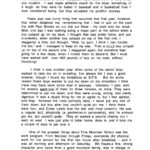
was too formidable for me to cope with successfully. It described the characteristics of every occupation you could think of and a lot you couldn’t. I was made athletics coach for the boys: something of a laugh, as they were far better in baseball and in basketball than I ever considered being, but they accepted my position anyway.
There was one funny thing that occurred that first year, however, that rather delighted me, remembering that I had to quit on the pack trip with Paul Brooks on our trip out West — my back was too weak. Well, one day I was walking along a major path at the school when a boy jumped up on my back. I thought that was pretty funny, and just proceeded, when another boy jumped on top of the first one. I staggered a little, but thought, “Well, by gum, I think I can handle this too,” and I managed to keep on my way. Then a third boy jumped up on top of the second one. I staggered again, but somehow kept going for a few steps, when I invited them to descend. But I must have walked with over 400 pounds of boy on my back, without flinching!
I think it was another year when some of the senior boys wanted to take me on in wrestling. I’ve always felt I was a good wrestler, though I found my limitations at S.P.S. But for some reason these boys wanted to put me down on my shoulders. I think there may have been some kind of jealousy. Unwisely, I said, well, I’d wrestle each one of them for three minutes, no more. They were determined to put me down, and they were young, strong, and plenty vigorous. It was a stupid thing for me to agree to, but I had agreed, and they followed the rules perfectly fairly. I never put any one of them down, but boy after boy couldn’t quite pin me. I think there were four, and Elmer Lewis was the last and most powerful. He was a regular bull, physically (a gentleman, in personality), and he almost got me, but couldn’t quite. They all wanted a second chance, but I said, no way! I was just able to totter home, done in, and it took me a couple of days to get over it.
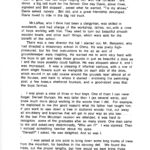
One of the greatest things about Pine Mountain School was the work program. From Monday through Friday, everybody did physical work for the school for the first two hours after breakfast — and it was all morning and afternoon on Saturday. Bill Hayes, a fine, strong character who came from a good mountain family, was in charge of the farm and had boys helping him, including care of the cows. Brit Wilder, of medium height and about 280 pounds, with a
010 barry_autobiography_010 (page 209)
heart of gold, had two boys helping him with the furnaces. Brit drove a big red truck for the School. One day Davie, about three, signaled and Brit stopped, asked what he wanted. “Tie my shoes,” Davie asked, naively. Brit did, and a great friendship developed. Davie loved to ride in the big red truck.
Mr. [Glenn] LaRue, who I think had been a clergyman, was skilled in woodwork, and had charge of the workshop, lathes, etc., with a crew of boys working with him. They used to turn out beautiful smooth wooden bowls, and other such things, which were sold for the benefit of the school.
There was a new director the fall I started out, Mr. [H.R.S.] Benjamin, who had directed a missionary school in China. He was pretty high-pressured, but his first instructions to me as a sort of groundskeeper were inspiring. He wanted me to work very hard with the boys to get and keep those grounds in just as beautiful a state as I and the boys possibly could fashion. He was eloquent about it, and I was impressed.
It was a pleasing if informal campus, with a row of short single flowers such as marigolds on each side of the drive, which wound in an odd course around the grounds near almost all of the houses, and back to where it started, enclosing the swimming pool, a few trees, a sheltered fountain, and a good-sized area that the boys farmed.
I was given a crew of three or four boys. One of them I can never forget: Densel Duncan. He was taller than I (as several were), and knew much more about working in the woods than I did. For example, he explained to me (for good reason) what his father had taught him: if you want to saw down a tree in cluttered woods, first, cut away all shrubbery and branches that will get in your way as you saw. At the last Pine Mountain reunion we attended, it was hard to recognize some of the graduates after so many years. One man came to me and asked, very determinedly, “Who am I?” I was stymied. Then I noticed something familiar about his eyes. “Densel?” I asked. He was delighted. And so was l.
I was asked at one point to bring down some long trunks of trees from the mountain, for benches in the dancing dell [dancing green]. We found the trees, cut the proper lengths, but how would we best bring those lengths down? There was snow on the ground. The mountain was steep. I figured if we just got them started they’d toboggan down
011 barry_autobiography_011 (page 210)
that slope. They did. Mr. Benjamin’s house was up above other buildings, where it began to get steep. It was a fairly near thing whether one of those great long logs would careen right into that building. Well, it didn’t.
Girls worked in the kitchen, in the dormitories and Laurel House, and in the girls’ industrial building, where there were sewing machines and weaving looms and such. Senior girls might work in the little Pine Mountain Hospital. So some of my students in class helped in the birthing of Roxana, during our last year at the school.
There were some vivid personalities among the spinsters on the staff. Miss [Abby Winch] Christensen was a tall, distinguished-looking woman who directed folk-dancing regularly. We all took part in and loved it. She was also highly skilled in landscaping and flower or shrub planting.
Miss [Edith] Cold was a frail-looking but decisive little lady, also distinguished in her appearance, partly in charge of one of the girls’ dormitories. Despite her tremulous voice she could hold the whole schools’ attention when she told a story. such as “Who Stole My Golden Arm?” She had lived through terrible times in Turkish Armenia. Miss [Gladys] Hill was in charge of the Grounds Committee, which included me and several students. She had a terribly twisted back, which made her movements quite difficult, but she kept going, and was very serious about her responsibilities. I was deeply impressed by the respect which the students showed to her. This revealed to me as much about them as about her.
There were lots of charming things about life in Pine Mountain. One of them was singing folk songs together. And periodically one of these songs would be acted out before the whole school. I directed this, generally, and it was a lot of fun. Once during mild weather I had a group of boys act out “The Mary Golden Tree” down at the swimming pool. I had made a rectangular boat (the only one on the campus), which represented the “Turkish Robberie.” A platform on the edge of the pool represented the ship “Mary Golden Tree.” A sailor (played by Harold Cox) dived off it, sank the pirates and their ship, swam back, and then begged back on board but was refused, etc. It was very dramatic, I must say. (Harold Cox, by the way, was not big, but he was a macho hombre.
012 barry_autobiography_012 (page 211)
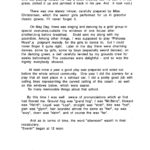
One day playing football he had a tooth knocked out. He saw it in the grass, picked it up, and jammed it back in his jaw. And it took root.)
There was one stately minuet, carefully prepared by Miss Christensen, which the senior girls performed for us in graceful classic gowns. I’ll never forget it.
On May Day, there was singing and dancing by a girls’ group in special costumes, outside the windows of one house after another, long before breakfast. Dodd sent me along with my accordion. Among other things, I was supposed to play “Princess Royal,” a poignant melody, for the girls to dance to; but I could never finger it quite right. Later in the day there were charming dances, some by girls, some by boys (especially sword dances), on the dancing green, a dell carefully tended by my grounds crew for weeks beforehand. The costumes were delightful — and so was the dignity everybody showed.
At least once a year a good play was prepared and acted out before the whole school community. One year I did the scenery for a play that all took place in a railroad car. I did a pretty good job with ceiling lines representing the curved ceiling of the coach, as well as the windows below, which were easier.
So many memorable things about that school.
By this time I was well aware of pronunciations which at first had floored me. Ground hog was “grand hog,” I was “Mr. Berry,” Howard was “Ha’rd,” Loyall was “Loal,” straight was “stret,” bite was “bat,” glen was “glynn,” hair sounded almost the same as “her,” ivy was “avvy,” down was “dahn,” and of course fire was “far.” And as to terms of time, the word “afternoon” wasn’t in their vocabulary. “Evenin'” began at 12 noon.
013 barry_autobiography_013 (page 214)
PINE MOUNTAIN 3
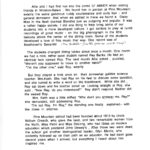
Allie and I had first run into the comic Li’l Abner when visiting friends in Winston-Salem. We found him in person at Pine Mountain: exactly the same generous ruddy countenance and curly hair — and general demeanor. And when we settled in there we found a Daisy Mae in the flesh (named Blondie) just as outgoing and popular. It was a rather happy society.
I did one thing to help bring some of our students into a more developed culture. I got seniors to play at lunch recordings of great music — on the big phonograph in the little balcony above the center of the dining room. Some of the students developed a love of fine music that way. One record was of Beethoven’s Seventh! — my favorite from the previous work camp.)
The students changed dining tables about once a month. One month we had a nice, rather quiet student named Ray Banks. He had an identical twin named Roy. The next month Allie asked, puzzled, “Weren’t you supposed to move to another table?” “I’m the other one,” said Roy, wearily.
But they played a trick once on their somewhat gullible science teacher, Mrs. [Alice Joy] Keith. She had Ray on his feet to discuss some question, and she turned to write a word on the blackboard. While she did, Ray sat down and his brother stood up. Looking straight at Roy, she said , “Now Ray, do you understand?” Roy didn’t respond. Neither did the seated Ray. Mrs. Keith was a little miffed. “Why don’t you answer me, Ray?” “I’m not Ray, I’m Roy,” the standing one finally explained — with the class in stitches.
Pine Mountain school had been founded about 1913 by Uncle William Creech, who gave the land, and two remarkable women from the North, Miss [Katherine] Pettitand Miss Ethel de Long, who had ideas on modern education which predated John Dewey’s. After those two were dead, the school got another distinguished leader, Glyn Morris, who evidently followed up on their path as an educator. He had been gone several years when I arrived, but everything I heard about him inspired me.
014 barry_autobiography_014 (page 215)
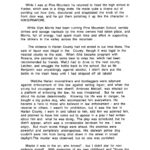
While I was at Pine Mountain he returned to head the high school in Harlan, which was in a dingy state. He made quite a drama out of pointing out how dirty, discolored and dilapidated the knob of the front door was, and he got them polishing it up like the character in H.M.S. Pinafore.
While Glyn Morris had been running Pine Mountain School, terrible strikes and savage reprisals by the mine owners had taken place, and Morris, full of energy, had spent much time and effort in supporting the strikers in the valley across the mountain.
The violence in Harlan County had not ended in our time there. The sale of liquor was illegal in the county, though it was legal in the nearest county to the east. When Allie became pregnant with Roxana, she yearned for some beer to relax her, which had been recommended by friends. Well, I had to drive to the next county, Letcher, and smuggle the bottle back to the school. But as Mr. Benjamin was unyieldingly against alcohol, I didn’t dare put the bottle in the trash heap until I had stripped off all labels!
Well, the Harlan moonshiners and bootleggers were adamant against enforcement of this law against selling liquor, and when the young but courageous new sheriff, Ambrose Metcalf, was elected on a platform of enforcing the law, he was threatened. But he went about his duties determinedly. Knowing his life was in danger, he bought a big police dog, who accompanied him everywhere. He became a hero to those who believed in law enforcement — and the reverse to others. I wasn’t for prohibition, but it was the law in Harlan County. I went in and talked to him, told him we admired him and planned to have him come out to appear in a play I had written about him and what he was doing. The play was scheduled, but he didn’t appear, which was a considerable let-down for me. I was angry. But much worse things were ahead. His enemies were powerful and completely unscrupulous. His stalwart police dog couldn’t save him from being shot down in the street in broad daylight. The murder was observed, but no-one was punished.
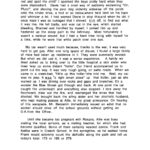
Maybe it was in the air, who knows?, but I didn’t star for nonviolence myself. With memories of my own childhood and “Spare the
015 barry_autobiography_015 (page 216)
rod and spoil the child.” I spanked the boys pretty hard when they were disobedient. Davie had a cruel way of suddenly exclaiming “Oh, Pluto!”, and shoving the poor dog violently sidewise off the porch onto the cinder drive, a foot or so below, where he’d land on his back and whimper a bit. I had warned Davie to stop this and when he did it once more I was so outraged that I shoved him off, to find out what it was like. He fell badly and was cut in the eye, which started bleeding. Shamed and horrified by myself, I picked him up and hastened up the steep path to the Infirmary. Most fortunately it wasn’t a serious wound, but I had a hard time living with myself for a time, while he wore that white patch over one eye.
My car wasn’t used much because, thanks to the war, it was very hard to get gas. After one long space of disuse, I found a large family of mice had taken up residence in it. They were summarily evicted. But when we did use it, it was a worse experience. A family we liked asked us to bring over to the little hospital a sick sister who lived “way up some distant ‘holler.” Our friend accompanied us to point out the way. It was very rough going, on awful roads. When we came to a creek-bed, “Hit’s up this holler,” she told me. Well, my car was no jeep. It was “a right smart piece” up that holler, just as she warned us. I was driving over rocks and gaps and branches; it’s a wonder the Blue Streak got through and back. At one point the car caught fire underneath and everything else stopped. I tore away the floorboard, blew out the fire, and rearranged the wires that had shorted. We brought back the ailing sister and her alcoholic husband, who kept making passes at Allie, to my great annoyance. On hearing of this escapade, Mr. Benjamin immediately issued an edict that no worker should drive off the school grounds without getting an okay from the Office.
Until she became too pregnant with Roxana, Allie was busy visiting the local schools, as a visiting teacher, for which she had become qualified. Some of them certainly needed advice. Frank and Kathie were in Creech School. In the springtime, as he walked home Frank would solemnly count the daffodils along the path and tell us today’s total: 173 or 195 or 279.
016 barry_autobiography_016 (page 217)
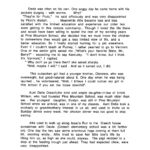
Davie was often on his own. One soggy day he came home with his pockets bulging — with worms. Why? “They’re for Pluto,” he said officiously and was very disappointed by Pluto’s disdain.
Meanwhile Allie became less and less satisfied with the limited education and experience our older two were getting in this remote community. Though I loved the life there and would have been willing to spend the rest of my working years at Pine Mountain School, she decided that we must move the children to somewhere they would get a less limited view of life and a better education. So I finally started hunting for a job elsewhere. Even if I couldn’t teach at Putney, I rather yearned to go to Vermont. One of the senior girls asked me, “What’s your favorite state, Mr, Berry?” — expecting me to say Kentucky. “I don’t know, but I think it’s Vermont,” I replied.
” Why don’t ye go there then?” she asked sharply. “Well, maybe I will,” I said. And as it turned out, I did.
This outspoken girl had a younger brother, Clarence, who was overweight, but good-natured about it. One day when he was being taunted, he volunteered, “Well, I b’lieve I could outrun ary girl in this school if you set me loose downhill.”
Aunt Delie [Delia] Creech, the kind and ample daughter-in-law of Uncle William, who had founded Pine Mountain School, was much older than we [were]. Her youngest daughter, Evelyn, still in Pine Mountain School when we arrived, was in one of my classes. Aunt Delia took a motherly or grandmotherly interest in us all and used to invite us to Sunday dinner every week. Her chicken dinner was too good to stop eating.
Allie used to walk up along Isaac’s Run to the Creech house sometimes with Davie. (Creech elementary school was a bit farther on). One day the two saw some enormous hogs coming at them full tilt, snorting wildly. Allie tried to save her little boy’s life by lifting him up, as high as she could, anyway. The pigs skidded to a stop at the feeding trough just ahead. They had expected chow [and] were very disappointed.
017 barry_autobiography_017 (page 222)
PINE MOUNTAIN 4
…Meanwhile, when I accompanied the baseball team to Redbird Settlement School, about thirty miles west, down the valley, we were trucked to Bledsoe, then walked. There was no road down the valley any further than that, only trails. It was an enchanting trip, through wonderful groves, woods, fields, and meadows, with a great wall (Pine Mountain) always to our left and a lower range to our right. I met another Harvard man, who enjoyed just wandering around that countryside, and we walked and talked together for a while. . . I had thought our team had gotten shellacked, but was corrected on that at the recent reunion. We won! . . . I think we spent the night at Redbird, and Brit came in the big red truck the next day, climbing over the mountain at Bledsoe and rounding its end at Pineville. [He] picked us up and drove us back.
I believe it was our second winter there when such a heavy snow came that it blanketed the upper half of Pine Mountain — and remained there for weeks. Every day you’d look up and see that bright white covering on the top half of the mountain — and marvel. But that happened only once, though each year we’d have brief late snows, and several “winters,” each named for a spring blossoming it was associated with: dogwood winter, redbud winter, etc. Spring in Pine Mountain was unbelievable, as the trees started flowering, and then the ground flowers. Allie waxed lyrical in describing it: particularly the lovely ubiquitous redbud, which itself enchanted the whole scene with its delicate, unbelievably charming rose hue, supplemented by the white of sarvis and dogwood. Here, there, and everywhere.
Burton Rogers was moderately tall, but slender. He had light hair and blue eyes, rather finely chiseled features. He was an immensely
018 barry_autobiography_018 (page 223)
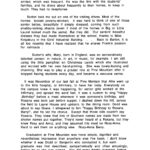
quiet person, and looked very serious all the time — except when he smiled, which was frequent. He was the link with the students’ families and he drove about frequently to their homes to keep in touch. They had no telephones.
Burton took me out on one of his visiting drives. Most of the homes looked poverty-stricken. It was hard to think of one of those senior belles, beautifully if simply dressed, coming from such shabby-looking shacks (even if most of the homes in Big or Little Laurel looked much the same). But they did. Our seniors’ beautiful dresses they had made themselves at the school, thanks to Miss [Helen] Kingsbury in the Girls’ Industrial Building.
Back to Burton, it is all too recently that I have realized that he shares Frank’s passion for railroads.
Burton’s wife, Mary [Rogers], born in England, was an extraordinarily talented person: in nature, in art, in music, for example. I am still using the little pamphlet on Christmas carols which she illustrated and worded with her own hand-printing. She was lovely-looking and charming. She was to play a greater role at Pine Mountain after it stopped having students every day and [the school] became a resource center.
It was November of our last fall at Pine Mountain that Allie went up to the little hospital, or Infirmary, to have her baby. Everybody on the campus knew it was happening, for senior girls worked at the Infirmary and spread the word fast. It was a custom to sing “Happy Birthday” before a meal whenever it was someone’s birthday, and Roxana was born just before supper. I dashed down the hill, across the field to Laurel House and upstairs to the dining room. Dodd was about to say grace. I whispered to him, “Happy Birthday to Roxana Barry!”, and he led the chorus. Except that those kids couldn’t say Roxana. They knew that lots of Southern names are made from two shorter names put together. They’d never heard of a Roxana, but they knew Roxy and Anna, and they assumed this must be Roxy-Anna. Hard to sell them on anything else. Roxy-Anna Berry.
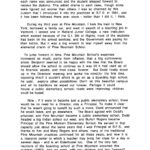
Graduation at Pine Mountain was more simple, dignified, and nevertheless impressive than anywhere else I’ve been. I don’t know whether it was Dodd or Benjamin who conducted it, but each graduate was first described sympathetically and often amusingly before he or she was named. You did some frantic guessing, before
019 barry_autobiography_019 (page 224)
each name was announced and the student stepped forward to receive the diploma. This added drama to each case, though some were figured out sooner than others. I was so charmed by this custom that I introduced it into the practices at B.F.S. in 1951 and it has been followed there ever since — better than I did it, I think.
During my third year at Pine Mountain, I took the train to New York, borrowed a family car, and went in search of a teaching job in Vermont. I landed one in Rutland Junior College, a new institution which existed because of the G.I. Bill of Rights. Most of the students had been in the armed services and the Government was paying for their tuition. But it was a big wrench to tear myself away from the elemental charm of Pine Mountain School.
To jump forward in time, Pine Mountain School’s expenses increased so much, partly from inflation, that a big controversy arose. Benjamin seemed to be happy with the idea that the Board should allow the school to continue as it was till it had used up all its financial assets and then close forever. But Dodd finally stood up in the Directors’ meeting and spoke his mind, for the first time, opposing this. If it couldn’t afford to go on as a boarding high school, he said, explore other possibilities. Don’t let this beautiful campus and all its traditions be wiped out forever. Perhaps it could house a public elementary school. Roads were improving [and] children could be bused.
Now, if it were to become just a public elementary school, there would be no need for a director, only a principal. To make it clear that he wasn’t going to benefit by such a move, Dodd announced that he would leave and go elsewhere. The Board agreed with Dodd’s proposal and Pine Mountain became a public elementary school. Dodd headed a big Indian school out west and Burton Rogers became principal of the Pine Mountain Elementary School. He served in that capacity just about the same years that I was principal at B.F.S., and thanks to him and Mary Rogers and others, many of the traditional Pine Mountain practices continued for all those years. [N]ow it is a resource center to which a teacher may bring her class for a day or several days — and is an Elderhostel too. One of the very last reunions of the boarding school at Pine Mountain occurred this summer (1997) and we went, with two children and two “grands”!
GALLERY I: STUYVESANT PETER AND ALICE BARRY Autobiographical Notes
(Pages 1-3, 203-211, 214-217, and 222-224 in the original document)
-

- barry_autobiography_002
-

- barry_autobiography_003
-

- barry_autobiography_004
-

- barry_autobiography_005
-
- barry_autobiography_006
-
- barry_autobiography_007
-

- barry_autobiography_008
-
- barry_autobiography_009
-
- barry_autobiography_010
-

- barry_autobiography_011
-
- barry_autobiography_012
-
- barry_autobiography_013
-
- barry_autobiography_014
-
- barry_autobiography_015
-
- barry_autobiography_016
-

- barry_autobiography_017
-
- barry_autobiography_018
-
- barry_autobiography_019
GALLERY II: Photographs
-
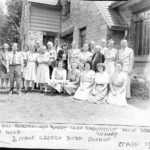
- 48 Full PMSS Staff photograph. Bramlett Album II. Staff 1947: Kingsbury; Gladys Hill; H.R.S. Benjamin; Mrs. Benjamin; Peter Barry; Alice Cobb; Abby Christensen; Willis; Sparrow; Dorothy La Rue; Glenn La Rue. Front row: Mr. Henderson; Dr. Henderson; Miss Cold; Dorothy Nace; Margaret Nace; Ruth Creech; Georgia Dodd ; Birdena Bishop. [ser_19_workers_misc_groups_0048.jpg]
-
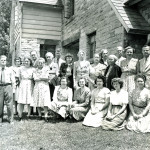
- Staff at Laurel House, 1947. Bottom row: Dorothy Nace, Margaret Nace, Ruth Smith, Mrs. Georgia Dodd, Mrs. Birdena Bishop. Front row: Ronald Henderson, Elizabeth Henderson, Miss Cold, Mrs. Benjamin, Miss Cobb, Miss Christensen, Miss Spinney, Miss Merrill, Mr. and Mrs. LaRue, Back Row: Miss Kingsbury, Miss Hill, Mr. Benjamin, Mr. Barry, Mrs. Willis, Miss Sparrow. [nace_1_038b.jpg]
-

- Peter Barry, teacher at Pine Mountain. X_100_workers_2603c_mod.jpg
-
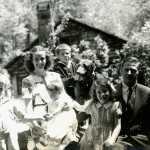
- David, Alice, Roxanna, Frank, Pluto, Kathy, and Peter Barry, 1947. [nace_1_041c.jpg]
-
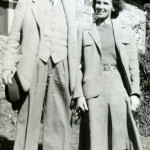
- Alice Barry and her father, Samuel Scoville, 1948. [nace_1_058c.jpg]
-
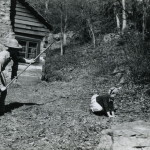
- Peter Barry and children enacting Peter and the Rabbit. [X_100_workers_2652_mod.jpg]
-
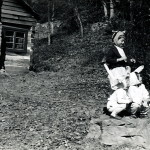
- Peter Barry children enacting Peter and the Rabbit. [X_100_workers_2651_mod.jpg]
-
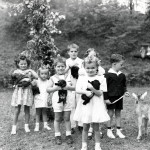
- 1945 May Day on the Dancing Green with (lft-rt) Kathy Barry, Helen Hayes, David Barry, Frank Barry, Libby Dodd, ? , Steven Hayes with goat. Arthur W. Dodd Album. [dodd_A_048_mod.jpg]
-
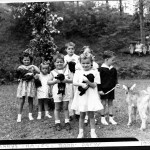
- May Day. Helen Hayes. David Barry. Frank Barry, Kathy Barry, Steven Hayes with goat. Elizabeth Dodd, in front. III_campus_life_0789
-
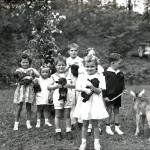
- ‘The young ‘uns.’ Human and otherwise, May 1946. Patsy O’Hearn, Helen Hayes [Wykle], David [Barry], Frank [Barry], and Kathy [Barry], Elizabeth Dodd, Steve Hayes. [nace_1_022a.jpg]
-
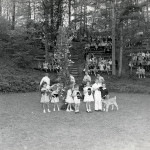
- May Day celebration. c. 1945. Staff children: (?), Helen Hayes, David Barry, Kathy Barry, Frank Barry, Steven Hayes, goat. [dodd_A_049_mod]
-
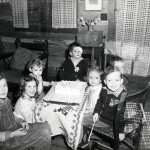
- Old Log Barry residence, interior, birthday party. Staff and community children. Arthur W. Dodd Album. [dodd_A_062_mod.jpg]
-
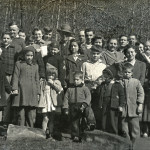
- Creech Sunday School and Church, February 1945. Taken by Robert Starbuck. (Front Row) Jean Cornett, Ola Mae Cornett, Charleen Cornett, David Barry, Kathy Barry, Frank Barry. (Second Row) Mrs. Charles Cornett, Dodd Lewis, Lester Cornett, Bobbie Hill, Barbara Wilder, Darwin Lewis, Mrs. Gib Lewis, Mrs. Omer Lewis, Mrs. Barry. (Third Row) Brit Wilder, Margaret Nace, Henry Creech, Owen Lewis, Mary Wilder, Mr. Pinke, Dorothy Nace, Mrs. Henry (Delia) Creech. (Last Row) Ella Wilder, Elmer Lewis, Mr. Gib Lewis, Mr. Alex Lewis. [nace_1_066a.jpg]
-
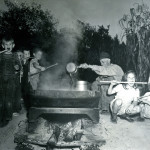
- Children’s Stir-off, September, 1946. Mable and Ralph Cornett, Helen and Steve Hayes, David Barry, Mr. Creech, Kathy Barry, Elizabeth Dodd. [nace_1_047a.jpg]
-
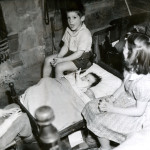
- Elizabeth Dodd, David, Roxana, and Kathy Barry in Old Log, 1947. [nace_1_041a.jpg]
-
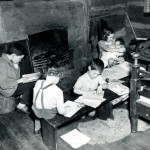
- Barry children in the living room of Old Log, home of the Barry’s. X_100_workers_2603e_mod.jpg
-
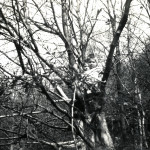
- Frank and David Barry up a tree. October, 1946. [nace_1_038a.jpg]
-
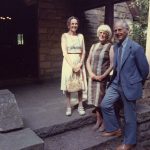
- Alice Barry, Mary Rogers, and Peter Barry at PMSS Homecoming. [barry_peter_mary_rogers_003.jpg]
SEE ALSO:
ALICE TRUMBULL (SCOVILLE) BARRY Staff – Biography
STUYVESANT ‘PETER’ BARRY Staff – Biography
STUYVESANT ‘PETER’ BARRY Family Correspondence Guide
STUYVESANT ‘PETER’ BARRY Family Correspondence I
STUYVESANT ‘PETER’ BARRY Family Correspondence II