
Pine Mountain Settlement School
Series 30: MUSIC AND DANCE
English Country Dance
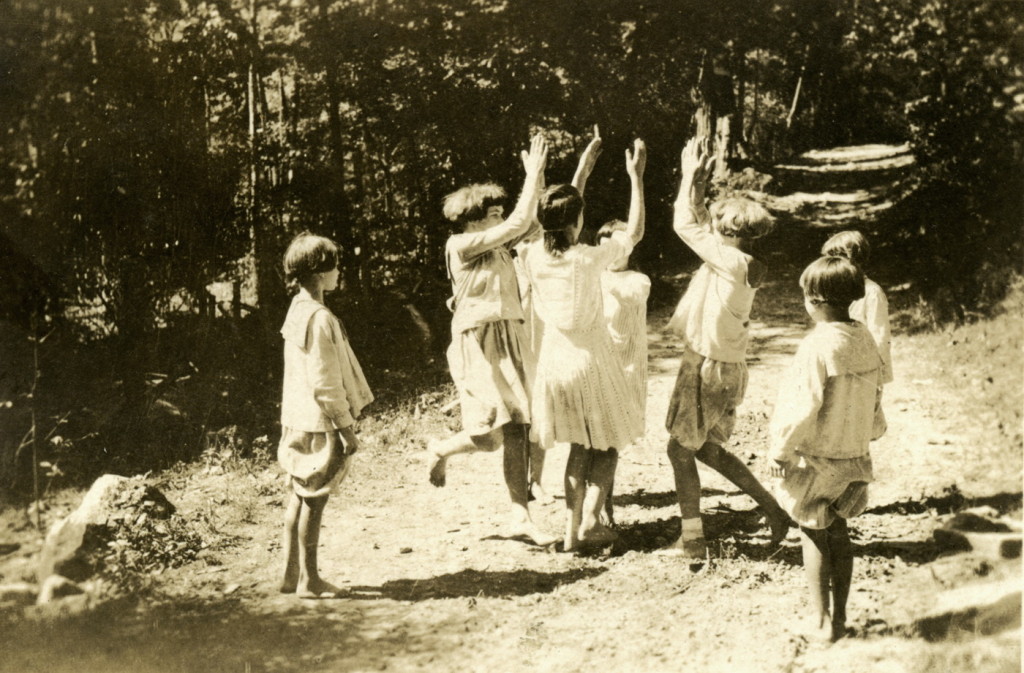
“Gathering Peascods,” c. 1920s. [hook_067_mod.jpg]
TAGS: English Country Dance, English Country Dance Society, English folk dancing, Armory, New York City, Kentucky Running Set, Glyn Morris, Cecile Sharp
DANCE English Country Dance
Some of the earliest photographs from Pine Mountain Settlement School depict students dancing. This famous photo (above) of barefooted young girls dancing “Gathering Peascods,” c. 1920, carries the exuberance that is seen in almost all the photographs of this favored recreation at the School.
Importance to PMSS Students
In the editorial from the January 1941 Pine Cone, the community paper published monthly by the students at Pine Mountain Settlement School, the editor signals how important English Country Dancing was to the School during the boarding school years (1913-1949). The romance of English Country Dancing continued throughout the following years.
Back in the days when “Good Queen Bess” ruled England, dancers with little bells strapped around their ankles performed on the green for Her Majesty. Five centuries later Cecil Sharp crossed the Atlantic and brought this same type of dance, which we know as folk dancing, to the United States.
Today in work camps, institutions, and clubs all over America, folk dancing furnishes the answer to what youngsters should be taught which is wholesome and which makes them think and enjoy themselves at the same time.
In Pine Mountain, with Cecil Sharp’s tunes and figures, folk dancing is practiced with as much airy lightness as “Good Queen Bess’s” performers attained, we hope. Unlike them, we do not dance because we are professionals and get pay for it, but to learn to appreciate the figures and go through them without faltering. This helps us to be graceful human beings with a light but sure foot on the ground.
Folk dancing is part of our amusement as well as of our learning. The Thanksgiving Ball is an event of much anticipation at which graceful dances such as Jenny Pluck Pears and Hearts-ease are done by girls in flowing dresses and boys in informal dress. This year the Ball was very special because we initiated the new dining room floor as a ballroom. The new students added greatly to the success of the Ball by their excellent cooperation in learning difficult dances.
Dancing indoors is fun but dancing out-of-doors on the dancing green is folk dancing at its best. That is just what we do on May Day. Students join together in making round and long-way sets of peppy figures such as Sage Leaf and The Ribbon Dance.
The purpose of folk dancing at Pine Mountain is not to train a group of our students to dance for the President, but to secure the participation of all students acting together. This stimulates clear thinking and creates a democratic form of living together.
Pine Cone, January 1941. Editor, Robert Blanton
English Country Dancing by the mid-1930s was well-established at Pine Mountain Settlement School. Under the direction of Glyn Morris, the School hired several accomplished country dance instructors: Evelyn K. Wells and later Dorothy Bolles, Abby Winch Christensen, and others. Many of the students became masterful performers.
White House Performances
The invitation received by Pine Mountain students to dance for President and Mrs. Franklin Roosevelt at the White House in 1937 was, for the selected dancers, a life-changing event, but it was also a proud event for every student. It was an honor that elevated Folk Dance to a high level of skill across the student body. The Presidential invitation of 1937 was an honor that was not repeated for Kentucky folk dancers until 1963 when the Berea College Country Dancers were invited to dance on the White House lawn for President John F. Kennedy.
Community Performance
The January 1941 Pine Cone follows the editorial with a report of another dance performance — this one for the immediate community in the county. This account records the integration of students and staff in the dance activities at the School.
SCHOOL DANCING PARTY PERFORMS FOR LOYALL HIGH
Piper’s Fancy was the beginning of a series of dances done by a group of Pine Mountain students and staff members at the Loyall High School on January twenty-third.
Special sets were formed by Mr. Hayes, Ruth Shuler, James Centers and Mary Pace in Hey Boys; Carl Farley, Mrs. [Georgia Ayers] Dodd, James Centers, Mary Pace, Louise Hawn, Bill Turner, Mr. Hayes and Bonnie Ayers in Hunsdon House. Additional students participating in the dances were Patsy Hall, Betty Elliot, Theda Howard, Charlsie Vaughn, Willard Enix, and Harvey Kinnard. The program was concluded with the Kentucky Running Set called by Bill Turner after which a dinner prepared by the senior girls of the Home Economics department was served.
Pine Cone, January 1941
Kentucky Running Set
One student’s dance performance was well described by a Northern newspaper (unknown source) and was clipped and placed in a large scrapbook for the School at Pine Mountain. It describes the enthusiasm of the Northern audience to a new dance in the English Country Dance repertoire, the so-called “Kentucky Running Set.”
First made famous by the noted English Country Dance instructor, Cecil Sharp, the Pine Mountain dancers put on quite a show for the audience in the Armory of New York City. The reporter who recorded the event declared, “Kentucky Hill Folk Dancers Show City How.” When Sharpe and his secretary Maude Karpeles saw the dance on the terrace of Far House I at the School in 1928, they knew they had seen something remarkable and declared it a remnant of the 17th century. “The Kentucky Running Set,” had long been a part of the socials of the Pine Mountain community and when the students of the School took their clapping and stomping to the English Country Dance festival in the New York Armory they were met with astonishment and delight. Ten girls and four boys, all from the Senior class of the School closed out the ninth annual English Folk Dance Society of America festival with an energetic and contemporary adaptation of English Country dancing, so said the anonymous author of the article. He went on to describe the dancers:
Benny Turner, the caller of the figures, led the mountain boys and girls through the intricate set without the aid of music but with rhythmic clapping and stamping to set the tempo. His calling was like no other calling which has been heard in New York, a traditional “yip” going before the name of each figure.
“Yip! Partners Left and Soot Owl! Yip!” Benny would cry in a high falsetto voice, then “Partner on the left and shoot the owl! Yip! Those Ocean waves! Yip! Lady ’round lady and gent also! Yip! Lady around gent — he won’t go!” There were other figures in which, oddly enough, the name of California figured — “California fruit basket” and “California show basket.” No one could be found to explain successfully this apparent anachronism.The youngsters kept it up on a dead run for twenty minutes and came back to their places with the applause of the 1,200 people in the armory in their ears. They were happy but much too dignified and poised to show it much. This was a characteristic of the mountain folk, [as] explained by Glyn A. Morris, in charge of the party. They maintained their stoic calm at all the wonders of New York, refusing to comment on skyscrapers and subways but they broke down a little when they saw the ocean for the first time in their lives at Asbury Park. …”
[unknown source]
See:
DANCE Guide