Pine Mountain Settlement School
Series 09: BIOGRAPHY – Staff
Edith Cold: Teacher, Librarian 1934-1947
Edith Cold (1879-1980)
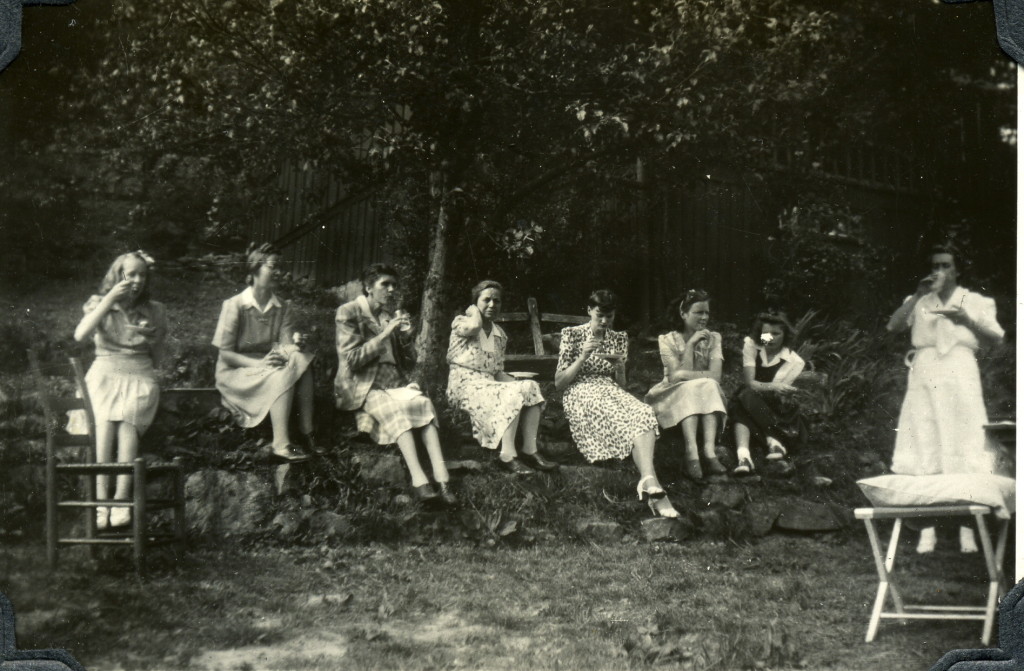
Edith Cold, 4th from left. Tea party at Country Cottage (Practice House) with (from left) Fern Hayes, (?Mrs Pishzak,) Gladys Hill, Edith Cold, Georgia Dodd, Mary Rogers, (?), Grace M. Rood, c.1942.Grace Rood Album II. [rood_115.jpg]
TAGS: Edith Cold, Bertha Cold, Pine Mountain Settlement School, dietitian, Pratt Institute, Hillsdale College, Adana, Turkey, Quakers, Ben Lomond CA, Santa Cruz CA, American Board of Commissioners of Foreign Missionaries, Congregationalist Church, Mennonites, Armenians, Hadjin, Turkey, Ottoman Turks, Armenian Massacre
EDITH COLD Staff
Teacher (English, “Reading, Bible and History”), Librarian
and Director of Nativity Play, 1934-1947
Edith Cold (1879-1980) came to Pine Mountain Settlement School as a teacher of English (1934-1947), Bible reading, and history (1942-1943), as well as a librarian (1940-1947). She had earned an A.B. at Hillsdale (Michigan) College and an M.A. at the University of Michigan at Ann Arbor.
Bertha Cold, Edith’s sister, a student at Pratt Institute in Brooklyn, New York, was also at the School from June 1933 through June 1935, as a dietitian.
The two Cold sisters maintained a lifelong correspondence with and affection for the School and for the colleagues they met while working there.
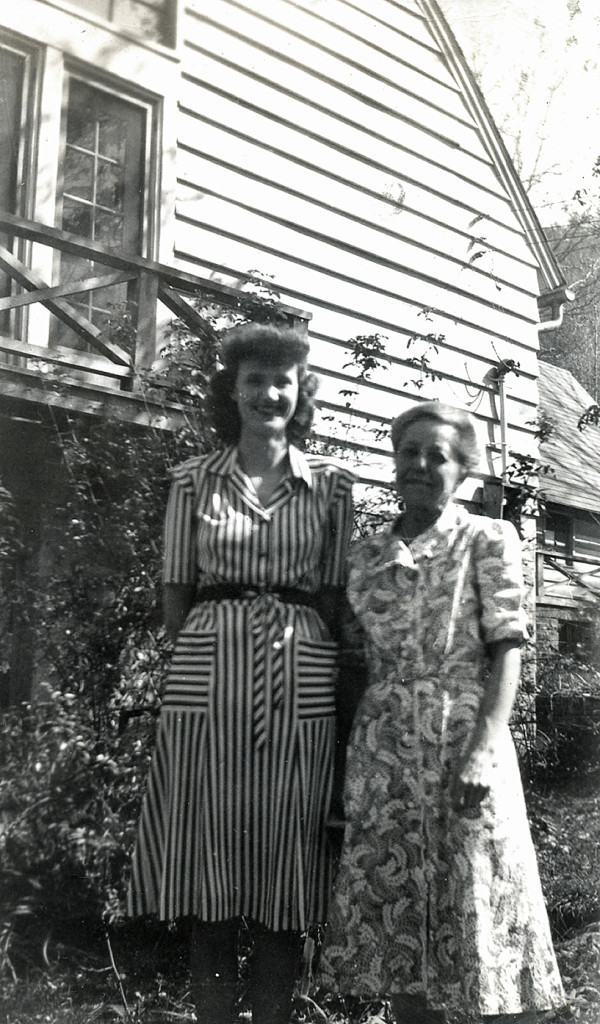
Georgia (Ayers) Dodd [left] with Miss Edith Cold, October 1946. [nace_1_036a.jpg]
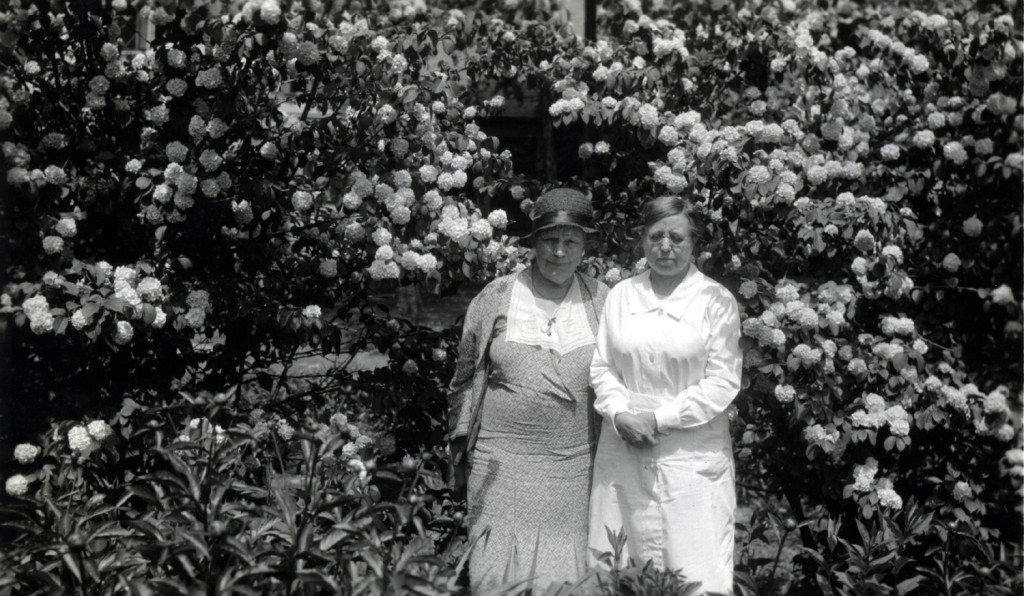
Bertha Cold [rt] with Dr. Ida Stapleton [lft], standing in front of large hydrangea [“snowball”] bush. [X_099_workers_2527m_mod.jpg]
EDITH COLD: Early History
Some of Edith Cold’s early history is recorded in notes accompanying the Ben Lomond Quaker Center.
Edith Cold, sister Bertha Cold, and a third sister, Lucile Cold Manley came from a Quaker family. Lucile and her husband Clyde, lived in Ben Lomond, CA, and the parcel of land they purchased in 1920 eventually became the “Quaker Center” in [Ben Lomond] Santa Cruz County, California. Edith Cold came to live at the center after leaving Pine Mountain and lived at the Center until her brief care in an assisted living center in the town of Santa Cruz, California. She died in 1976 [1980 ?]. Her home at the Ben Lomond Quaker Center became the central retreat building. In her late 90’s, Edith Cold was still raising soy beans in her garden and enjoying the many drop-in guests to her home on the mountain. She lived simply and with great thoughtfulness, much as she did most of her life.
**********
Edith Cold was born in 1879. She died in Santa Cruz, California, in 1980 at the age of 101. Further exploration suggests that the Cold family was not Quaker from the beginning, but had their roots in the related early Mennonite Church. Members of the church were often referred to as “Brethren.”
[UPDATE: According to an email to the co-editors dated September 12, 2025, from Edith’s sister Emma’s granddaughter:
I don’t think the family was Quaker while the sister were growing up. I was surprised to see Mennonite as I always thought Emma (my grandmother) was a Baptist before she became Presbyterian when she married my grandfather. I plan to email my family members and find out what they know.
EDITH COLD IN TURKEY/SYRIA – The Armenian/Ottoman Turk Conflict 1909
The inclusion of Dr. Ida Stapleton in the picture with Edith’s sister Bertha is important to the history that connects the Colds with the Stapletons. Theirs was a shared history. Edith and later, the Stapletons were in Turkey and Armenia during one of the most tragic events of history, the so-called “Armenian Genocide,” which resulted in the death of thousands of Armenians. The bond of Edith with the Stapletons has a very special poignancy. As difficult as the early years at the remote Pine Mountain Settlement School were for many, those years must have felt peaceful for both Edith Cold and for Dr. Ida Stapleton and her husband, the Rev. Robert Stapleton, while they were employed at Pine Mountain Settlement and at the nearby Letcher County medical center, Line Fork Settlement. The Stapletons and Edith Cold experienced one of the cruelest conflicts of history and one that has lingered in the minds of many — the so-called Armenian Genocide.
TURKEY AND THE AMERICAN BOARD OF COMMISSIONERS OF FOREIGN MISSIONARIES
In 1911-1915, Edith Cold was posted to Hadjin and what was then Adana, Turkey, serving with the Congregationalist Church through ABCFM (American Board of Commissioners of Foreign Missionaries). Edith had earlier become acquainted with the work of the ABCFM through contacts associated with the Brethren (Mennonite Church), and she became good friends with those who had placed missionaries in orphanages and in missions in many foreign countries. Working with the Committee for United Orphanages and Missions operated by the Congregationalist Church, an interdenominational organization that represented Mennonites, the Missionary Church, and the Mennonite Brethren in Christ and other denominations, Edith became interested in foreign service. An orphanage at Hadjin, Turkey, was one of Edith Cold’s assignments by the Committee for United Orphanages and Missions.
Arriving in Turkey in the first decades of the twentieth century was an unsettled time. The Turks had been brutally overrunning many small towns and cities of Armenian populations in what is now northern Syria. Their incursions were often brutal ones. Edith was serving in the region that began to see brutal exterminations of entire towns. By 1909, the towns of Hadjin and Adana, and other nearby population centers, had seen the extermination of thousands of Armenians by their Turkish occupiers. The tragic result of repeated conflict was an overwhelming number of orphaned children. The ABCFM foreign mission efforts were aimed at addressing the growing human tragedy of the conflict, and they had established orphanages in the region to care for the growing number of orphaned children. The missionaries charged with the care and education of the children in a series of orphanage-schools established in the region during the early conflicts had some insulation from the brutal world surrounding them, but were becoming especially vulnerable.
“THE SITUATION”
While stationed at Hadjin in 1915, Edith Cold wrote a report, titled “The Situation,” which describes the conditions and the “situation” she encountered at her outpost in Hadjin. At the time, Hadjin was recognized by Turkey as a Turkish village, but not one that was aligned with Ataturk, the brutal oligarch whose tactics against rebellion have been described by history as genocidal. Edith Cold’s report filed with the ABCFM casts another light on the situation in Hadjin. She characterized the current situation as one of the most telling confirmations of the brutal attempts by Ataturk to “cleanse” his country of dissenters and threats to his reign. Edith and others reported his tactics that included the brutal massacre of Armenians.
History has confirmed that some 30,000 Armenians lost their life in the years from 1909-1915, as part of what has been called the “Young Turk Revolution.”* Edith Cold’s work in Turkey is documented along with other brutal news accounts and documents that confirmed the brutality of the political situation associated with the charitable work of Edith Cold and others in Armenia and in Turkey.
THE ESCAPE FROM HADJIN
Listed below is the gripping account described by Edith Cold of her escape from Hadjin with her young charges, as described by her and recorded in the New York Times.
AMERICAN WOMAN GOES WITH FLAG OF TRUCE; Risks Her Life in Effort to Stop Fighting and Save Armenian Orphans. May 10, 1920; ProQuest Historical Newspapers The New York Times (1851 – 2006): p. 17. Internet resource.
In another New York Times article of November 2, 1920, the headline read:
Turks Take Hadjin, Slay 10,000 Armenians;
Town Had Withstood Siege for Eight Months
Prior to the siege of Hadjin, Edith Cold had described for her employers the tragedy of the nearby town of Adana that was overrun by the soldiers of Ataturk in 1909. Adana, near Hadjin, had fallen to a brutal siege, but remarkably, the town of Hadjin had been able to withstand the less violent Turkish assaults on their town; it then, too, faced the full onslaught of Ataturk. Cold’s vivid account of her time in Hadjin during the Ataturk siege, occupation, and her escape with the children in the orphanage is one of the more gripping accounts of the terrifying period of war. The Hadjin account graphically described in the New York Times account tells of the vulnerable position of charitable Christian missions in Turkey during this tense time and how the missionary enclaves dealt with the conflict. The account is that of Edith Cold.
The sweep of the town of Hadjin by Ataturk’s soldiers, often characterized as genocidal, was not, however, a clean sweep, and that was due, in part, to the smart and courageous efforts of Edith Cold and others associated with the Hadjin mission. As part of the mission work with the children made orphans by the earlier aggression and atrocities, Edith and others had learned how to negotiate the many threats to the orphanage and to their own lives and those of the children. Edith’s life was threatened in many instances, but she and her staff stood firm until the brutality and several deaths within the compound forced their escape under unimaginable circumstances.
By 1915, more than 1.5 million Armenians had been killed in what has been called a genocidal sweep of the largely Christian Armenian population and the missions that served them. The memory of the brutality of the Ottoman regime and the Young Turk Revolutionaries continued to be an undercurrent of unstable relations in the region, especially along the borders of Turkey and Syria. The Stapletons came to Turkey later and experienced the instability of these geographies and relations.
The events of the days at Hadjin stayed with Edith throughout her life, and those who knew her were infrequently afforded a glimpse into the events that shaped her very core so early in her formative years. Edith Cold was central to the rescue of many children and staff before she departed Turkey in 1915. Today, Hadjin is largely in ruin. The story surrounding the circumstances of that time is well documented, and a recent extensive website provides many photographs of the period, but centers on a time when Edith was away on leave. While still somewhat fragmented, the story of Edith Cold’s years in Hadjin remains one of enormous courage and intelligence, and clearly was central to the formation of her deep commitment to children and to education. The graphic record of Hadjin recently made available here helps to give Hadjin a visual presence, but much remains to be discovered regarding her years in the Middle East.
For an overview of the Mission at Hadjin and a cultural view of the region, see: https://www.houshamadyan.org/home.html
Very little of the original Hadjin town remains, and the accounts of the years in which Edith Cold worked in Turkey are fragmented and difficult to reconstruct. Some of the events in which Edith played a central role were recorded in the New York Times article. These details are not fully aggregated. Yet, they begin to fill in the gaps of her harrowing time in war-torn Turkey. The New York Times accounts are cited in the bibliography that follows this brief biography. The first-hand accounts written by Cold as reports on the Central Turkey Mission may be found in the papers of the American Board of Commissioners for Foreign Missions and are in the papers at Bilkent University in Turkey. See:
http://www.bilkent.edu.tr/~history/index_files/ABCFM/670.htm (accessed 2013-12-04). The partial listing, below.
Also, for an excellent PHOTO-ESSAY of Hadjin, see the comprehensive paper written by Rosemary Russell, “Hadjin: New Perspectives on the Siege and Massacre,” for the Journal of Armenian Studies, pp. 95 – 118. [http://rosemaryrussell.com/wp-content/uploads/2014/06/04-Russell-Hadjin.pdf]
DR. IDA STAPLETON AND REV. ROBERT STAPLETON: “The Storm of Life: A Missionary Marriage from Armenia to Appalachia”
A New Zealand author, Gretchen Rasch, granddaughter of Dr. Ida Stapleton and the Rev. Robert Stapleton, the two Pine Mountain workers, mentioned above, has has written a remarkable book that details the life of her grandparents. Rasch’s grandmother and her grandfather also experienced the brutal years of conflict in Turkey between the Ottoman Turks and the Christian Armenians. Her new 2015 publication, [Rasch, Gretchen. The Storm of Life: A Missionary Marriage from Armenia to Appalachia, Gomidas Institute, 2016. [ : contains the letters of her grandmother and grandfather, detailing their life as Mission workers in Turkey before coming to Pine Mountain. The letters from Pine Mountain detail the life at Linefork as employees at Line Fork Settlement near Pine Mountain. Rasch researched the later experience of her Grandparents in Turkey, and her account is an excellent supplement to the accounts gathered around Edith Cold. Rasch also explores her Grandparent’s first few years in Turkey when they, too, were caught up in the Armenian-Ottoman conflict. Rasch also sheds more light on the relationship of the Congregationalist Mission program in Turkey and the complexity of the massive loss of life of the Armenians who were at the center of the work of Edith Cold and the Stapletons.
The loss of so many Armenians remains a difficult subject and is frequently depicted as a genocide. The notion of genocide continues to bring the Turkish government’s denial. There is universal agreement that the Armenian-Ottoman Turk conflict was brutal and complex. Rasche’s book helps to unravel the complex conflicts in the border regions of Turkey and provides a detailed first-hand account of the conflict across the region. It is an excellent complement to the brief accounts of Edith Cold.
Author Gretchen Rasch’s book, her grandparents’ letters, and Edith Cold’s records all explore the Armenian-Ottoman Turk conflict in a deeply personal manner that opens windows into the ongoing conflicts in the region and the human and inhuman response to cultural difference. The accounts of the Stapletons and of Edith Cold in Turkey make difficult reading, but they serve to remind us all of the perils of tribalism, of ethnic exclusion and “cleansing”, and the ephemeral nature of borders and religious rigidity. The important role of women like Dr. Ida Stapleton, Edith Cold, and other courageous women continues to play significant roles in saving the lives of countless children and their families in war, natural disasters, and economic displacement. That Pine Mountain had the opportunity to share the lessons learned in this far-away land “acrost the sea” as William Creech hoped would happen, is among Pine Mountain’s remarkable contributions to history.
Edith Cold was also a witness to the deportation of Armenians from Erzerum and the subsequent battle for that city between Turkish and Russian forces during World War I. She was assigned to a location some distance from the Stapleton’s home base, located in the Erzurum area.
The conflicts described by all three parties and the retelling of the widespread and horrific outcomes of ethnic and political strife across a wide territory were most likely part of the educational stories of all three workers who brought the stories home to the children of Pine Mountain. All three Americans were witnesses to the horror of the Armenian massacres, and all three carried their experiences to Pine Mountain, where they used their wisdom to address the ravages of poverty, isolation, education, and community conflicts.
The Stapletons were well-seasoned instructors. They adjusted rapidly to the hardships of Line Fork in the early years of the twentieth century. The severe medical, social, and religious needs of the Line Fork area during 1926-37 were many. Life at Pine Mountain for all three former foreign missionaries, helped to heal the mental wounds they surely carried away from the Armenian-Ottoman Turk conflict but their wounds were salve for the instrumental processes needed to help the Line Fork community avoid similar conflicts, injuries, diseases, poverty, the strife of body and soul, especially the unexpected tragedies of life that sit so very close to the lives of us all.
Edith Cold’s experiences in Turkey, and the events at Adana, Hadjin, and other Armenian towns had a profound influence on the remainder of her life, which she devoted to peace and to a very simple lifestyle. Following her Armenian mission work, Edith Cold taught in several schools before she was employed by Pine Mountain Settlement School in the 1930s and 1940s. At Pine Mountain, her focus was well honed and, from all records, was profoundly important to the lives she touched — both children and adults.
While Dr. Ida and Rev. Robert Stapleton also worked in Turkey near the same time as Edith Cold, they came later to Pine Mountain Settlement to head the Line Fork medical outpost. They overlapped with Edith’s sister Bertha. It is not clear what the extent of the Stapleton-Cold[s] relationship was prior to Pine Mountain. They appear to have had connections through the Women’s Board of Missions of the Interior, as did a small group of workers at Pine Mountain, particularly those who saw international missionary work in China, India, Africa, and other foreign countries. The earlier direct relationship of the three workers remains to be explored and could further develop the religious and educational history of Pine Mountain Settlement.
EDITH COLD as a Poet
Edith Cold, was a soft-spoken woman who thought deeply about life and the role of kindness and bravery in life’s journey. Her view was most always outward, but she had a soft and deep inner soul, often expressed in her writing. She frequently found solace in poetry and inspired many students to hone their language and to then reflect on life in its most intimate and introspective moments. Her poems, such as “Mist,” seen at the beginning of this essay, and here, another, “Altar Flowers” are simple but strong reminders of the power of language, of light, and the role of love in the illumination of the soul.
ALTAR FLOWERS
. Pendant from the Chapel wall
Where the altar stands,
Sprigs of wayward ivy
Hang in dusky bands
When to that shadowed corner
Illumination comes,
The leaves turn into blossoms,
Radiant as suns.
See her touching article written for Mountain Life and Work in the Spring of 1947, “The King’s English” that captures her sensitivity to language and the more subtle nuances of life in the work of her students.
MIST
The mist with gentle fingers
Strokes my face.
Trying with elemental coolness
Its fatigue to efface.
– Miss E. Cold for the Dec. 1937 PINE CONE
See also the Stapleton Reports and Letters at Pine Mountain Settlement School, which form the foundation of Gretchen Rasch’s research on her grandparents’ early lives. The Stapletons’ Kentucky years provide graphic descriptions of life in the small community of Line Fork in Letcher County, Kentucky. [Rasch, Gretchen.The Storm of Life: A Missionary Marriage from Armenia to Appalachia, Gomidas Institute, 2016. [ :
Author Gretchen Rasch’s interests are a nice fit with PMSS. With a background in threatened species protection, she worked with the US Forest Service, NZ Forest Service, and the Department of Conservation. Her work in aquaculture permitting at the Ministry of Fisheries, where she “trained staff in report writing and the use of plain English,” certainly prepared her for this excellent book on her great-grandparents. A great read!
See Also:
ALICE COBB War’s Unconquered Children Speak
BERTHA COLD 1932-1940 Correspondence
BERTHA COLD Staff, Dietitian (Edith Cold’s sister)
EDITH COLD CORRESPONDENCE I, 1935-1939
EDITH COLD CORRESPONDENCE II, 1940-1947
EDITH COLD CORRESPONDENCE III, 1947-1958
EDITH COLD CORRESPONDENCE IV, 1959-1972
Dr. IDA STAPLETON & Rev. ROBERT STAPLETON Staff
|
Title |
Edith Cold |
|
Alt. Title |
Edith Cold and Bertha Cold |
|
Identifier |
|
|
Creator |
Pine Mountain Settlement School, Pine Mountain, KY |
|
Alt. Creator |
Ann Angel Eberhardt, Helen Hayes Wykle ; |
|
Subject Keyword |
Edith Cold ; Bertha Cold ; Pine Mountain Settlement School ; teachers ; dietitians ; librarians ; Hilsdale College ; University of Michigan ; Lucile Cold Manley ; Clyde Manley ; Pratt Institute ; Quakers ; Ben Lomond Quaker Center ; Mennonites ; Central Turkey Mission for the Mennonite Brethren in Christ of Pennsylvania ; Armenians ; Turks ; foreign missions ; Armenian massacre ; Young Turk Revolutionaries ; genocide ; Christian Armenians ; Ottomans ; New York Times ; Bilkent University ; American Board of Commissioners for Foreign Missions upon the Near East ; Pine Mountain, KY ; Harlan County, KY ; Hilsdale, MI ; Ann Arbor, MI ; Brooklyn, NY ; Ben Lomond, CA ; Santa Cruz County, CA ; Hadjin, Turkey ; Adana, Turkey ; Ankara, Turkey ; Lakewood, CA (?) ; Honolulu, Hawaii ; Chicago, IL ; Oberlin, OH ; |
|
Subject LCSH |
Cold, Edith, — 1879 – 1980. |
|
Date |
2007-09-14 |
|
Publisher |
Pine Mountain Settlement School, Pine Mountain, KY |
|
Contributor |
n/a |
|
Type |
Collections ; text ; image ; |
|
Format |
Originals and copies of documents and correspondence in file folders in the filing cabinet |
|
Source |
Series 9: Staff/Personnel |
|
Language |
English |
|
Relation |
Articles in the 1920 issues of The New York Times include accounts of the bravery of Edith Cold and others in the face of the Armenian massacres; Pine Mountain Settlement School Collections, Series 9: Staff/Personnel. |
|
Coverage Temporal |
1879 – 1980 |
|
Coverage Spatial |
Pine Mountain, KY ; Harlan County, KY ; Hilsdale, MI ; Ann Arbor, MI ; Brooklyn, NY ; Ben Lomond, CA ; Santa Cruz County, CA ; Hadjin, Turkey ; Adana, Turkey ; Ankara, Turkey ; Lakewood, CA (?) ; Honolulu, Hawaii ; Chicago, IL ; Oberlin, OH ; |
|
Rights |
Any display, publication, or public use must credit the Pine Mountain Settlement School. Copyright retained by the creators of certain items in the collection, or their descendants, as stipulated by United States copyright law. |
|
Donor |
n/a |
|
Description |
Core documents, correspondence, writings, and administrative papers of Edith or Bertha Cold; clippings, photographs, books by or about Edith or Bertha Cold ; |
|
Acquisition |
n/d |
|
Citation |
“[Identification of Item],” [Collection Name] [Series Number, if applicable]. Pine Mountain Settlement School Institutional Papers. Pine Mountain Settlement School, Pine Mountain, KY. |
|
Processed By |
Helen Hayes Wykle; Ann Angel Eberhardt ; |
|
Last Updated |
2007-00-14 hhw; 2013-11-30 hhw ; 2013-12-03 aae ; 2016-03-05 aae ; 2023-10-30 aae; 2024-10-10 aae ; 2025-09-12 aae ; 2026-03-12 aae ; |
|
Bibliography |
Sources Notes from the Pine Mountain Settlement School (1937 – 1938). Series 17: PMSS Publications. Pine Mountain Settlement School Institutional Papers. Pine Mountain Settlement School, Pine Mountain, KY. Internet resource. Pine Mountain Settlement School Archives. PMSS Staff Directory and Pine Mountain 1943 Family Album. Series 9: Staff/Personnel. Pine Mountain Settlement School Institutional Papers. Pine Mountain Settlement School, Pine Mountain, KY. Internet resource. “A Quaker Center Chronology.” Ben Lomond Quaker Center. http://www.quakercenter.org/history-quaker-center-chronology-1949-2012/ (accessed 2013-12-03). Internet resource. Bibliography Arpee, Leon. A Century of Armenian Protestantism. Published by Cambridge University Press on behalf of the American Society of Church History, Vol. 5, No. 2 (June 1936): pp. 150-167. doi:10.2307/3160526. http://journals.cambridge.org/action/displayIssue?decade=1930&jid=CHH&volumeId=5&issueId=02&iid=8555978 (accessed 2013-12-03). Internet resource. Arpee, Leon. A History of Armenian Christianity From the Beginning to Our Own Time [A centennial volume marking the one hundredth anniversary of Armenian Protestantism, 1846-1946.] New York, Armenian Missionary Association of America, 1946. FULL TEXT from Hathi Trust. (accessed 2015-09-01), Internet resource. American Board of Commissioners for Foreign Missions. The One-Hundred and Seventh Annual Report of the American Board of Commissioners for Foreign Missions – together with the minutes of the meeting held at Columbus, Ohio, October 15, 1917. Boston: The Board Congregational House, 1917.The Armenian missionary association of America, Inc., 1946
Lambert, Rose. Hadjin and the Armenian Massacres. New York: Fleming H. Revell, 1911. First Edition. Octavo. Approx. 7 x 4.5 inches. Frontis: Photo of author. Other full page sepia photos – various views of Hadjin, Armenian population, missionaries, Rev & Mrs. Henry Maurer. Adana after the Massacre. Introduction by O. B. Snyder. Print. The New York Times with Index. Proquest Historical Newspapers. http://www.proquest.com/assets/literature/products/databases/HNP_NYT.pdf (accessed 2013-12-04). Internet resource. Descriptions of the events in Hadjin, Turkey, are included in the following articles found in the New York Times: (1851 – 2006). Internet resource. AMERICAN WOMAN GOES WITH FLAG OF TRUCE; Risks Her Life in Effort to Stop Fighting and Save Armenian Orphans. May 10, 1920; ProQuest Historical Newspapers The New York Times (1851 – 2006): p. 17. Internet resource. DEMANDS NILSON’S RELEASE; American Destroyer Sends Airplane Message to Turkish Nationalists. New York Times (1857-1922); Jul 3, 1920; ProQuest Historical Newspapers The New York Times (1851 – 2006): pg. 8. Internet resource. Russell, Rosemary. “Hadjin: New Perspectives on the Siege and Massacre,” for the Journal of Armenian Studies, pp. 95 – 118. http://rosemaryrussell.com/wp-content/uploads/2014/06/04-Russell-Hadjin.pdf [Accessed 2014-10-30] Rosemary Russell has researched Rose Lambert and her work with the American Missionary Women in Turkey. https://twitter.com/rose11mary Matoian, Catherine. Influence of American Missionary Women in Turkey, Senior paper, 2009, UNCA Department of History, [Paper is specific to Edith Cold in Turkey] http://toto.lib.unca.edu/sr_papers/history_sr/srhistory_2008/mosian.pdf [Accessed 2014-10-30 “Grateful Turk Saved American Women By Delaying Shelling of Their Compound.” New York Times (1857-1922); Jul 8, 1920; ProQuest Historical Newspapers The New York Times (1851 – 2006): pg. 22. Internet resource. “AMERICAN WOMEN MADE TURKS OBEY.” Copyright, 1920, by The Chicago Tribune Co., New York Times (1857-1922); Jul 9, 1920; ProQuest Historical Newspapers The New York Times (1851 – 2006): pg. 14. Internet resource. AMERICANS GIVE UP ORPHANS TO TURKS; Women Forced to Surrender Compounds at Hadjin–Boys Reported Slain, Girls Abducted. ABANDONED BY FRENCH No Clause for Protection of Armenians in Franco-Turkish TruceTerms in Cilicia. New York Times (1857-1922); June 16, 1920; ProQuest Historical Newspapers The New York Times (1851 – 2006): pg. 6. Internet resource. WRITTEN BY MISS EDITH COLD Cold, Edith. “A Sojourn in the Valley of the Shadow of Death.” The Missionary Herald. October, 1920: Vol. 116, pp. 445- 448. (Original from Harvard University). http://babel.hathitrust.org/cgi/pt?id=hvd.ah6eji;view=1up;seq=510 (accessed 07 Sept 2015). Internet resource. “Letters from Edith Cold” reside in the archive of the Bilkent University American Board of Commissioners for Foreign Missions upon the Near East, 1817-1919, in Ankara, Turkey. They have been microfilmed by the Department of History at Bilkent University. Microfilm. Reference no. BV2410.A4 1984, Reel 670. Degree of readability: R (e.g., readable – all of the letters are in very good condition.) FULL TEXT NOT AVAILABLE ONLINE. http://www.bilkent.edu.tr/~history/index_files/ABCFM/505.htm (accessed 12-12-04). Internet resource. “The Situation,” as described by Edith Cold, included the following points: II. Central Turkey Mission 1- Difficulties of Past Two Years http://www.bilkent.edu.tr/~history/index_files/ABCFM/670.htm (accessed 2013-12-04). Internet resource. “Papers of the American Board of Commissioners for Foreign Missions” include the following: ABC 16: The Near East 3) Letters from Edith Cold: 3.1. to Barton: 3.2. to Mr. Lee: 3.3. Statements by Miss Cold: 3.4. to Bell: 3.5. to Barton: 3.6. to Bell: 3.7. to Barton: 3.8. to Mr. Case: 3.9. to Bell: OF FURTHER INTEREST: Moranian, Suzanne Elizabeth. The American missionaries and the Armenian question: 1915-1927. Published 1994
Series: Documents in The Pine Mountain Settlement School Archives, Pine Mountain, KY. [Includes various references to Edith Cold in the history of PMSS by Evelyn K. Wells and other notes and histories found throughout the collection.] Photograph collection. [None identified.] |
Return To:
BIOGRAPHY – A-Z