
Pine Mountain Settlement School
Series 08: ADMIN CORRESPONDENCE
Series 16: EVENTS
World War I
Pine Mountain Settlement School 1919
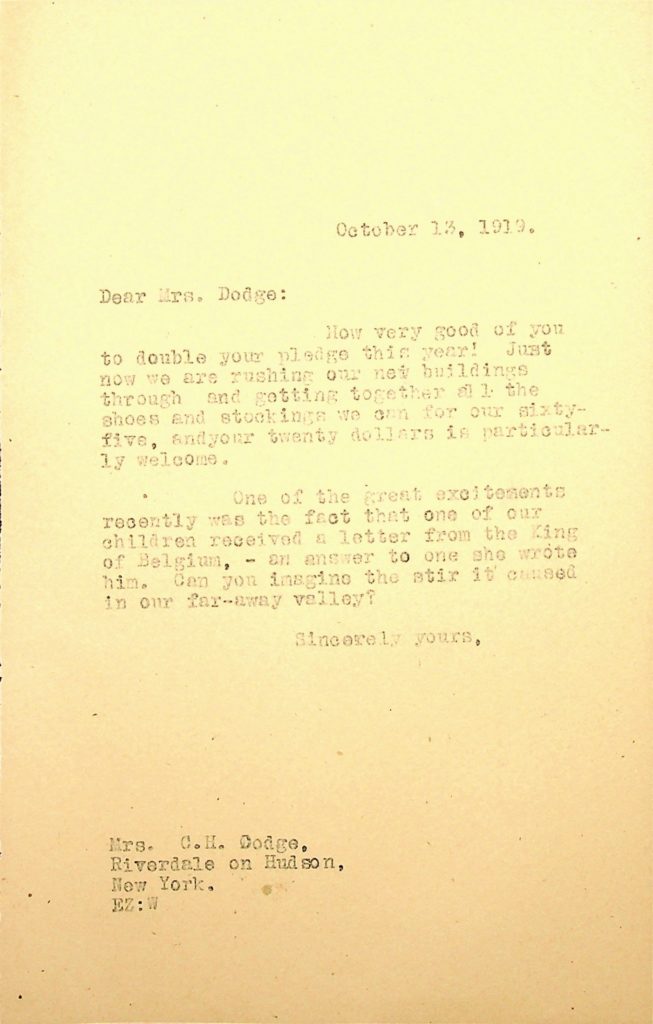
Copy of thankyou letter to Mrs. Cleveland Hoadley Dodge [cleveland_hoadly_012.jpg]
TAGS: Ethel de Long, correspondence with donors, World War I, WWI, student correspondence, King Albert I of Belgium, Leon Deschamps, Mrs. Cleveland Hoadley Dodge, Father Anton Docher, Native Americans, Pueblo Isleta, Willa Cather, Phelps Dodge Inc., philanthropy, Riverdale Neighborhood House, Agrarian Myth, Settlement Movement
EVENTS – WORLD WAR I and Pine Mountain Settlement School
The Letter, October 13, 1919
A copy of a small letter from October 13, 1919, in the archive at Pine Mountain Settlement School captures the broad reach of Pine Mountain during its formative years. It is a startling letter in its brief but hidden details. The letter, one of many that were sent to donors to the School, by the directors and staff, informs us of the close attention the students and workers at the School gave to the War effort in the first decade of the nineteenth century.
Addressed to Mrs. C.H. Dodge at Riverdale on the Hudson, New York, and dated October 13, 1919, the letter thanks Mrs. Dodge for her recent pledge to the School and tells her of the work underway on the new buildings for the School. The author of the acknowledgment letter is “EZ”, or Ethel de Long Zande, co-director of the School. She tells Mrs. Dodge that the School is busy getting shoes and stockings together for all the sixty-five students and that they are very appreciative of her $20 dollar donation.
Mrs. Zande in her letter goes on to describe a recent exciting event. The event involves a young student at the school. He had written to the King of Belgium, Albert I about the war. Probably inspired by the anxiety and patriotism of Leon Deschamps, a Pine Mountain worker recently settled in the United States from Belgium.
The child’s letter remarkably found its way to King, Albert I, of Belgium, who answered the child’s letter. When the answer from the King was received, it animated the full Pine Mountain community. Mrs. Zande asked her New York friend Mrs. Cleveland Hoadley Dodge, “Can you imagine the stir it caused in our far-away valley?” Unfortunately the letter from King Albert I cannot be found in the Archive. Nonetheless, the record of the correspondence alone is extraordinary. The story runs much deeper.
King Albert I and Father Anton Docher
1919 was the year that Belgian King Albert I visited the United States. From September 23 through November 13, the King, his Queen, Elisabeth of Bavaria, and their son Prince Leopold II made an official visit to the United States. Their American visit included a trip to a small Native American pueblo in New Mexico, the Pueblo Isleta. There, the King honored Father Anton Docher, a former hero of WW War I. The homage centered, particularly, on his work in the Belgian Congo. The King was intent on bestowing on him the insignia of Knight in the Order of Leopold II and the French Colonial Medal, for his war courage and service to Belgium.

Anton Docher. (2023, November 16). In Wikipedia. https://en.wikipedia.org/wiki/Anton_Docher
Anton Docher, the focus of the award, left the War and the Congo a changed man. He soon studied for the priesthood. During the remainder of his life Father Anton asserted that colonialism was an international evil and he committed his life to serving and learning from various Native tribes in New Mexico about their oppression. By all accounts, the Belgian-New Mexico ceremony to honor Docher was no small event as some ten thousand people reportedly came to attend the ceremony in the small Pueblo Isleta.

Father Docher also did not escape the attention of the writers of his day. The noted author Willa Cather used Father Docher as the model for her well-received novel, Death Comes for the Archbishop, (New York: Alfred Knopf, 1927.)
From New Mexico, Albert I and his entourage traveled to New York where the King was honored with membership in the New York Society of the Cincinnati and was given a ticker-tape parade. Hence the New York connection and Ethel de Long Zande’s clever comment on October 13, 1919, to Mrs. Cleveland Hoadley Dodge in Riverdale, New York.
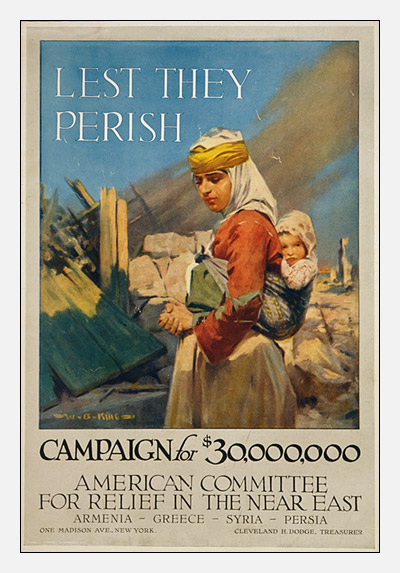
“Lest They Perish: Campaign for $30,000,000. American Committee for Relief in the Near East.”[Genocide_poster_USA.jpg]
The Dodge family was well-known and highly regarded in New York where they moved among many of New York’s notable families of wealth. Cleveland Hoadley Dodge had built his fortune in copper mining and was a major player in support of the war effort. He was an executive at Phelps Dodge, a leading copper mining corporation in the U.S. that had been co-founded by his grandfather in 1832. His family was known for its generous philanthropy.
Further, his daughter, Grace Hoadley Dodge, was well connected to the national Settlement Movement of Jane Addams. Her brother’s institution of the Cleveland H. Dodge Foundation and the larger Phelps Dodge Foundation helped her to further the work of the Riverdale Neighborhood House which she began as a neighborhood library at the early age of sixteen and that even today, in expanded form, continues to provide services to Riverdale and surrounding communities.
World War I and Pine Mountain Settlement School
Literacy and remarkably, optimism, was an idea close to the heart of Ethel de Long Zande and Katherine Pettit. The early novels of Willa Cather — Oh, Pioneers! (1913), The Song of the Lark (1915), and My Antonia (1918) — were all written during this period of Pine Mountain’s early development. The ages of the women were similar. Like Katherine Pettit and Ethel de Long Zande, Cather had a deep and close attachment to the land. Writing in 1918, she notes
In the course of twenty crowded years one parts with many illusions. I did not wish to lose the early ones. Some memories are realities, and are better than anything that can ever happen to one again.
It is this optimism that shines through in many of the letters from Pine Mountain during this difficult war-time period.
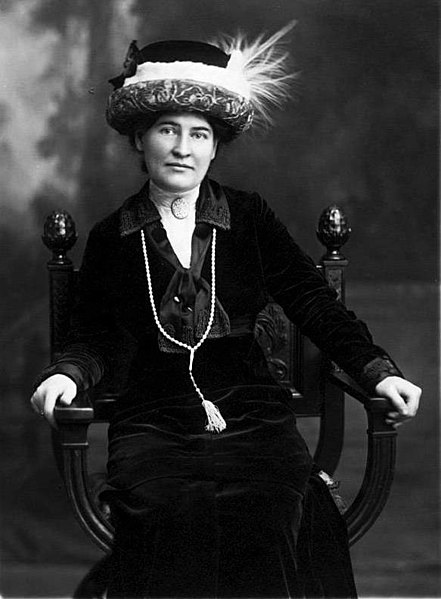
Willa Sibert Cather, Wearing necklace given her from author Sarah Orne Jewett, another lover of the land. [Public Domain, wikisource.org]
TRANSFORMATION AND ELEMENTS OF THE AGRARIAN MYTH THROUGH RELATIONSHIPS
Like Cather, PMSS Director Katherine Pettit’s fierce attachment to the land and its nurturing wealth of lessons pervades the creative elements that helped to move Pine Mountain and the larger country out of the War years.
Many of the workers who came to Pine Mountain, came with the romanticized vision of what has come to be called the “Agrarian Myth.” It carries many of the markers of the Settlement Movement, and the challenges that accompany immigration. The myth, the movement, and the challenges blended into one as the nation went to war and then sought to heal the wounds of war. Many citizens carried their personal experiences of the challenges and horrors of WWI forward. Life during war-time in countries “acrost the sea,” (as Uncle William would say) was closer to the students and staff at Pine Mountain than most would imagine. It was a remote mountain school, but it was also remarkably connected. The personal narratives of some of the workers set the imaginations of the students racing and learning. Ultimately, what all the workers and the students held in common was a world view — something outside their known experiences. Hope for a better future that took its image from the land and its people was a starting place for both. — whether “insider” or “outsider”.
The integrated experiences, the personal relationships, the kindnesses, the honor and social justice, and the hopes of humankind, bound many lives together during the formative years of Pine Mountain Settlement School. These shared experiences exploded narrow and protected mountain lives in a manner that is difficult to describe to today’s electronic youth separated as they often are from the tangible present and often isolated by their electronic world. The sensitive understanding and the indirect encounters with larger social forces were often tied to encounters with “outsiders” who passed through or connected with the Kentucky settlement school, deep in the hills of Appalachia were a remarkable force in transforming and growing the lives of many children.
The staff at the School were all the more remarkable when they are placed against the enormous disintegration of the world outside the Pine Mountain Valley during the two World Wars.. Many of the staff had seen the rubble of Europe, the broken soldiers, and a world recovering from vicious privation and violence. Now, those same individuals were living within a community that knew many of those social violations though in a very intimate way through their own history. Though isolated, near and far, the lessons and values learned in wartime have faded yet today remain a part of the Pine Mountain community psyche.
The lessons that were learned in October of 1919, are certainly embedded deeply in families who passed through the School in the Pine Mountain valley during its early years and the echoes of war have echoes in other valleys throughout the world. Compassion does not have borders. Throughout today’s world, nation, person, and psyche are woven of many overlapping fears, loves, and desires. What are the change agents that bring us to war? What brought a world leader to respond to a young boy in the mountains of Eastern Kentucky? How did that letter change the young boy? girl?
Today’s world cannot be easily explained away by our rapid communication and our crowded lifestyles. What were and are the lessons of institutions such as the Riverdale Neighborhood House, and in communities such as Puebla Isleta, and deep within the writing of authors such as Willa Cather, and the single and kind letter from a Belgian King to a child deep in the Kentucky hills? Were they messages of a different sort, or are we now people of a different sort?
Dr. Edward H. Egbert
In the last years of WWI Dr. Edward H. Egbert (c. 1882-1939), was the chief surgeon at the American Hospital for the Red Cross effort in Kiev, Russia, and the Executive Secretary of the Catherine Breshkovsky Russian Relief Fund in New York. In 1919 he planned a visit to Pine Mountain. There is no evidence he made the journey. He was a close friend of Herbert Hoover.
See Also:
War and PMSS (Post)
STUDENTS and STAFF WWII Military Service