
Pine Mountain Settlement School
Series 09: BIOGRAPHY – Staff
GLENN ARGETSINGER 1929 Education Report
Glenn Argetsinger:
Antioch College Co-op Student Teacher 1928-1930
PMSS Student Counselor 1937-1940
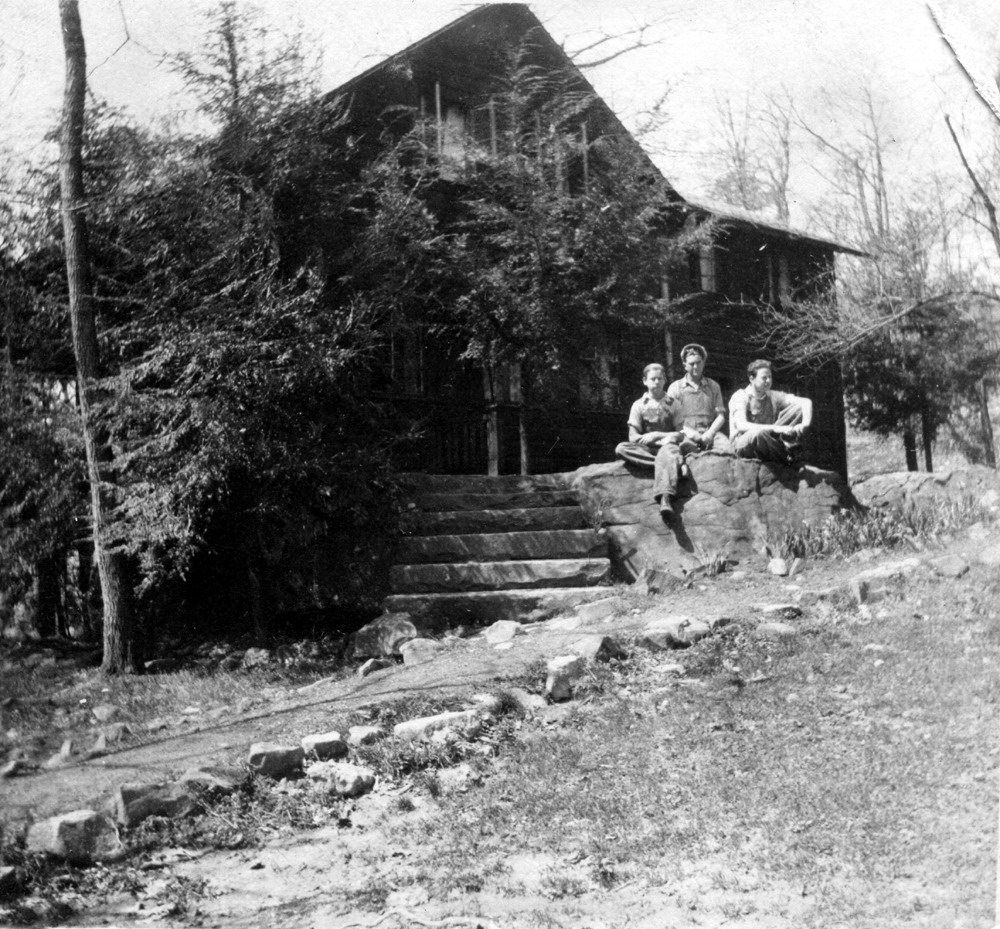
Farm House – Exterior view with 3 students on boulder in front of house; 1940s.
TAGS: Glenn Argetsinger, education counselor, student teacher, PMSS student counselor, Antioch College Cooperative Education Program
GLENN ARGETSINGER 1929 Education Report
Displayed below are Images and transcription of a typewritten summary of Mr. Argetsinger’s tests of seventh grade students, sent to the PMSS Board of Trustees in 1929. Attached to the report, and also transcribed, is a memorandum from Angela Melville, PMSS Interim Director, offering her recommendations for re-organization of the School.
Glenn Argetsinger was an Antioch College Co-op student teacher at PMSS (1928-1930) and the School’s student counselor (1937-1940).
TRANSCRIPTION
[NOTE: The original text has been slightly edited for clarity.]
Image 01
Memorandum of A. Melville attached to the summary of Mr. Argetsinger’s report of his test of the Seventh Grade, sent to the Board. 1929
Mr. Argetsinger, at my request, gave intelligence and achievement tests to our Seventh Grade. I have made a short summary of his findings and this I am sending to members of the Board. It is not possible to send you sample tests or diagrams, but these will be available to you in May at Pine Mountain.
My recommendation to the Board is that we give these tests next fall to all children who come to school, and group them where they belong; that we re-organize our school as a Junior and Senior High School, eliminating Grades V and VI; keeping the age of entry to Grade VII fourteen years (as it now is for Grade V,); that in place of a Fifth and Sixth Grade teacher we employ a tutor to bring students up in subjects in which they are particularly. backward, and to handle the few older students (over fourteen) who apply and are very much retarded perhaps even as low as in First or Second Grade.
The School when re-organized would show classes as follows:
Junior High School Groups I, II, III
corresponding to our present Grades VII and VIII and High School I
Senior High School Groups I, II, III
corresponding to our present High School II, III, and IV
This change of grouping might prevent some feeling of chagrin in a child who applies for eighth grade status in Pine Mountain if we put him in Group I in the Junior High School.
However, unless the Board is willing to face the possibility of a small school for one or more years until what we are trying to do has become plain to parents and children, it would be well not to adopt this new plan, as I think it highly probable that a good many children will leave when they find they are not in a grade where they think they should be. There seems however, to be no other way in which we may hope to bring up the quality of our academic work.
This re-grouping of the school would also make simpler the stressing of vocational guidance work, which would have its greatest emphasis in the Junior High School.
Image 02
1.
Summary of Mr. Argetsinger’s report on Achievement and
Intelligence Tests given to the Seventh Grade, February 1929.
—– —– —– —–
THE STANFORD ACHIEVEMENT TEST (showing what the students have actually learned) give the following facts :
Out of a class of twenty students (fifteen girls, five boys)
Five students (one-fourth of the class) have a composite score of over sixty, i.e., are within seventh grade range. Only one of these five students is above the normal score (for February fifteenth) for this grade. Four are below normal though they are in the grade.
Fifteen others do not show by their achievement that they belong to the seventh grade, though half the school year is over.
TABLE STUDENTS
I In Seventh Grade, above normal markings
4 “ Lower Seventh Grade
5 “ Upper Sixth “
5 “ “ Fifth “
5 “ “ Fourth “
Actually, by the central tendency of the group, our seventh grade is a sixth grade in achievement; and in all other subjects than Language Usage the class, as a whole, is in the Upper Fifth Grade level. In Language Usage it is about normal. The range of individual grade achievement is between 4.6 and 7.7
THE OTIS INTELLIGENCE TEST of the same grade shows :
The representative [handwritten insertion: percentile] ranking of the class is ————-18 which is considerably below normal (Fifty is normal). This low ranking is probably caused, to some extent, by the very low rankings of about half a dozen members of the class. As a whole, the rankings vary from 2- 69. Only four of the students show a Percentile Ranking of over sixty.
A comparison of the Intelligence and Achievement Tests shows that those rated low in achievement are also rated low in intelligence, and that outstanding over-agedness is related to the intelligence and achievement scores.
Image 03
2.
The diagnostic test is a highly specialized form of achievement test, and its particular value is to guide the teacher in presenting a subject to meet the particular needs – strengths and weaknesses – of her students.
Things indicated by the Tests
I )
a) That students should be re-grouped about the standard grade level norms, or
b) The standards of promotion raised and children not passed from one grade to another till they are actually ready.
II )
a) Difficulty: of making children realize that such re-grouping, often meaning placing them in a lower class, is to serve them best, and has no stigma of demotion attached to it.
b) Difficulty: would mean that a considerable number of each class would not pass each year — Disappointment to individual a matter to be well considered.
See Student needs and Education Guidance in
Mr. Argetsinger’s complete report.
Explanatory Note re Tests
The Achievement Test (Stanford) measures what the student has actually learned.
The Intelligence Test (Otis) score equals the student’s individual attainment.
The Norm — the normal score attained by this age.
I.B. — — Index of Brightness of individual and normal ability of this age.
P.R. — — percentile rank of individual with individuals of corresponding age.
The Diagnostic Test (Compass Diagnostic) identifies particular strengths and weaknesses of the students. Points the way to remedial treatment of student and so helps the teacher.
Image 04
1.
The Purpose of the Survey.
Perhaps in any field of human endeavor, the most effective results are obtained when definite aims and goals are established and when our progress can be measured. After once having determined its aims, the problems before this school are, “What have we accomplished thus far – where do we stand?” and “How may we do a better job? “
Since the general objective of this school is that of serving the needs of its students to the best of its ability, we may ask ourselves, “How well are we adapting our efforts and our school to the needs of the children?” “What actual results do our past efforts show in terms of our filling the needs of our students?”
Almost daily, we meet actual problems which seem importantly related to these questions. For instance, we find several students struggling bravely to master algebra or geometry, and we wonder if in many of these particular cases such work is good economy of time and effort for either the student or the school, since these students in question will probably never enter college or go into any walk of life in which algebra and geometry will be very useful. Might not such a student spend his time to better advantage in learning something more directly useful, and less foreign to his needs? Also, many teachers find that it is impossible to assume that most students have actually accomplished what their school classification would represent; in fact, almost every teacher feels that in order to make her work attainable by a class as a whole, she must simplify it and bring it down one or two grade levels. Again, within one group or class, we seem to find some students able to carry a quality of work which is…
Image 05
2.
…standard for a group of that grade, while others in the class are swamped by this same work. What is the cause of such difference among students? Is it because some are more intelligent than others; or is it because some of the students have been placed in a grade in which they do not belong? In the meantime, the difficulty of a teacher’s adapting her work to such a wide range of differences remains almost insurmountable. If a student is wrongly placed in a certain class in which the learning situations are a year or two above his actual ability, then is he to be blamed if he receives a failing grade upon an impossible task? If such a student is failed, then the school is at fault for imposing unreasonable tasks upon him. If we evade the consideration of the real accomplishment of the student and promote him, then promotion and class standings at Pine Mountain will lose their meaning and the student will carry the burden of our mistakes.
The occurrence of such problems causes us to desire reliable information concerning these situations. More specifically, we may wish to know some of these things:
-
-
- How the educational achievement of representative Pine Mountain classes compares with the accomplishment of corresponding classes which are representative of outside schools.
- What is the range of individual differences in real achievement among each of the students composing a group supposedly somewhat matched? Where does each student belong?
- Which are the students in the class who are bright or dull in their ability to learn? Of whom shall we expect certain accomplishments?
- Can we tell just where in any subject a student is weak, so that we may remedy that particular weakness most effectively?
-
Image 06
2a.
Before we can hope to know our present accomplishment as a school or before we can hope to fit our school to the needs of the child, we must get the facts of educational significance concerning each child. After finding what the real situation is, we can devise means for the greater achievement of our aims. It is as important for a school to know its children as it is for a navigator to know his position at sea.
Therefore this summary of the seventh grade has been made with the purpose of securing information which will give us a more intelligent basis for appraising and improving our work. Since this study has been carried on only in the seventh grade, it cannot be accepted as a survey of the entire school. Yet it is possible that to a considerable extent the seventh grade is representative of the situation in other classes throughout the school. The survey is an attempt to get needed facts and to point out the implications of the facts toward improvement.
Image 07
3.
Getting the Information.
In many ways teachers have tried to measure the progress of their pupils and to reveal defects in their instructions. In the past, most of the measurement of progress and the diagnosis of needs have been largely a matter of observation and comparison of students within the group. Now, however, such procedure is found to have its limitations in the face of certain demands for information.
The recent development of standard tests as measuring devices is but an extension and refinement of the former means of measurement. Standardized tests as measuring devices have some of the following advantages over individually devised teachers’ tests:
They are much more precise than the ordinary teachers’ tests, and are, therefore, much more reliable.
Standardized tests enable us to set up definite goals which are based upon the actual attainments of typical children under typical conditions.
They give us a basis for knowing how much progress should be made in a certain subject in a certain school period.
They enable us to compare not only individuals, but also classes and schools in the light of a truly representative standard.
The fundamental idea of standardized tests is relatively simple, for it involves mainly the careful selection and repeated use of examination exercises by many thousands of individuals until the typical reaction of these individuals becomes established. This typical reaction becomes a norm or standard in terms of which other results can be compared and evaluated.
Image 08
Educational tests in general are of three principal types, and may be catalogued as follows: (1) tests of intelligence or the ability to learn; (2) tests of general achievement; and (3) tests for diagnosing definite difficulties in school subjects. In this survey, all three types of tests were used, and these are briefly explained.
Intelligence tests, of which the Otis Group Intelligence Scale is a specimen, are used to measure the general mental ability of the individual to learn. Although we cannot measure innate intelligence directly, we can measure its power in terms of the extent to which it has acquired a number of specific powers for the mastery of learning situations. Most intelligence tests, therefore, consist of a battery of different tests for taking a cross section of all these different phases of general mental ability. The meanings of the summary terms used on the front of the Otis scale are: (1) the Score gives the individual attainment in the scale and serves as an index for evaluating the individual’s thinking power or Mental Ability, regardless of age; (2) the Norm is the normal score, or the median 200 score, attained by all individuals of the subject’s age; (3) the Index of Brightness, the IB, refers to the comparison between the individual’s actual mental ability and the normal ability of individuals of the same age, exact normality being 100; (4) the Percentile Rank, the PR, of an individual refers to the percentage of individuals of corresponding age who are exceeded in mental ability by the individual under consideration thus an individual in 50th percentile rank is normal, while one whose PR is 60 surpasses the mental ability of sixty percent of individuals of the same age. The norms of the Otis Scale used in this survey represent the typical reactions of…
Image 09
…forty thousand children.
Achievement tests, such as the Stanford Achievement Test used in the survey, have been devised to measure educational achievement, or what the student has actually learned. Such tests enable us to get a general cross-sectional measurement of the accomplishment of the student by sampling his knowledge attainments in several different fields. Thus such a test enables us to measure and compare both a student’s general level of educational attainment and also to find in which of several fields he may be advanced or retarded as compared with the normal.
Diagnostic tests are a highly specialized form of achievement test devised to yield separate measures of specific abilities in one subject. Such diagnosis tests as the Compass Diagnostic Test in the division of decimals are valuable in identifying the particular strengths and weaknesses of the student in all the different skills into which the learning project may be analyzed. Of all three types of tests, the diagnostic tests are of the highest direct instructional value to the teacher for besides measuring and diagnosing, they also point the way to specific remedial treatment. The diagnostic test used in this survey was given shortly after the class had studied the division of decimals.
Image 10
6.
WHAT THE TESTS SHOW
ACHIEVEMENT.
Figure I is a summary record of the accomplishment of the members of the class on the Stanford Achievement Test. Both the subject scores and the composite scores are listed. The names of of the students are listed according to the value of their composite scores. By comparing these scores with the norms, it is found that those students of the class who are considered by their teachers to be above the average, are not actually above normal at all, but are really doing work which is near normal for the seventh grade. It is because such students are so few as compared to the achievement of the other members of the class that they stand out. As shown further by Figure III, there are only five students whose educational accomplishment places them anywhere within the seventh grade range; and of these five students, only one is above the normal achievement for February fifteenth while the other four are below normal even though in the seventh grade. Although half the year is now past, the other fourteen members of the class have not yet made an achievement which would place them anywhere within the normal grade range.
Figure II shows several things concerning both the class and the individual achievement. The red line shows the central tendency of the class achievement, both in general grade achievement and also in subject achievement. The red line shows that the representative student of the group is actually a sixth grader, and it also shows the representative achievement of the class as a whole in the different subjects. It is interesting to notice that in their knowledge of language usage, the class as a whole is about normal, while in all other subjects the class is in the upper fifth grade level in its central tendency.
Image 11
7.
However, as shown by the short lines, there is a range of grade achievement among individuals of the group which distributes them between the levels of 4.6 and 7.
Figure III shows the grade distribution of the students as the Stanford test measures them in comparison with the normal accomplishment for these years. Here it can be seen that three large groups consisting of fourteen members of the class distribute themselves as follows: five in the upper fourth grade, five in the upper sixth, and four in the lower seventh grade; five of the remaining six students are in the fifth grade. Thus we find that the representative score of the class is that of the beginning of the sixth grade, that only one fourth of the members of the class actually belong anywhere in the seventh grade, and that only one of the students is above normal.
INTELLIGENCE.
After finding the above facts regarding the educational achievement of the class and of its individuals, further light is shed upon the significance of the results by the information furnished by the intelligence tests. Without the supplementary knowledge of the intelligence of the group, we may perhaps expect too much of the class toward meeting the norms of achievement, assuming that the intelligence of the class is normal.
The results of the Otis Group Intelligence Scale in figure IV indicate that there is a wide variation of individual differences in intelligence throughout the group, since the percentile rankings range from 2 to 69. Further computation shows that the representative intelligence of the percentile ranking of the class is 18, which would indicate that the [inserted: intelligence of the] class is considerably below normal This rather low ranking of the class is probably caused to some extent by the very low rankings of…
Image 12
8.
…about half a dozen members of the class who are considered to be notoriously dull by their teachers as well as by the scale.
By comparing the class records of intelligence and achievement (Figures I and IV) some of the following interesting facts will be apparent. It will be noticed that a student’s relative position in intelligence ranking is, in a general way, repeated in his achievement rating among the others of the group. Thus, those who are in the lower half of the class in intelligence are also among those of the lower half in achievement. Also, it will be seen that the older students of the class are, in general, those who have both the lowest intelligence ranking and also the lowest educational achievement, showing that low intelligence is a factor which usually accompanies out-standing over-agedness and low achievement.
THE COMPASS DIAGNOSTIC TEST
The compass test in the division of decimals was given more to investigate the value of such a type of test than to contribute a large share to the survey work. The use of the test has, however, shown us much in both respects.
In the light of its survey value, the test showed some of the following facts: First, it showed an unexpected wide range of grade level abilities in the general division of decimals which ran from grade 0 into the level of grade 8. As would be expected from the results of the Stanford Test, the median score for the entire class in this test was only 18, which would be considerably below sixth grade achievement. Unfortunately, we are unable to determine just what grade level the score of 18 represents, since the table of norms furnished ran only as low as the upper sixth grade, which would have been adequate for a group better matched and nearer normal than our seventh grade.
Image 13
9.
Such a situation is not surprising if we consider that the median score of the class in arithmetic according to the Stanford Test is 5.8 ( See Figure V for class record.)
As to the instructional value of diagnostic tests in showing a teacher where her work has been well done and where remedial work is needed, the opinion of Miss Denton, the teacher of seventh grade arithmetic is quoted. She says in part:
“To me the greatest value in giving this test lies in the fact that I can check on my own teaching of this subject, and also on the presentation by the textbook. I found that the majority of the class ranked very high in the placing of decimal points. I discovered that the entire class, with the exception of a girl who had come from another school, was very weak on the ‘pointing off’ method of division, thus proving that I had not emphasized oral work enough. In fact, this method has never been given in class. To be most effective, I think the same test should be given twice — once after the topic is completed, and again after further drill on the weak points brought out by the test. I intend giving parts of the test again to my class.”
CONCERNING NORMS
Before leaving the results of the tests, a word must be said concerning the norms which have made the above comparisons possible. It must be borne in mind that a norm represents typical reaction and is not to be regarded as a standard of perfection. Therefore, a school should not be content merely to achieve the established norms, for to do so indicates the achievement of mediocrity rather than excellence.
POSSIBLE IMPROVEMENTS
The facts which have been shown concerning the seventh grade are incapable in themselves of doing anything to improve the situation.
Image 14
10.
The tests have merely enabled us to compare individuals with individuals and class with class, and many of the strengths and weaknesses of the group have been shown. However, it is not sufficient that the situation be merely revealed, for it is logical that after finding some of the squeaks we might well oil them. Therefore, the next step, in order that the needs of the children be met effectively, is the development of a constructive program.
Knowing some of the facts we do, it becomes possible to devise means for remedying the deficiencies they show. If we may go so far as to assume that the seventh grade is somewhat representative of the whole school, then to some extent its needs are those of the other classes; and therefore, whatever remedial steps taken for the betterment of the seventh grade, might also have a general application to the other classes. Accordingly, a few suggestions are made. In all these proposals, the further use of the standardized tests would play an important part because of their value as accurate measuring devices.
RE-CLASSIFICATION
The need of a re-grouping of the students is shown by the Stanford Achievement Test. It shows a range of individual differences of over three grade levels, while only five students are anywhere within the seventh grade range. A teacher confronted with such a wide range of differences is faced by a hopeless task if he is expected to bring all the students up to the same level of proficiency. A re-grouping of the students, taking into consideration both their achievement and intelligence, would result in a greater economy of instruction, because it would be more possible for the teacher to adapt his work to the needs of all the individuals of a selected group.
Two general means of re-grouping the students are possible:…
Image 15
11.
…one, by making a comprehensive survey of the school and then making a complete re-grouping of classes about the standard grade level norms; or, second, by raising the standards of promotion, not promoting those who by measurement are a certain amount below normal, until after successive years, the representative achievements of the classes are raised and the variation between individuals is decreased. Each of these suggestions has its merits and faults. The first plan would be a speedy means of betterment, no doubt, but it would demand considerable tact in making the students understand that the re-classification would help us to serve their needs most effectively, and that placement in a lower class (which would be necessary in a great share of cases) would not bear with it any stigma of demotion. The second plan of raising the standards of promotion, would be less drastic and might be a spur to greater effort on the part of all students; nevertheless, a considerable number of each class would not pass each year. The sense of failure and disappointment over not passing would be very harmful to many students, and would in most cases be an injustice to them. The sense of failure in such cases would lie rather at the feet of the school for having allowed them to be placed in a group whose achievement they should not be expected to attain.
MEASURING FOR INSTRUCTION AND GRADING
The Compass Diagnostic Test in arithmetic demonstrates some of the possibilities of the use of such tests to raise the efficiency of class instruction. The use of such tests in all subjects would enable the teacher to know all the particular strengths and weaknesses of each student in each subject. The results of the diagnostic tests would show the teacher the needs of each student as well as to reveal the effectiveness of her teaching the class as a whole in any phase of the subject.
Image 16
12.
As a basis for grading, standard tests would give us an objective measure and a real basis for accurate grading. Achievement tests would enable us to measure the actual progress of a student, and we might grade over long periods on the basis of relative growth, taking into consideration the intelligence of the particular student.
THE PLACEMENT OF NEW STUDENTS.
The wide range of individual differences found within the present seventh grade is probably indicative of the prevailing situation throughout other grades as well. A general situation of this nature would indicate that our technique of pupil classification is considerably at fault. Aside from the necessity for knowing more clearly when a student should be passed, if we are to maintain properly matched groups we must improve our technique of placing new students.
At the present time we employ no defensible means of placing a new student upon his arrival at this school; we merely take his word for his class standing and place him accordingly. However, class standing and educational achievement are two different things, as has been shown. Therefore, even a statement of a student’s previous class standing in another school is likely to bear but little weight. This is especially probable since so many of our students come from small outlying schools laboring under the limitations of poor equipment and short sessions; and therefore a seventh grade classification from such a school would not be likely to approach the equivalent of seventh grade normal school progress.
By the careful use of achievement tests and individual intelligence tests, it would be possible to place each incoming student in a grade level at which he could do his best work, and at which the demands made of him would be thoroughly fair. This procedure would undoubtedly…
Image 17
13.
…eliminate a very great share of the present low class standings and the present wide range of individual differences within classes.
STUDENT NEEDS AND EDUCATIONAL GUIDANCE
The suggestions that have been made thus far are concerned with the means of meeting student needs most effectively in the classroom and in daily instruction. If, however, we consider the individual differences and needs of each student as the starting point for our best ultimate service to the child, then the problem becomes many-sided and extensive.
We know, for instance, that many students are of low intelligence and some of high intelligence; some are studious and industrious and some are not; some wish to go to college and some who perhaps should go will find it impossible. The number of such factors is great and somewhat different for each student, and therefore our responsibility in meeting these needs so that the greatest good results for each student is correspondingly great and varied. Curiously enough, we are doing the greatest good for those students who will go on to higher education and into the professions; but up to the present we have given what seems inadequate attention to the shorter but equally vital training for the trades and non-professional vocations. Now it also happens that at the present time the majority of our students cannot and should not go on to college. To a considerable extent the larger portion of our students leave this school and blunder into such work as they chance upon, having had no great amount of help from the school in the choice of a particular vocation or in preparation for it. It seems that the need for economic competence should be met by the school as well as the other common needs of the students.
In order to meet the various needs of the students two steps are necessary; first, to make it possible to test and explore the abil-…
Image 18
14.
…ities, skills, interests, and needs of the student; and second, to provide the student with the learning experience best adapted to his discovered needs.
To a great extent the rebuilding of the curriculum and a well developed plan for educational guidance would help in meeting this situation. The curriculum changes involved might be toward a varied curriculum during the seventh, eighth, and ninth school years, giving introductory work, not only in science and academic subjects usually confined to high school, but also providing introductory courses in the fundamentals of several vocations. Such a curriculum during these years would not only give a student an opportunity to try himself out in different fields but would also have a certain immediate vocational and cultural value for those who might not go on to the high school level of training. It is during this period that new interests arise and that guidance toward some goal is most needed.
Such a curriculum during these years would provide the logical place for educational guidance facts to be gathered. During this period the needs, interests, abilities, and desires of the student could be ascertained, vocational enlightenment would have been part of the curriculum and imparted to each child, and the work of educational guidance would be placed upon a sound understanding and measurement of each child. Having done this exploration and guidance work during these three years, we would then be able to place the student in one of the several fields of the high school level of work which might well be considerably more specialized and lead toward several definite goals. Some of the fields of concentration on the high school level which first suggest themselves are: carpentry and wood working, college preparatory, weaving and domestic arts, and agriculture.
Image 19
15.
By such a procedure of learning a student’s needs, interests, and abilities, by guiding him toward his logical objective, and by giving him adequate and definite training through which to reach a chosen objective, it is felt that in a still larger sense Pine Mountain might meet the needs of its students.
Image 20
2.
MENTAL ABILITY OF STUDENTS IN GROUPS 1A. 11. 111. and 1V.
Purpose of the Classification
Mental ability in which the students have been measured, is defined as the degree to which a student possesses the ability to learn, to profit by experience, and to make adequate responses and adjustments to situations.
The following classification of the mental ability of the students is for the use of workers to whom an understanding of the relative mental ability of Individual students will be especially useful. That there are individual differences in mental ability is readily apparent in outstanding cases; yet our casual Impressions of relative intelligence often lack fine discrimination and are sometimes considerably at variance with the facts. Therefore it is hoped that the more exact information which follows will be useful in situations in which the mental ability of the student is a significant factor. Thus, in the apportioning of tasks the dental ability of the student must be known if the task is to be consonant with his capacity for accomplishment. We should not be quick to blame a mentally deficient boy for inefficiency on a Job above his ability, punish weak-minded students because of their inability to learn, or expect too much of the “bad” boy who lacks the mental ability to appreciate the ordinary codes of social conduct.
In the use of the ratings several things should be definitely understood. First, the mental ability of a child, although of great significance, is only one of the aspects from which to view him. Other factors such as nervousness and emotional conditioning or defects, and also environmental influences always contribute to the whole personality of the child and must be taken into consideration. A test of mental ability measures only mental ability and not the whole child. Second, a student’s rating must be regarded as confidential, and a knowledge of it must be used tactfully in dealing with the students. Usually it is undesirable for a student to know definitely the rating of himself or another student.
Classification of the Ratings.
For the purpose of this classification the division of the ratings into quartiles is about a fine as is distinction as is reliable with the type of test used. The range and significance of the quartile ratings is as follows:
First Quartile: A student in this quartile equals or surpasses not more than 25% of the students, and is excelled by at least 75%.
Second Quartile: Dull to normal. A student in this quartile equals or surpasses from 25% to 80% of the students and is excelled by at least 50%.
Image 21
2.
Third Quartile: Normal to superior. A student in this quartile equals or surpasses from 50% to 75% of the students and is excelled by at least 25%.
Fourth Quartile Superior. A student in this quartile equals or surpasses 75% to 100% of the students in mental ability.
Quartile Ratings of Mental Ability
[NOTE: Students’ names are considered private material. Therefore, text and images of their names are not publicly displayed. Access may be provided on request, pending approval of Pine Mountain Settlement School and the archivist of the PMSS Collections. Contact the main PMSS Office for information.]
Image 22
3.
The Significance of the Ratings
General
The rating of a student in one quartile or another indicates his relative standing in mental ability. In a general way the more intelligent student learns more, is more adaptable, and has the greatest inherent possibilities of high achievement and leadership, while the student of lesser mentality must be led and directed and must seek satisfaction in simpler tasks not too difficult for his intelligence.
Industrial Work
A student of high intelligence placed on a menial job not demanding his best efforts, originality, and initiative is likely to fall into the habit of sub-maximum efficiency or rebel at the monotony of his task. A student of lower mental ability would be a complete failure on many of the jobs which might be entrusted to a student of higher ability. Nevertheless, a simpler job might tax the more limited student so that he would derive considerable satisfaction and growth out of mastering it. In industrial work, as in scholastic work, the ideal situation would be approached if each student could be given tasks demanding his utmost exertion of mental ability and yet yielding the satisfaction of achievement.
Scholastic Work
In school work the data on a student’s mental ability should supplement the facts of his actual achievement. If we can assume that the students within the various groups are reasonably matched as to past achievement and progress, then the mental ability ratings should give a teacher some indication of the quality of work she has a right to expect from a given student. The more intelligent students of the group, then, should be expected to learn most rapidly, produce the best quality of work, and earn correspondingly high grades. On the other hand, a student of limited ability cannot be expected to do work better than low or mediocre quality as compared with the rest of the class. A student of low mental ability who does a C quality of work is making more of an effort and greater relative growth than the bright student who loafs and does only C quality. Such deviations from expected performance because of diligence or laziness deserve appropriate consideration in grading. If the bright student can out-rank the quality of work done by the class and still rest, then he should be promoted to a more advanced group.
Image 23
4.
General Conduct and Social Relationships.
A high quality of social conduct depends upon two factors:
(a) the mental ability to learn by experience and to foresee and weigh the possible consequences of different kinds of behavior, and
(b) upon the willingness and desire to exercise the proper conduct.
Therefore, the child of low mentality (lacking in factor a), is a potential social liability even though he may possess the best of desires to the contrary (factor b). In other words, the same high quality of social conduct can not be expected from a child of dull mentality as can be expected from a child of superior mental ability, even though both are subjected to the same high ethical and moral stimulation. The school cannot, of course, alter the mental ability of its students, but it can carry all students to the limits of their inherent ability in social conduct by the proper stimulation and guidance of factor b.
GALLERY: GLENN ARGETSINGER 1929 Education Report
[NOTE CONCERNING IMAGE 21: Students’ names are considered private material. Therefore, text and images of their names are not publicly displayed. Access may be provided on request, pending approval of Pine Mountain Settlement School and the archivist of the PMSS Collections. Contact the main PMSS Office for information.]
-

- 01 education_report_1929_argetsinger_001
-

- 02 education_report_1929_argetsinger_002
-

- 03 education_report_1929_argetsinger_003
-

- 04 education_report_1929_argetsinger_004
-

- 05 education_report_1929_argetsinger_005
-

- 06 education_report_1929_argetsinger_006
-

- 07 education_report_1929_argetsinger_007
-

- 08 education_report_1929_argetsinger_008
-

- 09 education_report_1929_argetsinger_009
-

- 10 education_report_1929_argetsinger_010
-

- 11 education_report_1929_argetsinger_011
-

- 12 education_report_1929_argetsinger_012
-

- 13 education_report_1929_argetsinger_013
-

- 14 education_report_1929_argetsinger_014
-

- 15 education_report_1929_argetsinger_015
-

- 16 education_report_1929_argetsinger_016
-

- 17 education_report_1929_argetsinger_017
-

- 18 education_report_1929_argetsinger_018
-

- 19 education_report_1929_argetsinger_019
-

- 20 education_report_1929_argetsinger_020
-

- 21 education_report_1929_argetsinger_021
-

- 22 education_report_1929_argetsinger_022
-

- 23 education_report_1929_argetsinger_023
See Also:
EDUCATION Antioch College Cooperative Education at PMSS
GLENN ARGETSINGER Staff – Biography