Pine Mountain Settlement School
Series 09: BIOGRAPHY Staff
ARTHUR W. DODD Ganado:
Addenda to PMSS School Experiences
“A Navaho Wedding” 1954
Arthur W. Dodd:
Business Manager, Teacher 1932 – 1934
Photographer, Filmmaker, Organist, Pianist
School Principal 1934 – 1949
Interim Director 1942
TEXT AND IMAGES ON THIS PAGE DUPLICATE THOSE ON “ARTHUR W. DODD in Arizona Navajo Wedding 1954 April 3.” IMAGE #004 DOES NOT RELATE TO THIS PAGE.
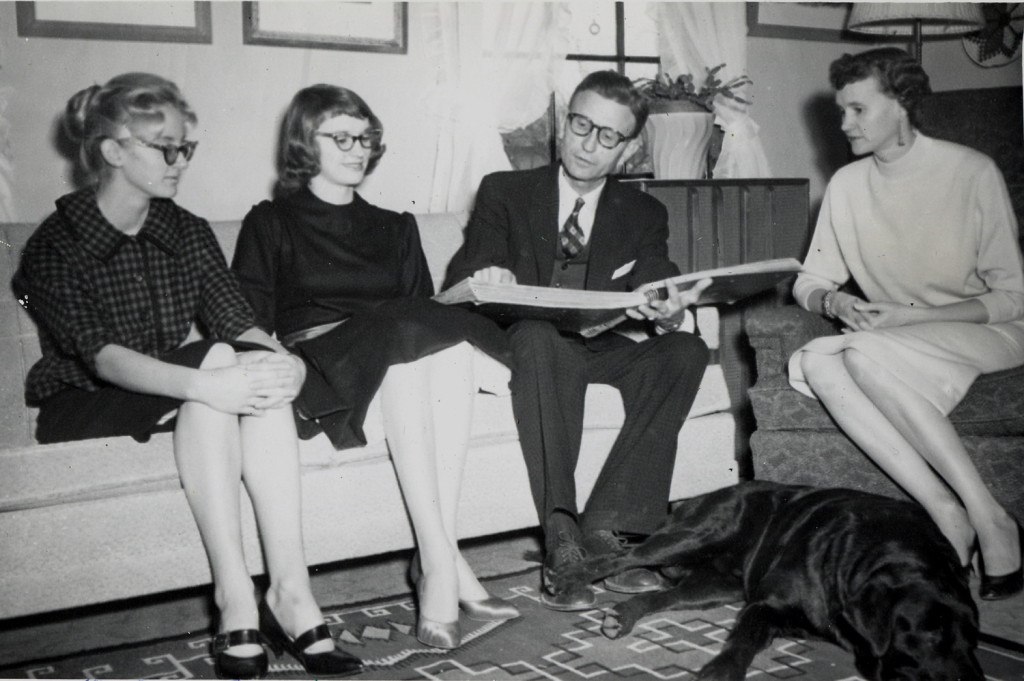
Arthur and Georgia Dodd and daughters, Margaret and Elizabeth, at Ganado Mission School, Ganado, Arizona. [X_100_workers_2603f_mod.jpg]
TAGS: Arthur W. Dodd, Pine Mountain Settlement School, school principals, curriculum, cooperative program, rural education, home economics, Ganado Mission High School, Navaho (Navajo) Indian Reservation, Franklin Delano Roosevelt, nursing, intercultural contact, food, Navajo wedding
ARTHUR W. DODD Ganado: Addenda to PMSS School Experiences
When Arthur Dodd left Pine Mountain Settlement School in 1949 he became the Principal of Ganado Mission High School located on the Navaho Indian Reservation near Ganado, Arizona. In many ways, the Presbyterian mission school was similar to Pine Mountain in size and some programming and staffing. The student body at Pine Mountain during Dodd’s tenure was approximately 100 boarding students from the area surrounding the settlement school. At Ganado the boarding school housed approximately 185 Native American students from a variety of tribes as well as Caucasian and African American students.
The curriculum of the two schools had some similarities, as described by Dodd in this essay, but in significant ways the two schools were quite different. For example, he points out “… that English was the only foreign language taught.” At Ganado, roughly 2/3 of the graduates from the boarding school “entered colleges, universities, and professional schools.”
Dodd describes that as the Principal of the school he attempted to institute some of the educational programs tried at Pine Mountain. He describes his successes and failures. Speaking broadly of the two experiences he remarks on the asset of the intercultural contacts as particularly important to the PMSS and the Arizona experience and describes specific experiences.
What is the difference between Navajo and Navaho?
TRANSCRIPTION: “A Navaho Wedding” 1954
[NOTE: This document is a copy of a typewritten original. Parts of the copy are not entirely legible, therefore some words in the following transcription are incomplete and indicated with a question mark.]
Page 001
A NAVAHO WEDDING
April 3, ’54
Georgia and I were invited to attend the Navaho (sic) wedding of a niece of Betty Todacheenie our next door neighbor at Ganado. We said that we would be delighted to go and that if they wished us to, we would gladly make a set of pictures for the bride and groom and the families. Grapevine took this proposal to the bride and brought back her response the same day — “No thank you – I’m too shy”. Later we were somewhat relieved that this had been her decision, because the camera’s flash in that primitive setting would have been as much out of place as plumbing fixtures in the stone age!
We left about sun-down, as is customary, for the “camp” of the bride’s people, about eight miles from Ganado in the direction of Cornfields. There were about four or five hogans in this cluster and we were taken to the grandmother’s hogan where a group of Navahos were eating on the earthen floor. We sat down and talked for some time with Betty doing the interpreting for us. The family, especially the older people were somewhat restrained with whites present, but the children, who had attended government day school went about the business of washing the dishes and two maternal aunts of the bride were busy cooking quantities of mutton, stewed and broiled, Spanish type tortillas and Navaho fried bread. After about an hour word came to the hogan that the groom had arrived at the camp.
Betty asked us if we would care to see the preparation of the corn meal mush used in the ceremony? Naturally we wanted to, so we were ushered to a nearby hogan, home of the bride’s parents. The bride had not yet made her appearance. Here the women were busy cooking more mutton, preparing pots of coffee and packing several large cartons with food and other household supplies to be presented to the groom’s mother and sisters after the ceremony. This was apparently the only gift exchange, except the two we presented later.
The mush was made in a small vase-like cast iron vessel. Water was set to boil over coals from cedar and juniper wood, and as the blue corn meal was added, Betty stirred it with a cluster of wooden stems bound together at the center with a strand of woolen yarn. Everyone including the children had to inspect the process and make sly remarks.
The bride’s father came in shortly afterward and asked his wife for the small bag of sacred corn pollen which she took from an abalone shell hanging from a nail on the hogan wall. The father was a man of about forty years of age. He was dressed in blue jeans, had a thin moustache (sic), and wore his hair cut short with a colorful band around the crown of his head. We assumed at first that he was a medicine man but learned later that he was not. As soon as he decided that the mush was the right thickness, it was poured into the shallow coiled basket, known to the Navahos as a “Wedding Basket” and usually made for them by the Ute Indians. Warm water was poured into the basket for exp..sion[?] purposes, before the mush was poured. When the mush had been poured it was set aside to cool and grow thick.
The bride, a girl of about sixteen came in at this point and sat down beside us. She was attractive in a rough sort of way, and of course dressed beautifully in Navaho style. She wore a brown plush blouse and a brown velvet skirt. The father shortened his concho belt by taking three or four of the large silver links out and she fastened it around her waist. She wore an attractive silver necklace, several rings, bracelets and dangling earrings of finely wrought silver through pierced ear lobes. She was as nervous as any young bride an hour before her wedding ceremony. She shifted from one side of the hogan to the other and tried on numerous other pieces of jewelry which her mother produced for her.
Next the mutton was taken up in metal bowls and carried outside and…
Page 002
…
Page 003
Page 004
GALLERY: ARTHUR W. DODD Ganado: Addenda to PMSS School Experiences
-

- 001 Arthur Dodd Arizona. [dodd_navajo_001]
-
- 002 Arthur Dodd Arizona. [dodd_navajo_002]
-

- 003 Arthur Dodd Arizona. [dodd_navajo_003]
-
- 004 Arthur Dodd Arizona. [dodd_navajo_004]
See Also:
ARTHUR W. DODD Administrative Correspondence
ARTHUR W. DODD Navajo Wedding April 3, 1954
ARTHUR W. DODD Photograph Album 1943-1946
ARTHUR W. DODD Staff, Interim Director – Biography
GEORGIA AYERS DODD Student Staff – Biography