Pine Mountain Settlement School DANCING IN THE CABBAGE PATCH THE POWER OF EMPATHY
Series 08: ADMIN General Correspondence 1919 World War I
“Lest They Perish: Campaign for $30,000,000. American Committee for Relief in the Near East.”[Genocide_poster_USA.jpg]
TAGS: Ethel de Long, correspondence with donors, World War I, WWI, student correspondence, King Albert I of Belgium, Leon Deschamps, Mrs. Cleveland Hoadley Dodge, Father Anton Docher, Native Americans, Pueblo Isleta, Willa Cather, Phelps Dodge Inc., philanthropy, Riverdale Neighborhood House, Agrarian Myth, Settlement Movement
THE POWER OF EMPATHY
The Letter, October 13, 1919
A copy of a small fund-raising letter from October 13, 1919, in the archive at Pine Mountain Settlement School captures the broad outreach of the School during its formative years. It is a startling letter in its brief but hidden details. The letter, one of many institutional solicitations and thank you’s that went out to various donors in the early years of the institution, has a deeper history than a first view may suggest.
The steady stream of brief letters in the early years were critical in building and sustaining the Settlement School. Letters were sent to donors by the School office, by the directors, and by staff. Today these letters inform us of the close attention the Administration, students, and workers at the School gave to the world outside the boundaries of the institution and the long-isolated valley of the Pine Mountain. In 1919 the world was at war. The War effort in the first decade of the nineteenth century was underway but, remarkably, not so far away as one might think.
Addressed to Mrs. C.H. Dodge (Grace Parish Dodge [1850-1949]) at Riverdale on the Hudson, New York, and dated October 13, 1919, the brief letter thanks Mrs. Dodge for her recent pledge to the School and tells her of the work underway on the new buildings for the Settlement School. The author of the brief acknowledgment letter is “EZ”, or Ethel de Long Zande, founder and co-director of the School during that time. In her brief letter, she tells Mrs. C.H. Dodge (Grace Parish Dodge) that the School is busy getting shoes and stockings together for all the sixty-five students in attendance. She says that they are very appreciative of the $20 dollar donation. Importantly, she comments on a letter written by one of the children at the School.
Mrs. C.H. Dodge is Grace Parish Dodge, the wife of Cleveland Hoadley Dodge , and part of the N.Y. Dodge family, one of the wealthiest families in the Riverdale, New York community and in the country at the time. Cleveland Hoadley Dodge had holdings in the Pacific Railroad, the early Citibank of N.Y and other major investments. He was a close friend of President Teddy Roosevelt family as well as President Woodrow Wilson and Dodge was among the ranks of the leading philanthropists in New York, as seen in this 1916 photograph.
Cleveland Hoadley Dodge. (2023, June 25). In Wikipedia. https://en.wikipedia.org/wiki/Cleveland_Hoadley_Dodge
Mrs. Zande in her brief acknowledgment letter to Mrs, C.H. Dodge describes a recent exciting event at Pine Mountain Settlement for Mrs. Dodge. The event involves a young student at the school who was inspired by recent world events. The student (a girl, not named) wrote to the King of Belgium, Albert I, about the war. Most likely the student was inspired by the anxiety and patriotism of Leon Deschamps, a Pine Mountain worker who had recently settled in the United States from Belgium and was working at Pine Mountain Settlement. The young girl was moved by her admiration of Mr. Deschamps and the desire to try to help with the war effort by writing a letter to the King of Belgium. We may never know what the letter said, but we do know the chain of events it set into motion.
The child’s letter remarkably found its way to King, Albert I, of Belgium. The King, or certainly his staff answered the young student. Whe she received an answer from King Albert I it created a sensation at Pine Mountain. When the answer from the King was received, it, in fact, animated the full Pine Mountain community and led Mrs. Zande to remark about the event to her New York friend Mrs. Cleveland Hoadley Dodge (Grace Parish Dodge),
“Can you imagine the stir it caused in our far-away valley?”
Unfortunately, the letter from the young girl and that of King Albert I cannot be found in the Archive. Nonetheless, the record of the correspondence alone is extraordinary and stirs the imagination. The story surrounding the letter of 1919 was not just a simple exchange of letters. It has a deeper history.
The Deeper Story: King Albert I and Father Anton Docher
1919 was the year that Belgian ruler, King Albert I, visited the United States. From September 23 through November 13, the King, his Queen, Elisabeth of Bavaria, and their son Prince Leopold II made an official visit to the United States. Their American visit included a trip to a small Native American pueblo in New Mexico, the Pueblo Isleta. There, the King honored Father Anton Docher, a hero of early World War I. The homage centered, particularly, on Father Anton’s work in the Belgian Congo. The King was intent on bestowing on the Priest the insignia of Knight in the Order of Leopold II and the French Colonial Medal, for his war courage and service to Belgium.
Anton Docher, the focus of the award, left the War and the Congo a changed man. He soon studied for the priesthood. During the remainder of his life, Father Anton asserted that colonialism was an international evil, and he committed his life to serving and learning from various Native tribes in New Mexico about their oppression as Native Americans. By all accounts, the Belgian-New Mexico ceremony to honor Docher was no small event, as some ten thousand people reportedly came to attend the ceremony in the small Pueblo Isleta.
Father Docher also did not escape the attention of the writers of his day, including the noted author, Willa Cather. Father Docher as the model for her well-received novel, Death Comes for the Archbishop (New York: Alfred Knopf, 1927). The newspapers were full of the events of the King’s visit. They describe his journey to New Mexico, and his how his entourage traveled to New York, where the King was honored with membership in the New York Society of the Cincinnati. He was also given a ticker-tape parade and an introduction to the leading families of the city of New York. It was this New York journey that brought the King into the social circle of the Dodge family with whom Ethel de Long Zande had connections. The New York connection with the Dodge family prompted Ethel to give the subtle nudge in October 13, 1919, to Mrs. Cleveland Hoadley Dodge in Riverdale, New York.
The Cleveland Hoadley Dodge family was a well-known and highly regarded family in New York. They moved among many of New York’s notable families of wealth. Cleveland Hoadley Dodge had built his fortune in copper mining and was a major player in the financial and social support of WWI efforts. Cleveland H. Dodge was also an executive at Phelps Dodge, a leading copper mining corporation in the U.S. that had been co-founded by his grandfather in 1832. His family was known for its generous philanthropy, and today the Dodge family continues to support the foundation he established in 1917, the Cleveland H. Dodge Foundation.
One of the central Foundation interests is its continued good work today in educational support, community programs, and cultural institutions, though mainly centered in New York. The father of Cleveland H. Dodge, William Hoadly Dodge, and his mother, Sarah Dodge, were the inspiration for their son’s philanthropy. But it was Cleveland Hoadley Dodge’s wife Grace Wainright Parish Dodge (1856-1949) , who had the connection with Pine Mountain.
GRACE WAINRIGHT PARISH DODGE
Grace was born in France but was known to be deeply connected to the Settlement Movement in America, begun by Jane Addams. As the wife of Cleveland Hoadley Dodge, her life of wealth made her strongly sensitive to the growing divide of wealth and poverty in their city of New York and in the world, and the many and growing populations displaced by war. Grace Parish Dodge was a pioneer in women’s rights and education and was the first woman to serve on the New York Board of Education, where she generously funded the New York Public Library.
Her connection to the Settlement Movement of Jane Addams and the work with the Cleveland H. Dodge Foundation, and the larger Phelps Dodge Foundation, helped to further her earlier work at the Riverdale Neighborhood House. Grace began the Riverdale House as a neighborhood library at the early age of sixteen and helped to expand its service from the early beginning. Even today, in an expanded form, the House and Library continue to provide services to Riverdale, New York, and its surrounding communities.
World War I and Pine Mountain Settlement School. The Cleveland H. Dodge Foundation established in 1917
Literacy and a remarkable push for optimism were ideas close to the heart of Ethel de Long Zande and Katherine Pettit. The early novels of Willa Cather — Oh, Pioneers! (1913),The Song of the Lark (1915), and My Antonia (1918) — were all written during the early period of Pine Mountain’s development and were well known to the two founders and their students. The ages of all the women were similar, as were their interests. Like Katherine Pettit and Ethel de Long Zande, Willa Cather had a deep and close attachment to the land. Writing in 1918, she notes
In the course of twenty crowded years one parts with many illusions. I did not wish to lose the early ones. Some memories are realities, and are better than anything that can ever happen to one again.
A strong optimism shines through the many connected lives that are called to attention by these related letters. Many of the letters from Pine Mountain during this difficult war-time period, including that of the young student sent to the King of Belgium, and the brief exchange with Mrs. Grace Parish Dodge, clearly evidence this optimism.
TRANSFORMATION AND ELEMENTS OF THE AGRARIAN MYTH
Willa Sibert Cather, Wearing a necklace given her by author Sarah Orne Jewett. (another Agrarian at heart.) [Public Domain, wikisource.org]
Many of the workers who came to Pine Mountain came with a romanticized vision of what has come to be called the “Agrarian Myth.” It carries many of the markers of the Settlement Movement, the Community Life Movement, and other cooperative organizations that challenged conflict, poverty, and human indifference to education and the challenges that accompany immigration and migration. The myth, the movement, and the diverse challenges blended into one as the nation went to war, and later, when they sought to heal the wounds of war. Many citizens carried their personal experiences of the challenges and horrors of WWI and life during wartime in countries “acrost the sea,” (as Uncle William would say), with them to the remote mountain School. The personal narratives of some of the workers set the imaginations of the students racing. Ultimately, what all the workers and the students held in common was a worldview — something outside their known experiences. Hope took its image from the land and its people. It was a starting place for all. The hope for a better future rests in that awareness of a shared place with diverse dreamers.
The integrated experiences, the personal relationships, the kindnesses, the honor, social justice, and the hopes of all bound many lives together during the formative years of Pine Mountain Settlement School. These shared experiences exploded narrow and protected mountain lives in a manner that is difficult to describe to today’s electronic youth, separated as they often are from the tangible present and often isolated by their electronic entertainment world. The sensitive understanding and acceptance of larger social forces encountered by those “outsiders” who passed through the Kentucky settlement deep in the hills of Appalachia were a remarkable force in transforming the lives of many children. The stability and optimism of PMSS School during the two Great Wars are all the more remarkable when placed against the enormous disintegration of the world outside the Pine Mountain Valley during those Wars and the great price paid by so many soldiers from Eastern Kentucky.
Many of the staff had seen the rubble of Europe in their early wars; the broken soldiers, and a world recovering from vicious privation and violence. Those same individuals were living within a community that knew many similar social violations through a very intimate history of feudings and the even more senseless personal violent gun history.
Though isolated, the lessons and values learned in wartime and equally through the local “feudalists” encounters, continue to remain a part of the Pine Mountain community’s history and psyche. The lessons that were learned from war and feuds are certainly embedded deeply in families who passed through the School in the Pine Mountain valley, and today continue to resonate in families in other valleys throughout the world.
War ignores borders, but compassion also does not have borders. Throughout today’s world, nation, person, and psyche, there is hate, fear, terror, and cruelty of many types. But there is also love, compassion, joy, and friendship. In these overlapping emotions, what are the change agents that bring us to war? What brought a world leader to respond to a young girl in the mountains of Eastern Kentucky? How did that letter change the young girl? Why are similar echoes so seldom heard in today’s news, even with our rapid communication?
Today’s world cannot be easily explained away by our rapid communication and our crowded lifestyles. The lessons of institutions such as Pine Mountain Settlement School, the Riverdale Neighborhood House, and in communities such as Puebla Isleta, in authors such as Willa Cather, and the kind letter from a Belgian King to a child deep in the Kentucky hills, are seldom remembered. Were they messages of a different sort, or are we now people of a different sort?
Dr. Edward H. Egbert
In the last years of WWI, Dr. Edward H. Egbert (c. 1882-1939) was the chief surgeon at the American Hospital for the Red Cross effort in Kiev, Russia, and the Executive Secretary of the Catherine Breshkovsky Russian Relief Fund in New York. In 1919, he planned a visit to Pine Mountain. He was a close friend of Herbert Hoover. But, then, that’s another story of Kiev, war relief, mysticism, Bolsheviks, murder, and healing. We are still writing that history. That history is not getting kinder, but philanthropy and hope are still alive.
DANCING IN THE CABBAGE PATCH
Olive Dame Campbell’s 1922 Letter
on Danish Folk School Training with
Marguerite Butler
John C. Campbell Folk School. Early brochure for School [SIA_brochure_005] PMSS Collect.
TAGS: Olive Dame Campbell, Marguerite Butler, Georg Bidstrup, Denmark, Danish Folk Schools, 1923, folk schools, Progressive education, ASKOV School, Denmark, Daisy Gertrude Dame, agricultural schools,
OLIVE DAME CAMPBELL’S 1922 Letter on Danish Folk School Training (3 pages)
FOUNDATIONS
The early years of the twentieth century were marked by a heightened interest in new educational models and particularly those that could remediate rural education in remote sections of the United States and also in other countries. The exploration of the Danish Folk School model was of particular interest to several of the earliest founders of rural residential schools in the Appalachians. The Danish Folk School model is one such program established in the 1830’s by its founder N.F.S Grundvig. Identified as a theologian, writer, philosopher, historian, educationist, and politician, Grundvig had ample experience that was turned toward reform in educational practice. Danish Folk Schools still persist in some 70 schools throughout Denmark, testimony to their solid contribution to education for high school populations in Denmark and other countries.
OLIVE DAME CAMPBELL and the JOHN C. CAMPBELL FOLK SCHOOL
John C. Campbell Folkhad School. SIA_brochure_005
The following letter and supplemental literature located within the archive of Pine Mountain Settlement School were sent by Olive Dame Campbell to friends and colleagues at Pine Mountain Settlement School, including Katherine Pettit, whose letters contain the recorded report. The letter concerns Mrs. Campbell’s exploratory time spent in Denmark with Marguerite Butler, learning about the Danish Folk School educational model. It exposes the foundational differences between the Settlement School and the Danish Folk School models and sheds light on Olive Dame Campbell’s earlier trip to Denmark with her husband, John C. Campbell. Both Campbells had a deep interest in the foundations of the Danish Folk School model. Their interest led to the Scandinavian folkehøjskole idea as a model for the John C. Campbell Folk School and to its influence on the foundation of the Highlander Folk School in Tennessee, begun by Myles Horton.
Folkehøjskole
Olive Dame Campbell and her husband were enchanted by what they learned of the Danish Folkehøjskole (Folk School) on their earlier trip to investigate the model schools. Following their return home, they set their sights on a similar school that would model values they believed were compatible with educational needs in the Central and Southern Appalachians. Olive Dame’s husband. John C. Campbell unfortunately suffered a heart attack and died suddenly before the couple could bring their dream to fruition. Olive Dame vowed to continue the pursuit of their dream. The Brasstown, NC institution that grew out of the Campbell’s enchantment with the Danish educational model and the early work of N.F.S. Grundtvig, the philosopher, writer, and Lutheran Minister. The school that took shape following this second trip to Denmark was called the John C. Campbell Folk School in memory of Olive Dame Campbell’s husband.
Christian Albrecht Jensen
Public domain, via Wikimedia Commons” ”
When John C. Campbell died suddenly in 1919, the dream of a Folk School in rural Appalachia was put on hold for several years, but not forgotten. The Danish Folk School model never left Olive Dame’s thoughts, and four years later, she sought out her sister Daisy Dame and Pine Mountain Settlement School’s Marguerite Butler to travel with her back to Denmark to give a close second look at the details of the unique Danish educational plan. This time, Olive Dame and her companions would fully engage the Folk-School program by actively participating in the programming and training. On this second trip, her sister Daisy Dame came along as an advisor and as a teacher with first-hand knowledge of rural schools in Eastern Kentucky, where she had taught for a brief time and where her ideas and those of her sister led to an amalgam of educational philosophies regarding rural education in the Appalachian mountains.
MARGUERITE BUTLER
Marguerite Butler. [X_099_workers_2511_mod.jpg]
Marguerite Butler, a worker at Pine Mountain Settlement School, had caught the attention of Olive Dame Campbell, based, no doubt, on the recommendations of Katherine Pettit, a founder of the Pine Mountain Settlement School and a friend of Olive Dame Campbell. The contacts made in the early years of the Pine Mountain Settlement School development were very formative, including an early exploratory trip by Olive Dame and John C. Campbell made of Eastern Kentucky. The connections brought all parties close together in their efforts to remediate the educational future of both Eastern Kentucky and Western North Carolina.
Marguerite was invited to come along on the Danish exploratory adventure with Olive Dame, as she had proved herself in her early years at Pine Mountain helping the founder, Katherine Pettit, establish a small satellite settlement at Line Fork, near the Pine Mountain School. Marguerite was an enthusiastic follower of the new educational and vocational models that were being tried following the success of the urban Settlement Movement and the educational enthusiasm surrounding Jane Addams and Settlement advocates. Further, Marguerite Butler’s interest and enthusiasm for the Settlement Movement seems foundational to her interest in the Danish Folk School model while a student at Vasser. Certainly, her imagination had been captured by the proposed trip, and she left Pine Mountain Settlement to join Olive Dame and her sister in their Danish educational quest.
FOUNDATIONS
Olive Dame had met Katherine Pettit on a trip to Eastern Kentucky in 1908-1909, when she and her husband. John C. Campbell, while travelling throughout the Central Appalachia, had already demonstrated her success in establishing Hindman Settlement. Working with May Stone, she established a rural settlement in Knott County, KY. First called the W.C.T.U [Women’s Christian Temperance Union] School, Hindman Settlement School became the first of a series of rural settlement schools throughout Eastern Kentucky. But by 1913, Katherine had set her sights on founding another rural settlement school in nearby Harlan County. Olive Dame Campbell kept up a correspondence with Pettit and later with Marguerite, and their work at the new Pine Mountain Settlement School found kindred spirits in both of the early Pine Mountain Settlement School visionaries.
Marguerite Butler was a talented Vassar graduate recruited by Pettit, who had demonstrated hands-on skills aligned with both the Settlement models and those of the Danish Folk Schools. Further, Marguerite was a remarkably resourceful and industrious young girl. She had been charged by Pettit to help plan and establish a new satellite settlement at Line Fork and received praise from all observation points — administration, community development, and regional improvement. She modeled Olive Dame’s vision of activism and the Danish model’s very hands-on approach. Soon, Olive Dame charmed Marguerite away from the Kentucky school with the offer of the trip to study at the Danish Folk School, and later, kept her near as a co-founder at Brasstown.
HOME AND THE WORK BEGINS
On their return to the United States, Marguerite and Olive Dame were firm believers in the Folk School model — with touches of the earlier Settlement School ethos. Marguerite became Olive Dame Campbell’s primary assistant in creating the new Brasstown Folk School after convincing the local community of the value of a new high school at Brasstown that would serve a very dispersed population. John C Campbell Folk School was born in the heart, mind, and hard work of Olive Dame and Marguerite. They both had skills at community building, and these talents were well demonstrated when the community of Brasstown, some 200 strong, gathered and endorsed the idea of a Folk School for their small community — and the building began.
The Danish educational model at John C. Campbell Folk School in Brasstown, North Carolina, joined the best of Pine Mountain’s lessons with the lessons learned in Denmark, as described in the following letter. Marguerite and Olive Dame Campbell were to spend the remainder of their lives at the school named for Olive Dame’s husband, John C. Campbell, and Marguerite soon planted roots even more deeply when she married a Danish farmer recruited from Denmark, Bjorn Bidstrup, and she became Marguerite Butler Bidstrup.
The relationship between the two rural schools, one a Settlement School and one a Folk School, remained fixed by their shared objectives for better answers to the needs of rural education. Some Pine Mountain staff, such as Leon Deschamp, a former worker at Pine Mountain, and his wife, May Ritchie Deschamp [older sister of folk singer Jean Ritchie], are two notable transplants to the North Carolina Folk School. A transcription of an oral history by Marguerite Butler Bidstrup gives more depth to these interesting and important transitions and collaborations.
Today, John C. Campbell continues its valuable work with the rural community in the surrounding Brasstown area, but has broadened its scope to include a large Arts and Crafts-influenced program that has gained National and International recognition and participation.
The other journey influenced by the Danish Folk School model, found in the person of Myles Horton, who also took the journey to Denmark to study the ways of the Danish Folk School model, is well documented. When he came back to found the Highlander Folk School in Tennessee, he led the institution toward grassroots social protest against bigotry and social ills … but that is another story that needs another telling, and the story is a good one.
LETTER OF OLIVE DAME CAMPBELL FROM COPENHAGEN, DENMARK
October 1922
TRANSCRIPT [shared copy in PMSS collections — not yet scanned]
The following form letter has been received from Mrs. Campbell. She asked if I would have copies made and one sent to you. I do this with great pleasure. F. J. Clark
Copenhagen, October 6, 1922
My Dear Friends:
Having been here now for over six weeks, I think it is perhaps time for me to register some impressions. I am new at the machine and shall doubtless turn out a bad sheet. Moreover, my thoughts do not flow as rapidly or as logically this way as they would at the end of a pen. Such as they are, however, I can share them with more of you, and you will find them much easier to read.
You may know. that there are three of us here. Marguerite Butler of the Pine Mountain Settlement School. My sisterDaisy Dame, who has been a teacher. for many years (one of which she spent getting a kindergarten started in a Kentucky Mountain County), and myself. I wish greatly that there were several more. We are already finding it valuable to check in on each other up. Moreover, there are so many things that can be arranged for a group as well as for one person, especially conferences with busy, important people who do not speak English well enough to care a great deal about going over the same ground many times. Then, so much time is saved by passing along information to each other. We have been fortunate in finding two of last year’s American-Scandinavian students still here. Their help, particularly one who has been studying agricultural cooperation, has been invaluable.
Except for two weeks trip into Jutland to visit Askov, the most famous of the high schools, to talk over our course of action with several leading people and to get something of an idea of the country before winter closes in, we have been here in Copenhagen [Denmark]. We shall remain here until Askov [a Southern Jutland Danish High School] opens. early. In November. And then go back there for a month as pupils!
Of course, one cannot get a great deal of firsthand information on the high schools here. In fact, it is quite amazing how little the average Copenhagener one meets. knows about these schools, which are bringing educators from all over Europe. There is a distinct line between. city and country. Or more exactly, between Copenhagen and the rest of Denmark. Inquiries are often dismissed with the statement that these schools may be all well enough, but that they are, of course, for peasants! On the other hand, we find that students, particularly women of the other groups, are beginning. to attend Askov, where some of the finest lecturers in the country are situated. Another factor is that the high schools are in no way connected with the state system, each being more or less a law unto itself, —– that is, depending upon the peculiar point of view and the personality of its “forstander” or principal. In spite of the fact that so many are subsidized by the state, no special track of their activities seems to be kept at headquarters, and one has to do one’s own hunting and get what help he can
page 2
through personal introduction. publications (practically all in Danish) and being passed along from one school to another. The University, which is a severely technical institution, is frankly indifferent, although of course there are interested individuals in the faculty, some of whom have actually taught in high schools. Fortunately, the Minister of Education, Herr Appel, is himself a high school man — the former head of Askov, which his wife now runs. He is a fine, big person, speaking broken English, but most helpful and human. One can get to him and other people of importance quite easily, although my connection with the American Scandinavian Foundation has greatly facilitated matters.
There are also here in Copenhagen three high schools for trade-union and industrial groups. run somewhat on the lines of the country ones, without the important residence feature. We have already established pleasant relations with the head of one a famous old man named Borup. [ later, literally Borup’s Folk High School]. His account of his work and his outline of his conception of what such education should mean have been one of my most stimulating experiences so far. His classes begin this week and we expect to attend some of them frequently. We shall, of course, visit the others too. It is. besides valuable to get the reactions of various kinds of people here not connected with educational and social work.
Our visit to Askov makes us a bit restless to be in the city, fascinating as Copenhagen is– and more. keen than ever to get to the heart of our study. I wish you might have been with us at the big fall reunion which we attended two weeks ago. Every year, the old students come back 1000 to 1500 strong and stay at the school visiting. and eating together and listening to lectures of all kinds. Old men and women were there who had attended the school [for] over 30 years or more before. One old man of 70 odd [yrs] had been at the original school at Rodding. You can’t imagine how interested he was in us and how persistently he tried to talk to us in spite of our very evident, painful, Danish fragments of speech. It was a picture to see him drive away in a big farm wagon, heaped high with bedding, which each comer must himself supply. A number of the women spoke fairly good English, so we had an opportunity to talk. which they were eager to do. There were, too, quantities of young men and women fresh. and intelligent looking. The Deans have a great sense of humor. And these young people get, I think, a great deal of entertainment out of our conversational difficulties. I don’t blame them, and they were. very polite about it. All these people, old and young together, sat through four one-to-one-and-a- half hours lectures each and every day. [They] came again in the evening to music. stereopticon pictures, et cetera. Some of the subjects of the lectures were present-day conditions in Belgium. Educational conditions, and Schleswig. (newly returned to Denmark), two educational addresses, one by. Minister Appel, two religious addresses (along what line I could not determine), two on prayer and work, one on modern Danish art, and one on Abraham Lincoln by a Dane who has taught in a People’s High School in Des Moines [IA] among the Danish. It was a curious feeling to hear him come out in English with. “… a government of the people, for the people, by the people”… Repeating this emphatically and slow a number of times, writing it on the blackboard, and translating it into Danish. I could understand that he said this was the foundation of one of the American ideals. Of course. I could understand very little of
page 3
the addresses. But it was evident that each speaker was using the full force of his personality, and the audience responded with absolute silence or with ripples of laughter. Imagine what such lectures and such connecting links year after year must mean to the people scattered out in the little farms. The government meets the expenses. The people pay the nominal sum of five Cronin (about $1,10 a day at this exchange). By the way, there seemed to be no checking system. A man simply sat there in the open court, ready to take the money. Our coming to stay at Askov, where some of the leaders are situated. Is going to be a most valuable one, and from there we will be. directed and introduced to the smaller schools. Askov itself. Is an extended high school — no student being allowed who has not had a session at one of the smaller schools. There are, of course, no examinations for admission.
I suppose you are wondering all this time about the language. It is difficult. We have an excellent teacher here and an unusually good little grammar with the phonetic system. But while the. construction is like English, and many of the words, for that matter, the [same ?] pronunciation. Is anything but English in sound. It is a guttural, breathless kind of language, and I question if anyone but a Dane will ever be able to pronounce its Gs and Rs and Es correctly. We are persisting valiantly with the reward that we can usually be understood when we ask simple questions. We can also understand simple answers and are beginning to get snatches of what we hear in lectures. We must get it. That is the first advice everyone gives us. It is evident to us that a statement of general methods and courses. Is not going to give us the secret of how the information is given, nor, as I said before, the various angles presented by the lecturers each. of whom is expected to use his personality to the utmost —- this. Involving the frank expression of his own point of view, each school will thus be individual and how Individual and how the individuals average up, we must decide for ourselves.
Our time here in Copenhagen is therefore a necessary and valuable study.. It would be more valuable still could we make use of the fine libraries here. There is much reading we shall have to do as soon as our Danish is more proficient. It does seem a pity when we are putting out so much time and energy on these details that we cannot share our experiences with others who might be able to come only for a few months. With what we could jointly translate and give through talks with people who speak English, (we will be ready to direct to those who have given us the most help. And through what one could see for himself, a shorter stay ought to be very profitable. It is not expensive living here. One can cover the essentials for about $60 a month. Passage on the one-class steamer of the Scandinavian-American Line brings you straight to Copenhagen and $150 will give you a good birth. So I am continuing to hope that some of you will still come over — Perhaps make a sudden start and join us at Askov early in November. Think it over well. Do !! Fine clothes are neither needed nor desirable. Plenty of comfortable shoes. Warm things, and rain things. I can. always be reached sooner or later through the International Students Committee. Studiestrasede [?] 6 Copenhagen, and I would of course come back again to Copenhagen to meet anyone if I knew in time. Later, I will try to write again as to what we find. I wish I had time to write of all the interesting incidentals. With regard to all.
Sincerely always.
(signed) Olive D. Campbell.
See also:
Bodene-Yost, Zizanie (2013) “in the U.S.: The Failure of the Danish-American Folk High Schools vs. the Success of Highlander Folk,” The Bridge: Vol. 36: No. 1, Article 9.
Available at: https://scholarsarchive.byu.edu/thebridge/vol36/iss1/9/
Free and open access article by BYU ScholarsArchive. It has been accepted for inclusion in The Bridge by an authorized editor of BYU ScholarsArchive.
Pine Mountain Settlement School DANCING IN THE CABBAGE PATCH Dancing in the Fields of Snow
[Dancing in the snow] mccullough_II_059d
Tags: snow, winter play time, cold, children and snow, transportation, hardship in winter,DANCING IN THE FIELDS OF SNOW
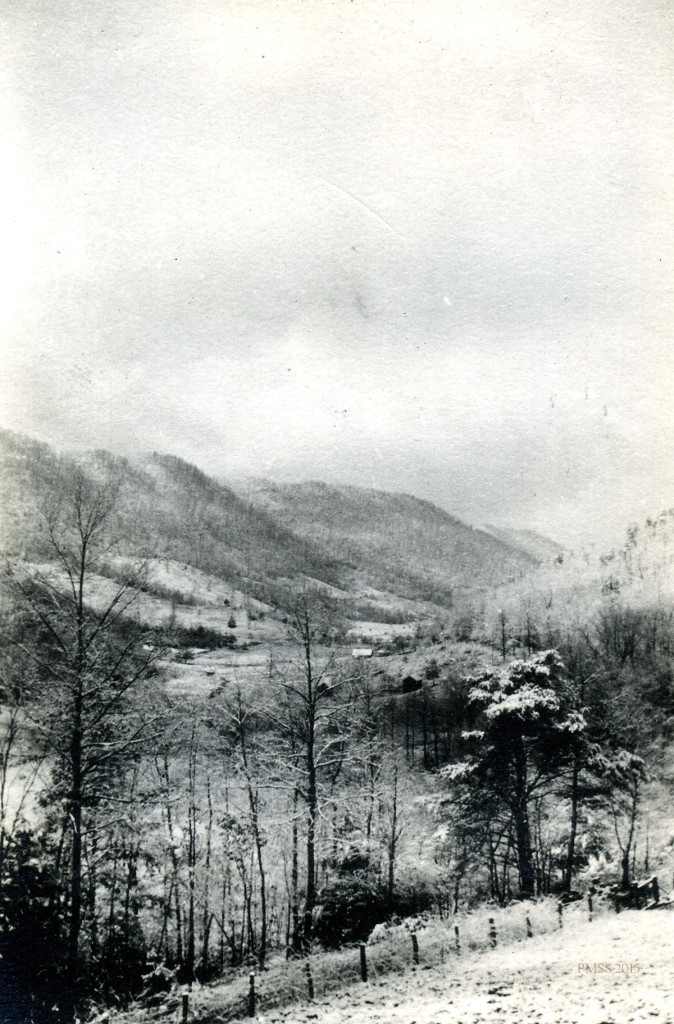
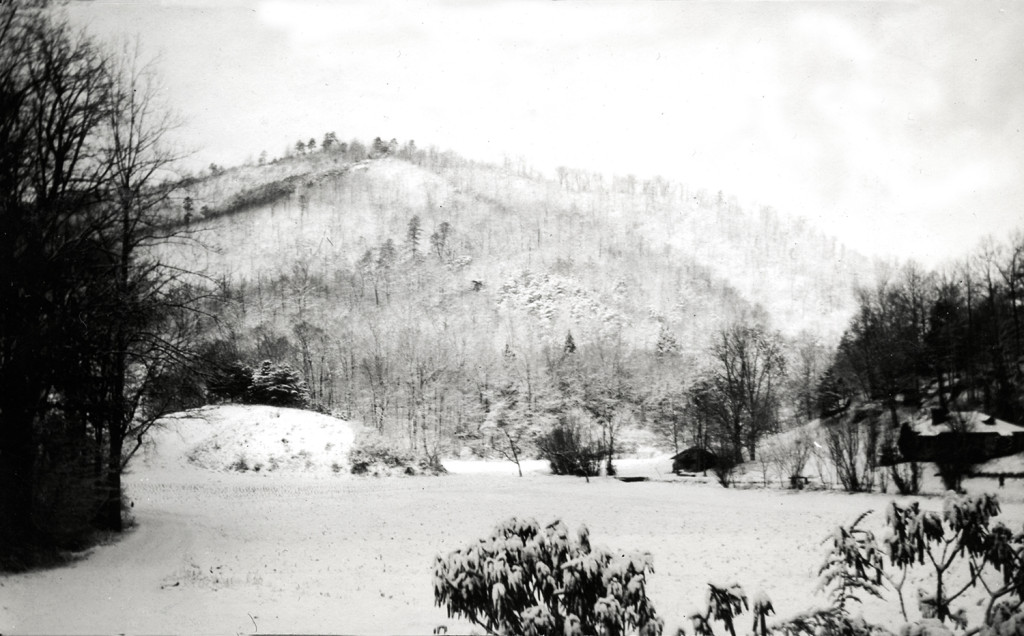
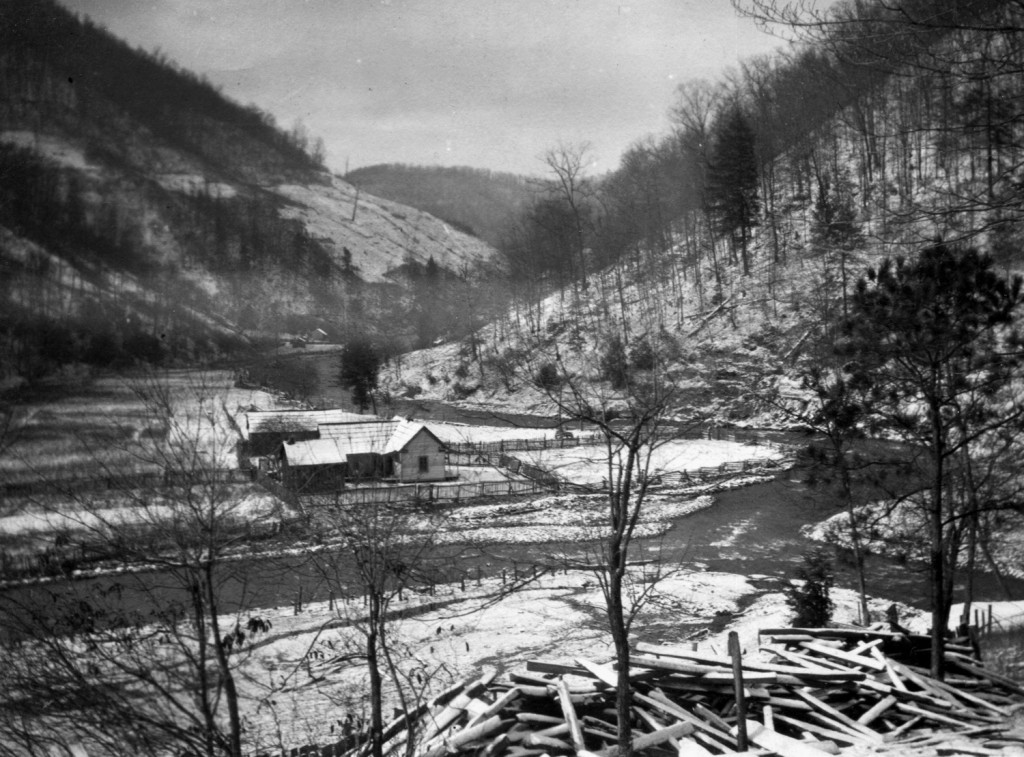
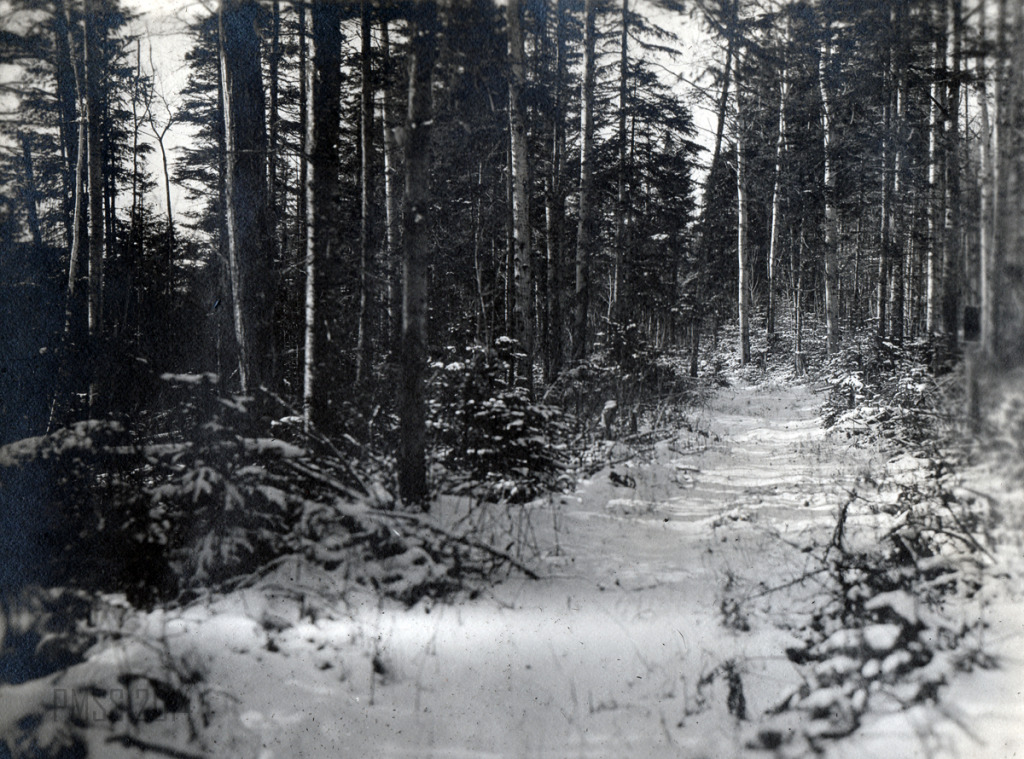
In the early winter years of Pine Mountain Settlement School, snow was a frequent and reliable visitor. Snow still visits the School, though not so frequently, and it rarely sticks around for long. The climate of the planet is shifting and it is getting warmer worldwide. Yet, snow, if it falls, can now fall at alarming rates — as can rain. These unexpected, rapid, and sometimes overwhelming climate changes are becoming more frequent. Sometimes snow fails to stay on the ground for a long stretch of time. Sometimes it is a soft and gentle visitor, and sometimes it is wind-driven, icy and deep. Today, there seems to be little to no sensible planning for how snow will present itself. So …. one could say: “Let it snow, let it snow, let it snow.”
In the mountains of Central Appalachia snow can begin its journey white and frozen and ultimately land as liquid. Deep in the mountains of Kentucky when the sky opens up with a sudden deluge of water it is talked about as a “cloud burst.” It is difficult to describe these erratic ice events and the sudden dumps of water. Yet, when the narrow streams in mountain hollows rapidly overflow and fill small homes with torrents of water, it increasingly demands national attention. The rapid accumulation of snow and the rapid crush of water can both threaten lives.
So-called”cloud bursts”, such as the one that recently dumped record amounts of water on Eastern Kentucky and on Asheville, NC, quickly formed a rapid and deep torrent of trouble for the regions. All along the banks of Troublesome Creek, near Hindman, there was little time to grab all that was nearby and precious and head for higher ground. This was the scene that quickly reminded Hindman Settlement School and the surrounding hollows and eventually valleys of the fierce and unprecedented rapid rise of water in the eastern Kentucky rivers. The Cumberland River, and the rapid inundations of small towns along those rivers caught many unprepared. The river that rushed through the town of Whitesburg, Kentucky, was described as “unprecedented”. But memory is short. There were precedents, and when the volume of rain falls as snow, those events become the stuff of local legend. Recent events, such as the Christmas snow in Buffalo, New York, in December 2022, left massive damage in the city. Heat is now equally unpredictable. The climate is changing.
What would the raging water of July 2022 have looked like had it fallen as snow? Is it even possible that snow can have such volumes? The recent December snow in Buffalo, NY suggests it is certainly possible — perhaps not in July, but possible, nonetheless. Snow and ice in the coldest regions of the globe, such as Antarctica, are rapidly melting away. Iceland’s glaciers are pouring into the sea. Kilimanjaro, K-2, and Everest, no longer have their deep winter snow caps. The world is warming and temperatures are going up and rain and snow have proved how erratic and how violent they can be.
Our world climate is changing and with the change comes a growing human uncertainty regarding our relationship to snow and water — and many believe — with each other. The United States Environmental Protection Agency reminds us
Climate change can dramatically alter the Earth’s snow- and ice-covered areas because snow and ice can easily change between solid and liquid states in response to relatively minor changes in temperature.
Further, the Environmental Protection Agency now tells us frequently that temperature is the change agent
Between 1972 and 2020, the average portion of North America covered by snow decreased at a rate of about 1,870 square miles per year, based on weekly measurements taken throughout the year. Recently, there has been much year-to-year variability. For example, the length of time when snow covers the ground has become shorter by nearly two weeks since 1972, on average.
The EPA describes a warming planet where
Across all sites, snowpack declined by an average of 23 percent during this [recent] time period. Peak snowpack is happening earlier in the season at the majority of sites, as higher temperatures cause snow to melt sooner. Snowpack season length decreased at about 86 percent of sites analyzed, decreasing by an average of more than 18 days.
The message in these growing indicators is that the climate is warming, and there will be increasing environmental consequences and causes
As the Earth’s climate warms overall (see the U.S. and Global Temperature indicator), the number of frozen days has decreased in most parts of the United States. Continued reduction in frozen days could lead to a variety of effects on ecosystems, drought, wildfire risk, agriculture, natural resources, and the economy.
The progress of global warming is erratic but scientists are clear that the speed of global warming is accelerating. Snowfall is a less predictable winter visitor than it was 100 years ago.
REMEMBERING SNOW YEARS AT PINE MOUNTAIN SETTLEMENT SCHOOL
While we are growing more and more unpredictable in our weather cycles, the winters at Pine Mountain seemed to regularly produce sufficient snow for excited workers and students. One local worker wrote
We did not wait for a schoolhouse to begin teaching; the House in the Woods took care of the children till snowfall until 1918, when they were distributed in the living room of various cottages; or the first three years at the Masonic Lodge over Mr. Nolan’s store.
The House in the Woods was an open-air classroom built of log posts with a roof cover and no walls — essentially a pavilion. It was located on the south slope above the valley, just up from where the School’s Barn is located today. The pavilion served as a community meeting place, as well as a classroom. Like snow, it slowly melted into the earth and by the late 1930s it was unusable and was fully taken down. It is hard to imagine such an open-air classroom in today’s world of air-conditioning, digital heating sensors, and comfort engineering that monitors our interior dwellings and their relationship to the environment. It was not habitable in the snow.
1916 Winter
By 1916, enclosed classrooms were available, and the attention of the Pine Mountain workers was focused outward on the snow-life of the community at large. In the winter of 1916, Evelyn Wells and another co-worker, Helen Strong, walked three miles in the snow down Greasy to Joanna Turner’s, “where we collected her horse.” Snow was a familiar part of the ecosystem of the region, and the change in the seasons became for the workers a part of both the joy and challenge of working and living in Appalachia. (See EVELYN K. WELLS 1916 Excerpts from Letters Home
Evelyn K. Wells, a native of Montclair, NJ, and Co-director of Pine Mountain in its early years, was no stranger to snow. She often wrote in her letters home of the snow in the Pine Mountain valley. But it was with new eyes that she began to write home about the snow in the Pine Mountain valley. Clearly, she seems to have developed a new relationship with snow. She recaptures the snowstorm as an exotic visitor, and as a beautiful blanket covering a place of primitive conditions but of exquisite beauty. The literary pictures of her early years at the School, now in its third year of evolution, remind us of a Shangri-la “hidden” in a white snow-filled valley where the visitors take a “lovely” trip in the snow and revel in the warmth of paradise. The enchantment of Wells is not quite James Hilton’s 1933 Lost Horizon, but hers is an exotic projection on a region that yearned for discovery and re-invention. Yet, there certainly was a romantic aura in the School wrapped in its snow blanket deep in the mountains of Kentucky for many of the School workers.
THE BEAUTIFUL RURAL
Today, nature’s earlier gifts continue to be mythologized and pursued in the remote Pine Mountain valley. While we will never again see winter through the lens of the early twentieth century, we continue to covet the “beautiful” rural scenes and wrap ourselves in nostalgia. We long for lost horizons, but we are slowly forgetting what those horizons might look like. We share our longings for a Shangrila, while forgetting that the snow of Hilton’s novel was not within Shangrila, but was a cold wasteland surrounding the paradise. Today, we join millions searching for those quiet and deep snow-falls that wrap us in beauty, but we now frequently fail to remember the treachery of cold snow. We sit within our warm buildings and look out at peaceful snow falling while watching events unfold in Ukraine and Buffalo, New York. Our windows are fogged, our horizons are no longer clear, and our ability to negotiate the vistas is less certain.
Evelyn Wells writes
Helen Strong [Teacher 1916-18] and I had a lovely trip recently. We started Saturday morning, in the snow, the weather having changed in the night, walking by turns the first three miles down Greasy to Joanna Turner’s, where we collected her horse. I rode Bobby, Miss [Ethel] de Long‘s horse, and I thoroughly enjoyed it all the way, for he paced and was full of spirits. Joanna told us not to let any horses get ahead of hers, as it made him mad, and Joanna’s maw told us not to let any horses get behind him, as that made him mad! However, he turned out to be a lovely horse, full of spirits and not “mean.”
Greasy [Creek] grows wilder as you work [your way] down towards the Middle Fork of the Kentucky River, and the houses are miles apart. We had dinner by the side of the creek, building a fire to cook bacon and heat a can of soup. Such lovely hillsides, covered with beech forest on one side and laurel growth on the other. There are flat bottom-lands further down Greasy, which in a thickly settled country would not have escaped the inevitable corn crop, but here they were quite unspoiled. We got to Henry Chappell‘s, where we were to stay over night, about four, and the sun had been down for an hour and a half. Henry Chappell is an old man who is rather progressive, and he has a fine farm, and a nice house. His wife is a lovely gentle woman, full of humor, and so hospitable to us. Their children, except one son, are married and have moved away from the mountains, and one of them edits a paper in Middlesboro. We saw Mrs. Chappell‘s quilts and woven covers, and for the first time I acquired an interest in quilts. She had one which was beautiful – a design of red palm leaves on a white background which had a Scandinavian effect. The kitchen was a big room with a fireplace big enough for five-foot logs, and a very modern range beside it. At the other end was a well, with good water, served from a gourd dipper.
When we sat down to supper three men came in, cattle men from New Mexico. It is a stopping place for all kinds of people. we slept in rather a dressy room, with straw matting and wallpaper, but it was the only exception I have seen to the mountain rule that every room has a fireplace. It certainly was cold that night!
As we sat round the fire after supper, they were very anxious to know all about us. They told me all about the Wellses over on Cutshin — how I needn’t be ashamed of ‘ary one of them, and they found many points of resemblance in my folks to the general Wells cast of features.
Another beautiful ride, starting at 8:30 on Sunday, coming up the frost-bound river, where we had to break the ice several times. Such stunning gorges, and big rocks in the stream, and some snow on the holly and evergreen trees and Main [mountain] Laurel, is exceptionally beautiful. One little house, very small, was two stories high and painted white with green trimmings, and had an upstairs balcony fairly hanging over the creek. The little clearing was practically surrounded by a holly grove, such staunch, stylish little trees.
We stopped for a call on 109-year-old Uncle John Shell, whom we found splitting kindling. He was most entertaining, telling us all about the game one used to be able to catch, and conditions when the country was really wild. [See:Uncle John Shell to read the real story of this “oldest man in the world]
From the transcriptions of other early worker letters gathered by Evelyn K. Wells when she served as Secretary at Pine Mountain Settlement in the 1930s comes a chilly account of how the mail traveled to the remote School. The letter describes how mail was delivered in the wintertime by rail to a station on the South side of the tall Pine Mountain and then packed by horse across a snowy mountain. The mail came daily from the rail line and up and over Pine Mountain in the beautiful but challenging wintertime. All visitors would have to make the journey on foot unless a horse or a mule could be sent to fetch them. Until the road, called Laden Trail, was completed in the mid-1930s, crossing Pine Mountain in winter was a truly adventurous endeavor.
Winter and snow also brought many children and staff under one roof for long periods of time. Colds and allergies ran rampant, and so did the full cycle of childhood diseases. Secretary Wells notes an outbreak of chickenpox at Far House, the girls’ dormitory, during one early snowy winter due to the constant close living.
Chicken-pox. Six cases at Far House, including my little roommate, who broke out tonight.
Rail fence in the snow at Pine Mountain Settlement School.
1922 WEATHER AND WELL WATER
In January of 1922, Marguerite Butler a worker at Pine Mountain Settlement School, experienced a particularly harsh winter in the shadow of Pine Mountain as she assisted in the establishment of a satellite Medical Settlement at Line Fork in nearby Letcher County. She wrote to her mother about her experiences coping with the weather and her responsibility for developing the new medical and educational satellite, approximately eight miles from the main Pine Mountain Settlement School. The following describes the preparation of a well for the new facility.
Dear Mother —
Yesterday it was 10 degrees above zero, today it must be up to 60 degrees above. Such a change overnight. I had sixteen at Sunday School. They were so excited over the [photographs] pictures of play. I let each family pick the one they would like a print of.
Yesterday I had to go to Line Fork, and I tell you I wore all the clothes I had. It was bitter cold and a high wind, but I didn’t get cold a bit. It was beautiful with everything white with snow. The sun made it so brilliant I could hardly see. I have to go over to Line Fork again to-morrow for several days to fix the well. When I was home it just stopped running. I am afraid a joint has cracked letting in air. It will be a job to fix.
Marguerite Butler
She then describes in detail the “job”.
Line Fork Settlement, an 8-mile hike or an equally slow horseback ride up over a small mountain and into the adjoining Letcher County, was a challenge in any weather. Marguerite Butler, a graduate of Vassar and an eager, young, and talented woman, was assigned by Director Katherine Pettit to take charge of developing the new satellite settlement, and she frequently made the journeys in the snow.
One of her first tasks at Linefork was overseeing the construction of a well for the settlement and preparing a small cabin for the staff at the new facility. A doctor and a nurse would soon join Butler at the facility where she was preparing to serve as the Industrial Training teacher. By offering community classes and medical support for the remote location, Pine Mountain hoped to duplicate its model services and create five more sites in the region. Marguerite had a daunting mandate, but one she engaged with enthusiasm.
Remarkably, the job of supervising the digging of the well at Line Fork was one of Marguerite’s first assigned duties in the development of the new settlement. Katherine Pettit was a force not to be argued with. Marguerite welcomed the complicated task as if to show Pettit she was fully equipped to meet even the toughest tasks. The well was a critical task as the facility could not function without clean and nearby water. She was not charged with the actual digging of the well, but Marguerite’s letters indicate she gave that task a go in the company of ready workers from the community. It was a difficult task. It would have been daunting in any season, but in winter, it was unimaginable to many of Pine Mountain’s hardiest workers. There are signals that Katherine Pettit took delight in seeing how far she could challenge her young workers. As the oldest Pettit child, she had managed her family’s farm after the death of her mother. She seemed to know how far she could push. She could imagine her young workers suffering a bit as she nudged the hardy Marguerite onward.
Lutrella Baker Album. The Cabin at Line Fork, in snow, distant view. line_fork_003b.jpg
On January 23, Marguerite tells us about the broken well and the working conditions
Sunday, January 23, 1922
Dear Mother —
… Last Monday morning I started out early for Line Fork to fix the water. For two days we worked and at 4 Tuesday once more had running water. The settling of the ground at the well had bent the pipe so it broke right in half under the elbow. Henry Creech came Tuesday to help us cut and thread the pipes. When we found the trouble I had to send him back to the school for a new elbow (pipe). He left on Queen [the PMSS horse} at 10:30, getting back at 1:05 – said he never was on such a good horse before. He told me to tell Jeannette if she picked a husband with as much judgment as a [the ] horse she’d get a good one.
Marguerite Butler went on to North Carolina after her early years at Pine Mountain, where she helped to found the John C. Campbell Folk School and married a Danish immigrant (Bidstrup) who was the School’s farm manager.
ALL THE COMFORTS OF HOME AND CROSSING THE PINE MOUNTAIN IN SNOW
When Harriet Crutchfield came to Pine Mountain as a worker in the early 1920s, she left her home, where there was every advantage. Her father, James S. Crutchfield, a School Trustee, was President of the American Fruit Growers’ Association, and she was used to the many comforts that financial security brings. She was not prepared for the rugged life at Pine Mountain, especially winter, and she sent a steady stream of letters to her home asking for small comforts and for items of clothing that would get her through the “Grip of Winter“. She seemed to try to accommodate the environment when she finally bravely says in one letter, “This can wait for a long time …” Her want list, in one memorable letter, however, starts with “alligator shoes & rubbers” …
4. Alligator shoes & rubbers to fit. All the shoes I have down here are the kind that you can’t get rubbers over and I understand that in December it gets pretty sloppy — more rain than snow in winter here. You will have to get my alligators sewed up in the places where they’ve broken apart and have taps put on the heels. I believe there are some rubbers in the house that would fit them, but I have no idea where. This can wait for a long time.
Crossing the mountain at 5:30 a.m., joining Lucretia Garfield and K. [Kay] Wright on the early train from Lynch, where they had been Girl-Scouting all week. At Harlan took another train, rode six miles and connected with what had been described as a “motor car,” which turned out to be a little truck that ran by gasoline engine on the railroad tracks six miles further, to the Head of Lick Branch, a coal mining district, We rode lickety-split, hanging on to each other, to the end of the road, where we bumped into the mountain. We were met by two little boys who took us over the low ridges to the Smith valley, only three miles, and such lovely country, winding instead of straight like ours.
We were to visit the Community Life School, a Presbyterian center (in Harlan County). Palatial houses where the people have black walnut sets and pianos and the ladies come to Ladies’ Aid meetings in plumed hats. At the creeks and hollows nearby are full of cabin homes and their neighborhood problems are much like ours. The buildings of the school are very plain little cottages, neat and comfortable and perfectly unimaginative, but there are fine workers. At a funeralizing, we saw the neighborhood gathered. The Presbyterian minister from Harlan came to officiate, and we returned with him, starting out on foot, changing to the hand-car for six miles, walking another three because the train wasn’t due for a long time, and being picked up by a very luxurious automobile parishioner of Mr. Michel for the last few miles to town.
After a night in the only hotel in town we came across Pine Mountain in a light snow, joined by a lot of children returning from vacations. Also, two little boys who ran away a month ago whom Lucretia and Kay had found in the poorhouse on their travels and who were now being returned to us by the County Judge.
Pine Mountain Settlement School Series 09: Biography – Staff/Personnel Series 05: Administration – Board of Trustees HARRIET CRUTCHFIELD Journal Transcribed Part 1 TAGS: Harriet Crutchfield Journal I Transcribed; Harriet Crutchfield; Harriet Crutchfield Orndorff; education; Pine Mountain Settlement School; Pine Mountain, KY; Mrs. Lewis; Mr. Lewis; Marian Kingman; Marguerite Emerson; Practice House (Country Cottage); Infirmary; Laurel House; Katherine Pettit; Alice (Pilkington) … Continue reading HARRIET CRUTCHFIELD Journal Transcribed Part 1
During the 1920s, snow showed its darker side. To some of those who supported the School and sought to alleviate the poverty they saw or perceived to be in the region, snow stories offered a means to reach into the conscience of the rich. To many wealthy supporters of the School, the pervasive and severe living conditions in the remote areas of the Central Appalachian mountains were made even grimmer by the imagining of cold snow and small cabins. The exposure to snow and to the cold of winter, compounded by pervasive poverty, was and is considered an inhumane event, but it is a solid fundraiser. Today, the realities of the 1920s can uneasily be recalled when we read of winter miseries such as the current events of the 2022-23 winter war in Ukraine.
Snow adds to the misery of poverty in the minds of many — an observation not without cause. At Pine Mountain Settlement in the 1920s, the combination of snow and poverty was a means of reaching donors and friends of the School. Winter was also an opportunity to plead for programs and for workers to “uplift” the people of the Central and Southern Appalachians from their perceived treacherous environment. By providing money and educational resources, the edge of Winter could be softened for mountain children. A school like Pine Mountain could shelter the mountain children from their harsh habitat and move the mountain dwellers out of the “misery of poverty” that was made so obvious while in the grip of winter snow. It was a cynical but effective means to capture the sympathy of donors, but it worked, and the children thrived.
Blanche Rannells, a visitor to Pine Mountain and a leader in the “uplift” movement, wrote a short article, “Our Mountain Neighbors,” that describes the austere environment of winter in Appalachia. From her brief first-hand encounter with winter and her efforts as a staff worker at the second satellite settlement, the Medical Settlement at Big Laurel, Blanche Rannells pulls on the heartstrings in one of her 1924 letters to prospective donors
Those of you who are interested in welfare work for children may be shocked by the statement that ” … last Sept. 30, children who entered this school together were nearly 450m pounds underweight. In two weeks regular rest and wholesome food had produced a gain for the group of 147 pounds!” If you could see the homes these children come from and know the character of their food, you would no longer wonder at the statistics reported by the school nurse.
Let me try to picture for you one of these homes. Imagine if you can the utter solitude and loneliness of a life spent in a windowless log cabin “at the head of a hollow” with none but the sounds of nature to break the sepulchral stillness. No traveler ever chances to pass the door for the winding footpath which leads to it does not extend beyond it.
Within it [the home] is even more cheerless, especially in winter, for sunlight cannot penetrate solid walls of logs. The fireplace must serve the double purpose of furnishing light and heat. A touch of color is lent to the interior of strings of “burney” red peppers and hanks of wool of various colors suspended from the rafters. Long ropes of “shuckey beans” decorate the walls, waiting to be shelled when needed for food. [The writer was obviously not familiar with “shucky beans” or “leather britches,” which did not require shelling to be eaten —as most times, the beans were cooked with shell and bean.]
BACK TO WINTER AT LINEFORK WITH THE STAPLETONS 1922-1942
Some of the most detailed early records of snow and cold come from the extension centers of Line Fork Medical Center and the Medical Center at Big Laurel. The Stapletons, who supervised the Line Fork facility in the late 1930’s and early 1940s, described many winters at the remote Line Fork Cabin. They also captured the lives of their neighbors who lived around the clinic and the isolation and struggles of those families. But their letters also capture the beauty of winter shared by all who lived in the Line Fork community.
Lutrella Baker Album. The Cabin at Line Fork, in snow, distant view. line_fork_003b.jpg
Before night the rain began again and continued thru our own Christmas Day which we spent in the Cabin. It was the first one spent alone by the Stapletons for many years. The schools had but one day for vacation and so on Monday the lessons began again and singing was taken up with the idea for closing exercises in February. New Year’s Day was a winterly one and a regular blizzard was the weather program. Thru out the day only one caller came to the Cabin and he was our neighbor who brought us the milk.
The Stapletons had many winters (1925-1944) at the Line Fork Cabin, and their informative reports and letters detail the extremes in weather they experienced while living there. See Stapleton Correspondence Guide
1933 REPORT – December“Dear Friends: — At the peak of the Year — and we are having our first snow storm which did not last but half an hour. The Fall has been about as perfect as we could wish. Just cold enough so that a moderate fire is sufficient…” [6 pages]
At Christmas, we found all the country covered with a thick white blanket of snow. The evergreens were so lovely it seemed quite unnecessary to have any further decorations – but in the schoolrooms it was quite different and the trees were trimmed in the usual way with candles, tinsel, holly wreaths and bells….
It has been too cold and frozen to do any more digging [of coal] so Johnny is splitting palings to fence in some land of his own. He has about five acres and has recently sold a half acre to a younger brother for fifty dollars on which to build a house for his newly acquired wife and in order to pay for it he tried unsuccessfully to beg a load [of coal] from the Cabin.
The next day I went up Jake’s creek to see Orrie who had been to the Cabin a week before for medicine. Now I called to see how she was getting on. She had been much better for a few days. Then she had to go foraging for coal while her father-in-law stayed in the house and nussed the baby. Why hadn’t he gone? The neighbors laughing say “That Dick would sit and freeze to death before he would pack coal”. Not quite as bad as that I reckon but at this time he wouldn’t, so Orrie rode the mule a mile to the coal bank where a quantity of coal had been taken out and after filling two pokes with it she loaded them on to the mule and walked back. She had another heart spell and was in a faint for some hours. I had warned Dick that she must not get wood for a month or two but he wouldn’t [warn her], and her brother, a young man, wouldn’t, so she had made the effort to keep her babes from freezing. Some families are helpful to their relatives, then again they are quite heartless.
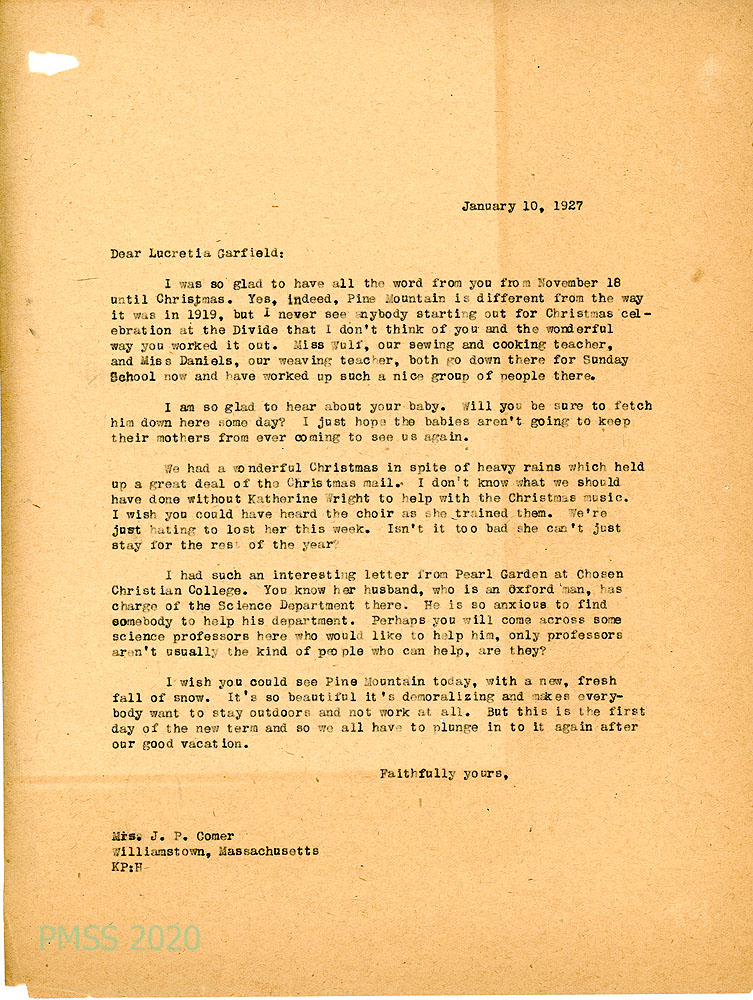
Another ambiguous response to snow is found in the correspondence of Katherine Pettit writing to a former staff member, Lucretia Garfield, a relative of President Garfield, in January of 1927. She speaks to the beauty of the snow and wishes that Lucretia could see the snow at the Pine Mountain School
I wish you could see Pine Mountain today, with a new, fresh fall of snow. It’s so beautiful it’s a demoralizing and makes everybody want to stay outdoors and not work at all. But this is the first day of the new term and so we all have to plunge in to it again after our good vacation.
ALICE COBB STORIES 1930s-40s
Alice Cobb, another worker at the School, gathered many stories of families in the community as they struggled with harsh winters and the cold and drafty cabins in which many of them lived. Cobb remembers with some poignancy, one conversation on her “Farewell Trip” to visit community friends as she prepared to leave Pine Mountain after many years of service
“I wish I could remember all the stories — perhaps I will from time to time and can jot them down. I tried so hard to memorize them as he [Abner] went along but you just can’t remember all Abner’s nice little sayings, and fancy words. One thing I remember, when he spoke about a cold winter, with the snow and tree branches a poppin’ and a crackin’. And then he asked me about you [Cobb’s Mother, her correspondent] and… …how many children there were at home.I said you [her Mother] had to be there alone most of the year. He was quite severe — asked how often I went home. I said only once or twice a year. He shook his head and said “And you don’t stay home no more than that — and them without ary chick nor child?” You see his idea is that a family should stay together, and he doesn’t want his children to come even as far as Pine Mountain school. He feels that their family circle must be unbroken — it’s a beautiful affection they all have for each other, and while in any other family I wouldn’t like it, in his it is different.”
Alice Cobb’s Farewell to Line Fork, June 14, 1937 (Via Little Laurel, Big Laurel and Turkey Fork)
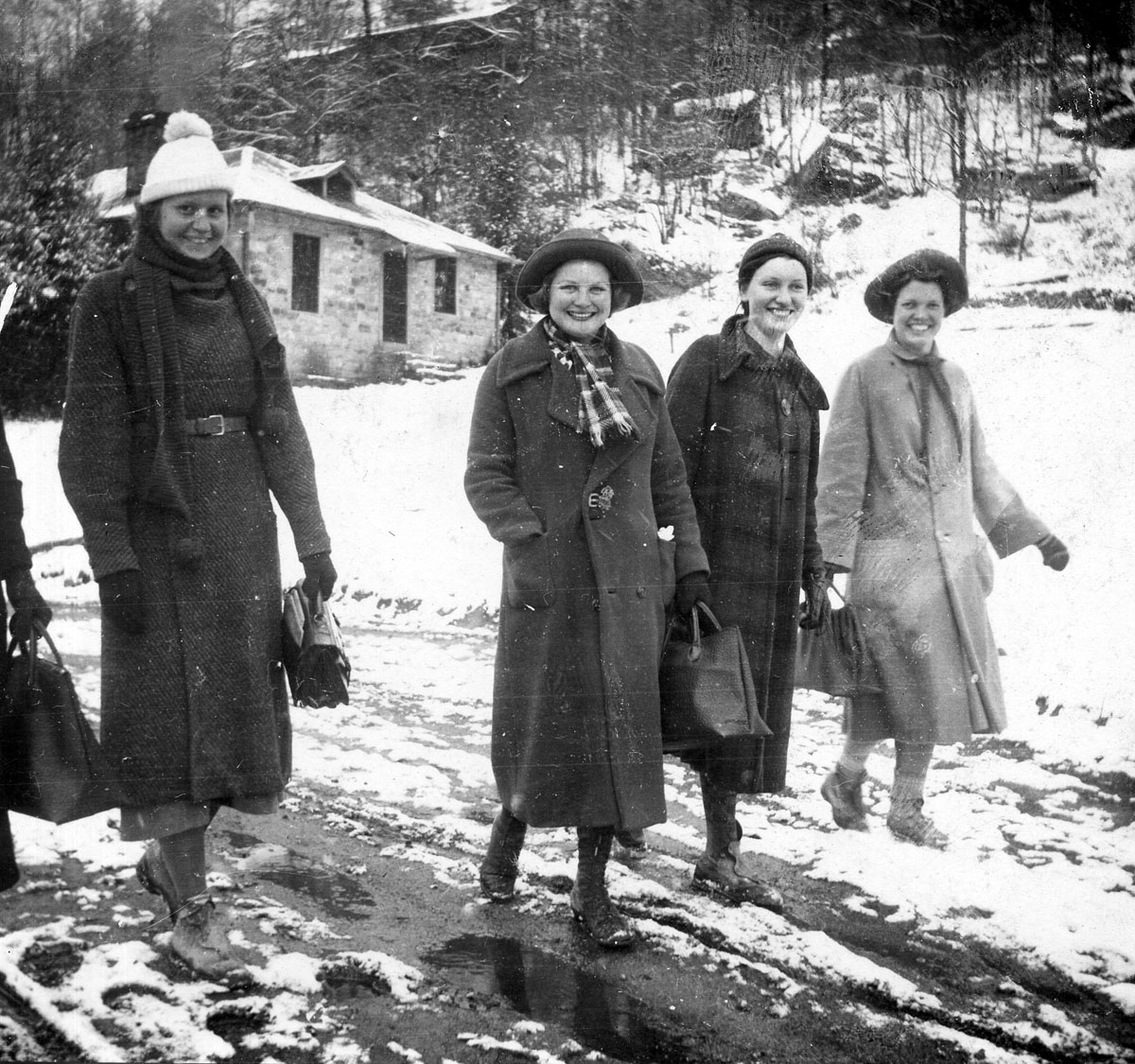
Lela Christian, Nan Milan, Stella Taylor, Nancy Jude. Student Community Service Workers, c. late 1930s – early 1940s. [duplicates_069.jpg]
The academic programs in the late 1930s and the 1940s pushed the older students out into the community, where they would experience the life of the people and provide much-needed social service supports as Community Service Workers. This program, designed by Director Glyn Morris, was ground-breaking in the rural setting of Eastern Kentucky and led to expanded development in the later regional Rural Youth Guidance programs initiated by Morris. It was also a model for the Frontier Nursing Service that was later developed nearby. The students seen above were trained by Grace M. Rood, who, at the end of her life, wrote of her work training students in the nursing field.
‘BATTLE OF THE YEAR’ SNOWBALL FIGHT 1944
While the School program was rigorous, it also made room for students to revel in the joy of play, and snow afforded the perfect playground. In this article from the 1944 Pine Cone, some of this revelry is described. It is a description familiar to any child who has had the joy of pummeling their schoolmates, no matter their age, with snowballs.
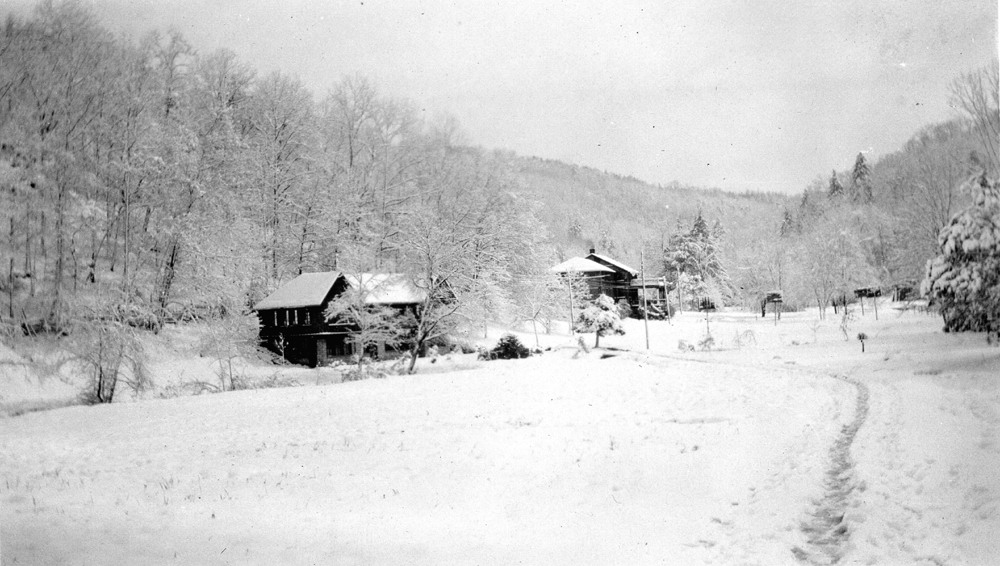
Boys’ House in the distance and Girls’ Industrial in the foreground with deep snow. c. 1940s
The deep, wet, and heavy snows that were, and are, common at Pine Mountain, provided perfect playgrounds for students to engage in snowball fights like the one described below by student John Deaton
BATTLE OF THE YEAR” by John Deaton Snowball fights among students from the various dormitories.” 1944 Pine Cone
As snowball fights were to be the order of the day with Boys’ House challenging Far House and West Wind offering to battle Big Log, everyone went home and changed into warmer clothes.
The scene of the boys’ skirmish was Far House lawn, which Boys’ House captured at will. The luckiest break for Boys’ House was the charge that netted us a panful of snowballs manufactured by Far House. Neither side can be declared the victor but Far House firmly declined an invitation to continue the fight on the playground which is nearer to Boys’ House.
The girls did not turn out in large numbers, but they surely created more excitement. The bandannas which were worn to protect their hair slipped off. The result was a generous amount of mud and snow in the hair of the participants. The mud was thicker and more plentiful than the snow, and much mud was mixed with the snow balls. this fight should go to West Wind, which was greatly outnumbered but kept on the offensive almost all afternoon. We are all looking forward to another afternoon of slinging snow.
“Daffodils and snow do not mix well. Still they are trying…”
Like the daffodils and snow, H.R.S. Benjamin, the new Director of Pine Mountain in the Post-War years, was caught in an equally incongruous event. As the Pine Mountain boarding school teetered on the edge of collapse following the end of the War and the financial downturn following the war and the departure of former Director Glyn Morris, Benjamin faced overwhelming challenges. Buffeted by the shifting economy and by the consolidating educational framework in Harlan County during the early post-war years, Benjamin found himself in a blizzard of enormous challenges. But, with the promise of the beautiful and unique building, West Wind nearly finished, he set about trying everything he knew to find the right mix of despair and enthusiasm.
The rapid shifts in climate only added to Benjamin’s anxiety about the many looming threats in the educational and economic climate that would have to be addressed, and as the bills for West Wind crossed his desk, he stepped up. The sizable building project of West Wind initiated by Morris to fill the need for a girls’ dormitory, was now a huge financial burden for Benjamin. Further, as the boarding students dwindled and the post-war economy grew more fragile, the boarding school was deep in a snow drift. But, as Benjamin walked out of the Office he saw the beauty and potential of Pine Mountain ….”… the daffodils pushing their way up through the snow.”
One can perhaps imagine that he was also thinking of Mary Rockwell Hook, the School’s architect, sitting in the sun of Sarasota, Florida, with her daffodils and palm trees as the snow filled his disintegrating horizon. We will never know if his remark was one of despair or hope, but it was certainly an apt description at the time.
It is still a common sight at the School to see the early daffodils keep trying to bloom through late winter snow … joyful yellow in a sea of white. In February, Benjamin wrote another letter of seasonal change and longing to a former Pine Mountain worker
February 5, 1947
Dear Miss Sparrow, I guess the near-zero temperatures this week are more in keeping with the season than the spring breezes which we enjoyed last week, and most of the winter, but they are scarcely as pleasant! We think often in this weather of our many Pine Mountain friends basking in Florida Sunshine.
H.R.S. Benjamin, Director
This signals that while despair was lurking, change held promise and envy.
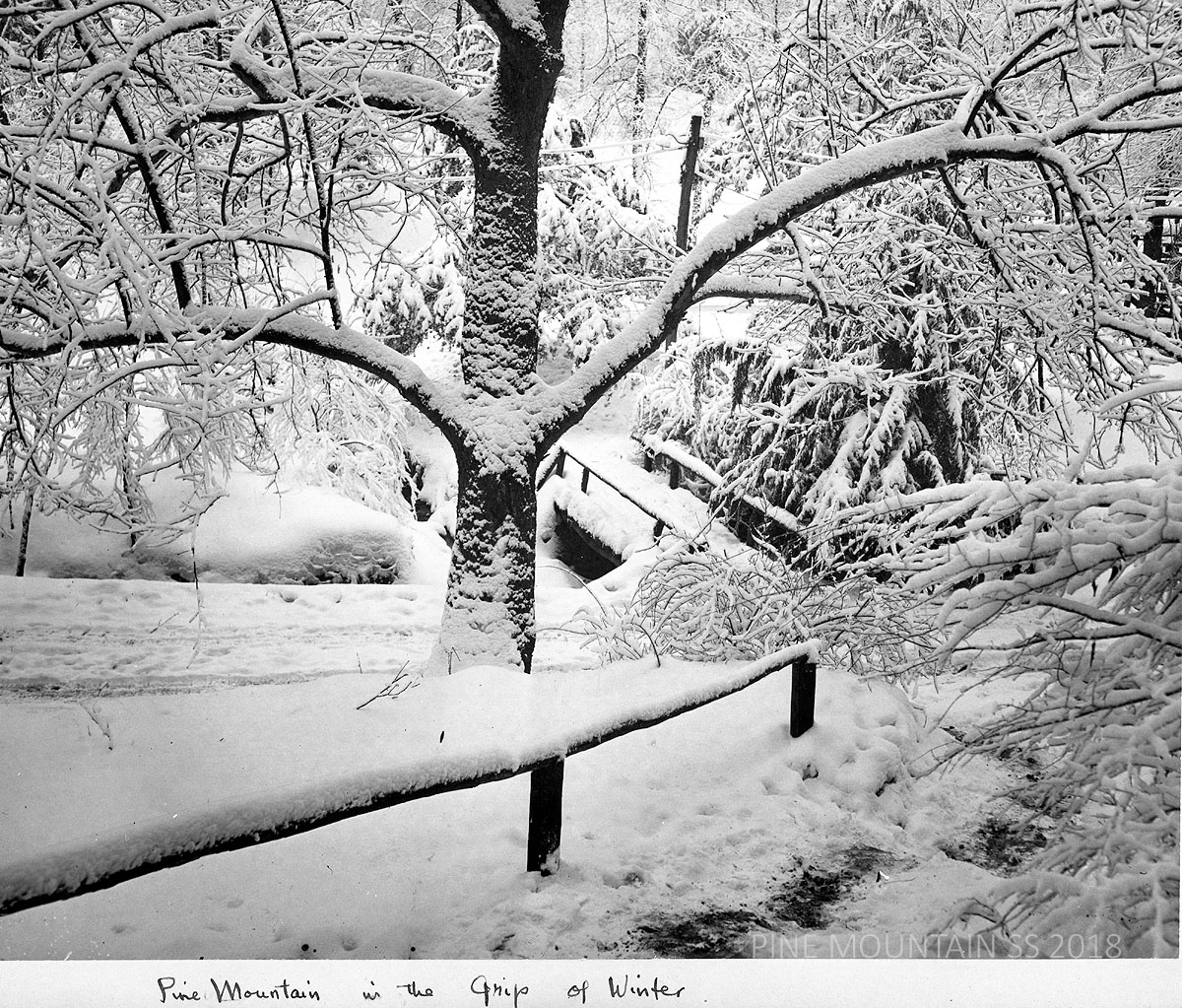
Pine Mountain in the grip of winter. [Arthur Dodd, Photographer ?] 1940s
1940 LADEN TRAIL AND THE JOE WILSON STORY
The migration of Joe Wilson and his family from Pine Mountain over Laden Trail to Harlan in the depths of winter is one of the most memorable snow stories of the School’s third decade. Alice Cobb, who accompanied the family, describes the caravan that set out in the snow to cross the mountain in an overloaded truck and the adventure that ensued. Cobb captures both the social and the physical misery of the transport and of change, in this clip from her short story Migration from the Hinterland to the Industrial Area [Harlan]
When the morning came it followed a sleet storm, and we awakened to a new world, coated with ice, every little branchlet of every little tree glorified, shimmering. One was shocked by so much beauty, so lavishly displayed and I thought with embarrassment for mankind and the things he is proud of, — the glass flowers in the cases at Harvard University, tenderly buried underground in case of fire — when here was this inimitable glory, a thousand miles from anywhere at all, blooming for a day, and careless of existence.
I slipped and slid over the cinder path to the office, to see what was going to be done about the trip over the mountain. Brit [was …? …?] said certainly he would go and hadn’t he been up since four o’clock out to the Wilsons, loading their house plunder on the truck.
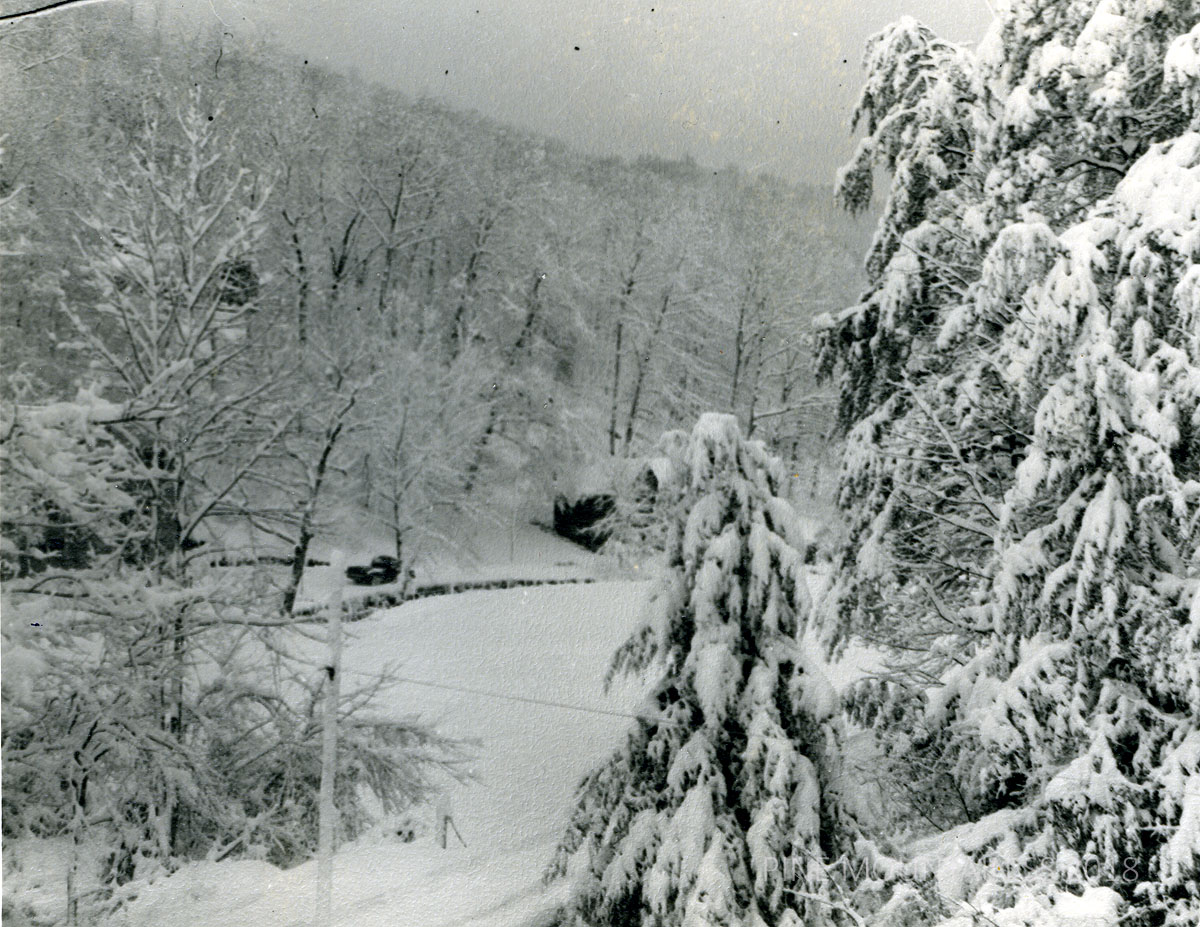
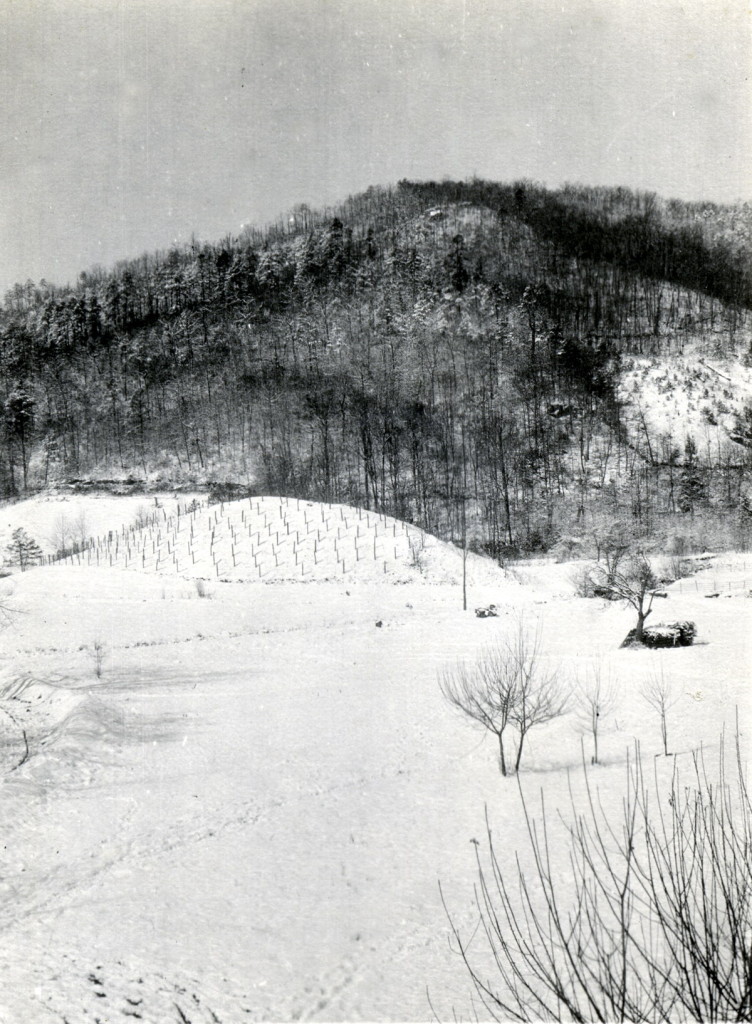
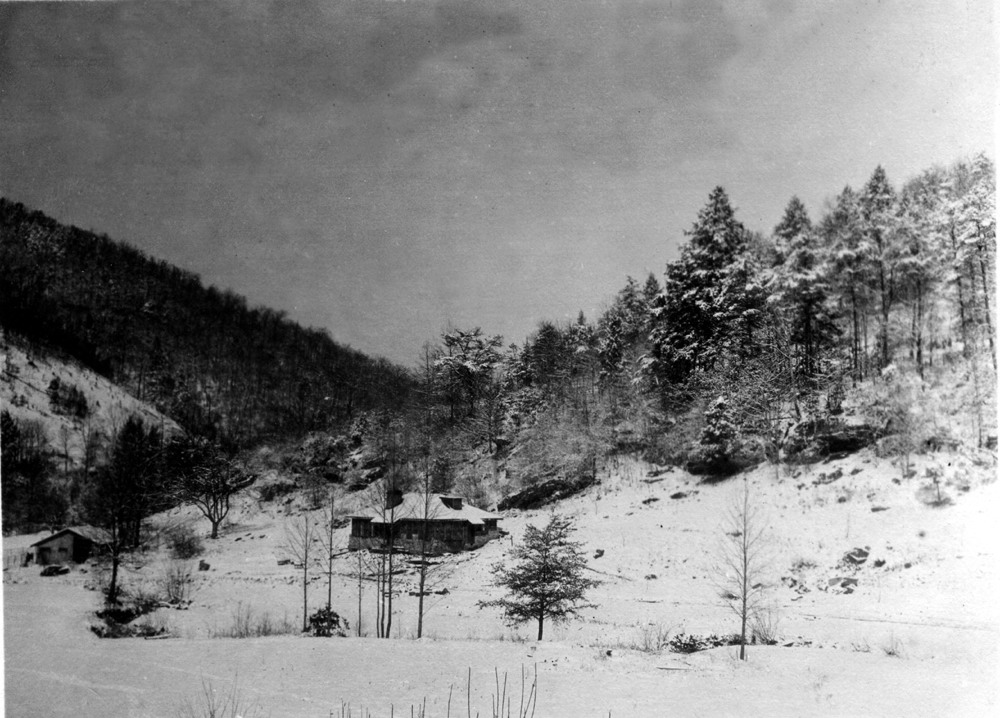
View down the Pine Mountain valley with snow. The Road to Harlan crosses the mountain near the gap in the far left mountain range seen in the image. [kingman_034c]
PHOTO GALLERY
[View across campus toward Grapevine Knoll, in snow, c. 1946.] [nace_1_028b.jpg]
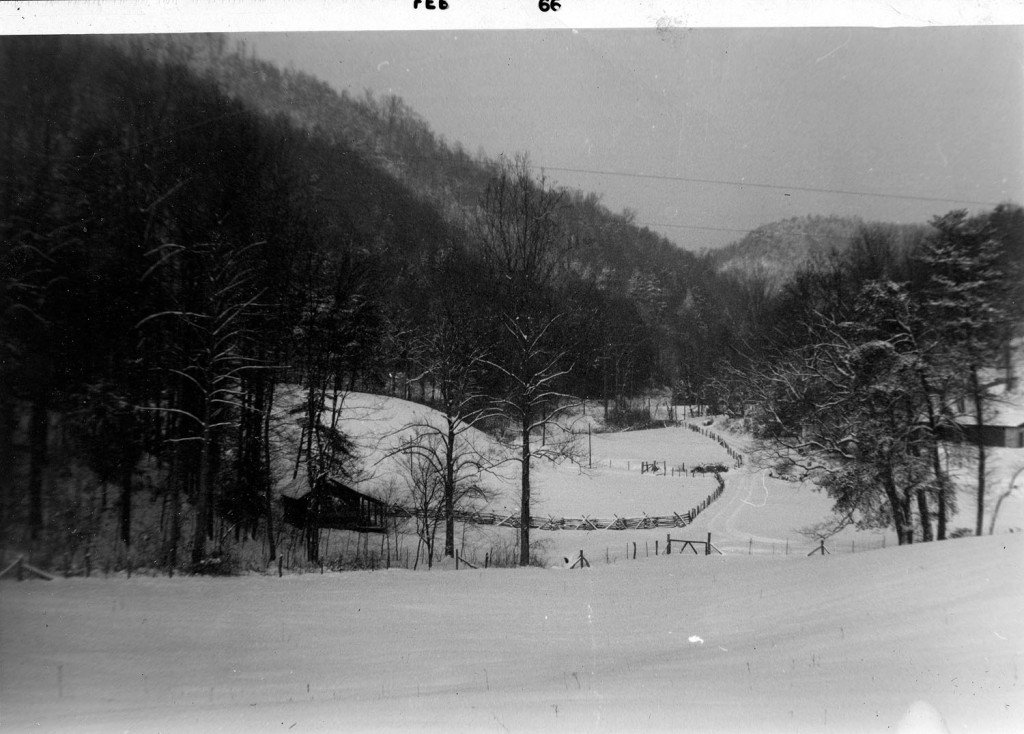
Medical Settlement- Big Laurel. View of homestead buildings in snow landscape across from Medical Settlement. [big_laurel_3338c.jpg]
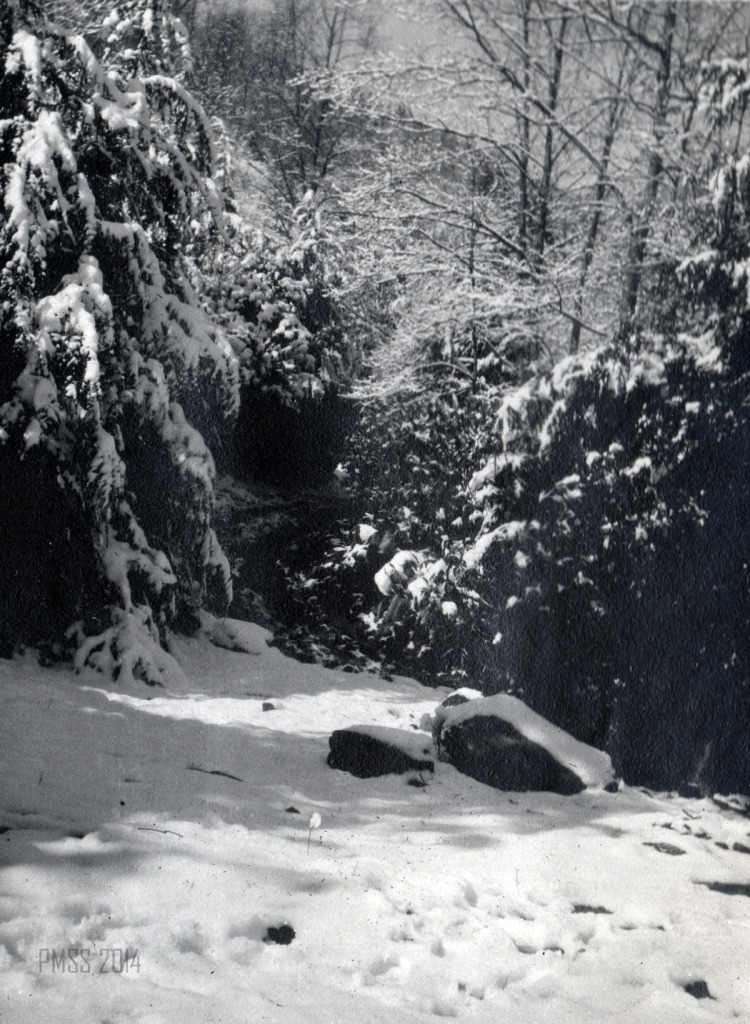
Maya Sudo Album: Snow-covered road lined with hemlocks and pines. 032a
Maya Sudo Album: Hemlocks and stones covered by snow. 035b
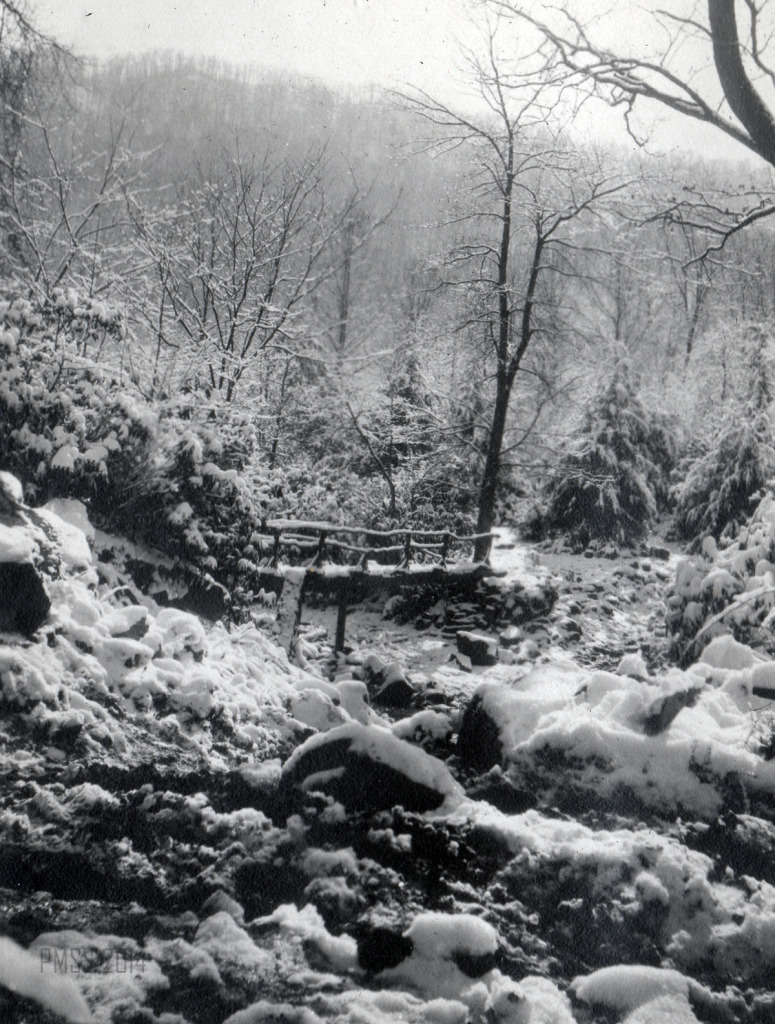
Maya Sudo Album: Snow-covered stream and foot-bridge near Old Log [?]. 033a
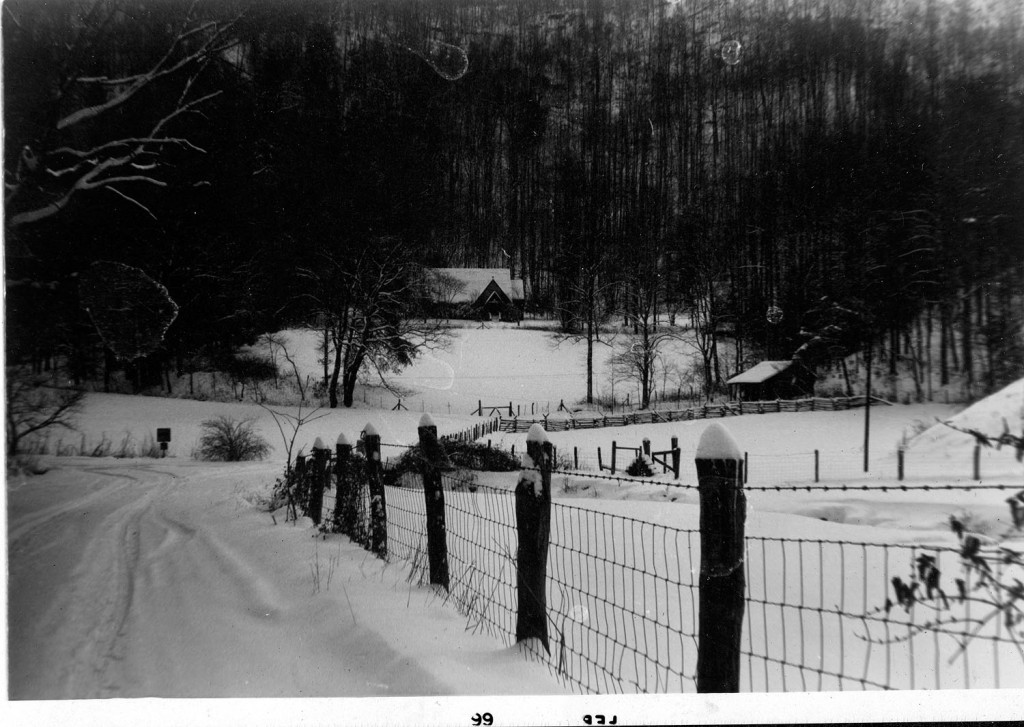
Chapel and Creech Cabin in the snow, distant view, 1999. [II_11-02_creech_cabin_0402-2.jpg]
Creech Cabin in the snow, distant view. [II_11-02_creech_cabin_0401a-2.jpg]
Grapevine knoll in snow. II_3_general_views_147a_mod
Office. Distant view in the snow. [II_5_old_log_office_227a.jpg]
Girl’s Industrial. Distant view of Boy’s House behind and to right after snowfall.
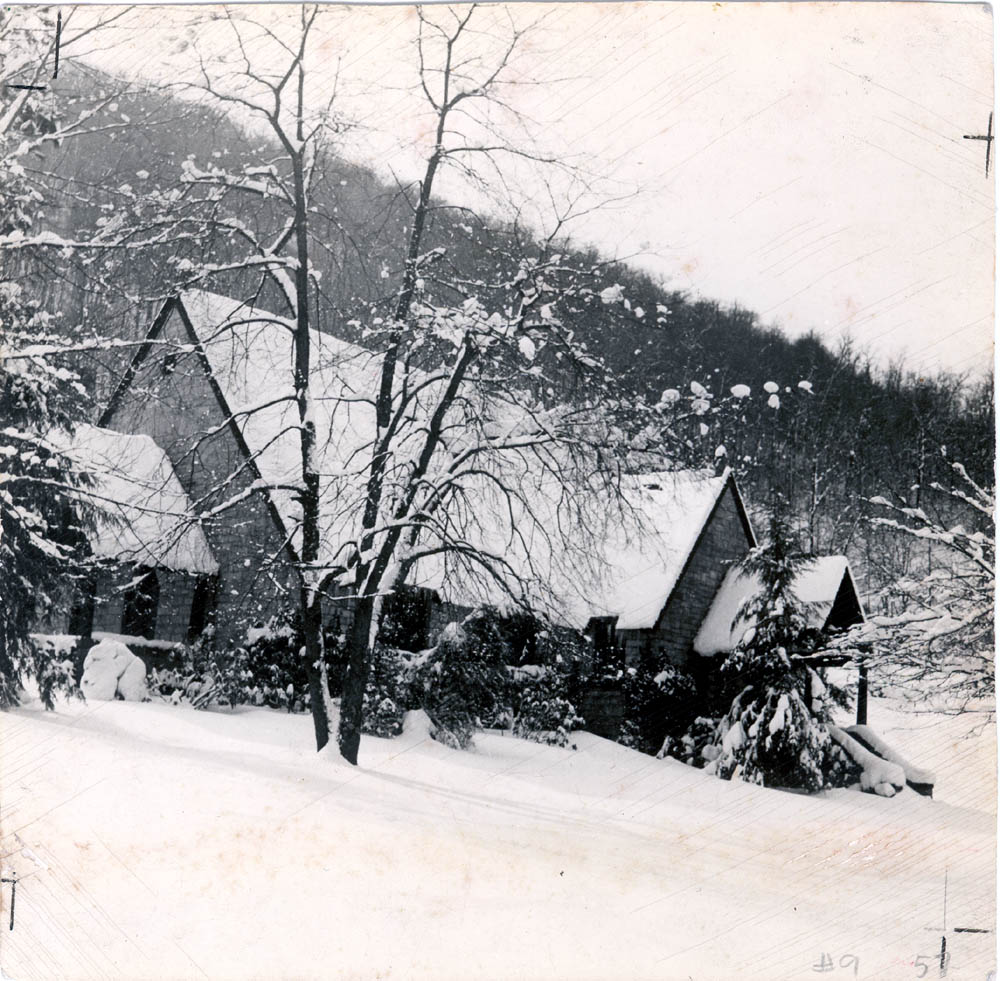
Chapel, c. 1930s. Western flank in snow, seen through trees. Photograph by Arthur Dodd. [pmss3191mod.jpg]
Far House II, Pine Mountain Settlement School, c. 2018.
Pine Mountain Settlement School Series: DANCING IN THE CABBAGE PATCH Books, Horses, and Place
Pine Mountain Settlement student Ruth Shuler on horseback, delivering books as part of the Co-op library program. c. 1941. garner_006 (120)
BOOKS, HORSES, AND PLACE
In 1941 the Co-op Program was a well-tested and central part of the educational curriculum at Pine Mountain Settlement School. As an important part of the progressive curriculum, it was a community outreach program that included many aspects of the popular WPA librarians on horseback or packhorse librarians initiative.
In addition to bringing books and magazines to the surrounding Community, the Pine Mountain Settlement program also checked on the health and well-being of the families it served. Many of the visits were in countrysides so rugged that the only means of reaching the home was to travel along streambeds or over roadless mountains. Horses and mules were the only viable transportation. The visits of the Co-op students and often their staff monitors were eagerly anticipated in the homes and they opened the way for families to connect to the Pine Mountain Settlement School and for the School to expand its services.
While the program was conceived under the direction of Glyn Morris, the young Settlement School Director, it was not implemented until the mid-1930s and ended in 1949. While not unique in the many mountain programs of Librarians on Horsebackt, it touched the lives of many children and their families. While established for very pragmatic and often life support reasons, the idea of young women on horseback traveling through difficult mountain terrain, in the rain, sleet, and snow also had a romantic over-tone.
Perhaps it is the romantic notion of a young girl and her horse facing the world together that appealed. In older generations, the story of Black Beauty still lingers with romantic nostalgia. Perhaps it is the Kentucky horse ambiance. Whatever the inspiration, the stories surrounding the workers and “librarians” who participated in the packhorse program have, in recent years, begun to proliferate. The reasons for the recent uptick in interest in the WPA Librarians on Horseback are many. But, the message, one of service, sacrifice, selflessness, and literacy is important to any generation.
The many selfless hours spent doing community work by women while dependent on the courage and coordination of a horse has far more practical lessons than many contemporary children’s book themes. Further, getting lost in the imagination while on the pages of a book seems far more productive than the passive clicking on electronic media.
A new book has just been published by Little Bee Books, written by noted children’s author Emma Carlson Berne, and illustrated by Italian artist Ilaria Urbinati. It fires up the reader’s imagination. What is so very special about this delightful book is that it is written for and about rural children who are often more removed from libraries. The rural in this case is based on conversations with people from the Pine Mountain Settlement School and the valley is in one of the most remote areas of Eastern Kentucky.
The book quickly brings the reader into a very accessible tale of Edith, the young “Librarian” who sets off to deliver books while riding Dan, her trusted horse. As the story gallops along, it is sprinkled with local references such as pawpaw pudding, mountain springs, a fierce and unexpected thunderstorm, and even a familiar mountain family name, “Caudill.” The possible nod to Caudill is perhaps an oblique recognition of noted Appalachian children’s author, Rebecca Caudill, a winner of the National Young Reader’s Award and also a Newberry Honor Book in 1950. Caudill was a frequent visitor of the Pine Mountain Settlement
The second delight in Berne’s book are the beautiful illustrations by Italian artist Ilaria Urbinati. Ilaria, who lives in Turin on the northern mountainous edge of Italy, has captured the dual nature of mountain living with its beauty and its danger. Her images nearly gallop off the page with energy that competently matches the romping narrative. While Edith looks a bit like a modern Pippi Longstockings, the artist has captured the energy of horseback riding and of the fearlessness of so many Appalachian girls in their native mountains. The author and illustrator have both grasped many of the natural obstacles that the women on horseback often faced in delivering their “libraries.”
Edith, the librarian in this little book, as Berne explains in her Author’s Note, is not the typical urban librarian that families may know in their city and town settings. She’s a very special librarian, and one that historically existed in the mountains of Eastern Kentucky. Edith, like the other “librarians” that were often called “Packhorse Librarians” in the WPA (Works Progress Administration 1935-43) offering, was special. In the Appalachian region, young girls were often hired from the local community to fill the librarian role. They knew the mountains, the weather, the dangers that come with the rugged countryside, and the lives of the isolated families.
In her notes, Emma Berne places the story within the genre of WPA Packhorse Librarians in the Appalachians, but she makes the nature of the program locally intimate in her description of the mountain librarian, as well universal in the bravery of women generally. She describes how her local interviews and personal background helped her to shape her story. What she offers up is an inspiring and beautifully illustrated tale that will capture the imagination of young children of both genders, will enchant the parent reader, and bring the public into close contact with rural America.
Pine Mountain thanks Emma for her interest in the Settlement School and for the inclusion of interviews in the region while developing her book. This book is highly recommended for all libraries. While other reviewers have pointed out that the book is “White”, suggesting that it was purposeful in excluding people of color, they have most likely not traveled in the most remote regions of Appalachia. Yet, it is a book that gives dignity to all peoples, particularly rural America, and which is independent of race, ethnicity, and class.
Pine Mountain Settlement School DANCING IN THE CABBAGE PATCH Sheep Shearing and Cecil Sharp
0046a P. Roettinger Album.”Sheep Shearing, Uncle John Shell, Aunt Sis Shell, and Mrs. Joe Day.” c.1920s [Woman standing next to a barn on left, watching man and woman sheer a sheep.]
TAGS: sheep shearing, Cecil Sharp, sheep, sheep flocks, dreaming of sheep, sheep in history, sheep in song, Uncle John Shell, Aunt Sis Shell, Mrs. Joe Day, George Pullen Jackson
SHEEP SHEARING and CECIL SHARP (Say that fast!)
It is not likely that Cecil Sharp (1859-1924), the British musicologist, ever sheared a sheep. But, he was, in any case, a close observer of the ruminants and probably an even closer critic of their bleets and baahs! Nonetheless, what Cecil Sharp has left to the history of sheep is a unique auditory trail that helps to re-trace the prevalence of sheep within the rich agrarian history of Great Britain and in the American Appalachian mountains.
When musicologist Sharp sat on the porch of Old Far House at Pine Mountain Settlement School in Kentucky and watched the Kentucky Running Set as it was performed by students and staff, he was watching the well-trained legs that probably had chased a sheep or two up the Pine Mountain and down. Tending sheep is an active job and the energy of that Kentucky Running set is just a short measure of the energy that is needed to maintain a sheep flock in the mountains of Eastern Kentucky.
SHEEP IN APPALACHIA AND BORDERLAND CULTURE
in the early years of the Central Appalachians, in the small hillside farms, it was a celebration when lambs arrived and again when wool was sheared. In the far-off “lands across the sea,” as Uncle William Creech, a founder of Pine Mountain Settlement used to say, many Europeans were continuing similar agrarian practices, particularly those people of the so-called “Borderlands,” that narrow bridge of land between Scotland and England. This region has long been associated with the early settlers of the Central Appalachians. The European Borderland customs and agrarian practices lingered on in many of the immigrant ancestors found in the Appalachians. In fact, they formed one of the largest immigrant groups living deep in the Appalachian mountains.
The raising of sheep was built into the early Appalachian pioneer imperative. Like so many of the customs familiar to the European immigrants from England, Scotland, Wales, and Ireland, and also those from other points of origin with agrarian roots, sheep were fundamental to survival. As an international livelihood, sheep flocks and along with those of goats are closely tied to the stories of agrarian cultures.
CECIL SHARP, SHEEP, AND SONGS
What Cecil Sharp added to sheep history was the discovery and transcription of an English folk song that no doubt flowed from the music and lives of early sheep farmers. While his discovery was not in the Borderlands but was probably in the Norfolk area of England, it captured the centrality of sheep to everyday agrarian life.
When Cecil Sharp made his journey to America and eventually to Appalachia he wove the common elements together. Other song and ballad collectors preceded Cecil Sharp, but few had his broad recognition. When Sharp identified the British elements found in Appalachian songs and ballads he opened the flood-gates to other musicologists to marry Appalachia to “Merri Old England.”
While Sharp was interested in the music, the music held a history that was less obvious. This is the relationship of the music to agrarian practice. While the growing obsession with “Merri Old England” in early twentieth-century America assured a close historical musical bond it also revealed something of the common agrarian practices. The catchy alliteration of Sharp’s collected songs underlines the importance of sheep in the daily lives of agrarian Europeans and their ancestors in the Appalachians. Alliteration and all its musical overtones came naturally to the early oral culture of England and Appalachia. Mother Goose rhymes such as “Peter Piper picked a peck of pickled peppers … etc. ” is well known on both sides of the Atlantic as are many other ditties. But, just try saying “Cecil Sharp and sheep-shearing,” and see what lyrical lapses leap from your tongue and fix on your memory. Songs of shearing sheep are not at all uncommon, especially in families with a weaving willfulness — a trait that springs from sheep-herders and that abounds in the mountains of the Central Appalachians and across the world. Our first school yards were the pastures of the world.
COUNTING SHEEP AND DREAMING
Even as we sleep, we are not far from the sheep pasture. It is no small wonder that when we speak of dreaming, we also often speak of “counting sheep.” There is a very practical origin for that numerical association. It was the duty of the herdsman to know the number of sheep in his herd. It was a daily practice. Counting sheep is deeply etched into the fabric of descendants of sheep-herders and deep in the historical agrarian psyche. We have been counting sheep for as long as we have joined our lives with the practice of raising sheep and other herds of animals. Sheep have been a part of our history as a country from the beginning of European settlement and have had considerable influence on our practical and formal education. At one time Kentucky led the nation in the number of sheep. For Kentuckians, that is a lot of counting and a lot of dreaming.
Yet, Cecil Sharp was a collector of songs, not sheep, nor wool though he shows all the instincts of a weaver, dreamer, and numerator. He began his collecting of folk ballads in the English countryside. There, it was inevitable that he would encounter a myriad of sheep and those who tended them. Those country sheep herders had a deep association with alliterative language and ballads and ditties. Some references to sheep were sure to appear, and they did.
The song that Sharp recorded on his journey to Norfolk was one that succinctly captures sheep and their shepherds. That ballad from his song-gathering encounters, was published in a small book he edited called 100 English Folk Songs [ published by Oliver Ditson Co., Theo. Presser Co. Distributors, Philadelphia, 1916].
SONGS FOR ALL TIME [Songs of All Time]
One of the songs in Sharp’s collection found its way into another small book of collected folk songs. The Songs for All Time printed at Pine Mountain Settlement School was issued by the Council of Southern Mountain Workers c. 1946, and was intended to be a resource for “recreation material in the Highland [Appalachian Highlands] area.” It was a utilitarian collection of songs for social gatherings that is largely dependent on the rich oral tradition of the Appalachian region and that contained many familiar tropes that would be recognized in Great Britain. The Foreword tells us that
The contents, folk songs for the most part, were compiled by a committee which has made practical use of them with singing groups. Where tunes and words depend on oral tradition, innumerable versions usually exist — some of them perhaps better than [the] variants included. There is no version which can be called the correct one, but the committee has chosen those which it has found satisfactory in the light of their lasting qualities and the ease with which they can be learned. Modal melodies are not always easy to introduce to those unfamiliar with such music, but practically all songs included have been put to the proof: given a little time and repetition they “sing well” and become dear to the heart of the singer.
Song For All Times [Songs of All Time], Copyright, 1946, by Cooperative Recreation Service, (Forward). [4 editions published in 1946 in English and Undetermined and held by 29 WorldCat member libraries worldwide.]
On the back of the booklet, Songs For All times, there appears a short essay by George Pullen Jackson, an American musicologist, and educator. Pullen was a pioneer in the field of Southern (U.S.) hymnody and popularized the spurious term “white spirituals” to describe “fasola“* singing. [*fasola= harp singing or shape-note singing] Pullen says
…Sing, preferably your own songs, brother. Live your own song life and be proud of it. Don’t let the I-dont’-know-a-thing-about-music complex trouble you. Don’t let the processed and canned music lower your musical morale. If you are a mature person, re-learn and re-sing the songs of your childhood and youth. (You’ll be surprised at the large admixture of genuine folk songs among your remembered ditties.)
George Pullen Jackson, comment from Songs for All Times [Songs of All Time]
What George Pullen Jackson sensed was the power of music to heal and make joyful the day when it is pulled from routine experiences and even more when it is derived from a shared experience. The shearing of sheep and other communal activities of pioneer families brings home the satisfaction of sharing with neighbors the sometimes daunting tasks that an agrarian life demanded. Further, Jackson in his remarks shares with Cecil Sharp the understanding of the healing power of song as it is remembered across all time and as it derives from the common stories of living.
While there is no direct knowledge of the following song appearing in the original musical repertoire of the Central Appalachians, the sentiment would clearly have resonated with the mountaineers. The Sheep-Shearing, was collected by Cecil Sharp in his 100 English Folk Songs for a good reason. He described it as “very popular among English country folk” and “in existence before 1760.” His sensitive ear could also, no doubt, frame the picture evoked by the lyrics in this and in his other collected songs
THE SHEEP-SHEARING
How delightful to see, In these evenings in Spring, The sheep going home to the fold.
The master doth sing, As he views everything, And his dog goes before him where told, And his dog goes before him where told.
The sixth month of the year, In the month called June, When the weather’s too hot to be borne, The master doth say, As he goeth on his way: “Tomorrow my sheep shall be shorn, “Tomorrow my sheep shall be shorn.”
Now as for those sheep, They’re delightful to see, They’re a blessing to a man on his farm. For the flesh it is good, It’s the best of all food, And the wool it will clothe us up warm, And the wool it will clothe us up warm.
Now the sheep they are all shorn, And the wool carried home, Here’s a health to our master and flock: And if we should stay, Until the last go away, I’m afraid ’twill be past twelve o’clock, I’m afraid t’will be past twelve o’clock.
Cecil Sharp, 100 English Folk Songs, …”In existence before 1760.”
Contains information related to marketing campaigns of the user. These are shared with Google AdWords / Google Ads when the Google Ads and Google Analytics accounts are linked together.
90 days
__utma
ID used to identify users and sessions
2 years after last activity
__utmt
Used to monitor number of Google Analytics server requests
10 minutes
__utmb
Used to distinguish new sessions and visits. This cookie is set when the GA.js javascript library is loaded and there is no existing __utmb cookie. The cookie is updated every time data is sent to the Google Analytics server.
30 minutes after last activity
__utmc
Used only with old Urchin versions of Google Analytics and not with GA.js. Was used to distinguish between new sessions and visits at the end of a session.
End of session (browser)
__utmz
Contains information about the traffic source or campaign that directed user to the website. The cookie is set when the GA.js javascript is loaded and updated when data is sent to the Google Anaytics server
6 months after last activity
__utmv
Contains custom information set by the web developer via the _setCustomVar method in Google Analytics. This cookie is updated every time new data is sent to the Google Analytics server.
2 years after last activity
__utmx
Used to determine whether a user is included in an A / B or Multivariate test.
18 months
_ga
ID used to identify users
2 years
_gali
Used by Google Analytics to determine which links on a page are being clicked
30 seconds
_ga_
ID used to identify users
2 years
_gid
ID used to identify users for 24 hours after last activity
24 hours
_gat
Used to monitor number of Google Analytics server requests when using Google Tag Manager

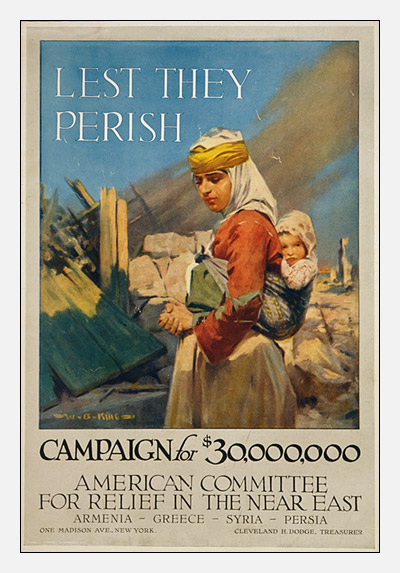
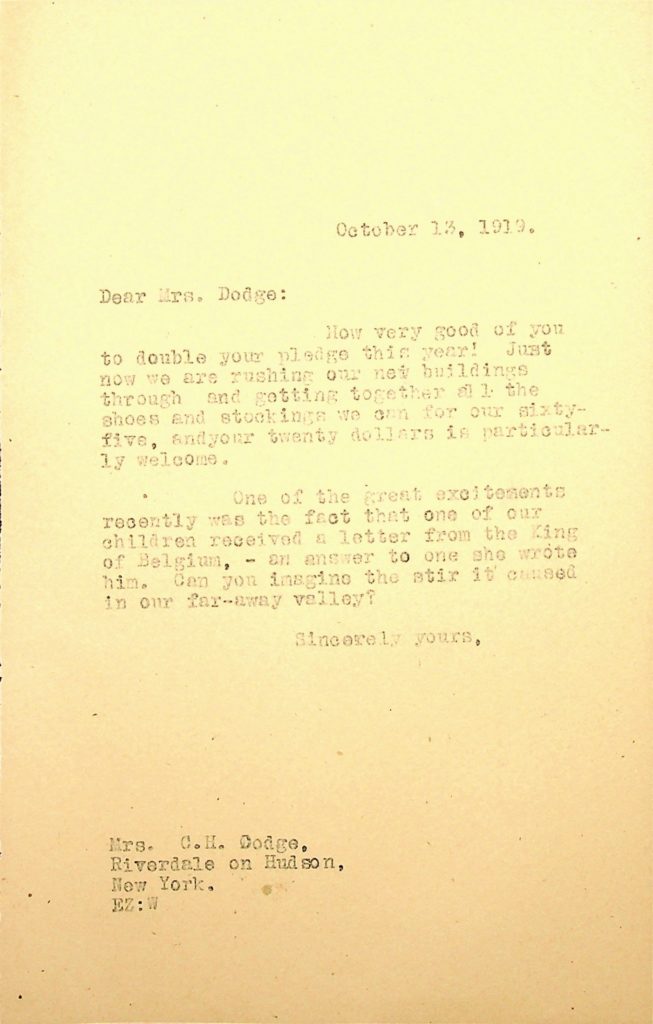
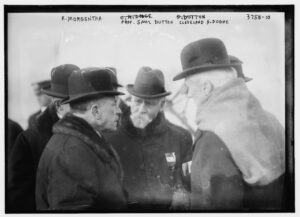
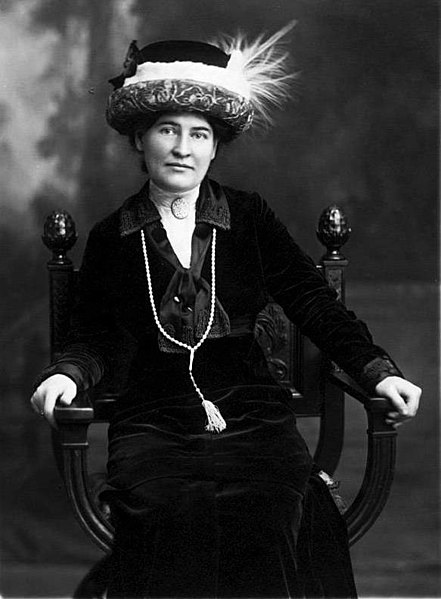
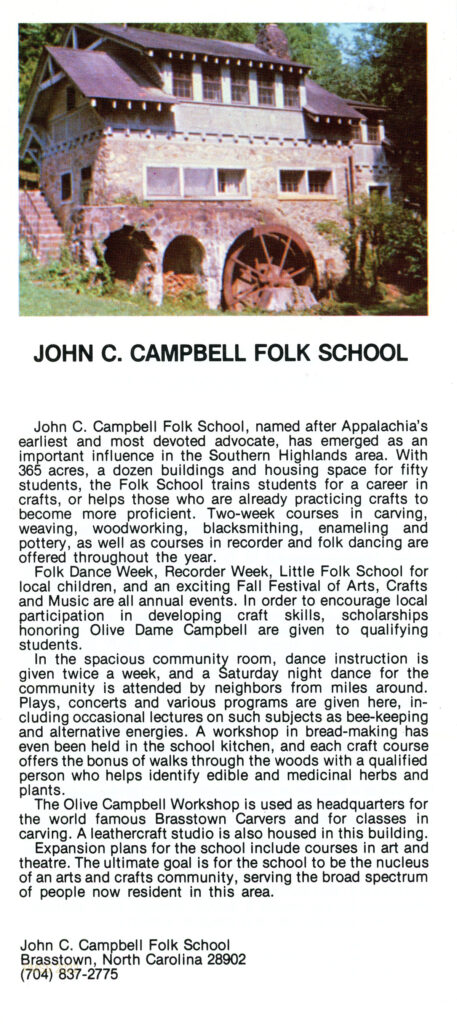
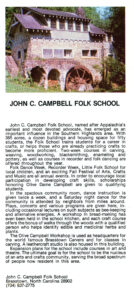
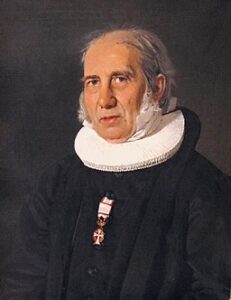
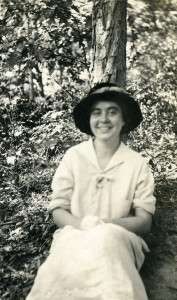
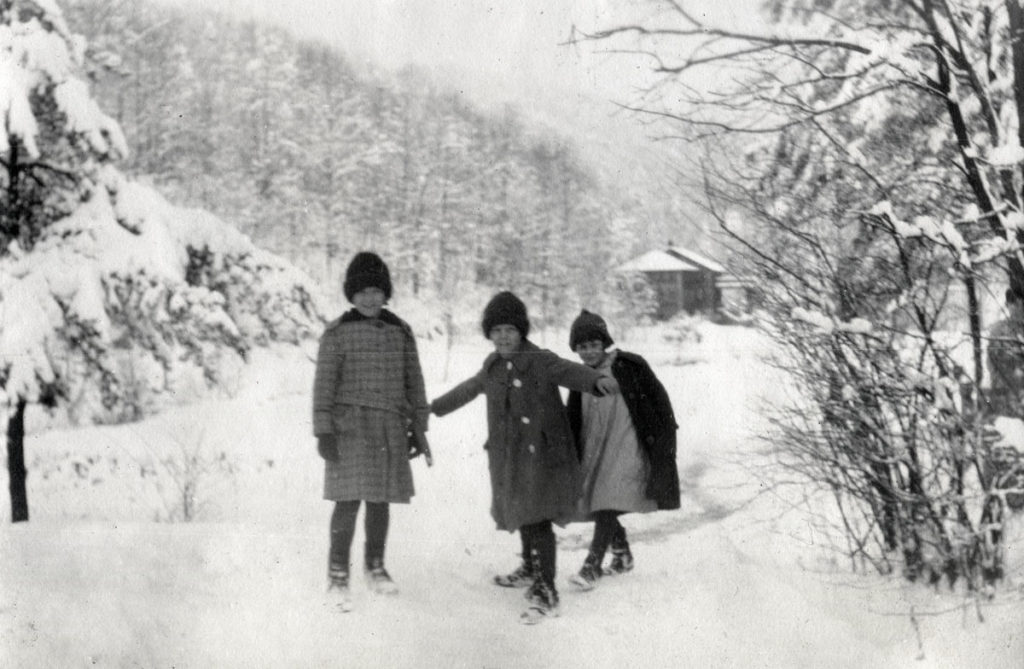
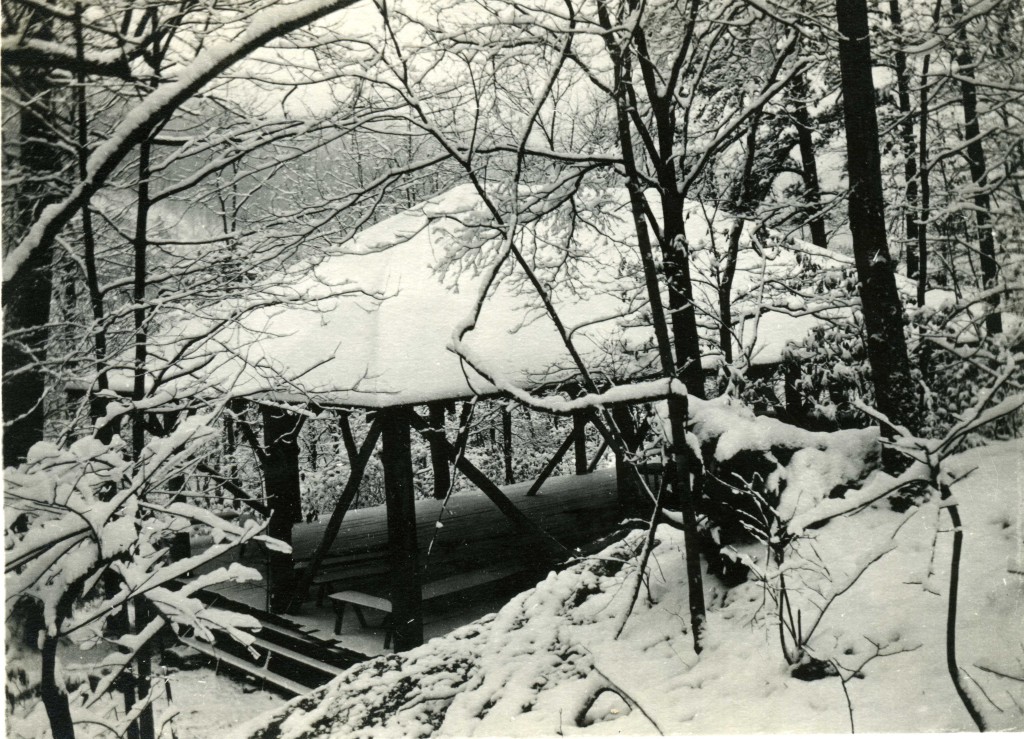
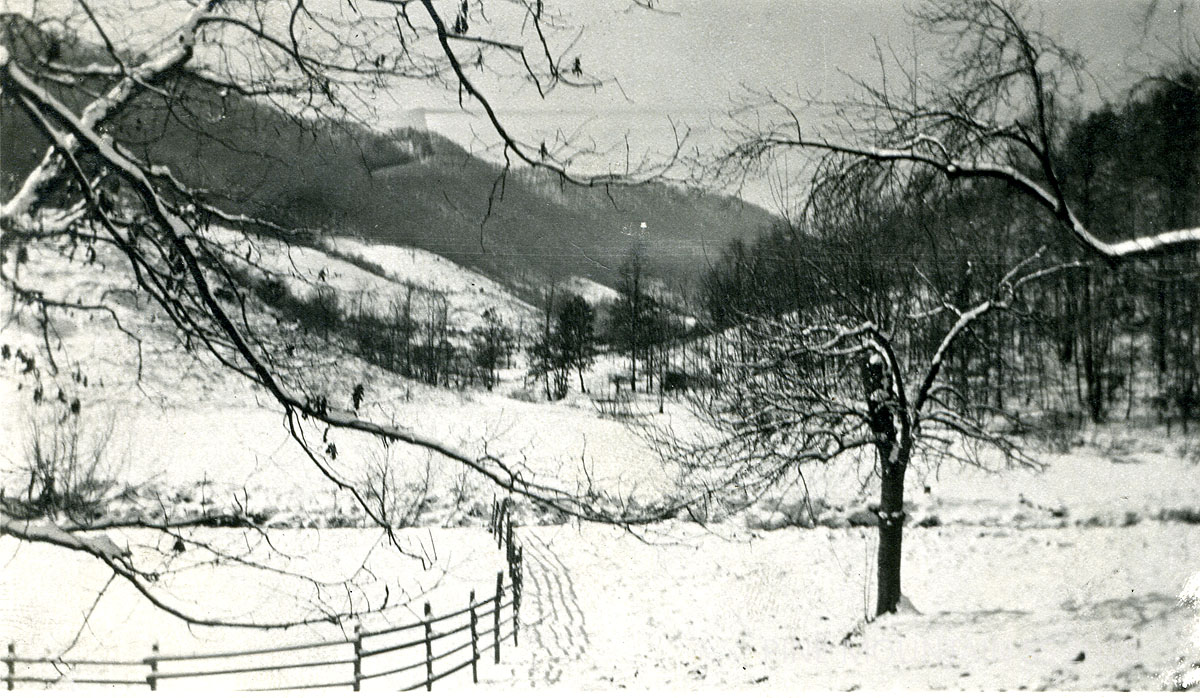
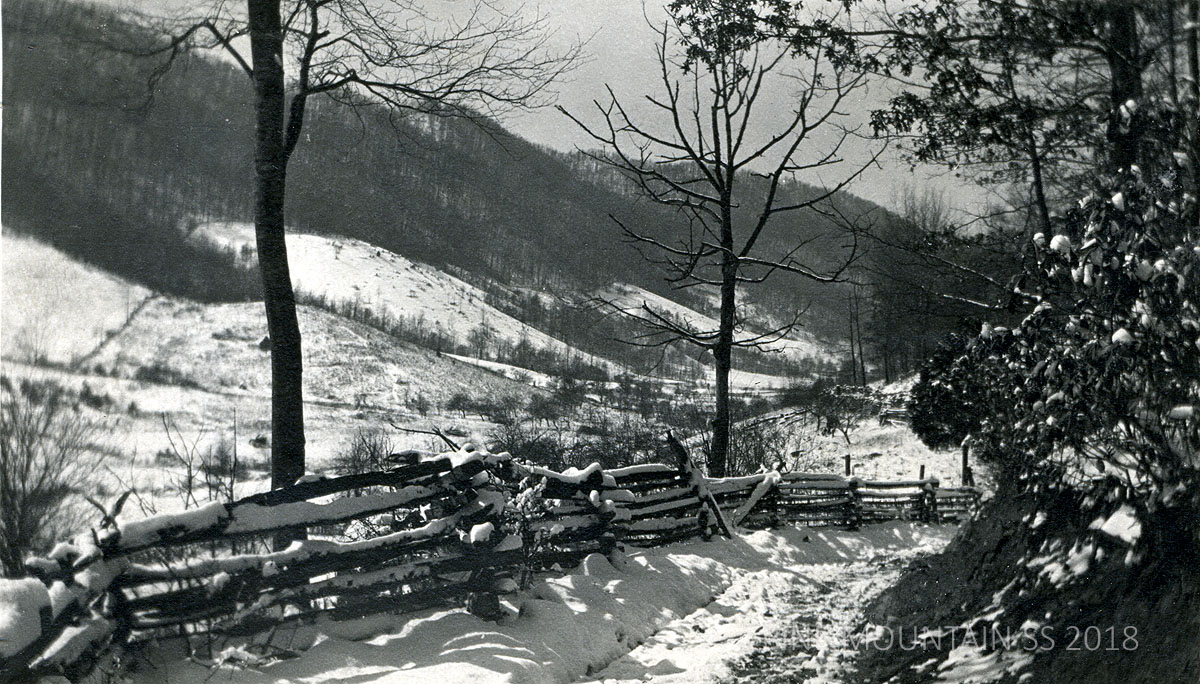
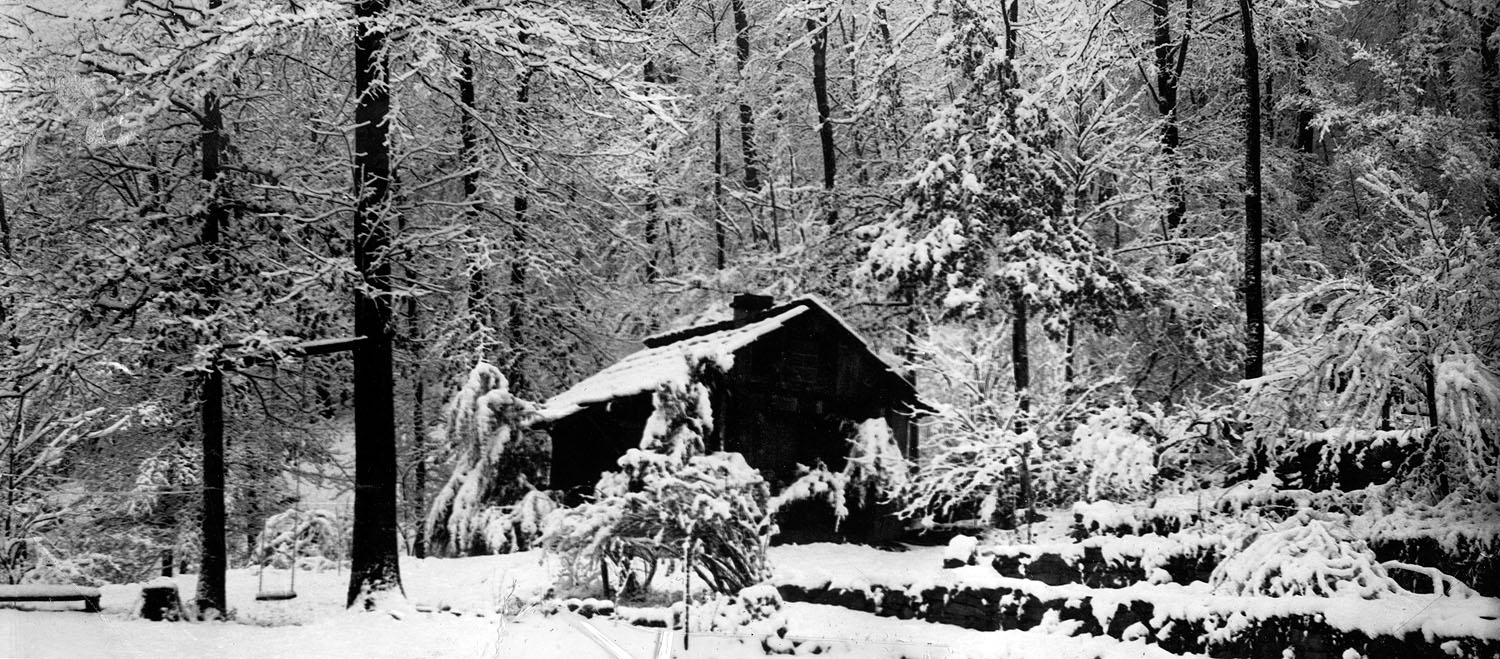
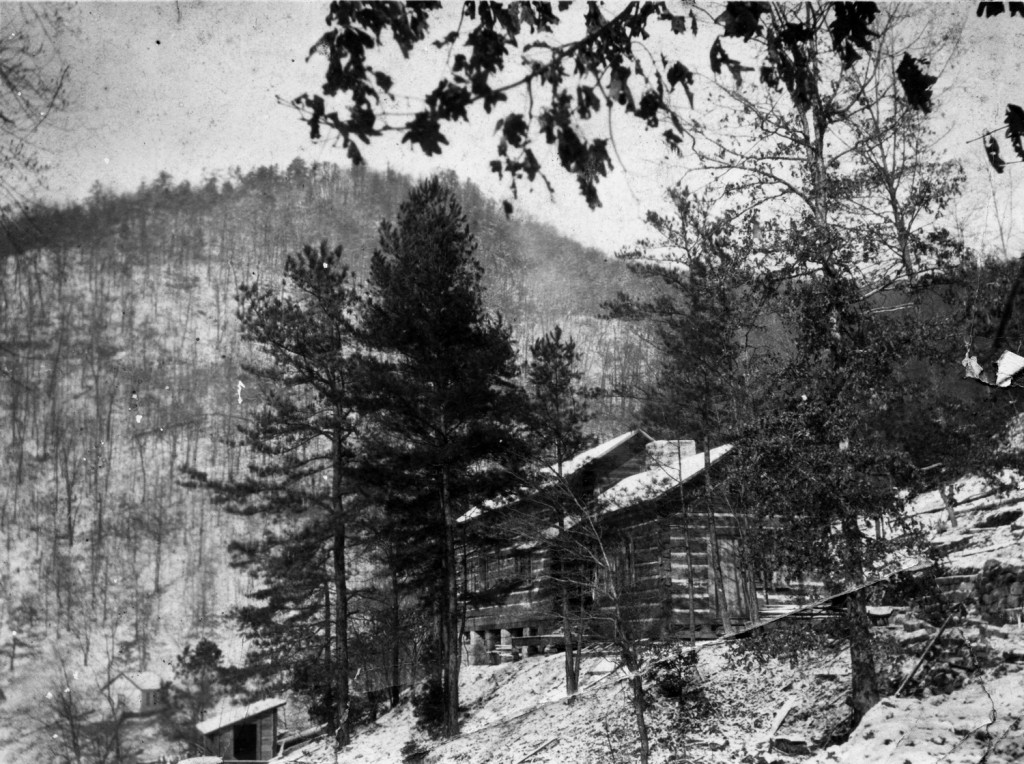
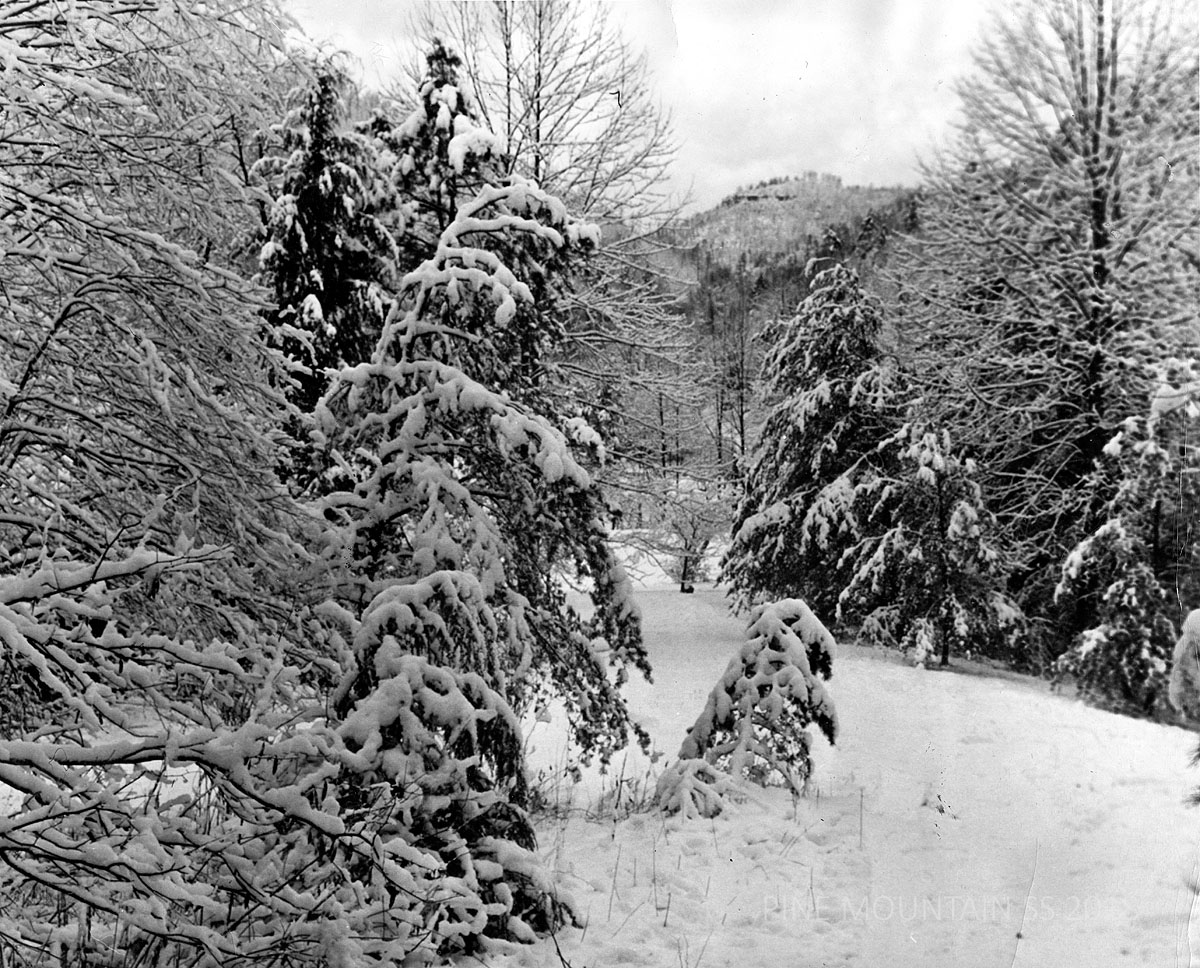
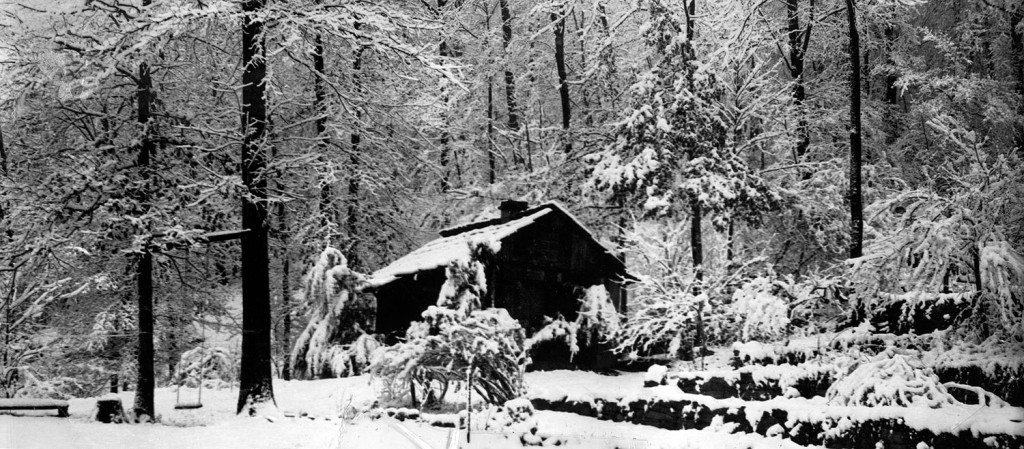 Lutrella Baker Album. The Cabin at Line Fork, in snow, distant view. line_fork_003b.jpg