Pine Mountain Settlement School
DANCING IN THE CABBAGE PATCH
POSTS
COMMUNITY FARMING – Beans, A Goose, a Sassy Lady, and Leather Britches

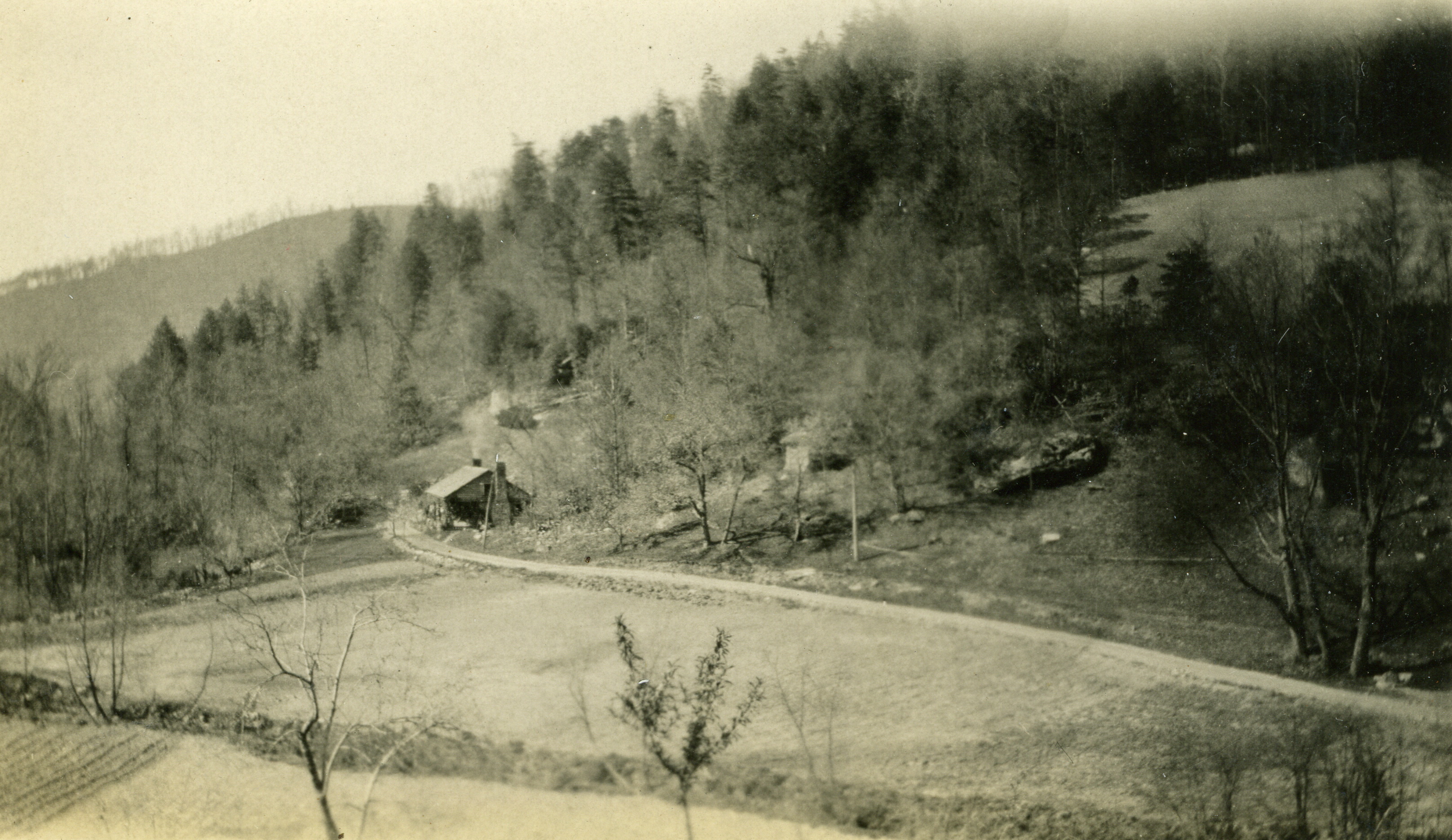
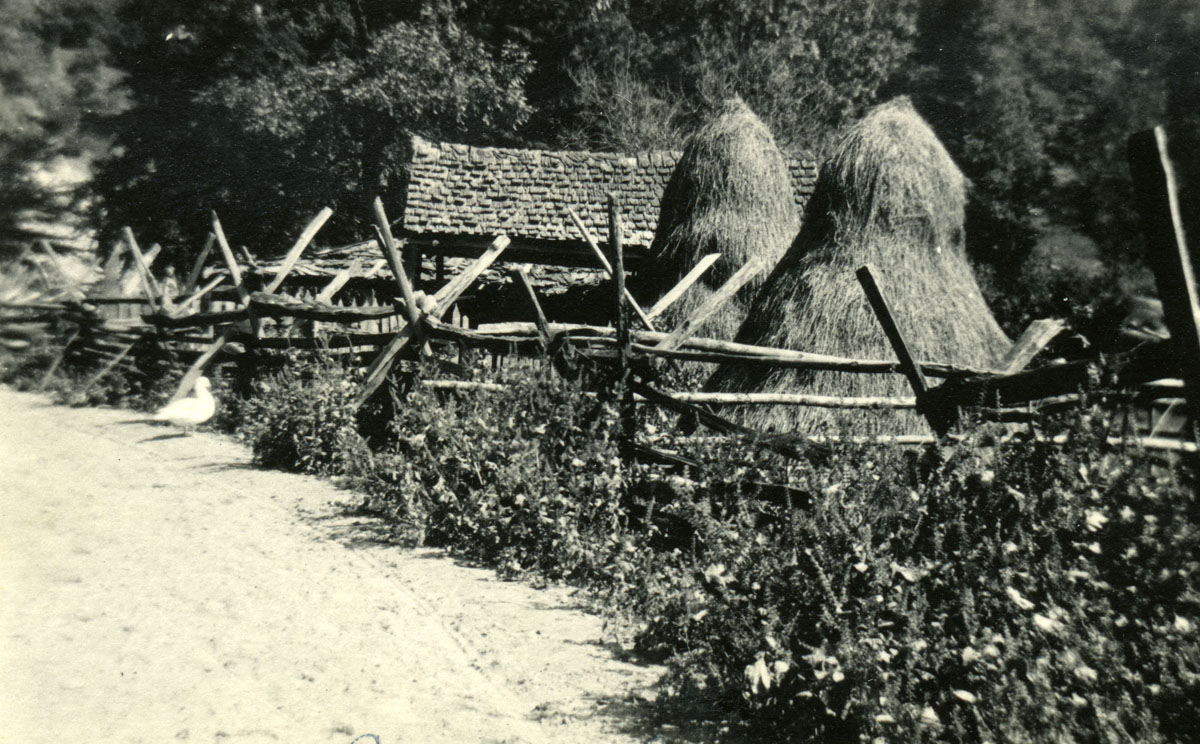
“Dry Fork – 1948.” Cabin, haystacks, mountainside. [nace_II_album_024.jpg]
By the second decade of Pine Mountain Settlement School’s existence, evidence of informed farming practices could be seen throughout the surrounding fields and valleys. Ravaged and timbered hillsides began to give way to more terraced hillsides with alternating crops that stood out against the remaining old-growth forests. In Fall, the carefully gathered corn shocks, fragile pyramids to summer’s bounty could be seen in open fields and gathered near barns in the Pine Mountain valley. Today, many of the early terraced hillsides have been overtaken by new forest.
Today many of the labor intensive farming efforts have faded away. The stacked pyramids of hay and shocks of corn are now a rarity except as decorative reminders at Thanksgiving and Halloween. Large machine rolls dominate the hay fields. For a time the corn fields grew the more lucrative crop of tobacco and family barns changed their shape to accommodate the drying of tobacco. Soon, even the barns began to sag and to melt into the earth as they were little used.
For the early community farmer, sometimes referred to as a subsistence farmer, hillside farming and “Fodder” time were labor intensive times for the entire family in the region. Early farming during autumn the Pine Mountain valley, families were seen busy on the farm, in the fields and “laying back” the crops in barns and homes. Most all other activity stopped while families gathered the season’s harvest. Students were pulled out of school to help with the harvest. In the Spring, the planting season also brought a halt to school and other home activity, except getting the crops in the ground. It was often futile to continue school during planting and harvest seasons and school populations dropped dramatically during these times.
Katherine Pettit and the many Directors of Pine Mountain Settlement School that followed her knew this cycle and had to devise a program that could withstand this seasonal pull on their educational program. Most student who left to help with planting would eventually return to end the semester, but the early seasonal interruption can be well documented in the early student records.
The seasonal abandonment of school was clearly an early problem at Pine Mountain School. It is recorded in family letters, the student records and often in the student grades. Many families who called their children back home to help with the crops, had few options as the farming processes were labor intensive. During the planting season in the Spring and the “Fodder” time in the Fall, the struggle between subsistence and education diminished but never really went away as the family economics ebbed and flowed. The institution also lost many students in the push-pull demands of an agrarian population. The push-pull struggle became particularly acute during World War I and II.
EXPANSION TO INDUSTRIAL TRAINING
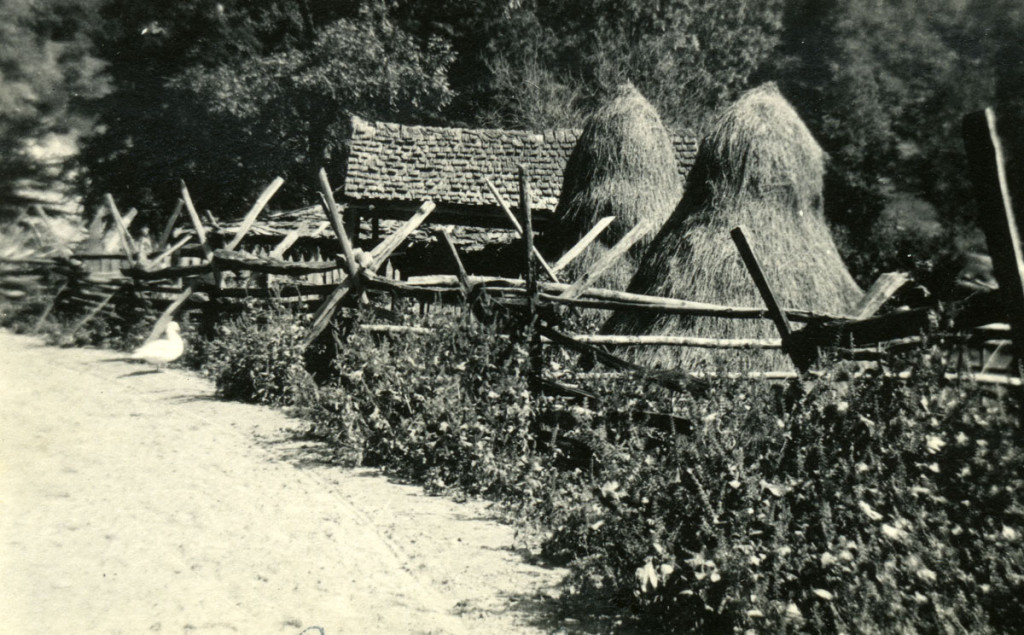
While Directors such as Katherine Petti and the early farmers at Pine Mountain could wax romantic about early farm practices, they knew that expanding into industrial training would be the future. “The Machine Age” was coming to the hills. More elegant than the pyramidal corn shocks, the early conical haystacks were towers of man skill learned over eons. They carried a message of prowess. The tall stacks seen above are particularly beautiful examples of the skill of the farmer.
Framed by the rail fence that defines the property of this Pine Mountain community neighbor, the haystacks seen above were winter feed for cows and horses, the essential livestock for many mountain farms. The goose, seen on the road, while picturesque perhaps to the photographer, was often a watch-dog, for the farmer and family. The squawk of the alarmed bird would alert families when company was coming, or the fox was headed for the hen house. Some geese were extra protective and would challenge visitors. These more aggressive birds were often the first to be consigned to the feather bed.
The hand-hewn shingles on the roof of the distant barn are a testimony to the careful art of both stacking and crafting and are testimony to the “organically novel” architectural creations of early pioneers. Shingles, hand-hewn from oak were frequently seen on the cabins and barns of farms along the Pine Mountain Valley. In the early years of the valley, art and craft were integrated with farm practice and the artisans of the community became the consultants. The builders and the pragmatic collective wisdom that helped to establish and to sustain craft at the settlement school at Pine Mountain has much to credit the surrounding community crafts people.
CRAFT
Craft education in the valley was usually a reciprocal process, though skepticism of “outsider’s” craft always ran close to the surface when families could fetch family histories as solid evidence of the validity of their farming practices, many mountain farmers and now the craftsmen could see the labor reduction and the value of the “machine” if it could be afforded.. This local skepticism of skill continues even today. It often surfaces when the farming practice or craft practice, cannot be imagined, and more importantly, be afforded. discussed or demonstrated or modeled and, more importantly, it remains today regarding some fcraft and farming practices.
Yet, there continues in the general population of Appalachia, a deep appreciation of the art, the innovation and the consummate skill of the early mountain craft prepared to back up their claims with the families and the farmer. In the cultural world, of the Appalachians there are also signs that county agents needed to be ready to learn, as “teachers” abound in the mountains. The modeled farm, the advice of the county agent, the deep knowledge of the agricultural “expert” and other “outsider” ideas did not quickly take hold. Suspicion often runs deep when the skills of centuries are questioned.Currents of suspicion run just under the surface of all “expert” farming and craftsmanship in eastern Kentucky but to the credit of all, the processes of craft and farming grew as a reciprocal process bonded strangers.
While the settlement school workers generally came to provide education and services, as did outside consultants such as the Farmer’s Institute and the University advisors from the Kentucky Quicksand Experimental Station, many Pine Mountain farmers, staff and consultants left with their own wealth of practical knowledge from local farming practices, heritage seeds and plants, and the close relationship of farmers to their basic craft and familiarity with land and crops. As evidenced in the letters of workers, even brief encounters with local farmers gave meaning to farming and gardening practice at the School and to their individual daily lives.
The letters and writing of Katherine Pettit early in the history of the Settlement institution made frequent reference to the farming practice of the local families in the nearby Pine Mountain Valley community. She was both critical and admiring of the practices of her neighbors. She never tired of collecting tips from the local families regarding farming, cooking, raising animals, and especially the craft of weaving. Like the horse and the hand-made wagons and sledges owned by many families, the craft way of life slowed down the lives of Pine Mountain staff and grounded them in the hard lessons of living close to the earth with few resources.
The close co-existence and natural curiosity of Settlement workers and community dwellers made clear that the best teaching environment and best lessons are those that are reciprocal. In the early Pine Mountain valley near the school, there was sometimes suspicion of new persons and new practice, but there was almost always shared respect for differing cultures bound together by a mutual love of place and a deep knowledge of the ways of “wandering nature” found in farming practice. This affection for the place and for the land is still seen throughout the region though the terms “subsistence farmer” and “creek families” was often used in a pejorative manner. Pride of land ownership and the management of the land goes very deep with Appalachian families. Families today are always eager to share news of their new tomato variety, or the trouble with fox in the corn, or lack of rain or the need for rain, a new compost, or irrigation system.
The return to the land movement of the 1970’s and the more recent Appalachian sustainable agriculture programs throughout the area, such as “Grow Appalachia” and the “Appalachian Sustainable Agriculture Project,” and the various “Farm to Table” plots, have revitalized community and cooperation and raised the awareness and the devotion to the land. At harvest time that pride can be seen in the produce brought to the Community Fair Day and the quiet conversations overheard between neighbors.
Crops in the area have largely stayed somewhat constant, but some major crops have been dropped and new innovative harvests have been imagined into viable agricultural endeavors. Tobacco, for instance, has disappeared from the creeksides but hay is a constant. No longer gathered in tall stacks, the hay now shows the wound stalks of a hay-baler. Corn appears with less frequency, but beans and tomatoes are still staples as are squash and various greens, such as turnip greens, kale and collards.
CORN
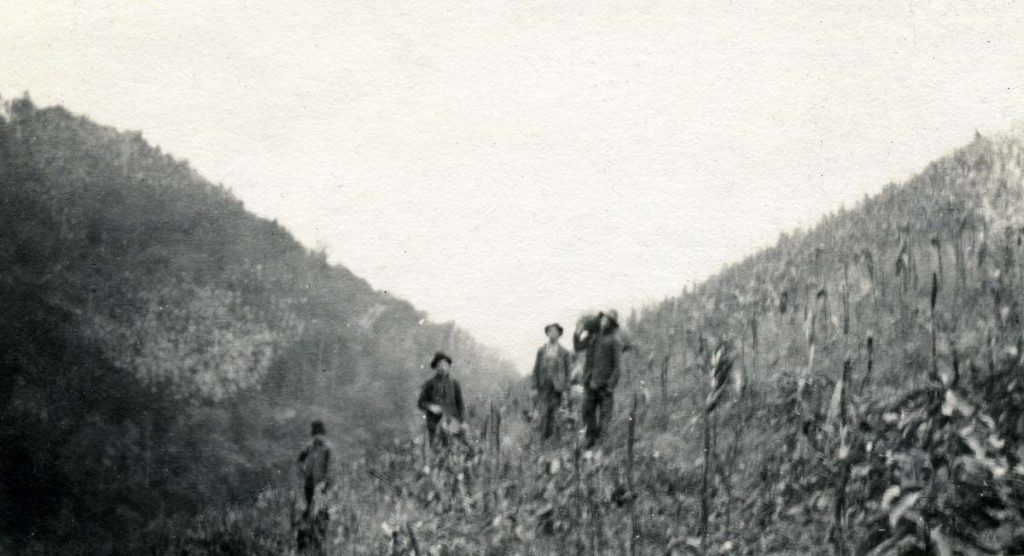
A burlap sack on the back of men and women was a familiar sight on mountain-sides at the turn of the twentieth century. Sometimes the carrier would disappear into the woods where the sack’s bounty would be ground to mash, fermented, and distilled into varying grades of moonshine. But, most times the sacks held winter’s survival and were deposited in family corn cribs to feed stock or to supply grain for milling into cornmeal for cornbread.
At Pine Mountain School the mountain talents with corn were many and they were plumbed for ever new outcomes to produce a variety of corn products. Many corn recipes were adopted by the workers at the School. Some were not! — corn liquor, in particular. Often milled on ancient stone grists, cornmeal could be stored for a whole year of cornbread, of “mush”, “hoe-cakes”, and a variety of other corn-meal offerings. Soaked in lye, the corn could be turned into hominy and when dried it could then become “grits.” If the corn was not fully hardened and had any liquid left, the corn could be converted to “gritted cornbread” — certainly one of the tastiest of mountain breads.
“Moonshine” or corn liquor, is another agrarian discussion. “Moonshining” was a mountain skill never adopted by the School but one that has now taken on a new cache and is appearing with more frequency as a new entrepreneurial and legal business in many small Eastern Kentucky towns. The recent controversy regarding “Kentucky Mist”, a distillery in Whitesburg, Kentucky has focused attention on this distillation resurgence.
It is ironic that “moonshine” a corn liquor, given much romanticizing during Prohibition and earlier, is now making a come-back as an elite and legal industry in the mountains of Appalachia. Distilled spirits were well known to many families in the Appalachian region as the distillation of corn crops kept many families alive during hard times, especially during the Great Depression. In the early nineteenth century, Appalachia was exporting around four million gallons of legal whiskey annually (Peine and Schafft 2012). While most of that export was not from the mountains, the raw talent was there and so was the market. Many of the Eastern Kentucky distilling families also provided sons to fight in both WWI and WWII, as the government “revenuers” gave moonshiners and the family a choice of going to jail or going to war.
In addition to distilling, brewing of one kind or another was also commonly practiced in most homes in the Pine Mountain Valley. Beer is a distant relative of mountain “Methugala” a drink similar in taste and origin to “chicha” a South American drink popular in Bolivia and Peru that is prepared by germinating maize and then extracting the malt sugars which are then boiled with the wort , and finally fermented in a large vessel for several days. This process, essentially the same as the process for the production of regular beer produced with hops, can be either low or high in alcohol. Brewed beverages like methugala and chicha have also gained new momentum in the craft brewing environment sweeping the country. The rapid rise of Kombucha It is not remarkable that Asheville, a mountain town in western North Carolina has become a leading center for craft brewing in the country as it had a long relationship with both distilled and brewed beverages.
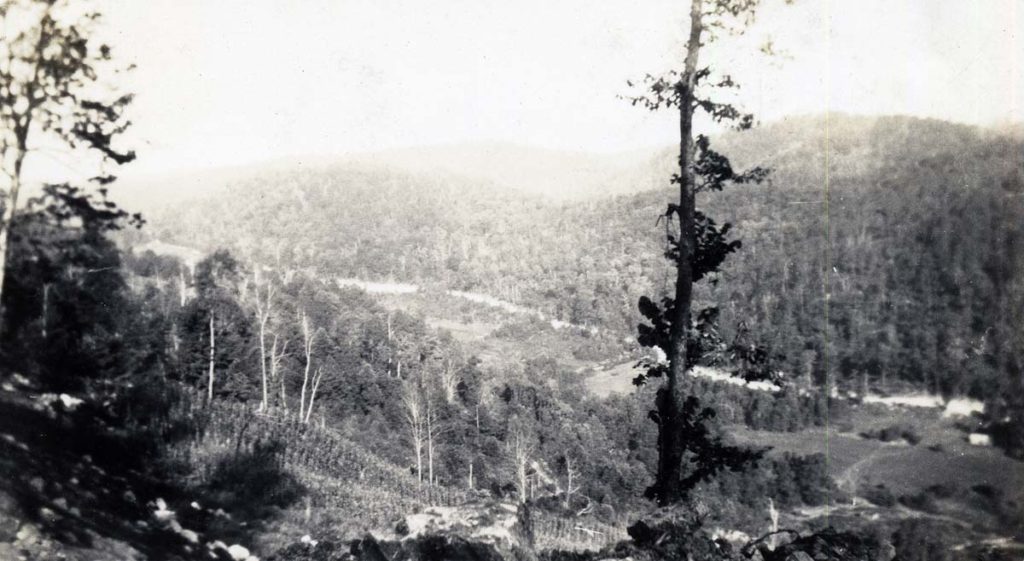
In Eastern Kentucky, the cornfields often stretched to the top of the mountain, as every piece of land was precious for the large families that farmed them. The clearing of the land was back-breaking work and often represented years and generations of forest and stone removal.
Flooding was an ever-present threat as the mountain timber was harvested with little regard for flood potential on surrounding creeks.

The extensive logging of the region also contributed heavily to severe flooding in the early years of the school. While the unexpected floods brought sudden disaster to crops and sometimes to homes, the year following flooding often saw the hillside again freshly planted in corn and homes re-built. Sometimes in cloud-bursts, the disturbed raw earth came down the mountain in torrents of mud and water as the bare fields could not contain the volume of water. Sometimes, too, the forest floor gave way and large chunks of mountain slipped into the valley. Small springs on the hill-sides could also sometimes explode as deep pockets of water suddenly broke their restraints. The hidden menace of old coal mines is a continual threat to many homes today.
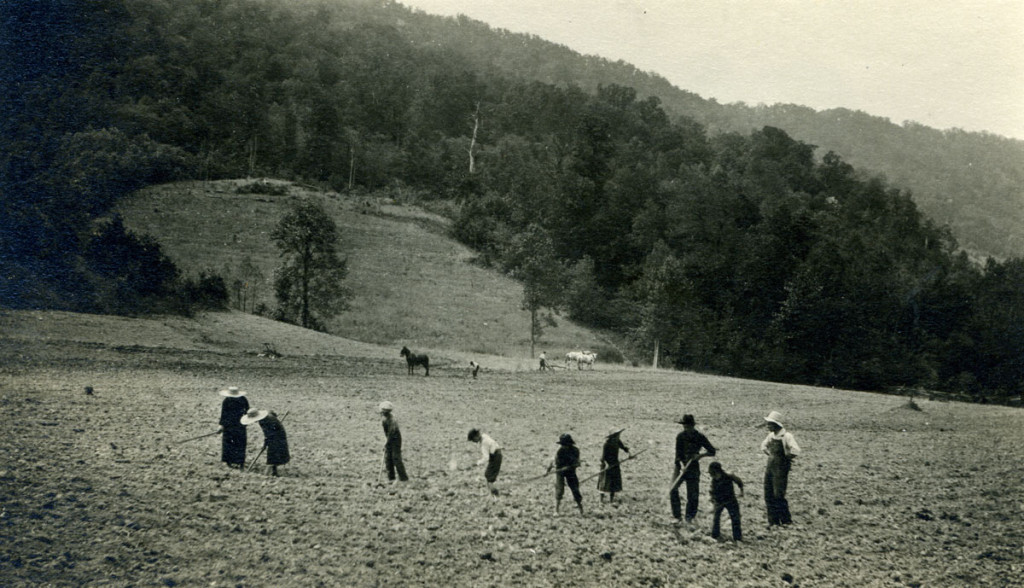
The use of Pine Mountain School land in 2013 reflects the shift in the mission and programs of the institution. The move from an active farm aesthetic to one more closely aligned with parks and recreation reflects the expectations of the growing urban audience who often come to the School. Today, well over 70 percent of the United States lives in an urban environment. Bucolic is no longer the rustic tranquility of a lived farm life but is instead the imagined pastoral of a genteel past in a park-like setting. Pine Mountain School serves to remind us all that such pastoral elegance requires strenuous effort and constant diligence in monitoring our environments. Marketing to tourists, while lucrative, is not the primary educational objective of the school as it seeks to retain its commitment to environmental concerns.
Currently, the sustainable mission of the institution is as an educational laboratory for environmental learning experiences. Today the school annually serves over 3000 children from Kentucky and neighboring states in a robust environmental education program that is mapped to the standard curriculum in science taught in the K-12 classroom. In addition to children’s educational programming, the school offers special programming for adults in environmental awareness and historic preservation and conservation. For this twenty-first century re-creational population the groomed campus offers a familiar park-like setting which is used as a base for expeditions into the “rugged” outdoors as well as a safe short expedition to stream ecology and night-hike classes.
The landscape changes in the community of the Pine Mountain Valley and at the School today reflects the shift that occurred when the boarding school closed in 1949 and a farm was no longer required to supplement the food supply of the school. Some fields have now returned to their natural forested land or are re-purposed to cleared and open recreation areas for a recreational population.
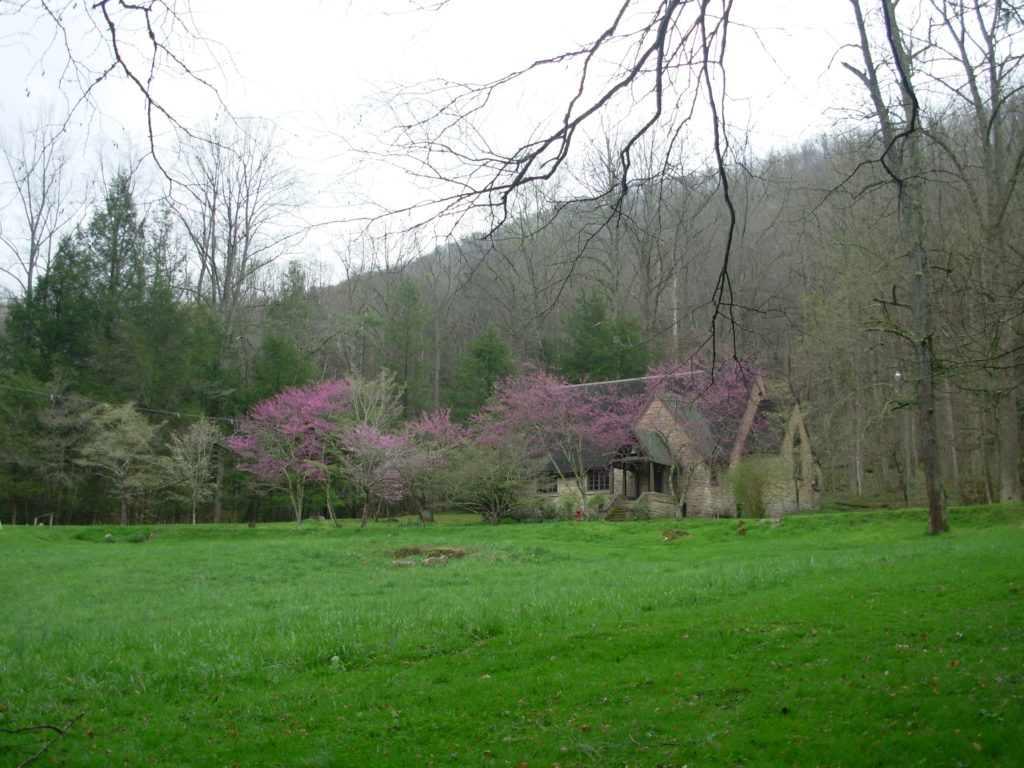
Over the course of the last twenty years, the grounds of the School have been closely mowed and are more garden-like, park-like — even golf-course-like, in appearance. Fields have become closely mowed lawns and by the 1980’s and later only small demonstration garden plots remained to be maintained by a small farm and garden staff. The landscape is, today, however, changing with new administration and a trained farmer on staff. Tunnel greenhouses have been installed and crops that move from garden to table are increasing annually.
Even more important to farming at the School is the addition of new machinery to handle many of the labor-intensive tasks. The new multi-purpose tractor will greatly aid the development of productive farmland.
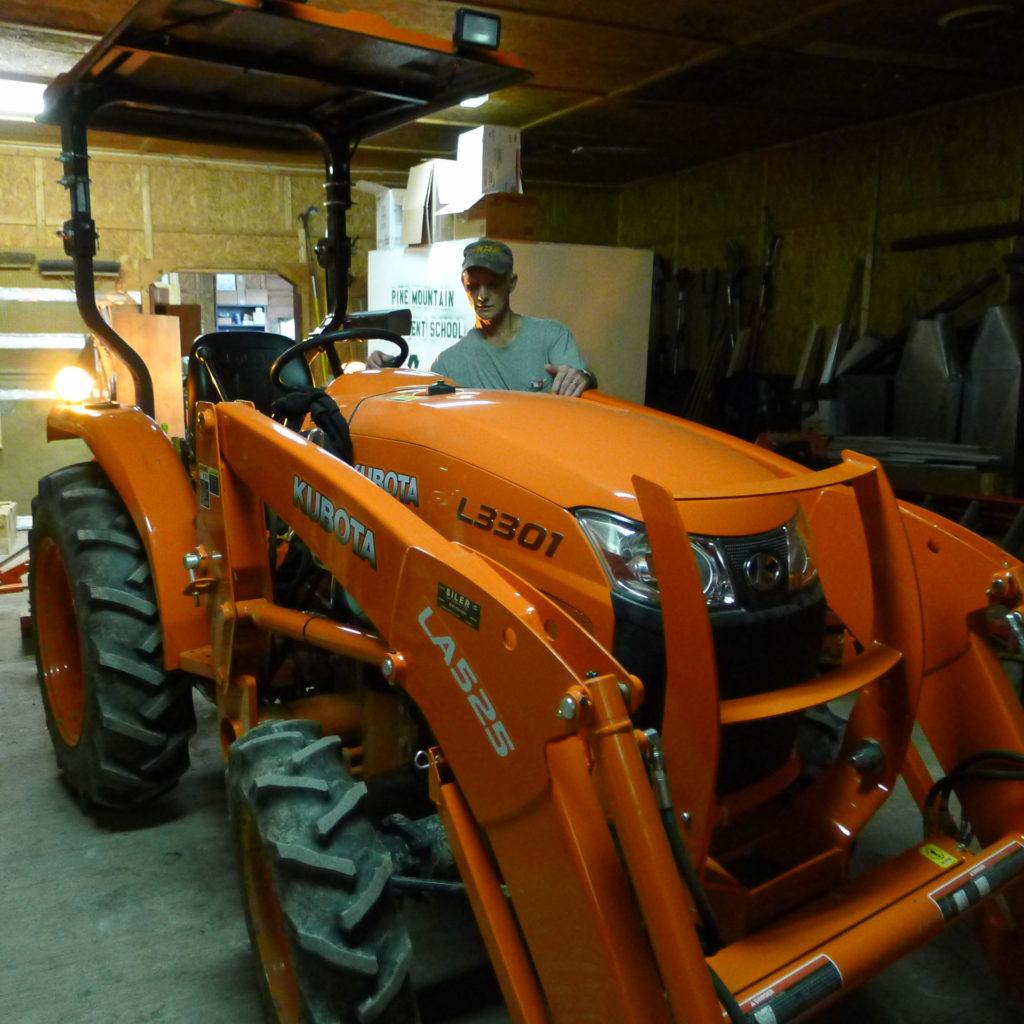
Paul Creech with new PMSS Kubota tractor. 2016.
COVER CROPS
Cover crops have always played an interesting role in the school’s history. To keep fields viable, the cover crop is a vital means of adding nutrients to the land. Tracing the older farming techniques as described in the Pine Mountain Settlement School Arhive, one can see the evolution of farming at the School.
By 1935 new farming techniques and crops had been in use for some time at the School and the idea of sustainable agriculture had taken hold. For example, the new Korean Lespedeza, a leguminous plant that has very high nitrogen production, was in wide use at the school. Fields that were once over-farmed were brought back to life as pasture by the new rotated cover-crop.
In the May 1935 school publication, The Pine Cone, the author of a small article on “Lespedeza Valuable Crop,” notes :
“…the crop is especially advantageous to the farmer of Kentucky because of the state’s poor soil. … The poor worn-out pastures could be turned into good pastures with cattle and sheep thriving on them. The soil of the mountainous section, which is rapidly finding its way to the sea, could be held on the slopes by growing Lespedeza. …”
The idea of a cover crop was a practice that quickly took root in the community and the practice contributed to the salvage of countless acres that might well have been exhausted by poor farming practices and the years of growing corn.
The addition of lime to the soil was another farming technique that brought life back to the tired soil of the valley. Limestone was in plentiful supply on the mountain ridges of Pine Mountain and when burned and mixed with water it produced a rich calcium carbonate fertilizer for the fields.
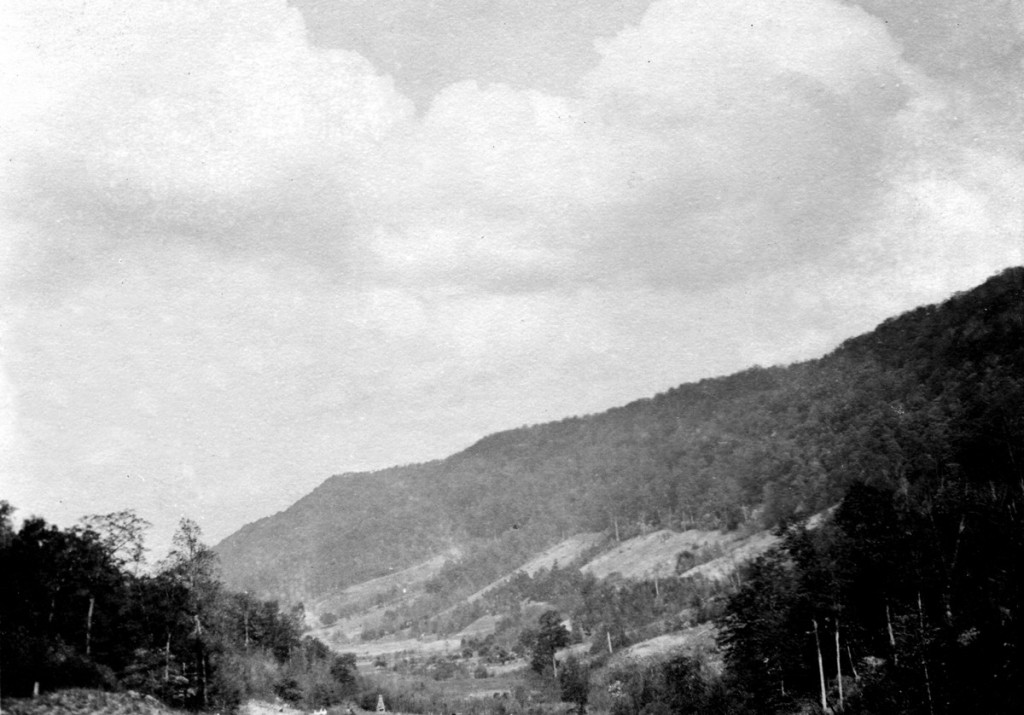
All able-bodied staff and students contributed to the cultivation of crops at the school regardless of age or gender. All crops were valued and well tended to ensure continuity. Seeds for all crops were set aside for the coming year. The seed noted for high yield or for robust size or hardiness was prized by families and shared with neighbors. Garden vegetables that did poorly were also noted and abandoned.
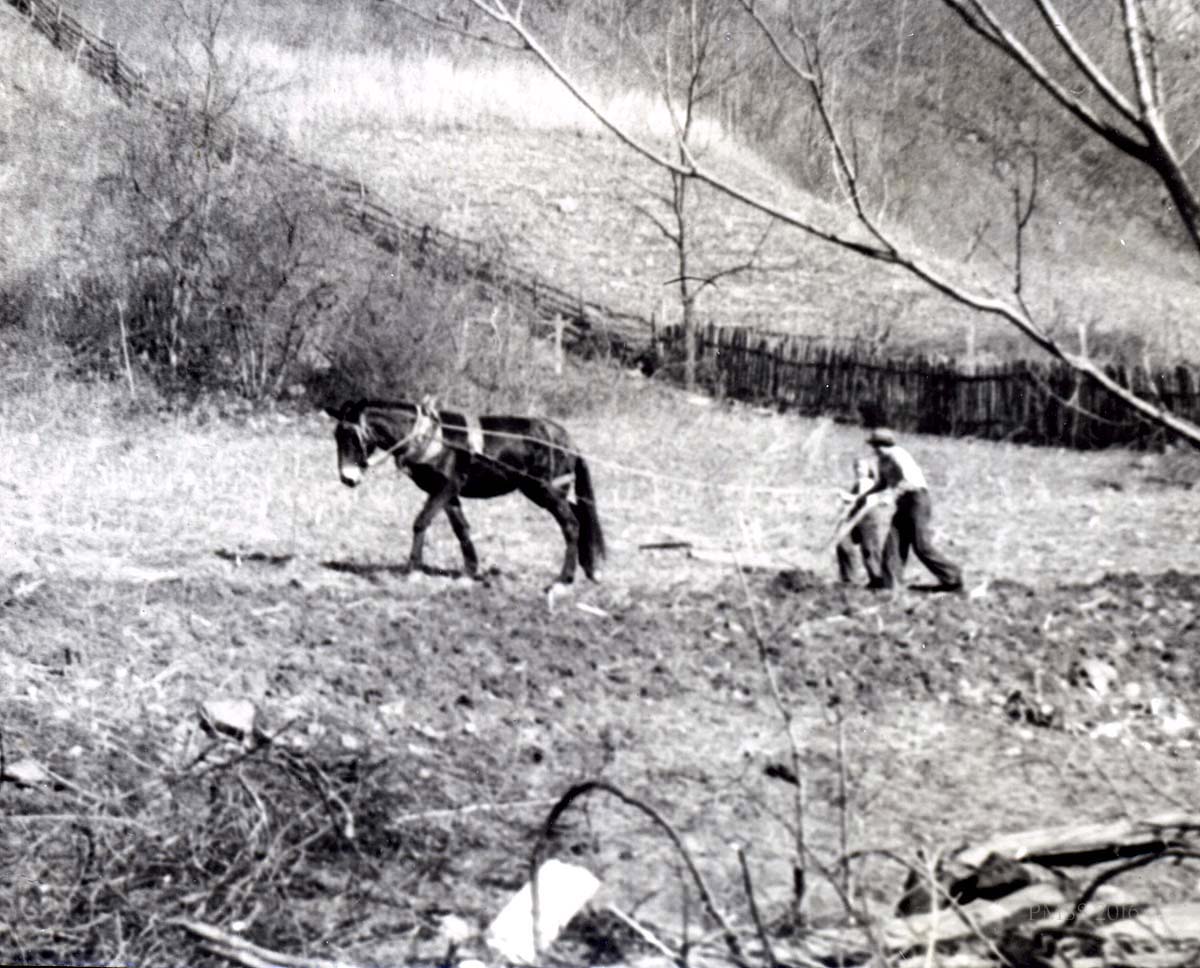
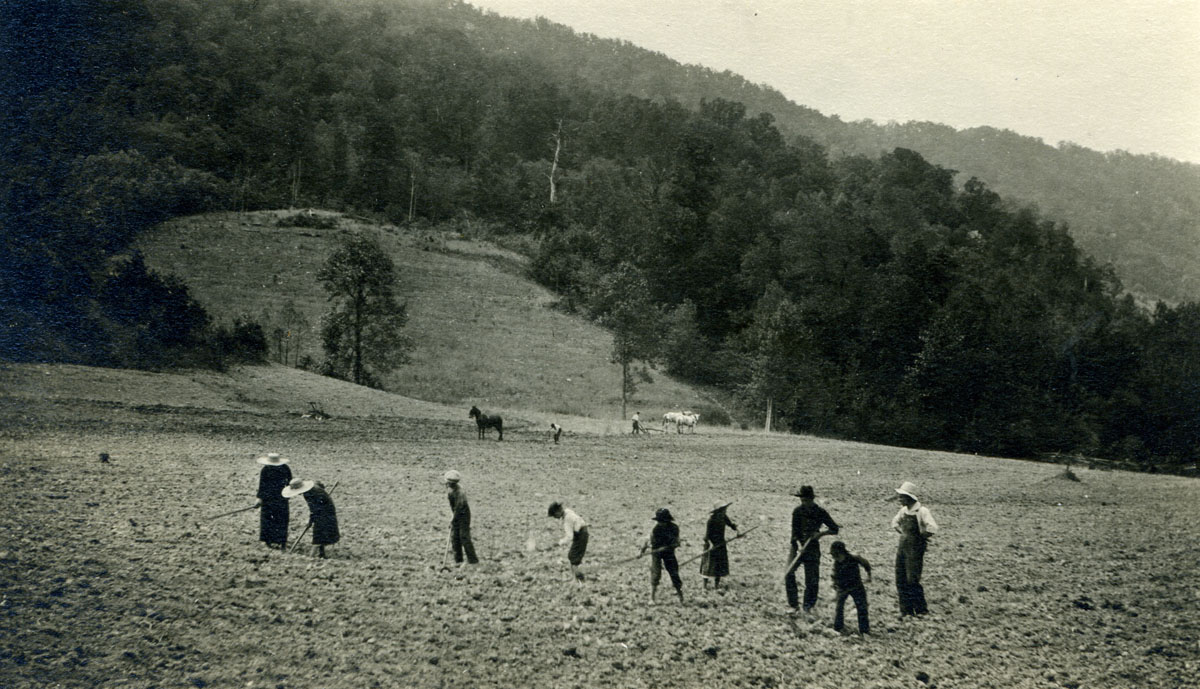
![019b P. Roettinger Album. "Planting cow-peas in new ground." [One man and seven children planting on a hillside.]](https://pinemountainsettlement.net/wp-content/uploads/2015/02/roe_019b-1024x780.jpg)
019b P. Roettinger Album. “Planting cow-peas in new ground.” [One man and seven children planting on a hillside.]
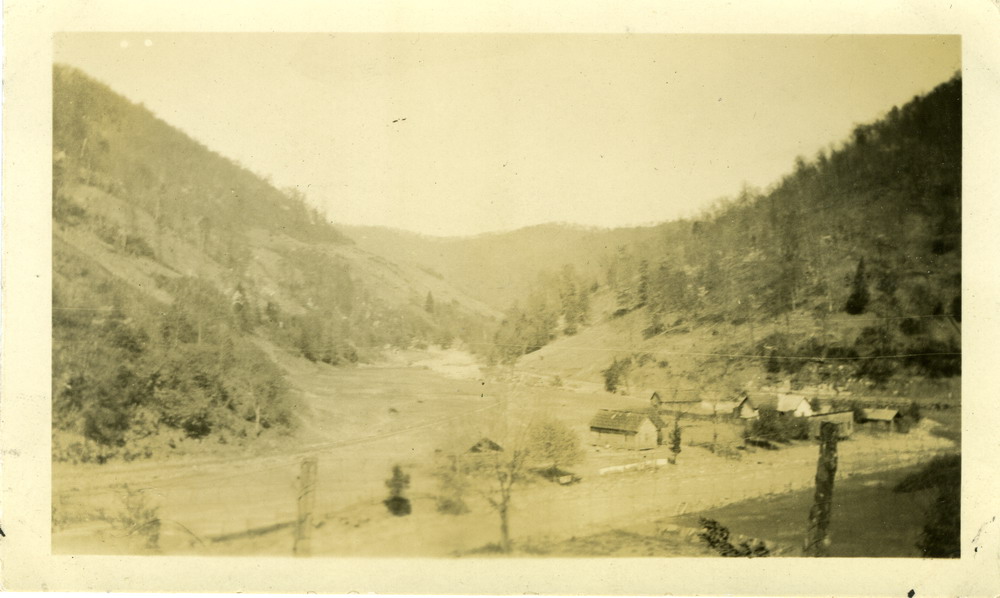
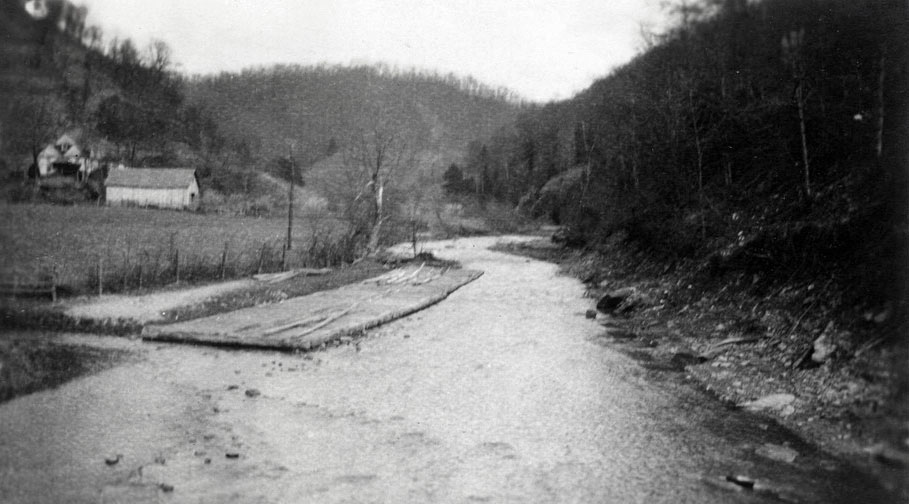
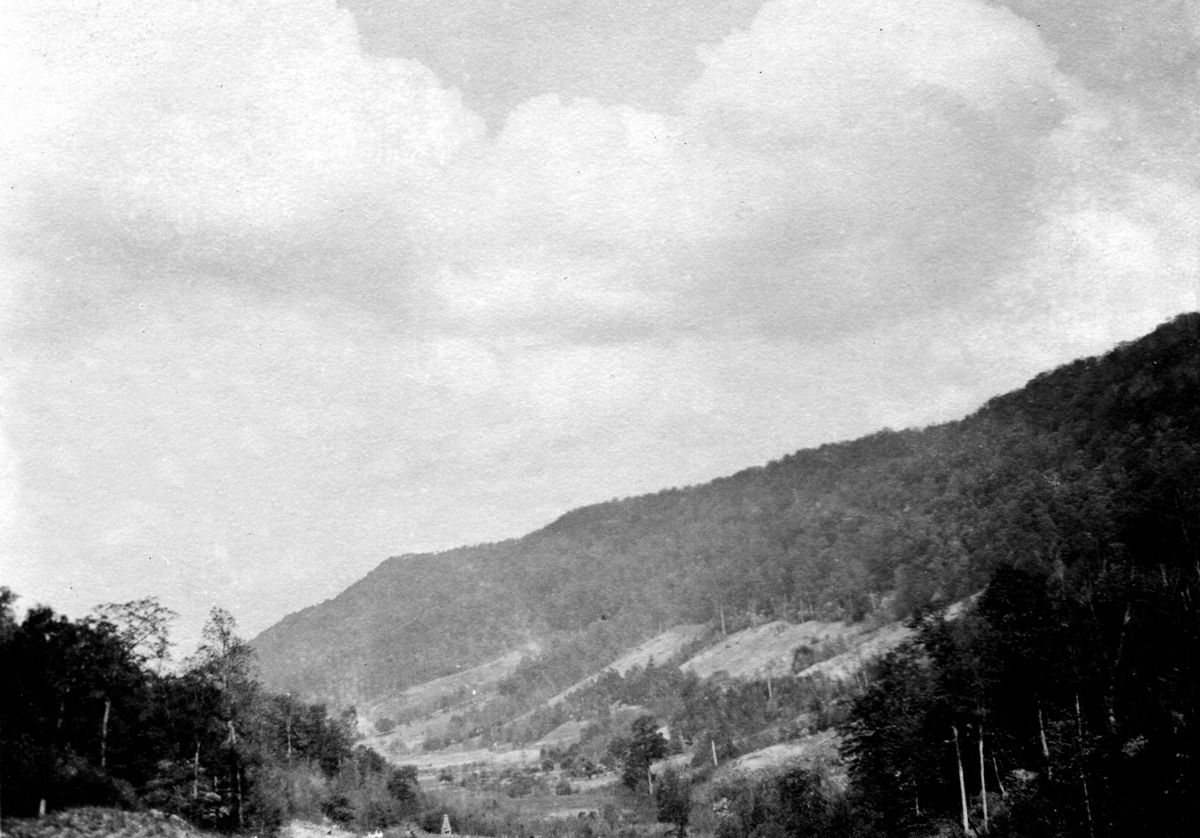
The climate of the Southern Appalachians varies but is generally moderate. Many varieties of crops can be raised and many flourish in the warm and moist atmosphere and have become staples in the diet of both early mountain dwellers and were later adopted by the School. Flooding in the early years occurred with regularity, as excessive logging disturbed the topsoil and allowed rapid run-off from the forests. Pine Mountain experienced many floods through the campus as seen in these early views of Isaac’s Creek in front of Draper building at the School. Greasy Creek, a larger tributary of the Kentucky River, that begins at the west side of the School was even more destructive.

William Hayes Photograph Album
Drought another cyclical event came to Pine Mountain and in 1944 the School experienced a drought that lasted for three months that greatly strained the crop cycle and called on considerable ingenuity to see the crops through to harvest. The following account describes that during the WWII years the terrible impact of drought left the School challenged for food. The School farmer describes his attempts to save the crops.
“For three long blazing months, we waited. All around us crops withered and dried. We were somewhat more fortunate than our neighbors because we had a narrow strip of bottomland
which stayed moist longer than the hillsides—but our hills burned like all the others.
But we did not lose our beans. Greasy Creek’s discouraged trickle was our only hope. The boys spent two days in the hot sun building a dam. TWO more days we waited until the little pool accumulated enough water to be pumped out by means of a cleverly rigged up motor, through ditches and pipes made of worn out fire hose laid across the field. It was not much water, but it was the difference between a crop failure and a crop—not a bumper like last years but a miracle considering our handicap. The beans grew, and flourished, and were gathered. We had bean stringings for days. We canned 1300 half gallon jars. (Beans were selling across the mountain for five dollars and more a bushel at wholesale!)
Our reservoir water failed until baths were rationed to two a week. Outdoor drinking fountains were turned off and water saved in every way permissible for health and hygiene. It was not until October 6th that we received unlimited bath privileges. But the beans—our staff of life, as all who know the mountains will recall— the beans were saved.
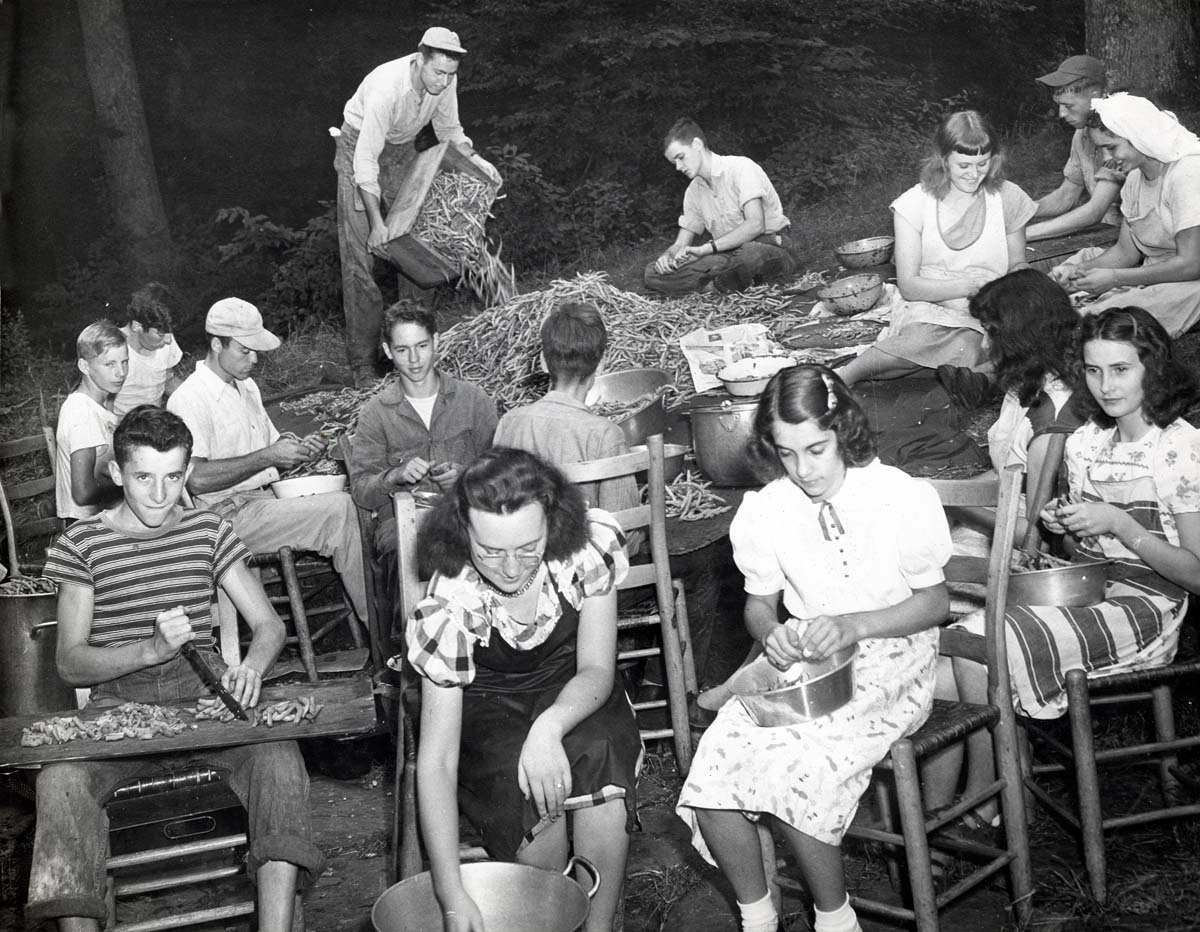
‘Bean Canning [Bean Stringing].” Boys and girls preparing green beans for canning. Doug Reynolds, left- front with knife. The farmer, William Hayes, sits to the back-left (hat). Dorothy Nace front, center. [nace_II_album_076.jpg]
This drought scenario has been replayed many times, but invariably the memory of the drought years are quickly washed away with a particularly wet season.
BEANS, A GOOSE, A SASSY LADY, AND LEATHER BRITCHES
Once, it is told, a wild goose flew into the valley community and was killed for the eating. It is said that in the craw of the goose were small beans that were salvaged and later planted. This green bean became known as the “Goose Bean” and is still a favorite climbing bean crop in many gardens in the Pine Mountain Valley. Another favorite bean was one known as “Aunt Betts Bean”, named for a woman who cultivated the seed and shared it with neighbors. She was also known to have “cultivated” relationships with many men. also neighbors. The bean was as prolific as her lovers and a high-yield producer. The importance of green beans and “shucky” or “shelly” beans cannot be overestimated in the diet of the Pine Mountain Valley community. In fall the “shucky” beans were strung and hung near the fire or on porches where they also earned the name of “Leather Britches” for their tough hulls, not unlike leather until they were thoroughly cooked … usually with a generous chunk of “fat-back”.
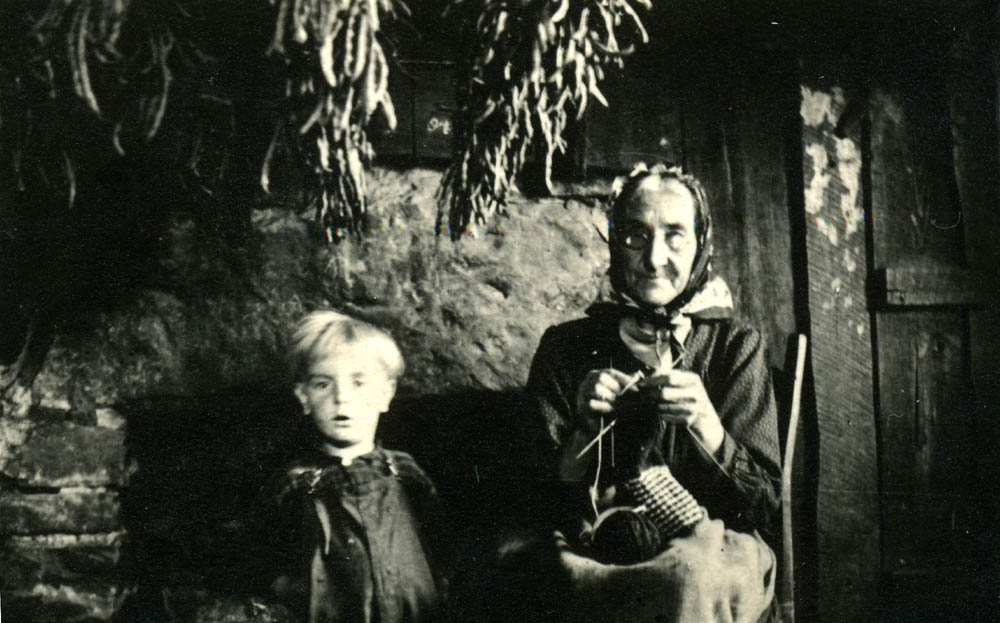
Friends & Family: VI 37 Aunt Bet Scott (Aunt Sal’s sister) with blond child in front of fireplace and “shucky beans” hanging above the two.
The early Board of Trustees had a deep interest in farming and one particular board member, J.S. Crutchfield, of Pittsburgh, is of significant interest. As President of the American Fruit Growers Association, Inc., Crutchfield served on the board at Pine Mountain in the late 1920s and early 1930s.
In 1922 Crutchfield was called to Washington to testify before Congress and the Joint Commission of Agricultural Inquiry. He was well known as an influential and innovative agricultural businessman and his 1922 testimony would not be the only time he appeared before Congress as an expert witness.
The 1922 testimony centered on getting products to market and the increasingly expensive costs of rail shipment of produce. He argued that the maturity of crops and the stability of crops in transit was difficult to predict so that farmers were always at the mercy of marketing and distribution.
Crutchfield’s assistance in the early years of Pine Mountain was very important to the development of the farm and to the training of the farmers and staff but he was not a source of bananas! He was, however, very interested in apples and apples were never in short supply once the trees, planted in the early years of Pine Mountain began to produce. Many of the varieties were used as dried apples, apple butter, canned apple sauce, and canned apple slices for pies. Apple cider was also a favorite at Halloween and Christmas celebrations.
Many interested parties contributed seed and young fruit trees to Pine Mountain. Of these the most lasting have been the apple trees.
A small orchard is still maintained near Far House on the campus. As a cash crop apples never were reliable in the mountains of eastern Kentucky. They were difficult to get to market and the poor lime soil combined with the fungal and blight picture in the area kept the orchard from becoming the production cash-crop that many hoped for and was found in other Appalachian mountain locations, for example, in the western North Carolina mountains.
In the late 1930s the folklorist John Jacob Niles wrote to farmer William Hayes regarding a new variety of plum that he had found particularly productive on his land. He had mailed a small tree to the School and Bill Hayes planted the specimen to see if it would adapt to the local soil and climate of the Pine Mountain Valley. While it thrived for a short time, the conditions were not conducive to a full orchard of plums.
In summary, like the plums, farming at Pine Mountain was never quite the model for the community that many of the staff believed it would be. Evelyn Wells in her assessment of farming practice suggested that some of the new practices caught on, but more often the local farmers reverted to old routines and practices and were wary of most new practice.
In Evelyn Wells’ and Ruth Hench’s history of the school from 1913 to 1938, the two provide a good overview of the early years of the institution.
“The Farm under the continuous supervision of Miss Pettit has been developed by Mr. Baugh (1914), Mr. McSwain (1915),Mr. Zande (1916), Mr. Browning (assisting Mr. Zande (1921 and full charge 1923).
After some experimenting with the raising of corn that was found to be too expensive a crop for us, and the chief effort has gone into developing, by ditching and draining and building up a sour, heavy soil with cover crops, a garden which little by little has spread over our bottom land until in June 1928 its produce was worth some $3200. Our garden land had a sorry reputation among local farmers when the school began, but by dint of thousands of feet of ditching and draining and a long rotation of crops it has been built up from an unproductive swamp and the kitchen is extremely dependent upon it.
For the first two years nothing could be done but ditching and fencing and soil reclamation. It was of no immediate good to the school table for some years But by 1917 Mrs. Zande writes of having helped can 1200 half-gallon cans of our own vegetables. It is fortunate that the garden began to yield as the war came on and food became a grave consideration. While we were experimenting on raising corn and hay, the Wilder farm and the Medcalf farm on Little Laurel were cultivated for those crops.
During Mr. Zande‘s regime the work of ditching and replacing old ditches went on, the creeks were straightened to give a handful more of tillable land here and there, the boulders that one met all through the garden were blasted out, more land was cleared, and the timber used in construction instead of being burned according to the usage of the country. At the end of this labor intensive clearing there was about 75 [new] acres in farm and garden at the school.
During the period that Mr. Browning had charge, the garden acreage has practically doubled, and the work of early years has born fruit in Mr. Browinings’ wonderful garden crops. The policy of sowing cover and legume crops and turning them under as an equivalent for manure has continued.
Evelyn Wells, the school’s secretary further records progress over the two decades she observed farming at the school. Her remarks are included in her unpublished history of the institution.
The increase in garden truck is shown by the fact that in 1923 we had 48 bushels of tomatoes from the garden, and in 1928 118 bushels. As against the 400 cabbages we raised in 1923, we think of the 9000 in 1927, of which those sold in the neighborhood and to the lumber camps alone after the family wants were supplied, were worth $125.00.
While Pine Mountain has always fallen far short of being a model farm for the neighborhood, it has taught valuable lessons, such as terrace gardening, apparently unknown here until people saw the school hillsides terraced, the rotation of crops, and the turning under of rye and legume crops. In the past three years, in particular, neighbors have begun raising soybeans and cowpeas for hay.”
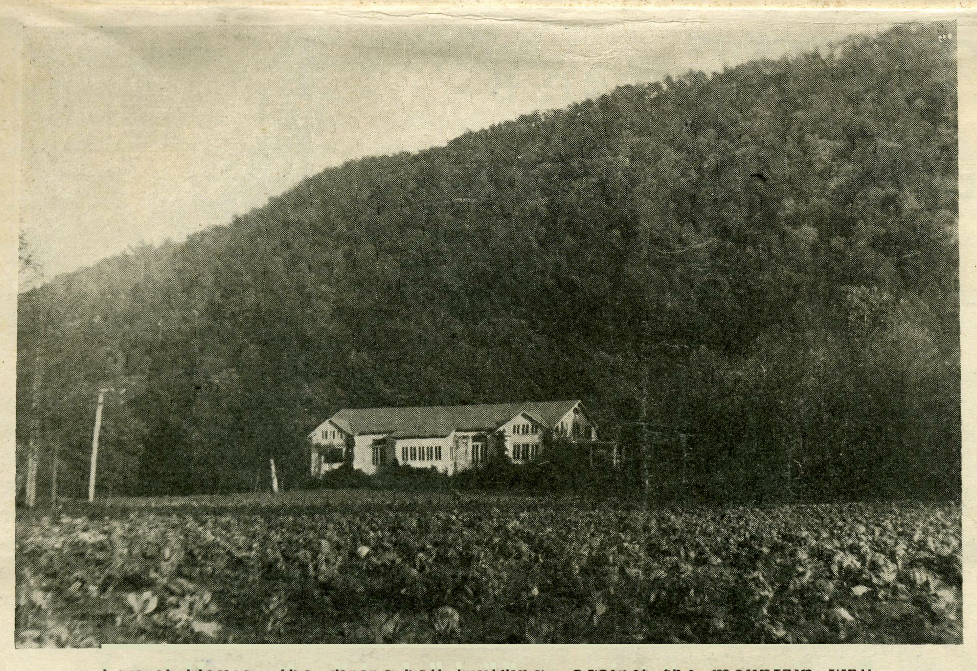 Cabbage field in front of Old Laurel House.]
BLOSSOMS AND FLOWER BEDS
“The Blossom Lady” Miss Pettit also left her mark on flower gardening. By sharing seeds and plants with the community she brought color and “pretties” to the yards of neighbors. and raised their awareness of the value of aesthetics on lives. The early plantings around the old Laurel House I have been praised by various authors over time.
The most quoted account of Pine Mountain’s influence on flower gardening is found in Florence McVey’s article “The Blossom Lady” about Katherine Pettit’s active campaign to bring aesthetics into the lives of the community surrounding Pine Mountain.
NEW FARMING PRACTICES
Pine Mountain’s farm program was a vital part of the school from its beginnings in 1913 until near the close of the boarding school programs in 1949. It ceased to be a viable part of the program in 1953 but was resurrected on a small scale many times in later years and farm work never ceased. The comprehensive farm program was never fully resumed after 1953 following the Board of Trustees decision to terminate operation of a full-scale farming operation. The Depression years had both encouraged and discouraged large-scale farming. Food was needed to supplement the decline in food supplies, but the costs were a challenge in the Great Depression economy and monies were needed in other areas of the School.
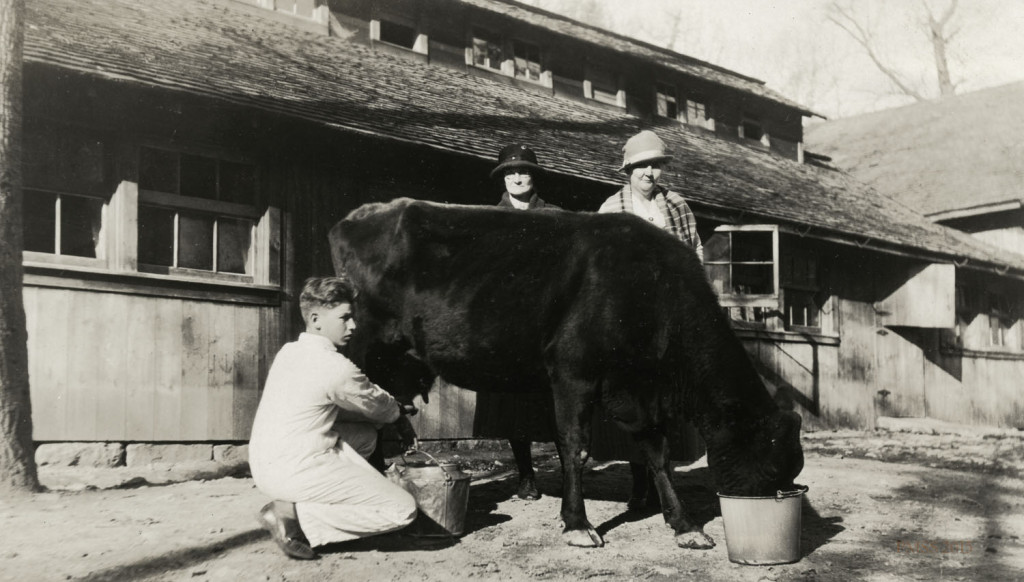
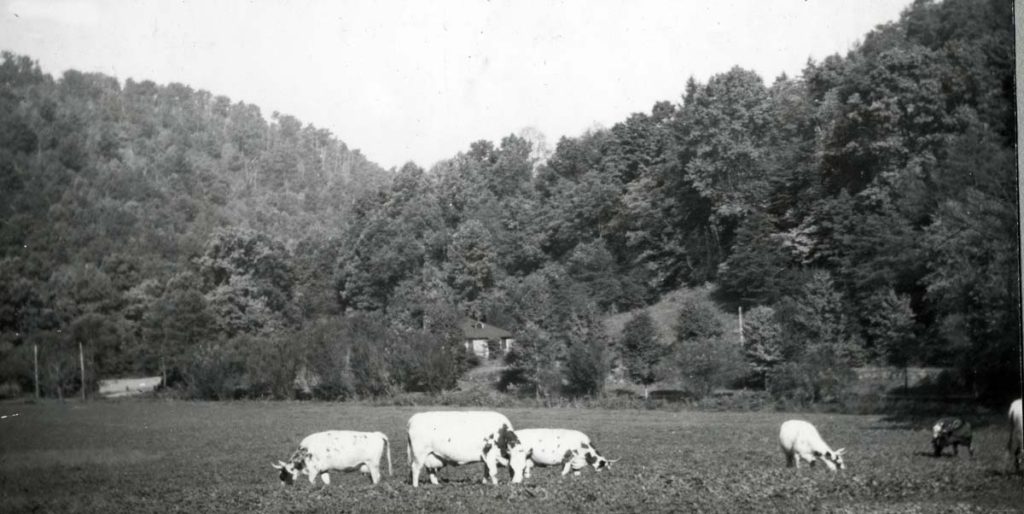
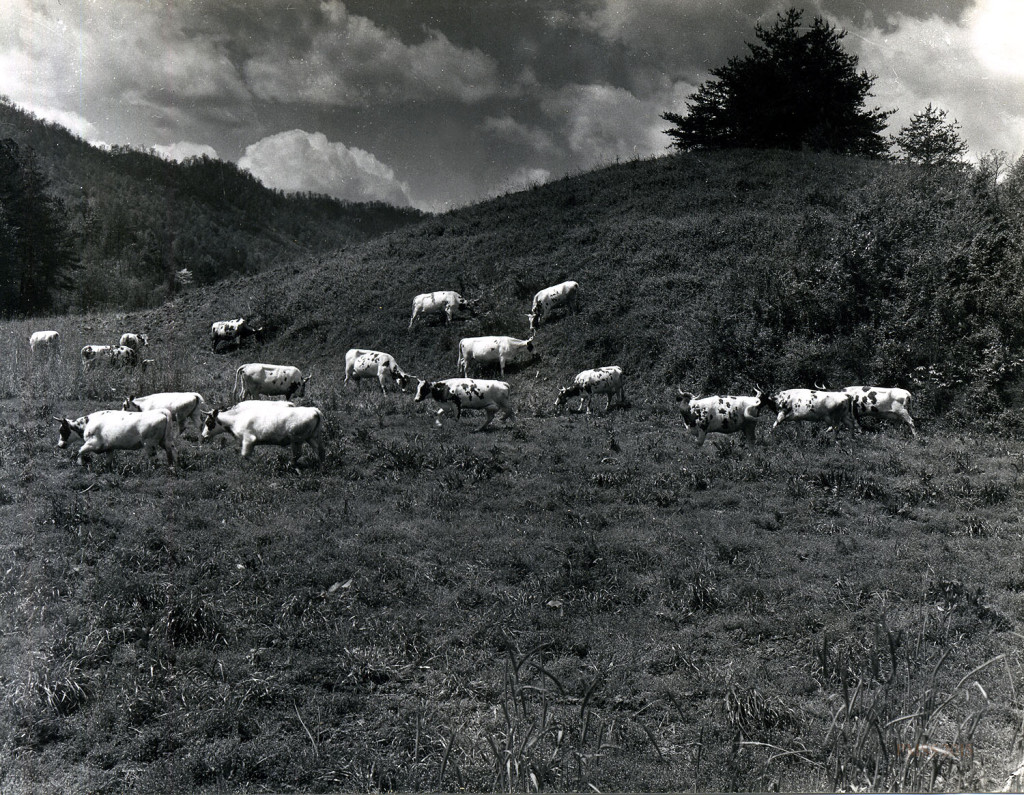
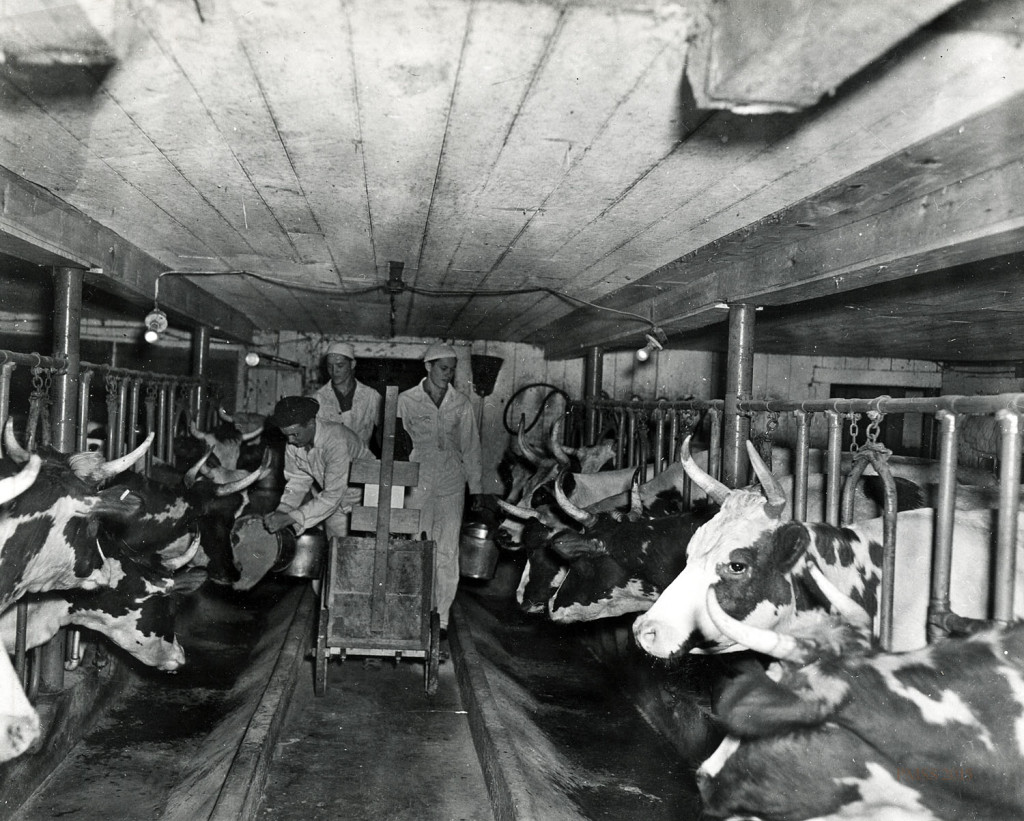
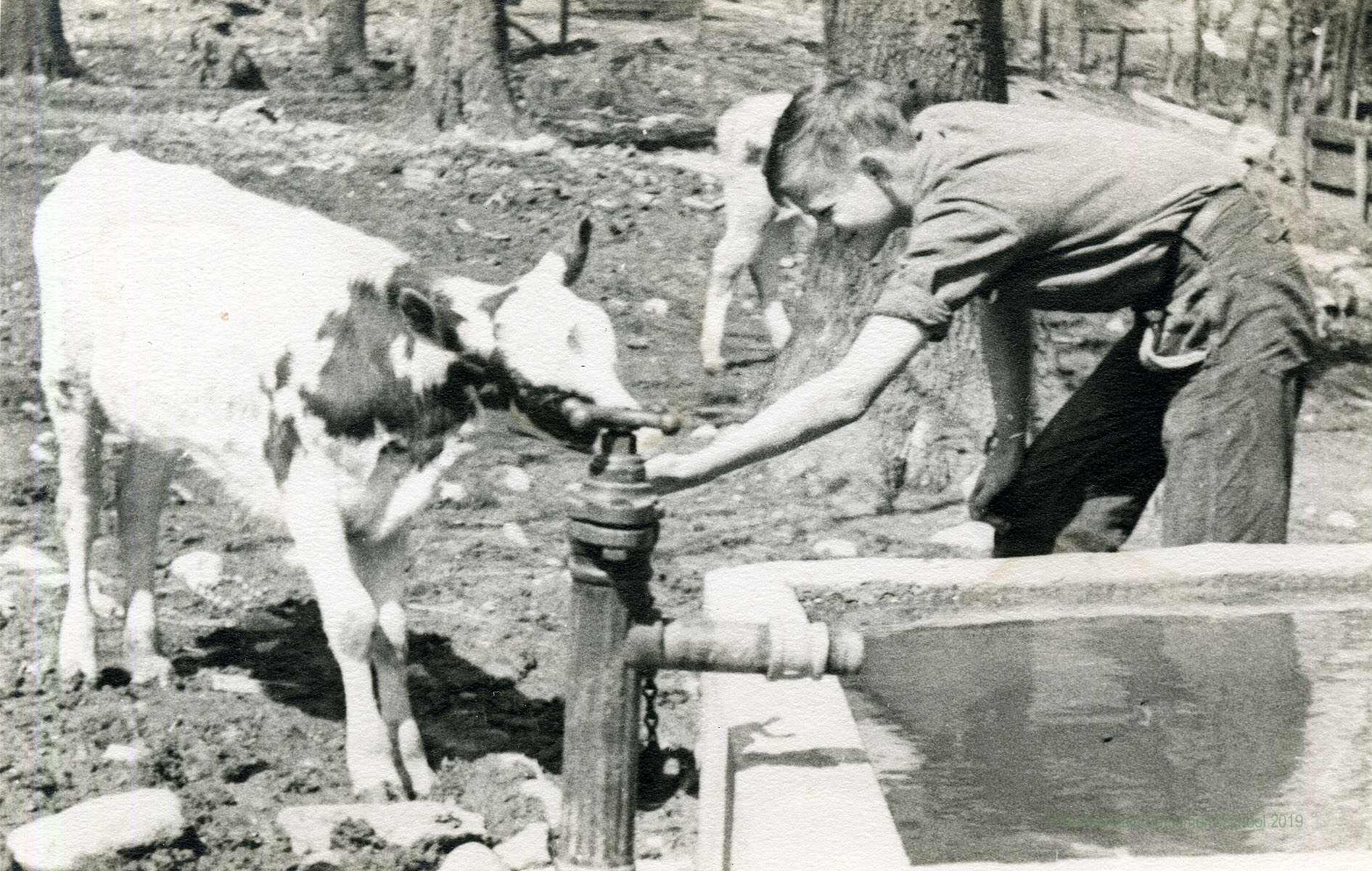
From the Great Depression forward, there was a steady see-saw in the emphasis given to farming at the School. By 1954, there was virtually no sustained farm program at the school and only sporadic attempts to grow small vegetable plots were made by staff. Though Pine Mountain saw a decline in the number of contributions coming to the school during the Depression, it fared much better than some of the other settlement schools in the Southern Appalachians as a result of its farm. For example, the support of the dairy herd continued during the very bleak years of the Depression, much to the credit of the staff and Board of Trustees who were able to garner strong financial support for this vital farm activity that supported the boarding students and yielded some income.
While farming across the country underwent a sea change in the years following the Great Depression, small scale farming never recovered from the changes in farming practice that were brought into play following the economic collapse of the Depression.
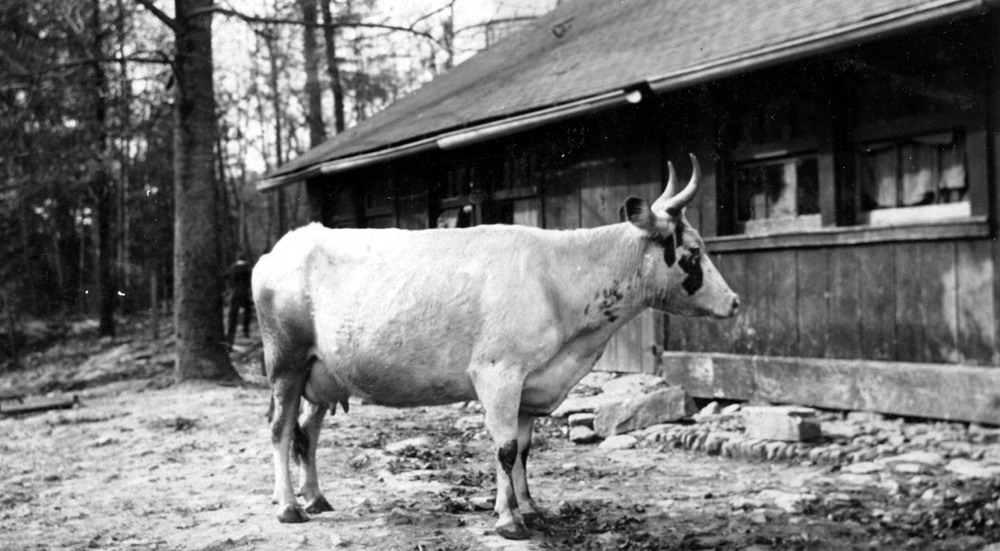
The letters of Elizabeth Hench, the champion of the Ayrshire herd adds both levity and charm to the history of the dairy herd at Pine Mountain. Hench put it to the donors in this manner:
Financial Center
January 1931
Dear Heirs and Assigns of the Orignal Cow Company:
44 stockholders during 1930 A.D. (Acute Depression) contributed $275.00 to the support of Joyce at the Pine Mountain Settlement School. That brings the grand total since 1920, up to $3027. ! ! I thank you the whole company of 124 strong.
This large donor base is outstanding given the national financial picture. The energy that Elizabeth Hench put forward for the support and growth of the Ayrshire herd is little short of miraculous. Her sense of humor and her tenacity may be seen in her letters to the members of the Joy Stock Company. In the small scrapbook that contains material that she often shared with her donors titled “Joy Makes History” can be found the wonderful positive outlook that many who worked with Pine Mountain shared.
As farming practice evolved, so did other rural land utilization. Up until the 1930’s the typical land tract for families in the Southern Appalachians was around 8 acres. These family tracts in other parts of the country have been declining, however, the density per square mile in Harlan County is still roughly 62.9 people, or close to the same as in 1930 and many of the tracts are still in the same family.
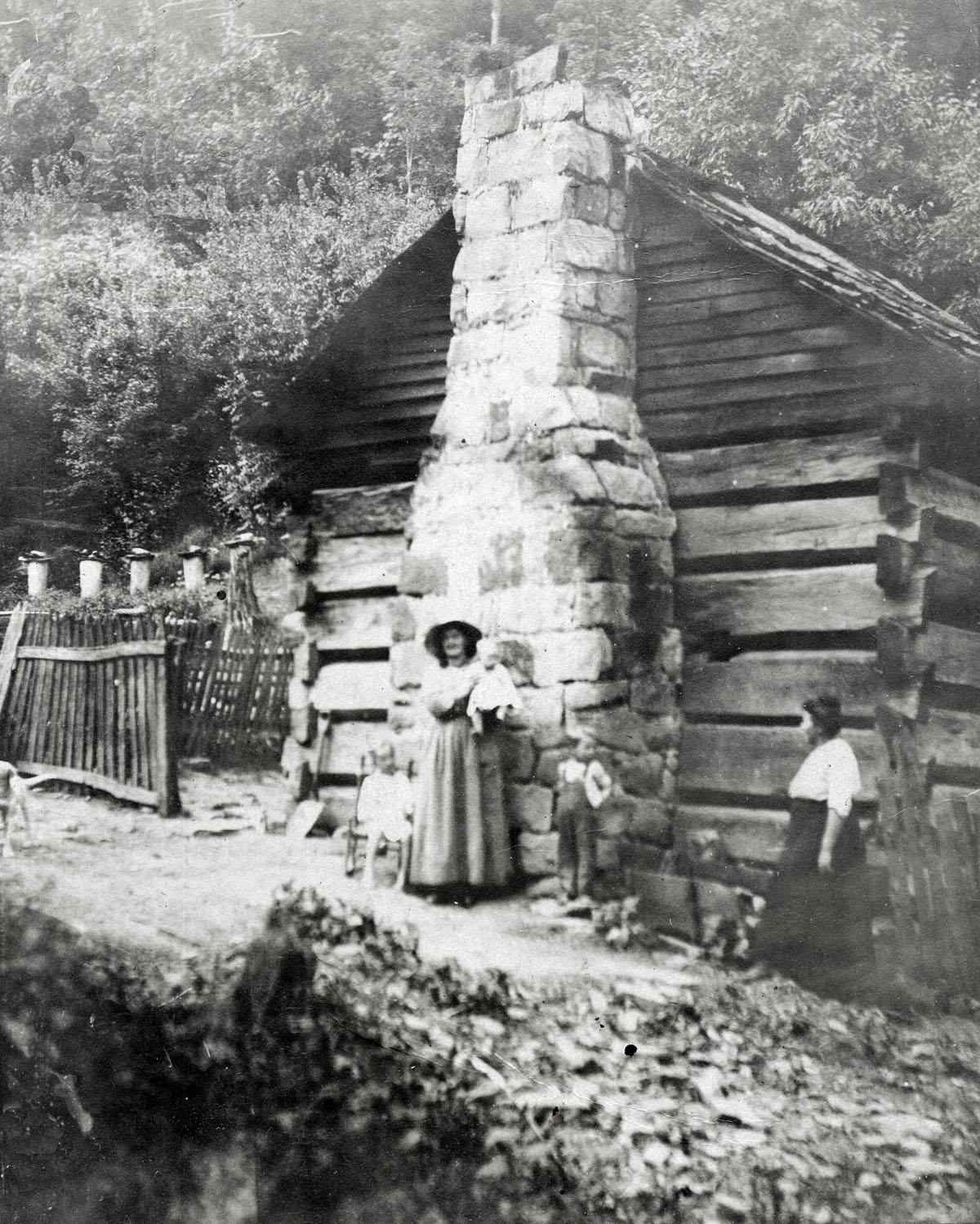
1322 “Mrs. Browning at Little Laurel.” Log bee hives in background [042_VI_friends_neigh_036.jpg]
[IMAGE: Rural Appalachian family in front of their home, c, 1920’s. Such images helped to perpetuate the view that this Appalachian family was representative of most all Appalachian families.]
More recently (2010 Census), 52% of the population of Harlan County is rural. 31.1% of those living in the county are below the poverty level. Harlan County joins 39 other counties in the state that are currently listed as “Distressed.” Tennessee is the closest state to Kentucky in number of distressed counties, with 16 distressed counties. Kentucky has over 100 counties and Tennessee has 95. These numbers suggest that considerable work needs to occur within the states and in Kentucky regarding poverty levels and that Pine Mountain still has an important responsibility in helping the region address its “distressed” conditions and that agricultural practice may have some answers. Sub-standard housing, inadequate and toxic water supplies, illiteracy, limited health care resources, “food desserts”, unemployment, and the list grows, also share in the need for mitigation.
In 2014 Washington again turned its attention to southeastern Kentucky exactly fifty years after the declaration of the “War on Poverty.” The declaration of the area as a “Promise” community will allow the area to implement remedial programs in the areas of education, jobs, health services with resources critical to the resolution of serious social ills. Drug use and crime are rapidly increasing in the area and are severly limiting the quality of life in this southeastern region of Kentucky. Now, in 2019, many of the promises of the “Promise” community have not materialized, but today few believe that the future is in coal and that coal will return as the focus of the economy in eastern Kentucky.
Lyndon Johnson’s “War on Poverty” initiated in the 1960s was created to address the growing issues in many regions of the country. However, Appalachia became a “poster-child” for all the ills of a life spent in poverty. The creation of the Appalachian Regional Commission was a good beginning but it failed to find a sustainable solution to the complex issues found in the diverse regions of Appalachia.
The rich coal reserves were both an economic boom and a virulent and rapacious industry that eventually turned a blind eye to the people’s long-term needs. Pensions were taken as mining operations were either bankrupted or consolidated. The Appalachian Regional Hospitals were turned over to private corporations as the health issues grew. The boom and bust economy of the region failed to give stability to the lives of the people and few alternatives have been found that have offered or can offer the sustained economic climate needed to maintain the quality of life found in other more stable communities with strong economies.
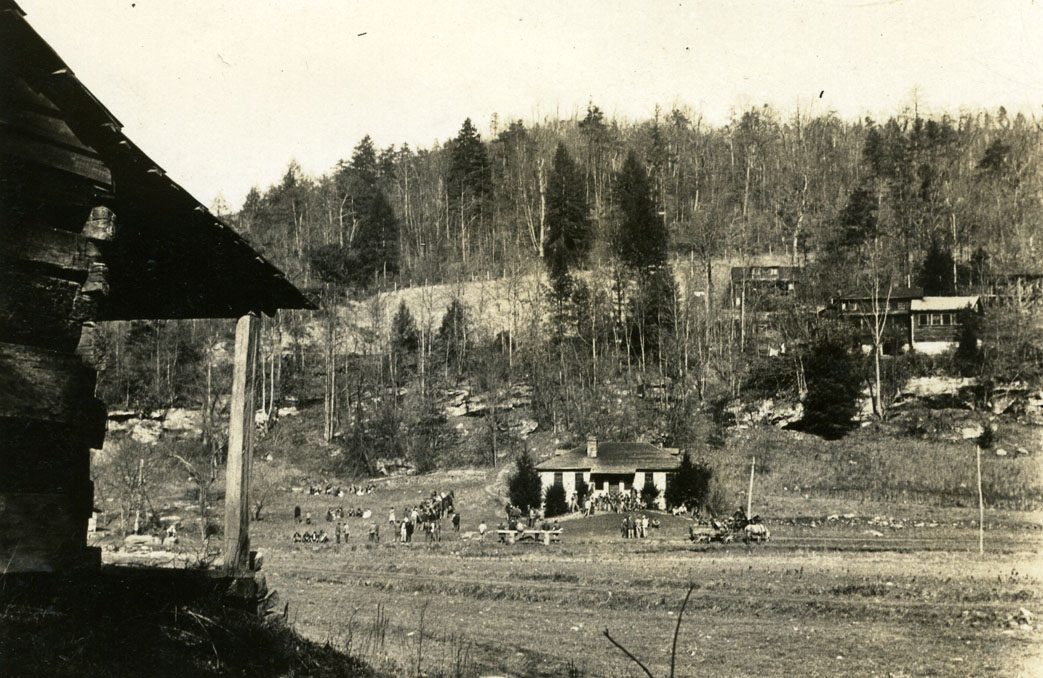
[IMAGE: This early view from the Chapel (c. 1930s) shows many new buildings. To the lower left, Aunt Sal’s cabin is framed by the cleared knoll. At the center is the Tool Shed and to the right, the Office building and above it on the hill, the new Infirmary. High on the right sits Practice House/Country Cottage and to its left ,another grazing field may be seen.]
[IMAGE: Here, the same view as the previous page. Until the closure of the boarding school, all reasonably sloped land was put to farm use. In the distance is a field of corn, and beyond that another vegetable planting may be seen. Today, these fields still grow small gardens, but the plantings are demonstration and aesthetic and share space with neatly mowed grass. The change is both aesthetic and pragmatic. ]
STONES, MORE STONES AND SCALLOPED POTATOES
LIMESTONE
Limestone was in rich supply in the valley. Often the stones were troublesome and were carried from fields where they troubled the plow. But, the prolific stone was also a gift to the land and the farmer. Limestone is a stone that can be burned and when burned it produces a rich fertilizer known appropriately as “lime,” and important nutrient for many crops to neutralize the soil’s acidity.
While the burning of limestone for lime has consumed considerable forest throughout history, it was well-known to give tired soil the boost it needed to support crops and grazing land. The history of lime kilns goes far back in the history of the world and no-doubt came to the New World with our earliest settlements. Until the advent of commercial fertilizers,, the production of lime through lime kilns (the burning of limestone) was common throughout much of rural America. It was, however, not so common in Appalachia and was a practice that Pine Mountain brought to many in the local population..
The so-called “lime cycle” starts with the stone — technically known as calcium carbonate and carrying the chemical compound symbols of CaCO3. The limestone is stacked over a fire fueled by wood or coal; layers of limestone and fuel is then alternated to create a sizable pile that would burn for 10 days and generally at temperatures in excess of 1200 degrees F.. The heat from the fire cooked off the carbon dioxide , CO2, and left rich carbonates (calcium oxide, CaO). This calcium oxide, also known as “quick lime” could then be applied directly to the soil, or better, could be mixed with water to de-acidify the soil.
Quick lime could also be used to make “white wash,” an insect retardant “paint” often seen on the base of trees, or on fences or around the base of wooden structures in early Appalachian homesteads.Even much later well into the 1950’s and 1960’s homes sported trees with bases white-washed or old tires painted white and filled with flowers.
When quick lime is mixed with other additives, it can also be a key ingredient to strengthen concrete or added to stucco it can supply strong walls or can be used in pointing stone work. Much of the concrete at the school used some local lime in the concrete mix. Today, the practice of burning lime has been replaced by commercial lime that may be purchased in fertilizer mixes and other commercial amalgams.
STONES AND MORE STONES
Stones in the Pine Mountain valley are everywhere present. They fill stream beds, sometimes tumble down mountains, pose major obstacles in the construction of roads and homes, or provide the central building material of the same. They are rockwalls, laid dry-stacked one on the other and stone mantles above the stone fire place.
SCALLOPED POTATOES
3 LB potatoes
4 T butter
4 T flour
2 t salt
1/4 t pepper
2 cups milk
Pare and dice potatoes and put in a buttered baking dish, sprinkling each layer lightly with the flour, salt, and pepper. Pour milk and melted butter over the potatoes. Cover, bake in moderate oven for 60 to 90 minutes.
Recipe in The Pine Cone, May 1935
Stacking potato slices is something like stacking a dry wall. Dry-stack rock work is one of the workshops now offered at the school and can be a valuable skill for the gardener or the cook. Both take a good eye!
Dry-stack rock work may be seen throughout the school campus. The recent preservation workshop re-built the wall just east of the Office, a beautiful sinuous stack of mountain stones.
But, there is a difference between a “rocks” and “stones”.
Stones at the School are flagstone walks and simple stream stepping stones. Deep in the woods they are natural monuments with trillium tops and gentle ferns laced sides. They are places to sit for stream-side picnics or reverie. At Pine Mountain no one was without stone — or an affection for one.
Potatoes were a popular crop in the mountains, but rocks and potatoes do battle in the field. It is difficult to grow potatoes in rocky fields, thus all workers took on the task of clearing the fields of rocks and turning them into stones:
“Another piece of economy has been the application of the two-birds-with-one-stone theory to the loose stones on our cultivable ground. We have secured building material for two sanitary closets and a fine tool house by gathering wagon loads of obstructive stone from our potato fields. As to rocks, we still have more worlds to conquer and we shall use them for building and retaining walls, paving, and roads.”
Nov. 14, 1914, Letter to Friends from Ethel de Long
[IMAGE: Stones are life-long labor for farmers. ]
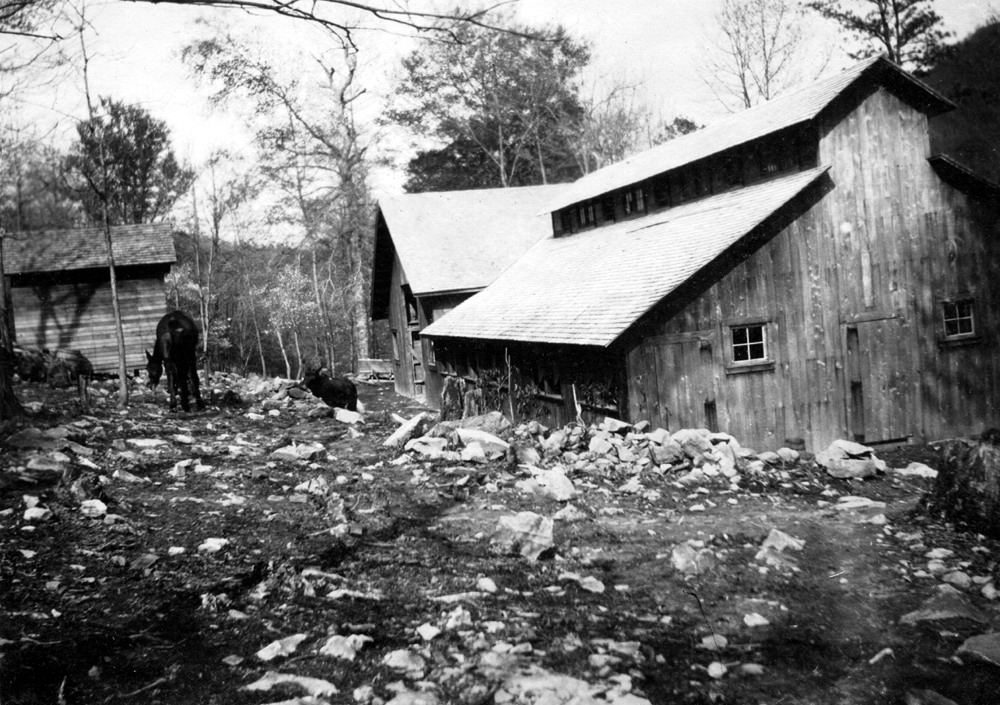
Stones were life-long labor for farmers at the school. Some areas were more troublesome than others. The barn yard seen here was slow to be cleared of these troublesome partners of most mountain soils.
In some locations stones were an advantage when they were arranged and sometimes even if they were not. In the barn yard at the school where soft earth could quickly become mired with manure and mud, the stones kept the yard drained and the feet of livestock, dry.
[IMAGE: Barnyard.]
STONE SOUP
There is even Stone Soup. Any soup may become “stone-soup” when a clean and dense stone is heated intensely and dropped into a soup pot. It acts as a slow cooker and both cooks and maintains the warmth of a meal. The following is a pleasant winter soup made from stored and home-canned goods.
Vegetable Stone Soup
1 cubed onion, braised (or added directly to pot)
1 qt. jar of tomatoes
1 qt. jar of corn
1 qt. jar of green beans
3 cups of beef broth
1 tsp dry oregano
1 tsp salt
1/tsp pepper
One clean medium stone thoroughly heated. Place stone directly in soup mixture. Let cook for 1 hour. Patience. Re-heat stone, if needed. Serve with cornbread. and cold buttermilk.
FARMING 1953 – PRESENT
When William Hayes, farmer from 1938 – 1953, left Pine Mountain Settlement School, he left with the satisfaction that he had met the fast moving changes and challenges as best he could. He left with two Master Pastureman awards from the Kentucky Green Pastures Program in Harlan County. One for the year 1950 and the other for 1953, the year of his departure. Full scale farming at the school ended with his departure, but still continued in more limited and focused ways for the decades of the 1960s and 1970s. By the 1980s, farming was so integrated into the Environmental Education program and the Community programs that it was rarely referred to as “the Farm at Pine Mountain.” It had essentially become “the Garden at Pine Mountain.” Activities associated with farming were referred to as “gardening.” Yet, the intensity of the work still remained the same under the direction of Matthew Boggs, as the support for his enormous agricultural efforts was severely limited by the reduction of available staff. Matt, along with many of the Maintenance staff spread themselves among many areas of need in the institution, often working in two to four different areas such as maintenance, security, and food services, in addition to gardening. While the level of work was intense and outcomes often remarkable in yield, the growing result was the fragmentation of farming practice.
In the late 1990’s the School turned a corner and started the long up-hill struggle to bring gardening back to a “farming” level. It had been recognized for some time that many of the fresh vegetables grown in the garden could off-set costs for the dining room. A concerted effort was made to focus on crops that could be easily planted and harvested but would begin to produce much needed fresh vegetables for the growing number of programs which were coming to the School. At the turn of the millennium the limited success of gardening argued for a full farmer position and several combined positions were tried that would incorporate the role of a “farmer.” The “farmer” soon became linked with a new regional initiative called Grow Appalachia, a highly successful program that was externally funded and that focused on modeling both garden concepts, as well as larger scale farming. Today, Pine Mountain collaborates with Grow Appalachia to provide support to local and regional growers who share tools, seeds and expertise to encourage a healthier life-style for mountain families.
Following the departure of the farm managers, produce was still grown for School consumption, but on a much smaller scale and only intermittently as other developing programs and limited staff, allowed. Farm reports were still solicited by the board of the School and were sporadically prepared during the two decades following the formal closure of the Farm program in 1953, but the reports were often rolled into other areas of campus activities. Further, full-scale farming was hampered by lack of equipment, much of it sold when the formal farming program closed and by break-downs of the aging equipment left behind. Further, farming still struggled to pay for itself as an integral program at the School.
There was, however, one activity that continued over the years to resonate with the surrounding community. That was any program that focused on “heritage seeds” and gardening in a sustainable and familiar manner. Programs that offered any portion of this combination always attracted a large audience. The program that seemed to resonate most soundly was the Grow Appalachia, program founded in 2009 and instituted at Pine Mountain in 2010.
It was not until 2010 that gardening began to again take on the appearance of an educational “program” and was a ramped-up as an activity intended to integrate the environmental education mission of the institution with farming practice. As a regional agricultural initiative Grow Appalachia began in 2009 with the intent to re-focus attention in the Appalachians on the importance of farming and gardening as an educational endeavor and a means to address food scarcity (healthy food) in the region. Coordinated regionally by the Loyal Jones Appalachian Center at Berea, and founded and funded by John Paul Dejoria, owner of the Paul Mitchell line of hair care products, the Grow Appalachia program is part of an international initiative.
The funding of Vista Volunteers at the School enabled the new Grow Appalachia program to extend its reach and regional participation began to grow. Using a small grant from John Paul DeJoria , the founder of the regional Grow Appalachia program, Pine Mountain Settlement, with the assistance of Berea College, leaped on the opportunity to share their congruent goals. Berea, the regional center for the Grow Appalachia program, helped the School hire a staff of three to test DeJoria’s theory that ” When food grows, communities and families grow too.” Grow Appalachia was an excellent fit with the mission and practice of Pine Mountain. In the program’s own language, it aimed
“…both to educate communities and to learn from communities. It works to preserve the past, build hope for the future, and empower Appalachians to live healthy, productive lives. Grow Appalachia is proud to be a part of the Loyal Jones Appalachian Center of Berea College. “
“When food grows, communities and families grow too,” says DeJoria and so said Katherine Pettit at the very beginning of the settlement institution. Under the direction of Maggie Ashmore in 2010, the concept was immediately palpable in the community. As roto-tillers were loaned out from the School to assist local gardeners in the preparation of their ground, heritage seeds (particularly through Bill Best and the Sustainable Mountain Agriculture program) came into the School. The response to this cooperative programming was overwhelming. The timing was opportunistic, in the best sense of the word. In 2014 the scale of the program has multiplied many fold and “old-timers”, “first-timers” and Sunday weeders, jumped at the opportunity to share ideas, tools, and produce.
The Pine Mountain Settlement School Grow Appalachia project demonstrated a remarkable success in the first three years, as recounted in this report to the board of trustees in 2013
Since partnering with Grow Appalachia in 2010, the gardening program at PMSS has continued to expand from 20 families to an anticipated 50 families for the 2013 growing season. Each of the families in the PMSS Grow Appalachia program has their own backyard garden, ranging from a small porch container garden to 2.5 acres in size. In 2012, PMSS Grow Appalachia participants grew a combined 835 bushels of produce, weighing in at over 38,000 lbs! To top it all off, those amazing families preserved 2,122 quarts of food! Each year, PMSS Grow Appalachia hosts a variety of workshops such as healthy cooking, garden planning, mushroom production, and chicken tractor construction, as well as local food potlucks. Through these events and hands-on work in the community, the Grow Appalachia program at PMSS has fostered a strong sense of community and a renewed enthusiasm for gardening and healthy food preparation.
Today, the program is both flourishing as demand in the region grows for its services, and also struggling to address the demand as well as the fill the void left by Grow Appalachia Coordinator, Maggie Ashmore, who married and moved on to establish her own chicken farm. Today, Maggie Ashmore’s work continues under the direction of David Hinkle who is the Coordinator of the farm program at Pine Mountain. David’s familiarity with the people, the soil, local farming practice, and the resources of the area have already proven to be invaluable in sustaining this vital program, as have his ideas and his energy.
Under the administration of a former director, Nancy Adams, the attempt was made to resurrect the School farm program by hiring a “Farm Manager.” While the attempt was noble, the results had peaks and valleys. The emphasis on Grow Appalachia was clearly the more successful attempt to resurrect farming at the School and to exercise a role in bringing new farming models to the region and to enable local farming across diverse populations.
While Pine Mountain was privileged to participate in Grow Appalachia, the restricted nature of the program’s funding does not integrate as well as it might with ongoing programs at Pine Mountain. For example, the integration of the on-campus agricultural programs with Grow Appalachia can often be seasonally awkward. It is sometime difficult to find a balance in staffing of the two programs and the challenges created around allocation of personnel, funds and time are on-going. For example seasonal demands on time is sometime difficult to meet. The lack of integration in the local programming has resulted in neither the farm program nor Grow Appalachia reaching full potential. Yet, both programs continue to gain adherents and to prove themselves important to the mission of the institution. Further, they interact in many critical ways that are supportive of the revitalization of small mountain farming. Under the direction of Paul Creech, a descendant of the Creech family, who founded the School, and with the staff assistance of Owen Callahan, the School garden is a large-scale operation and produces fresh produce for some 3000+ students who visit the school as part of the Environmental Education program each year. It has recently been proposed that the campus garden operation will sustain over 50% and more of the Schools fresh produce needs in the coming years. This is a noble aim for productivity and is particularly important to the support of the Environmental Education program which operates on a narrow profit margin. Clearly programs that can bring in a sustainable work-force, such as the recent Challenge Academy in Harlan, are neede if the goal is to be met.
Today, the farm staff of two, coordinate with Joyce Scearse, the kitchen supervisor to determine what crops are needed in the food service area and when they will be needed. Popular crops include Broccoli, Swiss chard, lettuce, spinach and other salad greens. Squash of several varieties, and eggplant, okra, and root crops such as potatoes, carrots, beets and Jerusalem Artichokes are also grown. The institutional staple, corn, is still grown, but continues to be a high maintenance crop. The use of early planting “hoop-houses” organic fertilizer, and non-chemical pesticides have been implemented and are increasing crop yield. Shrews, Vols, raccoon, possum, deer and, more recently, bear, have added their own stories. [PMSS Notes Summer 2014]
GO TO:
DANCING IN THE CABBAGE PATCH – ABOUT
DANCING IN THE CABBAGE PATCH I – GUIDE
DANCING IN THE CABBAGE PATCH II – INTRODUCTION
DANCING IN THE CABBAGE PATCH III – PLACE
DANCING IN THE CABBAGE PATCH IV – FARMING THE LAND 1913-1930
DANCING IN THE CABBAGE PATCH V – FARM & DAIRY I – EARLY YEARS
DANCING IN THE CABBAGE PATCH V – FARM & DAIRY II – MORRIS yEARS
DANCING IN THE CABBAGE PATCH VI – POULTRY
DANCING IN THE CABBAGE PATCH VII- IN THE GARDEN
DANCING IN THE CABBAGE PATCH VIII – IN THE KITCHEN
DANCING IN THE CABBAGE PATCH IX – DIETICIANS
DANCING IN THE CABBAGE PATCH X – IN THE DINING ROOM, MANNERS & ETIQUETTE

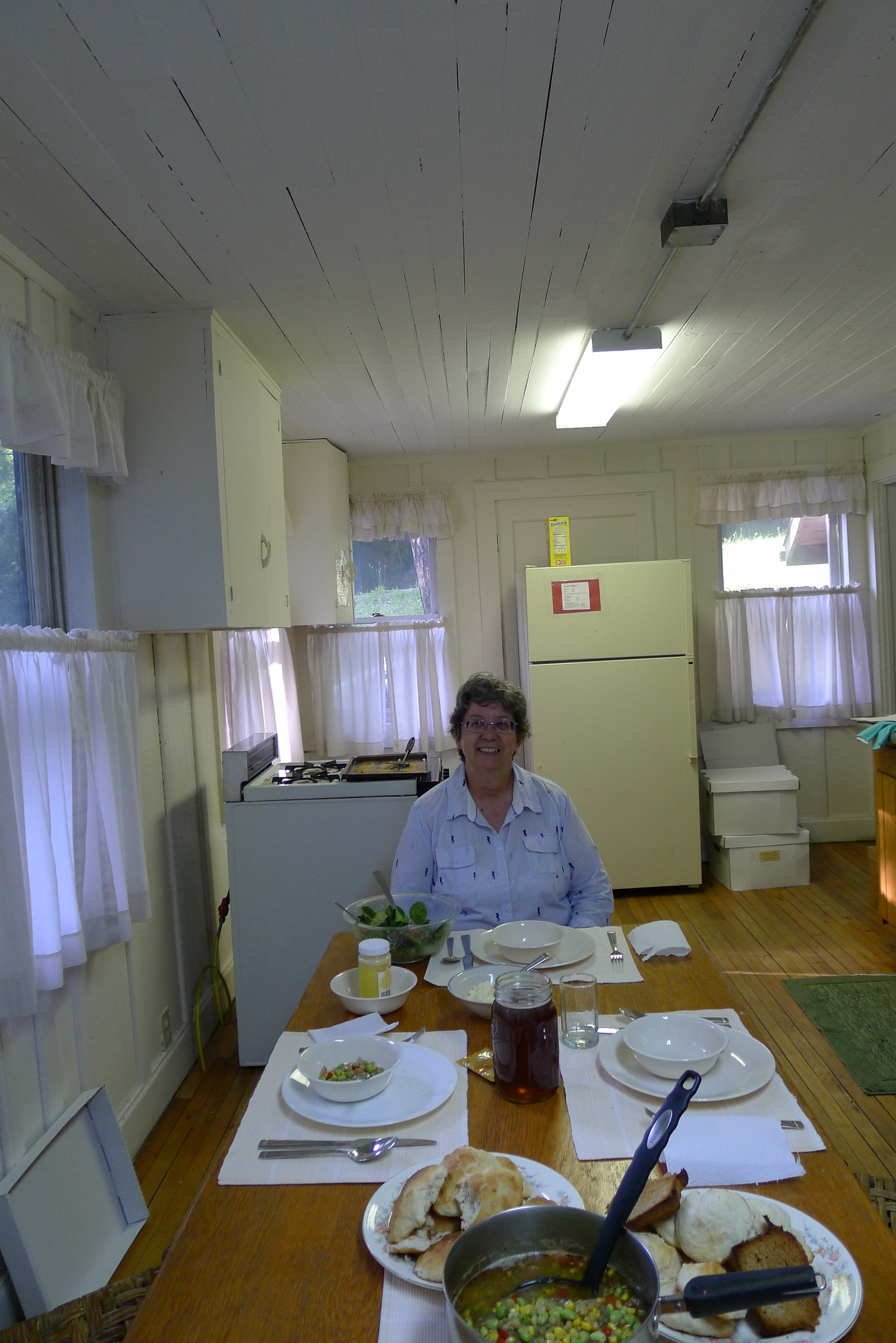
![Judy Lewis, Community Coordinator and her GIANT teapot and equally large hospitality! [P1060589.jpg]](https://pinemountainsettlement.net/wp-content/uploads/2015/06/P1060589-e1433448094821.jpg)






















![005a P. Roettinger Album. "Country [?] Looking from Uncle John's toward the School."](https://pinemountainsettlement.net/wp-content/uploads/2015/02/roe_005a_mod.jpg)

![019b P. Roettinger Album. "Planting cow-peas in new ground." [One man and seven children planting on a hillside.]](https://pinemountainsettlement.net/wp-content/uploads/2015/02/roe_019b.jpg)

 , the year Morris supported him.