Category Archives: DANCING IN THE CABBAGE PATCH

Dancing in the Cabbage Patch is a joyful and personal description of life at Pine Mountain Settlement School, Kentucky, seen through the lens of the author and those who worked at the school or those who lived nearby.  The narratives center on the main themes of farming, foodways, families, craft, people, and celebration and explore the years 1913 to the present. Like the dances of the region, the reflections here are broken into running topical sets that often relate thematically.

Dancing in the Cabbage Patch contains photographs, manuscript material, oral histories, artifacts, and external links largely derived from the PINE MOUNTAIN SETTLEMENT SCHOOL COLLECTIONS and family records. Tangible mementos of times past supplement the personal recollections and reflections of the author. The ruminations are mine alone. This Cabbage Patch of memories is pulled largely from the early formative years of my youth (1940s) when I danced as a youngster in this enchanted Cabbage Patch of Appalachia. My memories are nuanced by the later years of association with the School through my parents and friends, and as a member of the School’s Board of Trustees. No longer in my youth, my memories are both diminished and expanded by all that life has generously taken away and added in the intervening years spent in other geographies.

The fiddle tunes of words and often the ruminating dances shared here are, thus, mine alone. Music and dance are metaphors and not intended to necessarily represent the performance of the orchestra that is Pine Mountain Settlement School and its broader community. The personal songs and dances of the author are not intended to define the many dancers, ballads, and folk tales of the School or its Community, or any larger implied culture. Pine Mountain Settlement and the community people and the region are an ever-present orchestra, and this is but one dance among many that played here.

As a story of place, Dancing in the Cabbage Patch is written with the hope that some will identify with the feeling of dancing in their cabbage patch of memory and place. I am mindful that Dancing in the Cabbage Patch is a reflection on a region consumed by regional self-reflection. Many dances and songs will continue to be created as the history of Pine Mountain Settlement and its surrounding community evolves and changes with the many rich memories, voices, and talents yet to be discovered in this ever-changing world.

Across the world, other cabbages will be grown and somewhere a child may dance among them and sing and dream of lands across the seas, and stream their story in song and dance and later in 0’s and 1’s. Some will hold their stories close, but many will want to be singers, fiddlers, dancers, and storytellers… joy-makers of history and place. Appalachia is a story of place and a place of story. It is a storied cabbage patch place of memory.

DANCING IN THE CABBAGE PATCH Forests and Fires

Pine Mountain Settlement School
Series 11: Land Use
DANCING IN THE CABBAGE PATCH
Forests and Fires

DANCING IN THE CABBAGE PATCH Forests and Fires

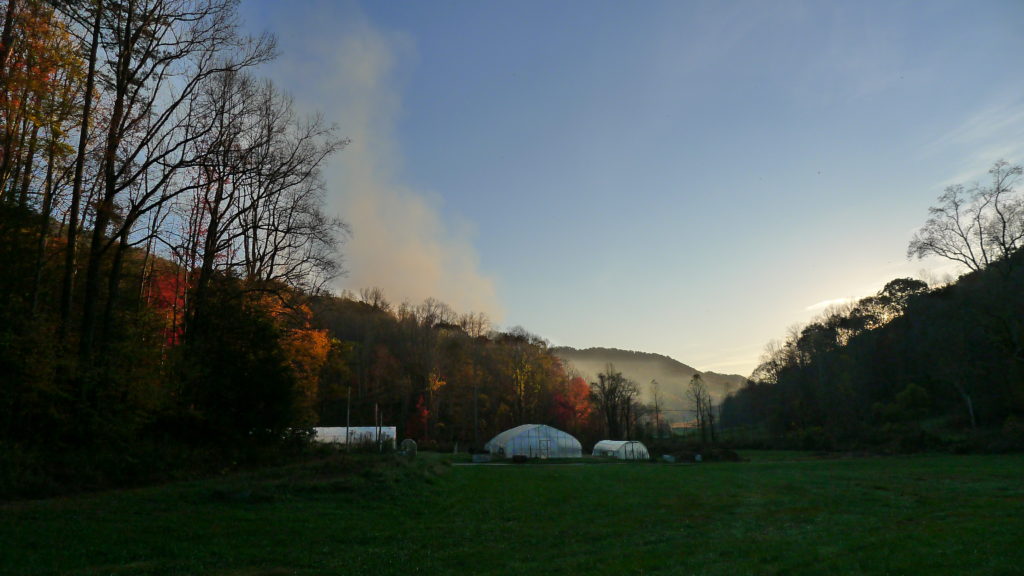
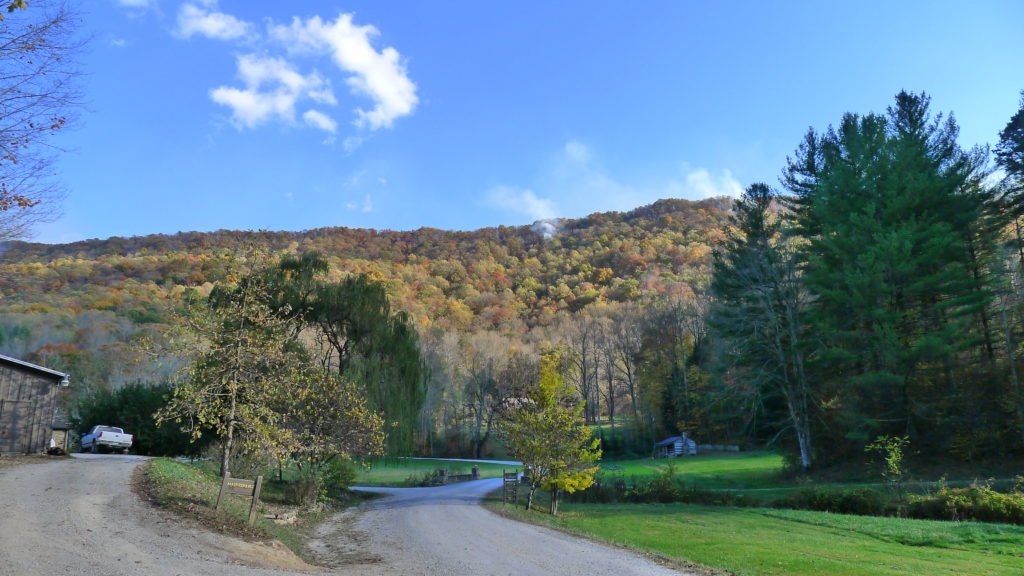
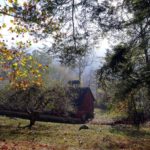
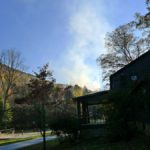
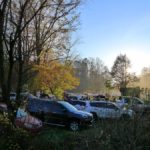
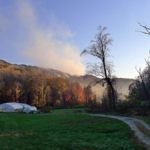
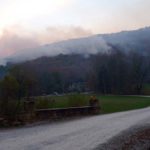
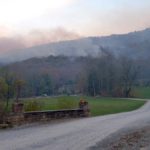
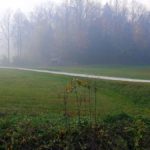
Smoke from nearby forest fire on Pine Mountain. p1130242

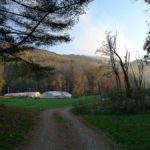
Forest fires along the Little Shepherd Trail above Pine Mountain School. Oct. 29, 2016. High-tunnels for crops in the foreground. [p1130242]

NEWSPAPER ACCOUNTS

In 1922 an article appeared in the Harlan Daily Enterprise.

PlNE MOUNTAIN LADS LOSE TIME FROM SCHOOL WORK AND SLEEP.
REPORT OF FOREST FIRE IN VICINITY OF PINE MOUNTAIN SETTLEMENT SCHOOL

The total burned area of the last forest fire on Pine Mountain is 4000 acres. The cost $12,000.  (a very conservative estimate).  Cost includes:

  • The destruction of half of the young trees forming the future forest crop.
  • The injury to the soil such as burning of leaves, humus [sic] and ground cover.
  • The injury to the standing timber by eating away the lower part of tree trunks until the wind blows the tree over or permits the entrance of wood-destroying fungi.

(signed) Leon F. Deschamps, Forester for the Pine Mountain Settlement School.

On  November 28, 1922,  the mountains around Pine Mountain Settlement School caught fire and threatened the entire community.  As reported in the Pineville (Ky.) Sun the terrible fire created a serious re-assessment of the forests and the threat of fire to part of the School’s important resources.  10 students at Pine Mountain, led by Leon Deschamps, the school forester and also the leader of the local Boy Scout troupe put forward a petition which they hoped to forward to Kentucky’s Governor Morrow. The petition was also signed by 19 girls, members of the local Girl Scouts and supplemented by a letter from their Scout Captain, Miss Lucretia Garfield, grand-daughter of President Garfield, who was on the staff of the School as a teacher and Scout leader from 1919 to 1922. The petitioners asked that the Governor establish a forestry service and a state forester to be appointed to Harlan County.  As part of the petition each of the boys who fought the fire, for an estimated 30 hours each, wrote of their personal experience fighting the fire in individual letters attached to the petition.

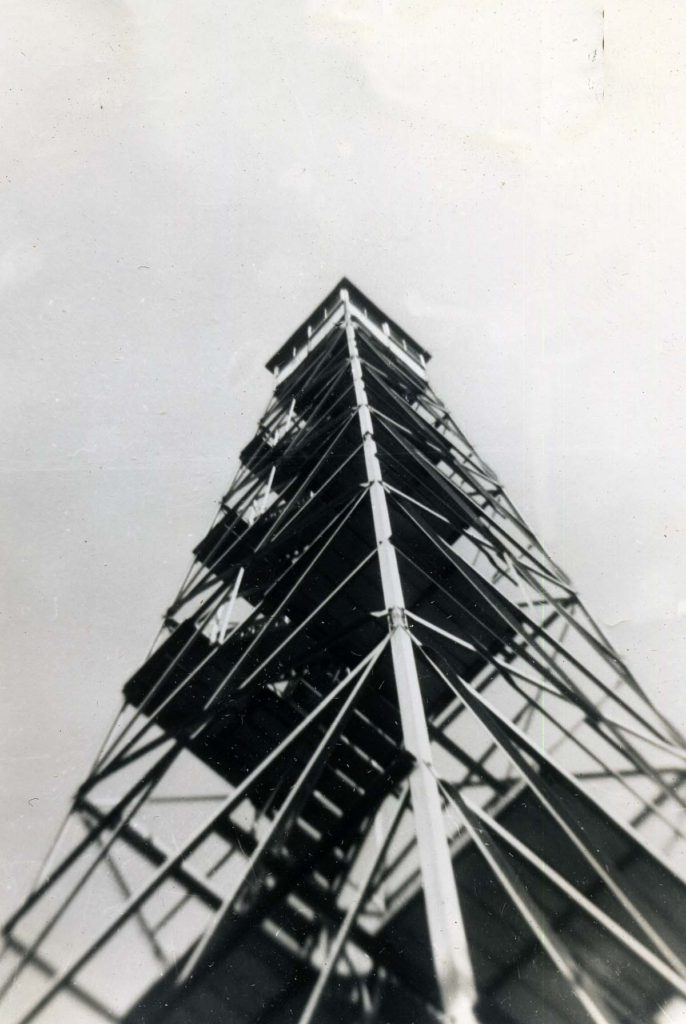
Mountain Day. Fire Tower in Kentenia State Forest.

Mountain Day. Fire Tower in Kentenia State Forest. c. 1953 (Putney Tower). No fire towers were available until after 1937-38. Today the tower no longer exists.

The student letters were prefaced by one from Lucretia Garfield, Scout Leader.  She describes the fire:

From October 27 to October 31, 1922 Pine Mountain Settlement school was surrounded by forest fires. There were fires along Pine Mountain for many miles on either side of the School, fires down Greasy Creek below the Medical Settlement and fires between the School and Line Fork Settlement seven miles to the east, 

For a week the boys of Pine Mountain School had been fighting fires in the mountain now and then, but from October 28 to 31 they fought night and day. The dry woods burned fast and the fires were coming down the mountain toward the School. For hours the boys worked to rake large rings about each fire and then started back-fires to make the rings wider. Several times the fire broke over the rings and just as the boys were ready to come in at night another alarm was called. They say that one man near Nolansburg let out the fire that spread up Pine Mountain and westward along the top of the mountain, past the Dillon Trail, past Divide, and far down toward Incline.

The Line Fork fire which spread up Bear Creek burning on both sides for many miles was said to have been started by one boy who lit a brush pile for fun.

Her letter is followed by a summary of the time lost from school, work, and sleep by the boys of the Pine Mountain school, while they were fighting the forest fires.

The following is a summary of the time lost from school, work, and sleep by the boys of the Pine Mountain Settlement School while fighting these forest fires:

Average time spent by each boy fighting fires: 30 hours

Average time lost from school: 1-2 hours

Average time lost from work: 14 hours

Maximum time spent in fighting fires by any boy from October 27 to 31, 1922:  40 hours

But the best story of the fight the children made  is told by them, in their own way. Some of them have made written report of their part in the fight, as a requirement in their school work, and their story, brief, simple, but convincing, tells the story of the seriousness and danger better than any other version could tell, and a few of those compositions follow.

By Clarence Dozier ; Grade VII: November 3, 1922.
Sunday morning there was a fire on top of the Pine Mountain. Mr. Deschamps who is the Boy Scouts Master took ten or twelve Boy Scouts to fight fire. We took our dinner and stayed there until 6 o’clock Sunday night. We came off the mountain and ate our supper, the five boys went back to make a fire-line around the fire. They stayed until midnight. The next morning when they got there the fire had broken over and was coming over into the school ground. One of the boys came back to tell Mr. Deschamps about the fire. Before he got down the mountain he met Mr. Deschamps with some of the boys. They fought fire until dinner. Then some of us went back and made a fire-line from the top of the mountain down to the Lime Stone Cliffs. After we got through with the line we went back to the top of the mountain. And three of the boys went over the fire line. One of them came back where the boys were waiting for him and he said, “boys the fire has broken over the line.

We went to the fire and raked as much as we could. After a while a  man came to help us fight the fire.

I fought fire 40 hours. Time lost from school, three days. Time lost from work, three days. Hours lost from sleep, five.


STUDENT REFLECTIONS

Discovering a Fire

By Roy Redwin, Grade VII; November 3, 1922.
One morning when I was working for Miss Pettit who is my house mother, we noticed the smoke rising up behind Pine Mountain. Mr. Deschamps who looks after the forest at Pine Mountain, took me with two other boys to the top of the mountain to investigate the smoke. He climbed a tree to see if he could see fire. When he got down he said that he could “see fire i the distance.” Then we went on out a piece farther ad burnt a fire line so that if the fire came dow there it could not get over into the school grounds. We stayed all night and next morning we came back about 7:30 o’clock smoke was rising very fast ad some boys went up to try to put it out. This was the beginning of a forest fire which lasted about seven days. I spent about twenty-six hours fighting fire. I lost about seven hours fro school. I lost about eighteen hours of work time. The fire has destroyed many fine trees ad killed many young ones.


How I Fought Fire

By Watson Caudill, Grade VI; November 3, 1922.
Last Sunday with some other boys I went to fight fire on the Pine Mountain, on top of the mountain, where the Nolansburg trail crosses. We started raking a fire-line on top of the mountain down towards Nolansburg. We went half way down the mountain ad burnt it so that it would not catch over. When we had burnt it off we came back to the top of the mountain and it had caught over this side. We worked about two hours more before we got it stopped. And then we came to the house and went to bed at one o’clock that night. The next morning it had caught over again and we had to take up the fight again. I missed school two days and sleep two nights. I fought fire about 22 hours in all.


By Harry Callahan, Grade VII;  November 3, 1922
One afternoon Mr. Deschamps who is the Boy Scout Master at Pine Mountain Settlement school came in and said he wanted some one to go and fight fire with him. He just took three boys at first, and after a while he came back after some more boys to help him. He just took three boys at first, and after a while he came back after some more boys to help him. He said that the flames were crossing the line ad that evening some of the Boy Scouts went and stayed out all night fighting fire.

The next day was Sunday and just as soon as the boys got back they saw that it was across the fire-line and they had to go back and fight all day Sunday. When Mr. Deschamps came in that night he asked for volunteers to go and stay out that night and fight fire.

One night we ate supper and went back and fought fire till about 10 o’clock that night. All the time we fought fire amounted to about six days of hard fighting.


By Gardner Combs, Grade VI; November 3, 1922.
Sunday a fire broke out in the forest and the boys at Pine Mountain were asked to help put it out. One party of boys went Sunday and another at night. 

The fire was coming up the other side of the mountain when we got there, and we began to rake a fire-line around the fire. When the ring was all way around the fire, we set fire to the leaves, next to the ring, to meet the fire coming. Then we came home at one o’clock in the night. 

The next day the fire broke over the time [sic line] and most all the boys went out to put it out. We raked a ring all the way around the fire, but it broke over again. Then we all went up and raked another ring and this time we put it out. I worked about thirty-four hours in all. I lost about 13 hours from school. I lost about 14 hours of work. I lost about six hours of sleep.


NEWSPAPER ARTICLE


p1130319

Forest fires above the Chapel, Pine Mountain, KY. Oct. 30, 2016.

HARLAN COUNTY FIRST COUNTY IN STATE TO CREATE FOREST FIRE PROTECTIVE ASSOCIATION

According to historian George E. Thompson, in his 2009 publication, You Live Where?, Harlan County, in 1913, was the first county in the state to create a forest fire protective association. The first state forest in Kentucky was also created in Harlan County in 1919, the Kentenia State Forest.

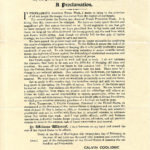
By 1925 the President of the United States had issued a Proclamation that declared April 27- May 3rd to be “American Forestry Week”.  He stated that “I desire to bring to the attention of all our people the danger that comes from the neglect of our forests.” His proclamation was an enlargement of the “Forest Protection Week” that had been in place for several years.  It was clear that all was not right with American forests in the 1920’s, what Coolidge called “unwise dissipation of a great resource.”

AMERICAN FORESTRY WEEK

BLANTON FOREST

Even in these early years the people of Harlan County recognized and wanted to protect their forests.  One of those Harlan County natives, Grover Cleveland Blanton, a grocer from Wallins Creek, near Harlan, had a particular love of forests and continued to purchase forest land to add to the Blanton forest all his life.

Grover Blanton was particularly fond of one tract that showed no signs of logging or removal of trees. It was that particular tract that became a focus of energy for conservationists. Just four miles west of the town of Harlan, that tract, later Blanton forest, is literally a national treasure. It is one of the oldest forests in America that is designated “old-growth” forest. Many of the trees, some over 150 feet high and some four feet in diameter have weathered many fires over the centuries.  And, there have been many centuries.  Some estimate many of the trees of 25-30 different species, are 300 to 400 years old. Many show the scars of fire.

This large forest, the Blanton Forest,  is comprised of 2,350 acres, of which 1,075, the least disturbed portion, has been set aside for a nature preserve. This important section is positioned on the south flank of the long Pine Mountain range that stretches through Harlan County, the longest of Kentucky’s counties (some 50 miles long by 20 miles wide). Marc Evans, working for the state Nature Preserves Commission to inventory the state’s forests,  is credited with the “discovery” of this remarkable old-growth” forest.  Marc is currently a Pine Mountain Settlement School board member.  When he walked into the area in 1992 he was astounded by what he saw and began a campaign to recognize and preserve the forest. In 1995 working with the Nature Preserves Commission, and with William Martin, then the Natural Resources Commissioner, about half of the Blanton Forest was purchased for $750,000.  This was the 1,075 acres identified as critical to preserving. The care given to this forest by the Blanton family and the care given to other forests in Eastern Kentucky, particularly Lilly Woods, and the forest in the Bad Branch area of Letcher County, are treasures that are very susceptible to fire.

The forest surrounding Pine Mountain joins a remarkable gathering of unique and irreplaceable forest lands in Eastern Kentucky.  Since 1913, when the School was founded, there have been fires in the forests of the school like the one mentioned above. Most of them were the result of careless behaviors. William Martin, an expert in old-growth forests and former Natural Resources Commissioner for Kentucky in the early 1990’s, once remarked, “A tree doesn’t care how long a human being lives …”  But, it is clear that we humans need to heighten our understanding of the life of trees.  In many ways, they are our legacy. Today, along with fire, a recurring challenge to forests in Harlan County is irresponsible timbering. Grover Blanton made it clear throughout his lifetime that his forest was “More than timber.” “This is for saving,” he told his daughters, Nora and Serena Knuckles.

IRRESPONSIBLE TIMBERING

Today, along with fire, a recurring challenge to forests in Harlan County is irresponsible timbering. Grover Blanton made it clear throughout his lifetime that his forest was “More than timber.” “This is for saving,” he told his daughters, Nora and Serena Knuckles. They did that and continue to advocate for their father’s legacy.

The care given to this forest by the Blanton family and now the Nature Preserves Commission, and the care given to other forests in Eastern Kentucky, particularly Lilly Cornett Woods, and the forest of the Bad Branch area of Letcher County, near Pine Mountain School, cannot be underestimated. These two forest tracts are treasures that are susceptible to timbering and to fire but are in many ways they are less susceptible than new forests.

Many of the old-growth forests have a built-in fire protection. Many of them have large “boggs” and a moist understory that holds moisture when other forests have succumbed to long periods of drought. As we struggle with Global Warming that is intensifying, this feature of old-growth forests and well maintained forests will become increasingly important. The forests surrounding Pine Mountain are joining other unique and irreplaceable forest lands in Eastern Kentucky in monitoring care and preservation.

HUMAN BEHAVIOR AND FIRE BEHAVIOR

Fires in forests have been present throughout history. Since 1913, when the School was founded, the fires in the Pine Mountain Settlement School forest, have been recorded, and like those described above, and like many of the fires of today, most of the fires were a result of careless and often malevolent behaviors.

In 1995 two fourth grade classes at Wallins Elementery School received a $500 grant from the Kentucky Environmental Council to develop games, a study guide, and other activities to heighten awareness of the unique forest in their back-yard and to educate for preserving that legacy. Education has always been linked to responsible fire management.

Fortunately, fires in Eastern Kentucky are usually in the understory and not the fierce fires in the tree crowns seen in the Western United States. Yet, the contributing wind can quickly change that comparison. It only takes one fire such as the one recently seen in the Great Smoky Mountains at Gatlinburg to remind us of the danger of fires in the Appalachian mountains. When all the elements conspired a conflagration, can be as destructive as that seen in the Western United States.  The following photograph in the Pine Mountain Settlement School Collections, taken in a very dry year in the early 1940s, shows a particularly fierce fire on the ridge-crest of the Pine Mountain, near the School.

Forest fire on the ridge-top of Pine Mountain, c. 1945

OCTOBER 2016 FIRE REFLECTIONS

In October 2016  the Pine Mountain was again on fire.  A series of small fires deliberately set along the Little Shepherd Trail grew into large fires that crept down the mountain. Today no small boys were sent up to meet the growing danger, but the small staff watched warily as the forest cleared its under-story and discussions centered on the process of making ready for the seeds of Spring. Yet, with each increase in the wind the observers grew more anxious and small groups went into the forest to combat the flames as they steadily marched down the mountain toward buildings.  Shortly a misting rain fell and everyone sighed relief yet many paused to consider and to wonder what it is in our common human community that still finds pleasure in setting things afire.

An editorial in the Lexington Herald, November 20, 1994 “Arsonists rob E. Kentucky of its verdant forests,” by Doug Crawford, wondered this, as well. He said, “…it is difficult to understand how one element of Eastern Kentucky’s own could be so disillusioned, so ostracized, so contemptuous that it could willfully destroy the region’s greatest and most lasting natural resource.” He goes on to muse that the

“... epidemic of arson fires would seem to be a symptom of something still larger, reflecting a mentality similar to those who thoughtlessly trash the roadways and countrysides of Eastern Kentucky ….the people who are doing this have no respect for themselves or where they come from …The motivations for such behavior one can only speculate. Revenge? Contempt? Power? Kicks? ….whatever the reasons, getting at the root of this self-destructiveness is growing more crucial to the survival of Eastern Kentucky.”

p1130268

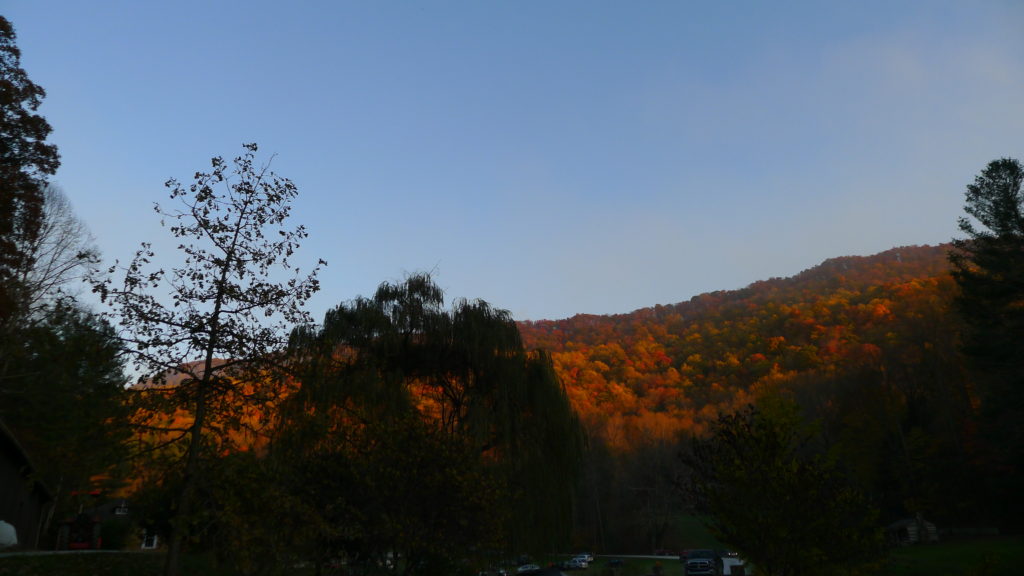
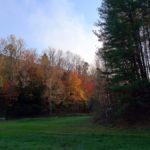
The Pine Mountain ridge in full Fall color. Late afternoon as fires begin to grow on South side of mountain.. October 28, 2016.

Pine Mountain Settlement School continues its environmental education work.  The year-round Environmental Education program which began in 1972 is no longer a focus of programming but it sits in the center of both the school outreach and the adult programming of the institution. Programming continues to offer students from throughout the state and beyond, the opportunity to study forest ecology, biodiversity, stream ecology and other aspects of environmental education for short or week-long sessions for public and private schools. Environmental education offers hope for a way out of the cycle of insensitivity and senseless crime and despair. It is never too early or too late to learn and devise ways to cope with the environmental changes occurring around us.

[Contact Pine Mountain Settlement School for information on educational programs or visit https://www.pinemountainsettlementschool.com/   for a list of programs and workshops.]

GALLERY (Included 2016 fire)


GO TO:   

DANCING IN THE CABBAGE PATCH – ABOUT

DANCING IN THE CABBAGE PATCH  I – GUIDE


DANCING IN THE CABBAGE PATCH: 1936 Pine Mountain Settlement School and Mexico

Pine Mountain Settlement School
DANCING IN THE CABBAGE PATCH
POST

1936 Pine Mountain Settlement School and Mexico

1936_mexico_009

1936_mexico_009

ADVENTURE

In 1936, the country of Mexico was opening up to travelers and cars. Some travelers were now able to make long journeys in the country and find the needed road assistance along the way. The Pan American Highway was still under consideration after it was first introduced at the Fifth International Conference of American States in 1923 but agreements to begin construction were underway and in July of 1937 when the participating countries signed the Convention on the Pan American Highway, construction began in earnest. The roads in the rural countryside, like those at Pine Mountain, were rustic and treacherous, at best. But it is unlikely that roads presented an obstacle to an adventuresome group from Appalachia.

Intrepid souls were venturing farther than just across the border and they navigated the roads of Mexico and beyond just as they navigated many of the rough roads that marked a large section of the rural United States. In the mid-1930s some of those intrepid travelers to Mexico were from Pine Mountain Settlement School. Following the closure of the 1936 school year, the Principal of the School, the secretary to the Director, and a rising star who had just graduated from the Pine Mountain Settlement boarding high school were given the opportunity to explore the world outside the United States. Accompanied by a proper school marm/administrator from Perry County, the quartet struck out for Mexico City and surrounding towns. Arthur Dodd apparently supplied the car and the camera, Fern Hall took notes, and Georgia Dodd supplied the vibrant dialogue, while all were observed by the quiet and reserved school administrator and first cousin of Fern Hall, Grazia Combs. In one touring car the group drove first to New Orleans where they explored the gulf port and the energetic life of one of America’s oldest cities.

1936_mexico_035

1936_mexico_035 New Orleans

Leaving New Orleans, the group then headed for Texas where they planned to cross the border at Brownsville which sits just north of the large Mexican border town of Matamoros, Mexico. All we know is that they crossed the border into Mexico. Apparently, Arthur Dodd hoped to repeat the trip he had made in 1934, just two summers previous.  What happened at the border is not certain. It is possible that the group took a train to Mexico City and rented a car within the country, or they may have driven the distance. That part of the story remains to be discovered.

The Mexican Highway 101, or the Carretera Federal 101, starting at Brownsville to Matamoros, is today a spur of the Pan American Highway that leads to one of the most treacherous highways in Mexico. But in 1935, it was an adventure, not a life-threatening drive, but also not for the faint of heart. To get some sense of highways in Mexico at this time, the home movie shot by adventurers in 1935,Touring Mexico by Car, 1935 should give some indication of the experience of driving to Mexico City during the early 1930s.

By 1936, Mexico’s Revolution had ended, Cardenas was installed as the new President of the country and oil was providing the country a new economy. Diego Rivera, Frieda Kahlo, Jose Clemente Orozco, and David Alfaro Siqueiros were making their revolutionary voices heard in the murals and paintings shared with the Mexican people, as well as with new and eager North American adventurers. North American artists and educational and recreational adventurers began to frequently travel to Mexico. For example, Anni and Josef Albers who were in residence at Black Mountain College in North Carolina in 1935, drove from North Carolina to Mexico City, an adventure of close to 28 hours or 1,740 miles.  Steeped in the art of the Bauhaus, the couple fell in love with the culture and the lively art of Mexico. Their interest and that of other icons of the day stimulated a surge of travel to Mexico and southward.

The automobile also played a role in the excitement of journeying to the neighboring country. The advantage of traveling “off the beaten path” in a car brought large numbers of adventuresome folk to cross the border. These eager adventurers then returned many times from 1935 to 1967 and brought back elements of the culture that were literally woven into their art. As a weaver, Anni Albers was particularly sensitive to textile patterns and textures and also intrigued by the ceramic patterns of decoration. Motifs taken from native Mexican weaving and ceramics show up in many of the Albers work and the vivid and subtle colors of native arts and natural landscapes were evocative inspirations for Josef Albers’ fascination with color theory. This new freedom of travel and excitement educators to flock to Mexico in the 1930’s ad early 1940’s.

AN EDUCATIONAL EXPERIMENT

Pine Mountain Settlement School had much in common with the educational experiment of Black Mountain College in North Carolina, and the educational exchanges between the Directors of the two institutions occurred with some regularity. Glyn Morris, a Welshman by birth, became the Pine Mountain director in 1932. He had been deeply schooled in the Progressive educational models of John Dewey and nurtured by the reformed theology of Reinhold Niebuhr John Andrew Rice, the Black Mountain College Director at the time, was a follower of John Dewey and later became a friend of the progressive educational reformer. Both Morris and Rice ran institutions that favored an educational model that was less a traditional educational institution and more a controlled educational experiment to test their theories of how best to teach and to learn.

John Andrew Rice, just fired from Rollins College in Florida, because he wished to abolish grading and other progressive ideas, was in a hurry in 1933. He wanted to try out his ideas as soon as possible. When he came to Black Mountain as the Director, he rushed the framework of a new institution into reality through what one observer noted was like a “pick-up game of football.” Born during the Great Depression, founded on the pragmatism of John Dewey, Black Mountain College was a model of great appeal to educators and students. The views so broadly adopted at Black Mountain were less in evidence at Pine Mountain under the guidance of Glyn Morris, but the young teachers and workers who came to the School had picked up the vibrations of the times and were eager to integrate them into the curriculum.

Glyn Morris, just out of Union Theological Seminary in New York City, was also in a hurry to make his mark on the world in another corner of Appalachia. When Glyn Morris had landed at Pine Mountain Settlement School in Harlan County, Kentucky in 1932, the country was in the beginning stages of the Great Depression. It is not remarkable that the two directors were looking for diversions, and both looked south of the border.

One major stumbling block in this new and exciting world was the conservatism and the poverty of their surroundings the deep Appalachians. Black Mountain College and Pine Mountain Settlement School, had very different educational objectives but similar sources of influence. Rice, for example had some disaffection for Robert Maynard Hutchins. Hutchins aimed to promote a kind of general education that would be comprised of fundamental ideas but would aimed to end in intelligent action guided by practical wisdom. Rice did not envision his educational model following Hutchins’ strict fundamentalism and by 1937 he felt secure enough in his own model to attack Hutchins “General Education” plan in an article in Harpers, titled “Fundamentalism and Higher Learning.

Robert Maynard Hutchins  (1899–1977), a legendary scholar who, at the age of 30, served as the President of the University of Chicago and later Chancellor, was the brother of Francis Hutchins, who became President of Berea College in 1939, following his father, William, in the role. Francis Hutchins was a major force in shaping the later years (after 1940) of Pine Mountain when he became a member of the Settlement School’s Board of Trustees. Hutchins, the son of a missionary, had been in China in the mid-1930s as the director of the Yale in China program, working with the emerging nation and it’s struggle to educate itself out of poverty and to build a future for a large and growing rural population.  As the newly hired Berea President, Francis Hutchins, had found an ally in Glyn Morris amd he became a key supporter of Morris near the end of Morris’s tenure at Pine Mountain.

The relationship of the two Hutchins brothers with Pine Mountain did not, however, appear to dampen the friendship of Rice and Morris and both Schools adopted a “no-grades” approach to their educational programs. But, when Robert Maynard Hutchins, then President of the University of Chicago published his book, The Higher Learning in America (1937), which outlined what he sought to do at Chicago with regard to reforming the curriculum. Robert Maynard’s reforms infuriated John Rice at Black Mountain and confounded Glyn Morris at Pine Mountain.

At Pine Mountain, Glyn Morris walked a delicate line between John Rice’s preferred experiential model of education, one not so fundamentally grounded in text, and the more sequential and proscribed program of Hutchins at Chicago. In his 1937 article for Harper’s magazine, “Fundamentalism and the Higher Learning,” Rice blasted Hutchins’ model as “removed from experience.” “Why,” Rice asked, “include what can be printed and leave out what must be seen or heard? …… ” [Reynolds, K. Visions and Vanities, p.147.] Rice elaborated …..

“Why include what can be printed and leave out what must be seen or heard: To some, Aeschylus and the sculpture of Chichen-Itza are in quality very near together. But we are to exclude one because it cannot be got from a book?”

“…Education, instead of being the acquisition of a common stock of fundamental ideas, may well be a learning of a common way of doing things, a way of approach, a method of dealing with ideas or anything else. What you do with what you know is the important thing. To know is not enough.”

THE EDUCATIONAL EXPERIMENT

While this discussion of Rice and Morris may seem outside the scope of the Pine Mountain connection with Mexico, there is a thread.  It is found in the dual role educational experimentation had on Pine Mountain and Black Mountain which paved the way for the groups’ travels to Mexico. What could be more experimental than such a far-flung journey of educators and students. It was something on the equivalent of today’s educational “travel abroad” … somewhat.

Glyn Morris, the Director, and Arthur Dodd, the Pine Mountain School Principal, and leading advocate of the Mexico trip, had frequently entertained Black Mountain faculty and students at Pine Mountain and the two educators had also visited in North Carolina, meeting and speaking with many of the faculty there and at the nearby Asheville Farm School (now Warren Wilson College). The institutional cross-experimentation planted some educational seeds.

In the coal fields of eastern Kentucky, unionization was heating up and the so-called “Coal Wars” were underway. Charges of Marxism and Communism were creeping into the language of the area and Europe was undergoing major political shifts. The mixed forms of energy were driving the push for more coal to support the growing industrialization and education and the arts were experimenting with models of education while debating the advantages of creativity and pragmatism. Trotsky was still in Norway but he would sail for Mexico within the year and arrive in Mexico in 1937 where , for a short time he shared a residence with Diego Rivera and Frida Kahlo in the famous Casa Azul or Blue House in the Coyoacan area of Mexico City. “Mexico,” as the largest Mexican city is called, was in 1936 a sprawling cosmopolitan city. It was generating enormous creative, political, and social energy that flowed North to a young and welcoming and eager intellectual population. In some ways it was the frugal traveler’s European vacation and the Progressives international immersion. It was their early travel abroad, the experiential education, and a test case for all of those challenging educational models.
1936 GLYN MORRIS AND EXPERIENTIAL EDUCATION

In his autobiography, Less Travelled Roads, (1977) Glyn Morris, the Pine Mountain Director, makes a case for experiential education and cites the growing trend across the country which found that educated rural youth were not returning to their rural home areas but were joining the growing numbers in suburbia and urban centers, and ultimately to countries abroad. Morris’s educational plan was progressive but it was also pragmatic. What Morris and Dodd and all the early Progressive experiential eduation pioneers at Pine Mountain would not live long enough to see was the migration back to the rural home areas by the youth who years earlier had departed.  There was a gradual retrenchment in the heightened exploration and curiosity of the youth about the world as they measured what they had against what they thought they desired.  For men, the ultimate re-shaper was the going away and coming back of War.  But, that came later.

Morris, for example, declares

Regardless of the school’s program, its net result was to whet the students’ appetites for a quality of living simply not possible in an isolated, sparsely settled mountain community. It is a well-established historical fact — and is a fateful and challenging human problem, very obvious today. Even a relatively prosperous and self-contained family farm of twenty-five years ago can’t make it today on good soil, let alone in the Appalachian Mountains. In addition to this fact, a number of our students came from coal camps in the surrounding counties, and to expect the student to route himself into a career as a coal miner was unrealistic. I began, early in my term at Pine Mountain, to question the goals not only of Pine Mountain but of all the many private secondary schools and colleges in the mountains which asserted this unrealistic goal. My viewpoint on this matter was expressed to Dr. Harold Spears, formerly Superintendent of Schools, San Francisco, California, now Professor of Education at San Francisco State College, during his visit to Pine Mountain late 30s.

THE JOURNEY AND THE TRAVELERS

This long detour into educational philosophy has a relationship to the Mexico trip. As an experimental settlement school, Pine Mountain was continually looking for innovative ways to open up the educational experience for both its teachers and its students. When Arthur Dodd headed to Mexico for the second time with a car full of single women, he may have been  thinking about the very good odds for himself, but he was also doing just what Pine Mountian did best. He was providing an optimum opportunity to expose the students to a new world and to give his very proper chaprone, the School Principal from Perry County,  an opportunity to open up her own educational perspectives.

Georgia Ayers, a Pine Mountain student who had just graduated was invited to be among the Mexico travelers. She was one of five girls selected from the graduating class of 1935 to remain at Pine Mountain and to participate in a rural education program. Dodd and Morris had devised and implemented a program in which the high school girls would visit homes in the community to nurse sick children or mothers, carry library books to homes, and assist in instruction in the area’s one-room schools. A catalog of responsibilities was constructed that acted as a guide for each girl’s participation in the program. Morris’s and Dodd’s new program became the core of the 11th-grade experience in a new curriculum. Georgia Ayers became the first supervisor of this experimental program as it was built into the new progressive curriculum. The Mexico trip was, in essence, her training and her interview. Fern Hall, a recent Pine Mountain Graduate and a Secretary in training at Pine Mountain was to accompany Dodd, Georgia, and her cousin, a highschool principal, from Perry County, who had collaborated with Pine Mountain for many years. With three female companions, Dodd was in favorable territory.
1936_mexico_047. Gladys Morris, Georgia Ayers, Fern Hall.

1936_mexico_047. Grazia Combs, Georgia Ayers, Fern Hall.

THE ITINERARY

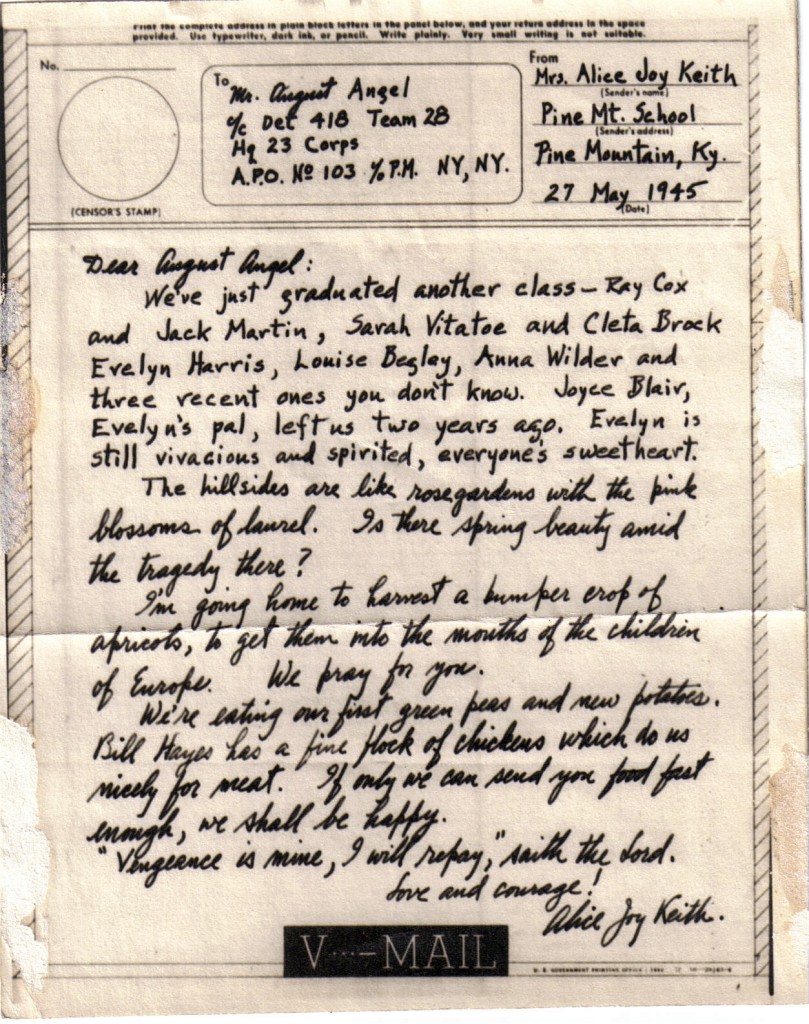
Arthur Dodd‘s earlier itinerary (if it can be called that) to Mexico in 1934 in the company of Caleb Shera, son of a former art teacher at Pine Mountain, and August Angel was very loose. The trio had planned to travel by car to Mexico City but when they reached the border they found that the road was impassable in some sections. August Angel, in assembling his memoirs recalls the journey of the trio

In the summer of 1934, Caleb, Mr. Dodd, Principal of Pine Mountain Settlement School from which Caleb graduated from high school, and I, drove to Mexico in a Ford touring car for a summer vacation. We took turns at the wheel as we traveled. In Georgia, we stopped at Mr. Dodd’s home and stayed overnight. After a sumptuous evening meal and memorable homemade ice cream topped with fresh sliced peaches for breakfast, we drove south to Laredo, Texas, to cross the border into Mexico and toward Monterey.

We drove as far south as Tamazunchale, where we learned that the mountain road to Mexican DF [Mexico City] was under construction and we could not traverse. We decided to take the passenger train from Vera Cruz to San Luis Potosi, then transfer to a second, ending in Mexico City. We traveled second class, sat on slatted wood benches, and mingled with natives who were aboard with livestock, pigs, kids, fruit and vegetables to sell to passengers, or going from the countryside to nearby market places in towns along the railroad tracks. It was a day and night trip, and also a social encounter that shocked us to remember to this day.

In the city itself we did the usual sights – bullfights, opera, church, parks and museum tours, and a visit to the pyramids of the Sun and Moon. Mr. Dodd ate or drank something and caught the bug we dubbed “Montezuma’s Crud,” and spent a miserable month starving himself to get rid of it.

…. The six weeks we were on the trip cost me only $60. I started with $75 and returned to Kentucky with $15. Those were the good old days! It was a truly good vacation and affordable.

Though Dodd had a bad bout of dysentery it did not seem to dull his appetite for Mexico and this time he brought along a good body of film stock and camera.

In the 1930’s many tourists were traveling to Mexico and “the tour” was variously described by those who made the journey. One comprehensive travel account that has an interesting connection with Pine Mountain was recorded in 1936 by J.C. Nichols of Kansas City. Nichols was a friend of the Hook family of Kansas City and reportedly sold a lot he owned in the Rockhill Park area of Kansas City to Bertrand Hook who passed it along to his daughter. Mary Rockwell Hook, the daughter, was the architect for most of the buildings at Pine Mountain Settlement School. Because Mary was a fledgling architect in 1908 her father sought to further her career by purchasing the lot from Nichols so Mary could design and build her first house. To get a sense of a typical itinerary in Mexico see J.C. Nichols account Our Trip to Mexico August and September 1936.” 

The travels of the 1936 Pine Mountain Settlement School group took them to three major destinations: Mexico City, Puebla, and Taxco. Included in Dodd’s photographs are road shots of the countryside as the group drove along the roads connecting Mexico’s urban centers. In Mexico City, the photographs mainly concentrate on Chapultepec Park or “Bosque de Chapultepec” (Chapultepec Forest). It is the largest city park in the Western Hemisphere and covers just over 686 hectares or 1,695 acres.

1936_mexico_040. "Charros - Mexico City Park." [Chapultepec Park]

1936_mexico_040. “Charros – Mexico City Park.” [Chapultepec Park]

From Mexico City the group went South to Taxco, a city known for its silver and beautiful ornate churches in the Mexican Churrigueresque style. There are two views of Mexico’s most famous volcanos, Popocatépetl, and Iztaccihuatl, that fill the skyline some 70 Km Southeast of Mexico City. The city of Puebla, is the fourth largest city in Mexico. It is located 40 kilometres (25 miles) east of the Popocatépetl and Iztaccíhuatl volcanoes, Founded in 1531, it has some of the most significant Spanish Baroque cathedrals in Mexico.

1936_mexico_005. View of Popocataptle and Iztaccihuatl volcanos. 70 Km Southeast of Mexico City.

1936_mexico_005. View of Popocataptle and Iztaccihuatl volcanos. 70 Km Southeast of Mexico City.

A highlight of the trip to Mexico City, if measured by the number of photographs, was a trip to the ancient bullring Toreo de la Condesa in the Condesa neighborhood of Mexico City. Today the older bullring has been replaced by a new stadium in another location and the capacity doubled. The older location was overwhelmed by the rapid development of the Condesa area of the city. Apparently, the group saw a mind-numbing number of bull fights. Fern Hall wrote in a postcard to her future husband, William Hayes, the farm manager at Pine Mountain, that she saw six bulls killed that day. We don’t know what he thought about that report but it is likely that he was not cheering for the matador.

1936_mexico_045. Postcard. "Pase Natural, 319"

1936_mexico_045. Postcard. “Pase Natural, 319”

So, outcomes? Arthur Dodd managed to stay healthy and to enjoy the second trip to Mexico and return to Pine Mountain where he administered the school programs until their closure in 1949. Georgia Ayers returned to Pine Mountain where she eventually married Arthur Dodd.  On her return to the School, she was not only “interviewed” to head the new social services program at Pine Mountain, she had evidently also “sized up” by Dodd, the adventuresome single man. He asked Georgia to marry him and they became a Pine Mountain couple. She married in late December of 1940. After her marriage, Georgia became the dietitian for the School. Georgia’s trip was the first of many journeys that Georgia and “Dodd” would take later in their lives.

Fern Hall continued on as Secretary to the Director at Pine Mountain and in 1941 married Wiliam Hayes, a former student who had stayed on at Pine Mountain as the Farm Manager and instructor in the industrial training program. The Hayes’ stayed on until 1953 when most farming programs at the School were discontinued. It is Fern’s set of Dodd’s Mexico photographs that prompted this blog. Fern and Bill’s daughter, Helen, inherited the photographs and with them a curiosity for travel first in Mexico in 1963 and then in other regions of the world. Grazia Combs returned to Perry County where she continued to teach and assume multiple roles in education in the county including Principal of Dilce-Combs High School and later Perry County Superintendent of Schools.

GALLERY: 1936 PMSS & MEXICO


Bibliography

Touring Mexico by Car in 1935 http://www.mexconnect.com/articles/4127-touring-mexico-by-car-in-1935

J.C. Nichols Mexico travel account Our Trip to Mexico August and September 1936.” 

Angel, August. Trivia and Me, 2008


DANCING IN THE CABBAGE PATCH In The Dining Room, Manners and Etiquette

DANCING IN THE CABBAGE PATCH
In The Dining Room, Manners and Etiquette

TABLE ETIQUETTE 

rood_062

Over the years table manners were taken very seriously at Pine Mountain.  As all meals early in the School’s history as a boarding school were served “family style” at large round tables that could hold up to eight students.  The need for decorum in these group settings was soon evident.  In these earlier years when young children made up the majority of the population, the need for supervision at each of the tables was evident.  Each table included a staff member who would model table manners and would remind any child whose comportment was lacking, that there were better behaviors to strive for. Soon rules were instituted for table behavior and amended over the years to accommodate behaviors that “came along” with new populations and older students. One of the most egregious offenses was “putting your knife in your mouth” or “eating with a knife”.
“I like my peas with honey
I’ve liked it all my life.
It makes the peas taste funny
But it keeps them on my knife!”

This ditty was often quoted with humor by many Pine Mountain students and no doubt called to mind the admonishment of NEVER eat with one’s knife. Never put your knife in your mouth!

Another table rule was that no matter how bad the food tasted to the students, they were never to complain about the food.  A recurring tale is told of a student who was having trouble with the new food he encountered at the School.  In the kitchen, a small bar of homemade soap had somehow slipped into a soup pot and the soup found it’s way to the table.  A young man at the table took his first spoonful and exclaimed, “This tastes like soap!” Silence and startled looks greeted his exclamation.  He quickly recovered, again exclaiming, “And, that’s just the way I like it!”

Every student at Pine Mountain Settlement was expected to also abide by what was called the “Three Bite” rule. The rule mandated that any food placed in front of the student was expected to be sampled by the student.  They were to take at least three bites of the “new” food and failure to do so was duly noted by their fellow students as well as the staff.  Failure to comply resulted in an end to the meal for the student. Many students would later say that was how they learned to like food unfamiliar to them.  Some recall this “Three Bite” rule with less fondness. Canned chard never became a favorite and there were many plots and maneuvers to avoid eating this limpid vegetable.

RULES

Certainly, the three “rules” noted above, seem reasonable for those early years, but those examples are only three of 39 rules associated with dining at Laurel House that were mandated in 1921! Some of the 39 were not so reasonable.

The documented rules were addressed to those dining as well as those serving the tables.

September 6, 1921

  1. Good manners begin on the porch. Be orderly and quiet. Don’t run through the dining room.
  2. Leave Laurel House promptly after meals.
  3. Observe good manners in the pantry too.
  4. Take three bites of everything offered. This is in order to learn to like it if you don’t and to be polite to the cook.
  5. Eat everything on your plate.
  6. Take small bites, but not too small.
  7. Chew everything well, with your lips closed.
  8. Don’t talk while you are waiting on the table.
  9. Sit up straight at a convenient distance from the table; keep arms off the table and feet off table rungs and chairs.
  10. Don’t talk or drink water when your mouth is full.
  11. Wait till the server is ready to eat before you begin.
  12. Clap only when it is appropriate, and don’t clap too much.
  13. Don’t reach in front of anyone.
  14. Don’t tip your chair.
  15. Don’t turn around and stare at the other tables. 
  16. Keep the table neat. Beware of crumbs!
  17. Leave the chairs straight when you are excused.
  18. Discuss only pleasant things at the table.
  19. Don’t whisper, or talk to your next neighbor alone.
  20. Be considerate of the other people at the table.
  21. Wait patiently while the table is being served.
  22. Enjoy the amount of food served to you.
  23. Break up large pieces of food into convenient sizes.
  24. Avoid calling attention to the bad manners of others. And, be a perfect example youself.
  25. Do not wait on the table when your mouth is full.
  26. Do not play with the silver.
  27. Do your best to make every meal pleasant. 
  28. Join in the blessing.
  29. Be sure to say “thank you”,”excuse me” and “please often enough.
  30. Come to the table with your face and hands clean.

By the late 1930’s some of this early discipline began to break down as the age of the student crept upward and some began to assert themselves or insist on their learned habits.  In a memo from Glyn Morris, the Director dictated to his secretary Fern Hall, that he sends notes to staff charged with overseeing the Dining Hall in Laurel House. In this case, the note is to John Spelman III. It reads

Notes from Staff Meeting held in Laurel House, April 2.

Mr. Morris requested that we watch the conduct in the dining room.
He mentioned such things as:

         excessive noise
         starting to eat before the hostess
         unnecessary amounts of going to and from the kitchen

Fern Hall, 
Sec.

THE DIETITIANS

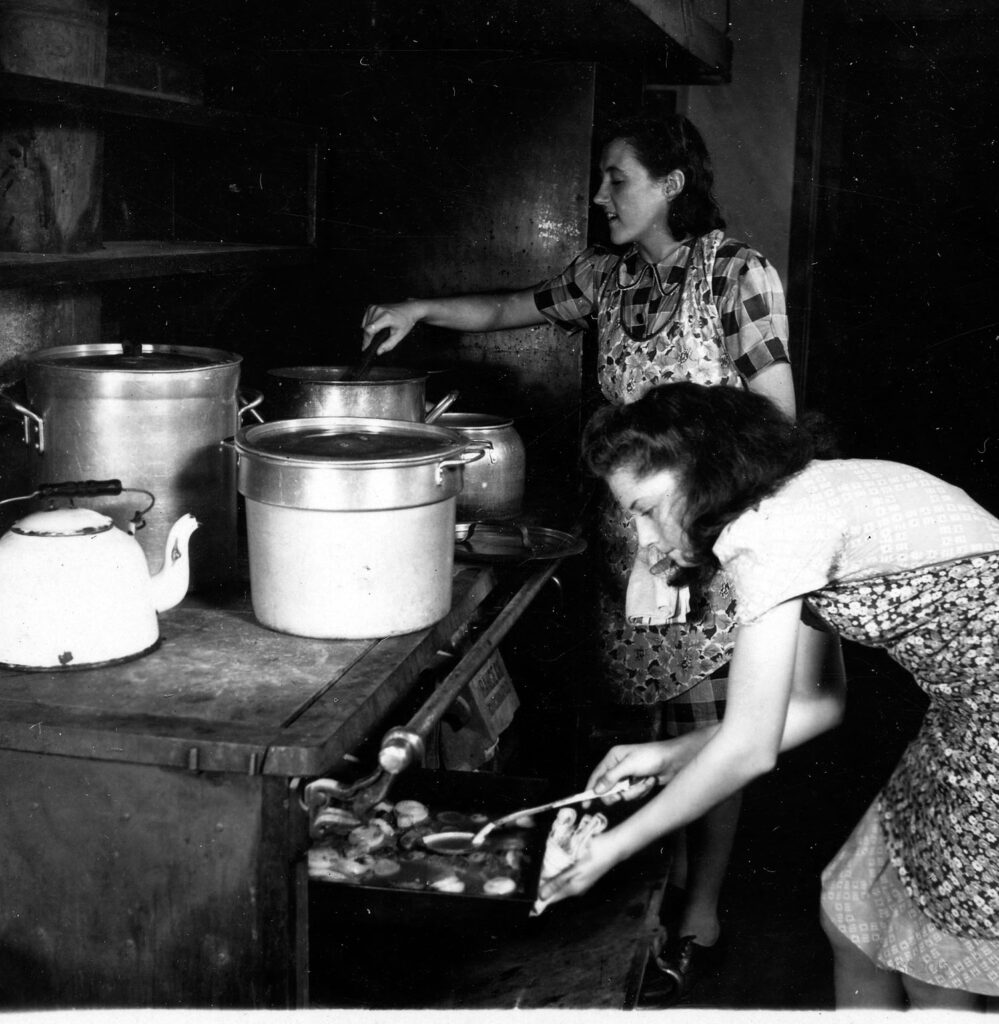
Dietitians rule at Pine Mountain. The Kitchen and the services associated with feeding students are unrelenting and critical to the overall well-being of the School. Attention to the dining decorum at the School was often front and center and there are several documents that spell out the rules of the table and one of them, importantly, is “Be polite to the cook.”

One of the longest-reigning dietitians at Pine Mountain was Berdina Bishop.  Like many of the women who assumed this role at Pine Mountain School, she was not trained as a dietitian but quickly showed her skills at this complex task. She writes in her dietician notes of her experiences in the kitchen. Her notes, found in a large scrapbook and an album she donated to the School, and in the gathered reports she was required to submit regularly to the Director, demonstrate her eye for detail.  Her large Scrapbook contains many of her memories of her Pine Mountain years and it is within this tome that we find some of the records she kept of her kitchen years. Her records and reports to the Directors she served are found scattered throughout her record. The reports to the Director also provide a cost accounting of foodways at the School. Her reports join those of dieticians who preceded and followed her and tracked the growing cost of feeding students and staff at the institution. 

Other notable dietitians include Bertha Cold, sister of Edith Cold; Georgia Ayers Dodd; Chloe Hayes-Bunch, and others. During the two World Wars, staff, such as teacher Louise Fliermans, were given that difficult task with little preparation. Much more may be learned about the Dining Room at Pine Mountain and etiquette and manners by consulting the various biographies of those who worked in the kitchen and dining area.

DINING IN THE COMMUNITY SCHOOL YEARS

During the Community School years (1949-1963)  at Pine Mountain, dining began to more closely follow that found in grade schools throughout the country.  However, as can be seen in the photograph that introduces this blog, the tables were still set for dining with plates, saucers, silverware, and napkins properly placed for each student. Each child would take their plate through a “cafeteria” line where they received the main offering of the day.  
Grace M. Rood (back to camera) at Laurel House II dining hall. Grace Rood Album. [rood_043.jpg]

What is missing in the later years is the presence of an adult at each table.  Modeling behaviors and monitoring eating habits were done at a distance. At a long table, seen in the background of the photograph, some of the staff may be seen. The placement of students and staff today who gather as part of the very active Environmental Education programs at the School looks much as it did during the Community School period.  One of the noticeable differences today is the use of sectioned cafeteria trays used by all diners. All visitors and staff continue to bus their dinnerware.

In the dining room, the beautiful multi-purpose tables from the very earliest years are still in constant use. The tops of the tables tilt to full upright and become a seat which can then be used on the dance floor when folk dancing is introduced following the meal. The hickory cane-bottomed chairs are still found throughout the dining room.  Notoriously easy to up-end, the chairs now are more frequently heard hitting the floor as children are more accustomed to heavier seating. Another observation is that the noise level of the children has gradually increased and echoes off the walls of the dining room.  The excited and animated conversations are also often punctuated by some child leaning too heavily on the tilt-top of the table causing it to “slap” back down on the base. As children compete to be heard, the loud voices fill the room. The auditory experience in the dining room has changed dramatically from the earlier years when children were quickly quieted. Shouting and raising the voice in the dining room was monitored by all present and quickly corrected by staff and by the children themselves.

The dining room at Laurel House, today. Environmental education classes

While the 3-bite rule has faded away for most children dining at Pine Mountain today, another rule has been instituted. That rule is to refuse or not ask for food that will not be eaten. The food waste at the end of each meal for the student groups is scraped into a special bin and the scraps are weighed for each visiting school for each meal. Remarkably, the Gospel of the Clean Plate ideal has been reached by some remarkable school groups whose”0″ waste at their meals set a record for other schools to emulate. Further, each student in today’s dining hall is asked to bus their tray and to assist the kitchen staff in the important job of sweeping floors, cleaning tables and straightening chairs after dining. Katherine Pettit is probably smiling at this continuation of individual disciplined responsibility which she attached to every activity.

GALLERY


SEE:   

DANCING IN THE CABBAGE PATCH   About

DANCING IN THE CABBAGE PATCH  I Guide

DANCING IN THE CABBAGE PATCH II   Introduction

DANCING IN THE CABBAGE PATCH  In the Garden

DANCING IN THE CABBAGE PATCH  In the Kitchen Pots and Pans

DANCING IN THE CABBAGE PATCH   Dieticians

DANCING IN THE CABBAGE PATCH  In the Dining Room, Manners and Etiquette 

        DANCING IN THE CABBAGE PATCH  Gospel of the Clean Plate

        FOODWAYS Overview

        FOODWAYS Essential Foods at Pine Mountain Settlement School

        FOODWAYS An Old Fashioned Dinner March 14, 1919


DANCING IN THE CABBAGE PATCH Guide

Pine Mountain Settlement School
DANCING IN THE CABBAGE PATCH
GUIDE

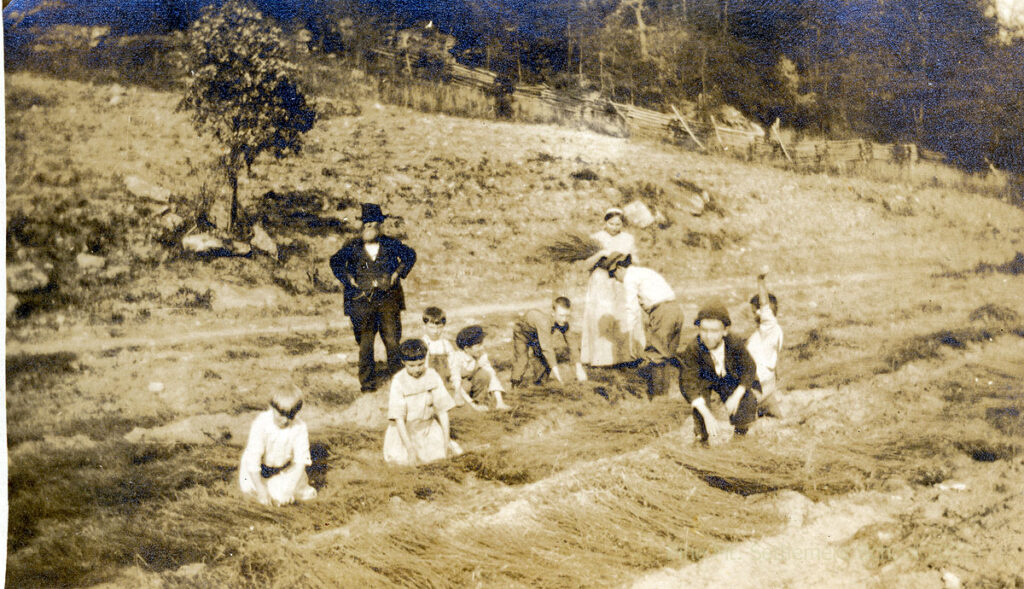
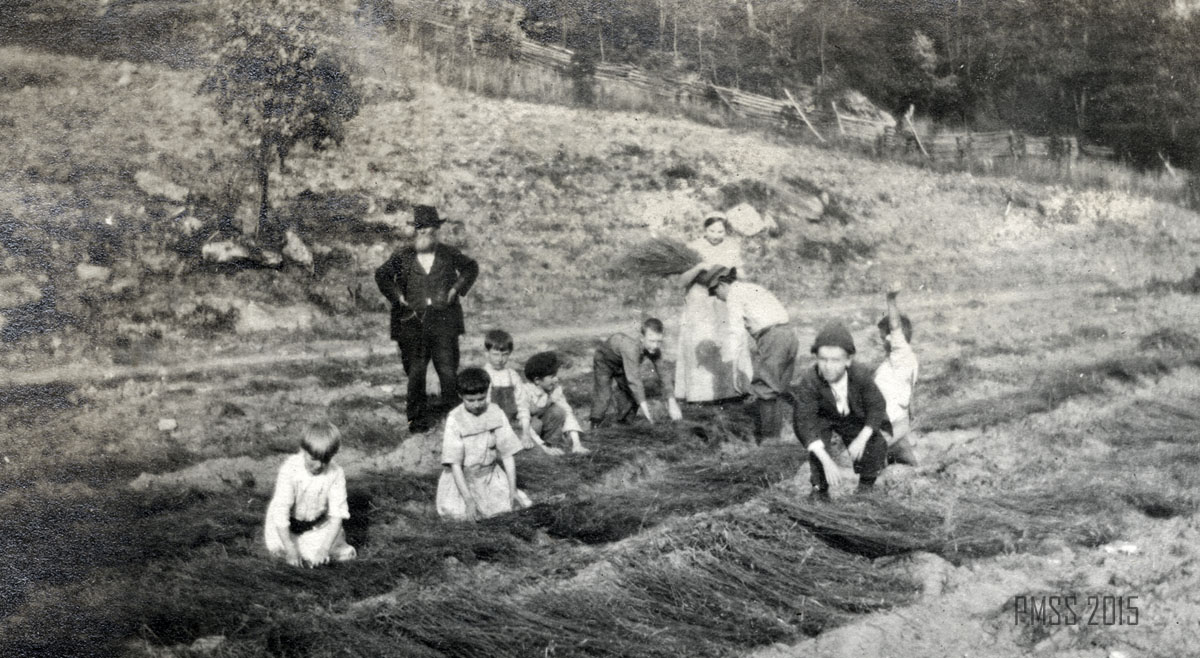
Cabbage patch below Grapevine Knoll, PMSS, c. 1915. [dancing-in-the-cabbage-patch-2-copy.jpg]

TAGS:  Pine Mountain Settlement School, Harlan County, Kentucky 1913 – present, rural settlement schools, sense of place,  foodways, cabbages, agrarian myths, sustainable agriculture, educational reform, industrial education, Ayrshire cows, heritage seeds, Appalachian foodways, settlement school kitchens, kindergartens, rural migration, miners, mining, mores and manners, Kentucky politics, educational reform, poppets,  play-pretties, sheriffs, Appalachian religions, settlement schools, communists and conservatives, hippies, hi-jinks, and other topics 


DANCING IN THE CABBAGE PATCH GUIDE (Alphabetical)

DANCING IN THE CABBAGE PATCH Guide

DANCING IN THE CABBAGE PATCH I  About

DANCING IN THE CABBAGE PATCH II  Introduction

DANCING IN THE CABBAGE PATCH III Place

DANCING IN THE CABBAGE PATCH IV A Brave and Imaginative Plan Takes Place

DANCING IN THE CABBAGE PATCH Cows

DANCING IN THE CABBAGE PATCH Dis-ease

DANCING IN THE CABBAGE PATCH  Earth Day and Mary Rogers 

DANCING IN THE CABBAGE PATCH English Country Dancing at Pine Mountain Settlement

DANCING IN THE CABBAGE PATCH  Farming the Land 1913-1930

DANCING IN THE CABBAGE PATCH  Farm and Dairy Early Years I

DANCING IN THE CABBAGE PATCH  Farm and Dairy Early Years II 

DANCING IN THE CABBAGE PATCH  Farm and Dairy Morris Years III

DANCING IN THE CABBAGE PATCH Going and Coming Back I

DANCING IN THE CABBAGE PATCH Coming Back and Going Some More II

DANCING IN THE CABBAGE PATCH Gospel of the Clean Plate

DANCING IN THE CABBAGE PATCH In the Dining Room Manners and Etiquette

DANCING IN THE CABBAGE PATCH  In the Kitchen Pots and Pans 

DANCING IN THE CABBAGE PATCH Laden Trail or The Road 

DANCING IN THE CABBAGE PATCH  Maple Syrup and Sugar

DANCING IN THE CABBAGE PATCH Mexico and Pine Mountain Settlement School 1936

DANCING IN THE CABBAGE PATCH Moonshine

DANCING IN THE CABBAGE PATCH Pigs

DANCING IN THE CABBAGE PATCH Poultry

DANCING IN THE CABBAGE PATCH Salamanders

DANCING IN THE CABBAGE PATCH Sheep

DANCING IN THE CABBAGE PATCH Sheep Shearing and Cecil Sharp

DANCING IN THE CABBAGE PATCH Santa Claus Christmas Trees Parties

DANCING IN THE CABBAGE PATCH  Sorghum Molasses Stir-Off I

DANCING IN THE CABBAGE PATCH Sorghum Molasses Stir-Off II

DANCING IN THE CABBAGE PATCH Snow

DANCING IN THE CABBAGE PATCH Trees

DANCING IN THE CABBAGE PATCH War and PMSS

DANCING IN THE CABBAGE PATCH Weaving


DANCING IN THE CABBAGE PATCH Laden Trail or The Road

Pine Mountain Settlement School
Series 12: LAND USE
THE ROAD [Laden Trail]

DANCING IN THE CABBAGE PATCH XIV – LADEN TRAIL or THE ROAD


TAGS: Laden Trail or The Road ; prospectus ; map ; economic advantages of the Road ; hauling goods over the mountain ; cable incline ; Harlan County’s financial contribution ; high cost of road-building in Appalachia ; benefit to School’s endowment and scholarship fund ; fundraising for the Road ; Little Shepherd Trail ; Kentucky Good Roads Association Plan ; biodiversity ; Ethel de Long Zande; Katherine Pettit; Celia Cathcart; Evelyn K. Wells


LADEN TRAIL, or “THE ROAD,” is a historical record of the campaign for and the building of a paved road over Pine Mountain that would connect Pine Mountain Settlement School to the Laden railroad station near Putney some eight miles across Pine Mountain. Negotiations for the building of the Road began in 1914, approximately a year after Pine Mountain Settlement School was founded.

The close timing of the Road and the School’s beginnings was not coincidental. As construction of the School progressed, it became obvious that the steep Laden Trail — truly only a trail —over the mountain was inadequate for hauling needed supplies by wagon. By 1920 the founders of the School had a plan, had called in consultants and had begun a fundraising campaign for a road. This page features a map and their argument for “The Road” in a Prospectus that was written to inspire donations.

LADEN TRAIL or THE ROAD: Gallery

LADEN TRAIL or THE ROAD: Transcription of the Prospectus

“Here, then is Appalachia: one of the great landlocked areas of the globe, more English than Britain itself, more American by blood than any other part of America, encompassed by a high-tension civilization, yet less affected by modern ideas, less cognizant of modern progress, than any other part of the English-speaking world.” — Horace Kephart

Will you help us build a road over our mountain, from Appalachia to modern America? The road will bring 5,000 people in touch with the railroad. It will be a wheeled-vehicle outlet for a great section of three mountain counties, which now have the most indirect communication with the world, either by costly, roundabout roads, or by tiny trails that even a sure-footed mule cannot haul a cart over.

It will mean economic improvement for the whole section — a market for apples and other surplus products — therefore, improved living conditions, larger houses, more knowledge of sanitation, a decrease in moonshining.

It will mean that the Pine Mountain Settlement School pays twenty-five cents a hundred pounds to haul goods from the railroad, instead of seventy cents. In 1916 the School paid to bring in from the L. and N. Railroad its groceries, building materials, heating apparatus, etc. $1000 of this, scholarships enough for eight children, could have been spent directly for their education, if there had been a road.

If we do not build the road, we will soon be at even greater expense in bringing in supplies. At present, we haul goods over the mountain on a broken-down cable incline, some eight miles away, built years ago to take poplar logs to the railroad. The cable sometimes breaks, the rails are rotten, and the incline is already dangerous. At the foot of the mountain, the goods must be reloaded onto wagons, and hauled eight miles over a road which is often impassable.

It is better economy for us to stop right now, and work for a road, than to go on spending money wastefully, year after year. It is also a more constructive policy for our neighborhood. Money spent now, in a lump, for the road, means improvement along many lines. Spent in smaller sums, year by year, it is frittered away, and accomplishes no solid good.

Harlan County cannot build this road now, because it is spending all it will have for some years on fifty or sixty miles of road in the heart of the county. Remember that road-building is in its infancy in Appalachia —that the hills and the creeks make a mile of good road a costly thing.

Our six miles of road are the costly link in a network of highways that will in time bind together three county seats, and give free communication to many square miles of mountains. For the passion for road-building has come to Eastern Kentucky. But a mountain a mile high, with seventy-five foot cliffs to blast through is a huge obstacle whose removal will hasten tenfold the opening up of communication, through the expenditure of County funds.

Harlan County has given five thousand dollars for this road,— a princely gift, — and the first large sum ever appropriated for the benefit of outlying districts. The county will also return $25,000 from its share of state road funds in annual installments of $1200 if we turn over to it the funds for road-building this summer.

The game is worth the candle, for the $25,000 will accomplish three purposes:

1. It will build the road immediately.
2. It will save the School money yearly, and thereby add to our
scholarship fund.
3. It will become endowment for the School as the annual installments are returned by the County.

Such results are worth a huge effort. A great constructive undertaking brings its own inspiration with it. $3500 has already been given for this project. For this $21,000 still needed we must find:

I. Givers of $500.
2. Givers of $100.
3. Friends who will organize groups to give $100.
4. Promoters, who will talk for the road, suggest possible givers, make appointments for Miss [Ethel] de Long, keep faith alive.

There must, and will be a road across Pine Mountain. How many feet of it will you help us build?


LADEN TRAIL or THE ROAD: History

What follows is a historical overview of the building “The Road” which was finally completed in 1940. The narrative concludes with a summary of the lessons that were learned and the changes the Road brought to the area and the School.

Laden Trail or The Road

Laden Trail road, car and forested hillside. c. early 1940s [nace_II_album_086.jpg]

From Katherine Pettit regarding progress on the Laden Trail, c. 1920:

You’d be interested in the preliminary report Mr. Obenchain [State Engineer] has just gotten out. On this side of Pine Mountain, there is a rise of one foot in every 1.34 feet (less than 45 degrees). The distance through the mountain is 1-7/8 miles, but we shall need almost 12 miles of road at $6,000 a mile, with an ascent of five feet in every hundred feet. Some undertaking!

This note from Katherine Pettit to the board in the early 1920s was a preliminary assessment of conditions for a road across Pine Mountain to the School. It was among the first steps in the difficult task of bringing a road from the south side of Pine Mountain to the north side of the mountain or, more specifically, from the railroad station at Laden to the settlement school at Pine Mountain.

Geography is often confounding. In the eastern mountains of Kentucky, this is especially true. From the earliest records of exploration of the “Dark and Bloody Ground” of Kentucky to the present day, mountains have been a barrier, friend, wealth, an obstacle to progress, an insulator of culture, and just plain hard to negotiate. The early accounts of travel in the region speak to the tangle of laurel thickets, the sharp ridges and the undulating crests, the short distance but the long journey. Horses and oxen fared little better than their passengers and their loads teetered on slippery saddles or slippery slopes. On many mountain paths supplies slipped, people tumbled down hillsides, roots caught up the unwary and weather made all mountain travel unpredictable, dangerous and costly.

Laden Trail or The Road

[lave015.jpg]

Katherine Pettit was wary of the rapidly developing industrial age, but she was practical and knew that if the school was to thrive it must have a viable transportation corridor for the exchange of goods, people, mail, and communication with new ideas. Rail had already been laid along the Cumberland river on the opposite side of the mountain to carry the cargo of coal and trees from the land, and this exploitative rush on the Southern Appalachians could not be stemmed.

Pettit and de Long believed that, while there were many reasons to join the industrial age, the process must be a partnership entered into with good skills and good sense, not one of exploitation. The isolation of the deep hollows and the mountain-locked valley would, in their view, eventually leave the region poor, exploited, and unhealthy. Roads, they believed, were part of the necessary infrastructure of the Progressive movement and they aimed to see to it that the school at Pine Mountain and the people of the long valley on the north side have this vital conduit to progress.

The undulating escarpment of the Pine Mountain, with its gentle dip slope and its sharp scarp slope is beautiful to view, but it yields few locations where roads can pass through natural gaps. The entire length of the Pine Mountain range, running northeast to southwest for 100 miles, give or take, is evidence of a thrust fault of major proportions. The settlement school sits at the foot of the steep side or scarp slope of the mountain.

LADEN TRAIL or THE ROAD: Biodiversity of Pine Mountain

A hike through the heavily forested area reveals the richness of the flora and fauna of the mountain. The Kentucky State Nature Preserves System has noted that there are more than 250 occurrences of 94 rare species of flora and fauna that are native to the region. Each year Pine Mountain School leads a walk through this wondrous mountain area that commemorates the early work of Emma Lucy Braun, a leading ecologist who stayed at Pine Mountain in 1916 while she conducted research on the “mixed mesophytic” (a term she coined) forest floor of the region. Her early work found the region to be the source of most of the woody species that appear throughout much of the Southern Appalachians. In the mesophytic forest there are some eighty different species as opposed to three or four in most other common forests. [Library of Congress: “Tending the Commons: Folklife and Landscape in Southern West Virginia: Cove Typography”, web resource]. Every year reveal the increasing risk to the some 250 occurrences of the 94 rare species of flora and fauna on the mountains surrounding Pine Mountain Settlement School.

Laden Trail or The Road

‘Rebel’s Rock’ in early Spring, along the Laden Trail road, 2016. [P1120108.jpg]

It is through this wonderland of vegetation and long views that the workers and students walked to get to the School from the rail station at Laden (later Putney). As travelers came down the mountain from Incline (appropriately named) they could look northeast down the long valley and see West Wind, the large white building that sits prominently on the hillside facing out from the campus. Many said that if they could see the building, they knew they were close to the school. But, it was still a long walk.

At $6,000 a mile and twelve long miles, the $72,000 road project was vastly beyond the fiscal grasp of the School, but not beyond a cooperative venture with the county and the state of Kentucky. Pine Mountain became the voice of the cooperative project and a long battle with bureaucracy and funding stretched over the course of many years and is well documented in the School records and archive. An important player in the construction was the Kentucky Good Roads Association.

KENTUCKY GOOD ROADS ASSOCIATION PLAN

In 1912 the Kentucky Good Roads Association came into being in order to promote better methods of road construction and maintenance and to improve the laws and under which the work on roads was to be executed. Out of these early discussions and over the course of about ten years the Kentucky Good Roads Association, a non-partisan association, advocated for the issuing of a $50,000,000 bond to be expended over a period of no less than five years in order to complete the state mandate of 1920 to construct a state-wide system. This system would connect every county seat with hard-surfaced roads. However, the Legislature of 1922 failed tp submit the bond referendum to the people in a timely manner and the Good Roads Association decided in 1923 they would push for the submission of the referendum in the 1924 Legislative session.

The Eastern Kentucky branch of the Kentucky Good Roads Association was formed in 1923 and joined with the Central Kentucky Good Roads Association. The two began a campaign for the adoption and passage of the referendum. Their adopted motto assigned by member Tom Wallace was “United, we move forward; divided, we stick in the mud.” This was in reference to the taxation for road repair that the people called the “mud tax.” The “mud” was a reminder of the condition of the many roads in the state that were in poor condition.

Various counties appointed district chairmen to represent them. Ominously, Harlan County had no representatives at the time the Kentucky Good Roads Association published their platform, which was to be taken to the State convention of the Good Roads Association in Lexington on July 19 and 20 of 1924. But, wisely, they were later chosen as a representative of Harlan County at the State convention. Pine Mountain was a voice in moving the Good Roads Association platform forward.

The plan of the 1923 campaign was to follow 3 objectives:

  1.  Distribute literature and news matter in order to show the people of Kentucky what it would cost to build and maintain a completed system of hard surface roads.
  2.  Form in every County an active organization to carry out the aims fo the Association.
  3.  Through solicitation of memberships, collect fund to defray the expenses of the campaign, from every resident, taxpayer, person, firm or corporation having a legitimate interest in the construction of a hard road system in Kentucky.

The common practice of operating in a patchwork manner in which over 54 different centers of construction tried to coordinate jobs and plans, was not working and it was clear that the old patchy system needed replacement. Another challenge was found in what was referred to as the “Sinking Fund” which was the provision that was mandated to be used to pay off the bonds. The current funding for the Sinking Fund was also to be used to maintain the roads after construction. It was a sinking proposition. The ultimate outcome was a proposal that would require some $2,830,000 a year to retire the bonds in the timeframe mandated by the State agreement. With state revenues to off-set the pay-back, the total approximate maintenance budget could be kept at $1,100,000, a figure that some felt to be beyond reach.

Laden Trail or The Road

Broadside for the Pine Mountain Laden Trail Road project. [roads_004.jpg]

Katherine Pettit and others, like her, believed that many of the deficits claimed by the nay-sayers could be recovered by increased revenues to the counties through improved roads and increases in the motor traffic of the region. The assessment of motor vehicle owners, it was believed, could further offset the cost of principle and interest of the 30-year bond. The thirty-year cost would stand at around $85,729,721 which includes the principle of the bond of $50,000,000 and an interest rate of 4.5%. A further justification was made regarding the improvement that suggested the vital importance of roads to agriculture in the state and to the increase in opportunity for industrial materials transport.

The Kentucky Good Roads Association plan was a good one and one that had the full endorsement of the Pine Mountain Settlement School administration and staff, particularly the efforts of de Long and Pettit. Both Director Ethel de Long and Katherine Pettit saw the state referendum as an opportunity for the School to raise sufficient money to qualify for extension and improvement of the trail into a full and useful road from the Putney rail-head to the School. Though their efforts were not immediately evident, the trail would never have become a road had they not pushed for a corridor to transport goods and services into and out of the Pine Mountain valley. The trajectory of their effort was a long one, seen in the chronology below.

LADEN TRAIL or THE ROAD: A Chronology of Pine Mountain Settlement School Road History

A one-page document compiling the history of the “Road Over Pine Mountain” was drafted by an anonymous author. It captures the long course of events associated with the creation of Laden Trail Road by the School.

1913

The School asked Harlan County Fiscal Court to appropriate money for a good road over Pine Mountain. Early estimates placed the cost at $10,000, and in June the fiscal court appropriated half that sum, and the School started out to raise the other half.

Miss de Long made trips to Harlan, found the cost would be $50,000, instead of $10,000, [The] School was to raise half and the state give dollar for dollar. But [the] School had to raise the second half to loan the state which promised to pay it back in annual installments of $1200.

Miss Celia Cathcart went to work to raise the first half in Ohio, Illinois, Indiana and Kentucky. Miss de Long, from the School, raised the second half, which was to be the loan to the state.

Uncle William Creech went to Louisville to speak for the Road and made many friends for the School.

1918 – JANUARY

Surveying began after preliminary work done in 1915-1916.

1919 – May

Work began, but prices so high by this time that the Road had to cost $100,000. All the $50,000 raised by the School had to be used, and none of it would come back. In 1922 the funds gave out, and the Road had been graded only to the top of Pine Mountain [on the South side]. There was no money for further work on this [North] side.

Mrs. [de Long] Zande went to Frankfort to lobby, succeeded in getting a bill through which made the Road a link in the chain of State primary Highways between county seats, thus ensuring that eventually Kentucky would have to finish the Road. The School could do no more.

1924

The hauling road down this [North] side of the mountain was built by neighbors and county labor about 1924.

1929

In 1929 a sum of $50,000 was appropriated by the Harlan County Fiscal Court for the completion of the Road, and resurfacing of what had already been graded, but this sum was not available in the end.

1931-32

In 1931-32 the poor grade was improved a bit by the emergency relief workers. Aaron Creech was paid by the School to survey the new grade and was boarded at E.M. Nolen’s house free. Some work was commenced but was given up when the money ran out again.

1934

In the spring of 1934 the CCC [Civilian Conservation Corps] workers began work on the new survey made by Aaron Creech. Right of way was given by all the owners except Otto Nolan, who was paid money by neighbors and School.

The Road was completed by CCC labor.

1937

By 1937 the road situation in eastern Kentucky had improved and the number of paved roads can be seen in this hand-drawn map prepared by an unknown individual at Pine Mountain Settlement School. As can be seen in the map, the only high school that does not have access by a paved road is Pine Mountain Settlement School. While getting a road across the mountain was successful, access continued to be difficult for students on the north side of Pine Mountain. The “S” in green at the center top of the map is Laden Trail road as it leads into PMSS.

Laden Trail or The Road

1937 Road Map of Harlan County, hand-drawn by anonymous individual and showing location of high schools in the county and their access by paved road in 1937. [roads_005.jpg]


Work on the Road continued for many years even after its energetic beginning. Evelyn Wells, the Editor[?], writing for the Pine Mountain NOTES in November of 1920, speaks lyrically of the progress on the Road :

The progress of the Pine Mountain Road has been without haste and without rest.
     Six years ago we had a Dream of a Road.
     Next year we hope to have The Road.

There is about its history a slow rhythm suggestive of classic Roman roads, which should augur well for its quality as a finished road. It started at the railroad, sauntering along so easily that one would never know it was climbing, stopping now and again at a refreshing spring or stream, or just to give one a chance to look at Big Black Mountain’s wonderful mass. It struck a little hill and had to gather up its young strength to eat its way through with a steam shovel that chewed out four hundred cubic yards of rock every day for weeks. Then it swept around the hill joyously and easily until it came to cliffs — a genuine jumping-off place, full of old bears’ dens. Here it halted many weeks while the air drills and steam shovels moved tons of rock to make a huge fill. And now the road continues its climbing unwearied, below the Rebel Rocks, through deep, still thickets of rhododendron, and across pure streams, viewing always the mountain across the valley. We stand at the point where the old trail crosses the road, and wonder if future visitors, coming across all the way on its beautiful, easy grade, will ever believe that once we all, two-footed and four-footed alike, scrambled up the twenty-five percent grade trail!

The other day at dusk, seven men started up the road on their mules, one behind the other, quite as if it were not wide enough for them to go three or four abreast. The Editor called out, “What makes you go up endwise still? Why don’t you ride together until you have to take the trail?” “We got so used to it we couldn’t help it” came the answer, and the Editor read again the poem of Mr. W. A. Bradley on the “Men of Harlan.”

“For, in that far, strange country, where the
men of Harlan dwell,
There are no roads at all, like ours, as we’ve
heard travelers tell.
But only narrow trails that wind along each
shallow creek,
Where the silence hangs so heavy you can hear
the leathers squeak,
And there no two can ride abreast, but each
alone must go,
Picking his way as best he may, with careful
steps and slow.”

Frances Lavender Album. I don’t know these girls but the rear horse is Bobby. — This is such a good view of our roads.

It was always a topic of conversation with workers and students as seen in this exchange in the student newsletter THE PINE CONE, October 1937, which captures the ambivalence of older staff to change and progress:

THEN

Signs of progress are the highways of travel
Asphalt, cement, sand and gravel;
All play a part in this building plan,
Making easy the tours of man;
Girding the earth like ribbons of gray
Stretch in untold miles the broad highway.

Mistaken the one who the above lines wrote,
The following facts are worthy of note
Pine Mountain, Kentucky, clings to the past
Old customs, old ballads, she holds these fast.
Highways of travel — roads did you say?
“No such animal” comes this way!

Trails, paths, a creek bed for a road
Rough and rocky — a light weight becomes a load;
Mud and slush, mire and hill —
Traveling her give one a thrill!
No easy sailing over a road like this;
End of journey is peaceful bliss.

Companions of travel along these bogs
Are countless razor backs and other kinds of hogs;
In spite of the primitive way of it all,
There’s something about it seems to call
To the soul of living for a bigger life,
Away from the modern rush and strife.

So here’s to Pine Mountain, her roads and her ways,
May the blessings of peace be hers always;
If progress and growth be her birthright
Grant these come with education’s light;
Roads — highways of hope!
These, too, perhaps in her horoscope.

AND NOW [The Editor (?) writes:]

The above poem, which was written by Miss McDavid, a housemother at Old Log in 1930, brings to the mind of a worker who has been away from Pine Mountain for seven years the great contrast between then and now. Change has taken place and it seems to be simultaneous with the building of the road. No longer is there a blind clinging to the past merely for the sake of tradition. The best of the past has been retained and many new things have been added. Old restrictions are gone. The freedom at Pine Mountain is an amazing thing, but more than that, the new responsibilities on the shoulders of each student are a sign of a large forward step. Roads are a symbol of civilization.

The ever-present question is in what direction will Pine Mountain go from now on? Has the road brought each student a new highway of hope?

LADEN TRAIL or THE ROAD: What About Today?

Today, in 2016, the School is encircled by paved roads and even roads that perhaps should have remained dirt thoroughfares, such as Little Shepherd Trail on the crest of Pine Mountain above the School. That one-lane scenic road was paved, in part, to keep it from washing out and, in part, as a response to the success of the paving of other scenic mountain roads, such as the Blue Ridge Parkway. However, the sections that are now paved will need to compete with foot traffic if a proposed Pine Mountain hiking corridor reaches fruition. Obviously, transportation corridors change and the changes reflect the changing times.

The lessons of “The Road” were many before it found its way across the mountain. The negotiation, cooperation, double-dealing, graft, community support, all brought along an education to a new generation entering the industrial age. The Road made the trip to the School easier for many visitors who made the journey. It enabled the Cooperative Store during the Boarding School year to function, and it kept the growing school supplied through the difficult years of World War II.

To put this simple unpaved road in perspective, the Appalachian Scenic Highway, later the Blue Ridge Parkway, was begun in 1935. The Parkway was a 469.1-mile road that stretched across two states and took 50 years to complete. The final Lynn Cove segment of the road was not completed until 1987!

The Road on Laden Trail, six miles of arduous negotiation and labor was finally completed in 1940. It is only in the late 1970s that the Road became a scenic route across the mountain. The completion of Highway 421 across Pine Mountain at Bledsoe became the preferred conduit for goods and people across the steep Pine Mountain ridge.

Today, Laden Trail is not a designated scenic parkway, but it holds a special place in the mind of the community and continues to offer the beauty of the forests of Pine Mountain and the long views of both the Black Mountain range on the south side and the peaceful Pine Mountain valley on the north side. It offers access to the Little Shepherd Trail, a popular narrow and scenic road that intersects the Laden Trail at near its mid-point. The Little Shepherd Trail, which runs along the crest of the Pine Mountain has become a long classroom for the many environmental programs that Pine Mountain School offers to the public.

Further, while the main transportation routes in the area are now paved, unfortunately, they remain some of the most dangerous roads in Kentucky and have some of the highest maintenance requirements. Due to the many years of travel by logging and coal trucks, the narrow roads in eastern Kentucky can be heart-stopping at times, and also confusingly un-marked and intricate.

Roads come with their benefits and their deficits, but it is certain that road construction leading into the Pine Mountain valley, one of the most remote of Harlan County’s areas, would not have happened for many years were it not for a passel of women working hard to pave the way.


SEE ALSO: 

CELIA CATHCART 1916 Road Correspondence
CELIA CATHCART 1917 Road Correspondence IN PROGRESS
CELIA CATHCART 1918 Road Correspondence
CELIA CATHCART 1919 Road Correspondence I
CELIA CATHCART 1919 Road Correspondence II
CELIA CATHCART 1920 Road Correspondence I
CELIA CATHCART 1920 Road Correspondence II

LADEN TRAIL or THE ROAD

LADEN TRAIL or THE ROAD CORRESPONDENCE Part I
LADEN TRAIL or THE ROAD CORRESPONDENCE Part II

LADEN TRAIL PHOTO GALLERY

LITTLE SHEPHERD TRAIL

LADEN TRAIL VIDEO (1980s) – Paul Hayes


This entry was posted in GUEST POSTS and tagged , , , , , on .