Category Archives: DANCING IN THE CABBAGE PATCH

Dancing in the Cabbage Patch is a joyful and personal description of life at Pine Mountain Settlement School, Kentucky, seen through the lens of the author and those who worked at the school or those who lived nearby.  The narratives center on the main themes of farming, foodways, families, craft, people, and celebration and explore the years 1913 to the present. Like the dances of the region, the reflections here are broken into running topical sets that often relate thematically.
Dancing in the Cabbage Patch contains photographs, manuscript material, oral histories, artifacts, and external links largely derived from the PINE MOUNTAIN SETTLEMENT SCHOOL COLLECTIONS and family records. Tangible mementos of times past supplement the personal recollections and reflections of the author. The ruminations are mine alone. This Cabbage Patch of memories is pulled largely from the early formative years of my youth (1940s) when I danced as a youngster in this enchanted Cabbage Patch of Appalachia. My memories are nuanced by the later years of association with the School through my parents and friends, and as a member of the School’s Board of Trustees. No longer in my youth, my memories are both diminished and expanded by all that life has generously taken away and added in the intervening years spent in other geographies.
The fiddle tunes of words and often the ruminating dances shared here are, thus, mine alone. Music and dance are metaphors and not intended to necessarily represent the performance of the orchestra that is Pine Mountain Settlement School and its broader community. The personal songs and dances of the author are not intended to define the many dancers, ballads, and folk tales of the School or its Community, or any larger implied culture. Pine Mountain Settlement and the community people and the region are an ever-present orchestra, and this is but one dance among many that played here.

As a story of place, Dancing in the Cabbage Patch is written with the hope that some will identify with the feeling of dancing in their cabbage patch of memory and place. I am mindful that Dancing in the Cabbage Patch is a reflection on a region consumed by regional self-reflection. Many dances and songs will continue to be created as the history of Pine Mountain Settlement and its surrounding community evolves and changes with the many rich memories, voices, and talents yet to be discovered in this ever-changing world.

Across the world, other cabbages will be grown and somewhere a child may dance among them and sing and dream of lands across the seas, and stream their story in song and dance and later in 0’s and 1’s. Some will hold their stories close, but many will want to be singers, fiddlers, dancers, and storytellers… joy-makers of history and place. Appalachia is a story of place and a place of story. It is a storied cabbage patch place of memory.

DANCING IN THE CABBAGE PATCH Stones, More Stones and Scalloped Potatoes

Pine Mountain Settlement School
DANCING IN THE CABBAGE PATCH
Blog

STONES, MORE STONES AND SCALLOPED POTATOES

TAGS: DANCING IN THE CABBAGE PATCH Stones, More Stones and Scalloped Potatoes; Pine Mountain Settlement School; Harlan County, KY; stones; scalloped potatoes; rocks; agriculture; farms; farming; foodways; cooking; Raven’s Rock; limestone; geology; lime; lime burning; kilns; quick lime; Perry County; accidents; horses; horseback riding; doctors; Dr. Alfreda Withington;


On June 8, 1920 Katherine Pettit wrote to Martha Van Meter, a nurse at the Line Fork Settlement, requesting her to purchase some grey shambray so she could mount her paper maps and preserve them. She goes on to ask Miss Van Meter “How are you on library and office work and filing and such things or do you rather dig and pile rocks as I do?” Miss Van Meter’s response is not known but the exchange suggests that rocks were a constant measure of how one approached work at Pine Mountain. The memo also signals  Pettit’s deep engagement with the land and its geography and geology.

ROCKS AND THE PINE MOUNTAIN RANGE

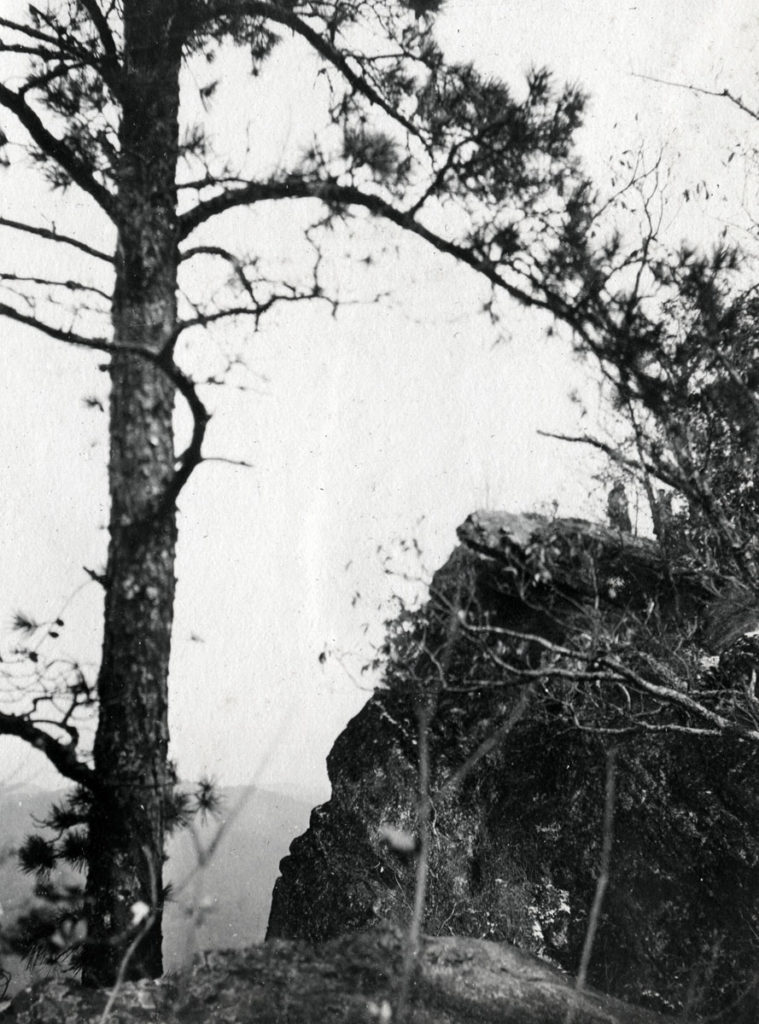
The geology of Pine Mountain is very complex. But one component is much in evidence. That is the stone. Limestone, conglomerate, shale, shist, coal, and sandstone are in abundance. From the bothersome creek boulders to the giant Rebel’s Rock, or the beautiful Raven’s Rock arch, stones in the region can charm and confound.

Kendall Bassett Photograph Album, c. 1928-1929. [pmss001_bas001.jpg]

BURNING STONES  –  LIMESTONE AND LIME KILNS

One stone in plentiful supply in the Pine Mountain geology is limestone. Limestone is in rich supply in the valley of Pine Mountain. Often limestones and other stones were troublesome and were carried from the fields where they had troubled the plow. But some stones could be a gift. Limestone, for example, was a gift to the soil and to the farmer. Limestone is a stone that can be burned. But unlike coal, limestone, when burned, produces rich by-products. The richest of these by-products is known appropriately as “lime.” It is an important nutrient for many crops in the mountains of Eastern Kentucky and helps to neutralize the soil’s acidity.

While the burning of limestone for lime has consumed considerable forest throughout history, it is still well-known as a boost for tired soil. Today packaged in various fertilizers, it continues to be added to the soil to support crops and enhance grazing land. Before the importation of commercial fertilizers, however, lime was wrested from the stones of the surrounding mountains.

The history of lime-kilns goes far back in the history of the world and no doubt the practice came to the New World with our earliest ancestors and settlers. Until the advent of commercial fertilizers, the production of lime through lime kilns (the burning of limestone) was common throughout much of rural America. It was, however, not so common deep in the small valleys in Appalachia. The practice of burning limestone for fertilizer, according to some, was a practice that Pine Mountain Settlement brought to many in the local farming population, though the practice of adding lime was in practice before the School was founded.

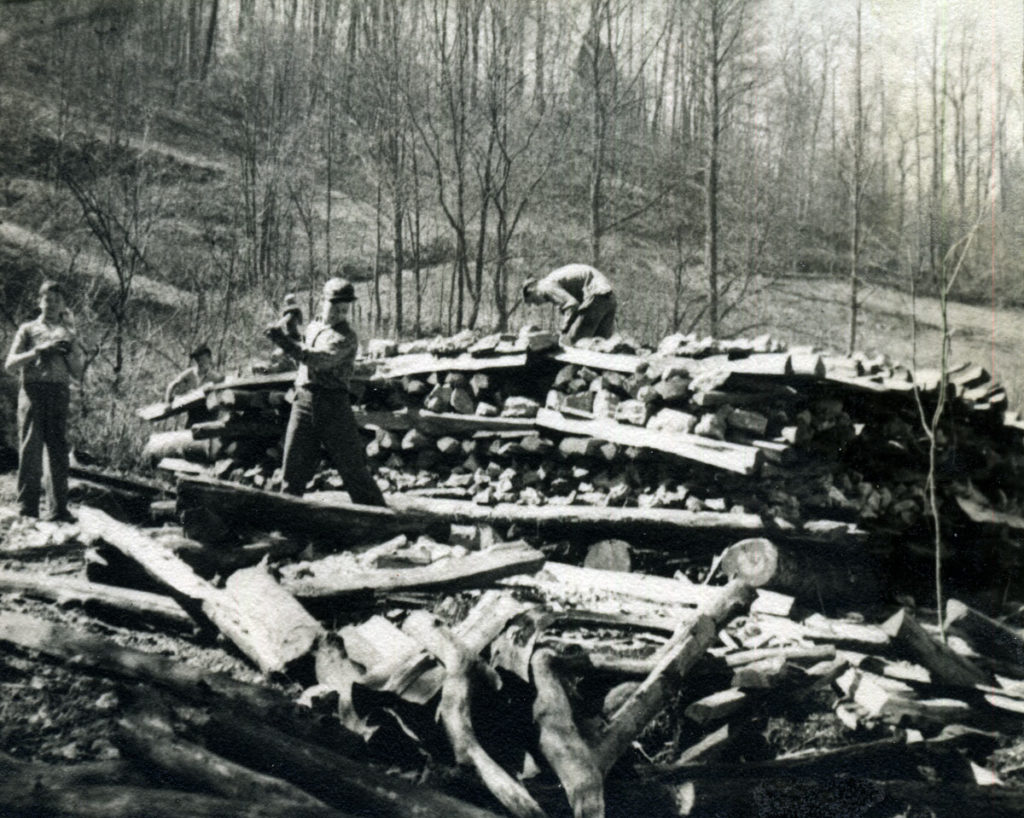
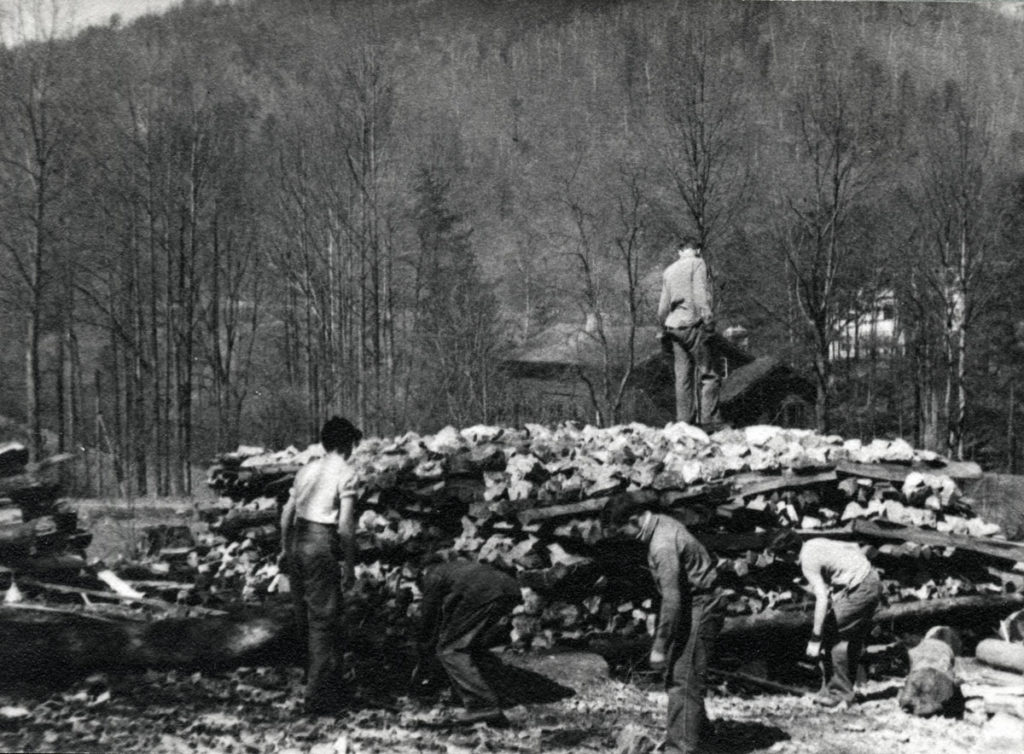
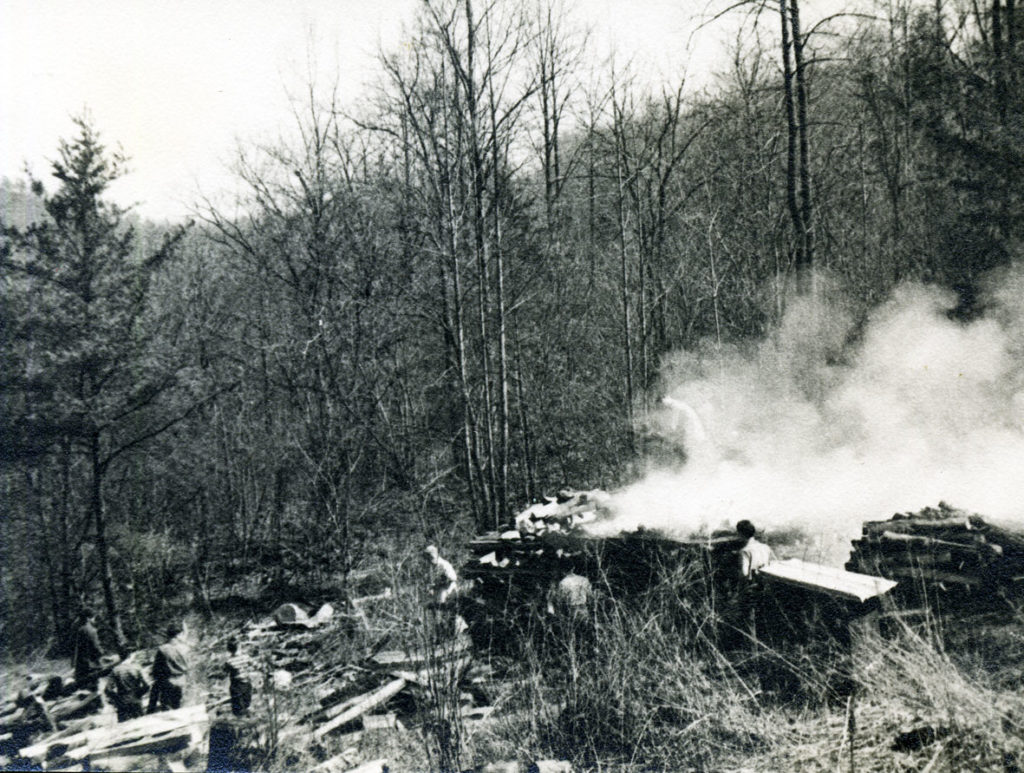
The so-called “lime cycle” starts with the stone — technically known as calcium carbonate and carries the chemical compound symbols of CaCO3. The limestone is stacked over a fire fueled by wood or coal and layers of limestone and fuel are then alternated to create a sizable pile that will burn for 10 days or more. This “pile” generally reaches temperatures in excess of 1200 degrees Fahrenheit. The heat from the fire cooks off the carbon dioxide, CO2, and leaves a rich residue of carbonates (calcium oxide, CaO). This calcium oxide, also known as “quick lime” can then be applied directly to the soil, or better, can be mixed with water to de-acidify the soil.

Building the llime-kiln 23_campus_work_052

Stacking the lime-kiln 23_campus_work_050

The lime-kiln fired-up and producing lime for farm land 23_campus_work_051

Quick lime can also be used to make “white wash,” an insect retardant “paint” often seen on the base of trees, or on fences or around the base of wooden structures in early Appalachian homesteads. Even much later, well into the 1950’s and 1960’s, homes sported trees with their bases white-washed or old tires painted white and filled with flowers or foundation stones supporting a home, carefully painted white. An important early use was hygienic. Lime was a key additive used to keep insects and disease at bay in the many privies of the Appalachians. Both lime and wood ash with its high concentration of lye were also used as alternative disease retardants in the privy. Today, lime is still used in water treatment and sewage treatment along with ferrous sulfate.

When quick lime is mixed with other additives, it can also be a key ingredient to strengthen concrete or added to stucco for the same purpose and for its pure white nature. It can bolster or build strong walls or can be used in ‘pointing’ stonework. Much of the concrete at the school used some local lime in the concrete mix. Today, the practice of burning lime has been replaced by commercial lime that may be purchased in fertilizer mixes and other commercial amalgams. The forest can be heard celebrating this turn toward commercial lime.

Analyzing and creating some of the early pointing concrete is an art. Pine Mountain has been fortunate to have Bob Yap’s good eye and deep knowledge of restoration when addressing many of the issues found in the stone foundations and sidings of many of the Pine Mountain buildings that have broken down with time. Yap’s annual workshops are some of the most exciting workshops held at PMSS. While Yap’s skills range across many restoration skills including window restoration, roof flashing, siding, fine carpentry, and so much more, he also addresses the vital skill or re-pointing rockwork. See the Pine Mountain schedule of events and workshops for dates the next series of restoration workshops.

STONES AND MORE STONES

Stones in the Pine Mountain valley are everywhere present. They fill stream beds, sometimes tumble down mountains, pose major obstacles in the construction of roads and homes, or provide the central building material of the same. They are rockwalls, laid dry-stacked one on the other and stone mantles above the stone fireplace. They mark the well-traveled paths around the campus. They hide the infrequent copperhead snake and the quick-witted “red-britches” ground squirrel. Stones are in evidence at every turn at the School and they are still being added to the landscape in the dry stack workshops that have now become an annual offering at the School.

hook_album_2blk__036

From Mary Rockwell Hook Album. [hook_album_2blk__036]

But, there is a difference between “cliffs”, “rocks” and “stones”.

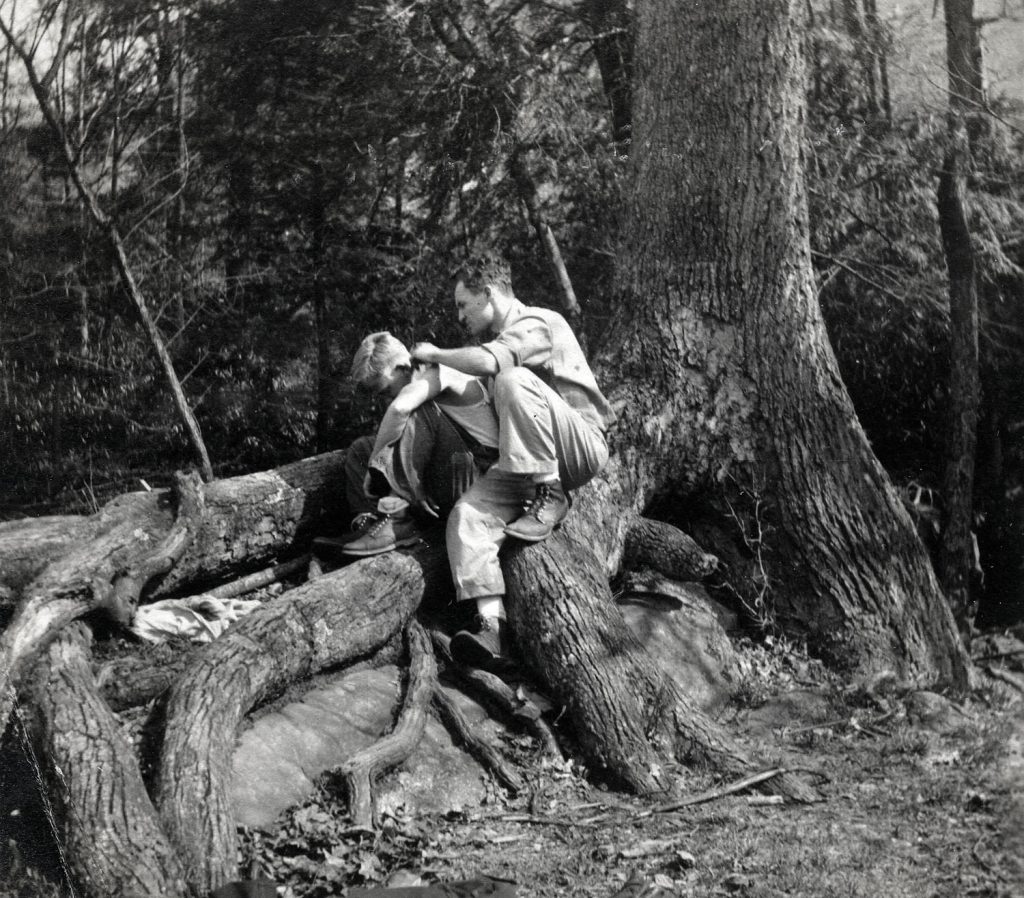
Stone at the School can be found in flagstone walks and simple stream stepping stones. Rocks are often referred to as residing deep in the woods, where they are natural monuments with trillium tops and gentle fern and lichen-laced sides. They are places to sit for a stream-side picnic or a personal reverie. At Pine Mountain, almost no one is without a stone — or some affection for a “rock.” The Playground rock beside Isaac’s Creek is one of the most iconic rocks at the School. The large rock (no one calls it a stone) is nearly encased in the root of a giant poplar tree and provides many nooks to play or sit, or cut hair.

2457 Clyde Blanton and August Angel cutting hair at large poplar on playground, 1930s. [IX_students_09_2457_001.jpg]

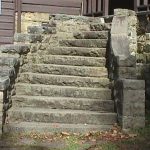
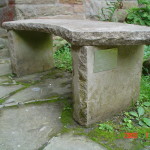
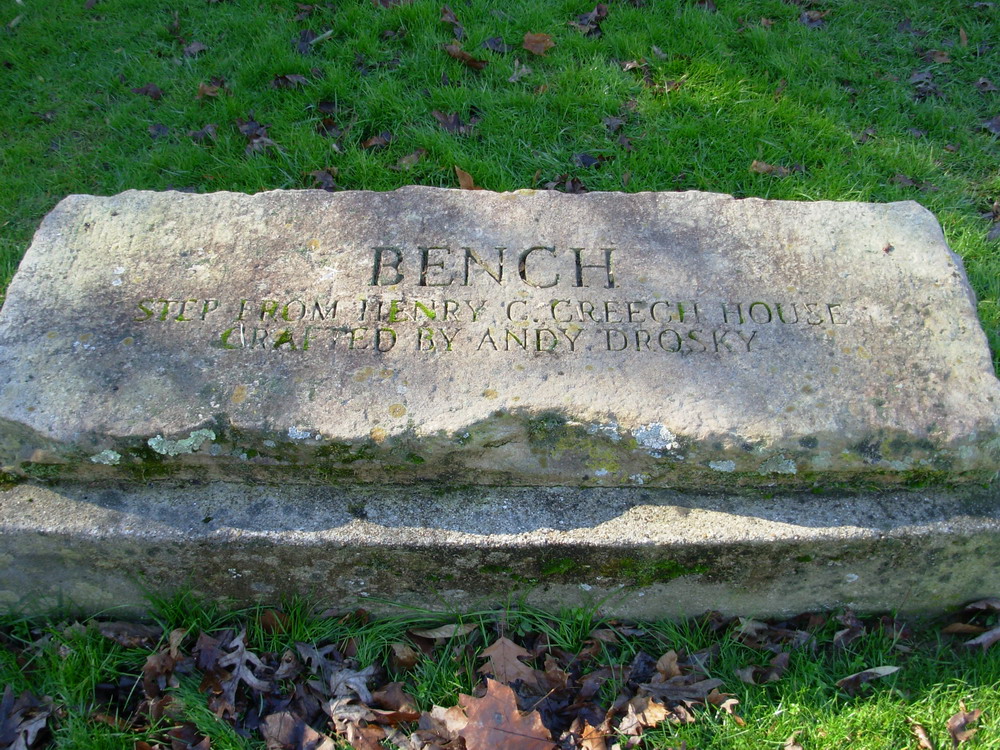
The stone steps of Boy’s House have long been a favorite photography venue for Board pictures, students, and solitary musing. A special stone pulled from the steps of the Creech cabin was crafted by Andy Dorsky, a talented stone carver, into a seat where visitors may view the cabin.

POTATOES AND ROCKS

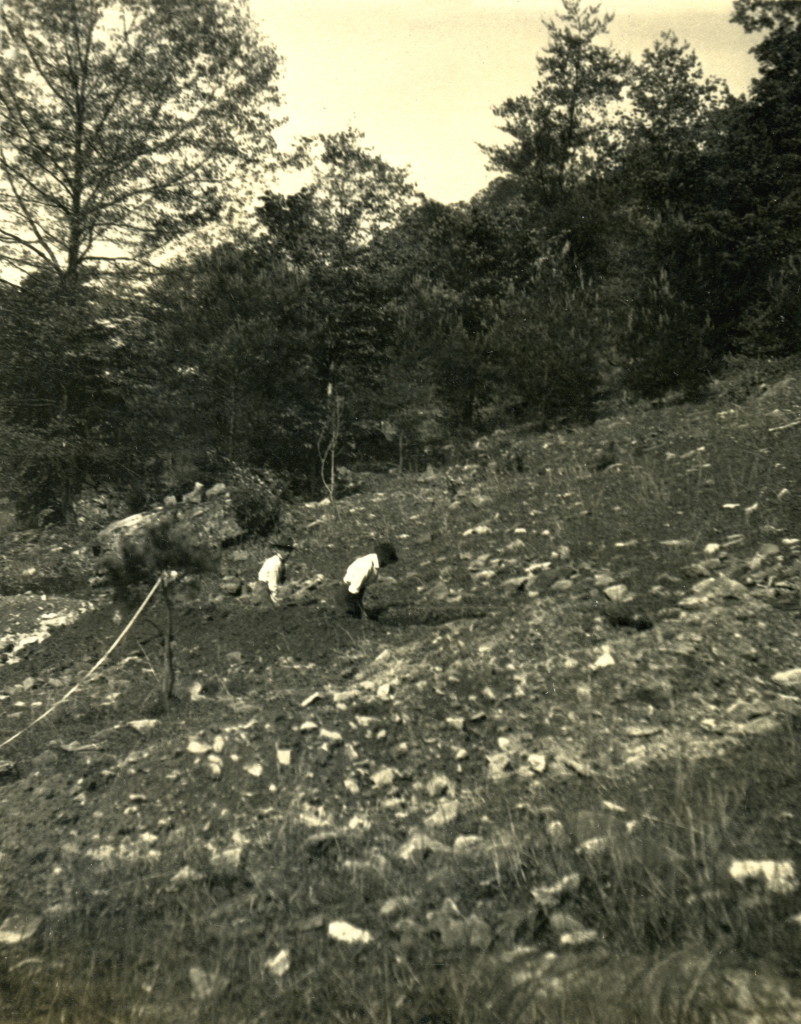
Not all rocks are stones. Potatoes were a popular crop in the mountains, but rocks and potatoes do battle in the field. It is difficult to grow potatoes in rocky fields, thus all workers took on the task of clearing the fields of rocks and turning them into construction stones:

“Another piece of economy has been the application of the two-birds-with-one-stone theory to the loose stones on our cultivable ground. We have secured building material for two sanitary closets and a fine tool house by gathering wagon loads of obstructive stone from our potato fields. As to rocks, we still have more worlds to conquer and we shall use them for building and retaining walls, paving, and roads.”

Nov. 14, 1914, Letter to Friends from Ethel de Long

DRY STACK CONSTRUCTION AND SCALLOPED POTATOES

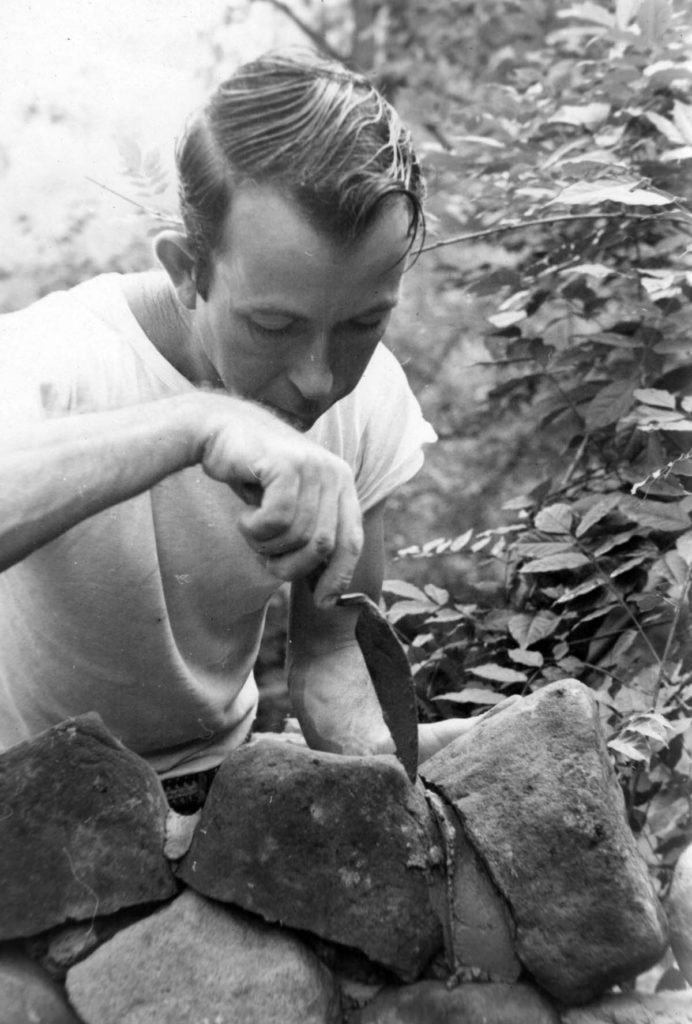
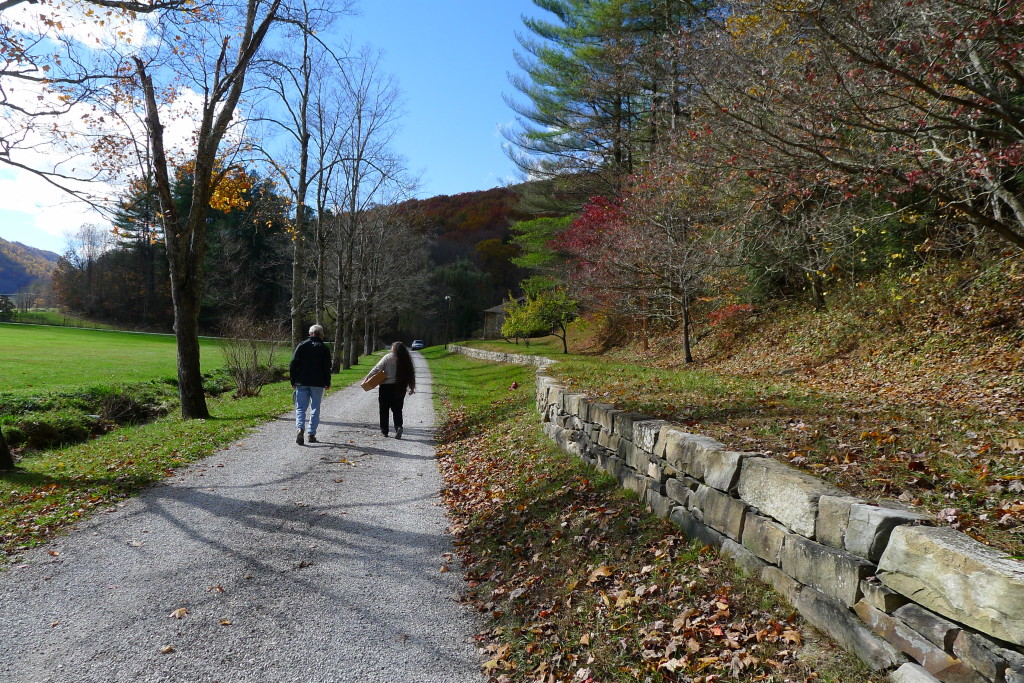
In recent years Pine Mountain has held several workshops in dry-stack wall construction. The sinuous wall along the road from the Office to the Industrial Building (Plant Center) is a good example of the work of dry-stacking.

P1050413

Stone wall along road from Office to Industrial Building. [P1050413.jpg]

While it may be a stretch to compare stacking potato slices to something like stacking a dry wall, the art of stacking can make all the difference in a random pile of rock and a random pile of potatoes. Both can become an aesthetic work of art, or a tumbling pile of mush.

Dry-stack rock work was a workshop offered at the School and it can be a valuable skill for both a gardener or a cook. Both take a good eye! Dry-stack rock work may be seen throughout the School campus. Many of the walls are early drystack, but many are also the new and repaired work of the dry stack crews in training. A recent preservation workshop that re-built the wall just east of the Office were possibly treated to a meal with scalloped potatoes. It is not known if the masons were rewarded with the scalloped potatoes, but the following recipe is one drawn from the records of the School and would go well with a day of dry stacking.

SCALLOPED POTATOES

Scalloped potatoes? They actually have much in common with stacked stones. Potatoes are often what cause a stone to be moved, removed, stacked, broken up, hated or other actionable scenarios. Like dry stacked walls, scalloped potatoes are laid into the pan one slice on top of the other. In the kitchen the idea is “light-weight” but in the field, it is an exercise in heavy lifting.

SCALLOPED POTATOES

3   LB potatoes
4   T butter
4   T flour
2   t salt
1/4  t pepper
2  cups milk

Pare and dice potatoes and put in a buttered baking dish, sprinkling each layer lightly with the flour, salt, and pepper. Pour milk and melted butter over the potatoes. Cover, bake in moderate oven for 60 to 90 minutes.

Recipe in The Pine Cone, May 1935

GALLERY OF STONEWORK AT PMSS see ROCKWORK

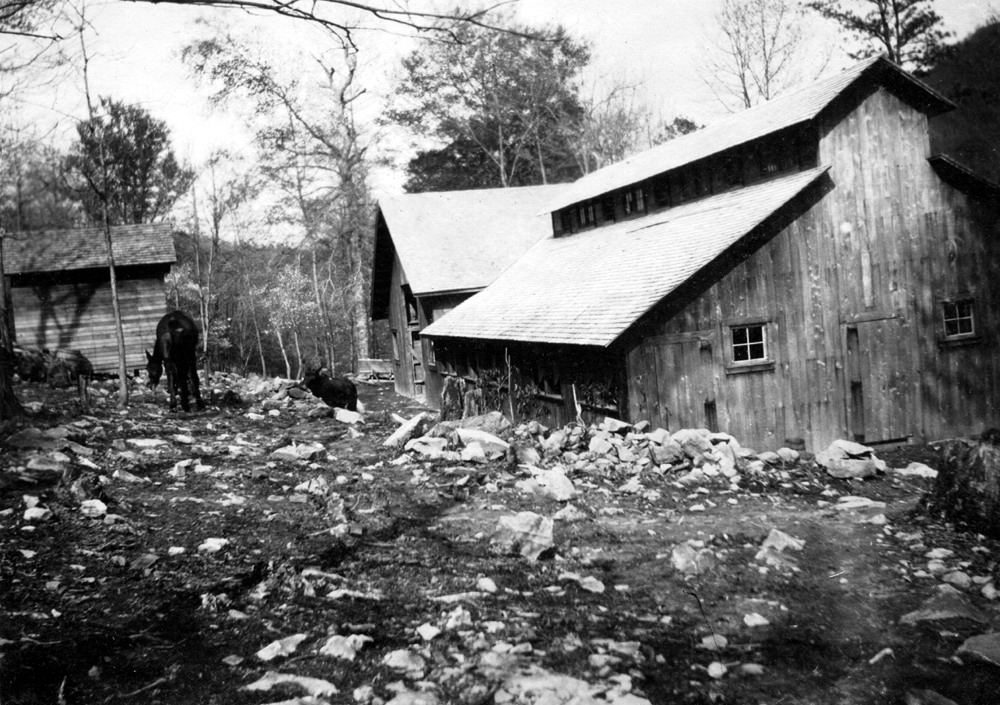
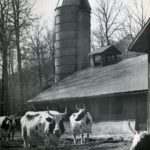
Stones were life-long labor for farmers at the School as well as in the community farms and gardens. Some areas were more troublesome than others. The barnyard seen here was slow to be cleared of these troublesome partners of most mountain soils. But when “clearing” was completed, the stones were ordered into a rough paving behind and in front of the barn where the mud and muck was an ever-present nuisance.

Barn. Early construction with stones littering yard. [II_7_barn_281.jpg]

LIke the barn, other locations benefitted from the rearrangement of stones.  Stones were often an advantage when they were re-arranged and sometimes even if they were not. Before they were used as paving stones in the barnyard where the soft earth could quickly become mired with manure and mud, the native stones, though lacking organization, kept the yard drained and the feet of livestock sore but dry.

HORSES AND ROCKY ROADS, TRAILS AND PATHS

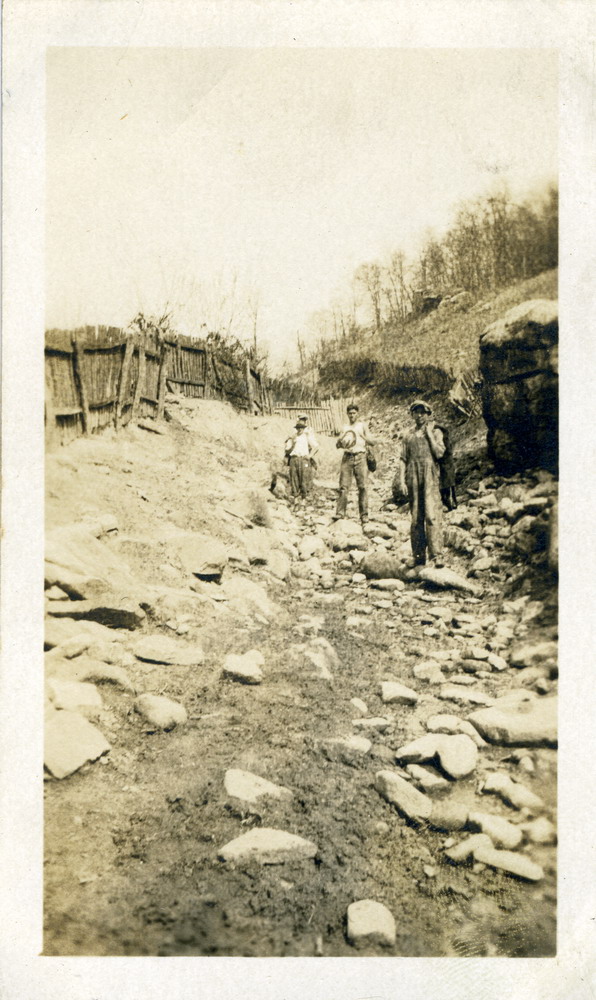
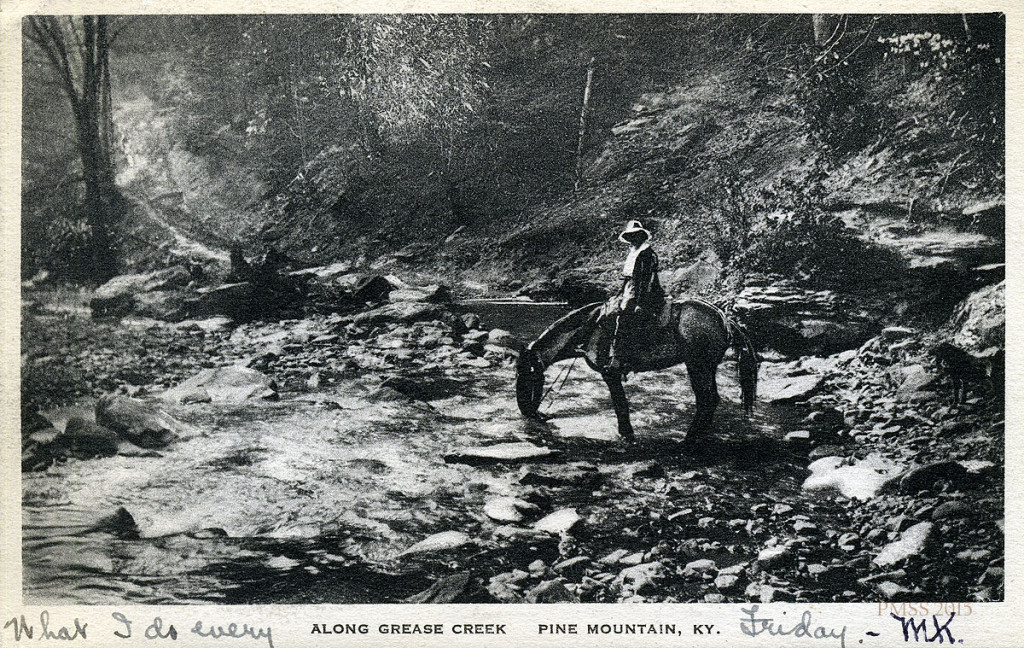
The stories of negotiating rocky streambeds on the backs of horses or in wagons abound in the Pine Mountain Valley. Steep mountain slopes and laurel thickets offered poor trails and often the thoroughfares were the streambeds. One story stands out in the myriad of tales of rocky-stream mishaps. This tale of the fall of Dr. Alfreda Withington on a dark night medical call is particularly memorable. In her own words from her autobiography, Mine Eyes Have Seen (E.P.Dutton & Company, 1941) she describes the 1926 accident that began when she was called to treat a child who had been badly burned. Dr. Withington had stayed the night with the family. As she started the next day on the long trip back to the Medical Settlement at Big Laurel by horseback she had what she described as “bad luck.”

It was the next day when I was returning alone from this visit, that bad luck overtook me. As Maud [the horse] was going downhill she stumbled on a rock, falling and hurling me straight over her head, so that I struck almost squarely on my face. I remember the sensation of hurtling through the air and hearing a crash. Then there was a blank

A mountain woman was standing over me when I came to. I had an awareness that something was wrong; putting my hand to my nose felt it crunch, and it was bleeding terribly. I told the woman to give me my kit, and lying there I manipulated the grating bones, straightened them, and poked some gauze up my nostrils. Though faint from loss of blood there was nothing for me to do but remount and ride the four miles home.

The next day my face was swollen beyond recognition. I rode thirteen miles more to the railroad and took the night train for Louisville to consult a specialist. He said I could be thankful indeed that my malar bones were not smashed; a stiff hat saved them.

“What I do every Friday. M.K.. [Marian Kingman] Along Grease [sic] Creek, Pine Mountain, Ky.” [kingman_098a.jpg]

Dr. Withington’s tale was repeated many times over by staff at Pine Mountain and the community families whose only roadways were streambeds and rocky hillsides. Most could identify with her “bad luck” as they had either experienced it or knew someone who had. Dr. Withington was 65 years old when her accident occurred. She was slowed down for a while but she continued to ride in streambeds and along narrow ledges above streams in order to serve the many families needing medical attention for many more years. She left the stones of the Kentucky mountains in 1931, finally retiring at the age of 70,

SCENIC ROCKS AND HIGH PLACES

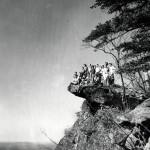
Indian Rock, Rebel’s Rock, Raven’s Rock, arches,. Sandstone cave…..

STONE SOUP

Besides scalloped potatoes, there is Stone Soup. Any soup may become “stone-soup” when a clean and dense stone is heated intensely and dropped into a soup pot. It acts like a slow cooker and it both cooks and maintains the warmth of a meal. The following is a pleasant winter stone soup made from stored and home-canned goods.

Vegetable Stone Soup

1 cubed onion, braised (or added directly to pot)
1 qt. jar of tomatoes
1 qt. jar of corn
1 qt. jar of green beans
3 cups of beef broth
1 tsp dry oregano
1 tsp salt
1/2 tsp pepper

One clean medium stone thoroughly heated. Place stone directly in soup mixture. Let cook for 1 hour. Patience. Re-heat stone, if needed. Serve with cornbread. and cold buttermilk.


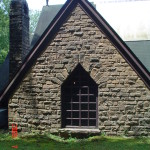
To explore the many uses of stones and rocks at Pine Mountain a quick look at the built environment, of foundations, steps, walls, etc..  All will give a good overview of the value and required skills to utilize this building material. Buildings that are noteworthy for their rockwork are the Chapel, Laurel House II, and Draper Industrial BuildingRockwork, as seen in ROCKWORK at PMSS can also demonstrate some of the troublesome aspects of this medium.

PLAYING IN THE ROCKY, STONEY, BOULDER STREWN CREEK

Ann Angel Eberhardt, the other editor and voice on the Pine Mountain Settlement School Collections website (there are two of us) shared the following story. Ann is a cousin, a friend, a writer and a superlative sounding-board. Her father is the hair-cutter in the photograph above.  When she read this piece about stones …  she felt compelled to share some of her memories among the stones of Pine Mountain. I am sure other readers will have similar memories especially of the creeks of Eastern Kentucky. I asked if I could share her memories of visiting near the right fork of Mason’s Creek in Perry County.

Your article reminds me of those times my family would regularly visit Mom’s people, the Halls, in Viper in the summers of 1940s & early 50s. We cousins would spend most days setting up little “playhouses” on the huge boulders in the creek. Each of us would have his or her own boulder (stone?) and use twigs, pebbles, stones, discarded items, and anything else we could find to create our playhouses. One cousin even directed the creek in a way to have “running water.” There was a perfectly round hole in the rocky creekbed that we called “Indian’s washbowl.” It was probably formed by eons of circling pebbles that the creek water washed into it.

Sound familiar?

Helen Hayes Wykle


SEE ALSO:

FARM and FARMING Guide
FARM Guide to Resources
FARM LIME KILN Processing

ROCKWORK AT PMSS


DANCING Weaving, Natural Talents, and Natural Dyes – Becky Mae Huff

Pine Mountain Settlement School
DANCING IN THE CABBAGE FIELDS
Weaving and Natural Dyes and Natural Talents – Becky Huff

DANCING IN THE CABBAGE FIELDS
Weaving, Natural Talents, and Natural Dyes – Becky Huff

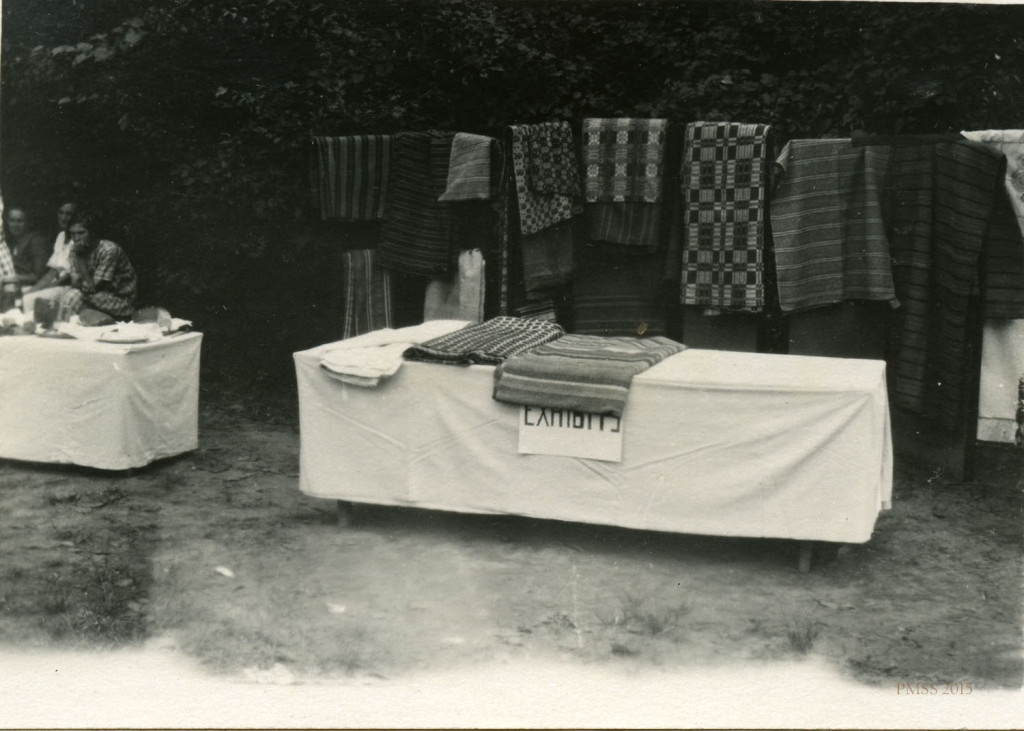
Exhibit of weaving and woven craft. [norton_021.jpg]

Weaving may look very easy. Back and forth, back and forth, and voila! a lovely “runner” for the chest of drawers. But neither life nor weaving is that simple. The most exquisite weavings come from those weavers with natural talents, diligence, and a strong sense of self-worth. Becky Huff was one of those weavers of both cloth and life. She was one of the first children to attend Pine Mountain Settlement School c. 1914.

By 1930, shortly before Katherine Pettit’s retirement, she {Pettit} tried to recruit Becky back to Pine Mountain as one of Pine Mountain’s most talented weavers.  She had been trained by Pettit and others and was an expert weaver, dancer, and institutional historian. Pettit wanted her to come back to the school and mainly resurrect the weaving program but there were other assignments. The letter, a full pleading page from Katherine Pettit, lays out the generous terms of employment if “Beckie” [Becky] would return to Pine Mountain to develop a weaving program, teach a few dance classes, and possibly perform several other tasks as required, she would be housed, salaried, and back among friends.

It is uncertain where the plea originated, but clearly it points to Katherine Pettit trying at the end of her life to bring back the craft on which she founded the School headed by one of her favorite students. But it was also more than that. Becky had been there with her as a child in her first years at the School in 1914 and forward.  Becky, while remembering those Pine Mountain first years to her family noted that as a child she was charged with bringing Pettit her breakfast each morning. Pettit and many others also remember Becky as the sister of Almon Huff. Almon was one of the students killed when the new School House caught fire and burned to the ground, killing Almon,  three other students, and one teacher. Miss Pettit and Becky shared many memories.

Pettit’s letter was written as she was preparing for retirement and her final days with the School. Pettit continued to center weaving at the height of the Depression — at the center of a  era unlikely to want to spend precious dollars on craft.  Her actions are difficult to asses — to explain her belief in a market that could balance the full throttle of Depression with craft sales and a School charging ahead into a new educational mode that did not place craft on the front line. In some ways Pettit’s plea captures the tension, desperation, and confusion of the 1930s across the country.— The Great Depression is still bearing down on the country following the 1929 crash, unemployment is rising and unstable, the Smoot-Hawley Tariff passes, the Dust Bowl is ravaging the agricultural centers of the country, and poverty is everywhere, and Pettit wants to teach weaving.

The country was desperately searching for solutions as Americans desperately searched for work.  The new discovery of the planet  Pluto diverts attention for a brief time as the newly abandoned populace looks to the planet and wishes they could escape there. But there are no easy answers. Somehow, this all sounds all too familiar.

The Smoot-Hawley Tarriff initiated during the early years of the Depression — the economic down-turn was a disaster.  It raised import duties on over 20,000 goods by roughly 20% to 50–100% in some cases. While it aimed to protect agriculture, the farmers of America and related industries tanked, and the Great Depression ravaged the country as so well described by Steinbeck in The Grapes of Wrath.  As a result of Smoot-Hawley the  country’s trade partners retaliated, and the trade battles caused a 66%  decline in world trade for nearly five years and the retaliatory tarriff on the USA — on Harlan County and its coal. The tariffs set off the Great Depression, and in an area that could little afford further declines in its near-poverty living standards.

Did Katherine Pettit win Becky back to Pine Mountain? Was this the end of the weaving program? Read on. See BECKY MAY HUFF Student Staff

THE LETTER    (Katherine Pettit to Beckie Huff)
April 2, 1930

My dear Beckie [Becky].

I have been wondering what you’re going to do about your job next winter? Miss Gaines  [RUTH B. GAINES] says that you are expecting  to come here. Although I have not received any word in reply to my last letter. Asking you definitely about it. Now, won’t you tell me very definitely? if you would like to come to take charge of the [weaving] department. Although I will not be here. Miss Gaines will be here to carry the ideals and standards that we have set. I should like to know if you are interested in our plans for this department and if you will help me to carry them out. Will you fill out the enclosed questionnaire that I may have it for our files as we require it of all our workers.

Did you know that, Mrs. Wilmer Stone is just getting published her [Katherinde Pettit book ] book on vegetable dyes. I saw an exhibition of her weaving. In Knoxville last week, where there were many very beautiful things, and hers was the most beautiful. Again, she told me if you could  do so next year, she would be so glad to have you come to North Carolina and teach you all she knows about vegetable dyes as many people think she is wonderful at that.  It seems to me it would be a great chance for you. Miss Ruth B. Gaines thought that you would also be interested in helping out with the country dancing, gymnastics, and singing games. Mrs. [John C.] Campbell, and Miss Butler have offered to take any people who worked in the mountains there for 10 days and let them have special instructions from their [John C. Campbell’s] Danish gymn teacher, and if you go to Miss Stone in Saluda, NC. would you not like to go to Mrs. Campbell’s [John C. Campbell Folk School] while you are there, for those special lessons?

We have a chance to get a wonderful weaving teacher — 35 years old. She would like to have a permanent job, and if you know positively you do not want to take this job, we shall certainly take her, for we are so anxious to get it [weaving] on a permanent basis. Run year by year by the same person. Now, Beckie May, if you are likely to get married within a year or so, as most young girls do, we want to tell us very frankly so that we may know how to plan for the future of this department. Miss Gaines is so eager to have you come and I think you could have an awful good time living at Laurel House with her and Emily.

Saturday is Aunt Sal’s Day, and all her family and friends are coming here for dinner with us in her little cabin and to see her great-granddaughter weave on her loom the same kind of a blanket that her great-grandmother taught her. Now I wish you could be here for such an interesting occasion.

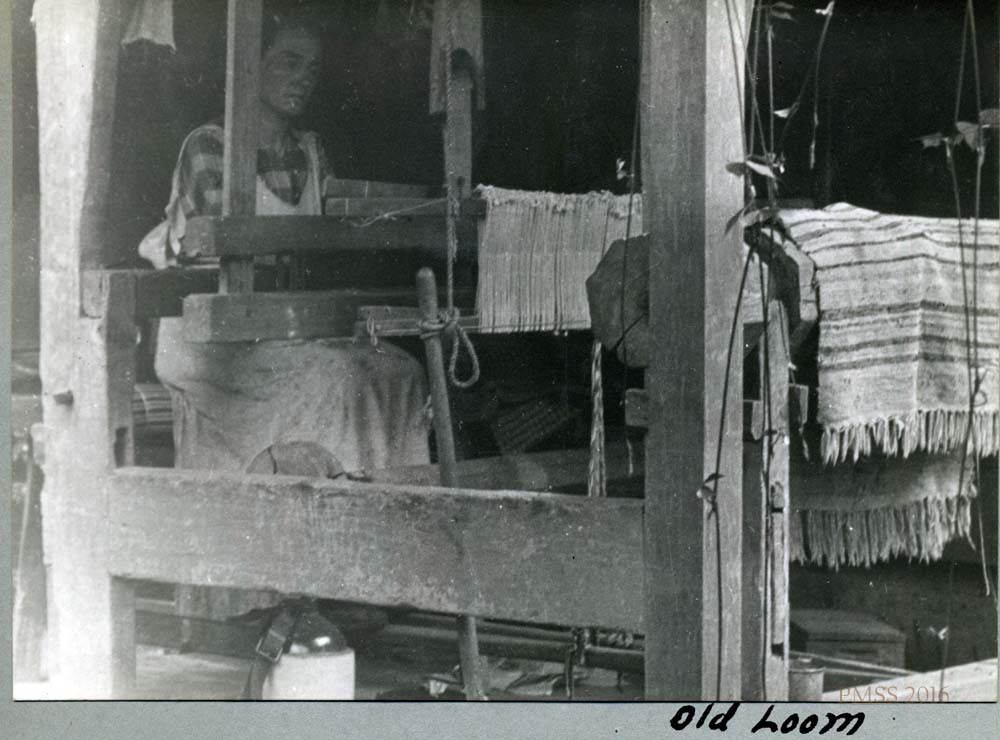
Woman weaving at “Old Loom.” [nace_II_album_020.jpg]

Now tell me about yourself and what you had been up to all this time and if you really think this is what you want to do next year? Are you coming to see us as soon as school is out …
p.2
… and will you be here for our Mayday and pageant of olden days? Miss Bolles is coming soon, and I wish you could be here all the Spring with us as we dance.

Yours sincerely.

Miss Becky May Huff
Methodist School
Olive Hill, KY
KP/B


1930 saw the initiation of  the  high-school boarding program just one year before the arrival of Glyn Morris and his Progressive Educational agenda that set a new course for the School from 1932- 1940 and just two years following the death of Ethel de Long Zande on 1928 from cancer.

Pettit’s letter captures the void left by Ethel de Long’s death and the uncertainty of the world between the Wars, the Coal Wars raging on the other side of the mountain, and the slowly healing Great Depression. It was one of the most fragile times at the School as it struggled to find its educational direction.


Becky Huff

DANCING IN THE CABBAGE PATCH Going and Coming Back I

Pine Mountain Settlement School
DANCING IN THE CABBAGE PATCH
Blog

DANCING IN THE CABBAGE PATCH Going and Coming Back I

A personal reflection on Appalachian migration.

“The effect of mass migration has been the creation of radically new types of human beings: people who root themselves in ideas rather than places, in memories as much as material things; people who have been obliged to define themselves — because they are defined by others — by their otherness; people in whose deepest selves strange fusions occur, unprecedented unions between what they were and where they find themselves.”
Salman Rushdie

“It seems to me from my personal experience that there is kindness everywhere in different proportions and more goodness and tenderheartedness than we read of in the moralists.”
                           Elizabeth Barrett Browning

These may seem strange companions in a discussion of migration — Salman Rushdie and Elizabeth Barrett Browning — yet they both share an understanding of our deeper selves. They reach into the core of what makes us human regardless of our origins. Migration can tear at that core in ways we are still coming to understand. In Appalachia migration is a constant theme that runs throughout our conversations. So is the idea that others can redefine us; it makes us defensive and not just because we are perceived as “something else.” It is much more complex.

My grandfather was always on the move, going and coming from somewhere else but always returning to there —to Appalachia. He didn’t have a car. He was left to the many devices of journeying. Neither did he have a career that kept him moving up the staircase of advancement in the ways we understand advancement today. He simply moved. That was his advancement. He changed his location and with it, he changed his sense of self. Though he mined coal for much of his life, we never knew many of the other jobs he worked into and out of in his goings. But we knew him because he was always coming back.

“Papaw,” the Appalachian term of endearment, or not, — for the fathers and grandfathers of children growing up in the mountains of eastern Kentucky, was always going and coming back. He kept the flow of life in the household unsteady, but he also kept it animated by expectation. When he returned, the household filled with somber but expected and at times unspoken conversations. Where did you go? What did you do? Who did you meet? What was it like living … there? Did you miss us? Silence. The silence in the house dictated by our grandmother Daisy, whom we affectionately called “Daa”, was palpable. Our questions and the non-answers often hung in the air with their weight of deep anxiety. But the silence was always temporary. When the house filled with family, with the sons, the wives, and their sons and daughters, the voices and laughter, stories filled the rooms. The memories of family, together, flowed like healing waters over all the unspoken answers to Papaw’s going and coming. Our Daa kept him in her wary view and could silence his answers with just a gaze. He had gone one too many times.

When we gathered, Daa often filled her table with fried chicken, cornbread, ham slices with red-eye gravy, fried oysters, pickles, mashed white potatoes from the garden, cole-slaw, and fried sweet potatoes — crisp with hard sugar edges. We playfully juggled for chicken legs, yearned for four-legged chickens, and made jokes about the “toot” which Daa always left on the bird. No one got enough sweet potatoes, and we rarely had room for the blackberry cobbler, but we ate it anyway. For us, coming home was a celebration of family and the wealth of the table. We, the family and the cousins, repeated this ritual many times in the early years of growing up. Our visits were frequent because we never lived far from our grandparents. We traveled to Coxton, a coal camp in Harlan County, Kentucky, where our grandparents spent most of their lives; first, as residents of the coal camp and later in a house they bought near the coal camp on the road to Evarts. Our coming and going was across the county of Harlan, or up and over Pine Mountain to the valley where my family lived, at Pine Mountain Settlement, a beautiful little community nestled between two steep mountains and beside gentle Isaacs Creek, the headwaters of the long and beautiful Kentucky River. 

Papaw left home many times, but the most telling time was when he left — really left Daa and their boys. She had just been diagnosed with tuberculosis. In a coal camp, tuberculosis was held to be a slow death sentence. And she still had young boys at home — five of them. According to apocryphal tales told by cousins, Daa had told someone that Papaw, when he left, said he had to go because he did not want to stay and watch her die.

Given the common prognosis, his expectation that she would die was not unrealistic, many tuberculosis cases in the camps ended in death, but it was cruel to have said it out loud. Daa had been diagnosed with tuberculosis.  During those years many tuberculin cases ended badly. But, this going away seemed most cruel if that was what he said, and if that was why he left. Some of us never accepted this story, but clearly, Daa never forgave Papaw for his thoughtless words, whatever was said, and silence often sat in the house like a deep fog when the two were together.  If he said all those things, it did not enter into his grandkids ‘ heads as cruel as it now sounds.  We could not get enough of his tall tales. His awful prognosis for Daa did not come through in his stories and his love of his grandchildren. Both grandparents, it seemed, feared being alone in the later years of their lives.  Whether it was fear of being alone, or the threats of the labor wars in the mining camps that had led to his departure, Papaw left during the strike years of the 1930s. These were the troubled years that brought silence to later conversations.  Daa, even in her anger, filled up those years with empty places that were only grasped when reading family letters and the snippets of stories shared by the sons. But, during those years, the family held together.   Pine Mountain Settlement was part of that glue. Daa was angry but pragmatic. Her sons were resolute and creative. They never gave up trying to entice him back home. Daa was clever, and she found ways to carve out pieces of her dreams. It all would finally work out she believed.

The 1930s in Harlan County were not easy years, with strikes and union unrest, and violence. Daa’s “disease” could easily have been fatal, and so could so many other diseases of the day. A random bullet could have instantly broken the tight bonds of mother and children. Bad things happened, but they could have been much worse. In many ways, Papaw’s prognosis was just as stark as that of Daa. Black lung ended the lives of most miners, and the unpredictable cave-in of a deep mine could crush the life from a man in an instant. Union thugs could target whomever they did not like, and disease could randomly kill anyone. When Papaw left to take jobs in Detroit and the industrial north, or to Colorado, or wherever he went in his mysterious departures,  I always believed that he knew he was saving his life and the life of the family. The industrial factories had their own labor strife and workplace dangers, but dying was not generally a common outcome in Pawpaw’s mind. When he left, I am sure he aimed to be lucky for later.

But Daa, with her lung disease, her tuberculosis, needed luck right away. Dr. Clark Bailey, a doctor in the town of Harlan, Kentucky and a Pine Mountain Board of Trustees member, who had diagnosed her disease early on, had found her a sanatorium in Louisville where she could possibly be cured. Dr. Bailey learned of an experimental treatment of the deadly disease in the Louisville program. Through Dr. Bailey, she had also learned about Pine Mountain Settlement School, a progressive and affordable boarding school for mountain children, and with his help, she started the process of enrolling her sons. Though Daa had only an eighth-grade education, she had been called on from time to time to teach in the coal camp school and later served as postmistress. She knew the value of an education, and she aimed for schooling for her sons.

When she learned from Dr. Bailey of the Pine Mountain program and that the sons could earn their education through a work program, she planted the seed of that idea in her sons. The older sons could pay their way through work and also earn money in the summer to help pay for their younger brothers and, later, perhaps, save funds for their mother’s care. The plan, as it turned out, was a good one and Daa’s tuberculosis was healed, the boys went to school, and Papaw was for a time not deep inside a mine. But, the wound of abandonment, the going away and Papaw’s long migration history, was not so easily healed.

WAR AND MIGRATION

In the mountains of Appalachia, wars also created migrants in the sense that many young men left the mountains and never returned, or if they did return, they carried with them the changes wrought by new and brutal experience but often romantic tales of far-off battles in far-off places. Papaw’s brother fought in the Boxer Rebellion and also in the Spanish American War and when he returned he brought the romance of far-away places. All but two of Daa’s five sons fought in WWII. One of the two sons died from a coal camp disease — chronic diarrhea. Another became a farmer. Daa cried when her sons went to war but her “babies”, as she called them even into adulthood, went anyway. Going to war was a noble and necessary act for the country and the sons adopted those noble ideals. They took on the journey to war with relish and looked forward to the chance to travel, to adventure and to do something that would stamp them with the noble entry into manhood.

But not all noble ideals end well. When Uncle Silven, Daa’s oldest son went to fight in France, he returned to the mountains, in a coffin nearly five months after his death. His service was lauded throughout the community and within the family and by his wife, Alline. His body returned from the distant and foreign war to the war being waged in the coal camps as mines ramped up to support the war effort. His death filled the house with grief. His coming back brought foreign lands to the mountain family, and all the myths of exotic lands exploded with his death.

Silven’s story has been repeated many times over by Appalachian families and their mountain sons. The heroes, the wounded, and the families of the killed in action, like Daa’s family, shared how they were so proud of their heroes as they filled the rooms with tears. Silvan had been missing in action, and throughout the long five months it took to determine his fatal end, Daa wrote stacks of letters. When his death was confirmed, she shed tears of relief and of grief. Daa’s family and other mountain families then came face to face with another kind of tangled emotion, that of displacement.

Hidden behind the pride and the grief that war brings, was a growing distrust in the minds of some; a great fear of going away and the dangers it carried. Noble or not, the scars of displacement, of leaving home, were deep in the mental fabric of many Appalachian families. Who they were before the war and where the families found themselves following the war, were not the same.

When Uncle Silven went away, he went, not for family, but for some larger community, the nation, freedom, a cause, that we knew was somehow ours as well. We knew we also shared in his death because he fought for us, but we knew that his death was among many noble deaths and that we should be proud. We also knew that his going away had killed him. It was a going, a departure on two levels of our imagination and understanding. The soldiers who went to war and who came back either dead or alive created a community, a neighborly, a psychic and an emotional displacement in families.

When Silven’s body came back home, the conversations in our family and those families who had experienced similar losses turned. Daa’s other sons, her “babies,” were now determined to go to war, to also fight in the war. Daa’s fears were palpable all around her. She talked of nothing but their safe return until they were all back home. Her mind during those years was as displaced as a migrant’s must be. Her neighbors and our neighbors and their neighbors went to war, and the conversations revolved around the places of those war’s battles — past and future. Men sat on crates in front of the local post office and told tales of wars — past and future. The Civil War, the Spanish-American War, the Boxer Rebellion, and WWI. It was those conversations that prepared the next generations for war, for the long journey to some foreign country where, like Achilles, they would challenge an unknown enemy. It was not remarkable that my brother and my cousins, my friends went into the military to prepare for future wars. Later, the conversations around Daa’s table were ever more expansive as conservations began to “migrate” toward the wars in the world. We all became experts on the subject of war and the “enemy” and foreign lands.

While the elderly grieved war’s loss and the young stood lonely and confused on the edge of that large landscape of death and destruction, and noble causes, we all followed the conversations with them in our romantic notions. Later, when my brother went to war in Viet Nam and survived his many supply flights and sorties into Da Nang airbase, we stopped holding our breath and proudly watched him advance in his military career. Yet, we still understood that we were preparing and training for the next war and that war and migration were joined in creating new ideas and new places where those ideas would grow, but also where men die. It was a painful growth. We knew that what we were and what we would become was somehow tied to the outcome of wars and displacement — and migration. As Daa’s grandchildren grew up, as we grew up, the coming and going to Daa’s house seemed to grow, as well. Transportation changed, and travel became easier. Still, we always carried the memory that going was a kind of war that never ends and that coming back would have an end — could be the end — a finitude.

Our family continued to gather after the war, in the times of peace between the wars. In the 1950s we still gathered around the dinner table to tell stories. It remains a time of my best memories of going and coming back. The fried chicken was still shared with tall tales of the earlier war in the South Pacific, Navy training, guns, ships, airplanes, the sandy beaches of the Solomon Islands, the training for the Navy, and bravery. The boys waited for the stories with the eagerness of juveniles looking for heroes, and adolescents looking for the crisp edges of fried sweet potatoes. The girls listened with polite reverence, often admiration, and some sorrow — at least this one did.

When we were very young the stories lingered in our heads, and we went home and got our play guns and loaded them with caps and shot each other in mock battles of cowboys and Indians. We tuned our radios to the Lone Ranger and the Hi-Ho of Silver. I know we all thought of Silven in his casket, but it still did not stop us from romanticizing war and playing with guns. My brother and I were young and the Viet Nam war and his fatal air crash on Mt. Rainier were thirty years or more away. I had not yet migrated to California but my brother was soon in Utah majoring in aeronautical engineering and chasing forest fires in old Navy planes. We both still practiced the ritual of going back home every chance we got. Strange, the physical power of stories and the ritual of coming back. Neither of us could think of never going back.

Early on, the conversations of war had filled the imaginations of all the young-uns at our family table and those conversations had gradually given more meaning and nuance to the idea of going and coming back. Our going had punched a hole in the fabric of our isolation. As we grew, the coming back of our family members had made many of us wonder what was beyond the small world of our goings and coming back across a county, a mountain, a country, a world. The fragile fabric of family, forever held tightly together by the conversations across Daa’s extraordinary table. While we knew the lives that were ripped apart by war and the stories we heard, we then imagined and we then lived pieces of those family moments. As our younger generation aged, and our coming back to share stories and to listen to the voices of our relatives sometimes left us insecure, excited us, educated us, it prepared us for our own adventures to come. As we got older, we started to find that the stories sometimes conflicted with our growing understanding of the world and our loyalties to people and place. The stories, old and new gave us restless ideas. The coming and going and all the tales spun from those brief migrations fractured some of our loyalties and made some stronger. Our stories unsettled us just as surely as did our physical departures into our multiple worlds.

In my mind, I knew that my own migration and the migrations prompted by the war years of WWII had some common threads. The early war years were times of massive going and coming back for many families like ours in the Appalachians and across the country. The displacements were upending and made our younger generation restless. Going meant that our lives were fragile but it also meant we were brave. It meant that some of us would die in faraway places and some would come back with their mighty tales of adventure. But we all migrated. We a left “home”. Some near and some far. Our family, like so many others, was pushed and then pulled back time and again.

Papaw did not fight in any war, but war had raised the mystery of the going and coming back of Papaw to another level. It had made travel mysterious and set the imagination in flight. Now older, I hunger for new tales and new outcomes. I still want to know the adventures of Papaw while he was away. I still want to travel….. to go away and come back filled with stories. Now, I still want to hear the spirit of adventure in his tales like those we heard from the Uncles. But the memory of the gaze of my grandmother and the tension around the dinner table that always froze those conversations haunts me and gives the going a weight that I cannot fully understand or shake off.

Papaw’s stories of what he did in his personal war were never fully told by him. He came back, not as a hero, but as one who left his family behind. He did not have the stories to give honor to his departure or his return. His valor in coming back was never celebrated. But, I have never doubted its valor on another level. In some sense, he never came back because his migration had been a permanent fracture with Daa, but he came back for family. He came back before he ever started — to a place where he was not welcomed. His migration was the migration of an idea. He held fast to his idea that a better life was out there. Daa was firmly rooted in place. It was the ultimate battle of going and coming back. I like to believe that his going away was brave, but his return was heroic.

The icy stare of our loving Daa, our powerful grandmother, ended many of my grandfather’s stories before they began. Anything that might give credence to “That Man” and his adventures was censored by Daa. The going and coming back of Papaw would remain a mystery and that was that. For the grandchildren, Papaw was imaginary travel writ large. His untold stories of goings and comings would remain mysterious and compelling. Papaw’s life was, for me, a grand idea. It was the idea of a “better life”. Daa’s life was anchored to one place to which everything returned. That was her “better life.” Now I deeply believe that a “better life” is our own. 

Many, many families in Appalachia have stories that revolve around going and coming back and are fueled by dreams of a “better life.” My family story is only one. War certainly filled many conversations in the cyclical migrations that constitute war’s outcomes. But strangely, it was the going of Papaw that pulled most strongly on my imagination. Many Appalachian fathers went away alone. It was not uncommon. But, a more common way of going was the whole family that packed up and went away together. It is the kind of going where place is abandoned. This going and coming back of Papaw’s mysterious travel — somewhere in the North, was the journey that was so very hard for many Appalachian families to process. It was a journey not to exotic places like Iwo Jima or France or the jungles of Batan. It was to Cincinnati, Indianapolis, Chicago and Detroit, and other centers of industrial production. It was this form of migration that was clearly a going — that took families and individuals from Appalachia away from the “home-place” and constructed the fabric of what we generally consider as the Appalachian family migration. It fractured many families or it made them stronger.

Today migrant families are spread throughout the world. What some of these migrant families shared with Papaw was not the journey itself, but a perception of a lack of responsibility to a place. Going North when the mines failed was a journey of faith as much as it was a journey of necessity. But the journey to an urban environment puzzled those who stayed behind. To not have land to work, to not pull your existence from inside the earth, to own your own earth, was to lack responsibility. The shift in lifestyle that came with the move to urban centers during the 1930s-1940s was monumental. The life of the Appalachian family would no longer be bound to the soil, and the context of the stories around the communal table would develop toward a new framework and a new conversation of “place” and deeds.

When the migrants came home from the urban North the telling of stories now had to capture for family and relatives left behind, their new and unfamiliar landscapes. They had to introduce new words, new traditions, new lifestyles, all often so alien that their descriptions, their stories were intrusive. The stories of migrant families became stories of urban survival, of bullying, of discrimination, of playing in streets and alleys. These were poignant stories tinged with unspoken longing for corn fields and mountains and rivers — for “their people. In many ways, these new stories fractured the bonds of families unless the story could be woven into the quilt of the extended family that had stayed put.

In Harriet Arnow’s novel The Doll Maker, going was an inventory of things to be missed, a litany of stories about hoeing corn, feeding the livestock, freezing in hard winters, walking barefoot in a creek. In Arnow’s novel, the migrants took their patchwork quilts, their “crazy quilts”, their heritage seeds for a garden, a string of shucky beans, their courage …. their fatalism. When they came back, the stories changed among their own. At their core, the celebrations of return were pure fatalism. Their life as a migrant was a violent story of being ripped from nature’s familiar arms, the enfolding of mountains, and the warm bosom of the family. As a family, they had been to “war.” Coming back was often a rant against the new environment or false boasting of wealth and the excitement of cities. Migration in hard times became a mantra writ large and passed along in the rich oral tradition of Appalachia. It is the dinner at Daa’s house.

Even deeper, the going became an all too familiar series of stories told over and over by those who experienced migration or those who witnessed migration’s impact on the extended family unit. Their stories became fusions of the stories told by migrants throughout the world. Their stories were war stories as well as economic sagas. A thousand times over, their stories were at their base the stories told by migrants from Mexico, Venezuela, Syria, Sudan, Yemen, the Rohingya of Indonesia, and so many more. We are a world awash with the psychic trauma of displacement — of having to come and now having to go.

Environmental disasters have added to the displacement saga. What distinguishes the Appalachian migrant from those now filling temporary camps throughout the world is the fact that most of the world’s migrants will not have the advantage of going back. War has obliterated “home.  Today’s immigrats will become immigrants in a state of permanent displacement. Their displacement is our terror, the terror of never coming home. It is millions of stories with no family table to return to.

For every family going to Cincinnati, to any new city, to find work, to survive, to build a future, there are hundreds more on the move throughout the world. But, migration is not always immigration; a going and staying. Like Papaw’s going, migration is most like a yo-yo, – a constant motion of families. In Appalachia, going is often a continuous loop of going and coming back but it is bound together by a return to a common culture. For most of the Appalachian migrants, the departure was not a permanent exile — it was deeply believed to be temporary. The migration and the new place were malleable, and so were the people to some degree. For Appalachian families, the migration was a constant recreation of communities of support balanced against the need to stay connected to home, to the rural familiar. Coming back, in some cases, could take years, as it did in my case from far across the country. Or, coming back could be only the old stories around a new and permanent table in the new “home.” Most times, coming back was ritualized. It was part of being a family from the Appalachian mountains. It was required.

Living as a migrant is to adapt but retain. It is in its low moments to be reminded to never “get above your raisin’ and never forget. It is foodways raised to the level of a sacrificial offering. It is barter, not money. It is the noble dream carried in the back pocket billfold and the voice of ancestors in the head. For the migrant in the city, the physical state was dirt, crime, monotony, an urban prison where the walls of tall buildings replaced mountains. For most families from Appalachia who experienced leaving for urban centers, going required a coming back … a return to the cathedral of nature and the true familiar community where the memories could be refreshed or restored. When the migrants could not soon go home again, they pulled the vision of home from their dreams and were bolstered and awash in memories of themselves at home; they sought out other like-dreamers and formed centers of Appalachian life in their new cities. Today’s migrants from all over the world are like those Appalachian dreamers. In its essence, it is us all. Migration is not about “other.” It is about us.


SEE:

DANCING IN THE CABBAGE PATCH  Coming Back and Going Some More 

DANCING IN THE CABBAGE PATCH English Country Dancing at Pine Mountain Settlement

Pine Mountain Settlement School
Blog: DANCING IN THE CABBAGE PATCH  

TAGS: English Country Dancing, Pine Mountain Settlement School, Harlan County, Kentucky, dancing, recreation, folk dancing, set running, party games, Kentucky Running Set, Cecil Sharp, Maude Karpeles, Phil Jamison, Dorothy Bolles, Abby Winch Christensen, Dorothy Nace, Mary Rogers, Berea College Country Dancers, Berea College, Arthur Dodd, Glyn Morris, 

ENGLISH COUNTRY DANCING
AT PINE MOUNTAIN SETTLEMENT SCHOOL

May Day 1949. Drawing by Mary Rogers

English Country Dance crept into the Pine Mountain Valley like the bright green of Spring time creeps up the North flank of the mountain — slowly. Dance in the valley was not unknown in the first decades of the twentieth century, but the gentility of English Country Dance was unknown. Anywhere there was a large community gathering in the mountains of Eastern Kentucky there were “parties” and “party games” and often “set-running.” Churches were largely opposed to “dancing” but “party games” were often accepted. In the more strict religious sects, dance had always been forbidden. Dancing was seen as the work of the devil, but so was moonshine, but never guns.

In the Pine Mountain Valley, many in the community had been “dancing” most of their lives. The dance most favored was one later called the Kentucky Running Set. It was a fast-paced, vigorous and lengthy series of maneuvers which were rhythmically called out by a leader. According to Phil Jamison, in his 2015 book, Hoedowns, Reels, and Frolics: Roots and Branches of Southern Appalachian Dance, pp.72-73, the idea of a “Running Set” is not as intuitive as it seems. A noted North Carolina dance historian, dancer and set caller, Jamison suggests that the term “set” has several definitions.

In the seventeenth century, for example, a “set” was used to describe a series of simple steps in place to one’s partner, as in the action to “set” to a partner before turning. Jamison. however, also conjectures that Karpeles and Sharp conflated the meaning with another “set”, that of a composition of figures, such as Jamison’s suggestion, “a ‘set of Quadrilles.'” Further, French dances that had many parts were referred to as “sets”. This last description of a set given by Jamison, suggests to him that the use of the term is associated with the idea of a Quadrille “set” and this seems to be confirmed in the appearance of the term and idea in the Southern Appalachians. Strengthening his argument for a French connection with the Quadrille, he quotes Karpeles from an article, “Some Additional Figures for Set Running,” In the Journal of the English Folk Dance Society 2, no. 3 (1930): 39-50.

“It is very probable that the word ‘set’ implies a ‘set of figures,’ in the way that it is customary to speak of a ‘set of Quadrilles.'”

As for “running” Jamison conjectures that it has its origins in Scotland. In dances, particularly the reel, where “running a set” was a common description of the dance pattern.

It was this “dance,” this running of sets, that surprised and charmed one of the world’s leading instructors of English Country Dance when he first viewed it at Pine Mountain. The dance form had been observed by visitors to the School and commented on by the staff when visiting on fundraising trips to the North East. And when Cecil Sharp came to America, it was recommended by English Country Dance lovers in the North East that Sharp come listen to the ballad singers and see what the remote people in Eastern Kentucky had retained of old English forms of entertainment in song and dance. Pine Mountain gave Cecil Sharp a gift, and Cecil Sharp left a gift for the School — English Country Dancing. 

Cecil Sharp‘s discoveries at the School were well described in his book. English folk songs from the southern Appalachians, collected by Cecil J. Sharp; comprising two hundred and seventy-four songs and ballads with nine hundred and sixty-eight tunes, including thirty-nine tunes contributed by Olive Dame Campbell, edited by Maud Karpeles. Oxford: Oxford University Press, 1932. The book, dedicated to William Creech, the donor of the land for the Pine Mountain Settlement School remains a testimony of a mutual fondness for the culture of the Southern Appalachians. When Cecil Sharp came to the School along with his secretary, Maud Karpeles, he witnessed a joyful and energetic community of set runners and when he left, he set a tradition for the inclusion of English Country Dancing in annual celebrations and in the school’s educational program.

GALLERY I: DANCING IN THE CABBAGE PATCH English Country Dancing at PMSS


Some English Country Dancers may recognize formations that readily suggest the named dance being performed. Most will not. Many times the dance forms overlap and are incorporated in a new dance with new sequences and new rhythms. Few English Country Dancers,  will, however, fail to recognize the familiar names of the dances.


RECORDINGS:  COUNTRY DANCE MUSIC LIST RECOMMENDED BY  DOROTHY BOLLES

When Pine Mountain Settlement School was organizing its dance programs they borrowed heavily from the Boston Center music and dances. Dorothy Bolles, the link in that important chain of influence, supplied the School with a list of available music for English Country dancing.

Here is her list of “His Master’s Voice, Gramophone Records” most of which were collected by Pine Mountain or were played on the piano by Arthur Dodd and accompanied by Glyn Morris on violin or by fiddlers in the community.

All records are 12″ and 4/6

I.D # Titles
C 1644 Apley House
Old Noll’s Jig
C 1645 Seed the Plough
Pop Goes the Weasel
C 1646 The Triumph
The Twenty-ninth of May
C1263 Nancy’s Fancy
Tink a Tink
C1264 Flowers of Edinburgh
Christchurch Bells
C 1265 Childgrove
Sage Leaf
C 1266 Mr. Beaveridge’s Maggot
Jack’s Maggot
C 1072 Brighton Camp
The Ribbon Dance
C1073 My Lady Cullen
Bonnets So Blue
C 1074 The Mary and Dorothy
Haste to the Wedding
B 2954 Oaken Leaves
Mage on a Cree
Hey Boys Up Go We
B 2955 Newcastle
Jenny Pluck Pears
B 2956 The Old Mole
Shepherd’s HOliday
Parson’s Farewell
B 2957 The Phoenix
St. Martins
B 2958 Lady Speller
Rufty Tufty
The Maid Peeped Out at the Window
B 2959 The Merry Merry Milkmaids
If All the World Were Paper
The Black Nag
B 5071 Galopede
We Won’t Go Home Till Morning
B 1370 Scotch Cap
The Boatman
Picking Up Sticks
B 1371 Chelsea Reach
The Lady in the Dark
Confess
B 1372 Argeers
Broom, the Bonny Bonny Broom
Oranges and Lemons
9769 Helston Furry
Indian Queen
5503 Fourpence Halfpenny Farthing
Lilli Burlero
5504 Epping Forest
Gathering Peascods
B 1193 Three Mewt
The Butterfly
B 1194 Goddesses
Hudson House
5505 Picking Up Sticks
Newcastle
5434 Haste to the Wedding
Bonnets So Blue
5733 Hey Boys Up Go We
Rufty Tufty
Mage on a Cree
Parsons Farewell
5734 Sellinger’s Round
The Black Nag
If All the World Were Paper
DB 82 Dick’s Maggot  (orch.)
Nonesuch
DB 84 The Fine Companion
Hit and Miss
The Beggar Boy
Heartsease
DB 182 Oranges and Lemons
Grimstock
Hyde Park
DB 183 Never Love Thee More
The Maid in the Moon
Chestnut
  COLUMBIA (Morris Jigs and Running Set)
DB 226 Jackie to the Fair  (Violin E. Avril)
Old Mother Oxford  (Violin E. Avril)
The Fool’s Jig  (Pipe and Tabor/ J. Sharp)
Old Woman Tossed Up (Pipe and Tabor/ J. Sharp)
DB227 Running Set  (Violin E. Avril)
Ladies Pleasure  (Pipe and Tabor/ J. Sharp)
None So Pretty
  COLUMBIA  (Sword Dances)
9800 Flamborough
Kirkby Malzeard
(Folk Songs)
DB ? I  Will Give My Love An Apple  (Clive Carey)
Oh Sally My Dear  (Clive Carey)
My Billy Boy  (Clive Carey)
The Lover’s Tasks  (Clive Carey)
DB 336  A Farmer’s Son So Sweet  (Annete Blackwell)
As I Sat On A Sunny Bank  (Annete Blackwell)
Dance to Your Daddy  (Annete Blackwell)
   

 SEE:

DANCING IN THE CABBAGE PATCH  English Country Dancing at Pine Mountain Settlement School

CECIL SHARP AND MAUD KARPELES VISIT TO PMSS


DANCING War and PMSS

DANCING IN THE CABBAGE FIELDS
War and Pine Mountain Settlement School

PINE CONE 1944 January

Pine Cone 1944 January, cover. [pine_cone_1944_8-5_001.jpg]

TAGS: WWI, WWII, Vietnam War, soldiers, nursing, Europe, Sgt. Alvin Callum York, York Syndrome, war, casualties, valor, Alice Joy Keith, August Angel, rations, Grace M. Rood, nurses, V-Mail, food shortages,


DANCING IN THE CABBAGE FIELDS  War and PMSS

Many families have carried forward the idea that Eastern Kentuckians have contributed disproportionately to enlistment, casualties, and valor during our wartimes.  One author has noted that this idea has some roots in reality. Alice Cornett, writing in 1991 for the Baltimore Sun, noted that the disproportionate number of Appalachians killed while fighting in the wars following WWI did not go unnoticed.  Cornett and others have recently suggested that the large numbers of enrollees, often a large number of soldiers from Appalachia, are associated with what some have referred to as the “Sgt. York Syndrome.”

THE SGT. YORK SYNDROME

The syndrome coined by Dr. Steven Giles, a psychologist working for the Tennessee Veterans Administration Medical Center at Mountain Home, is, in Dr. Giles’ view, both laudatory and troubling. He notes that the syndrome is bolstered by the pervasive idea that the Appalachian soldier is a “good” soldier; that  ”Appalachians make good soldiers, and the Army knows it.” This goals-congruence factor, for good or ill, has often found Appalachian soldiers at the front-line of battle and has often been lauded as the most heroic of soldiers in battle.

Why has Sgt. York today has become a “syndrome’ of Kentucky soldiers?  Sgt. Alvin Cullum York (December 13, 1887 – September 2, 1964), was a native of Pall Mall, in eastern Tennessee. By most accounts, he has been described as a hero and the quintessential soldier.  A rifleman, whose bravery in battle and subsequent award of a Medal of Honor, captured the imagination of a nation. He was immortalized when his life was made into a movie in 1941.  Sergeant York, directed by Howard Hawks with Gary Cooper as York, was as timely as it was motivating for many young men who viewed the film.  The enrollment for WWII was growing, and Sgt.

York set a standard of conduct that almost made serving in the Army a religious duty. York’s exploits, which were translated to the silver screen, furthered his legend and that of the Appalachian soldier. On the cusp of WWII, York, in the mind of the nation and particularly in the minds of Appalachians, Sergeant York was the model soldier, and the “Sgt. York Syndrome” took root and grew. York’s bravery and his philanthropy, now known to all Appalachian young men and to their families following the Great War, became a topic of pride in the mountains and remains so today.

York’s bravery and his philanthropy, now known to all Appalachian young men and to their families following the Great War, became a topic of pride in the mountains and remains so today. After the release of the film, perceptions grew regarding the fearless nature of the Appalachian soldier. In fact, all the wars since the Great War that the United States has engaged in have invoked the name of Sgt. York. In the Appalachian mountains, particularly when recruiters came to enlist soldiers, the name of Sgt. York was often lurking at the back of both the recruit’s and the recruiter’s mind.

Yet, even before York, the Nation had seen large numbers of young men and women from Appalachia step eagerly forward to serve. In one Appalachian county in Kentucky, Breathitt, there were no draftees during the whole of WWI because quotas had been met and exceeded by the general enlistment of county residents.

However, all this patriotism has yielded a grim fact.  Data gathered by Alice Cornett should be noted

As a percent of its population, the Appalachian region has sustained higher losses in our wars of the past 50 years than has any other section of the country. West Virginia, the only state designated as wholly in Appalachia, had the highest casualty ratio in both World War II and the Vietnam conflict.

Many of the counties in Appalachian states have seen their young men recruited, volunteered, and served in war, but the propensity to fight in wars has also been associated with the need for employment and the often biting poverty.  The same Appalachian counties that sent large numbers to war were often some of the poorest counties.  The number of Appalachian soldiers is also now matched by a disproportionate number of racial minority recruits. Thus, the Appalachians, Blacks, Hispanics, and other groups struggling with economic and social challenges often find military recruitment a way into careers and out of poverty.  Again, the military recognized that these young men and women would “soldier on” because of their deep patriotism.

[See: http://kentuckyguard.dodlive.mil/2013/03/19/a-patriotic-clan-from-eastern-kentucky-in-the-war-to-end-all-wars-part-one/]

WWII V-Mail letter from Alice Joy Keith to August Angel, 25 May 1945. [Angel WWII_vmail_from Alice Joy Keith. [Angel-WWII_vmail_from-Alice-Joy-Keith.jpg]

PMSS AND WWI

rood_066x

Unidentified PMSS student.

At Pine Mountain, there are many stories regarding the School’s engagement with WWI. As students left to fight in the Great War, the staff also left their positions to fight alongside their students. The School was often challenged to fill critical staff positions as well as maintain a balanced student body.  For example, when Leon Deschamps, a Belgian farmer working at Pine Mountain, left to fight in WWI early in 1918, he kept in touch with the School and with the children. Deschamps served in the American Expeditionary Forces in Europe in 1917, under the command of General John J. Pershing. He was assigned as a translator (French) and in the forestry department. His presence in the battle abroad was followed with fascination by the whole School.  The students regularly held cocoa and rice dinners to save money for the “Belgians in the war” effort.

In reading through the Leon Deschamps Correspondence, we are reminded of the discrimination that many immigrants faced following WWI and WWII, and today. As a “foreigner,” Leon was one of the first members of the Pine Mountain staff to join the WWI war.  Yet, he was excluded from many of the opportunities afforded to job seekers when he returned. In some cases, the discrimination came from some of the more “enlightened” educational institutions in the country, though there is little indication that Pine Mountain showed him any exclusions. His talents, determination, and the enormous endorsement given by those who worked with him are well documented in his correspondence. Yet, the suspicions ran deep regarding “foreigners” following the war.  In the mountains of Appalachia, largely a rural geography, it is no surprise to find the inclusion of those who knew him, that he left legends in all the institutions he touched. Not many of us can claim such legacies.

War, for most of the students at Pine Mountain Settlement, was a distant and somewhat romantic engagement until the soldiers began to return home shell-shocked, lungs destroyed by mustard gas, or, in a casket. Yet, for many staff at the School, war was already a very real experience, and one not to be romanticized.

Perhaps one of the most remarkable impacts of war on Pine Mountain staff is found in the personal narratives of those who came to the School after having served in remote corners of the world during wartime. One of the most harrowing first-hand accounts of war can be found in the staff who were impacted by the front lines of conflict. One of these conflicts, the Ottoman Turk-Armenian conflict witnessed by Dr. Ida and Rev. Robert Stapleton, was particularly horrific and is well recorded in a recent book published by their granddaughter, Gretchen Rasch. The Storm of Life: A Missionary Marriage from Armenia to Appalachia, published by the Gomidas Institute in 2016, tells of the two missionaries’ horrific struggle with the mass genocide of Armenians in and around Ezerum, Turkey.

The Stapletons came to Kentucky in the late 1920s to serve as co-directors of Line Fork Settlement (Letcher County, Kentucky), a satellite settlement associated with the Settlement School. They were particularly well equipped to meet almost any human conflict with experience and compassion following their harrowing experiences in Turkey.  The battles around moonshine and the frequent revenge killings of the Appalachians were part of their everyday life on Line Fork in the early decades of the twentieth century. It was a life they often met with humor and compassion, but even more, with understanding. Their early work with the Ottoman-Armenian conflict no doubt brought the petulance of personal and familial battles quickly into perspective.

Another staff member at the School also experienced the Ottoman Turk-Armenian conflict in a more Eastern region of Turkey. Edith Cold was stationed in Hadjin, Turkey as a school teacher for children orphaned by the ethnic war. Her letters and stories regarding the conflict that slowly engulfed the region are equally chilling and capture the severe circumstances that war brings to communities across the world. The trials of Edith Cold were captured in a series of New York Times articles that chronicled her ordeals and her incredible bravery in efforts to keep the children and the staff of the school safe from harm. As genocide ravaged the Armenian populations, workers such as Edith Cold and the Stapletons witnessed horrendous atrocities and placed themselves in harm’s way on a daily basis. Today, those echoes of brave volunteers and their harrowing experiences continue to fill the news and speak more of the inhumanity that lurks in every conflict of border, ideology, and beliefs. The tales recounted by the Stapletons and by Edith Cold of life in Turkey in the first decades of the twentieth century were shared with students at Pine Mountain, more in their models of tolerance, support, and understanding, than in their recounting or bearing witness to war’s inhumanity. There is good evidence that they softened the edges of many hard lives in the Pine Mountain valley and beyond.

PMSS AND WWII

During World War II, the actions of war came closer to the School as communication improved and the radio brought reports of the war closer to home.  Great numbers of Staff and students left to join the ranks of soldiers or became support staff to the war effort.  During these years, communication flowed more rapidly and frequently, and the war became a real and present conflict that had little room for romanticizing.  The American mind was war-focused in this Second World War and was daily informed through the radio.

rood_065x

A “Thank you” to nurse, Grace Rood from Lester.

Of all the wars, World War II possibly had the greatest impact on life at Pine Mountain and in the valley.  Many fathers and sons left their farms in the valley to fight in the war. Many young men stopped their classes at PMSS to go fight the war in Europe, and women signed on to the nurses corps or to the Red Cross or to canteens in Europe to do their share in the war effort. Classes were suspended when key instructors left. Basic supplies could not be obtained for many families, and money was tight. Many families could not afford even the smallest tuition. The impact of WWII on the farm was dramatic as rationing began to impact food supplies, and families in the community looked to the School for more assistance in farming needs and health issues. Subsistence and rationing became uneasy partners in many families. Rationing, particularly, was a critical issue with all residential schools, and the food issues and family loss only compounded the national and personal crises in the Appalachians.

There are many stories related to Staff who had some family relation in either the European or the Pacific theater of war. See especially the important documentation of war efforts by soldiers in Perry County, KY, maintained by Waukesha Lowe Sammons, daughter of one of the county’s soldiers who did not return from WWII. Waukesha, a Berea College graduate, has created a comprehensive website that traces the Military Legacy of the Soldiers, Sailors, Airmen, and Marines who served from the American Revolutionary War to Operation Iraqi Freedom. Her comprehensive website covers just one eastern Kentucky county — Perry County, but it gives a vivid picture of how many wars impacted the region.

http://www.perrycountykentuckymilitarylegacy.com/

World War II in the Asian theater also directly affected the lives of many of Pine Mountain’s staff and students. For example, the expulsion of staff member Burton Rogers from Yali, the Yale in China School where he was teaching when the Japanese invaded in 1937, brought the family to Pine Mountain. His relocation is another story of severe challenge, hardship, and courage.  rood_030xBurton Rogers came as the school principal in 1941 and later served as the Director of the Pine Mountain Settlement School. His wartime experience was profound and prompted him to a lifetime as a conscientious objector. As a member of the Quaker faith and outspoken critic of war for the remainder of his life, Burton and his wife, Mary Rogers, committed their lives to pacification. Mary had learned how to skillfully negotiate conflict when she worked in India and met the pacifist, Gandhi.

The brave and courageous contributions of two Pine Mountain Doctors, Emma and Francis Tucker, and their nurse protegee, Grace Feng Liu,  brought first-hand accounts to the School’s understanding of the impact of war on individuals. Their stories are remarkable. The Tuckers’ heroic struggles during the Japanese invasion of China and their work to raise the standards of health in rural China equipped the couple for the rural medical work they completed at Pine Mountain. The two were at that time long past the normal retirement age.  Their story of encounters with the Japanese invading forces and their escape from China when it was overrun by the Japanese, is an inspiring tale of courage and contribution that they shared with the Pine Mountain community and with the students. Grace Feng, a native Chinese nurse, was brought by the Tuckers when they departed China, and she came for a brief time to the School. It was at the School that she later married T.C. Liu, another Chinese migrant. The story of Grace Feng Liu and TC. Liu is a touching one and can be traced in their own words in the School’s archive.  The couple returned to China following the completion of their education in America, but were soon caught up in the deadly Communist regime of Mao. 

GLYN MORRIS ARMY CHAPLAIN

In 1941, the School’s Director, Glyn Morris, left to join the war effort as a military chaplain, and with him went a large number of young men to either enlist or take advantage of the V-12 programs that offered training and educational assistance to capable young men. The letters to staff from soldiers in WWII are important records of the history of the war years at the School, as well as the adjustments that the School made during those difficult years.  See, for example, the Bill Blair WWII Letters and the record of Joe Glen Bramlett, two students at the School.

Another remarkable personal story is that of Frank  W. “Unk” Cheney, who survived the bombing of Shanghai and imprisonment by the Japanese during WWII at the Chapel prison camp. His experiences as a prisoner of the Japanese were both horrendous and productive for “Unk,” who learned the Japanese language and developed an appreciation for Japanese furniture design. He demonstrated how even the most oppressive features of war can be turned to advantage. His aesthetic sensibilities and gentleness brought a different perspective of the Far East to students who had the privilege of working with him at Pine Mountain.

rood_063x

WWII students at PMSS.

Many students felt the call to service in both wars, but perhaps WWII had the most profound effect on Pine Mountain Settlement, as so many young men enlisted that work crews and the workflow of the institution were dramatically affected.

The three young men to the right are typical of the pride shown by these new soldiers.

Paul Hayes, a student and later PMSS Director, went to Berea College as part of the V-12 program and later to Duke as a recipient of the same military assistance. Paul saw duty in the Pacific. His brother John Hayes first signed on as part of the Army Corps of Engineers and later in the regular Army, also going to the Pacific theater to fight. Silvan Hayes, the oldest brother, was already in the Army in the European war and was killed in 1943 in France. Enoch C. Hall II, a PMSS student from Perry County, left Pine Mountain and joined the Army and served in Hawaii.  He was among the many soldiers who were witnesses to the opening days of WWII when Pearl Harbor was bombed by the Japanese, and led to the declaration of war by the U.S.  Hall’s barracks at the Honolulu airfield were strafed by the Japanese in the opening days of the Pacific war. Joe Glen Bramlett, a student who served in the Army, left a large visual record of his years at the School and those in the Army.

Student William David Martin left PMSS in March of 1941 to join the Navy and, following his completion of duty, wrote a letter to the School saying that he had earlier been overcome by “Navy fever” and would like to complete his degree at the School — which he did.

All these young men served with valor and conviction in WWII. Most came home, but some did not survive the ravages of battle. Their names were placed on a small plaque that once hung in Laurel House. Delicately inscribed and gilded, it now shows its age and has been placed in the Archive of the School.

WOMEN IN THE WARS

[**See: http://kentuckyguard.dodlive.mil/2013/03/19/a-patriotic-clan-from-eastern-kentucky-in-the-war-to-end-all-wars-part-one/#sthash.1NIycerE.dpuf]

There were no women allowed in the ranks of the military before WWI.  In 1901, women were able to join the Army Nurse Corps, and by 1908, women were allowed into the Navy Nurse Corps. When the US entered WWI, the ranks swelled in number to around 250 women, with approximately 15 drawn from the Appalachian region. Three of the women were from eastern Kentucky, and all were graduates of Berea College’s nursing program. **

During WWII, there were numerous women from eastern Kentucky and from Pine Mountain who joined the war effort. Two notable nurses who trained at Pine Mountain were Mable Mullins, from Partridge, and Stella Taylor. Both young women earned commendations for their war work.

rood_064x

Stella Taylor

Many will agree that Mullins and Taylor made remarkable careers for themselves in WWII. Mable Mullins became a Major in the Army, a rank as high as a woman could go at the time.  Stella Taylor contributed nursing services as an Army nurse and gained recognition for her work.  Other nurses trained at Pine Mountain were quickly signed on to the war effort.  Also, women left the School to provide services or direct support in WWII in jobs that did not require enlistment, but that supported the war effort. Generally, these jobs were those in industrial support, and/or canteen work.

Many young men in WWII were not drafted but were exempted in order to maintain farms and critical operations on the home front, or, often, they were exempted because they already had multiple siblings fighting in the war. William Hayes was one such student who was retained at Pine Mountain to maintain the farm while three brothers were recruited. His correspondence with his mother, his brothers, and with various students who fought in the war is poignant. The sacrifice of his older brother, Silvan Hayes, to the war effort in France left permanent scars on his family as the war did for so many families in Appalachia. William’s correspondence with student Bill Blair is extensive and provides a picture of a student’s course through military training and deployment during wartime.  The list of enrollees in the war efforts of the 1940’s is a long one. Yet, exemption for most young men from Appalachia was not something that they welcomed during WWII, just as it was not during WWI and many of the succeeding wars.

The list of enrollees in the war efforts of the 1940’s is a long one. Yet, exemption for most young men from Appalachia was not something that the men generally welcomed during WWII, just as it was not welcomed during WWI and the succeeding wars. It was noble to serve most men in the community.  Within the staff workers at Pine Mountain, the story was often quite different, as many came to the School as conscientious objectors and served their time contributing to the work at the mountain settlement. Two Quakers come readily to mind: Peter Barry and Burton Rogers.

PMSS AND THE KOREAN WAR

The Korean War did not have the same impact on PMSS as did the larger WWII conflict, but it still left its mark on families in the Pine Mountain Valley.  As noted by Alice Cornett’s statistical accounting of participation in that war in her 1991 Boston Sun article,

Nine percent of U.S. military forces in the Korean War were from areas of Appalachia, but 18 percent of the Medals of Honor awarded in that war went to the Appalachian soldiers. In Vietnam, they made up 8 percent of our troops and received 13 percent of the Medals of Honor.

[See:  http://articles.baltimoresun.com/1991-11-11/news/1991315046_1_appalachian-counties-vietnam-war]

PMSS AND THE VIETNAM WAR AND THE WAR ON POVERTY

At the opening of the Vietnam conflict, Pine Mountain was no longer a Community School site, but many of the children who had attended the Community School began to be caught up in the action in Vietnam as they came of age. The most dramatic impact on Pine Mountain of this conflict was the same as that found throughout the country. Families were wrenched apart by conflicting sympathies for the war effort, and communities were pitted against other communities as the war dragged on for almost two decades.  Coal was often in the news as the resources went to support the energy needs of the growing war effort, and families saw both a coal boom and a large out-migration to Northern factories, as in WWII, where work in the military-industrial complex could bring better wages.

Cmdr. Steven Hayes (back row, far rt.). a student at PMSS and his crew following the end of the Vietnam War..

In April of 1964. Lyndon Johnson traveled to Inez, Kentucky, and sat on the porch of the Tom Fletcher family and declared a War on Poverty.  As noted by many, the universities in the Appalachian region were more engaged in naming buildings and honoring the dead than engaging their cultural and economic conscience. A political and economic protest was not high on their agendas as they followed the welfare of family members caught up in the Vietnam conflict. Eventually, however, it was Johnson’s “War on Poverty” that created the largest shock wave in Appalachia, not the fighting in Vietnam. The fall-out from Johnson’s social service programs for the Appalachian region would have an impact far greater than any war fought in foreign lands.  Many scholars today remind us that families in the region are still climbing out of poverty that was prolonged by this federal assistance effort. —the War on Poverty. The casualties from the ramifications of the War on Poverty were not just sons and daughters; it was entire families and generations of those families.

Used as a sort of guidebook for the eager volunteers that came into the region, Jack Weller’s Yesterday’s People (1965) became the cultural window for the Appalachian Volunteer program, an outgrowth of the War on Poverty. Funded through the Office of Economic Opportunity, the Appalachian Volunteers soon found themselves in a cultural war that roughly followed the same timeline as the Vietnam War, and the political differences were often as volatile and acrimonious as the anti-Vietnam War movement.  Accused of being Communists, radicals, hippies, elites, subversives, and importantly, “Outsiders,” the Appalachian Volunteers (AVs)  came into the region believing that they could make a difference. Two other “outsiders, Glyn Morris, then at Evarts, and Myles Horton at the Highlander Center in Tennessee, cautioned the new arrivals to respect the cultural differences of the region. Both Myles Horton and Glyn Morris had studied under Reinhold Niebuhr at Union Theological Seminary, and Myles admonished the AVs who trained at his center in Tennessee to “…find out what they [people of Appalachia] want you to do and work quietly, and remember: you’re different. They’re not different.” Neibaur’s book, Moral Man in an Immoral Society, made a profound impact on both Morris and Horton and helped to shape both of their worldviews regarding war, and each had an antipathy toward a war of any sort.  Don West, poet, activist, and native of Appalachia, was more direct in his cautions regarding the War on Poverty

The Southern mountains have been missionarized, researched, studied, surveyed, romanticized, dramatized, hillbillyized, Dogpatched, and [now] povertyized …

By 1970, the Appalachian Volunteers had lost their funding from the OEO, and Johnson’s War on Poverty had come to a virtual halt, but not before a number of Harlan County youth had begun to question and rethink the cultural and economic divide in the county and had begun to dialogue with the Volunteers- often against their parents’ protests.

Mildred Shackleford, interviewed by Alessandro Portelli for his book They Say in Harlan County (2011), put it this way

“I got involved in them [Appalachian Volunteers] because I thought they had something different to offer, and I wasn’t too sophisticated at that time. I was about sixteen or seventeen years old. I was reading a lot. I was finding out different things. The involvement in Vietnam — I was finding out a little bit of it, and I found out that what the United States was doing in that country wasn’t something that I could respect; and I hadn’t thought of looking at Harlan County in the same way that I looked at Vietnam. That’s one thing I did learn from those people pretty quickly; that in a way we were more like the people in Vietnam than [like] the people in the rest of the country.”

War comes in many forms and is met with an equal variety of responses. Whether it was the Civil War, the War of 1812, the Spanish-American War, WWI, WWII, the Korean War, the Viet Nam War, the War on Poverty, or the wars in the Middle East, the people of Appalachia have been there as defenders, patriots, educators, nurses, and very often, leaders, and they often carry the lessons of the Pine Mountain Valley. Most have never been far away from their place, their early educations, and the many lessons of Pine Mountain.

*The commentary in this blog is that of the author, Helen Wykle [sister of Steven Hayes], and does not necessarily represent the views of Pine Mountain Settlement School. hhw


Resources:

Billings, Dwight B; Ann E.  Kingsolver. Appalachia in Regional Context; Place Matters, Lexington, Ky: University Press, 2018.

Niebuhr, Reinhold. Moral Man and Immoral Society: A Study in Ethics and Politics, Louisville, KY: Westminster John Knox Press, 1932.

Portelli, Alessandro. They Say in Harlan County, Oxford/New York: Oxford University Press, 2011. Oral histories taken from families in Harlan County.

Satterwhite, Emily. City to Country circa 1967-1970, looks at war in the populations of the city and the country.

Webb, James. I Heard My Country Calling: A Memoir. New York: Simon & Schuster Paperbacks, 2015. ©2014.  A novel about the Vietnam War by Webb, a former U.S. Senator, Secretary of the Navy, recipient of the Navy Cross, Silver Star, and Purple Heart, and a combat Marine. In his words, “…a love story–love of family, love of country, love of service. ” Born in Arkansas but with roots in Appalachia, the Webb family saga spans WWII, Korea, and the Vietnam years. Explores the Vietnam War through the over-romanticized novel Christy by Catherine Marshall and the “familiar” depravity of Appalachians as depicted in James Dickey’s Deliverance.

Weller, Jack. Yesterday’s People,  Kentucky: University of Kentucky Press, 1965  (reprint 1995). Mr. Weller presents, with compassion and humor, one of the most incisive studies that have been made of an American folk community. It contains many quotable passages about social classes in America, and about Appalachia in particular.”―Publishers Weekly

See more at: http://kentuckyguard.dodlive.mil/2013/03/19/a-patriotic-clan-from-eastern-kentucky-in-the-war-to-end-all-wars-part-one/#sthash.1NIycerE.dpuf

Kentucky Soldiers in WWII, Harlan County  http://usgwarchives.net/ky/military/wwii/harlan.html


See also:  http://articles.baltimoresun.com/1991-11-11/news/1991315046_1_appalachian-counties-vietnam-war