DANCING IN THE CABBAGE PATCH – Cows

Pine Mountain Settlement School
DANCING IN THE CABBAGE PATCH
COWS

DANCING IN THE CABBAGE PATCH Cows

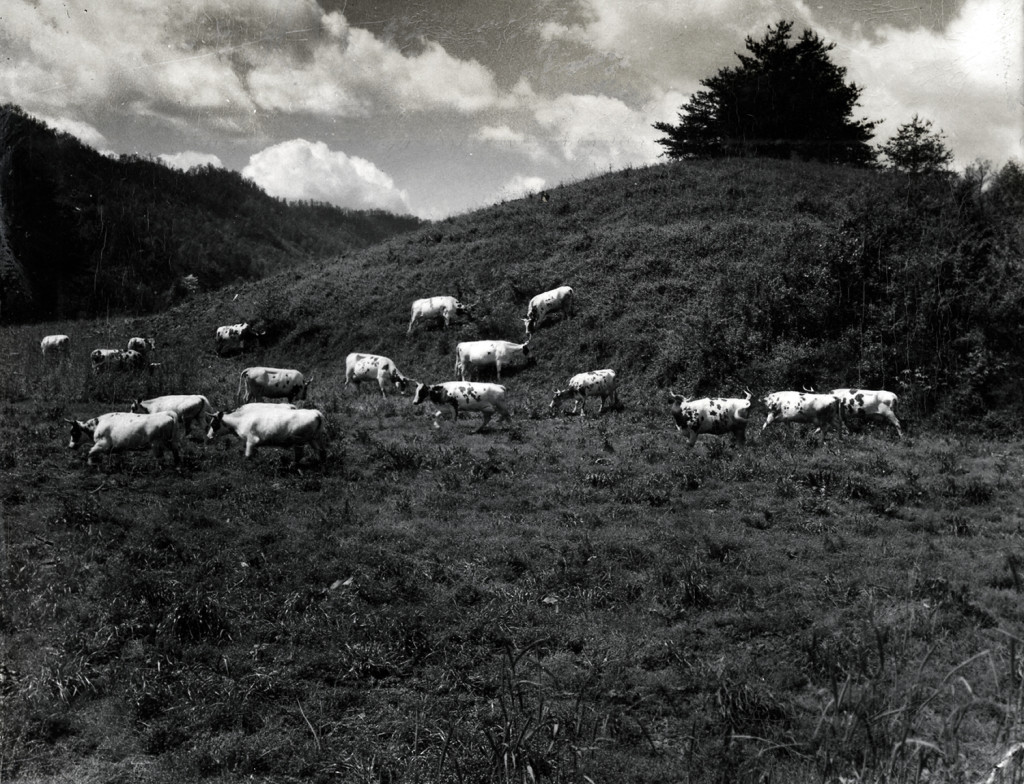
Ayrshire herd at Grapevine Knoll, Pine Mountain Settlement. [nace_1_052a.jpg]

THE COW

In the collection of the archive at Pine Mountain there is a curious and fanciful scrapbook of everything “cow”. Collected by Elizabeth Hench a member of the Pine Mountain Board of Trustees, the body of material celebrates the ruminating bovine. It is rich in images and quotables, as well as cartoons and paintings that capture moments all too familiar to those who share or have shared their lives with cows. Hench calls her scrapbook, “Joy Made History” and it features the Ayrshires that made up the large herd that became the pride of Pine Mountain Settlement School’s farm. But, that’s a later story. However, one particular fragment in the scrapbook collection caught my eye. It was a chapter removed from a little book of rural reminiscences called Bucolic Beatitudes by the author “Rusticus”. Published in 1925 by the Atlantic Monthly Press of Boston, the little book’s cow chapter was pasted inside the scrapbook. It was titled “Blessed Be the Cow.”

RUSTICUS

This one bucolic fragment by Rusticus calls up memories of the many cows I have known. The chapter charmed my imagination. It describes a chance communion of Rusticus with his milk cow, “Dolly” which changes his day of discontent to one of joy. Because I grew up with cows, it is not surprising to me that the mood change occurred when Rusticus made an unexpected bond with his “contented cow.”

Rusticus, as the author calls himself, had escaped a family gathering and small irritations on his farm by taking a walk. In the hot summer sun, he found a tree in his pasture and languished under its shade. Soon he was joined by the family milk cow, “Dolly” who also relished the shade of the tree. Dolly had ambled to the tree, and begun to chew her cud while curiously eyeing her owner. Both man and cow were soon prone on the grass not far from each other. Dolly chewed slowly on her cud and Rusticus ruminated on the relationship of man to animal as he stared at the contented cow. The following is Rusticus’ short description of their subtle communion

There being nothing else to look at, I looked at Dolly. She was chewing her cud. The slow rhythmic precision of her technique fascinated me. I particularly admired the sideways movement of the lower jaw. She stopped; a gentle genuflection of the neck was noticeable; and she resumed. I had never had a chance to observe a cow before and I made the most of it. I felt that I was seeing for the first time the noble dignity of her head, her broad fine brow, and above all the eyes, serene and beautiful.

Rusticus. Bucolic Beatitudes, Boston: the Atlantic Monthly Press, 1925, pp 58-9

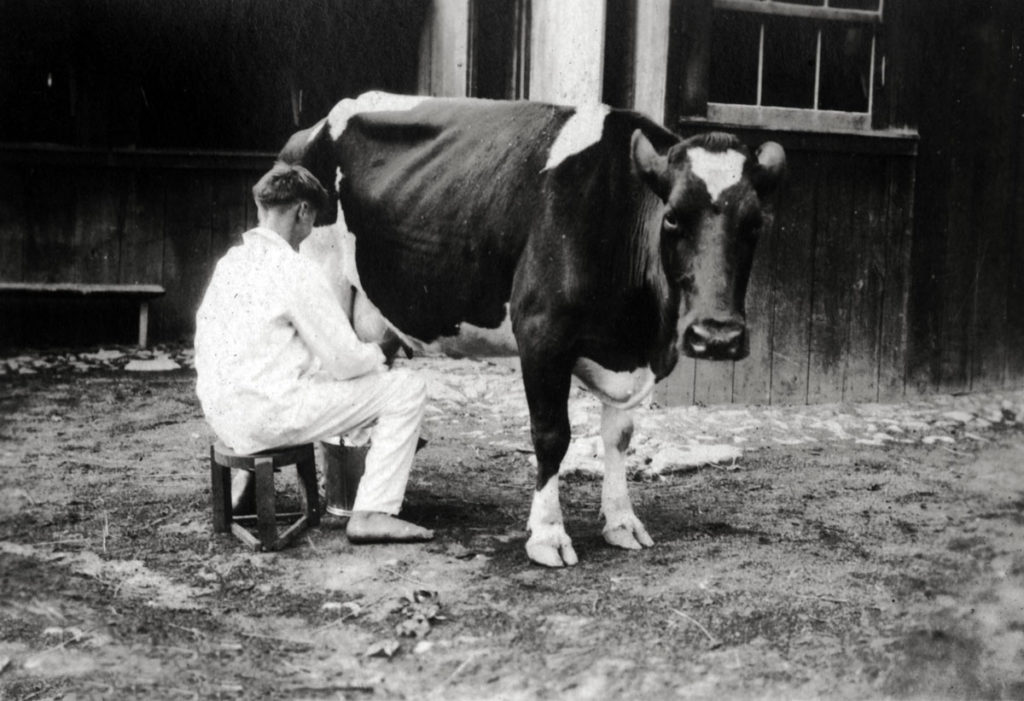
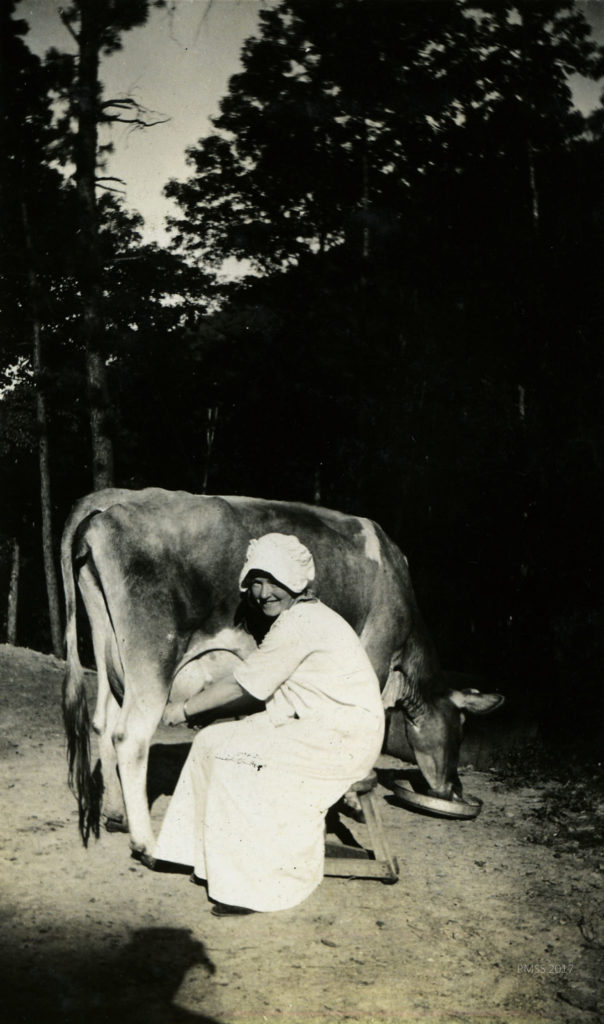
Rusticus continues his observations until the cow stirred, got to her feet and started the path to the barn. It was milk time and a cow feels milk-time calling her. Man and cow ambled slowly to the barn where Dolly is the be milked by a farm hand whom Rusticus calls, “The Incomparable One”. The process of milking that Rusticus so carefully described in this little book is also documented in photographs taken at Pine Mountain in the early years of the School before the Ayrshire herd was begun. Though, I doubt that “The Incomparable One” would have ever shown up barefoot. ‘

Milking the cow in the barnyard at Pine Mountain Settlement School, c. 1918. mccullough_IV_135b

Dolly now in place … With hands and arms glistening from recent soapy ablutions, he [The Incomparable One] takes the pail and holds it to the sun. He examines every inch of it critically and with deliberate care … His examination complete, we go where Dolly waits. He takes his place on gently tilted stool; we stand to one side. He pulls his rolled-back sleeves an inch higher, his great firm hands are rubbed together and then the fingers flex in smooth preparatory exercises. He leans forward and gently touches each teat in turn. From each he pulls a tiny lactic stream and lets it fall upon the clean rye straw beneath his feet. This is not done because — as held by some — the first milk contains more impurities than the rest; it is a libation, a propitiatory offering to whatever god there be who presides over the destines of cattle and impecunious rural sentimentalists.

And now the upward glance. A little figure, each in daily turn, takes its place and Dolly’s swinging tail is gently held at rest. The pail is raised to its position between extended knees, and all is ready. I notice that the milker adheres to the proper school. I do not hold, myself, for a position with the forehead of the milker pressed against the bovine flank; rather I like to see the left knee gently touching the off hind leg. It is a satisfaction to see things done with a nice attention to detail.

An now we hear the first streams strike the bottom of the empty pail. The shrill staccato of their impact is the overture, soon muffled by the increasing flood. The cadence slows; we are in the full orchestral swing by now. The milker’s bowed head is slowly raised, and, as the white foam nears the top he looks aloft. He sways a bit on his tilted stool; his head moves gently back and forth like some inspired conductor carrying his musician through the difficult passages of a mighty symphony. And now the beat quickens, the little streams leap into the rising tide of foam with soft lisping sounds. A final volley; then a few soft notes, long-drawn, and it is done.

… ‘Half quart off to-night — the grass is getting dry,” he says.’


Rusticus. Bucolic Beatitudes. Boston:The Atlantic Monthly Press, 1925, p.64-66

The ritual described in this short passage from Bucolic Beatitudes, was repeated over and again on early small Appalachian farms of those lucky enough to own such a gentle bovine ruminator. But the chore of milking was most often accomplished by the woman of the household, not a man.

A humorous mountain ballad captures the load the Appalachian woman often endures in house and on farm. It also calls out the relationships that cows often make with the milker. Cows, like people come with attitude and some cows are not quite so cooperative or bucolic as Dolly. The following brief stanza from “The Old Man in the Wood,” that I sang as a child, describes what happens when the man of the household brags that he can “… do more work in a day, than his wife can do in three…”

THE OLD MAN IN THE WOOD

There was an old man who lived in the woods
As you can plainly see
Who said he could do more work in a day
Than his wife could do in three

“If that be true,” the old woman said,
“Why this you must allow:
You must do my work for one day
While I go drive the plow.”

“Now you must milk the tiny cow
For fear she shall go dry
And you must feed the three little pigs
That are within the stye
And you must watch the speckled hen
For fear she’ll go astray
And you must wind the reel of yarn
That I spun yesterday.

The woman she took the staff in her hand
And went to drive the plow
The old man took the pail in his hand
And went to milk the cow.
Tiny hitched, and Tiny switched
And Tiny cocked her nose
Tiny gave the old man such a kick
That the blood ran down to his toes….etc

After failing to complete all the other tasks he said of his wife

Yes, he swore by all the leaves on the trees
And all the stars in heaven
That his wife could do more work in one day
Than he could do in seven.


Jean Ritchie. The Swapping Song Book, Lexington: Univ. Press of KY, and collected by Pine Mountain Settlement School in the PMSS Song Ballads and Other Songs printed and published by Pine Mountain Settlement School.

Many of the nine Ritchie Family children attended Pine Mountain Settlement School and also nearby Hindman Settlement. Jean attended public school and the University of Kentucky later becoming a well known folk singer. See PMSS records for May Ritchie, Truman Ritchie, Patty Ritchie, Una Ritchie, Kitty Ritchie.

A happy ‘Dolly” cow being milked and fed. Where is the bucket? mccullough_III_096b

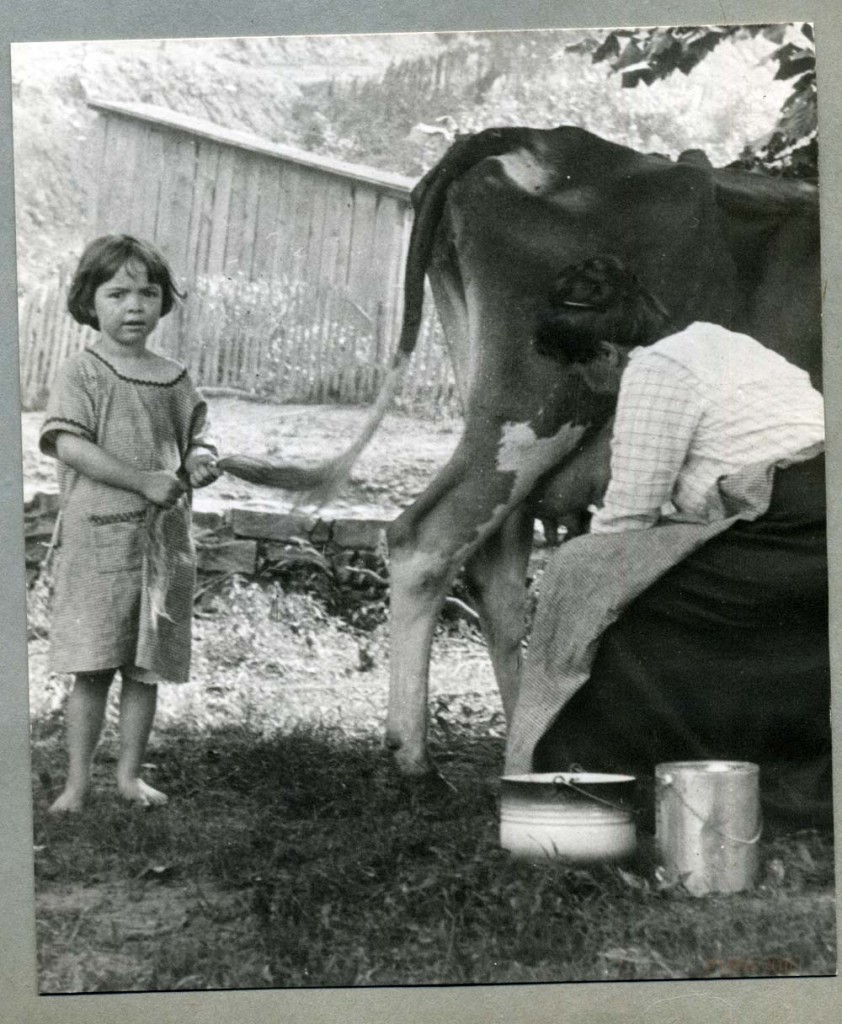
Cow tales abound in the Pine Mountain literature. And cow tails figure in many of the tales. When Tiny “twitched and Tiny switched” that was in reference to the switching tail used to dispense the many flies that often troubled the summer milk cow as well as troubling the milker. When Rusticus described the “little figure” coming to help the “Incomparable one,” he was, no doubt referring to some child assigned to this task. The photograph below, demonstrates the firm grasp of the tail which keeps it under control for the milker to progress.

Child tending cow to keep tail from switching on the woman milking. c. 1930s [nace_II_album_017.jpg]

FIRST, YOU HAVE TO FIND THE COW

Not only is milking a challenge, first, in the early years, one had to find the cow. Before range laws were in place, cows roamed freely in Appalachia and in other places in the Country. The cows were generally fitted with cow bells to more easily locate them. The bells were not just auditory ornaments, they were a GPS system that children could use to correlate cow and sound. Before the cow could be milked it had to be found and brought in for milking and be secured for the night. The following story by a Pine Mountain School student (unnamed) describes the task of finding the cow — a chore that was often assigned —- like tail holding — to children.

AS I LOOK BACK

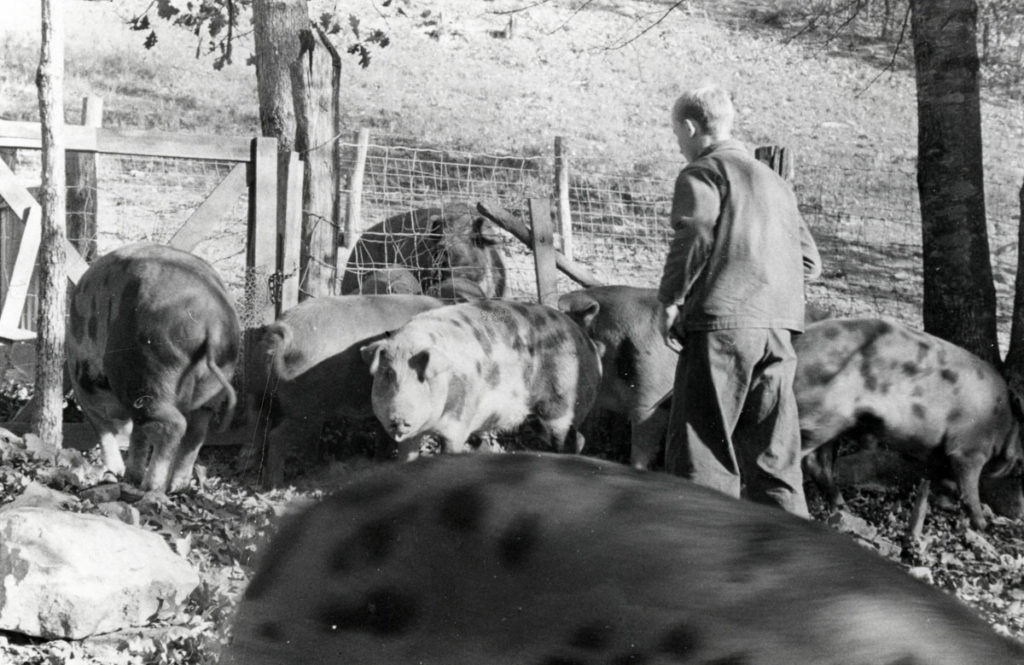
Oh, how I dreaded to see the time come just at sun set to hunt the cows, call up the dog and start up the hollow! How far it took, for the old belled cow was way up in the weeds and briars as far as she could get. I can still pant from climbing that steep hill knowing I would have to hunt for two hours maybe before I found them all. When I started from the house to get them, old Pide’s bell could be heard very distinctly but when she heard me coming not a tap of the bell would she make. Finally the dogs would find them all and down the hillside they would come with clouds of dust behind them, for they feared the sharp incisors that would clinch their legs. There was a reason why he never bit their tails; they were always too high in the air. Oh! how I dreaded to get to the gate with those cows for there were those pigs making their way like a terrific storm and we knew if they got out it would be another trip to the pasture field.

But sometimes we climbed up the cow pasture on our way to the Pine Knobb cliffs. There in the valley the house stands where the creek forks like a turkey’s foot. My mother and father are still living in it. Although on the cliffs we were a mile away, all that stirred around our house could be seen. Far, far away in other directions we looked into yet other valleys. At our feet were lovely tree tops where birds hopped from limb to limb and from one tree to another. When the sun hid behind the hills we started homeward. When we reached the big rock we would have to stop to satisfy our hunger from the store of walnuts we had gathered there. I’m sure our cracking stones are still in place. It was those times of fun we had cracking walnuts that made the thought of getting the cows, that never came by themselves, a little softer in my mind.

Anonymous. The Pine Cone 1937 Pine Mountain Settlement School newsletter.

And, that brings us back to Elizabeth C. Hench and her Joy Stock Company Limited Letters 1927-33. (People can ruminate just as can the cow.) The following is the last letter in her series of letters to those who so loyally supported the Ayrshire herd at Pine Mountain for many years. It is a fitting letter as it returns to the emotional contributions of cows to the world. Written near the end of the Great Depression, the letter is edgy with humor and anxiety.

The grand Ayrshire herd at Pine Mountain Settlement would last only a few years after the closure of the boarding school. When the expense and the labor to support the program and the new regulations regarding milk production came into play, the dairy herd became no longer viable. The last of the herd at the School was sold following the departure of the boarding  students.  The cow bells had been silent for many years and even the gentle communions with the cows of our ruminating neighbors became infrequent. Cows in Appalachia have now been replaced by the Dollar Store and mountain pastures now feed deer and elk that roam freely. But, neither deer nor elk will summer-nap with you under the same tree nor will they share their milk, or mellow your mood …

LETTER TO THE MEMBERS OF THE JOY STOCK COMPANY LIMITED 1933

Dear Stock-Holder:
Ordinarily I am as restless as a short-tailed bull in fly-time until I get the autumn cow letter off. But during the summer just past, to those of us in this section of the world, autumn, with its many days or rain, brought no terrors. As we oozed and mopped, we looked in vain to cows for relief. For, do you know, cows are weatherwise? Here are some of the signs:

1 — If a bull goes first to pasture, it will rain.
2 — If cattle lie down at once when they reach pasture, they want a dry bed before rain starts.
3 — If a cow licks a brick wall, rain will fall.
4 — If a cow lies down on her right side, rain will come soon.

But cows went placidly and contentedly on their way. What matter to them if springs went dry and creeks fell? The cow with the iron tail would supply them!

Contentment is so often spoken of as a characteristic of cows, that a quatrain I found does not ring true:

“The Worry Cow would have lived till now
If she had only saved her breath,
But she feared the hay wouldn’t last all day,
So she choked herself to death.”

Nevertheless, if the Joy Stock Company, Limited, and REJOICE, our cow, don’t have checks, we’ll be ready to sing The Tune The Old Cow Died On —

“There was an old man, and he had an old cow,
And he had no fodder to give her,
So he took up his fiddle and played her this tune:
‘Consider, good cow, consider,
This isn’t the time for grass to grow,
Consider, good cow, consider.'”

Those of us who have ridden along the main highways, have been enjoined by huge posters to roll our own, but how can REJOICE roll her cud without food?

If there be (notice the conditional tense) any of us whose incomes have not been slashed, and if there are any of us who can squeeze out a little money, let us send our checks soon.

From one who tries to keep the Milky Way
always visible at Pine Mountain,

[Signed] Elizabeth Hench

P.S. Did you realize that Amelia Earhart Putnam’s landing in Ireland was witnessed only by a herd of frightened cows?

https://pinemountainsettlement.net/?page_id=17147

SEE ALSO:

ELIZABETH C. HENCH Joy Stock Company Limited Letters 1927-33

DANCING IN THE CABBAGE PATCH The Dairy

DANCING IN THE CABBAGE PATCH Farm and Dairy Early Years

DANCING IN THE CABBAGE PATCH Farm and Dairy II Morris Years

ALICE COBB STORIES Howard Burdine Tail of Old Red

DANCING IN THE CABBAGE PATCH – Mountains and Sight to the Blind

Pine Mountain Settlement School
Series: POSTS
Mountains and 
Lucy Furman’s Sight to the Blind

MOUNTAINS 

Lucy Furman’s Sight to the Blind is one of the most memorable early works written by a Settlement worker in the Appalachian Mountains. Her process of adapting to living in the mountains of Appalachia was both an inspiration and an education for women of similar interests – those who wanted to find purpose in their lives while challenging themselves in one of the most remote geographies of the United States at the time.

Lucy Furman arrived in Knott County in the Eastern corner of the Central Appalachians in the first quarter of the twentieth century. Her keen ear for speech and her equally observant sight have left her readers, one of the more honest accounts of life in the remote Appalachian mountains near Hindman, Kentucky. Her graphic depictions of the beauty of the physical landscape begin with the eye and ear of an “outsider” but it is soon clear that the term “outsider” meant little to Furman. The bifurcation of “insider” and “outsider” are often reduced in distinction by what some may broadly call our joined “human condition” – something that Lucy Furman knew all so well.  

In her writing, Lucy Furman weaves a panoramic picture of early rural mountain living with the briefest of narratives. In her novel, her literary eyes and ears are sharply focused on the life of one mountain woman, whose name is Aunt Dalmanuthy. It is Aunt Dalmanuthy’s “Resurrection” following cataract surgery on her eyes that gives the book its title. The novel is slim and brief in details, but broadly panoramic as seen through this story of “vision.” It is so much more than just another Appalachian hard-luck novel. It is an ode to mountains written in the early dialect of the region but rendered with reverence and remarkable accuracy.

First recorded in the Century Magzine in 1912 and then published in book form by Macmillan Co., the book immediately had a wide audience. The 1914  publication’s popularity was enhanced by the introduction written by the journalist Ida Tarbell, a well-known journalist of the day. Tarbell prepares the reader for the journey Lucy Furman has chosen to share. She maps out the terrain ahead by broadly outlining the remote social setting and appealing to women’s instinct for new adventure in the locked-down world of the early twentieth century.

The stature of Tarbell no doubt boosted the sales of Furman’s book,  but Furman’s small book, Sight to the Blind is for the author, Furman, a classic in Appalachian literature. Her small book was written just as Katherine Pettit, the founder of Pine Mountain Settlement School, and her colleagues from Hindman were working to establish a new mountain school in Harlan County, Kentucky. Furman knew Pettit and, like many who had met her through her role in the earlier founding of the Hindman Settlement (W.C.T.U School), Furman was intrigued by such bravery and applied to work with the early School at Hindman.

Lucy Furman, became a long-time employee of Hindman Settlement and a lifetime friend of Katherine Pettit and  Pine Mountain Settlement School. Settling in at Hindman, Furman soon became well-known for her intimate literary portraits of eastern Kentucky and particularly of her life at Hindman, the first rural settlement school in Kentucky.  First called the W.C.T.U Settlement, Hindman was established by Pettit and her wealthy Louisville colleague, May Stone, who shared many of the same founding principles as Pettit. The W.C.T.U name, or Women’s Christian Temperance Union, paid homage to the school’s primary benefactor. In Furman’s book Sight to the Blind, she captures the essence of the “temperance” mission and gives it an exclamation mark! Her W.C.T.U. admiration was, however, not shared by Pettit, who kept some distance from the tenants of the anti-alcohol manifesto of the W.C.T.U. organization. 

But, like Pettit,  Furman had a keen ear for the local mountain dialect and culture, and she also had a keen nose. She could tell when liquor was in close company and took some pride in ferreting it out. In Sight to the Blind, Furman uses all her senses in the novel to bring the reader as close as possible to time and place and people in the mountains of Eastern Kentucky. Those who have grown up in the area, as this author has, will quickly sense the reality, the language,  and the delight of that early time in the mountains that Furman recalls in her book.  Many still living near the waters of Troublesome Creek, or whose ancestors lived nearby, will, no doubt share Furman’s delight and the author’s despair in the habits of the rural community – habits that are a deep silo of literary fodder. The geography and the life of the area agreed fully with Furman and she remained for her lifetime.

THE STORY

In Sight to the Blind, Furman tells the story of a woman whose sight is impaired by cataracts and who rails about her dark world to anyone who will listen.  Her plaintive and sometimes raging invectives as the book opens are familiar territory to many who have had similar “quarrelsome” relatives or who welcome a venue to gripe about current status. Aunt Dalmanutha is especially quarrelsome and easily animated by the local preachers as well as the “do-gooders” from the settlement school (Hindman). With the preachers, Dalmanutha is especially cantankerous.  Who are they to think that her vision will clear if only she will open her eyes to God as the local preachers admonish. She takes issue with the criticism of compatriots for her ‘ornery life” which they blame on her impaired reception of their Christian way of life. Dalmanuthy is not one to go gently anywhere.

In relating the story of Aunt Dalmanutha and her family, the author reveals many of the classic struggles with faith found in the course of Appalachian mountain living in the first quarter of the twentieth century.   Furman graphically challenges some of the basic tenets of mountain preaching with what she experienced in her early urban Settlement Movement life. The local preachers, if any ever read her books, most likely saw her as “ornery” as Dalmanutha. The challenges described by Furman are the familiar challenges that ring throughout early rural settlement school literature and that today resonate so strongly with many women’s issues worldwide. It is this obstinacy of Furman that attracted the author and most likely inspired suffragist Ida Tarbell to laud the all-too-familiar worldwide women’s story, then currently playing out in the mountains of eastern Kentucky.

Ida Tarbell says in the opening lines of her Introduction to Furman’s  authorship of two novels

A more illuminating interpretation of the settlement idea than Miss Furman’s stories “Sight to the Blind” and “Mothering on Perilous” does not exist. Spreading what one has learned of cheerful, courageous, lawful living among those that need it has always been recognized as part of a man’s work in the world. It is an obligation which has generally been discharged with more zeal than humanity. To convert at the point of a sword is a hateful business. To convert by promises of rewards, present or future, is hardly less hateful. And yet, much of the altruistic work of the world has been done by one or a union of these methods. 

Harriet Butler, to whom Furman dedicated her book,  was one of the most beloved nurses at Hindman in its first years. She was later recruited to Pine Mountain Settlement to work with Pettit in her founding years in Harlan County.  Harriet helped to found the Big Laurel Medical Clinic, a satellite of Pettit’s newly founded Pine Mountain Settlement School in Harlan County. In Furman’s story of Aunt Dalmanutha, Harriet Butler is clearly the nurse, re-named “Miss Shippen” in her book.

Furman’s precocious book captures the sentiments of local families for their mountain preachers, but through Dalmanutha and in Miss Shippen, Furman strongly questions the ” … cock-sure pride in the superiority of his religion and his cultivation,” seemingly taking a jab at the male preachers who often dominated life in the eastern mountains.

Back to the book, Dalmanuthy, urged by nurse Shippen to seek medical assistance in removing cataracts from her eyes, Dalmanuthy, is finally persuaded by Miss Shippen to pursue medical treatment for her eyes. She travels by train to a Bluegrass medical clinic, and there, the necessary treatment is successful. After many weeks in recovery at the home of her doctor, where she not only has her sight restored but is also given a new set of teeth and, more importantly, a “resurrection” in spirit, Dalmanuthy emerges a “whole” woman.

The story is a short one, but so very powerful in its literary comparison of the struggle of women to cope with Appalachian rural mountain life. The narrative places Dalmanutha as a strk contrast to the affluent life of women in the Bluegrass region.  On her return to the mountains, eyes wide open, she is Sight to the Blind personified. The dialect of Dalmanuthy, a woman who was severely impaired and poorly served by her environment due to the limited resources, is reborn powerful, eyes and soul now wide open to the world.  The physical limitations of her medical condition are removed, and with the new sight, she then recovers her self-reliance. She falls back into the well-known strong mountain reliance that some mountain women find, and some do not. But, is it enough for Dalmanutha?

The treatment to restore her sight was successful. But she is also reborn. As she travels back to her home in the mountains with her sight restored, she is quoted in the mountain dialect by Furman in what can only be called an Appalachian epiphany

‘But it were not till I sot in the railroad cyars ag’in, and the level country had crinkled up into hills, and the hills had riz up into mountains, all a-blazin’ out majestical in the joy of yaller and scarlet and green and crimson, that I raley got my sight and knowed I had it. Yes, the Blue Grass is fine and pretty and smooth and heavenly fair; but the mountains is my nateral and everlastin’ element. They gethered round me at my birth; they bowd down their proud heads to listen at my first weak cry; they cradled me on their broad knees; they suckled me at their hard but ginerous breasts. Whether snow-kivered, or brown, or green, or many colored, they never failed to speak great, silent words to me whensoever I lifted up my eyes to ’em; they still holds in their friendly embrace all that is dear to me, living or dead; and, women, if I don’t see ’em [the mountains] in heaven, I’ll be loesome and homesick thar.”

Furman, Lucy. Sight to the Blind, New York: McMillan Company 1914. With an introduction by Ida Tarbell.

Ida Tarbell speaks to this transformative event in her Introduction to the book

“A more illuminating interpretation of the settlement idea than Miss Furman’s stories ‘Sight to the Blind,’ and ‘Mothering on Perilous’ does not exist. … That to which we have converted men has not always been more satisfactory than our way of going at it.” 

Our way of going at it” was, in Tarbell’s eye, better seen through the vision of women and not the men who handed down principles, good tidings, and doctrine, but governed by dire consequences from their pulpit and desk. Tarbell, Furman, Pettit, Harriet Butler, and many more women advocated for women to “settle among those who need them.” This was the ethos of the Mountain Settlement Movement that Furman and Tarbell felt at the beginning of the twentieth century and clearly nurtured in women who lived in the mountains of Eastern Kentucky, there to mix and mingle with an ethos so often found in women living in other mountainous regions throughout the world.

THE MOUNTAINS

In Eastern Kentucky, it is impossible to ignore the mountains. They are both majestic and terrifying. They are sheltering and limiting walls of comfort. They are defined as dwelling places. They face one on getting up and one on going to bed. In Appalachia’s hollows, if the back is turned on one, another is in the face. It is not hard to imagine the dwellers of mountains all nodding their heads in agreement, smiling, or feeling a great lump rise in the throat when thinking about their/our mountains. But mountains defy ownership or specific worship. Go to the top of any mountain in the Central Appalachians, and mountains roll out like an ocean, broken only now by the yellow rock pushing its flat islands of recent surface mining along the horizon.

Mountains are jointly owned. Mountain dwellers hold as tightly to those mountains they can see as well as those they live near or below.  Sometimes even those that they cannot see, they know they are there. Those who live “in” the mountains are truly enfolded by the arms, the hollows, of mountains in Eastern Kentucky.

Distant view of 3 men tilling field; mountains & barn.[nace_II_album_085.jpg]

The students who attended Pine Mountain Settlement School and, later, even those students who came to visit in the environmental education programs, carried their own interpretations of “their” adopted mountains. In the early 1940s, a small poem written by a boarding student at Pine Mountain Settlement School described very specifically the mountains she preferred. The poem captures the disjoin of living in a town in the mountains and living “in” the mountains. The writer, Pine Mountain Settlement School student, Mildred Centers, captures the sense of mountain ownership.

I’m getting tired of this place. I don’t like being all crowded together.

I like the good hills. You know — where there is plenty of room for everyone and some to spare.

All I’ve seen are boulevards, streets, avenues, and building. All I’ve heard is the whirr of the motor and the rumble of machinery. And the people — crowded highways, jammed buses, workers packed in the street cars. the shrill voices of men, women, and children while going about daily tasks wear on me.

I like the hills. You know — the quietness, with only the chirp of the birds, the sigh of the breeze, the trickle of the brooks, the rush of the mountain stream. Best of all the quiet moonlit fields where paths lead from valley to valley.

I’d like to take a run up a long steep slope of some hill, find myself a seat on a stone, and whistle some good old mountain tune.

Mildred Centers. Pine Cone 1944  January.

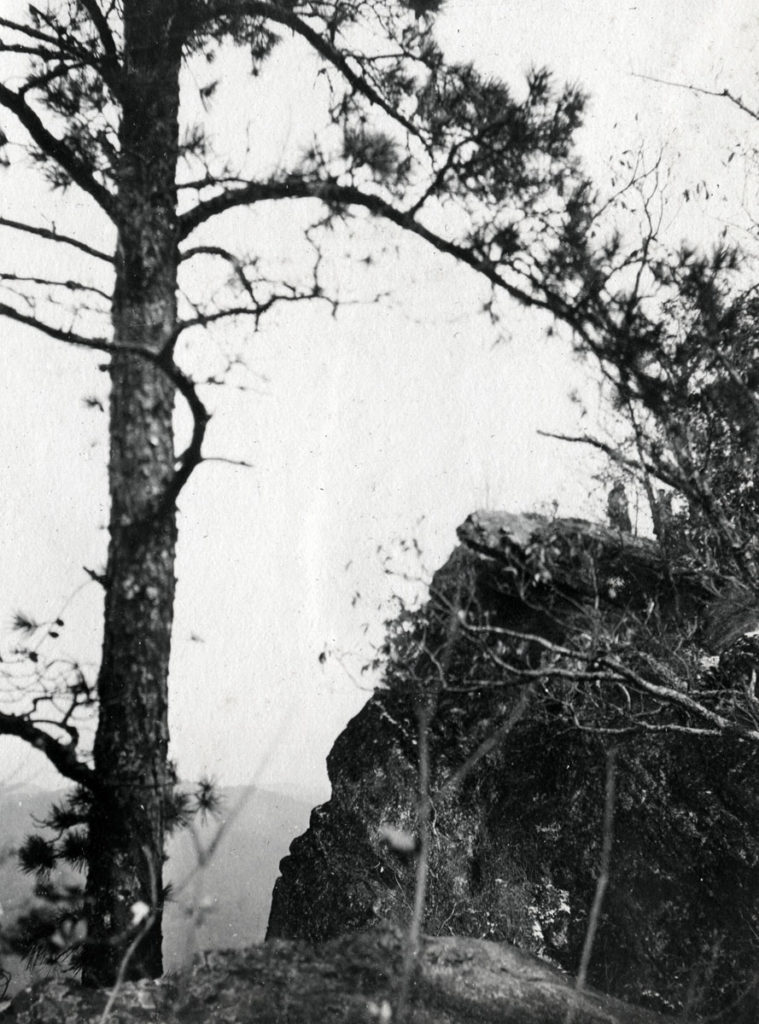
Jack’s Gap, is a favorite place to run up to. [pine tree and one figure on rock] mccullough_II_069c

The Geology of Mountains and “Dowbles”

“Pine Mountain is a long and unique ridge in the Central Appalachian Mountains that run through the Eastern section of  Kentucky. It extends about 125 miles from near Jellico, Tennessee, to a location near Elkhorn City, Kentucky. Birch Knob, the highest point, is 3,273 feet above sea level and is located on the Kentucky-Virginia border.” (Wikipedia) Pine Mountain Settlement School is positioned near the Eastern terminus of the long-tilted mountain chain.”

The geology of the long Pine Mountain inspired writers, whether as part of the local mythology or within the carefully delineated and many scientific tracts that have been written about the creation and evolution of its singular geology. Mr. Napier entertains us with his Observations on Pine Mountain when he describes the mountain as “…one of nature’s mysteries to be thought over.” He described to Katherine Pettit his view of the creation of the mountain as the remnant of a large river that originated somewhere near Long Island and was gouged out by the force of the water. He describes the Dowbles that one can experience when the ridgeline is walked. Some “Dowbles have retained the water and are treacherous swamps on either side of the mountain. He continues

You still see the signs of great river been flowed north east. You will find swamps, even marshes with more or less water followin’ the old river bed in different places the marshes are so bad that cattle gets in there and dies in the mire if they are not found and helped out. And decayed shells to show they has been a large water course the width of the clifts on each side of the Dowbles shows it has been the banks of the great river. By examinen the rocks on Both Sides of the old river bed it is plain to be seen that river flowed north east. If you notice you will get all kind of water flowin’ out of that mountain and you get the best proof of this by the lime stone in the Pine Mountain. The same lime stone you find several hundred feet below. Elsewhere the upheaval has raised the limestone ledge on Pine Mountain from a level of the lime stone bed found in northern Ky. around Lexington and Winchester.

To read more about Mr. Napier’s observations of mountains and their “upheavals”, visit the following page. Geologists beware …  but there is no doubt that Pine Mountain is “… a mysterious mountain that needs to be thought through.”.

Mr. Napier, Observations on Pine Mountain, 1 page
Come for a visit.

Pine Mountain is a long, narrow ridge starting in northern Tennessee and extending northeastward into southeastern Kentucky and southwestern Virginia. Its southwestern terminus is near Pioneer, Tennessee, and it extends approximately 122 miles (196 km) to the northeast to near the Breaks Interstate Park in Kentucky and Virginia.

DANCING Coming Back and Going Some More

Pine Mountain Settlement School
DANCING IN THE CABBAGE PATCH

DANCING IN THE CABBAGE PATCH Coming Back and Going Some More

TAGS: Roscoe Giffin, Southern Mountaineer, Cincinnati, migration, report,  Social Service Association of Greater Cincinnati, Mayor’s Friendly Relations Committee, workshop, Kentucky migration, sociological studies, statistics, population studies


ROSCOE GIFFIN AND THE  1954 CINCINNATI WORKSHOP

In April of 1954, Roscoe Giffin, faculty at Berea College, Kentucky, attended an important workshop held in Cincinnati, Ohio, and convened by the Mayor’s Friendly Relations Committee [MFRC] and the Social Service Association [SSA] of Greater Cincinnati. The gathering was titled simply, “The Southern Mountaineer in Cincinnati.” The workshop was conceived as a means to review the growing complexity of social issues surrounding “the newcomers from the Kentucky hills.”

Dr. Giffin was asked to write “The Southern Mountaineer in Cincinnati,” April 29, 1954, [the copy represented here is a second printing] that would bring together the issues facing the group and to assist in preparing the final report with the staff of the Mayor’s Friendly Relations Committee. Giffin’s work is a benchmark study of the going and sometimes coming back of Appalachian families who migrated to urban settings.

The issues for discussion determined by the participants were outlined as statements in the study:

  1. Substantial migration from the hills will go on due to the area’s poverty and high birthrate
  2. These migrants’ adjustment to city life, as workers, parents and citizens, is important to Cincinnati
  3. Too many now make a poor adjustment, to their own hurt and that of social agencies, city services, schools, churches, industry, and community relations generally
  4. The gap and conflict between living-ways of hills and city can be studied like any intergroup problem
  5. Pooling local experience and sociological data can reduce our ignorance and stereotypes, in fruitful consultation

A little over 200 individuals attended the workshop. With the support of the SSA [Social Service Association of Greater Cincinnati], the MFRC [Mayor’s Friendly Relations Committee], and a host of social workers, educators, government officials, personnel directors, and church and civic leaders, the joint effort produced a report. “The Southern Mountaineer in Cincinnati,” April 29, 1954, [here, second printing]. The final report was compiled by the staff of the Mayor’s Friendly Relations Committee and Dr. Roscoe Giffin of Berea College. It is a classic study of the going and coming back of Appalachian families to urban settings.

Dr. Giffin’s report is based on his observations of the work of the Cincinnati workshop and his own observations of the “culturally determined patterns of behavior which the Southern Mountaineers bring with them when they come to live north of the Ohio River.” By the necessity of the requirements of the urban setting, Dr. Giffin focused his report on “observed patterns of behavior” of the Southern Mountaineers in the urban setting and not on generalized behaviors associated with the people in their mountain regions. This declared bifurcation did not always work out in Dr. Giffin’s report, as it is nearly impossible to separate the two without assigning the Appalachian urban dweller a new identity. But perhaps that is one of his points.

KENTUCKY MIGRATION

What is so very valuable in Giffin’s study is the substantive work that he brought to the gathering social crisis identified with the mass migration of Appalachians to northern industrial cities such as Cincinnati. Statistically, he paints a growing population shift after 1870 in Ohio from the migration of populations from three states: Pennsylvania, Kentucky, and West Virginia.

By 1910, Kentucky had the second-largest number of migrants in Ohio in the metropolitan area of Cincinnati.  The largest population migration was to Pennsylvania, and West Virginia represented the third largest. By 1950, the entire Southern Appalachians were populated by approximately 8 million people. Also, by 1950, the distribution was roughly the same, but the new Ohio (not just Cincinnati) immigrant numbers had increased dramatically

1950 MIGRANTS

Pennsylvania 309,000 (new residents living in Cincinnati)
Kentucky 275,000 (new residents living in Cincinnati)
West Virginia 103,000 (new residents living in Cincinnati)

In the United States in 1950, Giffin informs us that there were some 3.5 million people who had been born in Kentucky, but only 2.4 million were living there. This put 1.1 million people living somewhere else. This suggests that the out-migration rate was near 1 in every 3 persons born in the state of Kentucky who chose to live somewhere other than Kentucky. Giffin points to the recurring cycle of coal-related employment as the impetus for most migration.  As coal production began to decrease following the end of  World War II, its market shares saw a sharp decline, and the jobs related to coal quickly collapsed. The economic bottom dropped out from under the poorly trained miners and those dependent on the coal economy. Out-migration saw upwards of 100,000 plus or minus people leave the state of Kentucky during the decline as coal began decreasing its production. The whip-lash boom and bust of coal production continued for decades following the downturn, exhausting both people and industry.

What seems so striking about the migration of people from the Southern Appalachians is the mobility of the migrants as they experienced the rapid shifts. While their mobility was fluid, the population tended to unite in cultural clusters within the chosen destinations.  The cultural cohesion in the new locations was and is not remarkable to Kentucky migrants.  They migrated, but they rarely severed their roots.  Time and again, Dr. Giffin notes the flow of cars filled with migrants going back to their states of origin for brief visits.  When times get tough, and the migration increases, the flow expands, but as economic conditions improve for the families, the ebb tide brings them back to “home” and family.  This brief but frequent return and immersion in their familiar surroundings, Giffin describes as a desire for the familiar, an integration that can be described as “knowing your way around” — a kind of immersion in family ties that reduces the emotional deficit” that strange places often bring about.” 

THE PROCESS OF APPALACHIAN MIGRATION

Giffin describes the process of migration as a familiar set of actions.  At “home,” the migrants sit around their familiar tables, laden with the familiar comfort foods, and tell family stories and share stories of the new, familiar city life. City life holds a considerable attraction for the young, and a tense dynamic often begins to evolve in the nuclear family.  Giffin suggests that the larger the family, the stronger the pull for migrants to maintain a connection with their home area. This “Familism” is a force that repeats itself over and over again in large Appalachian families, both yesterday and today.  It is of interest to Giffin that, as the Appalachian birth rate slowed starting in the 1950s to a 38/1000 ratio today, the pull to return “home” has not slowed significantly, though the returning population is largely comprised of those of retirement age. Another shift noted by Giffin in the urban populations is that the birth rate among the migrant Appalachian families declined. The result was a lessening of the pressure placed on housing in the urban landscape. The housing demographic is of particular interest to Giffin.

He suggests that the quality of living in an urban environment, while supporting a family of 7 to 8 children, requires significant income. Food, which often came from family gardens, is no longer available in the city and must be purchased and on top of rent costs. The economic demands substantially reduced any gains in the family income. Housing in the city for transient populations is generally rental and often sub-standard, as the urban landlords often exhibit hostile patterns of behavior toward the Appalachian populations, and extortion is not uncommon. 

The new economic demands, particularly the housing demands, gave families some urgency to seek out and form strong community bonds with Appalachian neighbors and other migrants and ethnic minorities. Giffin points out that these bonds are necessarily strong bonds.

WOMEN

In the 1950s, however, the patterns of behavior in the Appalachian family were not so remarkable to only that demographic.  Giffin seeks to describe them as a people apart, but the activity he assigns to their situation was repeated in many cities in the United States. It is a behavior that he called “well-marked.” He points us toward the women in the household.  Women across the country, he reminds us, were not leaving the home to work, he declares. Men still dominated the household wage-earner position women were still discouraged from leaving the home to work.

Women who did seek employment often faced the criticism of other women who saw work as interfering with child raising. Care for children and the affordability of child care were strong deterrents to women desiring to work outside the home in the 1950s. It was a trend that was diminishing but could still be found in communities throughout the country.  Giffin declares that the move to city life disrupted the cycle of “chores” that Appalachian family members engaged in. He observes that the discipline that accompanied the cyclical work routines, such as working the land and maintaining animals, began to fall away in the city, and new patterns began to develop.

Giffin observed that neighbors in the migrant communities of the city often changed frequently, and long interpersonal relationships were hard to establish. “Knowing your neighbor” and relying on the neighbor in an emergency became significant issues for struggling families in the city. The desire for the “community” had driven the Appalachians into extended communities of relatives and regional clusters, but even those could not sustain the pressures of urban life. The family authority also shifted to the mother, suggests Giffin, as the fathers were often more absent in the city environment. Giffin notes that this shift in parental control often resulted in the children’s and mothers’ anger issues toward the “absent but frustrated control needs” of the father.

WORK AND “JUST SETTIN” AND SCHOOL

Social issues surrounding motivation are also cited by Giffin.  He declared that the rural behavior, which he calls “just settin’ showed a marked disinclination toward competition and did not prepare the transplanted migrant children to deal with the competitive rivalry of city living. This lack of competitive rivalry, he notes, did little to prepare the children for success against the more competitive and versatile city dweller. Giffin tells us that “just settin'” is seen as “loafing” by the native city-dwellers, and a growing bias began to be evident in the areas of work and school.

Schooling was also a significant flashpoint in the dialogues of workshop participants. Giffin looked at the graduation statistics of the mountain counties of Kentucky and determined that less than 15% completed high school in 1950. In some counties, he studied he found that in the age group of adults over 45, most had less than 5 years of schooling. Absenteeism was a chronic problem in the mountains, and he cited the observation of half to one-third of the 7 to 13-year-old children who were out of school! This low regard for education placed many of the children far below their peers when they relocated to the city. It is little wonder, muses Giffin, that absenteeism was a chronic problem with the migrating families. in their new home.

MILITARY SERVICE

Giffin’s figures for the military draft seem to disagree with the popular notion that the Southern Appalachians saw a disproportionate number of men swept up in the draft.  The general myth has persisted that the Appalachians go to war in disproportionate numbers. This appears to Giffin as incorrect. The picture of strong, young, and eager men going to war and showing unusual bravery, such as the classic Sgt. York film mythology was not born out in the statistics. Based on an article cited by Giffin authored by J.J. McGrath, “Selective Service Rejectees — a Challenge to Our Schools,” in School Life, Vol. 35, No. 2, Dec. 1952 (pp. 35-37), the Selective Service in 1952 rejected 1/3 to 1/2 of all young men called into service from the Southern Appalachian region. This statistical analysis places the Appalachian region’s states among the highest rejection rates in the nation in 1952.  However, this does not take away from the high numbers from the region that served with honor and distinction in both WWI and WWII.

RELIGION

On the topic of religion, the Giffen study also has some surprising observations. He makes room for basically two strains of religious practice. The one, the Holiness organizations, he suggests, are attached to social status and reflect the belief that members “…are the elect because anyone who is rich obviously didn’t get there on the basis of virtue.” This “virtuous” group of believers is contrasted with the second group of more mainline denominations. This group is seen to be more affluent and members of the Baptist or more fundamentalist traditions. He notes that both the Holiness adherents and the Baptists seem to ignore the social gospel and show little interest in associating their beliefs with a social consciousness or action. This rather harsh observation suggests to Giffin that religion played a negligible role in moving the migrants toward any organized social self-rehabilitation.

MONEY MANAGEMENT AND “The characteristic of the species …”

Money management is another area that Giffin cites as problematic for some classes of Appalachian migrants in their new urban homes. A pattern that Giffin points to is the lack of ability to negotiate the thrift of tangible property and the saving of money. He notes an “easy come, easy go” attitude to money earned by many Appalachians.  He also suggests that there is another set of values, including thrift, that can be seen in some migrants. It is a tendency that Giffin suggests has its origins in the mountaineers’ Puritan heritage, but then does not further explain. Giffin suggests that the Cincinnati social service folk will rarely see migrants who come to their offices seeking relief from their social problems.  Giffin points to what he sees as a tendency for the migrants to see themselves as small numbers in a large city. As a group, they migrate in very small numbers to the city and only rarely will seek financial aid or present themselves as a perceived “problem case.”

At this point in the Giffin report, a phrase jumped off the page at this reader. It was his use of “the characteristic of the species ‘Southern Mountaineer’.” “Species”! Really? Up to this point, I could find points of identity with many of his observations, but suddenly I found myself lumped with a “species” that was separate from the rest of America. I began feeling like many migrants must have been made to feel in their new home. A “Rare species” suggests that any migrant from the Southern Appalachians is a rare species apart from the greater humanity — a sub-human being? The often-made comments about the Appalachians’ long and lanky arms, “slouching” figures, out-houses, and “Why do you talk different– look different?” surged to the top of my brain. Giffin now seemed, to this reader, as the unsympathetic observer and not an advocate for the welfare of the migrant he first seemed to champion.

Through the lens of the twenty-first century and as a Central Appalachian Mountaineer [Southern Mountaineer], I suddenly found myself wanting to take issue with Giffin and his observations. I wanted to be sitting in his classroom at Berea debating what made a sociologist tribalize his subjects — and that class full of Appalachian students. Strange as this reaction may seem to some, it was associated with the very section of the Giffin study that dealt with the freedom to see things differently. In many ways, Giffin touched on a dilemma that still plagues migrants and immigrants throughout the world. How do we maintain our identity with dignity and not with our native defenses? On reading this section again, it seemed valuable to transcribe a section in its entirety. Reading the quote again, I forgave him a little for his use of  “species,” which he isolated by quotes around “Southern Mountaineer.”

“Free to Differ, But —: Continuing this listing of the characteristics of the species “Southern Mountaineer,” we must not overlook the behavioral patterns centered around individualism. They expect to have their own decisions accepted and grant to others the right to their own decisions and the right to differ. ‘…Mountain people are inclined to be nonconformists. Many … have … ability to go their own way … being quite sure that their own way is just as good as anyone else’s.'” (20) 

The quote within the quote is that of Edwin E. White, who wrote Highland Heritage, published by Friendship Press, New York, (p.35), in 1947. It is often cited in connection with the perplexing problem of defining “culture” in Appalachia. In actuality, White’s book was written in 1937, not 1947. It was then re-published in 1947, ten years later, with no revisions. White, a Presbyterian minister, was not unlike William Aspenwell Bradley, whose article, “The Folk Culture in the Cumberlands,” in the Dial of 1918, tried to make a direct connection of Folk culture as found in Appalachia with the essence of American civilization. Even early writers as admired as John C. Campbell, in The Southern Highlander and His Homeland, used a broad brush to categorize mountain people…. it always ended badly as it set us apart — while yet giving us a “homeland” and consequently an identity.

The insistence on associating  Appalachian mountain people with specific ethnic, even racial, folk, and, for goodness’ sake, “species,” has been a trend that has plagued the field of Appalachian studies for the length of its existence. Sometime after 1920, this need to isolate the exceptional in the native Appalachian dweller began to fray, and today our contemporary conception of the nature of America’s civilization is one that is fundamentally comprised of both migrants and immigrants who share many of the same aspirations basic to well-being.

Another grave concern in the report of the Cincinnati workshop, in this writer’s view,  is the omission of a full accounting of African-American Appalachians as integral to an understanding of Appalachians, generally. Irish? Italians? Or? To read the report is to assume that there were no African Americans making the journey to Cincinnati to find work and that the only interaction occurs with “natives” or so-described Anglo-Saxon whites. The African American, Irish, Italian, German, and other racial and ethnic populations are also represented as distinct subcultures but rarely are they isolated as a “migration” group from some American rural area. African Americans fleeing slavery and poverty in the South seem the most closely aligned to the Appalachian migrant. 

“Other” is used today to set people apart, and it continues to be a divisive word for Appalachian residents identified with a so-called Anglo-Saxon origin. Pulled along as “other,” America’s subcultures and sub-groups make up smaller proportions of many regions’ populations, but none of us is exempt from some subculture. The ratio of the “other” migrants in the Cincinnati social complex and their social relationship in the urban community is still under construction and discussion. Clearly, these “other” populations were not seen as integral to a discussion of the whole of the Appalachian migrants in the 1950s. 

All this close analysis of Giffin left me wondering about the isolation of intervention. It left me wondering if a consideration of all “others” would have come to fit Giffin’s analysis.  Would those “others” have benefited from the targeted social services that aimed to care for the Appalachian migrants? What were the similarities? What were the differences? Who saw them as not “fitting” the social need?  Would the “other” qualify as a “species” of Appalachian?  Such is the nature of the continuing debate about what constitutes an Appalachian. Clearly, when “other” is used, or “species ” is defined, someone is disenfranchised. “Other” builds a wall around people. The term fragments the discussion of what should be universal empathy for the distress of all populations forced to migrate and to immigrate. Social intervention needs to be a human instinct for all people in distress, both here and abroad. Intervention can not be parsed out to species, but only to people. Recognition and empathy for the individual seem to still be out of the reach of our contemporary world, which is now even more fractured than in the 1950s ….. and just what is “maximum recognition”?  Empathy does not need to be re-packaged.

MAXIMUM RECOGNITION

The author’s report continues its discussion of “Free to Differ, But …” and Giffin says

A practical application of these observations might be that personnel policies need to provide maximum recognition for the individual if their work is to yield mutual satisfaction.

I believe that this individualism also shows up as a tolerance, which partly explains the fact that they possess less of the deep-seated racial and religious prejudices characteristic of many Americans, both North and South. I am of the opinion that in the right atmosphere, they will lose their prejudices rather quickly. Such prejudice as they have is more like a coat than a suit of underwear into which one has been sewed. At Berea, we have found that their socially inherited prejudices yield quite readily to the medication of the integrated living of diverse racial, ethnic, and religious groups.

Migration is a story of going and coming back, but today’s migration is also a story of the struggle to identify a place that welcomes and understands going and coming back. We now have a world in a state of migration and immigration as people seek to leave places where life has become intolerable. Today, people are on the move due to many reasons: economic pressures, civil strife, political oppression, war, disease, and drought. ocean rise, environmental disasters, and a myriad of other impingements on quality of life.

MIND YOUR OWN BUSINESS

But, with an eye to the growing tensions in contemporary life, all these dilemmas bring us to another characteristic found in Giffin’s study. That is, “Mind Your Own Business.” While most scholars acknowledge the general individualism and tolerance of the Appalachian people, there is a long history of feuds among Appalachian people that could quickly escalate and result in violence. Such anger can also be slow to dissolve, says Giffin in his analysis. Guns still play a role in solving grudges, family disputes, and perceived injustices. With the prevalence of guns in society today and the long-standing role of guns in Appalachian households, this tendency is and should be a point of major concern to urban and rural social service providers alike. I suspect Giffin would find many who are sympathetic to this view.

WORDS ARE DIFFERENT

Well, I knew it was coming. Our language. Words Are Different, says Giffin — when spoken by an Appalachian. He notes that the language of Appalachian folk is distinctive. There is no disputing this auditory evidence. Scholars and others have found the distinctive sound and pattern and choice of words in the language of many Appalachians to be a treasure and a wealth of creative expression. Others have found the language of Appalachians to be “Hillbilly English” and a way to single “those people” out from the mainstream of American life and to label them as “ignorant”, uncultured, and lacking in social skill, particularly the skills of social dialog. It is my view and that of Giffin that what is needed is not a retooling of Appalachian English but a lesson in listening to the general population.  We all need to listen  — not just to the unique cadence and construction of the language found among Appalachian people, but also to what is being said. We could all benefit from a conversation that doesn’t focus on the “accent” before listening to the message.

SUMMARY

In summary, Dr. Giffin leaves us with this message. Listen and Look and get Beyond the Data. He questions whether we can statistically isolate the average Southern Mountaineer and notes that his survey is preliminary and partial.

He provided the conference attendees with a list of his summarized innate characteristics of Appalachian migrants

Behavior is directed by the traditions of the culture, but marked individualism is an aspect of this tradition.
At home in the mountains, the stranger is usually received with cordial hospitality, which may be concealed beneath certain shyness and reticence of manner.
Placidity of manner and behavior yields readily to any word or action which infringes on the prevailing definition of the rights of a free independent, self-reliant individual.
When so provoked, the response is apt to be militant if not violent.
Persons of authority tend to be defined as threatening rather than helping symbols though accredited authority is usually paid its due.

 Throughout this report by Dr. Giffin, I kept thinking of my grandfather in a migrant culture in some city in the North. I wondered how he fared. I thought about the process of describing the Appalachian migrant and defining his needs against what I knew and did not know about my grandfather. I thought about my own absorption of Appalachian traditions and culture, and my own long “migration” path that turned me into an “outsider” of my birth geography.

I recollected my own goings and comings and the patterns and traditions that I thought were unique and that held resonance with the patterns seen in the Giffin report. I thought about the current political tribalism that so readily identifies those for “us” and against “us”. I mused about the current state of the nation and measured that against the turmoil I have seen characterized in the political attention paid to Appalachia and Appalachians. I have learned that “going back” is sometimes painful, and sometimes joyful. I have learned to question my “Appalachianess” and to treasure it and distance myself from it when it centers on the darker side of human nature.

What is lost and what is gained from all the coming and going from our places of origin? What does it mean to have an identity? Are we born with identity? Is it enough just to be a part of humanity in this world of branding? Our labels used to be on the inside. We had style, not fashion, or even more sinister, fad.  As Appalachian-born born have we been co-opted? Will the current identity crisis only be a fad defined by the J.D. Vances of the world? Our problem is not in the symbol but in the semiotics.

In giving this coming and going a deep thought, I remembered what I  read in a favorite book by Raymond Williams, The Country and the City, as he watched his rural countryside being destroyed by manufacturing and railroads.

“It is not the known, but the knowable community: A selected society in a selected point of view.”

I did not go and come back. I am constantly going and coming back and going and selecting my point of view.

SEE:

DANCING IN THE CABBAGE PATCH Going and Coming Back I

DANCING IN THE CABBAGE PATCH Stones, More Stones and Scalloped Potatoes

Pine Mountain Settlement School
DANCING IN THE CABBAGE PATCH
Blog

STONES, MORE STONES AND SCALLOPED POTATOES

TAGS: DANCING IN THE CABBAGE PATCH Stones, More Stones and Scalloped Potatoes; Pine Mountain Settlement School; Harlan County, KY; stones; scalloped potatoes; rocks; agriculture; farms; farming; foodways; cooking; Raven’s Rock; limestone; geology; lime; lime burning; kilns; quick lime; Perry County; accidents; horses; horseback riding; doctors; Dr. Alfreda Withington;


On June 8, 1920 Katherine Pettit wrote to Martha Van Meter, a nurse at the Line Fork Settlement, requesting her to purchase some grey shambray so she could mount her paper maps and preserve them. She goes on to ask Miss Van Meter “How are you on library and office work and filing and such things or do you rather dig and pile rocks as I do?” Miss Van Meter’s response is not known but the exchange suggests that rocks were a constant measure of how one approached work at Pine Mountain. The memo also signals  Pettit’s deep engagement with the land and its geography and geology.

ROCKS AND THE PINE MOUNTAIN RANGE

The geology of Pine Mountain is very complex. But one component is much in evidence. That is the stone. Limestone, conglomerate, shale, shist, coal, and sandstone are in abundance. From the bothersome creek boulders to the giant Rebel’s Rock, or the beautiful Raven’s Rock arch, stones in the region can charm and confound.

Kendall Bassett Photograph Album, c. 1928-1929. [pmss001_bas001.jpg]

BURNING STONES  –  LIMESTONE AND LIME KILNS

One stone in plentiful supply in the Pine Mountain geology is limestone. Limestone is in rich supply in the valley of Pine Mountain. Often limestones and other stones were troublesome and were carried from the fields where they had troubled the plow. But some stones could be a gift. Limestone, for example, was a gift to the soil and to the farmer. Limestone is a stone that can be burned. But unlike coal, limestone, when burned, produces rich by-products. The richest of these by-products is known appropriately as “lime.” It is an important nutrient for many crops in the mountains of Eastern Kentucky and helps to neutralize the soil’s acidity.

While the burning of limestone for lime has consumed considerable forest throughout history, it is still well-known as a boost for tired soil. Today packaged in various fertilizers, it continues to be added to the soil to support crops and enhance grazing land. Before the importation of commercial fertilizers, however, lime was wrested from the stones of the surrounding mountains.

The history of lime-kilns goes far back in the history of the world and no doubt the practice came to the New World with our earliest ancestors and settlers. Until the advent of commercial fertilizers, the production of lime through lime kilns (the burning of limestone) was common throughout much of rural America. It was, however, not so common deep in the small valleys in Appalachia. The practice of burning limestone for fertilizer, according to some, was a practice that Pine Mountain Settlement brought to many in the local farming population, though the practice of adding lime was in practice before the School was founded.

The so-called “lime cycle” starts with the stone — technically known as calcium carbonate and carries the chemical compound symbols of CaCO3. The limestone is stacked over a fire fueled by wood or coal and layers of limestone and fuel are then alternated to create a sizable pile that will burn for 10 days or more. This “pile” generally reaches temperatures in excess of 1200 degrees Fahrenheit. The heat from the fire cooks off the carbon dioxide, CO2, and leaves a rich residue of carbonates (calcium oxide, CaO). This calcium oxide, also known as “quick lime” can then be applied directly to the soil, or better, can be mixed with water to de-acidify the soil.

Building the llime-kiln 23_campus_work_052

Stacking the lime-kiln 23_campus_work_050

The lime-kiln fired-up and producing lime for farm land 23_campus_work_051

Quick lime can also be used to make “white wash,” an insect retardant “paint” often seen on the base of trees, or on fences or around the base of wooden structures in early Appalachian homesteads. Even much later, well into the 1950’s and 1960’s, homes sported trees with their bases white-washed or old tires painted white and filled with flowers or foundation stones supporting a home, carefully painted white. An important early use was hygienic. Lime was a key additive used to keep insects and disease at bay in the many privies of the Appalachians. Both lime and wood ash with its high concentration of lye were also used as alternative disease retardants in the privy. Today, lime is still used in water treatment and sewage treatment along with ferrous sulfate.

When quick lime is mixed with other additives, it can also be a key ingredient to strengthen concrete or added to stucco for the same purpose and for its pure white nature. It can bolster or build strong walls or can be used in ‘pointing’ stonework. Much of the concrete at the school used some local lime in the concrete mix. Today, the practice of burning lime has been replaced by commercial lime that may be purchased in fertilizer mixes and other commercial amalgams. The forest can be heard celebrating this turn toward commercial lime.

Analyzing and creating some of the early pointing concrete is an art. Pine Mountain has been fortunate to have Bob Yap’s good eye and deep knowledge of restoration when addressing many of the issues found in the stone foundations and sidings of many of the Pine Mountain buildings that have broken down with time. Yap’s annual workshops are some of the most exciting workshops held at PMSS. While Yap’s skills range across many restoration skills including window restoration, roof flashing, siding, fine carpentry, and so much more, he also addresses the vital skill or re-pointing rockwork. See the Pine Mountain schedule of events and workshops for dates the next series of restoration workshops.

STONES AND MORE STONES

Stones in the Pine Mountain valley are everywhere present. They fill stream beds, sometimes tumble down mountains, pose major obstacles in the construction of roads and homes, or provide the central building material of the same. They are rockwalls, laid dry-stacked one on the other and stone mantles above the stone fireplace. They mark the well-traveled paths around the campus. They hide the infrequent copperhead snake and the quick-witted “red-britches” ground squirrel. Stones are in evidence at every turn at the School and they are still being added to the landscape in the dry stack workshops that have now become an annual offering at the School.

hook_album_2blk__036

From Mary Rockwell Hook Album. [hook_album_2blk__036]

But, there is a difference between “cliffs”, “rocks” and “stones”.

Stone at the School can be found in flagstone walks and simple stream stepping stones. Rocks are often referred to as residing deep in the woods, where they are natural monuments with trillium tops and gentle fern and lichen-laced sides. They are places to sit for a stream-side picnic or a personal reverie. At Pine Mountain, almost no one is without a stone — or some affection for a “rock.” The Playground rock beside Isaac’s Creek is one of the most iconic rocks at the School. The large rock (no one calls it a stone) is nearly encased in the root of a giant poplar tree and provides many nooks to play or sit, or cut hair.

2457 Clyde Blanton and August Angel cutting hair at large poplar on playground, 1930s. [IX_students_09_2457_001.jpg]

The stone steps of Boy’s House have long been a favorite photography venue for Board pictures, students, and solitary musing. A special stone pulled from the steps of the Creech cabin was crafted by Andy Dorsky, a talented stone carver, into a seat where visitors may view the cabin.

POTATOES AND ROCKS

Not all rocks are stones. Potatoes were a popular crop in the mountains, but rocks and potatoes do battle in the field. It is difficult to grow potatoes in rocky fields, thus all workers took on the task of clearing the fields of rocks and turning them into construction stones:

“Another piece of economy has been the application of the two-birds-with-one-stone theory to the loose stones on our cultivable ground. We have secured building material for two sanitary closets and a fine tool house by gathering wagon loads of obstructive stone from our potato fields. As to rocks, we still have more worlds to conquer and we shall use them for building and retaining walls, paving, and roads.”

Nov. 14, 1914, Letter to Friends from Ethel de Long

DRY STACK CONSTRUCTION AND SCALLOPED POTATOES

In recent years Pine Mountain has held several workshops in dry-stack wall construction. The sinuous wall along the road from the Office to the Industrial Building (Plant Center) is a good example of the work of dry-stacking.

P1050413

Stone wall along road from Office to Industrial Building. [P1050413.jpg]

While it may be a stretch to compare stacking potato slices to something like stacking a dry wall, the art of stacking can make all the difference in a random pile of rock and a random pile of potatoes. Both can become an aesthetic work of art, or a tumbling pile of mush.

Dry-stack rock work was a workshop offered at the School and it can be a valuable skill for both a gardener or a cook. Both take a good eye! Dry-stack rock work may be seen throughout the School campus. Many of the walls are early drystack, but many are also the new and repaired work of the dry stack crews in training. A recent preservation workshop that re-built the wall just east of the Office were possibly treated to a meal with scalloped potatoes. It is not known if the masons were rewarded with the scalloped potatoes, but the following recipe is one drawn from the records of the School and would go well with a day of dry stacking.

SCALLOPED POTATOES

Scalloped potatoes? They actually have much in common with stacked stones. Potatoes are often what cause a stone to be moved, removed, stacked, broken up, hated or other actionable scenarios. Like dry stacked walls, scalloped potatoes are laid into the pan one slice on top of the other. In the kitchen the idea is “light-weight” but in the field, it is an exercise in heavy lifting.

SCALLOPED POTATOES

3   LB potatoes
4   T butter
4   T flour
2   t salt
1/4  t pepper
2  cups milk

Pare and dice potatoes and put in a buttered baking dish, sprinkling each layer lightly with the flour, salt, and pepper. Pour milk and melted butter over the potatoes. Cover, bake in moderate oven for 60 to 90 minutes.

Recipe in The Pine Cone, May 1935

GALLERY OF STONEWORK AT PMSS see ROCKWORK

Stones were life-long labor for farmers at the School as well as in the community farms and gardens. Some areas were more troublesome than others. The barnyard seen here was slow to be cleared of these troublesome partners of most mountain soils. But when “clearing” was completed, the stones were ordered into a rough paving behind and in front of the barn where the mud and muck was an ever-present nuisance.

Barn. Early construction with stones littering yard. [II_7_barn_281.jpg]

LIke the barn, other locations benefitted from the rearrangement of stones.  Stones were often an advantage when they were re-arranged and sometimes even if they were not. Before they were used as paving stones in the barnyard where the soft earth could quickly become mired with manure and mud, the native stones, though lacking organization, kept the yard drained and the feet of livestock sore but dry.

HORSES AND ROCKY ROADS, TRAILS AND PATHS

The stories of negotiating rocky streambeds on the backs of horses or in wagons abound in the Pine Mountain Valley. Steep mountain slopes and laurel thickets offered poor trails and often the thoroughfares were the streambeds. One story stands out in the myriad of tales of rocky-stream mishaps. This tale of the fall of Dr. Alfreda Withington on a dark night medical call is particularly memorable. In her own words from her autobiography, Mine Eyes Have Seen (E.P.Dutton & Company, 1941) she describes the 1926 accident that began when she was called to treat a child who had been badly burned. Dr. Withington had stayed the night with the family. As she started the next day on the long trip back to the Medical Settlement at Big Laurel by horseback she had what she described as “bad luck.”

It was the next day when I was returning alone from this visit, that bad luck overtook me. As Maud [the horse] was going downhill she stumbled on a rock, falling and hurling me straight over her head, so that I struck almost squarely on my face. I remember the sensation of hurtling through the air and hearing a crash. Then there was a blank

A mountain woman was standing over me when I came to. I had an awareness that something was wrong; putting my hand to my nose felt it crunch, and it was bleeding terribly. I told the woman to give me my kit, and lying there I manipulated the grating bones, straightened them, and poked some gauze up my nostrils. Though faint from loss of blood there was nothing for me to do but remount and ride the four miles home.

The next day my face was swollen beyond recognition. I rode thirteen miles more to the railroad and took the night train for Louisville to consult a specialist. He said I could be thankful indeed that my malar bones were not smashed; a stiff hat saved them.

“What I do every Friday. M.K.. [Marian Kingman] Along Grease [sic] Creek, Pine Mountain, Ky.” [kingman_098a.jpg]

Dr. Withington’s tale was repeated many times over by staff at Pine Mountain and the community families whose only roadways were streambeds and rocky hillsides. Most could identify with her “bad luck” as they had either experienced it or knew someone who had. Dr. Withington was 65 years old when her accident occurred. She was slowed down for a while but she continued to ride in streambeds and along narrow ledges above streams in order to serve the many families needing medical attention for many more years. She left the stones of the Kentucky mountains in 1931, finally retiring at the age of 70,

SCENIC ROCKS AND HIGH PLACES

Indian Rock, Rebel’s Rock, Raven’s Rock, arches,. Sandstone cave…..

STONE SOUP

Besides scalloped potatoes, there is Stone Soup. Any soup may become “stone-soup” when a clean and dense stone is heated intensely and dropped into a soup pot. It acts like a slow cooker and it both cooks and maintains the warmth of a meal. The following is a pleasant winter stone soup made from stored and home-canned goods.

Vegetable Stone Soup

1 cubed onion, braised (or added directly to pot)
1 qt. jar of tomatoes
1 qt. jar of corn
1 qt. jar of green beans
3 cups of beef broth
1 tsp dry oregano
1 tsp salt
1/2 tsp pepper

One clean medium stone thoroughly heated. Place stone directly in soup mixture. Let cook for 1 hour. Patience. Re-heat stone, if needed. Serve with cornbread. and cold buttermilk.


To explore the many uses of stones and rocks at Pine Mountain a quick look at the built environment, of foundations, steps, walls, etc..  All will give a good overview of the value and required skills to utilize this building material. Buildings that are noteworthy for their rockwork are the Chapel, Laurel House II, and Draper Industrial BuildingRockwork, as seen in ROCKWORK at PMSS can also demonstrate some of the troublesome aspects of this medium.

PLAYING IN THE ROCKY, STONEY, BOULDER STREWN CREEK

Ann Angel Eberhardt, the other editor and voice on the Pine Mountain Settlement School Collections website (there are two of us) shared the following story. Ann is a cousin, a friend, a writer and a superlative sounding-board. Her father is the hair-cutter in the photograph above.  When she read this piece about stones …  she felt compelled to share some of her memories among the stones of Pine Mountain. I am sure other readers will have similar memories especially of the creeks of Eastern Kentucky. I asked if I could share her memories of visiting near the right fork of Mason’s Creek in Perry County.

Your article reminds me of those times my family would regularly visit Mom’s people, the Halls, in Viper in the summers of 1940s & early 50s. We cousins would spend most days setting up little “playhouses” on the huge boulders in the creek. Each of us would have his or her own boulder (stone?) and use twigs, pebbles, stones, discarded items, and anything else we could find to create our playhouses. One cousin even directed the creek in a way to have “running water.” There was a perfectly round hole in the rocky creekbed that we called “Indian’s washbowl.” It was probably formed by eons of circling pebbles that the creek water washed into it.

Sound familiar?

Helen Hayes Wykle


SEE ALSO:

FARM and FARMING Guide
FARM Guide to Resources
FARM LIME KILN Processing

ROCKWORK AT PMSS


DANCING Weaving, Natural Talents, and Natural Dyes – Becky Mae Huff

Pine Mountain Settlement School
DANCING IN THE CABBAGE FIELDS
Weaving and Natural Dyes and Natural Talents – Becky Huff

DANCING IN THE CABBAGE FIELDS
Weaving, Natural Talents, and Natural Dyes – Becky Huff

Exhibit of weaving and woven craft. [norton_021.jpg]

Weaving may look very easy. Back and forth, back and forth, and voila! a lovely “runner” for the chest of drawers. But neither life nor weaving is that simple. The most exquisite weavings come from those weavers with natural talents, diligence, and a strong sense of self-worth. Becky Huff was one of those weavers of both cloth and life. She was one of the first children to attend Pine Mountain Settlement School c. 1914.

By 1930, shortly before Katherine Pettit’s retirement, she {Pettit} tried to recruit Becky back to Pine Mountain as one of Pine Mountain’s most talented weavers.  She had been trained by Pettit and others and was an expert weaver, dancer, and institutional historian. Pettit wanted her to come back to the school and mainly resurrect the weaving program but there were other assignments. The letter, a full pleading page from Katherine Pettit, lays out the generous terms of employment if “Beckie” [Becky] would return to Pine Mountain to develop a weaving program, teach a few dance classes, and possibly perform several other tasks as required, she would be housed, salaried, and back among friends.

It is uncertain where the plea originated, but clearly it points to Katherine Pettit trying at the end of her life to bring back the craft on which she founded the School headed by one of her favorite students. But it was also more than that. Becky had been there with her as a child in her first years at the School in 1914 and forward.  Becky, while remembering those Pine Mountain first years to her family noted that as a child she was charged with bringing Pettit her breakfast each morning. Pettit and many others also remember Becky as the sister of Almon Huff. Almon was one of the students killed when the new School House caught fire and burned to the ground, killing Almon,  three other students, and one teacher. Miss Pettit and Becky shared many memories.

Pettit’s letter was written as she was preparing for retirement and her final days with the School. Pettit continued to center weaving at the height of the Depression — at the center of a  era unlikely to want to spend precious dollars on craft.  Her actions are difficult to asses — to explain her belief in a market that could balance the full throttle of Depression with craft sales and a School charging ahead into a new educational mode that did not place craft on the front line. In some ways Pettit’s plea captures the tension, desperation, and confusion of the 1930s across the country.— The Great Depression is still bearing down on the country following the 1929 crash, unemployment is rising and unstable, the Smoot-Hawley Tariff passes, the Dust Bowl is ravaging the agricultural centers of the country, and poverty is everywhere, and Pettit wants to teach weaving.

The country was desperately searching for solutions as Americans desperately searched for work.  The new discovery of the planet  Pluto diverts attention for a brief time as the newly abandoned populace looks to the planet and wishes they could escape there. But there are no easy answers. Somehow, this all sounds all too familiar.

The Smoot-Hawley Tarriff initiated during the early years of the Depression — the economic down-turn was a disaster.  It raised import duties on over 20,000 goods by roughly 20% to 50–100% in some cases. While it aimed to protect agriculture, the farmers of America and related industries tanked, and the Great Depression ravaged the country as so well described by Steinbeck in The Grapes of Wrath.  As a result of Smoot-Hawley the  country’s trade partners retaliated, and the trade battles caused a 66%  decline in world trade for nearly five years and the retaliatory tarriff on the USA — on Harlan County and its coal. The tariffs set off the Great Depression, and in an area that could little afford further declines in its near-poverty living standards.

Did Katherine Pettit win Becky back to Pine Mountain? Was this the end of the weaving program? Read on. See BECKY MAY HUFF Student Staff

THE LETTER    (Katherine Pettit to Beckie Huff)
April 2, 1930

My dear Beckie [Becky].

I have been wondering what you’re going to do about your job next winter? Miss Gaines  [RUTH B. GAINES] says that you are expecting  to come here. Although I have not received any word in reply to my last letter. Asking you definitely about it. Now, won’t you tell me very definitely? if you would like to come to take charge of the [weaving] department. Although I will not be here. Miss Gaines will be here to carry the ideals and standards that we have set. I should like to know if you are interested in our plans for this department and if you will help me to carry them out. Will you fill out the enclosed questionnaire that I may have it for our files as we require it of all our workers.

Did you know that, Mrs. Wilmer Stone is just getting published her [Katherinde Pettit book ] book on vegetable dyes. I saw an exhibition of her weaving. In Knoxville last week, where there were many very beautiful things, and hers was the most beautiful. Again, she told me if you could  do so next year, she would be so glad to have you come to North Carolina and teach you all she knows about vegetable dyes as many people think she is wonderful at that.  It seems to me it would be a great chance for you. Miss Ruth B. Gaines thought that you would also be interested in helping out with the country dancing, gymnastics, and singing games. Mrs. [John C.] Campbell, and Miss Butler have offered to take any people who worked in the mountains there for 10 days and let them have special instructions from their [John C. Campbell’s] Danish gymn teacher, and if you go to Miss Stone in Saluda, NC. would you not like to go to Mrs. Campbell’s [John C. Campbell Folk School] while you are there, for those special lessons?

We have a chance to get a wonderful weaving teacher — 35 years old. She would like to have a permanent job, and if you know positively you do not want to take this job, we shall certainly take her, for we are so anxious to get it [weaving] on a permanent basis. Run year by year by the same person. Now, Beckie May, if you are likely to get married within a year or so, as most young girls do, we want to tell us very frankly so that we may know how to plan for the future of this department. Miss Gaines is so eager to have you come and I think you could have an awful good time living at Laurel House with her and Emily.

Saturday is Aunt Sal’s Day, and all her family and friends are coming here for dinner with us in her little cabin and to see her great-granddaughter weave on her loom the same kind of a blanket that her great-grandmother taught her. Now I wish you could be here for such an interesting occasion.

Woman weaving at “Old Loom.” [nace_II_album_020.jpg]

Now tell me about yourself and what you had been up to all this time and if you really think this is what you want to do next year? Are you coming to see us as soon as school is out …
p.2
… and will you be here for our Mayday and pageant of olden days? Miss Bolles is coming soon, and I wish you could be here all the Spring with us as we dance.

Yours sincerely.

Miss Becky May Huff
Methodist School
Olive Hill, KY
KP/B


1930 saw the initiation of  the  high-school boarding program just one year before the arrival of Glyn Morris and his Progressive Educational agenda that set a new course for the School from 1932- 1940 and just two years following the death of Ethel de Long Zande on 1928 from cancer.

Pettit’s letter captures the void left by Ethel de Long’s death and the uncertainty of the world between the Wars, the Coal Wars raging on the other side of the mountain, and the slowly healing Great Depression. It was one of the most fragile times at the School as it struggled to find its educational direction.


Becky Huff