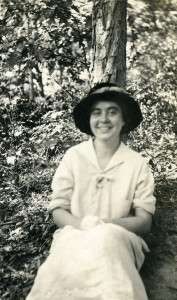
DANCING IN THE CABBAGE PATCH Environmental Education at PMSS, Yesterday, Today, and Tomorrow

DANCING IN THE CABBAGE PATCH
Series 13: EDUCATION
ENVIRONMENTAL EDUCATION
At PMSS Yesterday, Today, and Tomorrow

TAGS: Environmental Education at PMSS, Bickford State Nature Preserve, hemlocks, natural resources, conservation, science education, elementary and secondary environmental education, adult environmental education, AI-generated images, virtual classrooms


ENVIRONMENTAL EDUCATION at PMSS Yesterday, Today and Tomorrow


Environmental Education programming at Pine Mountain is deeply indebted to the foundations of the original ENVIRONMENTAL EDUCATION program, conceived in the 1970s. The early program served a range of schools within and outside the state of Kentucky. Reaching more than 3,000 children each year, the early programs strived to educate our future natural resource stewards. The programming today follows the original founding philosophy and has been expanded to include adult programs, workshops, and retreats that utilize the rich ecology of the school setting.

In addition to the School’s work with educators, the School is charged with preserving the 800-acre Bickford State Nature Preserve, including the removal of invasive species such as the invasive woolly adelgid on the local hemlock trees and the pervasive spread of multiflora rose.

The current environmental programming at the School may be followed on the Environmental Education pages of the Pine Mountain Settlement School’s main website.

ENVIRONMENTAL EDUCATION at PMSS Today and Tomorrow

Environmental Education. Ben Begley teaches students to use a crosscut saw. Early 2000. [EE_Picture2.jpg]

ENVIRONMENTAL EDUCATION AND THE FUTURE

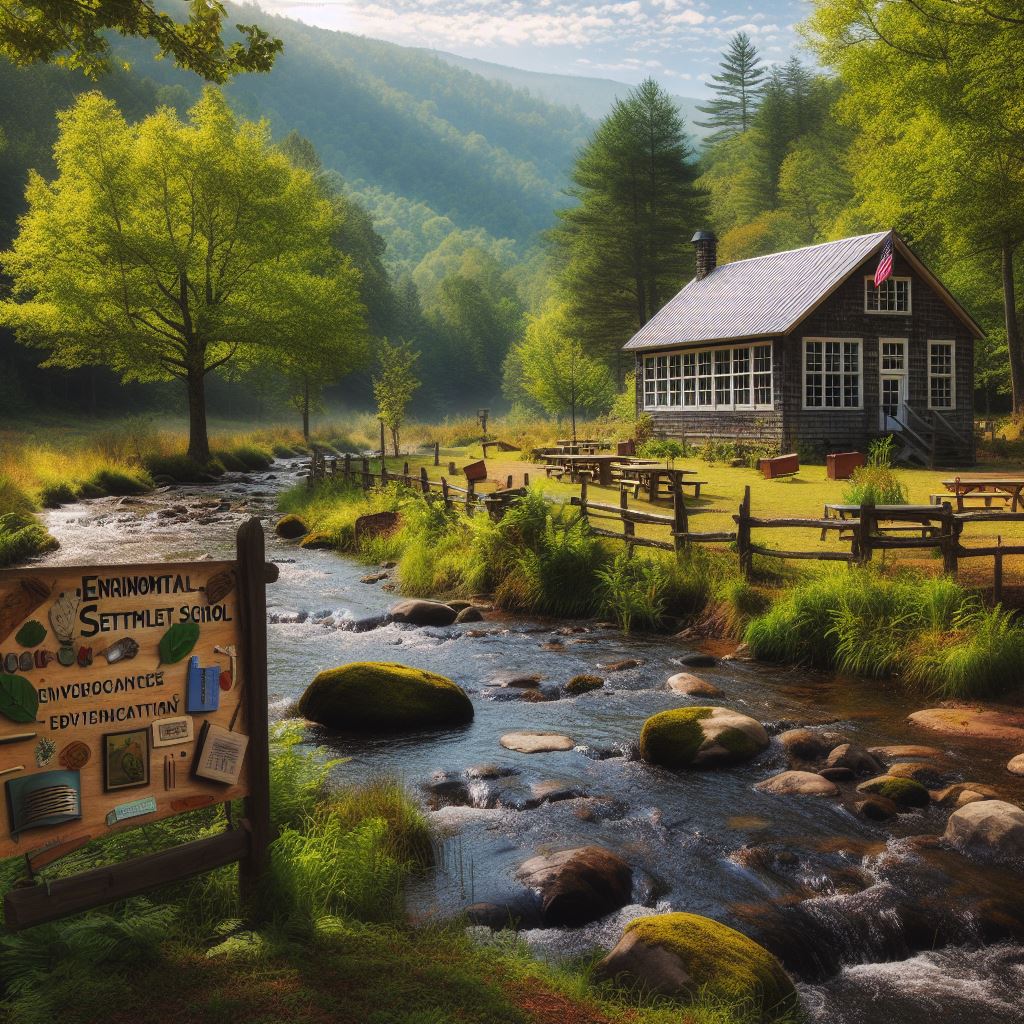
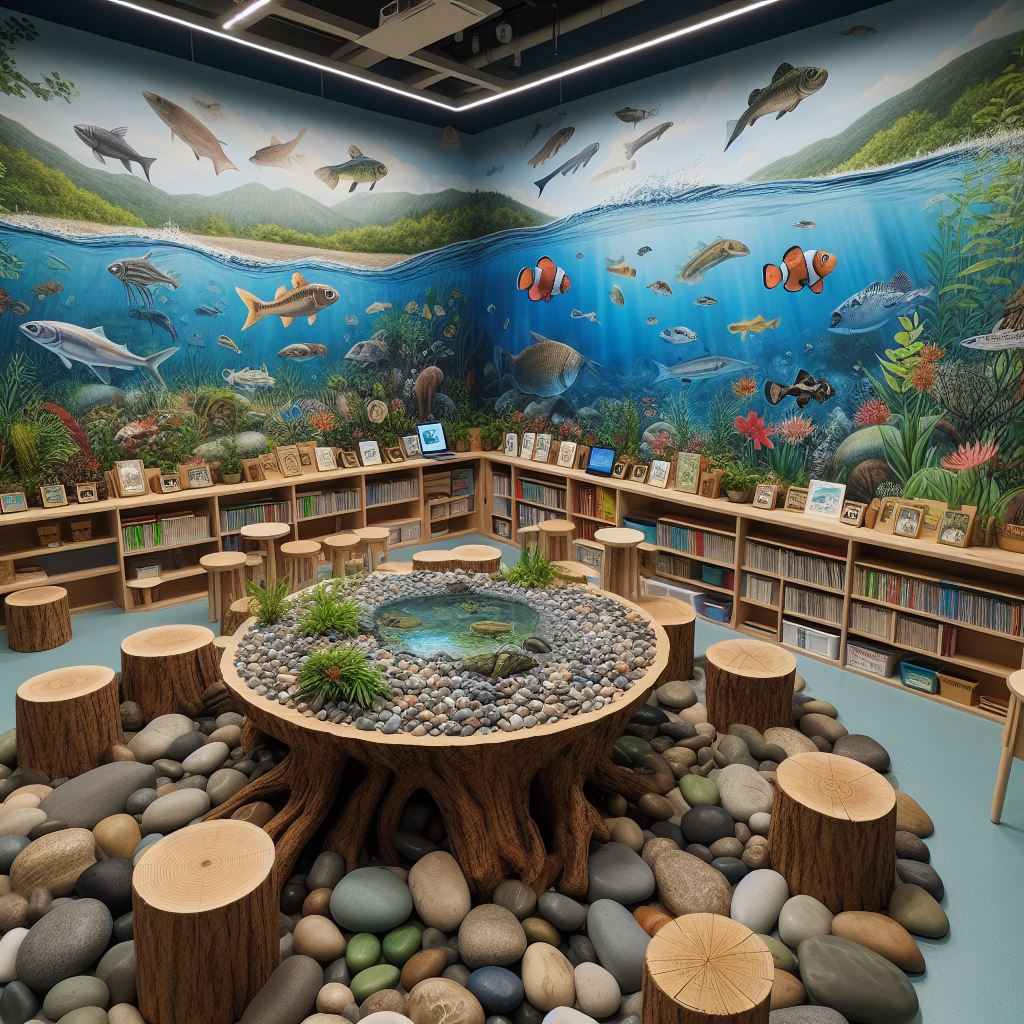
When the world made a leap into the future with AI (Artificial Intelligence), the editors of this website queried AI about the future of Environmental Education using the phrase, “futuristic environmental education class”. Specifically, we asked what the future would look like in a new AI “eco-friendly classroom” at Pine Mountain. The results were startling — but not. Consensus? Spelling? : AI may need to go back to school when exploring environmental education’s future.

AI Generated image

AI generated image of Pine Mountain Settlement School Environmental center. [e2fd1d33-f389-4531-a577-2ab3894d917a.jpeg]

[OIG.jpeg]

In the futuristic visions, the grass is green, but the images are dystopian. The spelling ?? is derranged. If you do not know what “dystopian” means, then you may try to look up (“futuristic education”) in the new APP (application) in an AI search. After that quick look-up, you might try to contemplate what kind of future YOU desire or are perhaps beginning to live within. Think deeply. You perhaps may find “your virtual self ” walking out a screen door into a forest, where the “virtual you” sits beside a stream, gazes on a sunset, perhaps camps among the wild creatures, or marvels at the change of the seasons. Or, perhaps the “real you” may open the door to a virtual environment where you explore virtual rainforests, Antarctica, African deserts, or other parts of the globe. It may be a time when only your virtual self can survive the new environmental world. The real outdoors may no longer welcome the real you.

Perhaps the new virtual “outdoors” will prevent us from freezing, overheating, or gasping for breath. But it may also permanently alter our relationship to our surrounding world. In the new virtual world, we may be forced to interact with our environment through virtual tools. We may look out onto a new world where our children will no longer be safe in unstable or even hostile outdoor environments. Distracted and educated by the rapid advancement of virtual life, we may fail to sense the dangers of not living within nature. We may fail to curb our appetite for entertainment, and, critically, fail to understand the “tipping points” in our planet’s growth and our appetites. We may become too distracted and entertained to see our role in our mandatory environmental stewardship.

What will environmental education look like in the future? We asked AI: “What is the future of outdoor education for children?AI answered:

“The future of outdoor education for children will involve a significant shift toward integrated, nature-based, and inclusive learning experiences. Key trends and projections include an increased emphasis on sustainability, technology integration, mental health benefits, and policy support for accessible outdoor access.”
Key Future Trends
    • Increased Emphasis on Sustainability and Environmental Stewardship: Growing concerns about climate change will lead to a greater focus on environmental education. Programs will become “living laboratories” that teach children about ecosystems, conservation, and sustainable practices, fostering a sense of responsibility and connection to the planet from a young age.
    • Integration with Academic Subjects: Outdoor learning will move beyond an enrichment activity to a core part of the curriculum, integrating subjects like science, math, history, and literature into real-world, hands-on experiences.
    • Focus on Mental Health and Well-being: As mental health issues and screen fatigue become more prevalent, outdoor education programs will place a stronger emphasis on promoting well-being. Time in nature is proven to reduce stress, improve focus, and build resilience and confidence, making it a crucial component of holistic child development.
    • Incorporation of Technology: While the goal is often to unplug, technology will play a supplementary role. Tools like GPS for navigation, location-based apps for learning about local flora and fauna, and virtual reality for accessing remote environments will enhance outdoor experiences and safety.
    • Increased Diversity and Inclusivity: Efforts will continue to make outdoor education more accessible to underrepresented groups, addressing issues of cultural sensitivity and disability access. The goal is to democratize nature and ensure all children, regardless of background or location (including urban areas), have opportunities to learn outdoors.
    • Creative Use of Urban Green Spaces: In response to urbanization, innovative approaches will transform urban landscapes into learning environments. This includes using rooftop gardens, pocket parks, and repurposed vacant lots to integrate nature into city living.
    • Adventure-Based Learning and Risk-Taking: There will be a continued recognition of the importance of “adventure play” and acceptable risk-taking in child development. Activities involving climbing, balancing, and exploration will be encouraged to build problem-solving skills, physical literacy, and confidence. 

Both on target and off, the responses are important to consider.

THE VIRTUAL CLASSROOM

AS the AI-generated query and suggestion list continued, it provided an additional adaptive programs list. The AI adaptive responses were encouraging, but they appeared to assume that the existing environment would be accommodating and relatively stable. Clearly, that future scenario does not appear to be the evolving climate direction.  Outdoor activity will surely be more frequently disrupted under the current weather projections. The temperature rise and the associated instability may be too far along to stop.  Other negative trends may be too far along to realistically halt. Conflicts may accelerate environmental degradation.

The virtual environmental classroom will certainly be of use to scientists looking for solutions to our environmental downturn — and a welcome intervention. But, how do we educate for this? What does that education look like?  What difference will we see?

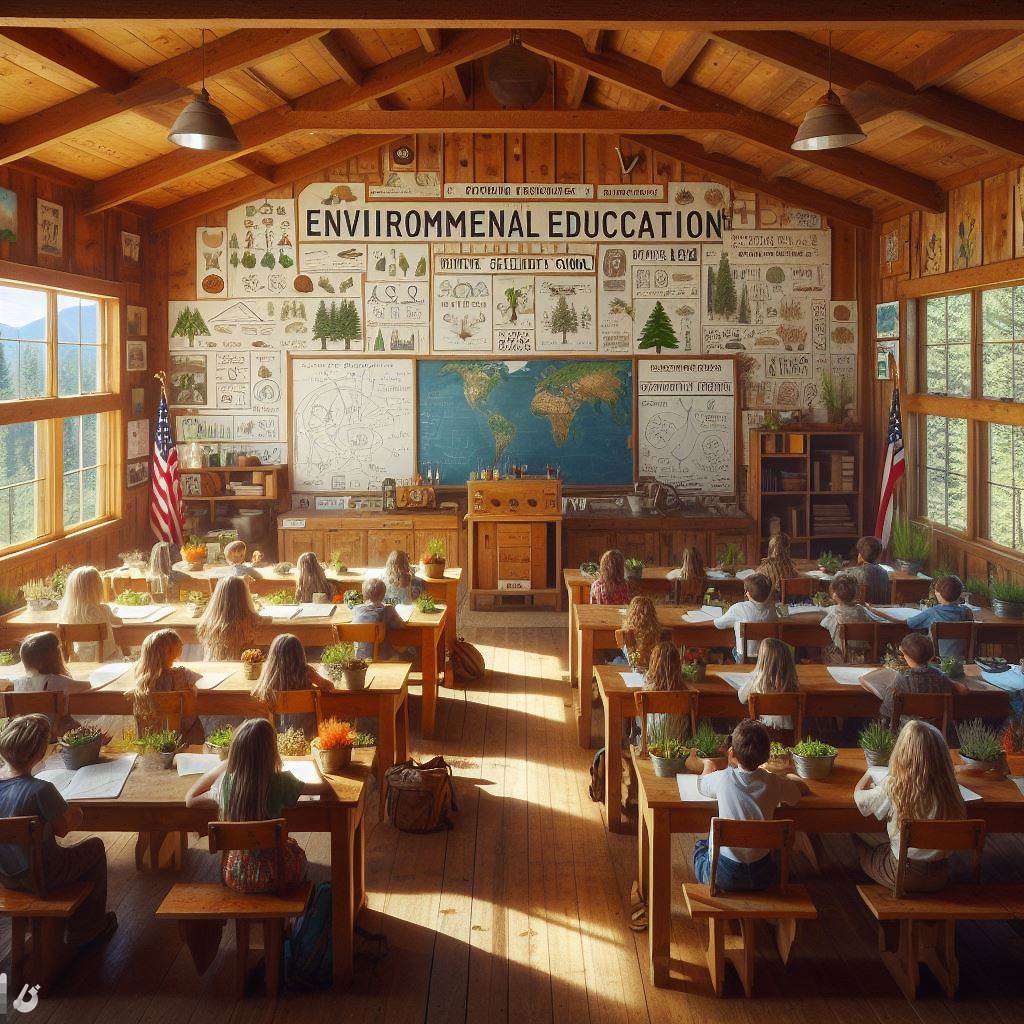
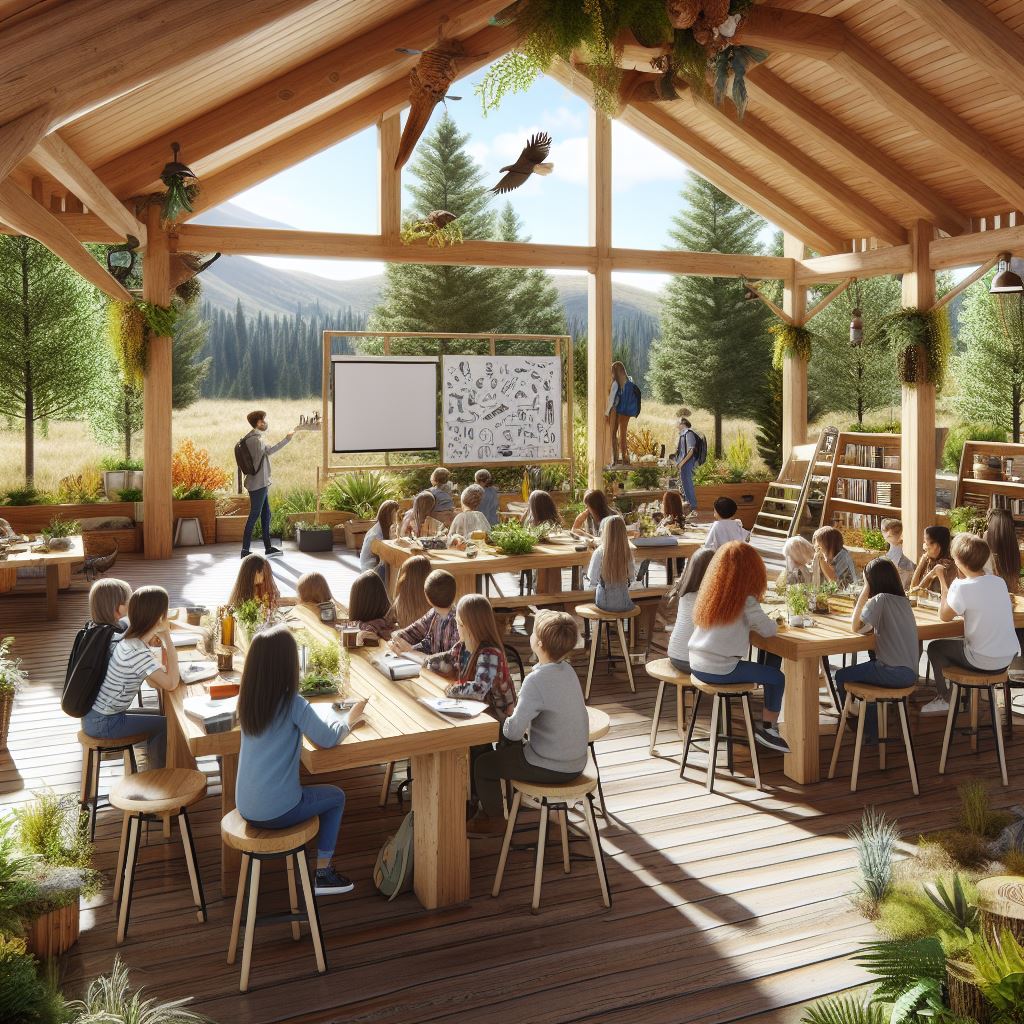
IF the VIRTUAL outdoor classroom points us toward our future, what do you think those virtual lessons will teach? Should teach? The following experimental image was created when AI was instructed to create an environmental education classroom in the future. While the images and the narrative below may be exaggerated, they are there to remind us of our choices and the education and lessons that inform our choices.

Environmental education class in year 2050 ; ENVIRONMENTAL EDUCATION at PMSS Today and Tomorrow

AI generated image of Environmental Education Class in 2050. [OIG.jpeg]

LESSONS OF THE OUTDOOR CLASSROOMThe AI examples provided above did not quite untangle what it means to have an outdoor classroom.  And the questions surrounding AI and the environment continue to grow in a myriad of both positive and negative ways. Forming our questions is as important as forming our answers. The AI examples above address environmental education in the “classroom” where the presence of desks and seats is set up for lectures.  The images above bring the environment into a classroom. Pine Mountain knows the importance of the indoor classroom and uses it, but, Pine Mountain also knows the difference between indoors and outdoors. Outdoor education is outdoors.

[ffa9fdae-d7f7-4ebb-abf0-0f7f4918301a_stream–ecology (1).jpeg]

Stream ecology classroom.

And an “outdoor” classroom …

ENVIRONMENTAL EDUCATION at PMSS Today and Tomorrow

[8479ea0e-9037-45f0-b583-ce6527a55bc3.jpeg]

The lessons found in REAL outdoor classrooms abound at Pine Mountain Settlement School, and the educational lessons to be found in the physical environment of the School are unlimited. Many of the lessons are critical to our survival as a species and can only be learned within the OUTDOOR classroom. Sure, you can look to the future of the “eco-friendly” classroom through a headset, seated in a “plastic” chair, or you can look longingly toward the “grove” of trees in the top right corner of your small window view! YOUR relationship to your environment is your choice. But, outdoors is still  — outdoors.

PICK UP YOUR FEET

Real outdoor education requires that you pick up your feet and walk the trails. There are no sidewalks. It requires that you leave the rare salamander under the leaves. It recommends that you ask where your water comes from. At Pine Mountain Settlement, it requires that you drink water filtered by million-year-old limestone rocks, and you share meals made with home-grown salads. It recommends that if you want to hike the “Summit Trail” you need to be in good physical shape. Outdoor education for early settlers of the area was not taught in a classroom; it was a way of life for the early settlers of the area.

If the cow did not come home to be milked, the early families listened for the sound of a familiar bell and climbed the mountain to search for their cow.  Today, if you reach the “Summit” of the Pine Mountain ridge and watch the sun set or rise, you will be surrounded by beauty, hope,  pride, and perhaps, ancestors who made that climb daily. In the outdoor classroom of the campus, the experience of environmental education surrounds the visitor. Educators know that educating is imperative, but they also realize that their understanding is selective. Contributions to environmental education can come in many forms, and these forms will shape our shared future. Pine Mountain provides a wealth of environmental lessons for instructors.

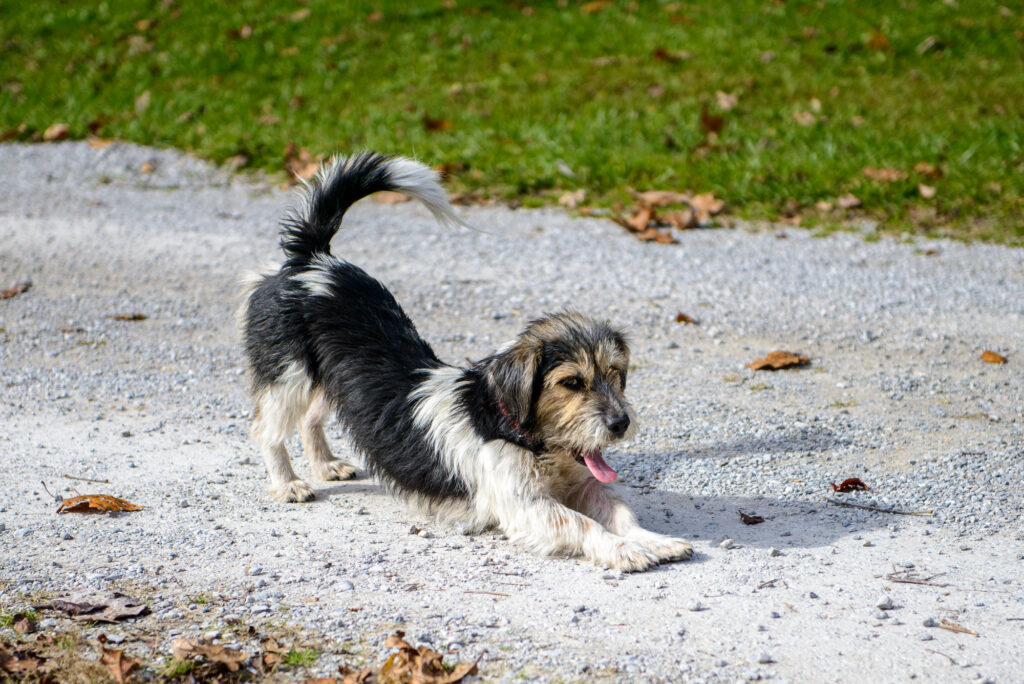
In the valley below the Summit, students learn lessons from the critters at the school. The sheep, goats, bears, and groundhogs, and possibly the campus dog, will contribute to your understanding of nature if you observe carefully.  For example, one can wonder at how the smartest guardian of the School’s environment, “Lady,” the campus dog, knows to dive into the warmth of a pile of leaves on the cool days of November.  And, you may learn why knowing the native plants could keep you from starving or dying. If you ask why there are no bees in the hives, you will find that the bee hives have trouble with hungry bears. If your question is why vegetable “tunnels”, rare plants, and rare ideas can all grow together. The answers may take some time, but they may carry a myriad of lessons.

The outdoor joys of a day in Spring, Summer, and Fall will linger with you after you leave the campus. Perhaps you will find yourself remembering how a small corn-snake feels on your hand — or not. How the gentle pinch of a crayfish says “Put me back in the stream”. How a very small “chigger” insect can pack a mean bite in the summer blackberry patch and keep the victim awake all night. Nature is at its best when it can physically remind us that we live within it, and we need to educate ourselves for survival. So many real memories from nature, each tuned to the environment and to the seasons as they shift, help us all to shape how we treat this precious global home we share and, even more importantly, how we share and care for the future of each other.

See Also:

ENVIRONMENTAL EDUCATION EE

ENVIRONMENTAL EDUCATION Guide

Environmental Education Resources at PMSS Today

ENVIRONMENTAL EDUCATION Staff 1972 to Present

ENVIRONMENTAL EDUCATION 1972 – Present Bayside Academy and Pine Mountain Settlement School

ENVIRONMENTAL EDUCATION 1983 EE Operations

ENVIRONMENTAL EDUCATION A Legacy for Future Generations

ENVIRONMENTAL EDUCATION Brochure 1

ENVIRONMENTAL EDUCATION Brochure 2

ENVIRONMENTAL EDUCATION Case Statement Nature-Culture

ENVIRONMENTAL EDUCATION Green Book 1974

ENVIRONMENTAL EDUCATION Lesson Plans and Supplementary Information 1973-1995

ENVIRONMENTAL EDUCATION Personnel Chart

ENVIRONMENTAL EDUCATION Pine Mountain Bird Checklist

ENVIRONMENTAL EDUCATION PMSS 1997 Wellhead Protection Plan 1997

ENVIRONMENTAL EDUCATION Split Rock Nature Loop Trail Guide

ENVIRONMENTAL EDUCATION Stream Ecology Hopscotch Mosaic

ENVIRONMENTAL EDUCATION Student Groups at PMSS

ENVIRONMENTAL EDUCATION Flowers

ENVIRONMENTAL EDUCATION Salamanders

ENVIRONMENTAL EDUCATION Scott Matthies EE Narrative

ENVIRONMENTAL EDUCATION Trees

ENVIRONMENTAL EDUCATION Warblers

E. J. CARR PLANT CENTER Guide

LOREN W. KRAMER 1970 First Earth Day at Pine Mountain Settlement School

LOREN W. KRAMER Notes on Educational Planning at Pine Mountain School 1968-70

PINE MOUNTAIN STORY – CH. II

MARY ROGERS 1977 GOVERNANCE Philosophy of PMSS

MARY ROGERS EE Planning and Programming Notes

MARY ROGERS Similitudes

MARY ROGERS Tribute by Milly Mahoney 1998

NANCY SATHER Correspondence 1969 Educational Planning

NANCY SATHER Staff and Trustee

PERIODICALS Castanea Journal of Southern Appalachian Botanical Club

PUBLICATIONS RELATED 1968 Effects of Surface Mining on Fish and Wildlife in Appalachia

PHOTOGRAPHS

EVENTS

EVENTS Guide to Ongoing Annual Events

 EVENTS ANNUAL Fall Color Weekend 2005
EVENTS ANNUAL Lucy Braun Weekend
EVENTS ANNUAL Spring Flower Weekend
EVENTS ANNUAL Fall Color Weekend

…and more

DANCING IN THE CABBAGE PATCH – It’s a Dog’s Life

DANCING IN THE CABBAGE PATCH
It’s a Dog’s Life
January 2024
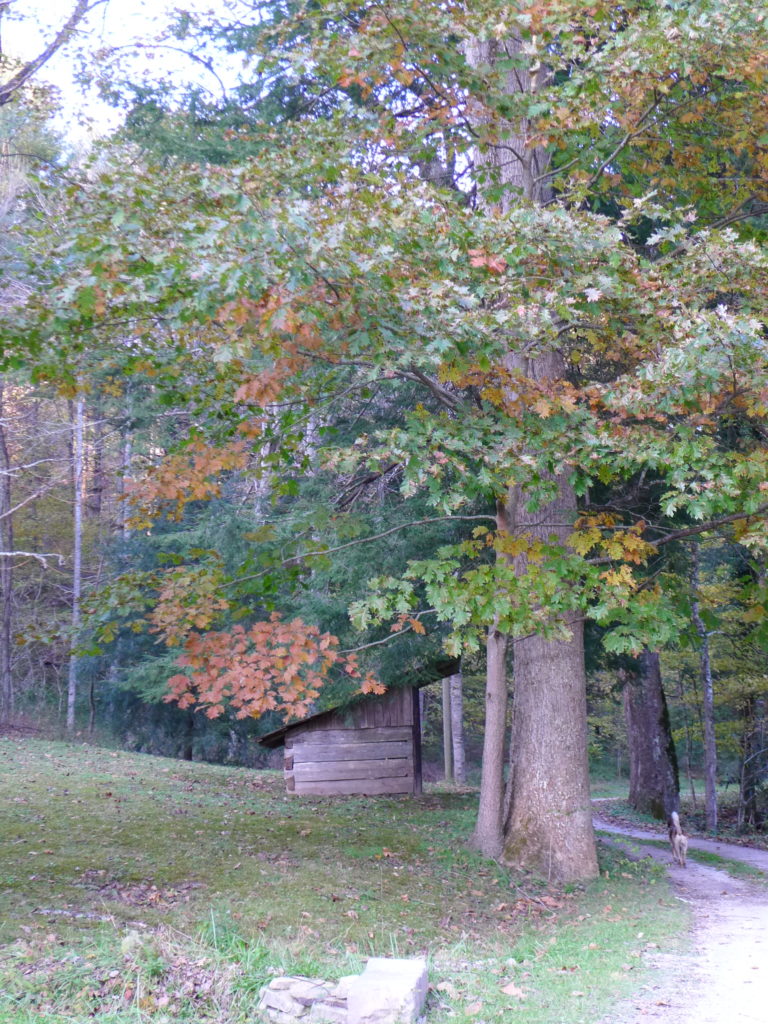
Sheep shed with “Lady” headed for Big Log. Photo: Helen Wykle 2018. [
P1150808-e1555820379540.jpg]

IT’S A DOG’S LIFE

Over time many dogs have found a home at Pine Mountain Settlement School and many dogs have resided in the homes of community families. Whether an adopted dog, a gift dog, a pup from an older family dog, a stray, or “another”, these four-legged companions have mostly charmed the families, owners, visitors and head-scratchers — all … or, at least most.  The occasional stray dog has even been known to charm themselves into the campus community and also into the homes of the surrounding Community. These four-legged friends sometimes belong to no one and everyone — even many visitors have claimed temporary ownership.  This writer is one of those.

Dogs seem to know how to negotiate mutual relationships surrounded by their two-legged ear-scratchers and when to avoid those relationships.  Instinctively, they seem to know when to stay and when times are tough they instinctively move on and find their way into the homes and hearts of another family or person, or place. People live and thrive — or not, in relationships and communities, Dogs do this, and often better.

There have been many dogs at Pine Mountain and the surrounding community and a myriad of stories to go along with these canine companions. Names such as Franklin,  Jonah, Waggie, Pug, Flossie, No-No, Bothwell, Amos, Megan, Stefan, Russell, and more, have over the years melted into their forgotten times. Various Collie dogs, mongrels, Red-setters, and most recently the small Russell terrier and especially the larger herding greeter, “Lady”. As the current self-appointed chaperon of visitors to the campus, guardian of the playground, and night watchwoman, Lady is one of the most accomplished of Pine Mountain’s ambassadors

As the all-around Ambassador, Lady often can be found on the doorstep of the guest houses. At night she can be heard chasing coyote away from the sheep and goats, and when School groups arrive she can be found escorting hikers up the Summit Trail, and guarding the play-ground. Many full nights of guarding for bears and other night-explorers has also made her voice, well known.

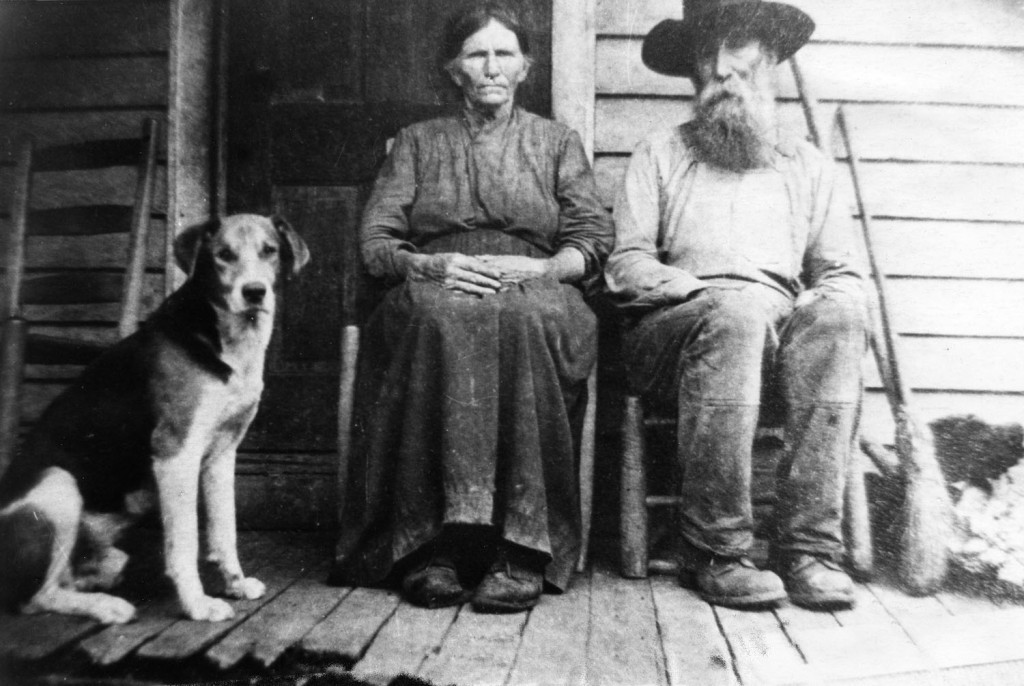
Dogs at Pine Mountain often show up in family pictures. On campus and in the surrounding community dogs are of every sort.  One of this author’s favorite canine portraits is that of the giant hound on the porch of the Shell family who lived near the School early in the twentieth -century.  The stoic and solemn portrait of the hound’s owners matches the dignity of the solemn but guarded look of their dog that looks remarkably like “Lady”.  This trio is difficult to forget, once seen as they sit on their hickory-cane chairs “guarded” by their companion. All three sit before a doorway that reminds those who were born in the area that their past is never far from their memories. The open doorway and front-porch sitting, reminiscent of Aunt Sal’s Cabin, used to be an open invitation of “Come sit a spell.” Their doorbell — their dog.

Woman, bearded man, and large dog, seated on porch,  [misc_exhibit_021.jpg]

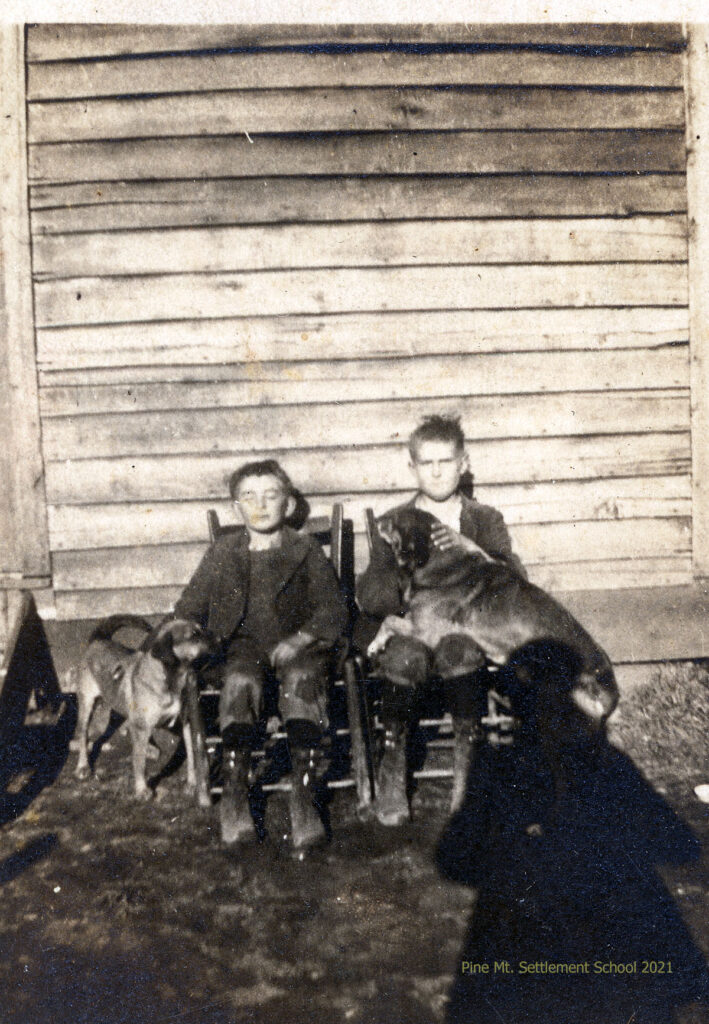
The Shell’s dog of a type, often called a “hound-dog” was a familiar and valued family addition in most of the homes surrounding the Pine Mountain Settlement. Also called “coon-hound” and “bear-runners” these canines often had short lives but were long remembered in many conversations when porch-sittin’. There are numerous tall tales regarding dogs that continue to be told in the surrounding community. They may be related to a family’s “coon-hounds”, a brave bear fight, or any number of familiar and often exaggerated dog tales.. These stories live on. Their details reflect the close relationship we continue to have with “man”s [and woman’s] best friend,”

HOUNDS  418 Boy and young man seated with two hunting dogs. Ship-lap wall behind them.

TALL TAILS

Perhaps the most famous and fantastical  “bear-runner” hunting-dog story, is the one that Ben Begley, a legendary Environmental Education teacher at Pine Mountain often shared with the school groups that came to Pine Mountain’s environmental education sessions. Ben captivated his audience with tall tales that at first seemed to be plausible but then became more folk-lore and finally fantasy. Ben’s story about a treasured hunting dog was certainly captivating and memorable.  Perhaps more memorable than the story were the expressions of the visiting children as they listened to Ben’s tall tale.

The tale ran something like this-

A man had a treasured hunting hound who was used as a bear-hunting companion. The man and the dog one day encountered a bear who fiercely went at the dog, and the two had a violent and gory battle. Ben spared no detail of the bloody battle between the bear and the dog and that described how the dog’s body was ripped and sliced into two halves. The distraught hunter then gathered the two pieces of the dog and wrapped it tightly to keep his dog together. He then headed for home with the dog, where he proceeded to sew the dog up, and then again wrap the dog tightly with the hope he would live. After a while, the man was happy to see that the dog lived. The dog was a fighter, and after some time,e the stitches seemed to have saved the dog but as he unwrapped his dog who had been sliced in two pieces from head to tail, he made a startling discovery.

There was a problem — the hunter didn’t realize that he had sewn one-half of the dog’s body upside-down and the other right-side-up. One set of legs was up in the air and one set of legs firmly down on the ground.  The owner had saved the life of the hound that had tangled with the bear, but now he had a problem as two feet were in the air and two were on the ground and that looked like the end of the hunting days for the dog.  One can imagine the unique mental picture of the dog with two legs up and two legs down. How could he possibly remain the hunter’s companion?  But the hunter soon found that he had a unique hunting companion. His dog could now run on two legs and, when tired, flip and run on the other two!

[I only wish I could remember Ben’s story in greater detail … or not!]. I suspect that I have “sewn” it together badly! But, just imagine a room full of kids hanging on every part of the tale and then exploding when they realize they had been “snookered.”

Ben Begley,  former  Director of the Environmental Education Program at PMSS was one of the most magnificent of the storytellers at the School.  He always had a room full of pre-teens trying to “piece together this gory tale and to imagine how the dog negotiated the world. Ben’s tall tales were often improbable tales but he had mastered the art of suspense in story-telling. Ben’s command of tales is similar to the many such fantastic stories that get embellished by mountain tall-tale-tellers. Their tall tales can bring laughter, or sadness to an audience — even audiences that are “snookered” find it hard to erase the picture of that unique hunting hound from their visual memory, or the fun of sharing such an improbable tale. To read more about Appalachian tall tales, visit the work of author Richard Chase, a sometime staff-member and story-teller who often visited Pine Mountain and entertained children and staff with his “tall tales.”

EARLY CANINES 

Two of the earliest dogs on the Pine Mountain Settlement School campus included one owned by Ethel de Long who later married the stone-mason, Luigi Zande, and another dog owned by the early school staff member, Marguerite Butler.  The de Long dog, a long-haired and pert-eared companion, shows up in several photographs taken during the founding years of the School. The name of Ethel Zande’s dog is sure to surface at some point, but it is not known by this author.

The second canine identified as an early campus dog, belonged to staff member Marguerite Butler. The dog, a Dalmatian hound, was named”Franklin”.   He or she has been identified as a faithful companion of Butler and the name recorded.

Early photographs have captured Ethel and her dog companion and Marguerite Butler and her sleek companion, “Franklin” in the very early days of the School in 1914 or 1915.
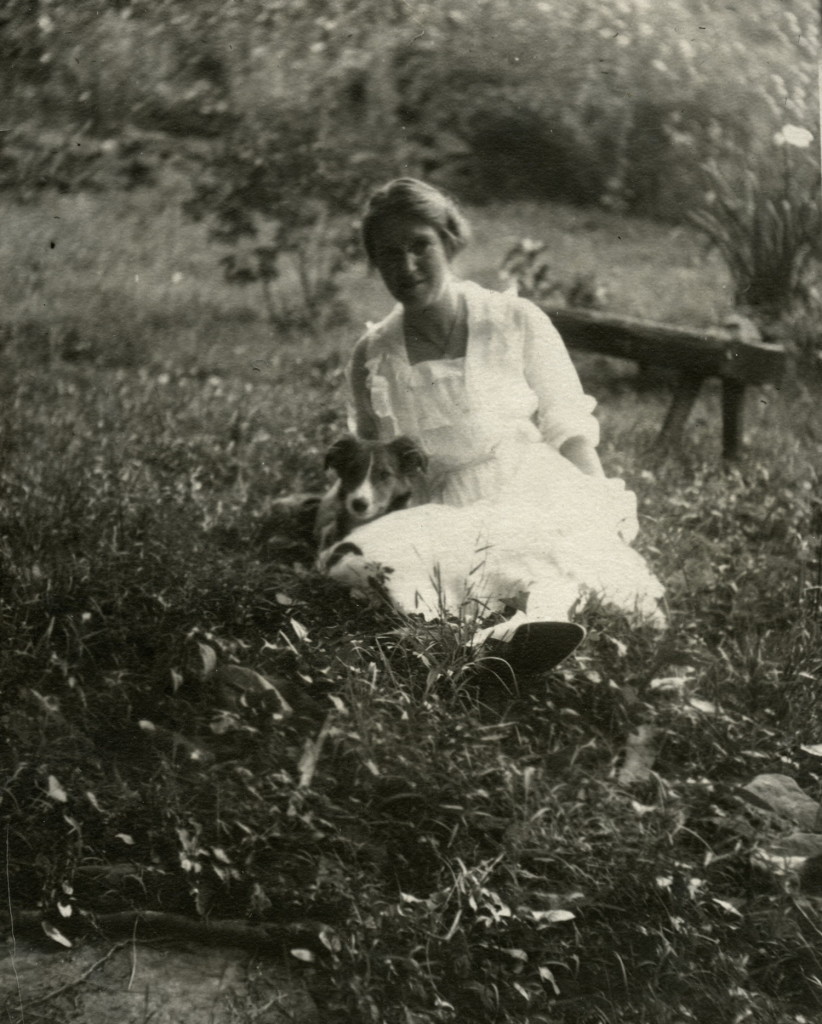
Ethel de Long with her dog. X_099_workers_2527r_mod.jpg

Like a familiar face the little Zande dog can be easily identified (sort-of) and shows up in several early photographs. It is fun to encounter a photograph and to recognize “Ethel’s dog,” like a familiar friend’s face.
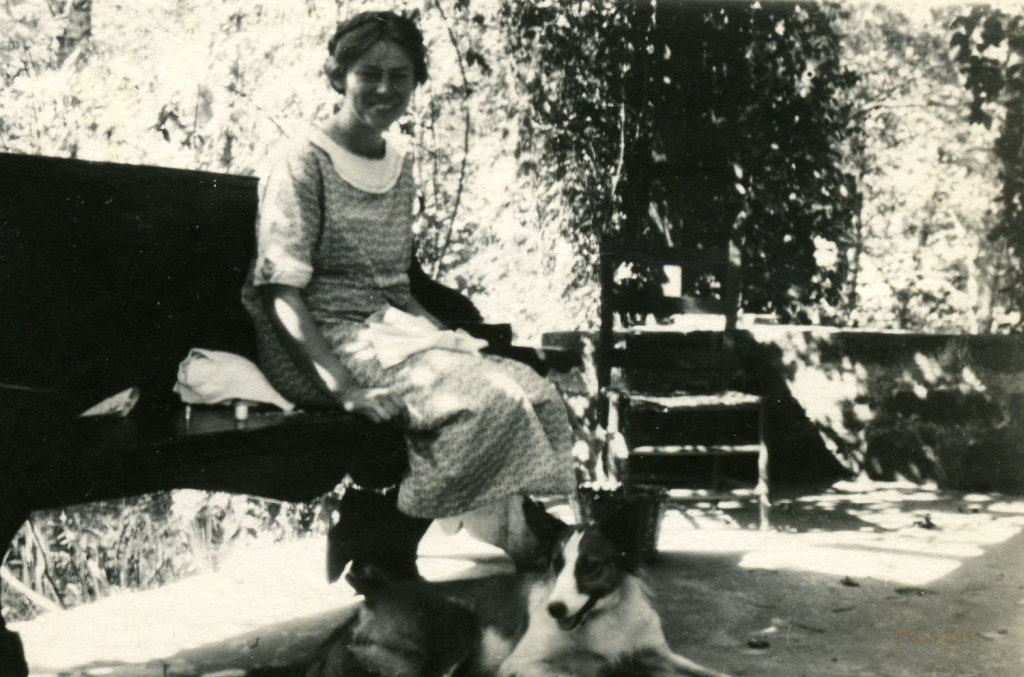
 

Woman [Ethel de Long ?] seated with dog at her feet. norton_048.jpg
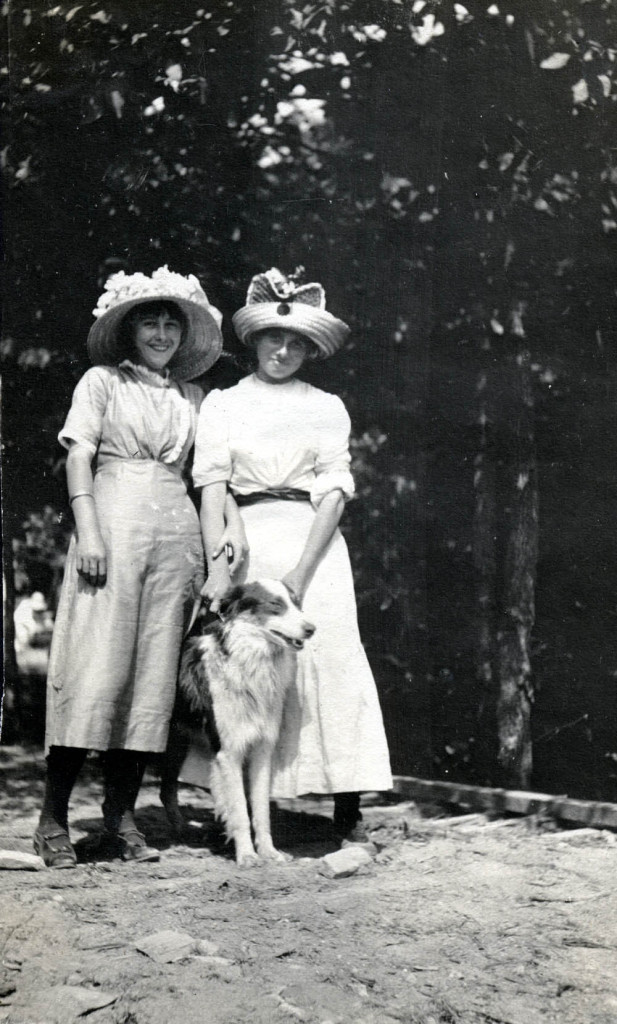
Two young ladies wearing hats and with a shepherd dog, or the Zande dog between them. FN Vl_35_1142a FN Vl_35_1142a
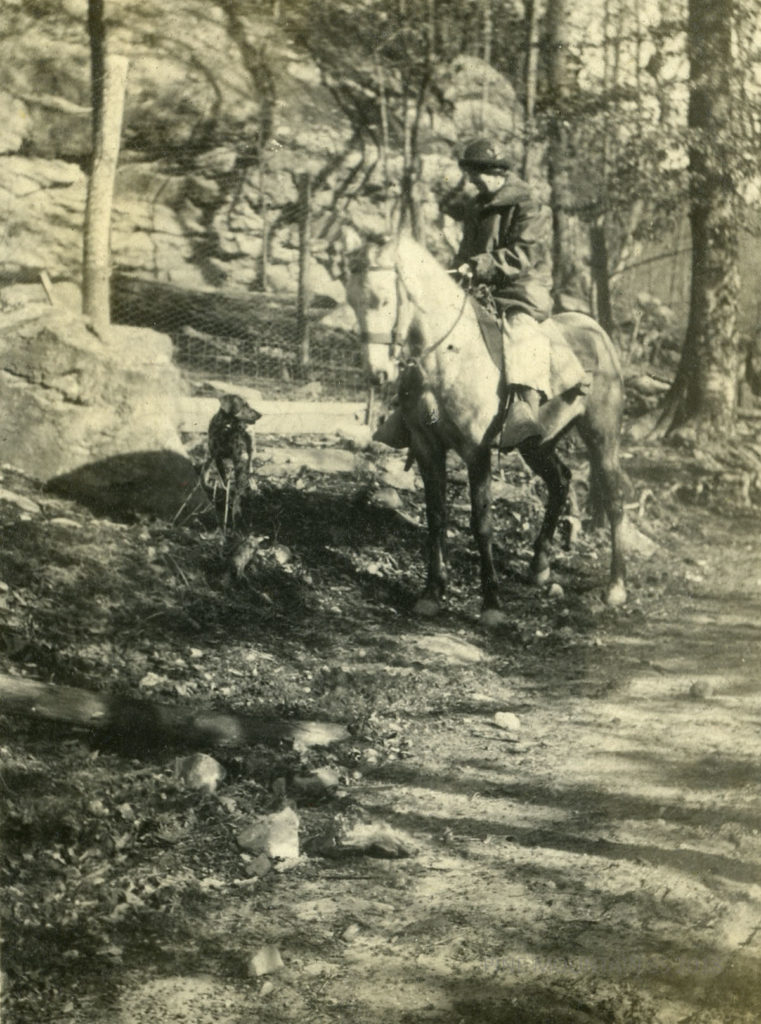
025c. M.B. [Marguerite Butler] on Queen with Franklin, a Dalmatian hound at their side, . mccullough_I_025c

Why “Franklin” as a name choice for Marguerite Butler’s Dalmatian?  There is usually a history of some kind attached to naming a pet. It seems there is a long history associating the name  “Franklin” with Dalmatians … some of it credible and some of it not so much.

Several sources note the name “Franklin” given to Dalmatians has a high incidence. In fact it is quite common that Dalmatians find “Franklin” as their moniker, but, in fact, it is a favorite across breeds and also is found frequently in cat names.  This all seems to be based on the  “personality” associated with the name. For example, Franklin suggests strength, loyalty, trustworthiness, and a wise and gentle nature, so say many of the sources.  “Franklin,” many say is derived from the Old French word “franc” which means sincere, genuine, and free, and in Old  Eng. “frank”. One online source suggested it is a favorite name because “… In the US, Franklin is the 63rd most popular name for dogs, with over 4,000 r, —Benjamin Franklin.  The dignified name suggests a “dignified dog” … certainly a pedigree?  with which to identify. But let’s get the facts straight. The influence and personality of Benjamin Franklin rarely pan out.  Just because we might admire Groucho Marx does not call for naming our dog “Groucho”  — though I have known dogs that qualify. Well, so much for our National confusion/stupidity … it seems to be rampant today but I have never met a dog named “Dumbo”! Perhaps that is where AI [Artificial Intelligence] can come in handy. It is an interesting journey to ask for AI help in naming your pet. Give “Franklin” a try.

It is not known if Katherine Pettit had a dog. No reference to a Pettit dog has yet surfaced in the literature of the School or in the many letters of Pettit and her colleagues. Yet, in reading through the related material in the Pine Mountain Archive, it seems, to this writer, that Katherine, an agrarian at heart, loved farm life but kept any affection for animals partitioned or separated from any deep “petting” attention. Her concerns for children and their daily care and education were the center of most of her recorded reflections and animals were animals. Perhaps her possible disaffection for dogs was tied to her early life. As the oldest child, life on her father’s farm included many farm responsibilities, including caring for many animals. The farm responsibilities in addition to the demands of the farm’s animals gave her a wealth of knowledge and caring for children but probably not so much empathy with animals. Her younger siblings fell to her care following the death of her mother early in her life. She had little time for pets.

PETS & DOG SUBSTITUTES

While Katherine Pettit may not have been a pet lover, many in the Community had pets.  It was and still is common to find pets that were as important to the family children and the pets were not necessarily dogs. Groundhogs seem to be the favorite dog substitutes. As seen below, a young girl shows off her two groundhog pets  …. a common garden raider that burrows beneath the ground much like prairie dogs, but once tamed can be coaxed to be dependent on a human.
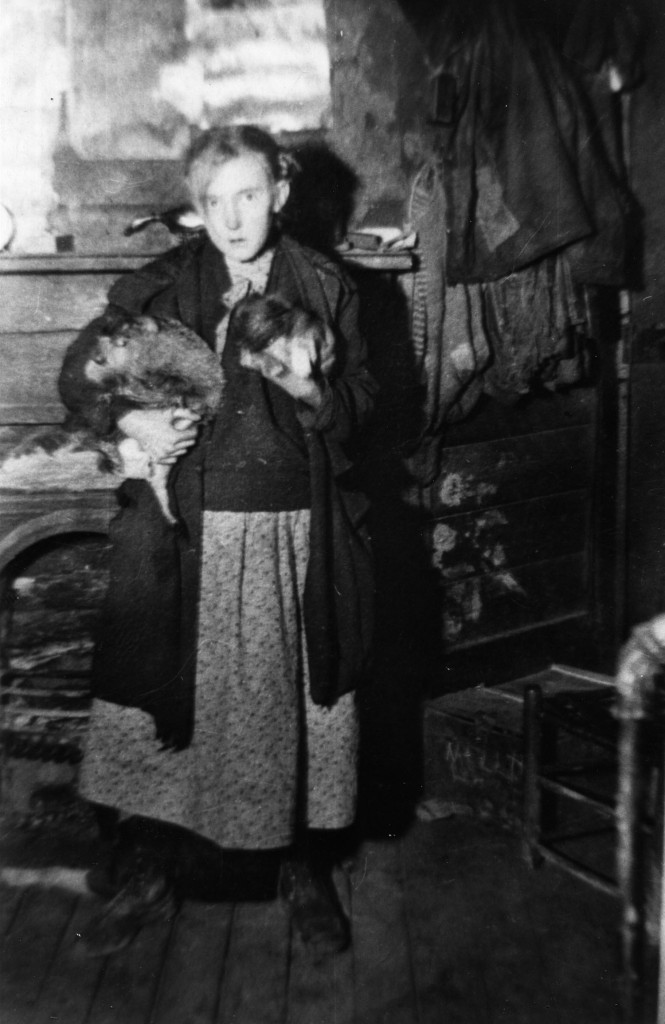
Young Girl Holding Two Groundhogs [?] Pets.[misc_exhibit_038.jpg]

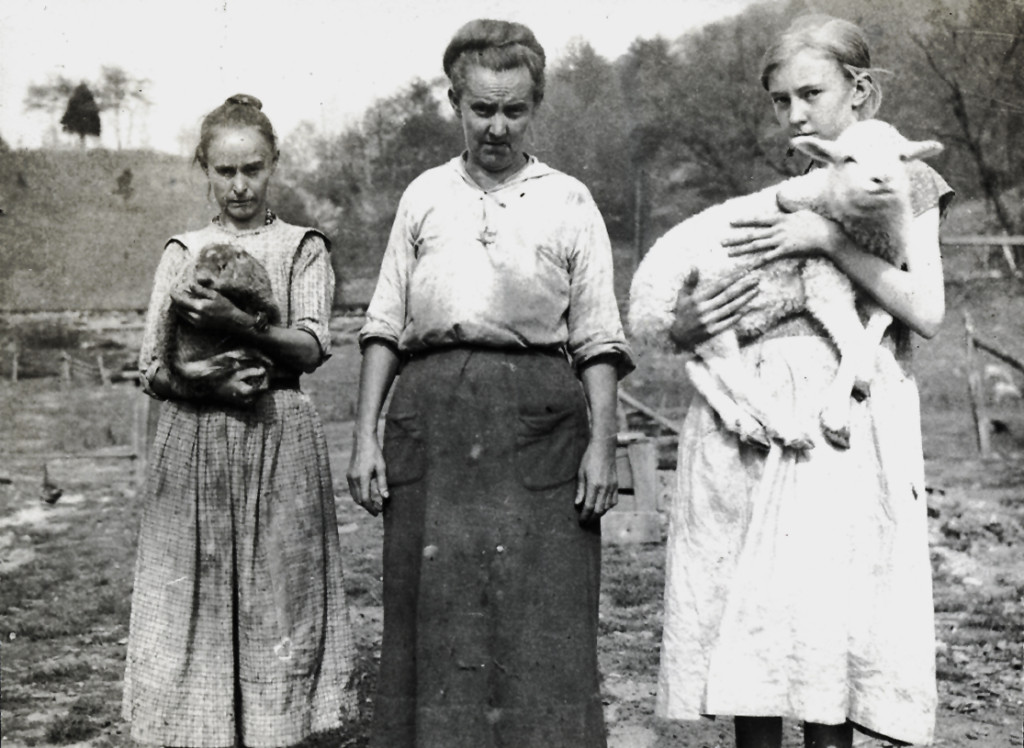
The instinct to care for animals is with most of us but the level of care varies as do the animals we become attached to. Often the children in the community were successful in taming animals and birds that many city dwellers might not even recognize. Yet, if one has lived in a relatively rural area and raised a garden they may identify with the alternate dogs in the arms of the community children below…. and also identify with the Mother’s expression. Really!?

The two children seen below hold “pets” they have tamed. One pet, a groundhog, and the other a lamb, These were not uncommon pets of mountain children. When entering a home in the valley it was not uncommon to be introduced to other home-dwelling pets.  Grey squirrels, rabbits, flying squirrels, toad frogs, snakes, crows, box turtles, lambs, goats, —- a regular zoo in some instances, could be found in the rural community homes.

Mellie Day family with pets.[nace_1_070a.jpg]

Mellie Day, looking just a bit dubious is seen above with two children who hold family pets. Their mother does not look too charmed by their offerings, but perhaps the mother and her children may hold expressions of suspicion of the  photographer’s intentions in capturing the image of the unusual “family.”   While girls favored the small pets and baby animals, the boys generally continued striking up relationships with their dogs — most often their hunting dogs.

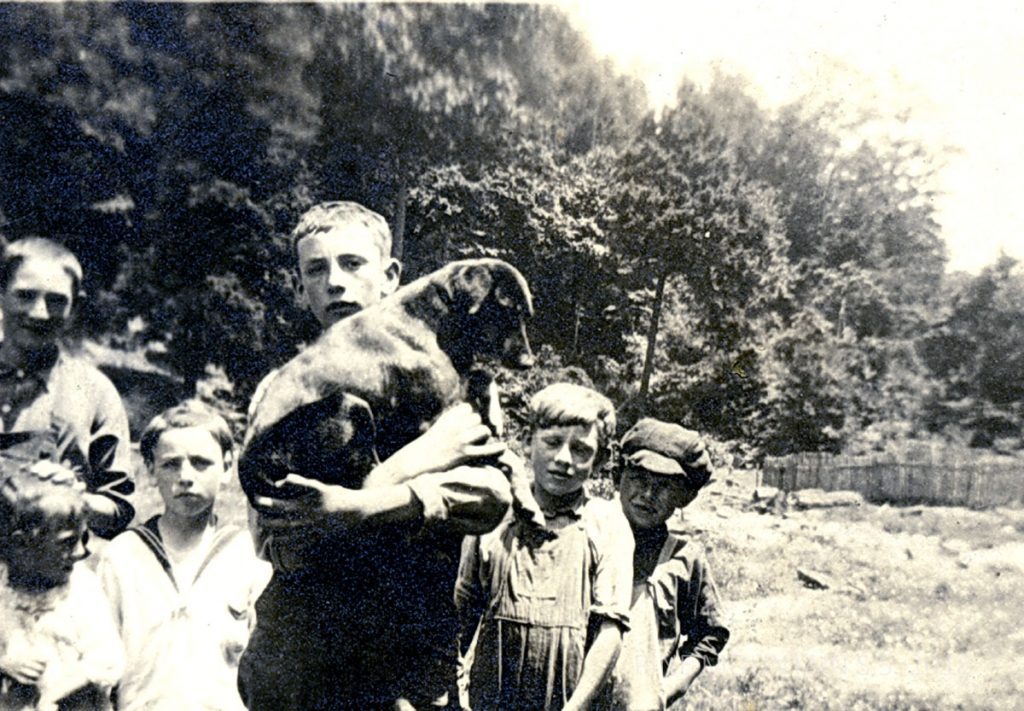
Here a young boy holds his favorite pet dog and the two are center stage. He proudly shares his companion with siblings and friends for the photographer.

1254 “Browning? 1920″Young boy and a dog. [VI_39_1254_mod.jpg]

GLYN AND GLADYS MORRIS – The Cairns

A second era of dogs at Pine Mountain Settlement appeared with Glyn Morris, who became the Director of the School in 1935. Dogs began to play an important role in the Settlement School campus life when Glyn Morris and his wife Gladys came to the School with two Cairn terriers.

Glyn Morris, of Welch and Scots-ancestry was familiar with the Cairn terrier breed.  There is no doubt that Morris loved dogs, but he favored not just any dog. His dogs were pedigreed — no mongrel breed dogs for this city man. Glyn and his wife Gladys’s two cairn terriers were an instant hit with the students and the workers, pedigree or not.

The Cairn breed, highly popular in Scotland, is known for its tenacious hunting instincts,  The dog breed gets it’s name from the cairns (human stacks of rocks or rocky mounds of rocks on land formations) of Scotland and in the rugged and rocky farmlands of Wales.  Morris was Welch and Wales was the ancestral home of the Morris family. Also, if one is privileged to hold a Cairn terrier, it is a bit like holding a stack of rocks with a warm heart and a wet tongue. Perhaps that is why this writer has such a preference for terriers, especially Cairns.

As favored additions to the farms of Great Britain, Cairn terriers are small and fiercely loyal working dogs. They were used for keeping the small vermin populations under control on small farms in Wales. As their reputations grew as defenders of small farm operations in the agricultural sections of not only Wales but also Scotland and England, they grew to become a favorite breed for small farms across Europe. The Cairns introduced by the Glyn and Gladys Morris showed the same spirited farmyard hunting ferocity at Pine Mountain.  In the barnyard and on the hiking trails, the little dogs were ferocious and dogged hunters and protectors. The breed easily ferrets out small rodents, vols, snakes, and, at Pine Mountain, unfortunately, chipmunks and squirrels. In short, small critters don’t stand a chance against these fast and fierce little terriers. On a snake trail, they are, however, invaluable.

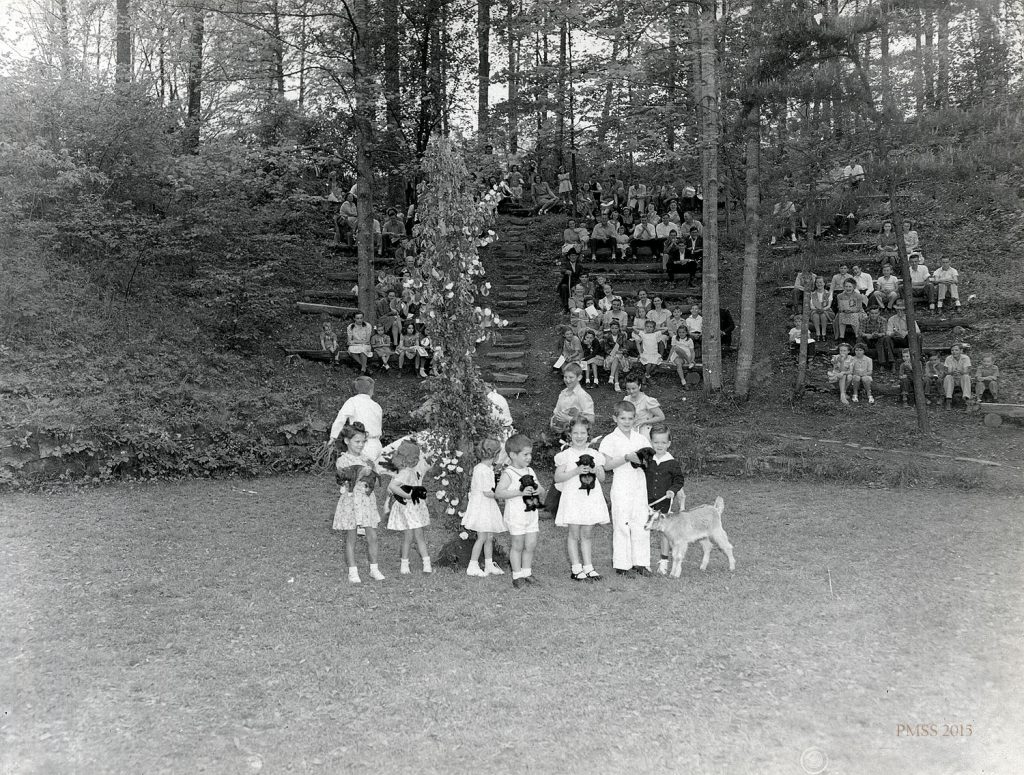
The two Morris Cairn terriers soon had pups and these were spread around to various staff at Pine Mountain. A May Day photograph shows off a new 1945 litter of Cairn puppies as they are held by staff children on the May Day Green. This author is second from the left, holding a newborn puppy.  Stefan was the name of our family cairn pet, but Stefan is not the puppy held below. “Uncle Stefan” was at home as he was a descendant of the Morris couple and was our family’s first “child” or firstborn. The Uncle Stefan” and our family pet, was already five years old .. essentially our family’s “firstborn.” The puppies held by the children are Scotty pups recently delivered by a Scotty couple owned by the Dodd family on campus.

ALICE TRUMBULL (SCOVILLE) BARRY Staff

May Day on the Dancing Green, staff children, 1945. [dodd_A_049_mod]

Earlier, in 1941 the campus newspaper had noted the first litter of Cairn puppies — a trio of just-born “show off pups”; —  these, the earliest pups of Director Glyn Morris’ little Cairn terrier dog called  “Flossie” were charmers.  Flossie was Stefan’s mother, who had won many hearts at the School and when her pups were born, they were celebrated by the campus students in their newspaper, The Pine Cone. An account of a visit by the Seniors to Zande House, the residence of Glyn and Gladys Morris, is found recorded in the school newspaper, the Pinecone. Flossie’s pup, Stefan, was an adolescent when the May Day gathering of Scottie pups was on display.

An account of Stefan’s origins is found in the student newsletter:

PUPS “SHOW OFF” FOR SENIORS

Yelping sounds attracted the attention of the seniors at their Sunday night gathering at Zande House. Curiosity led to the showing off of the three puppies. No, no. Bothwell and Stefan.

Even Sears and Roebuck had had the privilege to become acquainted with the pups. For on February 3rd they were presented with a pen, a  “baby crib”, in fact, Flossy is rather fond of her children, but is always willing to lend them to visitors.

The Pine Cone  Feb. 1941 .

Stefan was quickly adopted by this writer’s parents, and ten months later, I arrived and grew up with Stefan by my side  — always looking out for snakes and other unpleasant critters in my constant woods-roaming. He trained me well. Stefan left me with a lifelong affection for dog companions and deep forests.

IT’S A DOG’S LIFE

“It’s a Dog’s Life” is a phrase that is often used to describe a sub-standard course of life.  But, at Pine Mountain, “it’s a dog’s life” is paradise regained for most canines. It has been rarely the case at Pine Mountain that dogs be subjected to the isolation of “It’s a dog’s life”. Further, the Settlement School must have looked like Paradise to many of the dogs who have been privileged to live there.  Unless they were too temperamental or chicken-stealers, most of the campus dogs were allowed to run free and to greet friends and visitors alike. Some however, never warmed to the responsibility of being part of a community. Those dogs did not last long at the institution. Nor did dogs last long if they could not share their space with other dogs.

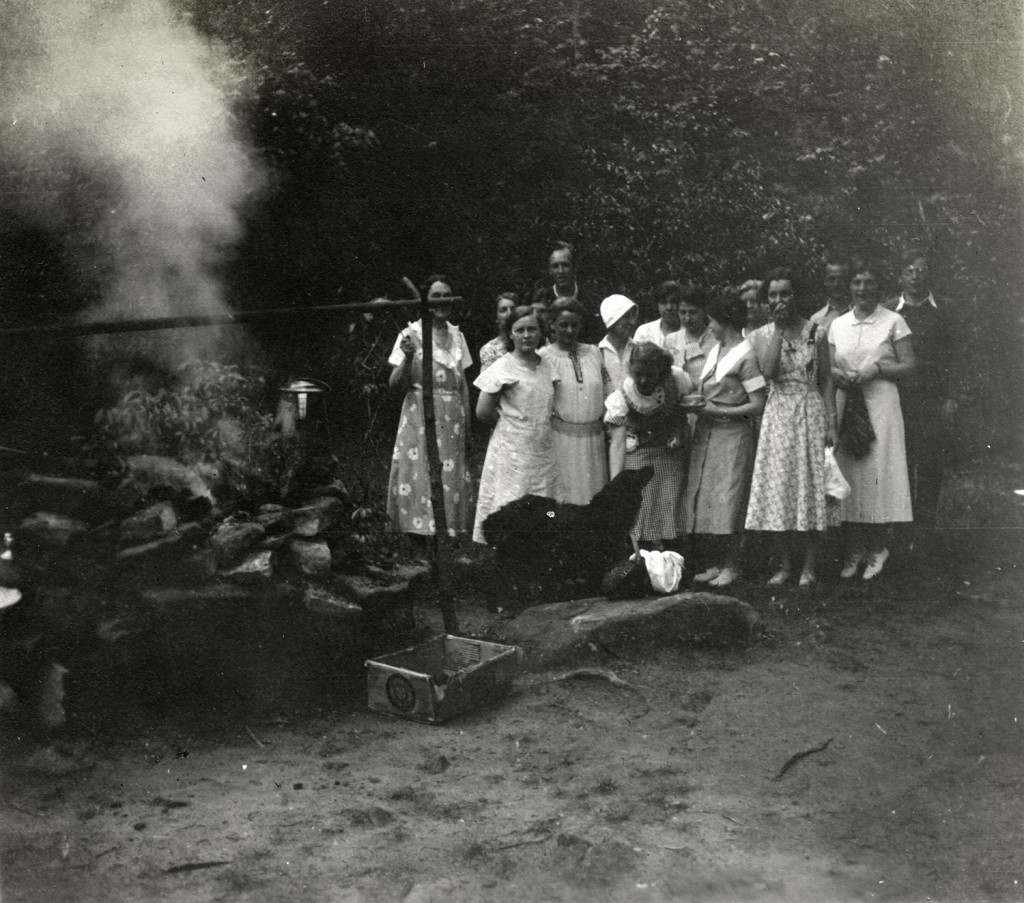
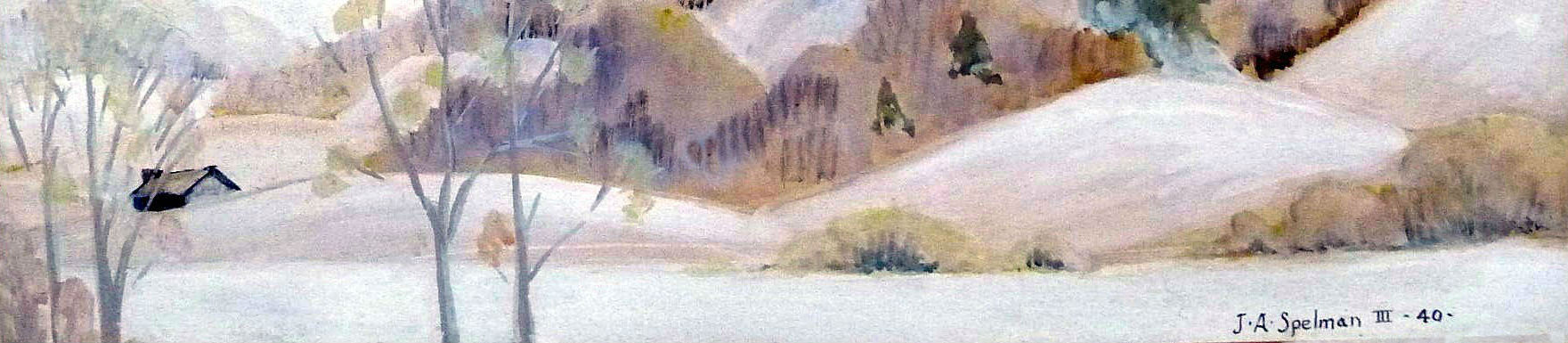
There is ample evidence that dogs were required to share multiple spaces on the campus and that they generally understood this amicable shared space. Miss Wilbur (Barbara Wilbur Spelman) with her dog “Jonah” is shown below in a picnic scene at the “Lean-To”, a favorite place on campus for community cook-outs. Jonah was also shared with Barbara’s brother John A. Spelman III, the art teacher at the School. The leftovers must have been quite good for Jonah at this cookout.
ORADELLE MALAN Staff

Picnic at the Lean-To. [Late 1930’s] Miss Wallace; Miss Jones; Miss Ross; Miss Bartlett; Miss Wilbur (with her dog Jonah); Alice Cobb; Lexine Baird; Oradelle Malan; Marian Kingman; Oscar Kneller; Glyn Morris. [X_100_workers_2574_mod.jpg]

Another dog of memory was the beautiful Collie that belonged to the Charles Creech family when the two worked at Pine Mountain.  Many children called the dog “Lassie” for the dog’s resemblance to the famous dog of filmdom. The dog’s real name is lost in the collective memory. “Lassie” was a beauty… some of the time. However, Pine Mountain was not kind to long-haired dogs. The campus is rampant with sticky burrs, insects, tadpole pools, and mud-puddles, etc. and “Lassie” stayed “untouchable” much of the time and was also quickly banished to an “outside dog” life — much to her liking.
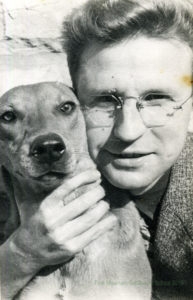
100 Arthur Dodd. Principal at PMSS with his dog,”Brennan”. [burk_people_100.jpg]

Contemporary canines, like  ” Waggy” the Rogers dog and “Amos” the Director, Paul Hayes’ dog, were ambassadors. They both roamed freely and greeted most visitors, though some were warned not to linger long on the campus.

To the left is Arthur Dodd, a PMSS School Principal [early 1940s] and his companion, “Brennan” a later addition to the Dodd family after the Dodd children’s Scotty was gone.

Following the death of Stefan dog, at the age of 15, the Hayes family dog, a small stray dog, entered the life of the Hayes family. “Rusty” belonged to the farm manager, William Hayes’ family. Rusty had a short life. Adopted at Pine Mountain “Rusty” had been only a short time at the Settlement School when he joined the Hayes family as they re-located to the Forestry Station at Putney — across the mountain from PMSS.  “Rusty” dog was a “mutt” with Beagle origins whose joints were brown and who looked to be “rusting” even in his youth. Like Waggy, Amos, and other dogs on the campus, Rusty had campus routines.  Like many Beagle derivatives, Rusty also ran — and ran. He was not a “please pet me character.” Rusty ran and my brother and I chased him.  He was the exercise master for his owners, including this author.
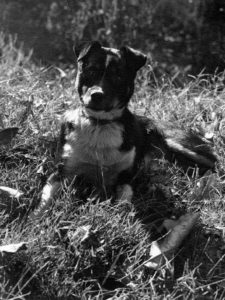
The Hayes’ “Rusty” dog. [burkh_032.jpg]

When, as children, we swam and fished in the Cumberland River near the Forestry Station at Putney, across the mountain from Pine Mountain Settlement,  Rusty was always in company. Unfortunately, his life was short after we left Pine Mountain. He did not understand that cars run faster on paved roads and that he could not outmaneuver them. He was struck on the highway, or, —  as we sometimes wondered — had a neighbor shot him for stealing eggs from the chicken house? …  But, that thief was, most certainly, our pet crow. That is another story. I still mourn “Rusty.”

The loss of a pet is like a death in the family. This is true of dogs that have grown up with a family with children.
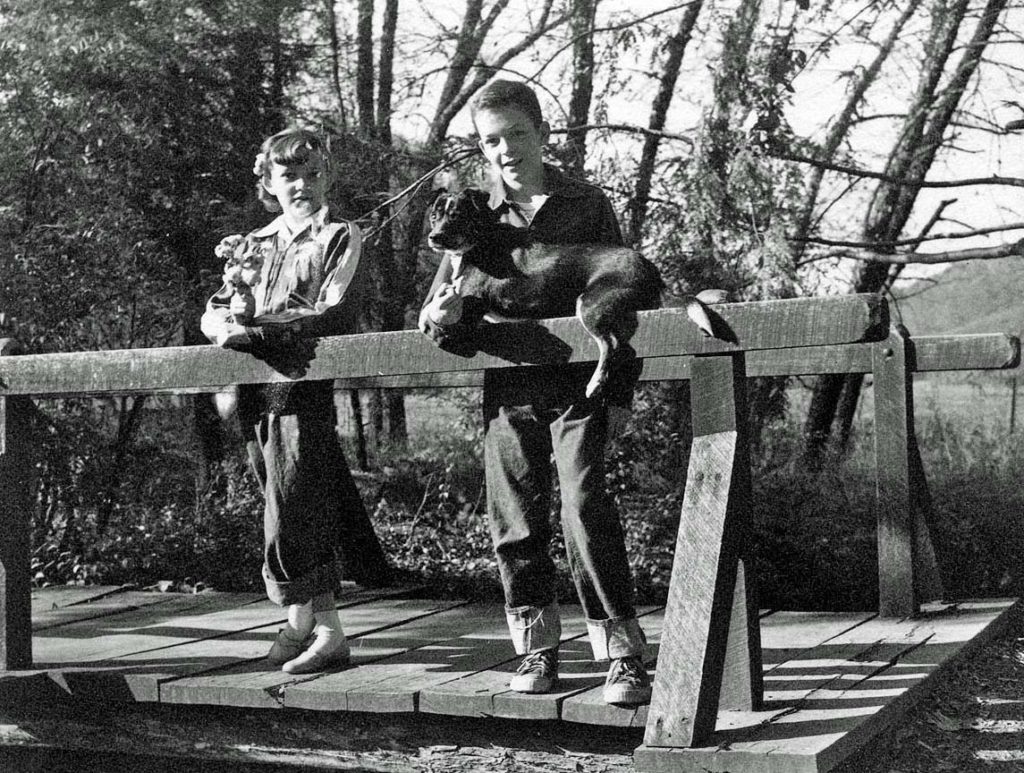
Helen and Steven Hayes, with “Rusty” dog on the Isaac’s Creek bridge at PMSS. c. 1953 [burkh_033.jpg]

More recently, the small dog, below, just showed up one day at Pine Mountain in 2021-22. He quickly became a close companion of the most favorite of recent dogs at the School — “Lady”. This little terrier’s life, like that of Rusty, was also a short one. In this case, he vanished into thin air, Perhaps his previous owners found him, or, perhaps new owners saw a delightful companion.  We can only hope his home is a good one. Lady misses him, as do those at the School.

 
“Russell” 2022 A short-term terrier visitor/boarder and friend of “Lady” Probably a “drop-off” and ultimately a disappeared dog. Information on his whereabouts is requested if known. [Photo: Eric Tomberlin, UNCA 2022]
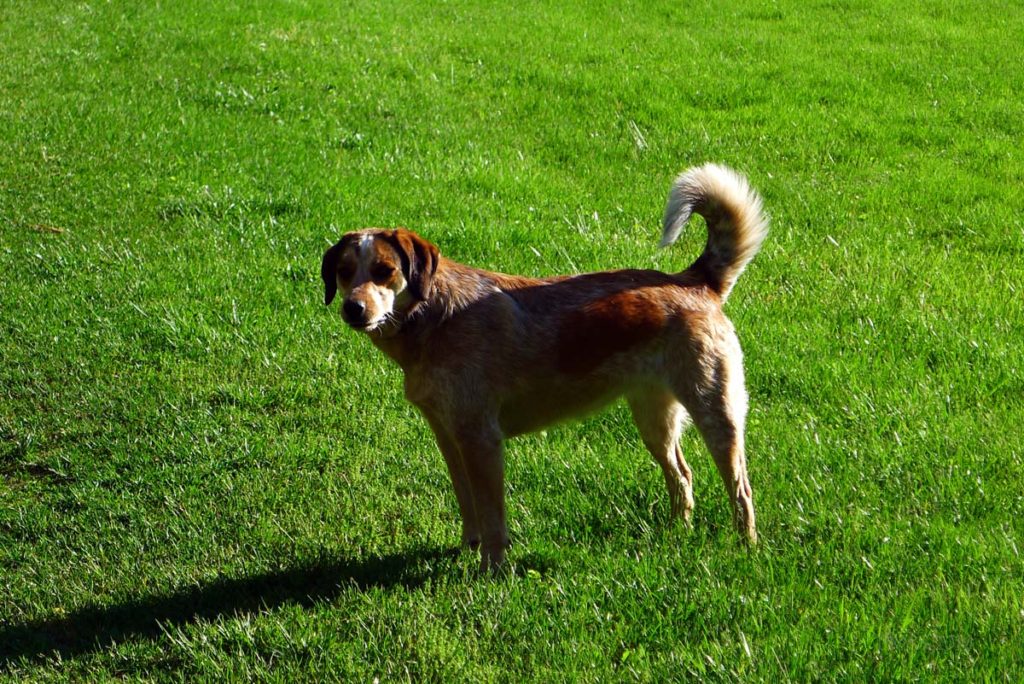
 

Lady of the Meadow.

This beautiful, talented, and dignified dog now resides on the campus. She is certainly the next dog legend of the campus. She is a constant companion of children on the playground and a guard dog of residents when they visit.  She has known three Directors. Lady “owns’ the campus, and often accompanies visitors on trails or as an escort from building to building. She is the School’s masterful ambassador. We hope you will visit and meet her.


While writing this essay, an article caught my eye and signaled the opening of a new world where future dogs may no longer be warm and fuzzy, but are robotic … No more dog food …no poop… no barking …. no whining,  …. companionship?  …..best friend?  Come and meet Lady … no contest.
LETTERS to a Sweetheart

Pine Mountain Settlement School
Series 09: BIOGRAPHY
Letters to a Sweetheart
Between Dot (Olive Coolidge)
and Bob (Robert Butman)
March 1942

LETTERS to a Sweetheart

Valentine, c. 1920. Source: Chordboard [Public domain], via Wikimedia Commons

LETTERS to a Sweetheart

Excerpts from WWII-era letters between Robert Butman and Olive Coolidge (PMSS assistant nurse, 1941-1942)

Valentine’s Day — a time to express your affection for or admiration of that very special person. If you’re needing inspiration to convey your feelings, consider the following excerpts from letters written in March 1942, during World War II, when “Bob” (Robert Butman), stationed at a military base, exchanged letters with “Dot” (Olive Coolidge). Olive served as an assistant nurse at Pine Mountain Settlement School from 1941 until early 1942.

The letters were among a very large collection of correspondence, photographs, and memorabilia donated to the PMSS Collections in 2024 by Marcia Butman, the grandniece of Olive Coolidge. Work on organizing and archiving the Coolidge collection and adding much of it to the PMSS Collections website is on-going.

Always beginning his letters with “Darling,” Bob thanks Dot for the cookies, books, and clippings she has sent him. The two reminisce about past times together and look forward to marriage and a honeymoon. As evident in the excerpts below, the couple was not at a loss of sweet words for each other.

March 24, 1942 – From Dot to Bob

We had such a lot of fun in such a short time, darling — even though there weren’t any waves on the ocean — that I feel more lonesome than ever. Seems as though each time we see each other we understand each other a little better, and have just a little more fun. It doesn’t seem as though that could go on forever — but I believe in miracles.

…She also remarked that Coral Gables was a good place for a honeymoon! Just a little too far away though — for the amount of time we’ll probably have for a honeymoon. But then perhaps we can take a 2nd one sometime if the 1st isn’t long enough. Perhaps we will be on a perpetual honeymoon — hmmm?

March 29, 1942 – From Bob to Dot.

Shucks Dearie, I feel very much in a “how about a date tonight?” mood. Which Is nothing unusual because I feel that way most of the time. And even more so after getting a letter from you. Yes Darling, it must be love — says he — seeing a fireplace in front of him.

March 30, 1942 – From Bob to Dot.

How are you? That’s good–I’m fine too. Darling, you are wonderful, says he, plunging into his uppermost thoughts. Questions: How can I love you more and more every day? Answer: Perhaps I can’t –- but I do.

 Right now you’re wonderful is about all I can think of to say (repetition at that) — beyond that, words fail me. Except perhaps — I love you — with all my heart — yes, you Dear. [P.S.] Does “yes, you dear” remind you of a valentines poem once written by none other than one O.D.C.?

March 31, 1942 – From Bob to Dot.

Sometimes, when I’m feeling very philosophical, I wonder what I ever did to deserve you. And no matter how much I flatter myself the answer always seems to come out the same. The answer being: “nothing, you’re just lucky Robert.”

…anyone that doesn’t melt when you smile at them is a block of granite.

Love is a wonderful thing, Dearie — though I don’t know much about it because you have all of mine.


See Also:
OLIVE COOLIDGE Staff – Biography

VALENTINES From the Past – Post

DANCING IN THE CABBAGE PATCH – The Power of Empathy

THE POWER OF EMPATHY

Pine Mountain Settlement School
DANCING IN THE CABBAGE PATCH
The Power of Empathy
Series 08: ADMIN  General Correspondence 1919
World War I

WORLD WAR I and Pine Mountain Settlement School

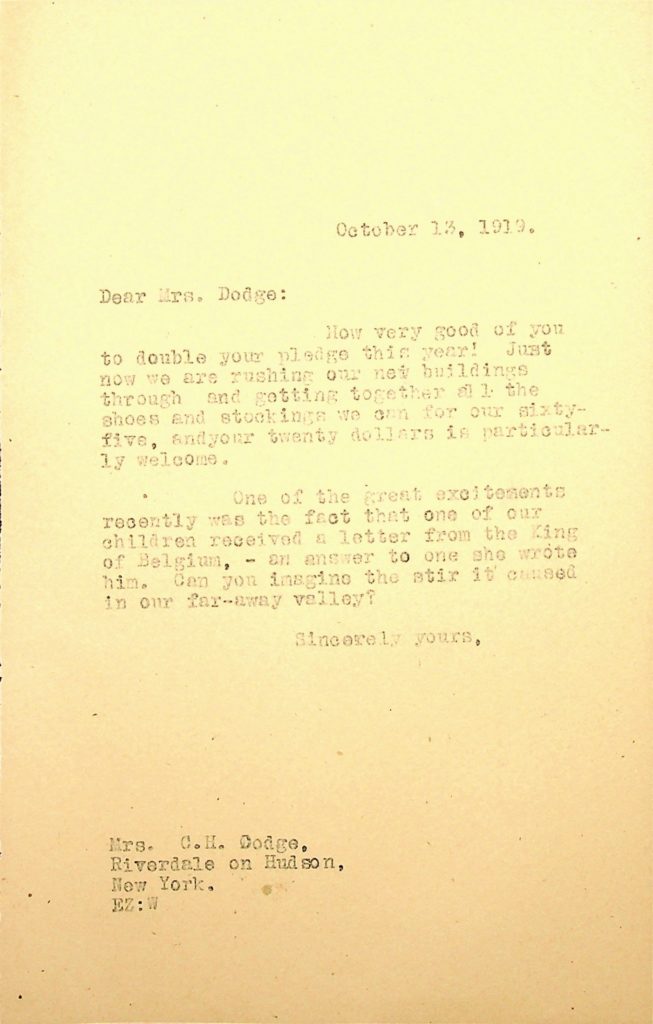
Copy of thankyou letter to Mrs. Cleveland Hoadley Dodge from Ethel DeLong Zande, PMSS [cleveland_hoadly_012.jpg]

THE POWER OF EMPATHY


TAGS: Ethel de Long, correspondence with donors, World War I, WWI, student correspondence, King Albert I of Belgium, Leon Deschamps, Mrs. Cleveland Hoadley Dodge, Father Anton Docher, Native Americans, Pueblo Isleta, Willa Cather, Phelps Dodge Inc., philanthropy, Riverdale Neighborhood House, Agrarian Myth, Settlement Movement


 The Letter, October 13, 1919

A copy of a small fund-raising letter from October 13, 1919, in the archive at Pine Mountain Settlement School captures the broad outreach of the School during its formative years. It is a startling letter in its brief but hidden details. The letter, one of many institutional solicitations and thank you’s that went out to various donors in the early years of the institution, has a deeper history than a first view may suggest.

The steady stream of brief letters in the early years were critical in building and sustaining the Settlement School. Letters were sent to donors by the School office, by the directors, and by staff. Today these letters inform us of the close attention the Administration, students, and workers at the School gave to the world outside the boundaries of the institution and the long-isolated valley of the Pine Mountain.  In 1919 the world was at war. The War effort in the first decade of the nineteenth century was underway but, remarkably, not so far away as one might think.

Addressed to Mrs. C.H. Dodge (Grace Parish Dodge [1850-1949]) at Riverdale on the Hudson, New York, and dated October 13, 1919, the brief letter thanks Mrs. Dodge for her recent pledge to the School and tells her of the work underway on the new buildings for the Settlement School. The author of the brief acknowledgment letter is “EZ”, or Ethel de Long Zande, founder and co-director of the School during that time. In her brief letter, she tells Mrs. C.H. Dodge (Grace Parish Dodge) that the School is busy getting shoes and stockings together for all the sixty-five students in attendance. She says that they are very appreciative of the $20 dollar donation. Importantly, she comments on a letter written by one of the children at the School.

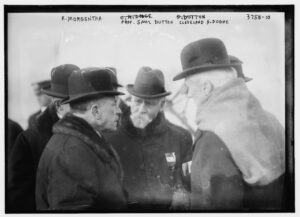
Mrs. C.H. Dodge is Grace Parish Dodge, the wife of Cleveland Hoadley Dodge , and part of the N.Y. Dodge family, one of the wealthiest families in the Riverdale, New York community and in the country at the time. Cleveland Hoadley Dodge had holdings in the Pacific Railroad, the early Citibank of N.Y and other major investments. He was a close friend of President Teddy Roosevelt family as well as President Woodrow Wilson and Dodge was among the ranks of the leading philanthropists in New York, as seen in this 1916 photograph.

Henry Morgenthau, Sr., Samuel Train Dutton, and Cleveland Hoadley Dodge

Cleveland Hoadley Dodge. (2023, June 25). In Wikipedia. https://en.wikipedia.org/wiki/Cleveland_Hoadley_Dodge

Mrs. Zande in her brief acknowledgment letter to Mrs, C.H. Dodge describes a recent exciting event at Pine Mountain Settlement for Mrs. Dodge. The event involves a young student at the school who was inspired by recent world events. The student (a girl, not named) wrote to the King of Belgium, Albert I,  about the war. Most likely the student was inspired by the anxiety and patriotism of Leon Deschamps, a Pine Mountain worker who had recently settled in the United States from Belgium and was working at Pine Mountain Settlement.  The young girl was moved by her admiration of Mr. Deschamps and the desire to try to help with the war effort by writing a letter to the King of Belgium. We may never know what the letter said, but we do know the chain of events it set into motion.

The child’s letter remarkably found its way to King, Albert I, of Belgium. The King, or certainly his staff answered the young student. Whe she received an answer from King Albert I it created a sensation at Pine Mountain.  When the answer from the King was received, it, in fact, animated the full Pine Mountain community and led Mrs. Zande to remark about the event to her New York friend Mrs. Cleveland Hoadley Dodge (Grace Parish Dodge),

“Can you imagine the stir it caused in our far-away valley?”

Unfortunately, the letter from the young girl and that of King Albert I cannot be found in the Archive. Nonetheless, the record of the correspondence alone is extraordinary and stirs the imagination.  The story surrounding the letter of 1919 was not just a simple exchange of letters. It has a deeper history. 

The Deeper Story:  King Albert I and Father Anton Docher

1919 was the year that Belgian ruler,  King Albert I, visited the United States. From September 23 through November 13, the King, his Queen, Elisabeth of Bavaria, and their son Prince Leopold II made an official visit to the United States. Their American visit included a trip to a small Native American pueblo in New Mexico, the Pueblo Isleta. There, the King honored Father Anton Docher, a hero of early World War I. The homage centered, particularly, on Father Anton’s work in the Belgian Congo. The King was intent on bestowing on the Priest the insignia of Knight in the Order of Leopold II and the French Colonial Medal, for his war courage and service to Belgium.

Anton Docher, the focus of the award, left the War and the Congo a changed man. He soon studied for the priesthood. During the remainder of his life, Father Anton asserted that colonialism was an international evil, and he committed his life to serving and learning from various Native tribes in New Mexico about their oppression as Native Americans. By all accounts, the Belgian-New Mexico ceremony to honor Docher was no small event, as some ten thousand people reportedly came to attend the ceremony in the small Pueblo Isleta.

Father Docher also did not escape the attention of the writers of his day, including the noted author,  Willa Cather.  Father Docher as the model for her well-received novel, Death Comes for the Archbishop (New York: Alfred Knopf, 1927).  The newspapers were full of the events of the King’s visit. They describe his journey to New Mexico, and his how his entourage traveled to New York, where the King was honored with membership in the New York Society of the Cincinnati. He was also given a ticker-tape parade and an introduction to the leading families of the city of New York. It was this New York journey that brought the King into the social circle of the Dodge family with whom Ethel de Long Zande had connections. The New York connection with the Dodge family prompted Ethel to give the subtle nudge in October 13, 1919, to Mrs. Cleveland Hoadley Dodge in Riverdale, New York.

“Lest They Perish: Campaign for $30,000,000. American Committee for Relief in the Near East.”[Genocide_poster_USA.jpg]

The Dodge Family

The Cleveland Hoadley Dodge family was a well-known and highly regarded family in New York.  They moved among many of New York’s notable families of wealth. Cleveland Hoadley Dodge had built his fortune in copper mining and was a major player in the financial and social support of WWI efforts.  Cleveland H. Dodge was also an executive at Phelps Dodge, a leading copper mining corporation in the U.S. that had been co-founded by his grandfather in 1832. His family was known for its generous philanthropy, and today the Dodge family continues to support the foundation he established in 1917,  the Cleveland H. Dodge Foundation.

One of the central Foundation interests is its continued good work today in educational support, community programs, and cultural institutions, though mainly centered in New York. The father of Cleveland H. Dodge, William Hoadly Dodge, and his mother, Sarah Dodge, were the inspiration for their son’s philanthropy.  But it was Cleveland Hoadley Dodge’s wife Grace Wainright Parish Dodge (1856-1949) , who had the connection with Pine Mountain. 

GRACE WAINRIGHT PARISH DODGE

Grace was born in France but was known to be deeply connected to the Settlement Movement in America, begun by Jane Addams.  As the wife of Cleveland Hoadley Dodge, her life of wealth made her strongly sensitive to the growing divide of wealth and poverty in their city of New York and in the world, and the many and growing populations displaced by war.  Grace Parish Dodge was a pioneer in women’s rights and education and was the first woman to serve on the New York Board of Education, where she generously funded the New York Public Library. 

Her connection to the Settlement Movement of Jane Addams and the work with the Cleveland H. Dodge Foundation, and the larger Phelps Dodge Foundation, helped to further her earlier work at the Riverdale Neighborhood House. Grace began the Riverdale House as a neighborhood library at the early age of sixteen and helped to expand its service from the early beginning. Even today, in an expanded form, the House and Library continue to provide services to Riverdale, New York, and its surrounding communities.

World War I and Pine Mountain Settlement School. The Cleveland H. Dodge Foundation established in 1917

Literacy and a remarkable push for optimism were ideas close to the heart of Ethel de Long Zande and Katherine Pettit. The early novels of Willa Cather — Oh, Pioneers! (1913), The Song of the Lark (1915), and My Antonia (1918) — were all written during the early period of Pine Mountain’s development and were well known to the two founders and their students. The ages of all the women were similar, as were their interests. Like Katherine Pettit and Ethel de Long Zande, Willa Cather had a deep and close attachment to the land. Writing in 1918, she notes

In the course of twenty crowded years one parts with many illusions. I did not wish to lose the early ones. Some memories are realities, and are better than anything that can ever happen to one again.

A strong optimism shines through the many connected lives that are called to attention by these related letters.  Many of the letters from Pine Mountain during this difficult war-time period, including that of the young student sent to the King of Belgium, and the brief exchange with Mrs. Grace Parish Dodge, clearly evidence this optimism. 


TRANSFORMATION AND ELEMENTS OF THE AGRARIAN MYTH 

WORLD WAR I and Pine Mountain Settlement School

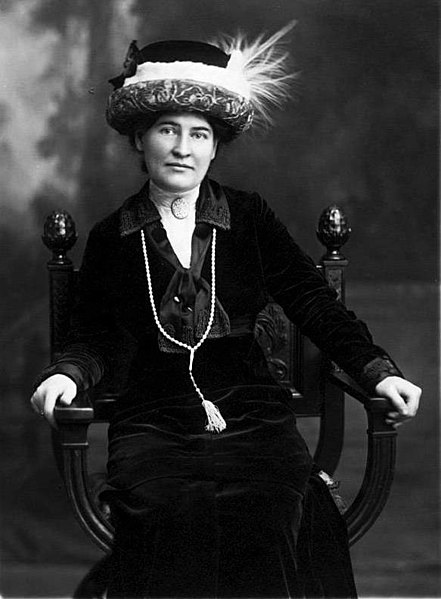
Willa Sibert Cather, Wearing a necklace given her by author Sarah Orne Jewett, another Agrarian at heart. [Public Domain, wikisource.org]

Many of the workers who came to Pine Mountain came with a romanticized vision of what has come to be called the “Agrarian Myth.” It carries many of the markers of the Settlement Movement, the Community Life Movement, and other cooperative organizations that challenged conflict, poverty, and human indifference to education and the challenges that accompany immigration and migration. The myth, the movement, and the diverse challenges blended into one as the nation went to war, and later, when they sought to heal the wounds of war. Many citizens carried their personal experiences of the challenges and horrors of WWI and life during wartime in countries “acrost the sea,” (as Uncle William would say), with them to the remote mountain School. The personal narratives of some of the workers set the imaginations of the students racing. Ultimately, what all the workers and the students held in common was a worldview — something outside their known experiences. Hope took its image from the land and its people. It was a starting place for all. The hope for a better future rests in that awareness of a shared place with diverse dreamers.

The integrated experiences, the personal relationships, the kindnesses, the honor, social justice, and the hopes of all bound many lives together during the formative years of Pine Mountain Settlement School. These shared experiences exploded narrow and protected mountain lives in a manner that is difficult to describe to today’s electronic youth, separated as they often are from the tangible present and often isolated by their electronic entertainment world. The sensitive understanding and acceptance of larger social forces encountered by those “outsiders” who passed through the Kentucky settlement deep in the hills of Appalachia were a remarkable force in transforming the lives of many children. The stability and optimism of PMSS School during the two Great Wars are all the more remarkable when placed against the enormous disintegration of the world outside the Pine Mountain Valley during those Wars and the great price paid by so many soldiers from Eastern Kentucky.   

Many of the staff had seen the rubble of Europe in their early wars; the broken soldiers, and a world recovering from vicious privation and violence. Those same individuals were living within a community that knew many similar social violations through a very intimate history of feudings and the even more senseless personal violent gun history. 

Though isolated, the lessons and values learned in wartime and equally through the local “feudalists” encounters,  continue to remain a part of the Pine Mountain community’s history and psyche. The lessons that were learned from war and feuds are certainly embedded deeply in families who passed through the School in the Pine Mountain valley, and today continue to resonate in families in other valleys throughout the world.

War ignores borders, but compassion also does not have borders. Throughout today’s world, nation, person, and psyche, there is hate, fear, terror, and cruelty of many types. But there is also love, compassion, joy, and friendship. In these overlapping emotions, what are the change agents that bring us to war? What brought a world leader to respond to a young girl in the mountains of Eastern Kentucky? How did that letter change the young girl? Why are similar echoes so seldom heard in today’s news, even with our rapid communication?

Today’s world cannot be easily explained away by our rapid communication and our crowded lifestyles. The lessons of institutions such as Pine Mountain Settlement School, the Riverdale Neighborhood House, and in communities such as Puebla Isleta, in authors such as Willa Cather, and the kind letter from a Belgian King to a child deep in the Kentucky hills, are seldom remembered. Were they messages of a different sort, or are we now people of a different sort?

Dr. Edward H. Egbert

In the last years of WWI, Dr. Edward H. Egbert (c. 1882-1939) was the chief surgeon at the American Hospital for the Red Cross effort in Kiev, Russia, and the Executive Secretary of the Catherine Breshkovsky Russian Relief Fund in New York. In 1919, he planned a visit to Pine Mountain. He was a close friend of Herbert Hoover. But, then, that’s another story of Kiev, war relief, mysticism, Bolsheviks, murder, and healing. We are still writing that history. That history is not getting kinder, but philanthropy and hope are still alive.


See Also: DANCING IN THE CABBAGE PATCH War and PMSS (Post)

DANCING IN THE CABBAGE PATCH – Olive Dame Campbell’s 1922 Letter on Danish Folk School Training

Pine Mountain Settlement School
Series: DANCING IN THE CABBAGE PATCH
Series 09: BIOGRAPHY
Olive Dame Campbell
Marguerite Butler
Letter: Danish Folk School Training
1922

SETTLEMENT INSTITUTIONS OF APPALACHIA Inc. Brochure 1970 Serving in Appalachia

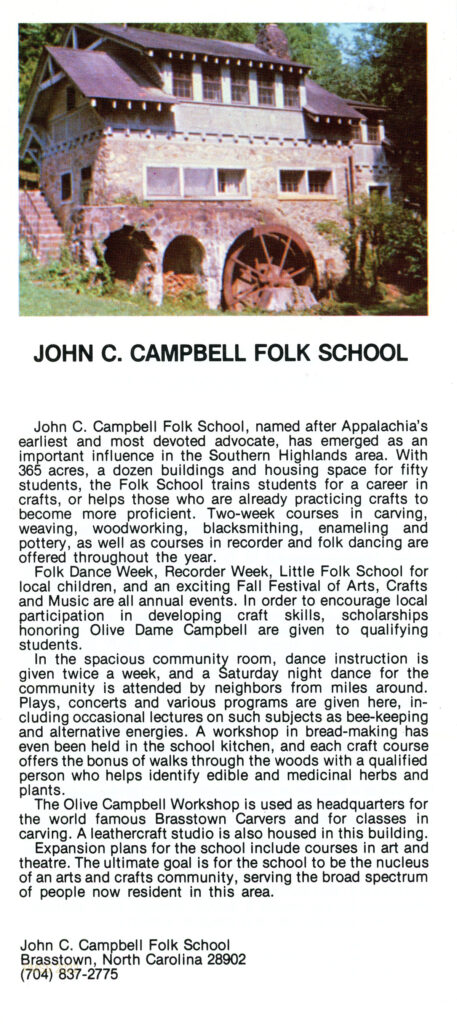
John C. Campbell Folk School. Early brochure for School [SIA_brochure_005] PMSS Collect.

TAGS: Olive Dame Campbell, Marguerite Butler, Georg Bidstrup, Denmark, Danish Folk Schools, folk schools, Progressive education, ASKOV School, Denmark, Daisy Gertrude Dame, agricultural schools,

OLIVE DAME CAMPBELL’S 1922 Letter on Danish Folk School Training   (3 pages)

FOUNDATIONS

The early years of the twentieth -century were marked by a heightened interest in new educational models and particularly those that could remediate rural education in remote sections of the United States and also in other countries. The exploration of the Danish Folk School model was of particular interest to several of the earliest founders of rural residential schools in the Appalachians. The Danish Folk School model is one such program established in the 1830’s by its founder N.F.S Grundvig.  Identified as a theologian, writer, philosopher, historian, educationist and politician, Grundvig had ample experience that was turned toward reform in educational practice. Danish Folk Schools still persist in some 70 schools throughout Denmark , testimony to their solid contribution to education for high school populations in Denmark and other countries.

OLIVE DAME CAMPBELL and the JOHN C. CAMPBELL FOLK SCHOOL

SETTLEMENT INSTITUTIONS OF APPALACHIA Inc. Brochure 1970 Serving in Appalachia

John C. Campbell Folkhad School. SIA_brochure_005

The following letter and supplemental literature located within the archive of Pine Mountain Settlement School was sent by Olive Dame Campbell to friends and colleagues at Pine Mountain Settlement School, including Katherine Pettit, whose letters contain the recorded report.  The letter concerns Mrs. Campbell’s exploratory time spent in Denmark with Marguerite Butler, learning about the Danish Folk School educational model. It exposes the foundational differences between the Settlement School and the Danish Folk School models and sheds light on Olive Dame Campbell’s earlier trip to Denmark with her husband, John C. Campbell. Both Campbells had a deep interest in the foundations of the Danish Folk School model. Their interest led to the Scandinavian folkehøjskole idea as a model for the John C. Campbell Folk School and influential in the foundation of the Highlander Folk School in Tennessee begun by Myles Horton.

Folkehøjskole

Olive Dame  Campbell and her husband were enchanted by what they learned of the Danish Folkehøjskole (Folk School) on their earlier trip to investigate the model schools.  Following their return home they set their sights on a similar school that would model values they believed were compatible with educational needs in the Central and Southern Appalachians. Olive Dame’s husband. John C. Campbell unfortunately suffered a heart attack and died suddenly before the couple could bring their dream to fruition. Olive Dame vowed to continue the pursuit of their dream. The Brasstown, NC institution that grew out of the Campbell’s  enchantment with the Danish educational model and the early work of N.F.S. Grundtvig, the philosopher, writer, and Lutheran Minister. The school that took shape following this second trip to Denmark was called the  John C. Campbell Folk School in memory of Olive Dame Campbell’s husband.


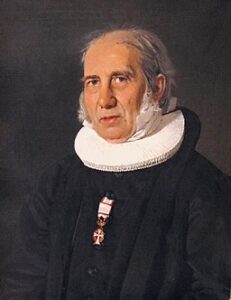
N.F.S. Grundtvig
Danish Folk Schools
Lutheran Minister, Philosopher, Writer, Theologian,  Historian, Politician

Christian Albrecht Jensen
Public domain, via Wikimedia Commons” ”


When John C. Campbell died suddenly in 1919, the dream of a Folk School in rural Appalachia was put on hold for several years, but not forgotten. The Danish Folk School model never left Olive Dame’s thoughts and four years later she sought out her sister Daisy Dame  and Pine Mountain Settlement School’s  Marguerite Butler to travel with her back to Denmark to give a close second look at the details of the unique Danish educational plan. This time Olive Dame and her companions would fully engage the Folk-School program by actively participating in the programming and training.   On this second trip, her sister Daisy Dame came along as an advisor and as a teacher with first-hand knowledge of rural schools in Eastern Kentucky where she had taught for a brief time and where her ideas and those of her sister led to an amalgam of educational philosophies regarding rural education in the Appalachian mountains.

MARGUERITE BUTLER

MARGUERITE BUTLER Staff

Marguerite Butler. [X_099_workers_2511_mod.jpg]

Marguerite Butler, a worker at Pine Mountain Settlement School, had caught the of attention Olive Dame Campbell, based, no doubt, on the recommendations of Katherine Pettit  a founder of the Pine Mountain Settlement School and a friend of Olive Dame Campbell. The contacts made in the early years of the Pine Mountain Settlement School development were very formative including an early exploratory trip by Olive Dame and John C. Campbell made of Eastern Kentucky. The connections brought all parties close together in their efforts to remediate the educational future of both Eastern Kentucky and Western North Carolina.

Marguerite was invited to come along on the Danish exploratory adventure with Olive Dame, as she had proved herself in her early years at Pine Mountain helping the founder, Katherine Pettit establish a small satellite settlement at Line Fork, near the Pine Mountain School. Marguerite was an enthusiastic follower of the new educational and vocational models that were being tried following the success of the urban Settlement Movement and the educational enthusiasm surrounding Jane Addams and Settlement advocates. Further, Marguerite Butler’s interest and enthusiasm for the Settlement Movement seems foundational to her interest in the Danish Folk School model while a student at Vasser.  Certainly, her imagination had been captured by the proposed trip and she left Pine Mountain Settlement to join Olive Dame and her sister in their Danish educational quest.

FOUNDATIONS

Olive Dame had met Katherine Pettit on a trip to Eastern Kentucky in 1908-1909 when she and her husband. John C. Campbell, were travelling  throughout the Central Appalachia, Katherine Pettit had already demonstrated her success in establishing Hindman Settlement. Working with May Stone she established a rural settlement in Knott County, KY. First called the W.C.T.U [Women’s Christian Temperance Union] School, Hindman Settlement School became the first of a series of rural settlement schools throughout Eastern Kentucky.  But by 1913 Katherine had put her sights on founding another rural settlement school in near-by Harlan County. Olive Dame Campbell kept up a correspondence with Pettit and later with Marguerite and their work at the new Pine Mountain Settlement School and Olive Dame found kindred spirits in both of the early Pine Mountain Settlement School visionaries.

Marguerite Butler, was a talented Vassar graduate recruited by Pettit and who had demonstrated hands-on skills aligned with both the Settlement models and those of the Danish Folk Schools. Further, Marguerite was a remarkably resourceful and industrious young girl.  She had been charged by Pettit to help plan and establish a new satellite settlement at Line Fork and received praise from all observation points — administration, community, and regionally.  She was a model of Olive Dame’s vision of activism and the Danish model’s very hands-on approach. Soon, Olive Dame charmed Marguerite away from the Kentucky school by the offer of the trip to study the Danish Folk School and later, kept her near as a co-founder at Brasstown.

HOME AND THE WORK BEGINS

On their return to the United Sates, Marguerite and Olive Dame were firm believers in the Folk School model — with touches of the earlier Settlement School ethos. Marguerite became Olive Dame Campbell’s primary assistant in creating the new Brasstown Folk School after convincing the local community of the value of a new high school at Brasstown that would serve a very dispersed population. John C, Campbell Folk School was born in the heart, mind, and hard work of Olive Dame and Marguerite.  They both had skills at community building and these talents were well demonstrated when the community of Brasstown, some 200 strong, gathered and endorsed the idea of a Folk School for their small community  — and the building began.

The  Danish educational model at  John C. Campbell Folk School in Brasstown, North Carolina joined the best of Pine Mountain’s lessons to the lessons learned in Denmark, as described in the following letter. Marguerite and Olive Dame Campbell were to spend the remainder of their lives at the school named for Olive Dame’s husband, John C. Campbell and Marguerite soon planted roots even more deeply, when she married a Danish farmer recruited from Denmark, Bjorn Bidstrup, and she became Marguerite Butler Bidstrup.

The relationship between the two rural schools, one a Settlement School and one a Folk School, remained fixed by their shared objectives for better answers to the needs of rural education.  Some Pine Mountain staff, such as Leon Deschamp, a former worker at Pine Mountain and his wife May Ritchie Deschamp [older sister of folk singer Jean Ritchie], are two notable transplants to the North Carolina Folk School. A transcription of an oral history by Marguerite Butler Bidstrup gives more depth to these interesting and important transitions and collaborations.

Today John C. Campbell continues its valuable work with the rural community in the surrounding Brasstown area but has broadened its scope to include a large Arts and Crafts influenced program that has gained National and International recognition and participation.

The other journey influenced by the Danish Folk School model, found in the person of Myles Horton, who also took the journey to Denmark to study the ways of the Danish Folk School model, is well documented.  When he came back to found the Highlander Folk School in Tennessee , he led the institution toward grass-root social protest against bigotry and social ills … but that is another story that needs another telling and the story is a good one.


The success of the Danish Folk School model at the  John C. Campbell Folk School at Brasstown, North Carolina.   may be read in the basic tenets spelled out in the following letter by Olive Dame Campbell to Friends.


LETTER OF OLIVE DAME CAMPBELL FROM COPENHAGEN, DENMARK
October 1922

TRANSCRIPT [shared copy in PMSS collections — not yet scanned]

The following form letter has been received from Mrs. Campbell. She asked if I would have copies made and one sent to you. I do this with great pleasure.  F. J. Clark

Copenhagen, October 6, 1922

My Dear Friends:

Having been here now for over six weeks I think it is perhaps time for me to register some impressions. I am new at the machine and shall doubtless turn out a bad sheet. Moreover my thoughts do not flow as rapidly or as logically this way  as they would at the end of a pen. Such as they are, however, I can share them with more of you, and you will find them much easier to read.

You may know. that there are three of us here. Marguerite Butler of the Pine Mountain Settlement School. My sister Daisy Dame who has been a teacher. for many years (one of which she spent. getting a kindergarten started in a Kentucky Mountain County), and myself.  I wish greatly that there were several more. We are already finding it valuable to check each other up. Moreover, there are so many things that can be arranged for a group as well as for one person, especially conferences with busy important people who do not speak English well enough to care a great deal about going over the same ground many times. Then. so much time is saved by passing along information to each other. We have been fortunate in finding two of last year’s American-Scandinavian students still here. Their help, particularly one who has been studying agricultural cooperation, has been invaluable.

Except for two weeks trip into Jutland to visit Askov, the most famous of the high schools, to talk over our course of action with several leading people and to get something of an idea of the country before winter closes in, we have been here in Copenhagen [Denmark].  We shall remain here until Askov [a Southern Jutland Danish High School] opens. early. In November. And then go back there for a month as pupils!

Of course, one cannot get a great deal of first hand information on the high schools here. In fact, It is quite amazing how little the average Copenhagener one meets. knows about these schools which. are bringing educators from all over Europe.  There is a distinct line between. city and country. Or more exactly between Copenhagen and the rest of Denmark. Inquiries are often dismissed with the statement that these schools may be all well enough, but that they are of course, for peasants! On the other hand, we find that students, particularly women of the other groups,  are beginning. to attend Askov, where some of the finest lecturers in the country are situated. Another factor is that the high schools are in no way connected with the state system. each being more or less a law unto itself,  —– that is, depending upon the peculiar point of view and the personality of its “forstander” or principle. In spite of the fact that so many are subsidized by the state no special track of their activities seems to be kept at headquarters and one has to do his own hunting. and get what help he can

page 2

through personal introduction. publications (practically all in Danish) and being passed along from one school to another. The University, which is a severely technical institution, is frankly indifferent, although of course there are interested individuals in the faculty, some of whom have actually taught in the high schools. Fortunately, the Minister of Education, Herr Appel, is himself a high school man — the former head of Askov, which his wife now runs. He is a fine big person, speaking broken English but most helpful and human. One can get to him and other people of importance quite easily, although my connection with the American Scandinavian Foundation has greatly facilitated matters.

There are also here in Copenhagen three high schools for trade-union and industrial groups. run somewhat on the lines of the country ones without the important residence feature. We have already established pleasant relations with the  head of one a famous old man named  Borup. [ later, literally Borup’s Folk High School].  His account of his work and his outline of his conception of what such education should mean has been one of my most stimulating experiences so far. His classes begin this week and  we expect to attend some of them frequently. We shall, of course, visit the others too. It is. besides valuable to get the reactions of various kinds of people here not connected with educational and social work.

Our visit to Askov makes us a bit restless to be in the city fascinating as Copenhagen i— and  more. keen than ever to get to the heart of our study. I wish you might have been with us at the big fall reunion which we attended two weeks ago. Every year the old students come back 1000 to 1500 strong and stay at the school visiting. and eating together and listening to lectures of all kinds. Old men and women were there who had attended the school over 30 years or more before. One old man of 70 odd [yrs] had been at the original school at Rodding. You can’t imagine how interested he was in us and how persistently he tried to talk to us in spite of our very evident, painful, Danish fragments of speech. It was a picture to see him drive away in a big farm wagon, heaped high with bedding, which each comer must himself supply. A number of the women spoke fairly good English so we had an opportunity to talk. which they were eager to do. There were, too, quantities of young men and women fresh. and intelligent looking. The Deans have a great sense of humor. And these young people get, I think, a great deal. of entertainment out of our conversational. difficulties, I don’t blame them and they were. very polite about it. All these people, old and young together, sat through four one-to-one-and-a- half hours lectures each and every day. [They] came again in the evening to music. stereopticon pictures, et cetera, Some of the subjects of the lectures were present day conditions in Belgium. Educational conditions, and Schleswig. (newly returned to Denmark), two educational addresses,  one by. Minister Appel,  two religious addresses (along what. line I could not determine), two on prayer and work, one on modern Danish art,  one. on Abraham Lincoln by a. Dane who has taught in a People’s High School in Des Moines [IA] among the Danish. It was a curious feeling to hear him come out in English with. “… a government of the people, for the people, by the people”… Repeating this emphatically and slow a number of times, writing it on the blackboard and translating it into Danish. I could understand that he said this  was the  foundation of one of the American ideals.  Of course. I could understand very little of

page 3

the addresses. but it was evident that each speaker was using the full. force of his personality and the. audience responded with absolute silence or with ripples of laughter. Imagine what such lectures and such connecting links year after year must mean to the people scattered out in the little farms. The government meets the expenses. The people paying the nominal sum of five Cronin (about $1,10  a day at this exchange). By the way, there seemed to be no checking system. A man simply sat there in the open court, ready to take the money. Our coming to stay at Askov, where some of the leaders are situated. Is going to be a most valuable one and from there we will be. directed and introduced to the smaller schools. Askov itself. Is an extended high school — no student being allowed who has not had a session at one of the smaller schools. There are, of course, No examinations for admission.

I suppose you are wondering all this time about the language. It is difficult. We have an excellent teacher here and unusually good little grammar with the phonetic system. But while the. construction is like English and many of the words for that matter, the pronunciation. Is anything but English in sound.  It is a guttural, breathless kind of language and I question if any one but a Dane will ever be able to pronounce its Gs and Rs and Es correctly. We are persisting valiantly with the reward that we can usually be understood when we ask simple questions. We can also understand simple answers and are beginning to get snatches of what we hear in lectures. We must get it. That is the first advice everyone gives us.  It is evident to us that a statement of general methods and courses. Is not going to give us the secret of how the information is given, nor, as I said before, the various angles presented by the lecturers each. of whom is expected to use his personality to the utmost —- this. involving the frank expression of his own point of view, Each school will thus be individual and how Individual and how. the individuals average up, we must decide for ourselves.

Our time here in Copenhagen is therefore a necessary and valuable study.. It would be more valuable still, could we make use of the fine libraries here. There is much reading we shall have to do as soon as our Danish is more proficient. It does seem a pity when we are putting out so much time and energy on these details that we cannot share our experiences with others who might be able to come only for a few months. With what we could jointly translate and give through talks with people who speak English, (we will be ready to direct to those who have given us the most help). and through what one could see for himself, a shorter stay ought to be very profitable. It is not expensive living here. One can cover the essentials for about $60 a month. Passage on the one class steamer of the Scandinavian-American Line brings you straight to Copenhagen and $150 will give you a good birth,  So I am continuing to hope that some of you will still come over — Perhaps make a sudden start and join us at Askov  early in November. Think it over well. Do !! Fine clothes are neither needed nor desirable. Plenty of comfortable shoes. Warm things, and rain things.  I can. always be reached sooner or later through the international Students Committee. Studiestrasede [?]  6 Copenhagen, and I would. of course come back again to Copenhagen to meet anyone if I knew in time.  Later, I will try to write again as to what we find.  I wish I had time to write of all the interesting incidentals.  With regard to all.

Sincerely always.

(signed) Olive D. Campbell.


See also:

Bodene-Yost, Zizanie (2013) “in the U.S.: The Failure of the Danish-American Folk High Schools vs. the Success of Highlander Folk,” The Bridge: Vol. 36 : No. 1 , Article 9.
Available at: https://scholarsarchive.byu.edu/thebridge/vol36/iss1/9/
Free and open access article by BYU ScholarsArchive. It has been accepted for inclusion in The Bridge by an authorized editor of BYU ScholarsArchive.


SEE ALSO

MARGUERITE BUTLER Staff

MARGUERITE BUTLER Letters 1922

MARGUERITE BUTLER BIDSTRUP Oral History

KATHERINE PETTIT Director