Author Archives: pmss_editor

About pmss_editor

Editor, Helen Wykle, was born at Pine Mountain Settlement School in Southeastern Kentucky in 1942. Both parents were students at PMSS and later employees. William Hayes was the Farm Manager and Fern Hall Hayes, the Secretary to multiple Directors. Education for Helen began in the one-room school on Isaac's Creek, continued at Pine Mountain, at Red Bird Mission School, and Berea Foundation Highschool. Admission to Berea College in 1960 led to a B.A. in Art in 1964. Further study of Painting at Ohio Univ. and Art History at Tulane University and later the completion of an M.A. in Art History (1987) at San Jose State University encouraged an interest in archives. A brief return to KY and appointment with the Univ. of KY Jr. College at Maysville teaching Art and Art History and then a return to California where brief teaching jobs, (Gavilan College, and San Diego City College and San Diego Art Museum) the birth of our daughter Heather, who is deaf and has cerebral palsy, led to another life-long educational path. Juggling California, Heather, and a five-year employment at UC San Diego in the Library of Visual Resources and the Main Reference Services department later led to a M.L.A. at UC Berkeley in Library and Information Science (1987) and as Sr. Museum Scientist for the UC Irvine School of the Arts (1987-1992). In 1992 I returned with family to Appalachia (North Carolina) and our daughter began training at the NC School for the Deaf and I began a second academic career as faculty at Warren Wilson College Pew Library and the Art Department, followed in 1995 by a longer tenure as Assoc. Prof. at the University of NC Asheville as Public Services Librarian and Director of Special Collections. Full retirement in 2013 allowed a focus on the Pine Mountain Settlement School Collections and the initiation of volunteer work on the archive with my cousin, Ann Angel Eberhard, recently retired from the Smithsonian. This is the 15th year of our continuing and cooperative development and selective digitization of the Pine Mountain Settlement School Collections .

Going and Coming Back I

Pine Mountain Settlement School
Post: DANCING IN THE CABBAGE PATCH
Going and Coming Back I

Going and Coming Back I

A personal reflection on Appalachian migration.

“The effect of mass migration has been the creation of radically new types of human beings: people who root themselves in ideas rather than places, in memories as much as material things; people who have been obliged to define themselves — because they are defined by others — by their otherness; people in whose deepest selves strange fusions occur, unprecedented unions between what they were and where they find themselves.”
Salman Rushdie

“It seems to me from my personal experience that there is kindness everywhere in different proportions and more goodness and tenderheartedness than we read of in the moralists.”
                           Elizabeth Barrett Browning

These may seem strange companions in a discussion of migration — Salman Rushdie and Elizabeth Barrett Browning — yet they both share an understanding of our deeper selves as that self is forced to change locations. Change reaches into the core of what makes us human regardless of the change and our origins. Migration can tear at our core in ways we are still coming to understand. In Appalachia migration has been a constant theme that runs throughout its history and our conversations. So is the idea that others can redefine us as “migrants”.  The word “migrant” can make us defensive and not just because we are perceived as “something else” from “somewhere else.”  It is much more complex.

GRANDFATHER

My grandfather was always on the move, going and coming from somewhere else but always returning to there —to Appalachia. He didn’t have a car. He was left to the many devices of journeying. Neither did he have a career that kept him moving up the staircase of advancement in the ways we understand advancement today. He simply moved. That was his advancement. He changed his location and with it, he changed his sense of self. Though he mined coal for much of his life, we never knew many of the other jobs he worked into and out of in his goings and comigs. But we knew him because he was always coming back and he was always full of stories.

“Papaw,” the Appalachian term of endearment, or not, — for the fathers and grandfathers of children growing up in the mountains of eastern Kentucky, was always going and coming back. He kept the flow of life in the household unsteady, but he also kept it animated by expectation. When he returned, the household filled with somber but expected and at times unspoken conversations. Where did you go? What did you do? Who did you meet? What was it like living … there? Did you miss us? Silence. The silence in the house dictated by our grandmother Daisy, whom we affectionately called “Daa”, was palpable. Our questions and the non-answers often hung in the air with their weight of deep anxiety. But the silence was always temporary. When the house filled with family, with the sons, the wives, and their sons and daughters, the voices and laughter, stories filled the rooms. The memories of family, together, flowed like healing waters over all the unspoken answers to Papaw’s going and coming. Our Daa, his wife, kept him in her wary view and could silence his answers with just a gaze. He had gone one too many times.

DAA

When we gathered, Daa often filled her table with fried chicken, cornbread, ham slices with red-eye gravy, fried oysters, pickles, mashed white potatoes from the garden, cole-slaw, and fried sweet potatoes — crisp with hard sugar edges. We playfully juggled for chicken legs, yearned for four-legged chickens, and made jokes about the “toot” which Daa always left on the bird. No one got enough sweet potatoes, and we rarely had room for the blackberry cobbler, but we ate it anyway.

For us, coming home was a celebration of family and the wealth of the table. We, the family and the cousins, repeated this ritual many times in the early years of growing up. Our visits were frequent because we never lived far from our grandparents. We traveled from Pine Mountain Settlement to Coxton, a coal camp in Harlan County, Kentucky, where our grandparents spent most of their lives; first, as residents of several coal camps and later in a house they bought near the Coxton coal camp on the road to Evarts. Our coming and going was across the county of Harlan, or up and over the steep  Pine Mountain to the valley where my family lived, at Pine Mountain Settlement, a beautiful little community nestled between two steep mountains and beside gentle Isaacs Creek, the headwaters of the long and beautiful Kentucky River. 

GOING IT ALONE

Papaw left home many times, but the most telling time was when he left — really left Daa and their boys. She had just been diagnosed with tuberculosis. In a coal camp, tuberculosis was held to be a slow death sentence. Daa still had young boys at home — five of them. According to apocryphal tales told by cousins, Daa had told someone that Papaw, when he left, said he had to go because he did not want to stay and watch her die.

Given the common prognosis, his expectation that she would die was not unrealistic, many tuberculosis cases in the camps ended in death, but it was cruel to have said it out loud. Daa had been diagnosed with tuberculosis.  During those years many tuberculin cases ended badly. But, this going away seemed most cruel if that was what he said, and if that was why he left. Some of us never accepted this story, but clearly, Daa never forgave Papaw for his thoughtless words, whatever was said, and silence often sat in the house like a deep fog when the two were together. 

If he said all those things, it did not enter into his grandkids ‘ heads as cruel as it now sounds.  We could not get enough of his tall tales. His awful prognosis for Daa did not come through in his stories and his love of his grandchildren. Both grandparents, it seemed, feared being alone in the later years of their lives.  Whether it was fear of being alone, or the threats of the labor wars in the mining camps that had led to his departure, Papaw left during the strike years of the 1930s. These were the troubled years that brought silence to later conversations.  Daa, even in her anger, filled up those years with empty places that were only grasped when reading family letters and the snippets of stories shared by the sons. But, during those years, the family held together.   Pine Mountain Settlement was part of that glue. Daa was angry but pragmatic. Her sons were resolute and creative. They never gave up trying to entice him back home. Daa was clever, and she found ways to carve out pieces of her dreams. It all would finally work out she believed.

The 1930s in Harlan County were not easy years, with strikes and union unrest, and violence. Daa’s “disease” could easily have been fatal, and so could so many other diseases of the day. A random bullet could have instantly broken the tight bonds of mother and children. Bad things happened in coal camps, but they could have been much worse. In many ways, Papaw’s prognosis was just as stark as that of Daa tuberculosis. Black lung ended the lives of most miners, and the unpredictable cave-in of a deep mine could crush the life from a man in an instant. Union thugs could target whomever they did not like, and disease could randomly kill anyone. When Papaw left to take jobs in Detroit and the industrial north, or to Colorado, or wherever he went in his mysterious departures,  I always believed that he knew he was saving his life and the life of the family. The industrial factories had their own labor strife and workplace dangers, but dying was not generally a common outcome in Pawpaw’s mind. When he left, I am sure he aimed to be lucky for later.

But Daa, with her lung disease, her tuberculosis, needed luck right away. Dr. Clark Bailey, a doctor in the town of Harlan, and a Pine Mountain Board of Trustees member, had diagnosed her disease early on, had found a sanatorium in Louisville where she could possibly be cured. Dr. Bailey learned of an experimental treatment of the deadly disease practiced in the Louisville program. Through Dr. Bailey, Daa had also learned about Pine Mountain Settlement School, a progressive and affordable boarding school for mountain children, and with his help, she started the process of enrolling her sons. Though Daa had only an eighth-grade education, she had been called on from time to time to teach in the coal camp school and later served as postmistress. She knew the value of an education, and she aimed for schooling for her boys.

When she learned from Dr. Bailey of the Pine Mountain program and that the sons could earn their education through a work program, she planted the seed of that idea in her sons. The older sons could pay their way through work and also earn money in the summer to help pay for their younger brothers to attend the boarding school and, later, perhaps, save funds for their mother’s care. The plan, as it turned out, was a good one and Daa’s tuberculosis was slowly  healed, the boys went to school, and Papaw was for a time not deep inside a mine. But, the wound of abandonment, the going away and Papaw’s long migration history, was not so easily healed.

WAR AND MIGRATION

In the mountains of Appalachia, wars also created migrants in the sense that many young men left the mountains and never returned, or if they did return, they carried with them the changes wrought by new and brutal experience but often romantic tales of far-off battles in far-off places. Papaw’s brother fought in the Boxer Rebellion and also in the Spanish American War and when he returned he brought the romance of far-away places. All but two of Daa’s five sons fought in WWII. One of the two sons died from a coal camp disease — chronic diarrhea. Another became a farmer. Daa cried when her sons went to war but her “babies”, as she called them even into adulthood, went anyway. Going to war was a noble and necessary act for the country and the sons adopted those noble ideals. They took on the journey to war with relish and looked forward to the chance to travel, to adventure and to do something that would stamp them with the noble entry into manhood.

But not all noble ideals end well. When Uncle Silven, Daa’s oldest son went to fight in France, he returned to the mountains, in a coffin nearly five months after his death. His service was lauded throughout the community and within the family and by his wife, Alline. His body returned from the distant and foreign war to the war being waged in the coal camps as mines ramped up to support the war effort. His death filled the house with grief. His coming back brought foreign lands to the mountain family, and all the myths of exotic lands exploded with his death.

Silven’s story has been repeated many times over by Appalachian families and their mountain sons. The heroes, the wounded, and the families of the killed in action, like Daa’s family, shared how they were so proud of their heroes as they filled the rooms with tears. Silvan had been missing in action, and throughout the long five months it took to determine his fatal end, Daa wrote stacks of letters. When his death was confirmed, she shed tears of relief and of grief. Daa’s family and other mountain families then came face to face with another kind of tangled emotion, that of displacement.

Hidden behind the pride and the grief that war brings, was a growing distrust in the minds of some; a great fear of going away and the dangers it carried. Noble or not, the scars of displacement, of leaving home, were deep in the mental fabric of many Appalachian families. Who they were before the war and where the families found themselves following the war, were not the same.

When Uncle Silven went away, he went, not for family, but for some larger community, the nation, freedom, a cause, that we knew was somehow ours as well. We knew we also shared in his death because he fought for us, but we knew that his death was among many noble deaths and that we should be proud. We also knew that his going away had killed him. It was a permanant going, a departure on two levels of our imagination and understanding. The soldiers who went to war and who came back either dead or alive created a community, a neighborly, a psychic and an emotional silent conversation on the displacement in families.

GOING TO WAR

When Silven’s body came back home, the conversations in our family and those families who had experienced similar losses turned children into adolescents and adolescents into adults. Daa’s other sons, her “babies,” were now determined to go to war, to also fight in the war. Daa’s fears were palpable all around her. She talked of nothing but their safe return until they were all back home. Her mind during those years was as displaced as a migrant’s must be. Her neighbors and our neighbors and their neighbors went to war, and the conversations revolved around the places of those war’s battles — past and future. Men sat on crates in front of the local post office and told tales of wars — past and future. The Civil War, the Spanish-American War, the Boxer Rebellion, and WWI. It was those conversations that prepared the next generations for war, for the long journey to some foreign country where, like Achilles, they would challenge an unknown enemy. It was not remarkable that my brother and my cousins, my friends went into the military to prepare for future wars. Later, the conversations around Daa’s table were ever more expansive as conservations began to “migrate” toward the wars in the world. We all became experts on the subject of war and the “enemy” and foreign lands.

While the elderly grieved war’s loss and the young stood lonely and confused on the edge of that large landscape of death and destruction, and noble causes, we all followed the conversations with them as our own romantic notions. Later, when my brother went to war in Viet Nam and survived his many supply flights and sorties into Da Nang airbase, we stopped holding our breath and proudly watched him advance in his military career. Yet, we still understood that we were preparing and training for the next war and that war and migration were joined in creating new ideas and new places where those ideas would grow, but also where men die. It was a painful growth. We knew that what we were and what we would become was somehow tied to the outcome of wars and displacement — and migration. As Daa’s grandchildren grew up, as we grew up, the coming and going to Daa’s house seemed to grow, as well. Transportation changed, and travel became easier. Still, we always carried the memory that going was a kind of war that never ends and that coming back would have an end — and could be an end — a finitude.

.POST-WAR

Our family continued to gather after the war, in the times of peace between the wars. In the 1950s we still gathered around the dinner table to tell stories. It remains a time of my best memories of going and coming back. The fried chicken was still shared with tall tales of the earlier war in the South Pacific, Navy training, guns, ships, airplanes, the sandy beaches of the Solomon Islands, the training for the Navy, and bravery. The boys waited for the stories with the eagerness of juveniles looking for heroes, and adolescents looking for the crisp edges of fried sweet potatoes. The girls listened with polite reverence, often admiration, and some sorrow — at least this one did.

When we were very young the stories lingered in our heads, and we went home and got our play guns and loaded them with caps and shot each other in mock battles of cowboys and Indians. We tuned our radios to the Lone Ranger and the Hi-Ho of Silver. I know we all thought of Silven in his casket, but it still did not stop us from romanticizing war and playing with guns. My brother and I were young and the Viet Nam war and his fatal air crash on Mt. Rainier were thirty years or more away. I had not yet migrated to California but my brother was soon in Utah majoring in aeronautical engineering and chasing forest fires in old Navy planes. We both still practiced the ritual of going back home every chance we got. Strange, the physical power of stories and the ritual of coming back. Neither of us could think of never going back.

Early on, the conversations of war had filled the imaginations of all the young-uns at our family table and those conversations had gradually given more meaning and nuance to the idea of going and coming back. Our going had punched a hole in the fabric of our isolation. As we grew, the coming back of our family members had made many of us wonder what was beyond the small world of our goings and coming back across a county, a mountain, a country, a world. The fragile fabric of family, forever held tightly together by the conversations across Daa’s extraordinary table. While we knew the lives that were ripped apart by war and the stories we heard, we then imagined and we then lived pieces of those family moments. As our younger generation aged, and our coming back to share stories and to listen to the voices of our relatives sometimes left us insecure, excited us, educated us, it prepared us for our own adventures to come. As we got older, we started to find that the stories sometimes conflicted with our growing understanding of the world and our loyalties to people and place. The stories, old and new gave us restless ideas. The coming and going and all the tales spun from those brief migrations fractured some of our loyalties and made some stronger. Our stories unsettled us just as surely as did our physical departures into our multiple worlds.

In my mind, I knew that my own migration and the migrations prompted by the war years of WWII had some common threads. The early war years were times of massive going and coming back for many families like ours in the Appalachians and across the country. The displacements were upending and made our younger generation restless. Going meant that our lives were fragile but it also meant we were brave. It meant that some of us would die in faraway places and some would come back with their mighty tales of adventure. But we all migrated. We a left “home”. Some near and some far. Our family, like so many others, was pushed and then pulled back time and again, and again.

THE STORIES OF LEAVING

Papaw did not fight in any war, but war had raised the mystery of the going and coming back of Papaw to another level. It had made travel mysterious and set the imagination in flight. Now older, I hunger for new tales and new outcomes. I still want to know the adventures of Papaw while he was away. I still want, MYSELF,  to travel….. to go away and come back filled with stories. Now, I still want to hear the spirit of adventure in his tales like those we heard from the Uncles. But the memory of the gaze of my grandmother and the tension around the dinner table that always froze those conversations haunts me and gives the going a weight that I cannot fully understand or shake off.

Papaw’s stories of what he did in his personal war were never fully told by him. He came back, not as a hero, but as one who left his family behind. He did not have the stories to give honor to his departure or his return. His valor in coming back was never celebrated. But, I have never doubted its valor on another level. In some sense, he never came back because his migration had been a permanent fracture with Daa, but he came back for family. He came back before he ever started — to a place where he was not welcomed. His migration was the migration of an idea. He held fast to his idea that a better life was out there. Daa was firmly rooted in place. It was the ultimate battle of going and coming back. I like to believe that his going away was brave, but his return was heroic.

The icy stare of our loving Daa, our powerful grandmother, ended many of my grandfather’s stories before they began. Anything that might give credence to “That Man” and his adventures was censored by Daa. The going and coming back of Papaw would remain a mystery and that was that. For the grandchildren, Papaw was imaginary travel writ large. His untold stories of goings and comings would remain mysterious and compelling. Papaw’s life was, for me, a grand idea. It was the idea of a “better life”. Daa’s life was anchored to one place to which everything returned. That was her “better life.” Now I deeply believe that a “better life” is our own. 

Many, many families in Appalachia have stories that revolve around going and coming back and are fueled by dreams of a “better life.” My family story is only one. War certainly filled many conversations in the cyclical migrations that constitute war’s outcomes. But strangely, it was the going of Papaw that pulled most strongly on my imagination. Many Appalachian fathers went away alone. It was not uncommon. But, a more common way of going was the whole family that packed up and went away together. It is the kind of going where place is abandoned. This going and coming back of Papaw’s mysterious travel — somewhere in the North, was the journey that was so very hard for many Appalachian families to process. It was a journey not to exotic places like Iwo Jima or France or the jungles of Batan. It was to Cincinnati, Indianapolis, Chicago and Detroit, and other centers of industrial production. It was this form of migration that was clearly a going — that took families and individuals from Appalachia away from the “home-place” and constructed the fabric of what we generally consider as the Appalachian family migration. It fractured many families or it made them stronger.

MIGRANTS

Today migrant families are spread throughout the world. What some of these migrant families shared with Papaw was not the journey itself, but a perception of a lack of responsibility to a place. Going North when the mines failed was a journey of faith as much as it was a journey of necessity. But the journey to an urban environment puzzled those who stayed behind. To not have land to work, to not pull your existence from inside the earth, to own your own earth, was to lack responsibility. The shift in lifestyle that came with the move to urban centers during the 1930s-1940s was monumental. The life of the Appalachian family would no longer be bound to the soil, and the context of the stories around the communal table would develop toward a new framework and a new conversation of “place” and deeds.

When the migrants came home from the urban North the telling of stories now had to capture for family and relatives left behind, their new and unfamiliar landscapes. They had to introduce new words, new traditions, new lifestyles, all often so alien that their descriptions, their stories were intrusive. The stories of migrant families became stories of urban survival, of bullying, of discrimination, of playing in streets and alleys. These were poignant stories tinged with unspoken longing for corn fields and mountains and rivers — for “their people. In many ways, these new stories fractured the bonds of families unless the story could be woven into the quilt of the extended family that had stayed put.

In Harriet Arnow’s novel The Doll Maker, going was an inventory of things to be missed, a litany of stories about hoeing corn, feeding the livestock, freezing in hard winters, walking barefoot in a creek. In Arnow’s novel, the migrants took their patchwork quilts, their “crazy quilts”, their heritage seeds for a garden, a string of shucky beans, their courage …. their fatalism. When they came back, the stories changed among their own. At their core, the celebrations of return were pure fatalism. Their life as a migrant was a violent story of being ripped from nature’s familiar arms, the enfolding of mountains, and the warm bosom of the family. As a family, they had been to “war.” Coming back was often a rant against the new environment or false boasting of wealth and the excitement of cities. Migration in hard times became a mantra writ large and passed along in the rich oral tradition of Appalachia. It is the dinner at Daa’s house.

Even deeper, the going became an all too familiar series of stories told over and over by those who experienced migration or those who witnessed migration’s impact on the extended family unit. Their stories became fusions of the stories told by migrants throughout the world. Their stories were war stories as well as economic sagas. A thousand times over, their stories were at their base the stories told by migrants from Mexico, Venezuela, Syria, Sudan, Yemen, the Rohingya of Indonesia, and so many more. We are a world awash with the psychic trauma of displacement — of having to come and now having to go.

Environmental disasters have added to the displacement saga. What distinguishes the Appalachian migrant from those now filling temporary camps throughout the world is the fact that most of the world’s migrants will not have the advantage of going back. War has obliterated “home.  Today’s immigrats will become immigrants in a state of permanent displacement. Their displacement is our terror, the terror of never coming home. It is millions of stories with no family table to return to.

For every family going to Cincinnati, to any new city, to find work, to survive, to build a future, there are hundreds more on the move throughout the world. But, migration is not always immigration; a going and staying. Like Papaw’s going, migration is most like a yo-yo, – a constant motion of families. In Appalachia, going is often a continuous loop of going and coming back but it is bound together by a return to a common culture. For most of the Appalachian migrants, the departure was not a permanent exile — it was deeply believed to be temporary. The migration and the new place were malleable, and so were the people to some degree. For Appalachian families, the migration was a constant recreation of communities of support balanced against the need to stay connected to home, to the rural familiar. Coming back, in some cases, could take years, as it did in my case from far across the country. Or, coming back could be only the old stories around a new and permanent table in the new “home.” Most times, coming back was ritualized. It was part of being a family from the Appalachian mountains. It was required.

Living as a migrant is to adapt but to also retain with longing a hunger for the fmiliar. It is in its low moments to be reminded to never “get above your raisin’ and never forget because it is in your bones. It is foodways raised to the level of a sacrificial offering. It is a form of  barter, not money. It is the noble dream carried in the back pocket billfold and the voice of ancestors in the head. For the migrant in the city, the physical state was dirt, crime, monotony, an urban prison where the walls of tall buildings replaced mountains and space made no sense.  For most families from Appalachia who experienced leaving for urban centers, their going required a coming back … a return to the cathedral of nature and the true familiar community where the memories could be refreshed or restored. When the migrants could not soon go home again, they pulled the vision of home from their dreams and were bolstered and awash in memories of themselves at home; they sought out other like-dreamers and formed centers of Appalachian life in their new cities. Today’s migrants from all over the world are like those Appalachian dreamers. In its essence, it is us all. Migration is not about “other.” It is about us.


SEE:

DANCING IN THE CABBAGE PATCH  Coming Back and Going Some More 
Flax, Hemp and Silk

Pine Mountain Settlement School
FLAX, HEMP AND SILK

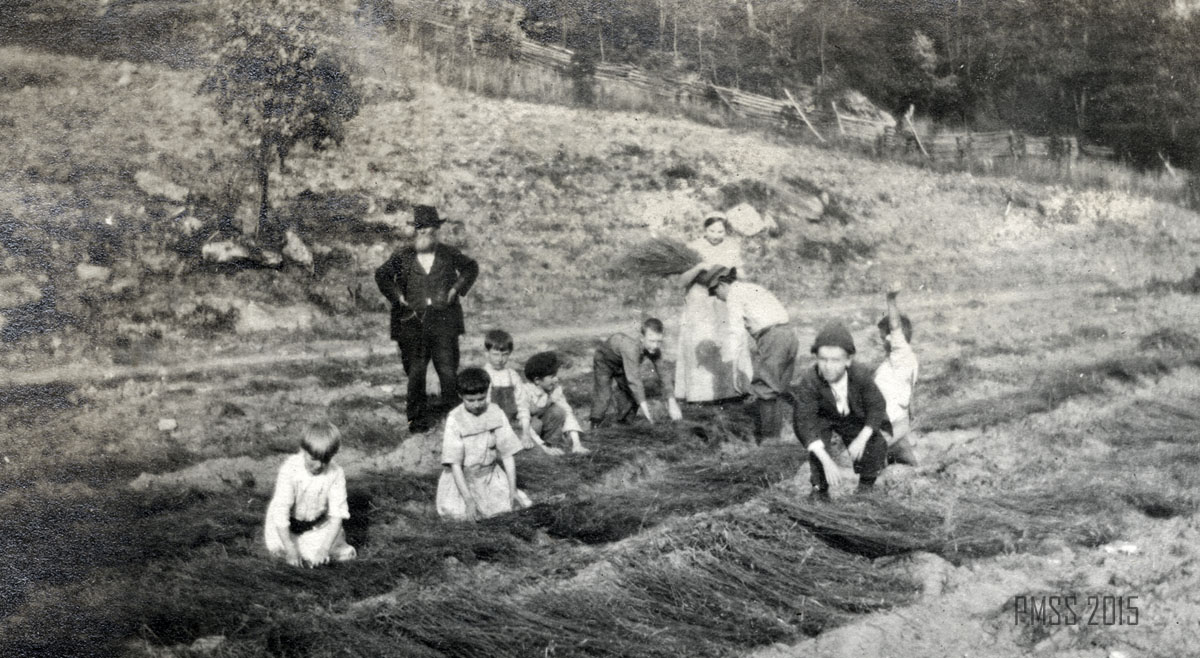
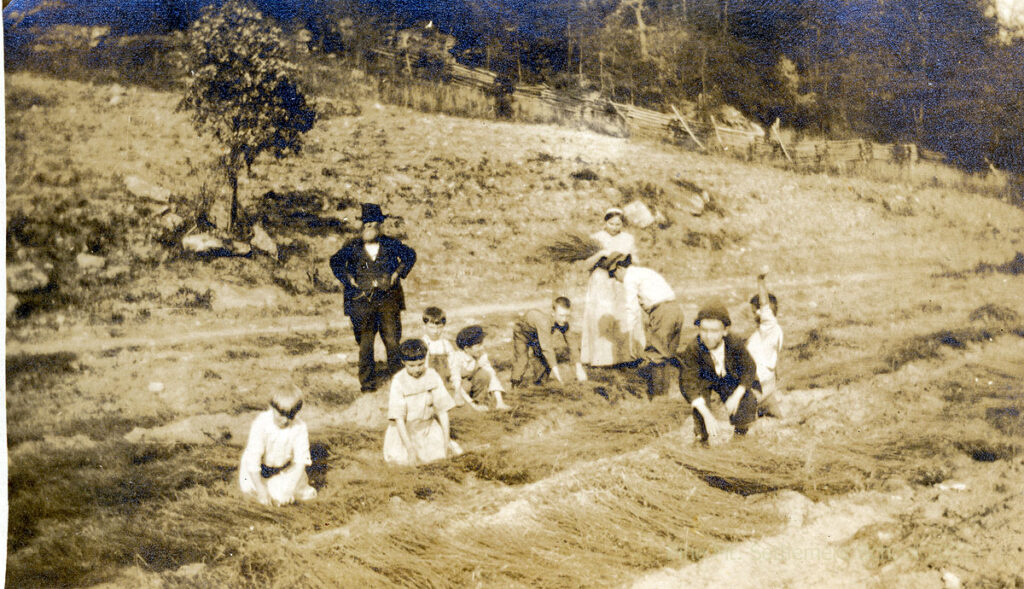
373 [Uncle William Creech with children from Pine Mountain School retting flax.]

Flax, Hemp and Silk

notes for flax article BELOW.

1913

By Lyster H. Dewey — Botanist in Charge of Fiber Plant Investigations, Bureau of Plant Industry.  United States Department of Agriculture, Bureau of Plant Industry – Circular No. 57. Author: Lyster HDeweyBotanist in Charge of Fiber InvestigationsBureau of Plant Industry Pages: 1 – 7. THE CULTIVATION OF HEMP IN THE UNITED STATES. INTRODUCTION. ??  1910

1910 INTRODUCTION

In 1910 Lyster H. Dewey, a botanist in charge of Fiber Plant Investigations for the Bureau of Plant Industry in the U.S. Department of Agriculture, wrote a small circular (No. 57) called “The cultivation of Hemp in the United States…” He noted that the two plants that were most promising for cultivation were hemp and flax. Kentucky became an optimum environment for the cultivation of these two plants.

018a P. Roettinger Album. “Uncle William giving a lesson in spreading flax.” [William Creech, standing in back, and 9 children in the field.]

FLAX

In one of the earliest photographs made at Pine Mountain Settlement School, William Creech, one of the founders of the settlement in Harlan County in eastern Kentucky, is shown with a group of children laying out cut flax on the hillside near his home. The Pine Mountain valley with its rich soil and long East to West orientation was, like the rest of the state “as favorable as anywhere in the world”, said Lyster Dewey of the growth of this friendly plant, particularly, its cousin, hemp.

HEMP

Hemp is one of the oldest fiber-producing plants and examples of the durable homespun fabrics and ropes and cords derived from hemp have been found in the archaeological remains of some of the world’s earliest civilizations.

Hemp is a member of the mulberry family, Moraceae which includes the Osage orange, the paper mulberry and the common mulberry trees.  It is also a relative of the nettle family from which ramie, a strong bast fiber, is derived. Anyone who has ever painted or produced fine art prints knows that mulberry paper is some of the best support for paints and inks and its strong and very white surface retains its purity through time.

What Dewey fails to tell us in this government publication is the history of the notorious side of the family of hemp, the genus Cannabis. Instead, he notes that the genus Cannabis

… is generally regarded by botanists as monotypic, and the one species Cannabis sativa is now held to include the half dozen forms which have been described under different names …  and which are cultivated for different purposes.

It has been asked which came first, the discovery of the narcotic properties of the plant or its usefulness as a fiber-producing plant. In China, one of the earliest civilizations to produce textiles of hemp, the people called the plant “ma” and the cloth became known as hempen cloth. Further, Chinese writings tell of the use of the hemps seeds and the oil from the seeds as central to their foodways. There does not appear to be any use of the plant for what the Chinese called bhang, charas, and ganga the common names of their narcotic drugs. “The production and use of these drugs were developed farther west,” says Dewey.

Hemp did come west but it was a variety that was first cultivated by the Puritans for its fiber-producing qualities. The early farming of hemp in New England was not nearly so successful as it became further South. For example, in Virginia the soil and longer growing season produced a robust plant but the industry failed to thrive as tobacco filled the fields.  (For discussion see: Moore, Brent. A Study of the Past, the Present, and the Possibilities of the Hemp Industry in Kentucky, 1905.)

It was in Pennsylvania and in Kentucky that the industry thrived. Dewey describes the origins

The cultivation of hemp seems to have been a flourishing industry in Lancaster County, Pa., before the Revolution. An elaborate account of the methods then employed in growing hemp, written about 1775 by James Wright, of Columbia, Pa., (New Era, Lancaster, Pa., June 25, 1905.) was recently published as an historical document. The methods described for preparing the land were equal to the best modern practice, but the hemp was pulled by hand instead of cut. Various kinds of machine brakes had been tried, but the had all “given Way to one simple Break of a particular Construction, which was first invented & made Use of in this country.” The brief description indicates the common hand brake still in use in Kentucky.

By 1910, when Dewey’s circular was published, hemp was grown and harvested mainly for the production of commercial twine, a staple for tying just about anything together.

The first crop of hemp in Kentucky was raised by Mr. Archibald McNeil, near Danville, in 1775. (Moore, Brent. A Study of the Past, the Present, and the Possibilities of the Hemp Industry in Kentucky, p. 16, 1905.) It was found that hemp grew well in the fertile soils of the bluegrass country, and the industry was developed there to a greater extent than it had been in the eastern colonies. While it was discontinued in Massachusetts, Virginia, and Pennsylvania, it has continued in Kentucky to the present time. In the early days of this industry in Kentucky, fiber was produced for the homespun cloth woven by the wives and daughters of the pioneer settlers, and an export trade by way of New Orleans was developed. In 1802 there were two extensive ropewalks in Lexington, Ky., and there was announced “a machine, moved by a horse or a current of water, capable, according to what the inventor said, to break and clean eight thousand weight of hemp per day.” (Michaux, F. Andre. Travels to the west of the Alleghanies, p. 152, 1805. In Thwaites, Early Western Travels, v. 3, p. 200, 1904.) Hemp was later extensively used for making cotton-bale covering. Cotton bales were also bound with hemp rope until iron ties were introduced, about 1865. There was a demand for the better grades of hemp for sailcloth and for cordage for the Navy, and the industry was carried on more extensively from 1840 to 1860 than it has been since.

ITALY.

The highest-priced hemp fiber in the markets of either America or Europe is produced in Italy (Bruck, Werner F. Studien uber den Hanfbau in Italien, p. 7, 1911), but it is obtained from plants similar to those in Kentucky. The higher price of the fiber is due not to superior plants, but to water retting and to increased care and labor in the preparation of the fiber. Four varieties are cultivated in Italy:

The two varieties of Neapolitan hemp are cultivated in the vicinity of Naples, and even so far up on the sides of Vesuvius that fields of hemp are occasionally destroyed by the eruptions of that volcano. Seed of each of these Italian varieties has been grown in trial plots at Washington, D.C., and Lexington, Ky. The Bologna, or Piedmont, hemp in seed rows attained a height of 8 to 11 feet, nearly as tall as Kentucky seed hemp grown for comparison, but with thicker stalks, shorter and more rigid branches, and smaller and more densely clustered leaves. The small hemp, cannapa picola, was only 4 to 6 feet high. The large-seeded Neapolitan was 7 to 10 feet high, smaller than the Bologna, but otherwise more like Kentucky hemp, with more slender stalks and more open foliage. The small-seeded Neapolitan, with seeds weighing less than 1 gram per 100, rarely exceeded 4 feet in height in the series of plots where all were tried.

FRANCE.

Hemp is cultivated in France chiefly in the departments of Sarthe and Ille-et-Vilaine, in the valley of the Loire River. Two varieties are grown, the Piedmont, from Italian seed, and the common hemp of Europe. The former grows large and coarse, though not as tall as in the Bologna region, and it produces a rather coarse fiber suitable for coarse twines. The latter, seed of which is sown at the rate of 1 1/2 to 2 bushels per acre, has a very slender stalk, rarely more than 4 or 5 feet high, producing a fine flax-like fiber that is largely used in woven hemp linens. The common hemp of Europe, which includes the short hemp of France, is also cultivated to a limited extent in Spain, Belgium, and Germany. It grows taller and coarser when sown less thickly on rich land, but it never attains the size of the Bologna type.

(1) “Bologna,” or great hemp, called in France “chanvre de Piedmont,” is grown in northern Italy in the provinces of Bologna, Ferrara, Rovigo, and Modena. In the rich alluvial soils and under the intensive cultivation, this variety averages nearly 12 feet in height, but it is said to deteriorate rapidly when cultivated elsewhere. (2) “Cannapa picola,” small hemp, attaining a height of 4 to 7 feet, with a rather slender reddish stalk, is cultivated in the valley of the Arno in the department of Tuscany. (Dodge, Charles Richards. Culture of hemp in Europe. U.S. Department of Agriculture, Fiber Investigations, Report No. 11, p. 5, 1898.) (3) “Neapolitan,” large-seeded. (4) “Neapolitan,” small-seeded.

ITALY.

The two varieties of Neapolitan hemp are cultivated in the vicinity of Naples, and even so far up on the sides of Vesuvius that fields of hemp are occasionally destroyed by the eruptions of that volcano. Seed of each of these Italian varieties has been grown in trial plots at Washington, D.C., and Lexington, Ky. The Bologna, or Piedmont, hemp in seed rows attained a height of 8 to 11 feet, nearly as tall as Kentucky seed hemp grown for comparison, but with thicker stalks, shorter and more rigid branches, and smaller and more densely clustered leaves. The small hemp, cannapa picola, was only 4 to 6 feet high. The large-seeded Neapolitan was 7 to 10 feet high, smaller than the Bologna, but otherwise more like Kentucky hemp, with more slender stalks and more open foliage. The small-seeded Neapolitan, with seeds weighing less than 1 gram per 100, rarely exceeded 4 feet in height in the series of plots where all were tried.

SOILS SUITED TO HEMP.

Hemp requires for the best development of the plant, and also for the production of a large quantity and good quality of fiber, a rich, moist soil with good natural drainage, yet not subject to severe drought at any time during the growing season. A clay loam of rather loose texture and containing a plentiful supply of decaying vegetable matter or an alluvial deposit, alkaline and not acid in reaction, should be chosen for this crop.

SOILS TO BE AVOIDED.

Hemp will not grow well on stiff, impervious, clay soils, or on light sandy or gravelly soils. It will not grow well on soils that in their wild state, are overgrown with either sedges or huckleberry bushes. These plants usually indicate acid soils. It will make only poor growth on soils with a hardpan near the surface or in fields worn out by long cultivation. Clay loams or heavier soils give heavier yields of strong but coarser fiber than are obtained on sandy loams and lighter soils.

EFFECT OF HEMP ON THE LAND.

Hemp cultivated for the production of fiber, cut before the seeds are formed and retted on the land where it has been grown, tends to improve rather than injure the soil. It improves its physical condition, destroys weeds, and does not exhaust its fertility.

PHYSICAL CONDITION.

Hemp loosens the soil and makes it more mellow. The soil is shaded by hemp more than by any other crop. The foliage at the top of the growing plants makes a dense shade, and, in addition, all of the leaves below the top fall off, forming a mulch on the ground, so that the surface of the soil remains moist and in better condition for the action of soil bacteria. The rather coarse taproots (Pl. XLI, fig. 3), penetrating deeply and bringing up plant food from the subsoil, decay quickly after the crop is harvested and tend to loosen the soil more than do the fibrous roots of wheat, oats, and similar broadcast crops. Land is more easily plowed after hemp than after corn or small grain.

HEMP DESTROYS WEEDS.

Very few of the common weeds troublesome on the farm can survive the dense shade of a good crop of hemp. If the hemp makes a short, weak growth, owing to unsuitable soil, drought, or other causes, it will have little effect in checking the growth of weeds, but a good, dense crop, 6 feet or more in height, will leave the ground practically free from weeds at harvest time. In Wisconsin, Canada thistle has been completely killed, and quack-grass severely checked by one crop of hemp. In one 4-acre field in Vernon County, Wis., where Canada thistles were very thick, fully 95 per cent of the thistles were killed where the hemp attained a height of 5 feet or more, but on a dry, gravelly hillside in this same field where it grew only 2 to 3 feet high, the thistles were checked no more than they would have been in a grain crop. Some vines, like the wild morning-glory and bindweed, climb up the hemp stalks and secure light enough for growth, but low-growing weeds can not live in a hemp field.

HEMP DOES NOT EXHAUST THE FERTILITY OF THE SOIL.

An abundant supply of plant food is required by hemp, but most of it is merely borrowed during development and returned to the soil at the close of the season. The amounts of the principal fertilizing elements contained in mature crops of hemp, as compared with other crops, are shown in the accompanying table.

Amounts of principal fertilizing elements in an acre of hemp, corn, wheat, oats, sugar beets, and cotton. (Insert first table from p. 310 here)

The data in the table indicate that hemp requires for its best development a richer soil than any of the other crops mentioned except sugar beets. These other crops, except the stalks of corn and the tops of beets, are entirely removed from the land, thus taking away nearly all the plant food consumed in their growth. Only the fiber of hemp is taken away from the farm, and this is mostly cellulose, composed of water and carbonic acid. The relative proportions by weight of the different parts of the hemp plant, thoroughly air dried, are approximately as follows: Roots 10 per cent, stems 60 per cent, and leaves 30 per cent. The mineral ingredients of these different parts of the hemp plant are shown in the following table:

p. 310 here.Peter, Robert. Chemical Examination of the Ash of Hemp and Buckwheat Plants. Kentucky Geological Survey, p. 12, 1884. )

Hemp leaves the ground mellow and free from weeds and is therefore recommended to precede sugar beets, onions, celery, and similar crops, which require hand weeding. If hemp is grown primarily to kill Canada thistle, quack-grass, or similar perennial weeds, it may be grown repeatedly on the same land until the weeds are subdued.

BARNYARD MANURE.—The best single fertilizer for hemp is undoubtedly barnyard manure. It supplies the three important plant foods, nitrogen, potash, and phosphoric acid, and it also adds to the store of humus, which appears to be more necessary for hemp than for most other farm crops. If other fertilizers are used, it is well to apply barnyard manure also, but it should be applied to the preceding crop, or, at the latest, in the fall before the hemp is sown. It must be well rotted and thoroughly mixed with the soil before the hemp seed is sown, so as to promote a uniform growth of the hemp stalks. Uniformity in the size of the plants of other crops is of little consequence, but in hemp, it is a matter of prime importance. An application of coarse manure in the spring, just before sowing, is likely to result in more injury than benefit. The amount that may be applied profitably will vary with different soils. There is little danger, however, of inducing too rank a growth of hemp on upland soils, provided the plants are uniform, for it must be borne in mind that stalk and not fruit is desired. On soils deficient in humus as a result of long cultivation, the increased growth of hemp may well repay for the application of 15 to 20 tons of barnyard manure per acre. It would be unwise to sow hemp on such soils until they had been heavily fertilized with barnyard manure.

RETTING.

Retting is a process in which the gums surrounding the fibers and binding them together are partly dissolved and removed. It permits the fiber to be separated from the woody inner portion of the stalk and from the thin outer bark, and it also removes soluble materials that would cause rapid decomposition if left with the fiber. Two methods of retting are practiced commercially, viz, dew retting and water retting.

DEW RETTING.

In this country, dew retting is practiced almost exclusively. The hemp is spread on the ground in thin, even rows, so that it will all be uniformly exposed to the weather. In spreading hemp, the workman takes an armful of stalks and, walking backward, slides them sidewise from his knee, so that the butts are all even in one direction and the layer is not more than three stalks in thickness. (Pl. XLIV, fig. 3.) This work is usually paid for at the rate of $1 per acre, and experienced hands will average more than 1 acre per day. The hemp is left on the ground for four weeks to four months. Warm, moist weather promotes the retting process, and cold or dry weather retards it. Hemp rets rapidly if spread during early fall, provided there are rains, but it is likely to be less uniform than if retted during the colder months. It should not be spread early enough to be exposed to the sun in hot, dry weather. Alternate freezing and thawing or light snows melting on the hemp give the most desirable results in retting. Slender stalks one-fourth inch in diameter or less, ret more slowly than coarse stalks, and such stalks are usually not overretted if left on the ground all winter. Hemp rets well in young wheat or rye, which hold the moisture about the stalks. In Kentucky, most of the hemp is spread in December. A protracted January thaw with comparatively warm, rainy weather occasionally results in overretting. While this does not destroy the crop, it weakens the fiber and causes much loss. When retted sufficiently, so that the fiber can be easily separated from the hurds, or woody portion, the stalks are raked up and set up in shocks, care being exercised to keep them straight and with the butts even. They are not bound in bundles, but a band is sometimes put around the shock near the top. The work of taking up the stalks after retting is usually done by piecework at the rate of $1 per acre.

WATER RETTING.

Water retting is practiced in Italy, France, Belgium, Germany, Japan, and China, and in some localities in Russia. It consists of immersing the hemp stalks in water in streams, ponds, or artificial tanks. In Italy, where the whitest and softest hemp fiber is produced, the stalks are placed in tanks of soft water for a few days, then taken out and dried, and returned to the tanks for a second retting. Usually, the stalks remain in the water for about eight days, and the second time a little longer. In either dew retting or water retting, the process is complete when the bark, including the fiber, readily separates from the stalks. The solution of the gums is accomplished chiefly by certain bacteria. If the retting process is allowed to go too far, other bacteria attack the fiber. The development of these different bacteria depends to a large extent upon the temperature. Processes have been devised for placing pure cultures of specific bacteria in the retting tanks and then keeping the temperature and air supply at the best for their development. (Rossi, Giacomo.) Macerazione della Canapa. Annali della Regia Scuola Superiore di Agricultura di Portici, s.2, v. 7, p. 1-148, 1907. These methods, which seem to give promise of success, have not been adopted in commercial work.

BREAKING.

Breaking is a process by means of which the inner, woody shell is broken in pieces and removed, leaving the clean, long, straight fiber. Strictly speaking, the breaking process merely breaks in pieces the woody portions, while their removal is a second operation properly called scutching. In Italy and in some other parts of Europe, the stalks are broken by one machine or device, and afterwards scutched by another. In this country, the two are usually combined in one operation.

HAND BRAKES.

Hand brakes (Pl. XLVI, fig. 1), with little change or modification, have been in use for many generations, and even yet more than three-fourths of the hemp fiber produced in Kentucky is broken out on the hand brake. This simple device consists of three boards about 5 feet long set edgewise, wider apart at one end than the other, and with the upper edges somewhat sharpened. Above this, a framework, with two boards sharpened on the lower edges, is hinged near the wide end of the lower frame, so that when worked up and down by means of the handle along the back, these upper boards pass midway in the spaces between the lower ones. A carpenter or wagon maker can easily make one of these hand brakes, and they are sold in Kentucky for about $5.

The operator takes an armful of hemp under his left arm, places the butts across the wide end of the brake near the hinged upper part, which is raised with his right hand, and crunches the upper part down, breaking the stalks. This operation is repeated several times, moving the stalks along toward the narrow end so as to break the shorter pieces, and when the hemp appears pretty well broken, the operator takes the armful in both hands and whips it across the brake to remove the loosened hurds. He then reverses the bundle, breaks the tops, and cleans the fiber in the same manner. The usual charge for breaking hemp on the hand brake in this manner is 1 cent to 1 1/2 cents per pound. There are records of 400 pounds being broken by one man in a day, but the average day’s work, counting six days in a week, is rarely more than 75 pounds. In a good crop, therefore, it would require 10 to 15 days for one man to break an acre of hemp. The work requires skill, strength, and endurance, and for many years, there has been increasing difficulty in securing laborers for it. It is plainly evident that the hemp industry can not increase in this country unless some method is used for preparing the fiber requiring less hand labor than the hand brake.

MACHINE BRAKES.

Several years ago, a brake was built at Rantoul, Ill., for breaking and cleaning the fiber rapidly, but producing tow or tangled fiber instead of clean, straight, line fiber, such as is obtained by the hand brake. This machine consisted essentially of a series of fluted rollers followed by a series of beating wheels. Machines designed after this type, but improved in many respects, have been in use for several years at Havelock, Nebr., and first at Gridley, then at Courtland and Rio Vista, Cal. These machines have sufficient capacity and are operated at comparatively small cost, the hurds furnishing more than sufficient fuel for the steam power required, but the condition of the fiber produced is not satisfactory for high-class twines and it commands a lower price than clean, long, straight fiber.

The Sanford-Mallory flax brake, consisting essentially of five fluted rollers with an interrupted motion, producing a rubbing effect, has been used to a limited extent for breaking hemp. This machine, as ordinarily made for breaking flax, is too light and its capacity is insufficient for the work of breaking hemp.

A portable machine brake (Pl. XLVI, fig. 4) has been used successfully in Kentucky during the past two years. It has a series of crushing and breaking rollers, beating and scutching devices, and a novel application of suction to aid in separating hurds and tow. The stalks are fed endwise. The long fiber, scutched and clean, leaves the machine at one point, the tow, nearly clean, at another, and the hurds, entirely free from fiber, at another. It has a capacity of about 1 ton of clean fiber per day.

Another portable machine brake has been in use in California during the past two years, chiefly breaking hemp that has been thoroughly air dried but not retted. This hemp, grown with irrigation, becomes dry enough in that arid climate to break well, but this method is not practicable in humid climates without artificial drying. The stalks, fed endwise, pass first through a series of fluted or grooved rollers and then through a pair of beating wheels, removing most of the hurds, and the fiber, passing between three pairs of moving scutching aprons, each pair followed by rollers, finally leaves the machine in a kind of continuous lap folded back and forth in the baling box.

A larger machine (Pl. XLVI, fig. 3), having the greatest capacity and turning out the cleanest and most uniform fiber of any of the brakes thus far brought out, has been used to a limited extent during the past eight years in Kentucky, California, Indiana, and Wisconsin. This machine weighs about 7 tons, but it is mounted on wheels and is drawn about by a traction farm engine, which also furnishes power for operating it. The stalks are fed sidewise in a continuous layer 1 to 3 inches thick, and carried along so that the ends, forced through slits, are broken and scutched simultaneously by converging revolving cylinders about 12 and 16 feet long. One cylinder, extending beyond the end of the other, cleans the middle portion of the stalks, the grasping mechanism carrying them forward being shifted to the fiber cleaned by the shorter cylinder. The cylinders break the stalks and scutch the fiber on the underside of the layer as it is carried along, and the loosened hurds on the upper side are scutched by two large beating wheels just as it leaves the machine. The fiber leaves the machine sidewise, thoroughly cleaned and ready to be twisted into heads and packed in bales. This machine, with a full crew of 15 men, including men to haul stalks from the field and others to tie up the fiber for baling, has a capacity of 1,000 pounds of clean, straight fiber of good hemp per hour. The tow is thrown out with the hurds, and until recent improvements, it has produced too large a percentage of tow. It does good work with hemp retted somewhat less than is necessary for the hand brake, and it turns out more uniform and cleaner fiber. For good work, it requires, as do all the machines and also the hand brakes, that the hemp stalks be dry. If the atmosphere is dry at the time of breaking, the hemp may be broken directly from the shocks in the field, but in regions with a moist atmosphere, or with much rainy weather, it would be best to store the stalks in sheds or under cover, and with a stationary plant it might be economical to dr them artificially, using the hurds for fuel. Extreme care must be exercised in artificial drying, however, to avoid injury to the fiber.

IMPROVEMENT NEEDED IN HEMP-BREAKING MACHINES.

While hemp-breaking machines have now reached a degree of perfection at which they are successfully replacing the hand brakes, as the thrashing machines half a century ago began replacing the flail, there is still room for improvement. This needed improvement may be expected as soon as hemp is grown more extensively, so as to make a sufficient demand for machinery to induce manufacturers to invest capital in this line. For small and scattered crops, a comparatively light, portable machine is desirable, requiring not more than 10 horsepower and not more than four or five laborers of average skill for its operation. It should prepare the fiber clean and straight, ready to be tied in hanks for baling, and should have a capacity of at least 1,000 pounds of clean fiber per day. For localities where hemp is grown more abundantly, so as to furnish a large supply of stalks within short hauling distance, a larger machine operated in a stationary central plant by a crew of men trained to their respective duties, like workers in a textile mill, will doubtless be found more economical. Artificial retting and drying may also be used to good advantage in a central plant. The hemp growers of Europe have adopted machine brakes more readily than the farmers in this country, and the hemp industry in Europe is most flourishing and most profitable where the machines are used. Most of the hemp in northern Italy is broken and scutched by portable machines. Machines are also used in Hungary, and the machine-scutched hemp of Hungary is regularly quoted at $10 to $15 per ton, higher than that prepared by hand. These European machines may not be adapted to American conditions, but, together with American machines which are doing successful work, they sufficiently contradict the frequent assertion of hemp growers and dealers that “no machine can ever equal the hand brake.”

MARKET.

All of the hemp produced in this country is used in American spinning mills, and it is not sufficient to supply one-half of the demand. The importations have been increasing slightly during the past 20 years, while there has been a decided increase in values. The average declared value of imported hemp, including all grades, for the 4,817 tons imported in 1893, was $142.31 per ton, while in the fiscal year 1913, the importations amounted to 7,663 tons with an average declared value of $193.67 per ton. There have been some fluctuations in quotations, but the general tendency of prices of both imported and American hemp has been upward. (Fig. 19.) The quotations for Kentucky rough prime, since October 1912, have been the highest recorded for this standard grade. Furthermore, the increasing demand for this fiber, together with the scarcity of competing fibers in the world’s markets, indicates a continuation of prices at high levels.


English Country Dancing at Pine Mountain Settlement

Pine Mountain Settlement School
DANCING IN THE CABBAGE PATCH
English Country Dancing at Pine Mountain Settlement

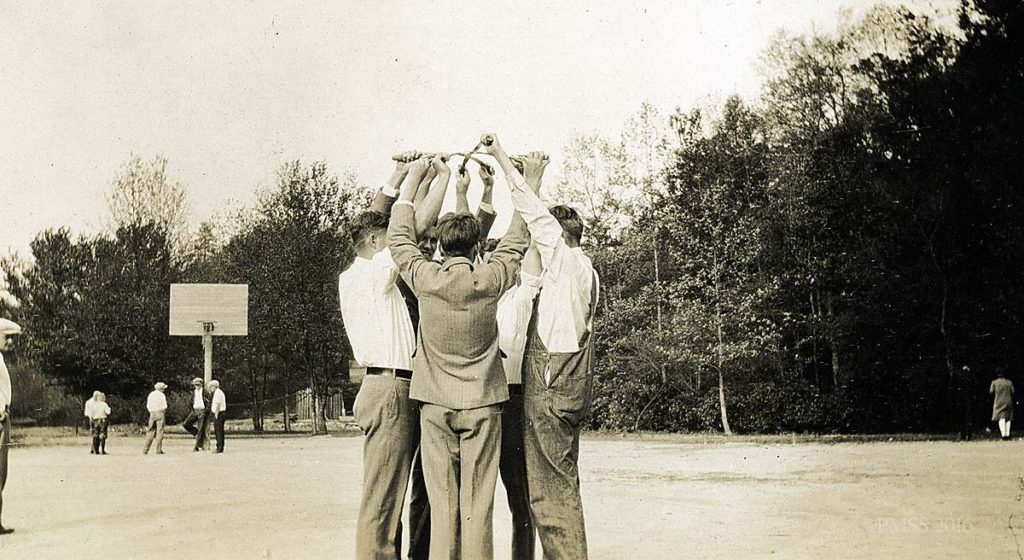
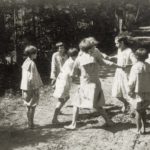
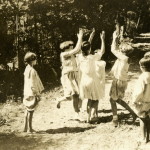
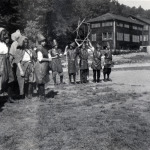
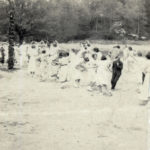
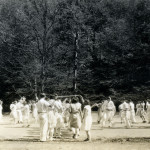
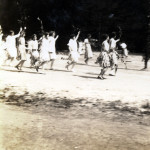
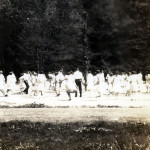
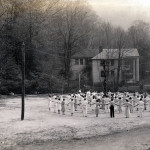
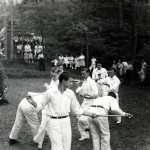
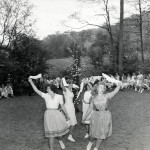
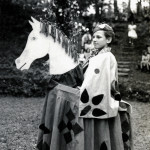
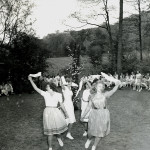
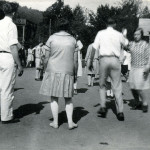
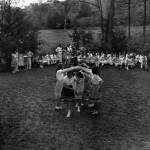
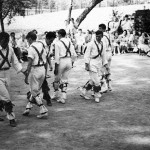
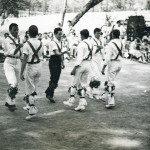
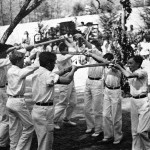
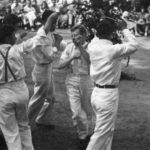
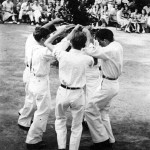
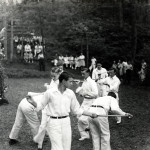
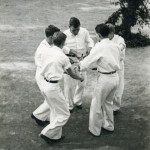
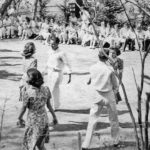
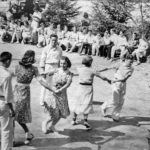
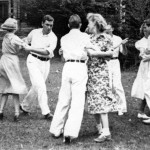
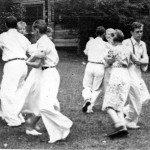
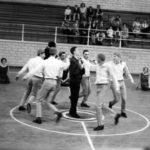
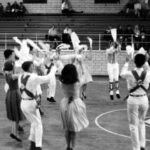
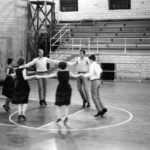
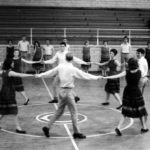
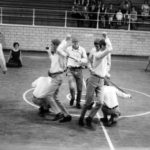
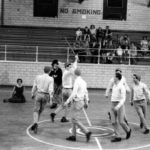
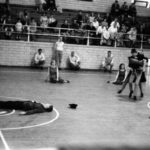
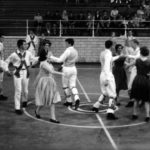
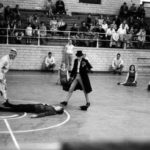
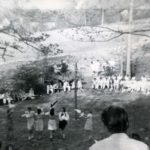
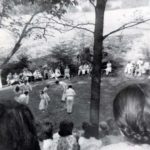
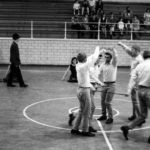
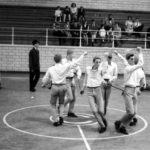
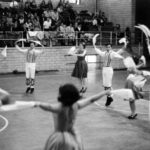
Sword dancing. Kendall Bassett Photograph Album, c. 1928-29. [pmss_bas101.jpg]

TAGS: English Country Dancing, Pine Mountain Settlement School, Harlan County, Kentucky, dancing, recreation, folk dancing, set running, party games, Kentucky Running Set, Cecil Sharp, Maude Karpeles, Phil Jamison, Dorothy Bolles, Abby Winch Christensen, Dorothy Nace, Mary Rogers, Berea College Country Dancers, Berea College, Arthur Dodd, Glyn Morris, 

ENGLISH COUNTRY DANCING
AT PINE MOUNTAIN SETTLEMENT SCHOOL

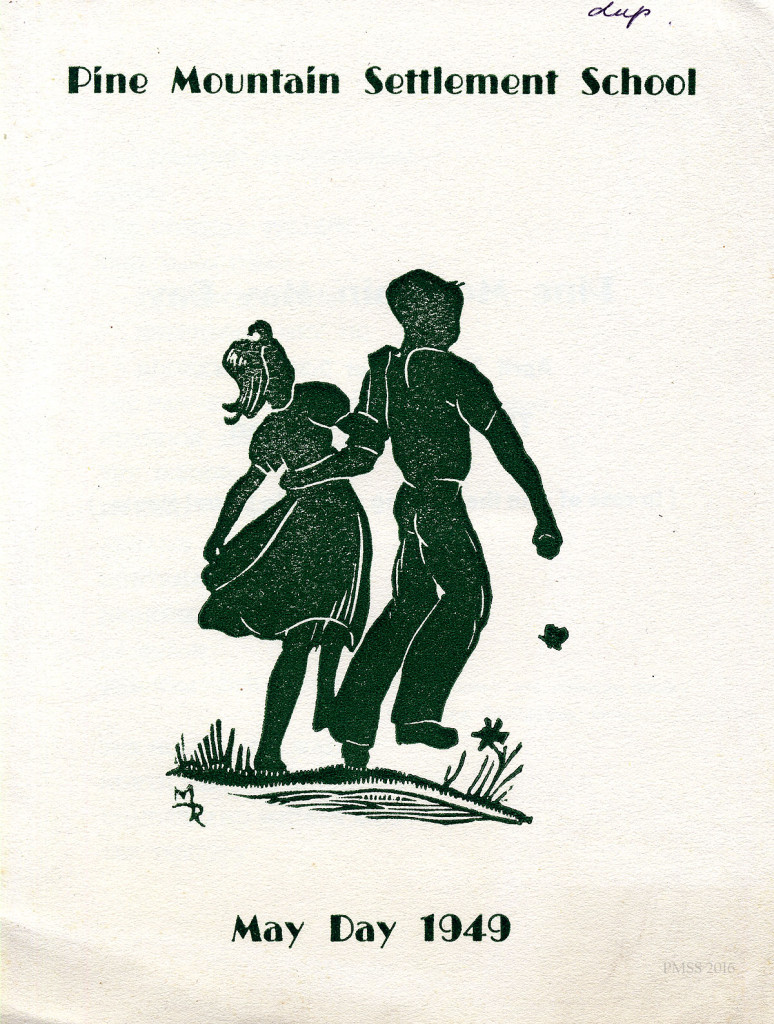
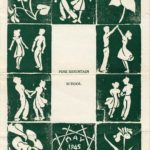
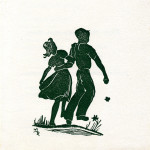
May Day 1949. Drawing by Mary Rogers

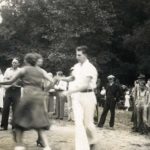
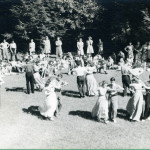
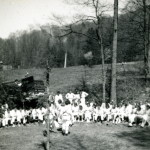
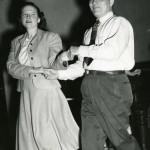
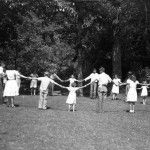
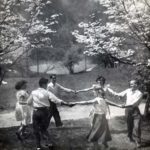
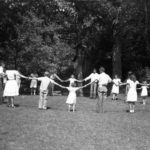
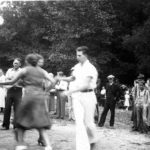
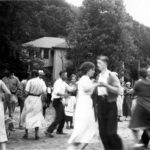
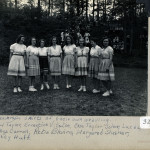
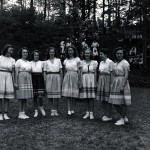
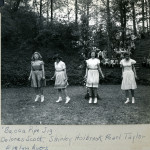
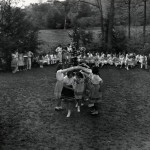
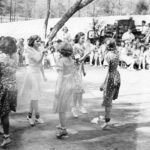
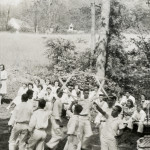
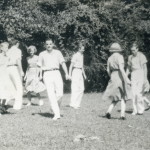
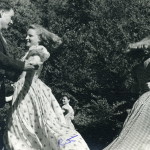
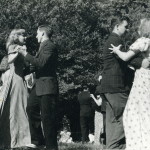
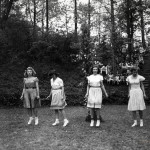
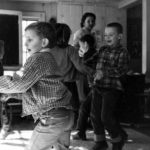
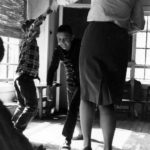
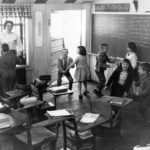
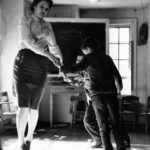
English Country Dance crept into the Pine Mountain Valley like the bright green of Spring time creeps up the North flank of the mountain — slowly. Dance in the valley was not unknown in the first decades of the twentieth century, but the gentility of English Country Dance was unknown. Anywhere there was a large community gathering in the mountains of Eastern Kentucky there were “parties” and “party games” and often “set-running.” Churches were largely opposed to “dancing” but “party games” were often accepted. In the more strict religious sects, dance had always been forbidden. Dancing was seen as the work of the devil, but so was moonshine, but never guns.

In the Pine Mountain Valley, many in the community had been “dancing” most of their lives. The dance most favored was one later called the Kentucky Running Set. It was a fast-paced, vigorous and lengthy series of maneuvers which were rhythmically called out by a leader. According to Phil Jamison, in his 2015 book, Hoedowns, Reels, and Frolics: Roots and Branches of Southern Appalachian Dance, pp.72-73, the idea of a “Running Set” is not as intuitive as it seems. A noted North Carolina dance historian, dancer and set caller, Jamison suggests that the term “set” has several definitions.

In the seventeenth century, for example, a “set” was used to describe a series of simple steps in place to one’s partner, as in the action to “set” to a partner before turning. Jamison. however, also conjectures that Karpeles and Sharp conflated the meaning with another “set”, that of a composition of figures, such as Jamison’s suggestion, “a ‘set of Quadrilles.'” Further, French dances that had many parts were referred to as “sets”. This last description of a set given by Jamison, suggests to him that the use of the term is associated with the idea of a Quadrille “set” and this seems to be confirmed in the appearance of the term and idea in the Southern Appalachians. Strengthening his argument for a French connection with the Quadrille, he quotes Karpeles from an article, “Some Additional Figures for Set Running,” In the Journal of the English Folk Dance Society 2, no. 3 (1930): 39-50.

“It is very probable that the word ‘set’ implies a ‘set of figures,’ in the way that it is customary to speak of a ‘set of Quadrilles.'”

As for “running” Jamison conjectures that it has its origins in Scotland. In dances, particularly the reel, where “running a set” was a common description of the dance pattern.

It was this “dance,” this running of sets, that surprised and charmed one of the world’s leading instructors of English Country Dance when he first viewed it at Pine Mountain. The dance form had been observed by visitors to the School and commented on by the staff when visiting on fundraising trips to the North East. And when Cecil Sharp came to America, it was recommended by English Country Dance lovers in the North East that Sharp come listen to the ballad singers and see what the remote people in Eastern Kentucky had retained of old English forms of entertainment in song and dance. Pine Mountain gave Cecil Sharp a gift, and Cecil Sharp left a gift for the School — English Country Dancing. 

Cecil Sharp‘s discoveries at the School were well described in his book. English folk songs from the southern Appalachians, collected by Cecil J. Sharp; comprising two hundred and seventy-four songs and ballads with nine hundred and sixty-eight tunes, including thirty-nine tunes contributed by Olive Dame Campbell, edited by Maud Karpeles. Oxford: Oxford University Press, 1932. The book, dedicated to William Creech, the donor of the land for the Pine Mountain Settlement School remains a testimony of a mutual fondness for the culture of the Southern Appalachians. When Cecil Sharp came to the School along with his secretary, Maud Karpeles, he witnessed a joyful and energetic community of set runners and when he left, he set a tradition for the inclusion of English Country Dancing in annual celebrations and in the school’s educational program.

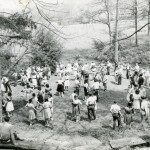
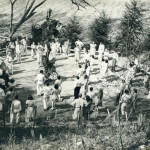
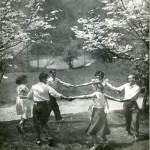
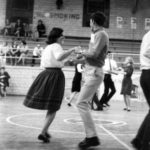
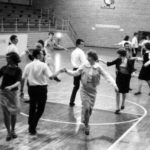
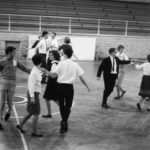
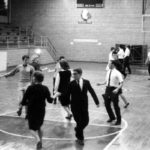
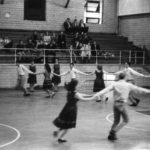
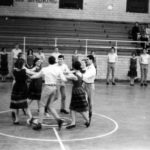
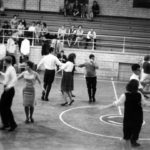
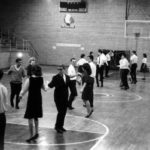
GALLERY I: DANCING IN THE CABBAGE PATCH English Country Dancing at PMSS


Some English Country Dancers may recognize formations that readily suggest the named dance being performed. Most will not. Many times the dance forms overlap and are incorporated in a new dance with new sequences and new rhythms. Few English Country Dancers,  will, however, fail to recognize the familiar names of the dances.


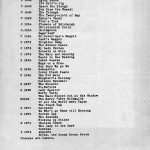
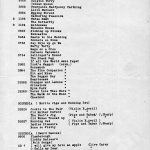
RECORDINGS:  COUNTRY DANCE MUSIC LIST RECOMMENDED BY  DOROTHY BOLLES

When Pine Mountain Settlement School was organizing its dance programs they borrowed heavily from the Boston Center music and dances. Dorothy Bolles, the link in that important chain of influence, supplied the School with a list of available music for English Country dancing.

Here is her list of “His Master’s Voice, Gramophone Records” most of which were collected by Pine Mountain or were played on the piano by Arthur Dodd and accompanied by Glyn Morris on violin or by fiddlers in the community.

All records are 12″ and 4/6

I.D # Titles
C 1644 Apley House
Old Noll’s Jig
C 1645 Seed the Plough
Pop Goes the Weasel
C 1646 The Triumph
The Twenty-ninth of May
C1263 Nancy’s Fancy
Tink a Tink
C1264 Flowers of Edinburgh
Christchurch Bells
C 1265 Childgrove
Sage Leaf
C 1266 Mr. Beaveridge’s Maggot
Jack’s Maggot
C 1072 Brighton Camp
The Ribbon Dance
C1073 My Lady Cullen
Bonnets So Blue
C 1074 The Mary and Dorothy
Haste to the Wedding
B 2954 Oaken Leaves
Mage on a Cree
Hey Boys Up Go We
B 2955 Newcastle
Jenny Pluck Pears
B 2956 The Old Mole
Shepherd’s HOliday
Parson’s Farewell
B 2957 The Phoenix
St. Martins
B 2958 Lady Speller
Rufty Tufty
The Maid Peeped Out at the Window
B 2959 The Merry Merry Milkmaids
If All the World Were Paper
The Black Nag
B 5071 Galopede
We Won’t Go Home Till Morning
B 1370 Scotch Cap
The Boatman
Picking Up Sticks
B 1371 Chelsea Reach
The Lady in the Dark
Confess
B 1372 Argeers
Broom, the Bonny Bonny Broom
Oranges and Lemons
9769 Helston Furry
Indian Queen
5503 Fourpence Halfpenny Farthing
Lilli Burlero
5504 Epping Forest
Gathering Peascods
B 1193 Three Mewt
The Butterfly
B 1194 Goddesses
Hudson House
5505 Picking Up Sticks
Newcastle
5434 Haste to the Wedding
Bonnets So Blue
5733 Hey Boys Up Go We
Rufty Tufty
Mage on a Cree
Parsons Farewell
5734 Sellinger’s Round
The Black Nag
If All the World Were Paper
DB 82 Dick’s Maggot  (orch.)
Nonesuch
DB 84 The Fine Companion
Hit and Miss
The Beggar Boy
Heartsease
DB 182 Oranges and Lemons
Grimstock
Hyde Park
DB 183 Never Love Thee More
The Maid in the Moon
Chestnut
  COLUMBIA (Morris Jigs and Running Set)
DB 226 Jackie to the Fair  (Violin E. Avril)
Old Mother Oxford  (Violin E. Avril)
The Fool’s Jig  (Pipe and Tabor/ J. Sharp)
Old Woman Tossed Up (Pipe and Tabor/ J. Sharp)
DB227 Running Set  (Violin E. Avril)
Ladies Pleasure  (Pipe and Tabor/ J. Sharp)
None So Pretty
  COLUMBIA  (Sword Dances)
9800 Flamborough
Kirkby Malzeard
(Folk Songs)
DB ? I  Will Give My Love An Apple  (Clive Carey)
Oh Sally My Dear  (Clive Carey)
My Billy Boy  (Clive Carey)
The Lover’s Tasks  (Clive Carey)
DB 336  A Farmer’s Son So Sweet  (Annete Blackwell)
As I Sat On A Sunny Bank  (Annete Blackwell)
Dance to Your Daddy  (Annete Blackwell)
   

 SEE:

DANCING IN THE CABBAGE PATCH  English Country Dancing at Pine Mountain Settlement School

CECIL SHARP AND MAUD KARPELES VISIT TO PMSS


In the Kitchen With Pots and Pans I

Pine Mountain Settlement School
DANCING IN THE CABBAGE PATCH
In the Kitchen With Pots and Pans I

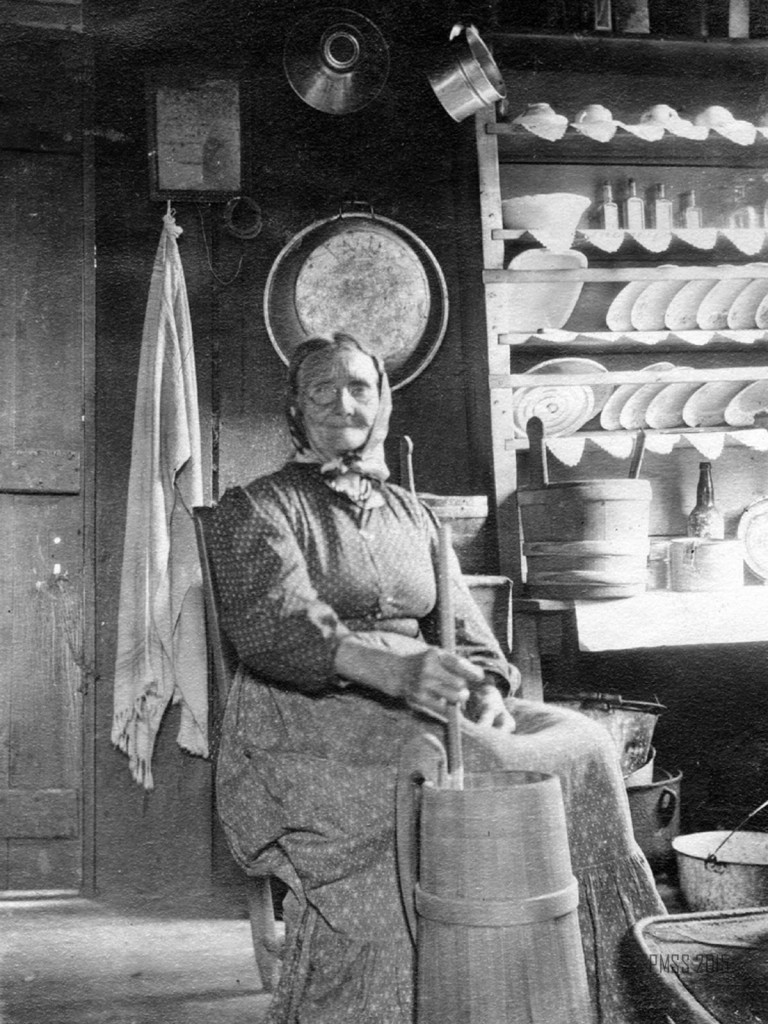
016b P. Roettinger Album. “Aunt Sal.” [Seated with butter churner in her kitchen.] [ [roe_017a.jpg]

IN THE KITCHEN  Pots and Pans I

Home Economics classes and the Practice House (Country Cottage) at Pine Mountain Settlement School aimed for a comprehensive education in kitchen ways and this included the many tips and tricks that women often learn following their mothers around their home kitchens.  But, most of the girls who came to the School in the early years did not have the advantage of following mothers around their kitchens, as some had no mothers, some had no kitchens to speak of, and most rarely had the time for extended kitchen instruction.

Cooking had to be balanced against many other tasks including care of children, gardening, canning and preserving, weaving, sewing, and other consumers of time — yet, most all these were practices that were being promoted in instruction. There was, however a difference. The kitchen education of women in the Pine Mountain community usually gave way to traditional practice that was not informed by hygiene, nutrition, time management, and other advances in “home-making.” The task of keeping ahead of economic disaster through a grinding work schedule or keeping the cycle of planting and harvesting on schedule superseded any attempt at “new” practices.  “Time” in the kitchen, if a kitchen even existed, had nothing of the time many younger women now take for granted. And, the kitchens, themselves, bore little resemblance to the developing contemporary kitchen.
In 1940 Alice Cobb, a staff member who frequently walked about visiting neighbors in the Pine Mountain valley community described a kitchen that belonged to the Sarah Bailey family. Cobbs stories were graphic and continue to shed light in eras now long in the past.  [See: ALICE COBB STORIES “About Sarah Bailey” 1940.]
The kitchen of Sarah Bailey was not the common kitchen found in many rural homes of families in the valley in the 1940s. Her kitchen was a community exception — not the rule, but it carried many of the practices often found in almost all the kitchens of the valley. The exception was that Sarah Bailey was an exceptional woman and she took common tasks and extended them to extraordinary lengths. 

ALICE COBB’S RECOLLECTION OF SARAH BAILEY

“Sarah Napier Bailey. 1947.” [nace_II_album_009.jpg]

“Come right in folkses. Supper’s all ready, and agittin’ cold on the table. Glyn [her son],  bring them chairs in here honey. (To us) “You set down now and go to eatin’ if they’s anything thar that’s fitten to eat.”

We were almost carried in on a wave of fragrance — a delicious combination of smells of all the good things in the world, sweet and sour and baked and fried. Glyn led the way with two chairs, we brought the other, and presently were seated saucer-eyed no doubt, if there had been mirrors to see with before the round groaning table (the work is used advisedly) in the same stout chairs we had occupied in front of the fire.
The children stayed in shy stairsteps in the doorway, watching our every move. Sarah stood by the kitchen stove, her hands folded, and with dignity oversaw the banquet.

The table was without any exaggeration covered, with no spaces between dishes. A heaping dish of spare ribs joggled against a bowl brimming with apple sauce. Piled-up sausages on a platter were ready to tumble into the full butter crock. There was so much that it was hard to know just where to start. And amid our protests at the bounty before us, Sarah brought another dish of what looked to be quarters of fresh raw apples, offered as a special treat. We were amazed.
“Not apples at this time of year!”

“Hit’s sulpherated  apples,” she explained. “They stay just like new that way.” She promised to take us out later to see her sulphurating equipment.

We began to count them to see how much of that dinner had come out of Sarah’s own farm of four acres. The chickens (there was boiled chicken, steaming and tender) she had hatched and raised in her own back yard. We saw some of their family roosting in the apple tree outside, while we ate.

“Them shucky beans,” she saidGrowed in the garden and me and the children strung them up and hung ’em out last summer.” (One has not really tasted beans until he has had the shucky kind and there is no mountain porch complete without lacy festoons of them, which like so many of the attributes of mountain life, represent combined social, aesthetic and practical values. Bean stringing is entertainment, the decoration is lovely, and they do taste wonderfully good when they are finally eaten!)

“The sausage and pork sides was from the two hogs we raised, and I butchered just last week” she went on, and then left’ her post by the stove to hasten the passing around. “Here, have some sausage — you hain’t eat nothing!”

“You mean you butchered  yourself?”

Her eyes danced like Glyn’s as she nodded. “Law, yes!” Why there haint no man alive can cut up a hog as good as me. The men folks around here always calls on Miz’ Bailey when they got a butchering on hand to do.” (“Miz Bailey” is a mite of a person not nearly so big as an average sized hog!”)

“I raised the corn and canned hit last summer, and I pickled my own beets and I raised them sweet potatoes and the Irish potatoes too.”

We went on enthusiastically to note that the eggs (a platter of fried ones, and a bowl of boiled eggs in gravy) of course came from her very own chickens, and the cornbread —

“Well, I reckon you wouldn’t hardly say hit was all mine. But hit was my corn that dried and went to the mill to grind. Hit was the meal that went in to bake!”

“And the milk, of course —”

Oh yes, my cow gives good milk. Plenty for butter for us and mam’s and pap’s. Have some more bread. You haint’ touched nary a thing seems like. course hit’s just plain country cooking’ but I’d hate it a sight for you fellers to go away hungry. Have some buttermilk?”

We couldn’t!

“Now you all just have some cake, if you won’t eat no more chicken or port and beans. Seem like you’re aiming to starve.” We were faced with two enormous cakes, one dark and the other light, and a great bowl of canned peaches (from Sarah’s tree, and canned by her). It is wonderful how accommodating the stomach can be so pleasant an emergency. We partook with gusto of the cake, which she regretfully confessed was “… all furrin ingredients, ‘cepting the lard,” and the coffee with sugar which was also furrin although she explained that as a general thing her family didn’t use “fotched on” sugar at all, but the sorghum from her own cane, made at her stir off last September, or the honey from her two bee gums ‘robbed’ last June.

At long last it was apparent even to this Sarah Bailey that her guests could hold no single spoonful more. It was time for another move.

“Well, if you hain’t aiming to eat nothing,” she spoke with a distinct tone of reproof, ”I reckon you all might want to see my canning cellar and the way I sulphurated them apples.”

Before we were well out of the tiny kitchen the children had snatched our places and were diving into the remains of the feast. Certainly, this had been no ordinary supper, but very evidently prepared for the special occasion with willing and friendly hands, prompted by a warm and welcoming heart.

How do we know all this? There are many stories of visits to the homes of neighbors by the scribbling settlement workers. They often charted in detail where they ate, what they ate, and how it fared with them. Even the most rudimentary meal was welcomed by the workers if they had been long in the community.  It was well-understood that criticizing a meal was one of the largest insults to be given to a homemaker and that any food raised by both School workers and community women, deserved respect. 

INDUSTRIAL TRAINING

That food was a constant topic at Pine Mountain School and in the Community is well documented in the literature of the School through many eras. The documentation surrounding “Practice House”  outlines a clear dialogue and a rationale for the inclusion of a “Practice House” where the foodways of both workers and students could be expanded and instructed. The instruction was part of a growing interest in industrial training. 

Some of the lessons that Pine Mountain sought to instill in its students were common sense and practical for increasing health and safety in homes.  But,  these practical skills were also mixed with a growing body of industrial training that could carry over into jobs in food service industries, domestic work, and as a dietitian, nursing and nutrition specialist, or other kitchen-related or food-related employment.  The helpful kitchen hints that came from instruction in good kitchen practice, are provided throughout the student newsletter, the Pinecone. 

HYGIENE

The student newsletter, the Pinecone, describes simple hints for the preservation of food, kitchen safety, cleanliness,  and maintenance of kitchen tools. Many of these prescriptions were part of Home Economics instruction and a requirement for most all students, girls and boys,  at some time in their education. The emphasis on foodways served to raise awareness of home-safety in the handling of foods and food preparation, as well as expanding the palate of the student.  

Food-borne illnesses, disease, and poor hygiene were ever-present in the homes of many in the surrounding community and particularly in some of the coal camps where close living made for a precarious existence. The direct impact of the integration of proper food handling, the relationship of disease to cleanliness, the transmission of common bacterial infections, etc. was high on the agendas of many of the health workers at the school as their health as well as the Community, was at stake.

 Handwashing, cooking at the proper temperature, storage, etc. were subjects integrated into classroom activities, work routines, and home visits in the community. Hands-on food preparation and preservation of food were part of the routine work program for many students at the school and the awareness of proper handling of food and food preparation was in the interest of the entire community.

LAUREL HOUSE

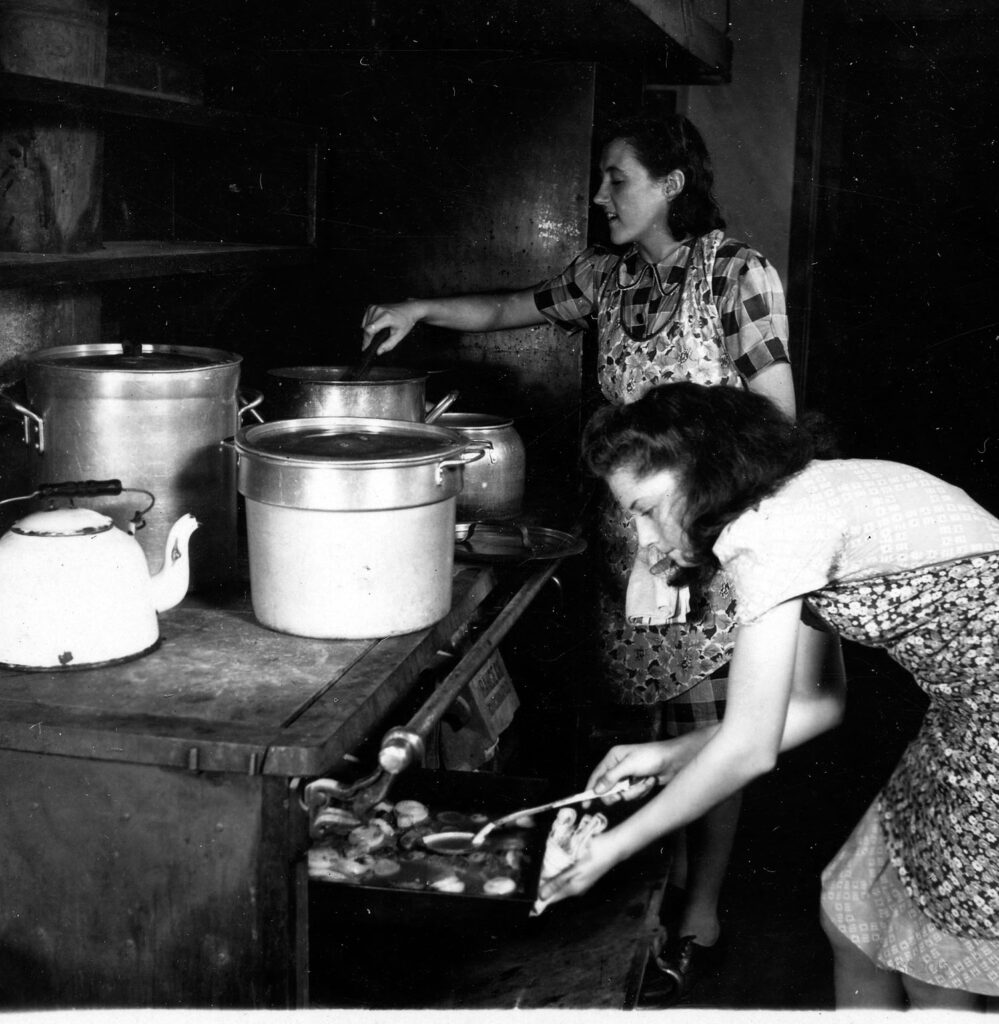
054 Kitchen workers. garner_ray (54)

The early kitchen in Laurel House I, the first main building and dining commons for the School was exemplary for its day.  It was a large facility, outfitted with ample ovens and stoves, washing areas, and food preparation areas. The Laurel House kitchen saw a steady rotation of students through its training.

The student newspaper, the Pinecone gives testimony to the integration of kitchen work and food savvy in the lives of the students.

Angela Melville Album II, Part I. [melv_II_album_018.jpg]

Angela Melville Album II, Part I. [melv_II_album_018.jpg]

The following is a Pinecone list of helpful hints.

KITCHEN HINTS

[From The Pine Cone, February 1938]

1.    To keep the smell of cabbage, onions, and other strong-smelling vegetables from going all through the house, burn newspaper on top of the stove.

2.    To keep smoke down from sugar and other things which have boiled over on the stove, apply salt.

3.    To keep lemon fresh in hot weather put in fresh water every day or keep buried in sand.

4.    To keep cheese from molding, wrap in a cloth wet with vinegar.

HINTS ABOUT DISHES

1.    Rinse and wash as soon as through using dishes if possible.  If not possible soak in cold water.

2.    Soak in cold water all dishes which have been used for batters [with] milk or eggs.

3.    Care of coffee and tea pot —

(a)   Rinse in cold water

(b)   Wash in hot water

(c)    Scald, dry and leave open.

4.    Egg beaters —

(a)   Rinse, clean, dry and hang up as soon after use as possible.

(b)   Never put egg beaters to soak and never let the cogs get wet.

POTS, PANS, AND STOVES

Stoves were rarely found in the early Pine Mountain community homes until coal became a common fuel and roads allowed the transport of large durable goods, such as heavy stoves, into the community. Even after the advent of the gas and the electric stove, the use of the coal stove continued in many households but, then, only in the homes that could afford the transport of the heavy metal stoves and the cost of the coal stove, itself.

“Kitchen” was also not a word that was common in many households where the cooking of food and preparation of food was not relegated to a specific room in small homes.  In the earliest cabins, the fireplace that warmed the cabin was also the kitchen. It was only in larger homes and cabins that “kitchens” as we refer to them, began to appear.  Most often they were in areas often referred to as the “dog-trot”, the area that sometimes joined the two sections of a two-cabin home.  The evolution of the “dog-trot” into a kitchen was not uncommon. The small Old Log cabin at Pine Mountain School has remnants of a “dog-trot” in the center of the lower floor of the structure and when cooking at the cabin moved indoors, this space was the preferred location. 

Another preference for cabin kitchens was to add a small shed attached to the side of a house or cabin.  This location was for several reasons.  The most common reason was that the removal of this area away from the central living space reduced the danger of fire and injury to children. These “dog-trot” kitchens were difficult to document because of the lack of light and windows.  Very few photographs exist of the interiors of mountain cabins, for the same reasons.  Those photographs that have captured interiors show how central the fireplace was to the small cabins and homes.

THE IRON POT – COOKING OUTDOORS and IN

In the early years the cooking pot on a tripod was constantly used. The large volume that could be cooked in a tripod pot could serve a large number of students and staff and until the interior kitchens were in place, this outdoor kitchen was common. 

Angela Melville Album II – Part V. [melv_II_album_240.jpg] The tripod “kitchen”.

Angela Melville Album II - Part III. [melv_II_album_229.jpg]

Angela Melville Album II – Part III. [melv_II_album_229.jpg]

The clever use of the iron cooking pot stands out when tracing the history of cooking and the common practice of kitchen arts in early mountain homes, .  Large cast-iron pots on tripods were used heavily at Pine Mountain in its early years.  Sometimes used in interior fireplaces or on tripod supports mounted in the yards or in the “dog-trots”  or “go-betweens” of cabins, the iron pots of various sizes were portable and versatile. They saw uses for many fundamental cooking projects including soap-making, dye pots and boiling down cane or maple syrup. The caution was to be very careful about mixing the task and the pot. Stew in the same pot following a soap-making would be well remembered!

Before the campus kitchen was in place at Laurel House I, workers at the School used iron pots to prepare group meals for the School. They also used them to boil laundry, dye wool, make soap, and various other tasks. When viewing a photogrpah of a pot on a tripod it  is difficult to know what the pot carried. Keeping the pots clean and being mindful of a pots previous use was an extremely important kitchen lesson!  There are good tales of pot confusion, however. 

A humorous story is told about the mixing up of pot contents when an iron pot accidentally became contaminated with soap and was then re-used for soup. One of the important lessons that all students were drilled on was to not criticize the food as it was served at the communal tables.  So, when the dinner soup arrived and was ladled out to the table, there was consternation written large on the faces of the students around the table.  One brave student suddenly exclaimed, “This soup tastes just like soap!”.  As the other students drew in their breath and looked to the staff member at the table for the requisite reprimand, the distressed student quickly altered his remark by saying, “…and, that is just the way I like it!”

 Iron pots were critical tools for the early mountain families and were heavily used.  Today they are treasured items of many mountain families or have been relegated to the yard where too often, their bottoms fell out from too many lye soap batches, or iron rot from standing water. In their bottomless state they were still treasured for they could hold plants and flowers on porches and in yards.

Worker at the Medical Settlement at Big Laurel next to cooking tripod with cross-bar. X_099_workers_2478a_mod.jpg

Iron pots can hold heat for long periods of time and whole meals can be cooked in a single unit and sometimes be stretched over several days.  Flat cast-iron skillets can be used with skill to fry fat-back to render cooking lard, a staple in almost all households. In the early households, cast iron pots and skillets were constantly put into quick action for all meals, often keeping an ever-ready location on the hearth.  Often, too, they were placed where they could readily be moved over hot coals or onto metal stands using a swinging “arm.”. The skillets were well seasoned and could withstand the high heat of frying as well as slow cooking.

With a lid, the pans could be used for baking by being buried in the coals of the fireplace.  Like the large cauldrons used on tripods, the deep cast-iron skillet with a lid was a vital tool in common food preparation.  Corn pone, fried chicken, bacon, fried onions, greens with fat-back, fried apples, fried potatoes, fried fish— anything that would fry, simmer, or bake was placed in these deep skillets and generally with a generous dollop of rendered lard.

Larger iron pots could be covered with a lid or not and could be hung from a metal “arm” and be placed or swung into the fireplace.  Into this pot could go most anything.  Squirrel stew, rabbit stew, chicken, and dumplings, or a rich vegetable stew.  Stews of many varieties were common in mountain homes as they could be kept going for several meals.  Any dish that required substantial liquid and a long cooking time was most often placed in these “slow cookers”  — the very deep cast-iron pot with a lid. If the family had a “footed” iron skillet with a lid, this was often placed directly in the coals of the fireplace and coals shoveled on top of the lid. This “oven” vessel would bake cakes and oven recipes.  Biscuits, cobblers, and other items that required baking could be handled quite well in these small “ovens.”  Clearly, the possession of a cast iron pot was critical to the early settlers.  It was a kitchen item that was almost sacred. It was guarded carefully and passed down from generation. The skills of its use were passed along in the family and readily adopted by a family and by the settlement workers. Kitchen savvy can be shared in many directions. It is likely that the students at Pine Mountain were the early teachers of “best practice” of the proper use and care of cast iron pots.

SEE:  FOODWAYS: “Old Fashioned Dinner” 1919


GO TO:

DANCING IN THE CABBAGE PATCH  I – GUIDE

DANCING IN THE CABBAGE PATCH II – Introduction

DANCING IN THE CABBAGE PATCH III  Place

DANCING IN THE CABBAGE PATCH IV  Farming the Land 1913-1930

DANCING IN THE CABBAGE PATCH V  Farm & Dairy I the Early Years

DANCING IN THE CABBAGE PATCH V  Farm & Dairy II the Morris Years

DANCING IN THE CABBAGE PATCH VI – POULTRY

DANCING IN THE CABBAGE PATCH  In the Garden

DANCING IN THE CABBAGE PATCH VIII In the Kitchen

DANCING IN THE CABBAGE PATCH IX  Dieticians

DANCING IN THE CABBAGE PATCH X  In the Dining Room, Manners & Etiquette 


War and PMSS

Pine Mountain Settlement School
DANCING IN THE CABBAGE PATCH
War and Pine Mountain Settlement School

PINE CONE 1944 January

Pine Cone 1944 January, cover. [pine_cone_1944_8-5_001.jpg]

TAGS: WWI, WWII, Vietnam War, soldiers, nursing, Europe, Sgt. Alvin Callum York, York Syndrome, war, casualties, valor, Alice Joy Keith, August Angel, rations, Grace M. Rood, nurses, V-Mail, food shortages,


DANCING IN THE CABBAGE FIELDS  War and PMSS

Many families have carried forward the idea that Eastern Kentuckians have contributed disproportionately to enlistment, casualties, and valor during our wartimes.  One author has noted that this idea has some roots in reality. Alice Cornett, writing in 1991 for the Baltimore Sun, noted that the disproportionate number of Appalachians killed while fighting in the wars following WWI did not go unnoticed.  Cornett and others have recently suggested that the large numbers of enrollees, often a large number of soldiers from Appalachia, are associated with what some have referred to as the “Sgt. York Syndrome.”

THE SGT. YORK SYNDROME

The syndrome coined by Dr. Steven Giles, a psychologist working for the Tennessee Veterans Administration Medical Center at Mountain Home, is, in Dr. Giles’ view, both laudatory and troubling. He notes that the syndrome is bolstered by the pervasive idea that the Appalachian soldier is a “good” soldier; that  ”Appalachians make good soldiers, and the Army knows it.” This goals-congruence factor, for good or ill, has often found Appalachian soldiers at the front-line of battle and has often been lauded as the most heroic of soldiers in battle.

Why has Sgt. York today has become a “syndrome’ of Kentucky soldiers?  Sgt. Alvin Cullum York (December 13, 1887 – September 2, 1964), was a native of Pall Mall, in eastern Tennessee. By most accounts, he has been described as a hero and the quintessential soldier.  A rifleman, whose bravery in battle and subsequent award of a Medal of Honor, captured the imagination of a nation. He was immortalized when his life was made into a movie in 1941.  Sergeant York, directed by Howard Hawks with Gary Cooper as York, was as timely as it was motivating for many young men who viewed the film.  The enrollment for WWII was growing, and Sgt.

York set a standard of conduct that almost made serving in the Army a religious duty. York’s exploits, which were translated to the silver screen, furthered his legend and that of the Appalachian soldier. On the cusp of WWII, York, in the mind of the nation and particularly in the minds of Appalachians, Sergeant York was the model soldier, and the “Sgt. York Syndrome” took root and grew. York’s bravery and his philanthropy, now known to all Appalachian young men and to their families following the Great War, became a topic of pride in the mountains and remains so today.

York’s bravery and his philanthropy, now known to all Appalachian young men and to their families following the Great War, became a topic of pride in the mountains and remains so today. After the release of the film, perceptions grew regarding the fearless nature of the Appalachian soldier. In fact, all the wars since the Great War that the United States has engaged in have invoked the name of Sgt. York. In the Appalachian mountains, particularly when recruiters came to enlist soldiers, the name of Sgt. York was often lurking at the back of both the recruit’s and the recruiter’s mind.

Yet, even before York, the Nation had seen large numbers of young men and women from Appalachia step eagerly forward to serve. In one Appalachian county in Kentucky, Breathitt, there were no draftees during the whole of WWI because quotas had been met and exceeded by the general enlistment of county residents.

However, all this patriotism has yielded a grim fact.  Data gathered by Alice Cornett should be noted

As a percent of its population, the Appalachian region has sustained higher losses in our wars of the past 50 years than has any other section of the country. West Virginia, the only state designated as wholly in Appalachia, had the highest casualty ratio in both World War II and the Vietnam conflict.

Many of the counties in Appalachian states have seen their young men recruited, volunteered, and served in war, but the propensity to fight in wars has also been associated with the need for employment and the often biting poverty.  The same Appalachian counties that sent large numbers to war were often some of the poorest counties.  The number of Appalachian soldiers is also now matched by a disproportionate number of racial minority recruits. Thus, the Appalachians, Blacks, Hispanics, and other groups struggling with economic and social challenges often find military recruitment a way into careers and out of poverty.  Again, the military recognized that these young men and women would “soldier on” because of their deep patriotism.

[See: http://kentuckyguard.dodlive.mil/2013/03/19/a-patriotic-clan-from-eastern-kentucky-in-the-war-to-end-all-wars-part-one/]

WWII V-Mail letter from Alice Joy Keith to August Angel, 25 May 1945. [Angel WWII_vmail_from Alice Joy Keith. [Angel-WWII_vmail_from-Alice-Joy-Keith.jpg]

PMSS AND WWI

rood_066x

Unidentified PMSS student.

At Pine Mountain, there are many stories regarding the School’s engagement with WWI. As students left to fight in the Great War, the staff also left their positions to fight alongside their students. The School was often challenged to fill critical staff positions as well as maintain a balanced student body.  For example, when Leon Deschamps, a Belgian farmer working at Pine Mountain, left to fight in WWI early in 1918, he kept in touch with the School and with the children. Deschamps served in the American Expeditionary Forces in Europe in 1917, under the command of General John J. Pershing. He was assigned as a translator (French) and in the forestry department. His presence in the battle abroad was followed with fascination by the whole School.  The students regularly held cocoa and rice dinners to save money for the “Belgians in the war” effort.

In reading through the Leon Deschamps Correspondence, we are reminded of the discrimination that many immigrants faced following WWI and WWII, and today. As a “foreigner,” Leon was one of the first members of the Pine Mountain staff to join the WWI war.  Yet, he was excluded from many of the opportunities afforded to job seekers when he returned. In some cases, the discrimination came from some of the more “enlightened” educational institutions in the country, though there is little indication that Pine Mountain showed him any exclusions. His talents, determination, and the enormous endorsement given by those who worked with him are well documented in his correspondence. Yet, the suspicions ran deep regarding “foreigners” following the war.  In the mountains of Appalachia, largely a rural geography, it is no surprise to find the inclusion of those who knew him, that he left legends in all the institutions he touched. Not many of us can claim such legacies.

War, for most of the students at Pine Mountain Settlement, was a distant and somewhat romantic engagement until the soldiers began to return home shell-shocked, lungs destroyed by mustard gas, or, in a casket. Yet, for many staff at the School, war was already a very real experience, and one not to be romanticized.

Perhaps one of the most remarkable impacts of war on Pine Mountain staff is found in the personal narratives of those who came to the School after having served in remote corners of the world during wartime. One of the most harrowing first-hand accounts of war can be found in the staff who were impacted by the front lines of conflict. One of these conflicts, the Ottoman Turk-Armenian conflict witnessed by Dr. Ida and Rev. Robert Stapleton, was particularly horrific and is well recorded in a recent book published by their granddaughter, Gretchen Rasch. The Storm of Life: A Missionary Marriage from Armenia to Appalachia, published by the Gomidas Institute in 2016, tells of the two missionaries’ horrific struggle with the mass genocide of Armenians in and around Ezerum, Turkey.

The Stapletons came to Kentucky in the late 1920s to serve as co-directors of Line Fork Settlement (Letcher County, Kentucky), a satellite settlement associated with the Settlement School. They were particularly well equipped to meet almost any human conflict with experience and compassion following their harrowing experiences in Turkey.  The battles around moonshine and the frequent revenge killings of the Appalachians were part of their everyday life on Line Fork in the early decades of the twentieth century. It was a life they often met with humor and compassion, but even more, with understanding. Their early work with the Ottoman-Armenian conflict no doubt brought the petulance of personal and familial battles quickly into perspective.

Another staff member at the School also experienced the Ottoman Turk-Armenian conflict in a more Eastern region of Turkey. Edith Cold was stationed in Hadjin, Turkey as a school teacher for children orphaned by the ethnic war. Her letters and stories regarding the conflict that slowly engulfed the region are equally chilling and capture the severe circumstances that war brings to communities across the world. The trials of Edith Cold were captured in a series of New York Times articles that chronicled her ordeals and her incredible bravery in efforts to keep the children and the staff of the school safe from harm. As genocide ravaged the Armenian populations, workers such as Edith Cold and the Stapletons witnessed horrendous atrocities and placed themselves in harm’s way on a daily basis. Today, those echoes of brave volunteers and their harrowing experiences continue to fill the news and speak more of the inhumanity that lurks in every conflict of border, ideology, and beliefs. The tales recounted by the Stapletons and by Edith Cold of life in Turkey in the first decades of the twentieth century were shared with students at Pine Mountain, more in their models of tolerance, support, and understanding, than in their recounting or bearing witness to war’s inhumanity. There is good evidence that they softened the edges of many hard lives in the Pine Mountain valley and beyond.

PMSS AND WWII

During World War II, the actions of war came closer to the School as communication improved and the radio brought reports of the war closer to home.  Great numbers of Staff and students left to join the ranks of soldiers or became support staff to the war effort.  During these years, communication flowed more rapidly and frequently, and the war became a real and present conflict that had little room for romanticizing.  The American mind was war-focused in this Second World War and was daily informed through the radio.

rood_065x

A “Thank you” to nurse, Grace Rood from Lester.

Of all the wars, World War II possibly had the greatest impact on life at Pine Mountain and in the valley.  Many fathers and sons left their farms in the valley to fight in the war. Many young men stopped their classes at PMSS to go fight the war in Europe, and women signed on to the nurses corps or to the Red Cross or to canteens in Europe to do their share in the war effort. Classes were suspended when key instructors left. Basic supplies could not be obtained for many families, and money was tight. Many families could not afford even the smallest tuition. The impact of WWII on the farm was dramatic as rationing began to impact food supplies, and families in the community looked to the School for more assistance in farming needs and health issues. Subsistence and rationing became uneasy partners in many families. Rationing, particularly, was a critical issue with all residential schools, and the food issues and family loss only compounded the national and personal crises in the Appalachians.

There are many stories related to Staff who had some family relation in either the European or the Pacific theater of war. See especially the important documentation of war efforts by soldiers in Perry County, KY, maintained by Waukesha Lowe Sammons, daughter of one of the county’s soldiers who did not return from WWII. Waukesha, a Berea College graduate, has created a comprehensive website that traces the Military Legacy of the Soldiers, Sailors, Airmen, and Marines who served from the American Revolutionary War to Operation Iraqi Freedom. Her comprehensive website covers just one eastern Kentucky county — Perry County, but it gives a vivid picture of how many wars impacted the region.

http://www.perrycountykentuckymilitarylegacy.com/

World War II in the Asian theater also directly affected the lives of many of Pine Mountain’s staff and students. For example, the expulsion of staff member Burton Rogers from Yali, the Yale in China School where he was teaching when the Japanese invaded in 1937, brought the family to Pine Mountain. His relocation is another story of severe challenge, hardship, and courage.  rood_030xBurton Rogers came as the school principal in 1941 and later served as the Director of the Pine Mountain Settlement School. His wartime experience was profound and prompted him to a lifetime as a conscientious objector. As a member of the Quaker faith and outspoken critic of war for the remainder of his life, Burton and his wife, Mary Rogers, committed their lives to pacification. Mary had learned how to skillfully negotiate conflict when she worked in India and met the pacifist, Gandhi.

The brave and courageous contributions of two Pine Mountain Doctors, Emma and Francis Tucker, and their nurse protegee, Grace Feng Liu,  brought first-hand accounts to the School’s understanding of the impact of war on individuals. Their stories are remarkable. The Tuckers’ heroic struggles during the Japanese invasion of China and their work to raise the standards of health in rural China equipped the couple for the rural medical work they completed at Pine Mountain. The two were at that time long past the normal retirement age.  Their story of encounters with the Japanese invading forces and their escape from China when it was overrun by the Japanese, is an inspiring tale of courage and contribution that they shared with the Pine Mountain community and with the students. Grace Feng, a native Chinese nurse, was brought by the Tuckers when they departed China, and she came for a brief time to the School. It was at the School that she later married T.C. Liu, another Chinese migrant. The story of Grace Feng Liu and TC. Liu is a touching one and can be traced in their own words in the School’s archive.  The couple returned to China following the completion of their education in America, but were soon caught up in the deadly Communist regime of Mao. 

GLYN MORRIS ARMY CHAPLAIN

In 1941, the School’s Director, Glyn Morris, left to join the war effort as a military chaplain, and with him went a large number of young men to either enlist or take advantage of the V-12 programs that offered training and educational assistance to capable young men. The letters to staff from soldiers in WWII are important records of the history of the war years at the School, as well as the adjustments that the School made during those difficult years.  See, for example, the Bill Blair WWII Letters and the record of Joe Glen Bramlett, two students at the School.

Another remarkable personal story is that of Frank  W. “Unk” Cheney, who survived the bombing of Shanghai and imprisonment by the Japanese during WWII at the Chapel prison camp. His experiences as a prisoner of the Japanese were both horrendous and productive for “Unk,” who learned the Japanese language and developed an appreciation for Japanese furniture design. He demonstrated how even the most oppressive features of war can be turned to advantage. His aesthetic sensibilities and gentleness brought a different perspective of the Far East to students who had the privilege of working with him at Pine Mountain.

rood_063x

WWII students at PMSS.

Many students felt the call to service in both wars, but perhaps WWII had the most profound effect on Pine Mountain Settlement, as so many young men enlisted that work crews and the workflow of the institution were dramatically affected.

The three young men to the right are typical of the pride shown by these new soldiers.

Paul Hayes, a student and later PMSS Director, went to Berea College as part of the V-12 program and later to Duke as a recipient of the same military assistance. Paul saw duty in the Pacific. His brother John Hayes first signed on as part of the Army Corps of Engineers and later in the regular Army, also going to the Pacific theater to fight. Silvan Hayes, the oldest brother, was already in the Army in the European war and was killed in 1943 in France. Enoch C. Hall II, a PMSS student from Perry County, left Pine Mountain and joined the Army and served in Hawaii.  He was among the many soldiers who were witnesses to the opening days of WWII when Pearl Harbor was bombed by the Japanese, and led to the declaration of war by the U.S.  Hall’s barracks at the Honolulu airfield were strafed by the Japanese in the opening days of the Pacific war. Joe Glen Bramlett, a student who served in the Army, left a large visual record of his years at the School and those in the Army.

Student William David Martin left PMSS in March of 1941 to join the Navy and, following his completion of duty, wrote a letter to the School saying that he had earlier been overcome by “Navy fever” and would like to complete his degree at the School — which he did.

All these young men served with valor and conviction in WWII. Most came home, but some did not survive the ravages of battle. Their names were placed on a small plaque that once hung in Laurel House. Delicately inscribed and gilded, it now shows its age and has been placed in the Archive of the School.

WOMEN IN THE WARS

[**See: http://kentuckyguard.dodlive.mil/2013/03/19/a-patriotic-clan-from-eastern-kentucky-in-the-war-to-end-all-wars-part-one/#sthash.1NIycerE.dpuf]

There were no women allowed in the ranks of the military before WWI.  In 1901, women were able to join the Army Nurse Corps, and by 1908, women were allowed into the Navy Nurse Corps. When the US entered WWI, the ranks swelled in number to around 250 women, with approximately 15 drawn from the Appalachian region. Three of the women were from eastern Kentucky, and all were graduates of Berea College’s nursing program. **

During WWII, there were numerous women from eastern Kentucky and from Pine Mountain who joined the war effort. Two notable nurses who trained at Pine Mountain were Mable Mullins, from Partridge, and Stella Taylor. Both young women earned commendations for their war work.

rood_064x

Stella Taylor

Many will agree that Mullins and Taylor made remarkable careers for themselves in WWII. Mable Mullins became a Major in the Army, a rank as high as a woman could go at the time.  Stella Taylor contributed nursing services as an Army nurse and gained recognition for her work.  Other nurses trained at Pine Mountain were quickly signed on to the war effort.  Also, women left the School to provide services or direct support in WWII in jobs that did not require enlistment, but that supported the war effort. Generally, these jobs were those in industrial support, and/or canteen work.

Many young men in WWII were not drafted but were exempted in order to maintain farms and critical operations on the home front, or, often, they were exempted because they already had multiple siblings fighting in the war. William Hayes was one such student who was retained at Pine Mountain to maintain the farm while three brothers were recruited. His correspondence with his mother, his brothers, and with various students who fought in the war is poignant. The sacrifice of his older brother, Silvan Hayes, to the war effort in France left permanent scars on his family as the war did for so many families in Appalachia. William’s correspondence with student Bill Blair is extensive and provides a picture of a student’s course through military training and deployment during wartime.  The list of enrollees in the war efforts of the 1940’s is a long one. Yet, exemption for most young men from Appalachia was not something that they welcomed during WWII, just as it was not during WWI and many of the succeeding wars.

The list of enrollees in the war efforts of the 1940’s is a long one. Yet, exemption for most young men from Appalachia was not something that the men generally welcomed during WWII, just as it was not welcomed during WWI and the succeeding wars. It was noble to serve most men in the community.  Within the staff workers at Pine Mountain, the story was often quite different, as many came to the School as conscientious objectors and served their time contributing to the work at the mountain settlement. Two Quakers come readily to mind: Peter Barry and Burton Rogers.

PMSS AND THE KOREAN WAR

The Korean War did not have the same impact on PMSS as did the larger WWII conflict, but it still left its mark on families in the Pine Mountain Valley.  As noted by Alice Cornett’s statistical accounting of participation in that war in her 1991 Boston Sun article,

Nine percent of U.S. military forces in the Korean War were from areas of Appalachia, but 18 percent of the Medals of Honor awarded in that war went to the Appalachian soldiers. In Vietnam, they made up 8 percent of our troops and received 13 percent of the Medals of Honor.

[See:  http://articles.baltimoresun.com/1991-11-11/news/1991315046_1_appalachian-counties-vietnam-war]

PMSS AND THE VIETNAM WAR AND THE WAR ON POVERTY

At the opening of the Vietnam conflict, Pine Mountain was no longer a Community School site, but many of the children who had attended the Community School began to be caught up in the action in Vietnam as they came of age. The most dramatic impact on Pine Mountain of this conflict was the same as that found throughout the country. Families were wrenched apart by conflicting sympathies for the war effort, and communities were pitted against other communities as the war dragged on for almost two decades.  Coal was often in the news as the resources went to support the energy needs of the growing war effort, and families saw both a coal boom and a large out-migration to Northern factories, as in WWII, where work in the military-industrial complex could bring better wages.

Cmdr. Steven Hayes (back row, far rt.). a student at PMSS and his crew following the end of the Vietnam War..

In April of 1964. Lyndon Johnson traveled to Inez, Kentucky, and sat on the porch of the Tom Fletcher family and declared a War on Poverty.  As noted by many, the universities in the Appalachian region were more engaged in naming buildings and honoring the dead than engaging their cultural and economic conscience. A political and economic protest was not high on their agendas as they followed the welfare of family members caught up in the Vietnam conflict. Eventually, however, it was Johnson’s “War on Poverty” that created the largest shock wave in Appalachia, not the fighting in Vietnam. The fall-out from Johnson’s social service programs for the Appalachian region would have an impact far greater than any war fought in foreign lands.  Many scholars today remind us that families in the region are still climbing out of poverty that was prolonged by this federal assistance effort. —the War on Poverty. The casualties from the ramifications of the War on Poverty were not just sons and daughters; it was entire families and generations of those families.

Used as a sort of guidebook for the eager volunteers that came into the region, Jack Weller’s Yesterday’s People (1965) became the cultural window for the Appalachian Volunteer program, an outgrowth of the War on Poverty. Funded through the Office of Economic Opportunity, the Appalachian Volunteers soon found themselves in a cultural war that roughly followed the same timeline as the Vietnam War, and the political differences were often as volatile and acrimonious as the anti-Vietnam War movement.  Accused of being Communists, radicals, hippies, elites, subversives, and importantly, “Outsiders,” the Appalachian Volunteers (AVs)  came into the region believing that they could make a difference. Two other “outsiders, Glyn Morris, then at Evarts, and Myles Horton at the Highlander Center in Tennessee, cautioned the new arrivals to respect the cultural differences of the region. Both Myles Horton and Glyn Morris had studied under Reinhold Niebuhr at Union Theological Seminary, and Myles admonished the AVs who trained at his center in Tennessee to “…find out what they [people of Appalachia] want you to do and work quietly, and remember: you’re different. They’re not different.” Neibaur’s book, Moral Man in an Immoral Society, made a profound impact on both Morris and Horton and helped to shape both of their worldviews regarding war, and each had an antipathy toward a war of any sort.  Don West, poet, activist, and native of Appalachia, was more direct in his cautions regarding the War on Poverty

The Southern mountains have been missionarized, researched, studied, surveyed, romanticized, dramatized, hillbillyized, Dogpatched, and [now] povertyized …

By 1970, the Appalachian Volunteers had lost their funding from the OEO, and Johnson’s War on Poverty had come to a virtual halt, but not before a number of Harlan County youth had begun to question and rethink the cultural and economic divide in the county and had begun to dialogue with the Volunteers- often against their parents’ protests.

Mildred Shackleford, interviewed by Alessandro Portelli for his book They Say in Harlan County (2011), put it this way

“I got involved in them [Appalachian Volunteers] because I thought they had something different to offer, and I wasn’t too sophisticated at that time. I was about sixteen or seventeen years old. I was reading a lot. I was finding out different things. The involvement in Vietnam — I was finding out a little bit of it, and I found out that what the United States was doing in that country wasn’t something that I could respect; and I hadn’t thought of looking at Harlan County in the same way that I looked at Vietnam. That’s one thing I did learn from those people pretty quickly; that in a way we were more like the people in Vietnam than [like] the people in the rest of the country.”

War comes in many forms and is met with an equal variety of responses. Whether it was the Civil War, the War of 1812, the Spanish-American War, WWI, WWII, the Korean War, the Viet Nam War, the War on Poverty, or the wars in the Middle East, the people of Appalachia have been there as defenders, patriots, educators, nurses, and very often, leaders, and they often carry the lessons of the Pine Mountain Valley. Most have never been far away from their place, their early educations, and the many lessons of Pine Mountain.

*The commentary in this blog is that of the author, Helen Wykle [sister of Steven Hayes], and does not necessarily represent the views of Pine Mountain Settlement School. hhw


Resources:

Billings, Dwight B; Ann E.  Kingsolver. Appalachia in Regional Context; Place Matters, Lexington, Ky: University Press, 2018.

Niebuhr, Reinhold. Moral Man and Immoral Society: A Study in Ethics and Politics, Louisville, KY: Westminster John Knox Press, 1932.

Portelli, Alessandro. They Say in Harlan County, Oxford/New York: Oxford University Press, 2011. Oral histories taken from families in Harlan County.

Satterwhite, Emily. City to Country circa 1967-1970, looks at war in the populations of the city and the country.

Webb, James. I Heard My Country Calling: A Memoir. New York: Simon & Schuster Paperbacks, 2015. ©2014.  A novel about the Vietnam War by Webb, a former U.S. Senator, Secretary of the Navy, recipient of the Navy Cross, Silver Star, and Purple Heart, and a combat Marine. In his words, “…a love story–love of family, love of country, love of service. ” Born in Arkansas but with roots in Appalachia, the Webb family saga spans WWII, Korea, and the Vietnam years. Explores the Vietnam War through the over-romanticized novel Christy by Catherine Marshall and the “familiar” depravity of Appalachians as depicted in James Dickey’s Deliverance.

Weller, Jack. Yesterday’s People,  Kentucky: University of Kentucky Press, 1965  (reprint 1995). Mr. Weller presents, with compassion and humor, one of the most incisive studies that have been made of an American folk community. It contains many quotable passages about social classes in America, and about Appalachia in particular.”―Publishers Weekly

See more at: http://kentuckyguard.dodlive.mil/2013/03/19/a-patriotic-clan-from-eastern-kentucky-in-the-war-to-end-all-wars-part-one/#sthash.1NIycerE.dpuf

Kentucky Soldiers in WWII, Harlan County  http://usgwarchives.net/ky/military/wwii/harlan.html


See Also:

http://articles.baltimoresun.com/1991-11-11/news/1991315046_1_appalachian-counties-vietnam-war

EVENTS – WORLD WAR I at Pine Mountain Settlement School