
Pine Mountain Settlement School
DANCING IN THE CABBAGE PATCH
In the Kitchen With Pots and Pans I
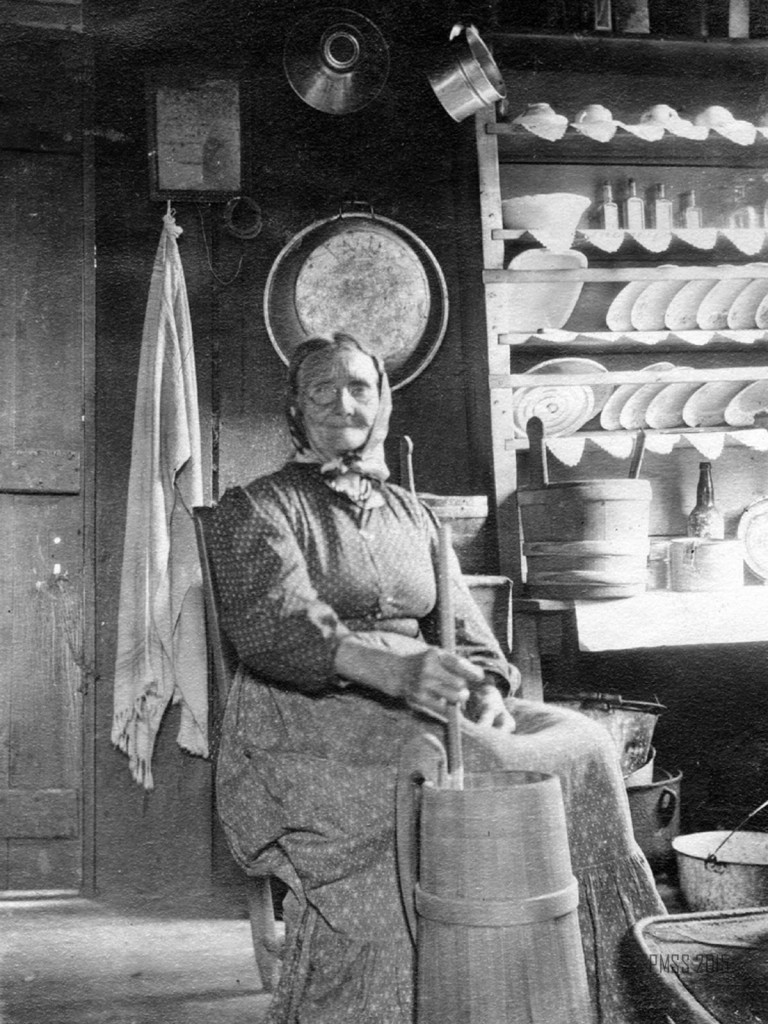
016b P. Roettinger Album. “Aunt Sal.” [Seated with butter churner in her kitchen.] [ [roe_017a.jpg]
IN THE KITCHEN Pots and Pans I
Home Economics classes and the Practice House (Country Cottage) at Pine Mountain Settlement School aimed for a comprehensive education in kitchen ways and this included the many tips and tricks that women often learn following their mothers around their home kitchens. But, most of the girls who came to the School in the early years did not have the advantage of following mothers around their kitchens, as some had no mothers, some had no kitchens to speak of, and most rarely had the time for extended kitchen instruction.
Cooking had to be balanced against many other tasks including care of children, gardening, canning and preserving, weaving, sewing, and other consumers of time — yet, most all these were practices that were being promoted in instruction. There was, however a difference. The kitchen education of women in the Pine Mountain community usually gave way to traditional practice that was not informed by hygiene, nutrition, time management, and other advances in “home-making.” The task of keeping ahead of economic disaster through a grinding work schedule or keeping the cycle of planting and harvesting on schedule superseded any attempt at “new” practices. “Time” in the kitchen, if a kitchen even existed, had nothing of the time many younger women now take for granted. And, the kitchens, themselves, bore little resemblance to the developing contemporary kitchen.
In 1940 Alice Cobb, a staff member who frequently walked about visiting neighbors in the Pine Mountain valley community described a kitchen that belonged to the Sarah Bailey family. Cobbs stories were graphic and continue to shed light in eras now long in the past. [See: ALICE COBB STORIES “About Sarah Bailey” 1940.]
The kitchen of Sarah Bailey was not the common kitchen found in many rural homes of families in the valley in the 1940s. Her kitchen was a community exception — not the rule, but it carried many of the practices often found in almost all the kitchens of the valley. The exception was that Sarah Bailey was an exceptional woman and she took common tasks and extended them to extraordinary lengths.
ALICE COBB’S RECOLLECTION OF SARAH BAILEY
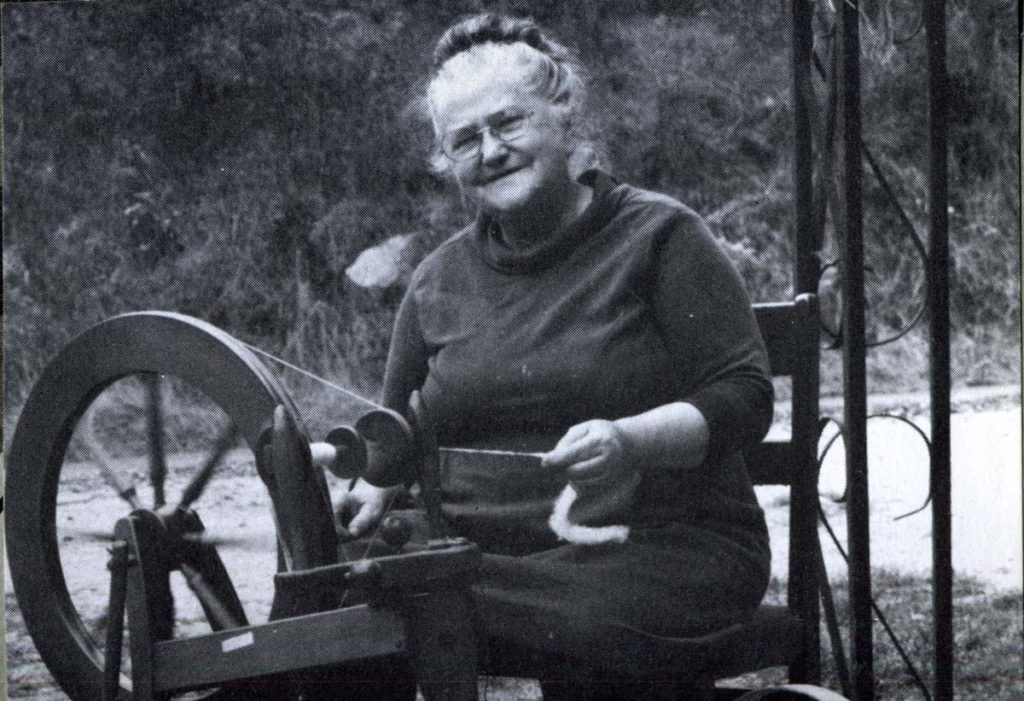
“Sarah Napier Bailey. 1947.” [nace_II_album_009.jpg]
“Come right in folkses. Supper’s all ready, and agittin’ cold on the table. Glyn [her son], bring them chairs in here honey. (To us) “You set down now and go to eatin’ if they’s anything thar that’s fitten to eat.”
We were almost carried in on a wave of fragrance — a delicious combination of smells of all the good things in the world, sweet and sour and baked and fried. Glyn led the way with two chairs, we brought the other, and presently were seated saucer-eyed no doubt, if there had been mirrors to see with before the round groaning table (the work is used advisedly) in the same stout chairs we had occupied in front of the fire.
The children stayed in shy stairsteps in the doorway, watching our every move. Sarah stood by the kitchen stove, her hands folded, and with dignity oversaw the banquet.
The table was without any exaggeration covered, with no spaces between dishes. A heaping dish of spare ribs joggled against a bowl brimming with apple sauce. Piled-up sausages on a platter were ready to tumble into the full butter crock. There was so much that it was hard to know just where to start. And amid our protests at the bounty before us, Sarah brought another dish of what looked to be quarters of fresh raw apples, offered as a special treat. We were amazed.
“Not apples at this time of year!”
“Hit’s sulpherated apples,” she explained. “They stay just like new that way.” She promised to take us out later to see her sulphurating equipment.
We began to count them to see how much of that dinner had come out of Sarah’s own farm of four acres. The chickens (there was boiled chicken, steaming and tender) she had hatched and raised in her own back yard. We saw some of their family roosting in the apple tree outside, while we ate.
“Them shucky beans,” she said “Growed in the garden and me and the children strung them up and hung ’em out last summer.” (One has not really tasted beans until he has had the shucky kind and there is no mountain porch complete without lacy festoons of them, which like so many of the attributes of mountain life, represent combined social, aesthetic and practical values. Bean stringing is entertainment, the decoration is lovely, and they do taste wonderfully good when they are finally eaten!)
“The sausage and pork sides was from the two hogs we raised, and I butchered just last week” she went on, and then left’ her post by the stove to hasten the passing around. “Here, have some sausage — you hain’t eat nothing!”
“You mean you butchered yourself?”
Her eyes danced like Glyn’s as she nodded. “Law, yes!” Why there haint no man alive can cut up a hog as good as me. The men folks around here always calls on Miz’ Bailey when they got a butchering on hand to do.” (“Miz Bailey” is a mite of a person not nearly so big as an average sized hog!”)
“I raised the corn and canned hit last summer, and I pickled my own beets and I raised them sweet potatoes and the Irish potatoes too.”
We went on enthusiastically to note that the eggs (a platter of fried ones, and a bowl of boiled eggs in gravy) of course came from her very own chickens, and the cornbread —
“Well, I reckon you wouldn’t hardly say hit was all mine. But hit was my corn that dried and went to the mill to grind. Hit was the meal that went in to bake!”
“And the milk, of course —”
Oh yes, my cow gives good milk. Plenty for butter for us and mam’s and pap’s. Have some more bread. You haint’ touched nary a thing seems like. course hit’s just plain country cooking’ but I’d hate it a sight for you fellers to go away hungry. Have some buttermilk?”
We couldn’t!
“Now you all just have some cake, if you won’t eat no more chicken or port and beans. Seem like you’re aiming to starve.” We were faced with two enormous cakes, one dark and the other light, and a great bowl of canned peaches (from Sarah’s tree, and canned by her). It is wonderful how accommodating the stomach can be so pleasant an emergency. We partook with gusto of the cake, which she regretfully confessed was “… all furrin ingredients, ‘cepting the lard,” and the coffee with sugar which was also furrin although she explained that as a general thing her family didn’t use “fotched on” sugar at all, but the sorghum from her own cane, made at her stir off last September, or the honey from her two bee gums ‘robbed’ last June.
At long last it was apparent even to this Sarah Bailey that her guests could hold no single spoonful more. It was time for another move.
“Well, if you hain’t aiming to eat nothing,” she spoke with a distinct tone of reproof, ”I reckon you all might want to see my canning cellar and the way I sulphurated them apples.”
Before we were well out of the tiny kitchen the children had snatched our places and were diving into the remains of the feast. Certainly, this had been no ordinary supper, but very evidently prepared for the special occasion with willing and friendly hands, prompted by a warm and welcoming heart.
How do we know all this? There are many stories of visits to the homes of neighbors by the scribbling settlement workers. They often charted in detail where they ate, what they ate, and how it fared with them. Even the most rudimentary meal was welcomed by the workers if they had been long in the community. It was well-understood that criticizing a meal was one of the largest insults to be given to a homemaker and that any food raised by both School workers and community women, deserved respect.
INDUSTRIAL TRAINING
That food was a constant topic at Pine Mountain School and in the Community is well documented in the literature of the School through many eras. The documentation surrounding “Practice House” outlines a clear dialogue and a rationale for the inclusion of a “Practice House” where the foodways of both workers and students could be expanded and instructed. The instruction was part of a growing interest in industrial training.
Some of the lessons that Pine Mountain sought to instill in its students were common sense and practical for increasing health and safety in homes. But, these practical skills were also mixed with a growing body of industrial training that could carry over into jobs in food service industries, domestic work, and as a dietitian, nursing and nutrition specialist, or other kitchen-related or food-related employment. The helpful kitchen hints that came from instruction in good kitchen practice, are provided throughout the student newsletter, the Pinecone.
HYGIENE
The student newsletter, the Pinecone, describes simple hints for the preservation of food, kitchen safety, cleanliness, and maintenance of kitchen tools. Many of these prescriptions were part of Home Economics instruction and a requirement for most all students, girls and boys, at some time in their education. The emphasis on foodways served to raise awareness of home-safety in the handling of foods and food preparation, as well as expanding the palate of the student.
Food-borne illnesses, disease, and poor hygiene were ever-present in the homes of many in the surrounding community and particularly in some of the coal camps where close living made for a precarious existence. The direct impact of the integration of proper food handling, the relationship of disease to cleanliness, the transmission of common bacterial infections, etc. was high on the agendas of many of the health workers at the school as their health as well as the Community, was at stake.
Handwashing, cooking at the proper temperature, storage, etc. were subjects integrated into classroom activities, work routines, and home visits in the community. Hands-on food preparation and preservation of food were part of the routine work program for many students at the school and the awareness of proper handling of food and food preparation was in the interest of the entire community.
LAUREL HOUSE
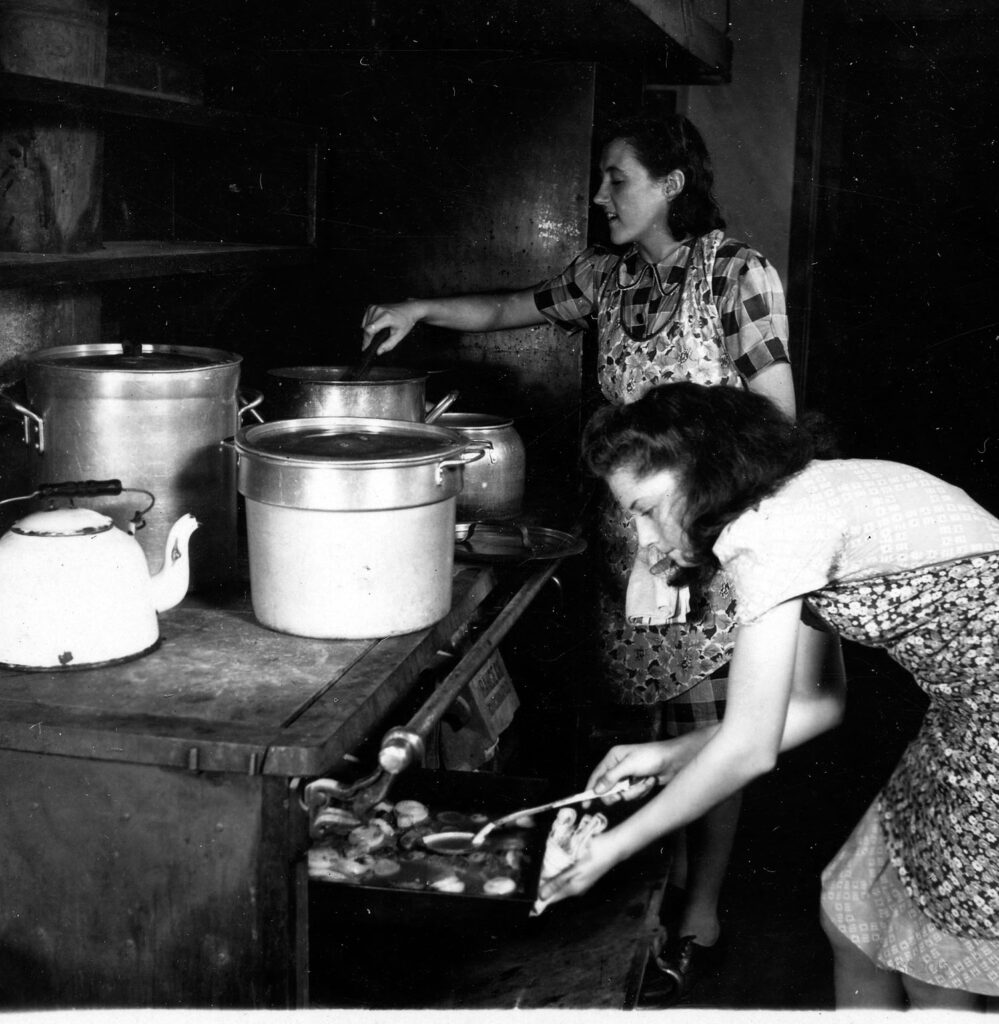
054 Kitchen workers. garner_ray (54)
The early kitchen in Laurel House I, the first main building and dining commons for the School was exemplary for its day. It was a large facility, outfitted with ample ovens and stoves, washing areas, and food preparation areas. The Laurel House kitchen saw a steady rotation of students through its training.
The student newspaper, the Pinecone gives testimony to the integration of kitchen work and food savvy in the lives of the students.
![Angela Melville Album II, Part I. [melv_II_album_018.jpg]](https://pinemountainsettlement.net/wp-content/uploads/2015/05/melv_II_album_018-1024x745.jpg)
Angela Melville Album II, Part I. [melv_II_album_018.jpg]
The following is a Pinecone list of helpful hints.
KITCHEN HINTS
[From The Pine Cone, February 1938]
1. To keep the smell of cabbage, onions, and other strong-smelling vegetables from going all through the house, burn newspaper on top of the stove.
2. To keep smoke down from sugar and other things which have boiled over on the stove, apply salt.
3. To keep lemon fresh in hot weather put in fresh water every day or keep buried in sand.
4. To keep cheese from molding, wrap in a cloth wet with vinegar.
HINTS ABOUT DISHES
1. Rinse and wash as soon as through using dishes if possible. If not possible soak in cold water.
2. Soak in cold water all dishes which have been used for batters [with] milk or eggs.
3. Care of coffee and tea pot —
(a) Rinse in cold water
(b) Wash in hot water
(c) Scald, dry and leave open.
4. Egg beaters —
(a) Rinse, clean, dry and hang up as soon after use as possible.
(b) Never put egg beaters to soak and never let the cogs get wet.
POTS, PANS, AND STOVES
Stoves were rarely found in the early Pine Mountain community homes until coal became a common fuel and roads allowed the transport of large durable goods, such as heavy stoves, into the community. Even after the advent of the gas and the electric stove, the use of the coal stove continued in many households but, then, only in the homes that could afford the transport of the heavy metal stoves and the cost of the coal stove, itself.
“Kitchen” was also not a word that was common in many households where the cooking of food and preparation of food was not relegated to a specific room in small homes. In the earliest cabins, the fireplace that warmed the cabin was also the kitchen. It was only in larger homes and cabins that “kitchens” as we refer to them, began to appear. Most often they were in areas often referred to as the “dog-trot”, the area that sometimes joined the two sections of a two-cabin home. The evolution of the “dog-trot” into a kitchen was not uncommon. The small Old Log cabin at Pine Mountain School has remnants of a “dog-trot” in the center of the lower floor of the structure and when cooking at the cabin moved indoors, this space was the preferred location.
Another preference for cabin kitchens was to add a small shed attached to the side of a house or cabin. This location was for several reasons. The most common reason was that the removal of this area away from the central living space reduced the danger of fire and injury to children. These “dog-trot” kitchens were difficult to document because of the lack of light and windows. Very few photographs exist of the interiors of mountain cabins, for the same reasons. Those photographs that have captured interiors show how central the fireplace was to the small cabins and homes.
THE IRON POT – COOKING OUTDOORS and IN
In the early years the cooking pot on a tripod was constantly used. The large volume that could be cooked in a tripod pot could serve a large number of students and staff and until the interior kitchens were in place, this outdoor kitchen was common.
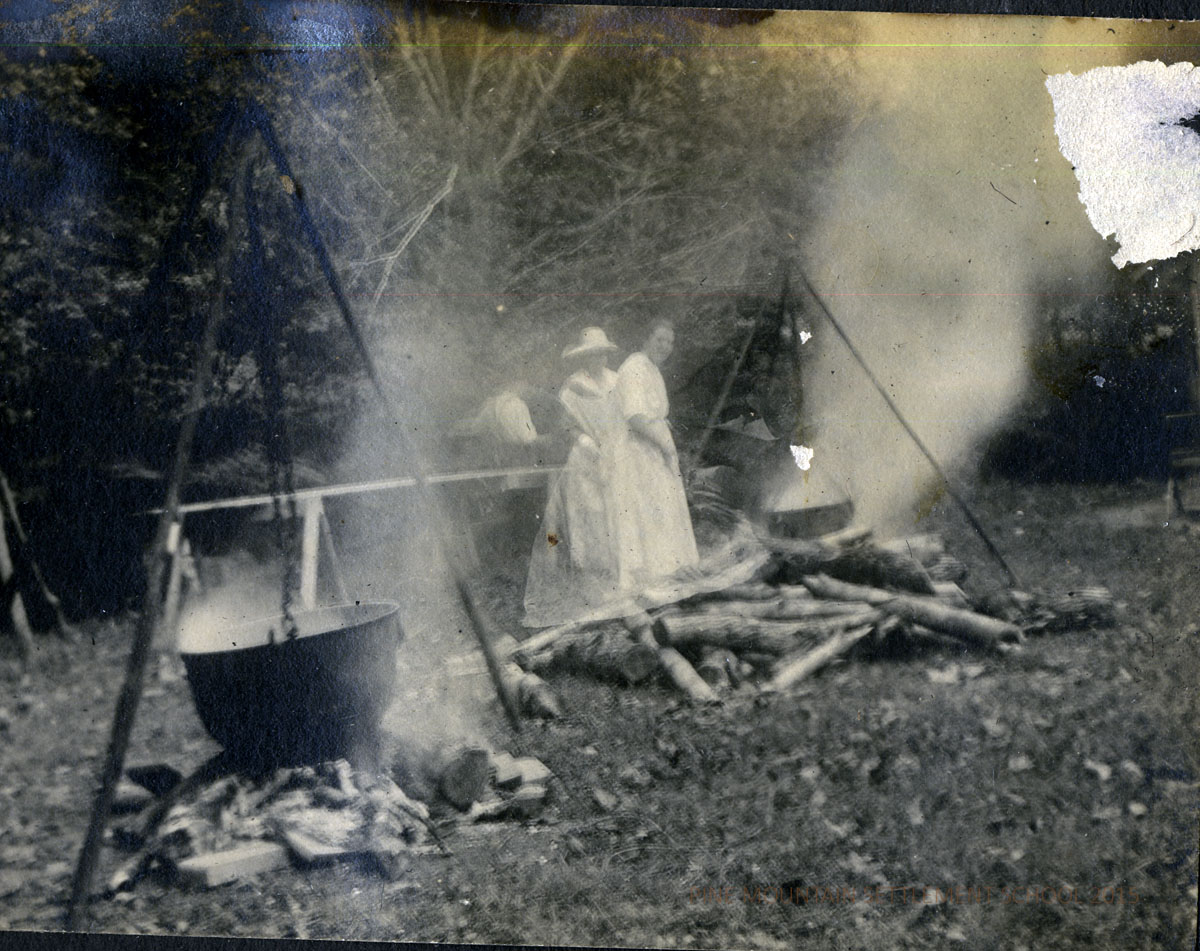
Angela Melville Album II – Part V. [melv_II_album_240.jpg] The tripod “kitchen”.
![Angela Melville Album II - Part III. [melv_II_album_229.jpg]](https://pinemountainsettlement.net/wp-content/uploads/2015/05/melv_II_album_229-1024x737.jpg)
Angela Melville Album II – Part III. [melv_II_album_229.jpg]
The clever use of the iron cooking pot stands out when tracing the history of cooking and the common practice of kitchen arts in early mountain homes, . Large cast-iron pots on tripods were used heavily at Pine Mountain in its early years. Sometimes used in interior fireplaces or on tripod supports mounted in the yards or in the “dog-trots” or “go-betweens” of cabins, the iron pots of various sizes were portable and versatile. They saw uses for many fundamental cooking projects including soap-making, dye pots and boiling down cane or maple syrup. The caution was to be very careful about mixing the task and the pot. Stew in the same pot following a soap-making would be well remembered!
Before the campus kitchen was in place at Laurel House I, workers at the School used iron pots to prepare group meals for the School. They also used them to boil laundry, dye wool, make soap, and various other tasks. When viewing a photogrpah of a pot on a tripod it is difficult to know what the pot carried. Keeping the pots clean and being mindful of a pots previous use was an extremely important kitchen lesson! There are good tales of pot confusion, however.
A humorous story is told about the mixing up of pot contents when an iron pot accidentally became contaminated with soap and was then re-used for soup. One of the important lessons that all students were drilled on was to not criticize the food as it was served at the communal tables. So, when the dinner soup arrived and was ladled out to the table, there was consternation written large on the faces of the students around the table. One brave student suddenly exclaimed, “This soup tastes just like soap!”. As the other students drew in their breath and looked to the staff member at the table for the requisite reprimand, the distressed student quickly altered his remark by saying, “…and, that is just the way I like it!”
Iron pots were critical tools for the early mountain families and were heavily used. Today they are treasured items of many mountain families or have been relegated to the yard where too often, their bottoms fell out from too many lye soap batches, or iron rot from standing water. In their bottomless state they were still treasured for they could hold plants and flowers on porches and in yards.
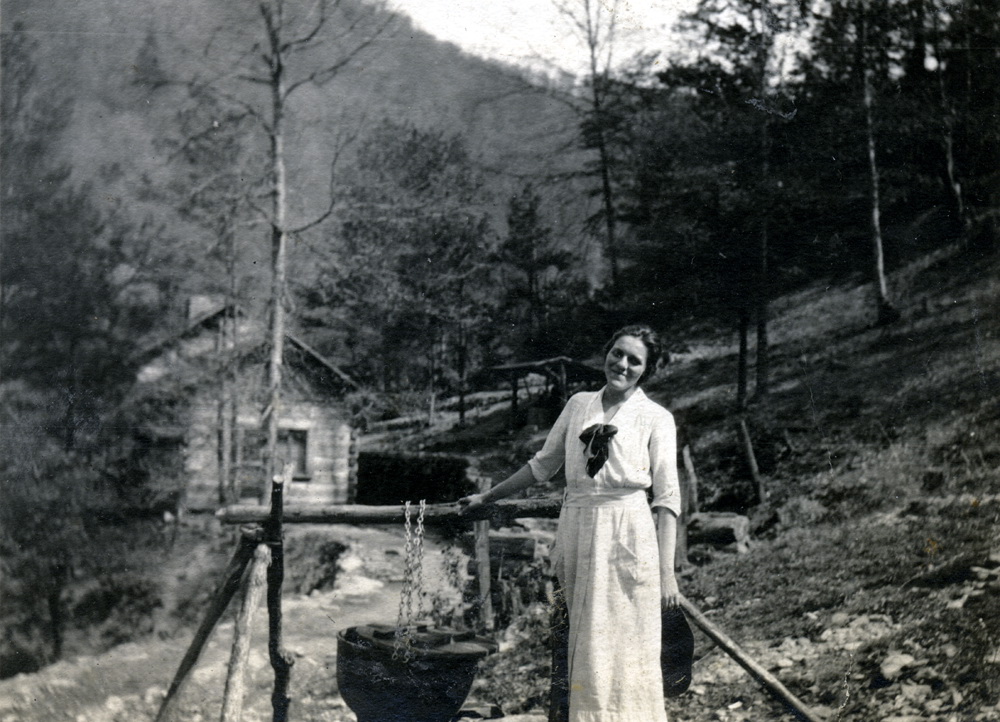
Worker at the Medical Settlement at Big Laurel next to cooking tripod with cross-bar. X_099_workers_2478a_mod.jpg
Iron pots can hold heat for long periods of time and whole meals can be cooked in a single unit and sometimes be stretched over several days. Flat cast-iron skillets can be used with skill to fry fat-back to render cooking lard, a staple in almost all households. In the early households, cast iron pots and skillets were constantly put into quick action for all meals, often keeping an ever-ready location on the hearth. Often, too, they were placed where they could readily be moved over hot coals or onto metal stands using a swinging “arm.”. The skillets were well seasoned and could withstand the high heat of frying as well as slow cooking.
With a lid, the pans could be used for baking by being buried in the coals of the fireplace. Like the large cauldrons used on tripods, the deep cast-iron skillet with a lid was a vital tool in common food preparation. Corn pone, fried chicken, bacon, fried onions, greens with fat-back, fried apples, fried potatoes, fried fish— anything that would fry, simmer, or bake was placed in these deep skillets and generally with a generous dollop of rendered lard.
Larger iron pots could be covered with a lid or not and could be hung from a metal “arm” and be placed or swung into the fireplace. Into this pot could go most anything. Squirrel stew, rabbit stew, chicken, and dumplings, or a rich vegetable stew. Stews of many varieties were common in mountain homes as they could be kept going for several meals. Any dish that required substantial liquid and a long cooking time was most often placed in these “slow cookers” — the very deep cast-iron pot with a lid. If the family had a “footed” iron skillet with a lid, this was often placed directly in the coals of the fireplace and coals shoveled on top of the lid. This “oven” vessel would bake cakes and oven recipes. Biscuits, cobblers, and other items that required baking could be handled quite well in these small “ovens.” Clearly, the possession of a cast iron pot was critical to the early settlers. It was a kitchen item that was almost sacred. It was guarded carefully and passed down from generation. The skills of its use were passed along in the family and readily adopted by a family and by the settlement workers. Kitchen savvy can be shared in many directions. It is likely that the students at Pine Mountain were the early teachers of “best practice” of the proper use and care of cast iron pots.
SEE: FOODWAYS: “Old Fashioned Dinner” 1919
GO TO:
DANCING IN THE CABBAGE PATCH I – GUIDE
DANCING IN THE CABBAGE PATCH II – Introduction
DANCING IN THE CABBAGE PATCH III Place
DANCING IN THE CABBAGE PATCH IV Farming the Land 1913-1930
DANCING IN THE CABBAGE PATCH V Farm & Dairy I the Early Years
DANCING IN THE CABBAGE PATCH V Farm & Dairy II the Morris Years
DANCING IN THE CABBAGE PATCH VI – POULTRY
DANCING IN THE CABBAGE PATCH In the Garden
DANCING IN THE CABBAGE PATCH VIII In the Kitchen
DANCING IN THE CABBAGE PATCH IX Dieticians
DANCING IN THE CABBAGE PATCH X In the Dining Room, Manners & Etiquette