Pine Mountain Settlement School
Series 05: ADMINISTRATION – Board of Trustees
Series 09: BIOGRAPHY – Staff
Series 10: BUILT ENVIRONMENT
Mary Rockwell Hook (1877-1978)
PMSS Architect, 1918-c.1968; Trustee
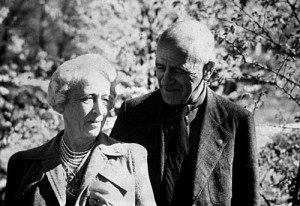
Mary Rockwell Hook and her husband, Inghram D. Hook. [HOOK_MOD.jpg]
TAGS: Mary Rockwell Hook, Wellesley College, women architects, Katherine Pettit, Ethel de Long, Art Institute of Chicago, Ecole des Beaux-Arts, Jean-Marcel Arbutin, gender bias, American Institute of Architects, Kansas City, MO, Howe, Holt, and Cutler, Old Log, Big Log, Laurel House, PMSS Board of Trustees, Inghram D. Hook, National Register of Historic Places, Kansas City Landmarks Commission, Hook and Remington, Eric Douglas, MacWilliam Remington, International Archive of Women in Architecture, Ann Huntington, Burton Rogers
MARY ROCKWELL HOOK Architect Board
Mary Rockwell Hook (1877 – 1978)
School Architect and Consultant 1913 through c. 1968
Member, PMSS Board of Trustees
Among the first women architects in the United States, Mary Rockwell Hook was recruited from her early role as a working architect in Kansas City, Missouri. Before her marriage to a Kansas City lawyer, Mary Rockwell was recruited by Ethel de Long and Katherine Pettit in 1913 to design the campus and buildings for the new Pine Mountain Settlement School in Harlan County, Kentucky. Over one hundred years later, her buildings continue to be appreciated for their attention to place and their harmonious blending with their natural surroundings, an innovative approach for an architect of her era. Her site plan and buildings are now part of the National Register of Historic Places and have a solid place in the history of American women architects. She was one of the first — in many areas.
At a time when society viewed it as improper for women to enter the field of architecture, the young Mary Rockwell was fortunate to have the support of her family, who supported her architectural interests. But the deepest interest was Mary’s alone. Her’s was not a career she was pushed into but one she grew into, and that she pursued with a fierce tenacity.
MARY ROCKWELL: Her Family
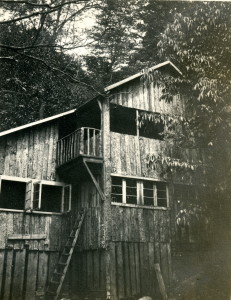
View of south flank of Open House showing balcony and two levels, including sleeping porch at top. [hook_album_2blk__044.jpg]
Proud of her membership in the Daughters of the American Revolution and Dames of the Loyal Legion, Mary was a good fit with Katherine Pettit, a founder of Pine Mountain Settlement School, whose early years had close ties to the National organization. Their initial encounter signaled a strong bond of values and an insatiable appetite for adventure. The Rockwells of Kansas City, Missouri, led by Bertrand, their father, and Julia, their devoted mother, were strongly bonded by their family ties and their appetites for adventure. Mary frequently visited Bertha, an older sister who lived in Santa Rosa, California, where the Rockwells lived for a brief time, and the family vacationed in various locations throughout Europe and the Far East.
Julia Rockwell came to Kansas when quite young to help care for an ailing aunt and met Bertrand while he was stationed at Fort Riley. The couple loved to travel, and their five children were regularly included in their adventures. Mary Rockwell was the third child, —all girls. The daughters in order of birth were Florence, Bertha, Mary, Katherine, and Emily. Their mother, Julia, an avid reader, encouraged all her daughters to read and pursue careers. But Julia’s third child, Mary, appears to be the most adventurous of the sisters and clearly had the support of her proud father.
Bertrand and Julia saw to it that their daughters experienced the world through a number of trips in the United States as well as to Europe and East Asia. Bertha (1874-1970), who studied painting in Italy married Carlo (Gino) Venanzi (d. 1964), a well-known Italian painter whose family was from Perugia.
MARY ROCKWELL: Her Education
WELLESLEY COLLEGE LIBERAL ARTS DEGREE 1900
Mary Rockwell’s mother was adamant that her daughters attend the best schools. They were sent first to good preparatory schools in the east and later to Wellesley College in Massachusetts. Mary first attended the Dana program, at the time a preparatory high school for Wellesley College, and then the college. Mary received her liberal arts degree in 1900 from Wellesley and it was at Wellesley that Mary Rockwell established relationships that eventually led her to Pine Mountain Settlement School.
CHICAGO INSTITUTE OF ARTS – DEPARTMENT OF ARCHITECTURE FIRST WOMAN 1903
After leaving Wellesley Mary Rockwell enrolled in the Chicago Institute of Arts in 1903 where she was the first woman in the school’s department of architecture. From all accounts, she was the only woman enrolled in the program during that year. Later, she continued her studies in Boston and eventually her interest brought her to the application process for the architecture program at the Ecole des Beaux-Arts in Paris, France.
ECOLE DES BEAUX-ARTS, PARIS and JEAN-MARCEL AUBURTIN STUDIO 1905
In 1905, Mary was granted the right to test for entrance into the Ecole des Beaux-Arts in Paris. In preparation for the many exams for admission, she studied for one year in the studio of Jean-Marcel Auburtin. She was reportedly the second woman from the United States to attempt acceptance into the Beaux Arts program. She did not complete the full program. (The first woman to successfully attempt the Paris program was Julia Morgan, later a noted architect in Northern California and a student of Bernard Maybeck. [For a description of the process of qualifying for a slot in the prestigious Ecole des Beaux-Arts see Cecil D. Elliott’s comprehensive book, The American Architect From the Colonial Era to the Present, (McFarland, 2003).]
Mary was fortunate to have met Jean-Marcel Auburtin (1872-1926) through her sister Kitty who knew Jean-Marcel through mutual friends. He was fond of Kitty and asked her to marry him but she later refused the offer. Jean-Marcel had completed the Ecole de Beaux Arts program, reportedly second in his class and had also recently received the Prix de Rome award for his architectural work. He had 7 young men studying with him from America, most graduates from Princeton and Yale. Mary was accepted as the eighth member of the atelier preparing for the Ecole des Beaux-Arts.
She describes the arrangement in her autobiography:
Through Kitty’s acquaintance with Marcel Auburtin, I arranged to study architecture at his atelier in Paris. He had seven American’s enrolled — all graduates of Yale and Princeton. When these boys heard a girl was coming they didn’t like the idea. They decided to name me “Liz.” It turned out that we all became lifelong friends. These Boys worked three years before they passed all the examinations to enter the Beaux-Arts.
We all took the first examination. I learned that I was the second woman who had ever taken an examination at Beaux Arts. The other woman was Miss Morgan of San Francisco who later devoted most of her life to the building of the Hearst Palace of great renown in California.
When the family of Bertrand Rockwell came to Kansas City in 1906, from Junction City, Kansas, Miss Rockwell was 29 and just completing her work in the Paris Auburtin studio. By this time, the family wealth was well established and her father Bertrand had gained the respect of the business elite in the city. This advantage enabled Miss Rockwell to exercise options not available to many women of her time, but it did not protect her from on-going sexism as an aspiring professional.
Not only did Miss Rockwell experience gender bias during her years of study in a field traditionally reserved for men only, her first application for a position with an architectural firm was rejected and the American Institute of Architects denied Miss Rockwell admission. Both rejections were gender related.
MARY ROCKWELL: Architect
SANTA ROSA, CALIFORNIA
Mary stayed in Europe through 1909. He parents had left Junction City, Kansas, for Santa Rosa, California, for her father’s health. His brother-in-law, Dr. Finlaw, was married to Julia’s older sister and was a well-known physician in Santa Rosa. While there, the couple experienced the 1909 San Francisco earthquake. Santa Rosa was very hard hit as described by Mary:
All the business sector of Santa Rosa was destroyed. Banks were burned and no money was to be had. My father immediately had currency sent out from Junction City (Kansas). For this act he is still remembered.
Mary would shortly go to Santa Rosa, California where she responded to her older sister Florence’s call for help in designing a house for her family. Florence had married James Edwards, a prominent figure in Santa Rosa, who later became mayor of the town. Mary designed the home, which went undiscovered as a Mary Rockwell design until just recently,y when Jeff Elliot researched the house at 930 Mendocino Avenue, and discovered that it was the work of Mary Rockwell.
Elliot’s excellent article also details Mary’s later (1923) work in California, including the home for her sister Kitty and husband Francis Crosby, on 80 acres of land in Woodside, California. This later structure, which Mary describes as a French country house, is more like a French chateau and was recently sold for over $8.5 million [2024]. It is obviously a far “holler” from the work that Mary had put forward at Pine Mountain. Mary only briefly refers to the house as most likely her final design was much altered by her sister and husband, and the influence of architect Henry Dangler and Mary’s co-worker in Kansas City, Mac Remington, who consulted on the work.
KANSAS CITY BEGINNINGS
When Miss Rockwell returned home from her European studies, her father had purchased land in the Kansas City, Missouri area, and the family moved to the city in 1906. Mary was encouraged to design structures for the lot her father owned at 54 East 53rd Terrace in Kansas City. Her first design was on a simple bungalow model home which enabled her to confidently approach building structures of her own design. Her father’s understanding and encouragement provided a way to hone her skills and try out new ideas, and later designs and construction of homes for her family and sister strengthened her skills. At this time, also at her father’s urging, she received an apprenticeship with Howe, Holt, and Cutler in Kansas City, a firm that specialized in creating large stone and brick domestic dwellings.
In 1908, when Mary returned from another trip abroad, she was now in her late twenties and traveled to Santa Rosa, California, to construct several more family dwellings for two sisters and to Wellesley to design and construct a home for a friend. Miss Rockwell was assigned a series of projects in the Sunset Hill and Raytown area of the city. Her style was unique and far ahead of its time in the use of recycled material, natural heating, and lighting innovations. Not long after her successful work with the Kansas City firm, she was also contracted to build homes in the Siesta Key area of Florida, near Sarasota. Mary’s work in Kansas City is well-detailed in her memoir, and that important work will not be covered in this short essay.
Kansas City was, however, Mary’s laboratory where she seemed free to try out her ideas. It was there that she designed the house that became the family home of Bernard, Julia, and the five girls. It was in Kansas City where she first experimented with city planning and was later asked to develop a city plan for the “city of fountains.” It was in Kansas City where she built the first home for herself, her husband, and two adopted children. And it was in Kansas City where she first became a partner in an architectural firm and found compatible colleagues.
These and other developmental milestones were described in 1977 by the Kansas City Landmarks Commission, on a form that nominated nine of Mrs. Hook’s Kansas City residences to the National Register of Historic Places. Her skill at designing buildings for steep hillsides was also recognized in the nomination form :
…[A development company] asked Mrs. Hook to design a home to demonstrate effective hillside construction. The site selected for this demonstration home had not only to solve the problem of hillside construction but also to handle the unusual situation of a double frontage of streets of different elevations and on a lot of irregular proportions. Mrs. Hook masterfully conquered all of these difficulties in the design of this home and, as a result, boosted the sale of hillside lots….
Such sites also allowed Mary to compose buildings with asymmetrical facades and projecting extensions or wings. The list of Mary Rockwell Hook buildings in Kansas City is impressive, as identified by Sherry Piland and Elaine Ryder in June of 1983 for the Landmarks Commission of Kansas City and shortlisted by Cathy Sala in May 2018 for the National Register of Historic Places Registration Form for Mary Rockwell Hook places in Kansas City.
- Domestic dwelling 54 E. 53rd Terrace (1908)
- Bertrand Rockwell House 1004 West 52nd Street (1908-09)
- Emily Rockwell Love House 5029 Sunset Drive (1915)
- Robert Ostertag House 5030 Summit Street (1922)
- “Pink House” 5012 Summit Street (1922)
- House at 5011 Sunset Drive (1922-23)
- Floyd Jacobs House 5050 Sunset Drive (Hook & Remington) (1925)
- Mary Rockwell Hook House 4940 Summit Street (1925-27)
- Four Gates Farm (Hook & Remington) (1925-27)
The nomination form notes the significance of the Kansas City structures:
The nine residences included in the Mary Rockwell Hook thematic nomination are significant as the work of one of Kansas City’s foremost early women architects. These residences, which demonstrate her innovative design approach, are among the finest in Kansas City and are representative of the high quality that typified residences built in the southern portion of Kansas City and are representative of the high quality that typified residences built in the southern portion of Kansas City during the first decade of this century. Mrs. Hook freely adapted historic styles and motifs to the eclectic homes she designed for romantically landscaped residential enclaves. Designing for wealthy clients, the constraints of cost were not a consideration. Her residences characteristically employ Spanish and Italian design elements; incorporate a stage area for amateur theatricals; and, through numerous doors, windows, and balconies, attempt to visually bring an outdoor atmosphere into the interiors
Steep hillsides were not new to Mary when she came to the Pine Mountain valley. Most likely, she had been warned by PMSS Co-director Katherine Pettit who stressed the need, where possible, to keep the bottomland open for gardens and farming. Mary knew early on how to integrate houses into hillsides because her work on the knolls of Kansas City that prepared her for building on uneven terrain. Yet, she apparently struggled to convey that she understood “Kentucky hills.” This was a particularly touchy subject when her assistance was requested on the design and construction of the Chapel at the School and she had to negotiate the blessing of Luigi Zande, husband of Ethel de Long Zande whose stonework was legendary at the School and Leon Deschamps, whose Perfect Acre was legendary and treasured by Katherine Pettit. [See: Mary Rockwell Hook 1923 Correspondence and Leon Deschamps and the Perfect Acre]. The end result was the Perfect Acre and the perfect Chapel.
MARY ROCKWELL: Pine Mountain Settlement School Beginnings
It was in 1913 that Mary Rockwell was recruited by Ethel de Long and Katherine Pettit to help plan the campus and buildings for their newly founded Pine Mountain Settlement School in Harlan County, Kentucky. Mary saw the offer to develop the rugged untouched land as an enticing challenge and decided to take the long arduous journey from Kansas to survey the potential of her new position as lead architect for the School.
The recruitment actually circled back to Mary Rockwell’s adventures in Puerto Rico and her lifelong friendship with Susan Huntington [Vernon]. Susan Huntington was, like Mary Rockwell, a woman of amazing aspirations and achievement. Following her departure from Wellesley College, Susan was for a time the Dean of Women at the University of Puerto Rico. Susan Huntington, a graduate of Norwich Academy and Wellesley College, had met Mary through mutual friends and had encouraged Mary, her sister Bertha, and friend Alma to come to the island to work as teachers. Susan Huntington’s sister, Ruth Huntington, had taken a job as principal of Hindman (Kentucky) Settlement School during the first decade of that institution and was a close friend of May Stone and of Katherine Pettit, who came from Hindman to found Pine Mountain Settlement. Ruth Huntington, a 1894 graduate of Smith College, the alma mater of May Stone, had been recruited by her to Hindman.
At the new Hindman Settlement, Ruth Huntington had been assisting Stone in the recruitment of women to come teach and work at Hindman, and in correspondence with her sister Susan, Mary Rockwell was suggested as a good choice for architectural consultation at the new school site proposed by Katherine Pettit and Ethel de Long. Through Ruth Huntington, Mary Rockwell was introduced to Katherine Pettit and Ethel de Long, who had just left Hindman (as the former Principal to serve as the Principal or Co-founder of the new Pine Mountain “satellite” settlement school in nearby Harlan County that was in need of an architect to plan the School structures. Harlan County, in the far eastern corner of Kentucky, had some appeal to Mary Rockwell as a former teacher of underserved children. She notes in her autobiography:
In the spring of 1913, while I was in San Francisco, I received a letter from Susan Huntington’s sister, Ruth, a recent graduate of Smith College [1894], asking me to come to see the Hindman Settlement School in Kentucky, of which she was one of the directors.
Miss Katherine Pettit, one of the founders of the Hindman School, and Ethel de Long had been offered 450 acres of mountain land in Harlan County if they would come and start a school for children who were out of reach of any ‘larnin.’
Mary Rockwell described her initial contact with Pine Mountain School in a talk she gave on April 4, 1920, to prospective donors to Pine Mountain regarding her work with the School
You may be wondering exactly what my connection with this school has been. A little over seven years ago I received a letter from Miss Pettit and Miss de Long, neither of whom I had never met, saying that they intended to start a new school in Harlan County, Kentucky, that they had 426 acres of land, no money, dozens of children begging to come to them, and would I give them some architectural assistance. As I was in California at the time and not anxious to leave, I replied that I could come under two conditions. The first was that if, upon talking things over, we discovered that our architectural ideals differed radically, we would proceed no further together and, second, that if I undertook the work I wanted to be present at the very start and lay out a comprehensive plan for the whole development.
I soon discovered that there could not be two more harmonious people to work with. During the seven years we have been building I have been to Kentucky two or three times every year and every visit is more delightful than the last.
After Rockwell, de Long, and Pettit did a preliminary walkabout of the Pine Mountain Settlement School land and studied its layout, they agreed on a plan. It was an obvious one. They agreed that the valley floor should be used as farmland to grow the School’s food, and the surrounding steep hillsides should be used for the School buildings and cottages. This would allow for the proposed 100 students to be placed at either end of the property.
Miss Rockwell’s first task in 1913 was the renovation of Old Log House, a rundown log cabin that had been moved near to the entrance of the School to be used as a residence while the new building took place.
Next, Mary designed Miss Pettit’s residence, Big Log, which was largely habitable in August 1914, and the School’s dining building, the original Laurel House I, completed in late 1915. At this time, Mary Rockwell’s structures were typically built with large amounts of stone and wood that naturally existed in the surrounding countryside. Chestnut, poplar, hemlock and oak were in abundance and a School sawmill was purchased to mill the lumber. It was hauled across Pine Mountain (no roads), the lumber was somewhat cured, and all operations were installed on location. No other mill was close by, milling costs were high and the vital resources, if outsourced, would present a drain on school resources.
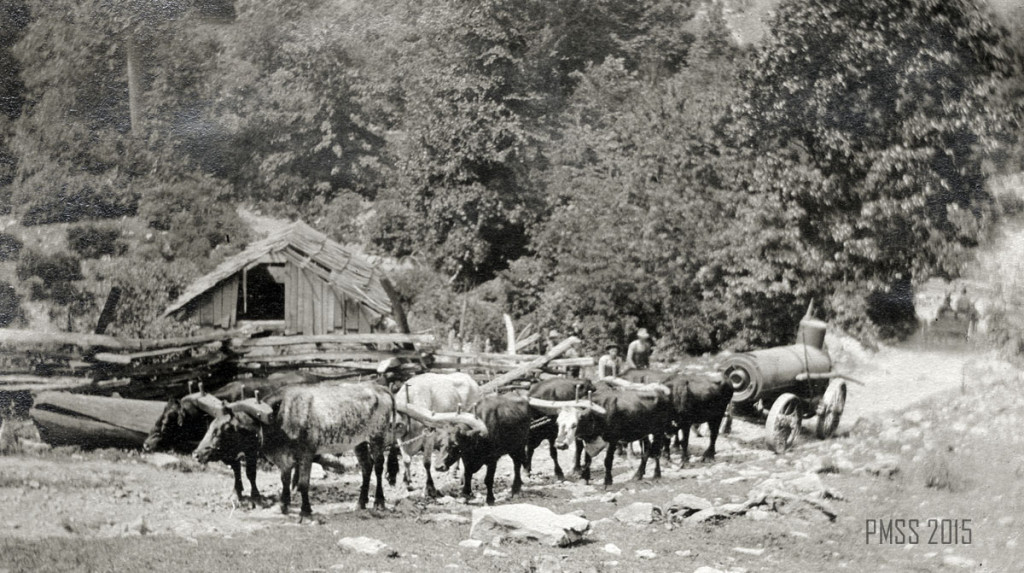
Sawmill. The eight oxen that hauled the boiler over Pine Mountain, 1913. [roe_033a.jpg]
OPEN HOUSE – RECYCLED MATERIALS
These signature elements can readily be seen in photographs of her personal vacation home, built on a small plot she owned at Pine Mountain Settlement School. Designed as a summer residence, the rustic house, Open House, was constructed partially from recycled remnants of stone and wood from the many building projects at the School. Hook frequently spent her summers in the house, a large, rambling structure that could accommodate the many guests who often visited the School with her and as guests of the School when she was not in residence. The home relied on fireplaces for heat and cooking and had two exposed sleeping porches at the rear of the structure.
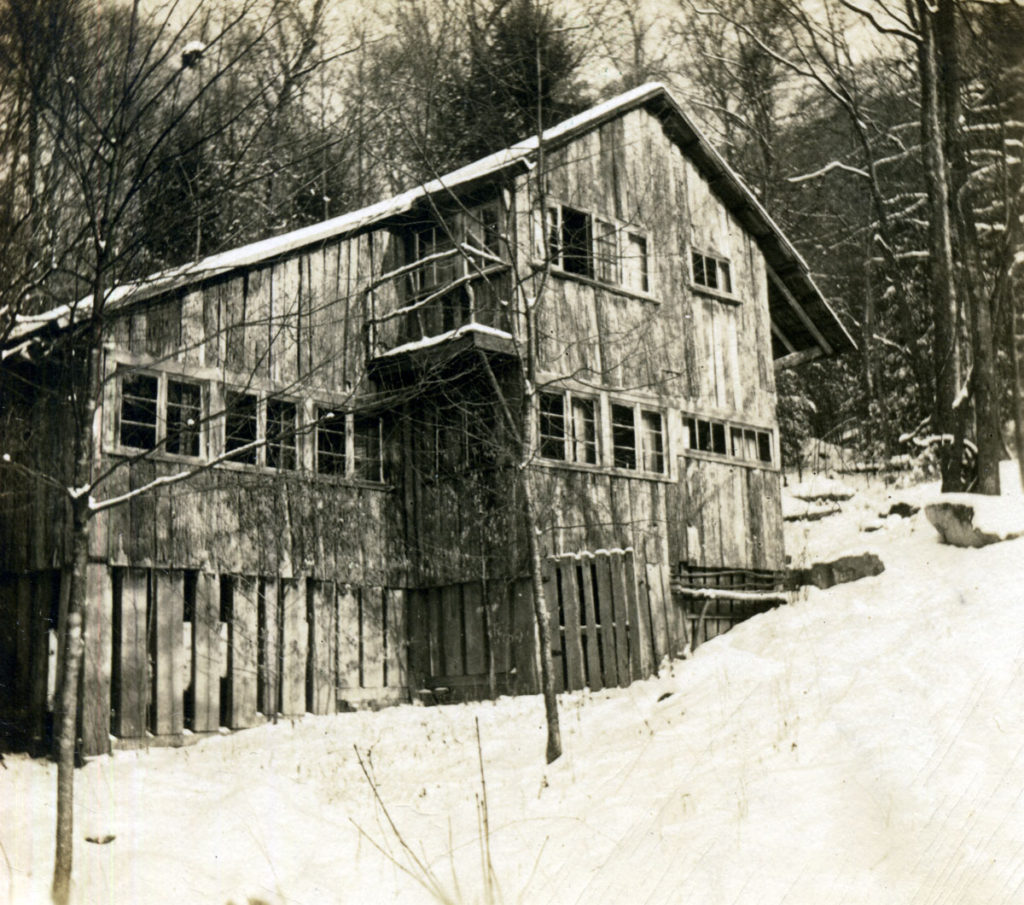
Open House, west flank. Served as Hook’s personal dwelling while working for Pine Mountain Settlement School, Harlan, KY. [cobb_alice_037.jpg]
…and the hospitality of Pine Mountain will fill you with a glow, Glyn Morris will guide you to the ‘Open House’, a guest cabin, perched on a big rock with its screened sleeping porches jutting over the very jungle. This house will interest you from the front porch to the second floor. Everything brings an artistic adaptation of “local to locality” — slab sides, rafter poles, stone fireplaces, woodcraft in evidence at every turn, plenty of the homespun, and fragrances of the forest pervading every room. You would go wild about this house. It seems to have grown of its own vitality from the rocks and woods. And so secluded is it, back in the white rhododendrons and ferns, that even Glyn Morris [then Director of the Pine Mountain School], leading us by flashlight, could hardly find it, along about “Whip-poor-will hour.”
MARY ROCKWELL HOOK: Marriage
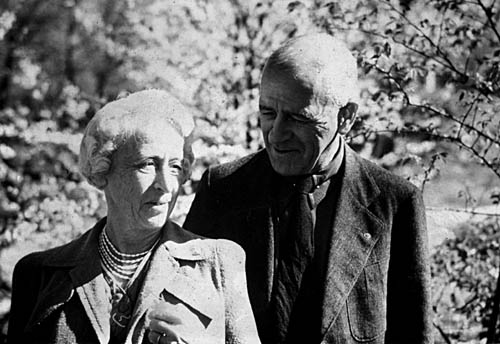
Mary Rockwell Hook and her husband, Inghram D. Hook. [HOOK_MOD.jpg]
In 1921, Mary Rockwell married Inghram D. Hook, an attorney. According to the National Register application for her Kansas City houses, “[Her career] was at its busiest and most fruitful stage during the first years of her marriage.” While living a busy life as a mother of two adopted sons and an active member of her communities of interest, the couple hosted their nieces and nephews, who were regularly included in the couple’s life, sometimes spending summers at Pine Mountain School.
But, life for the Hooks was not all work and no play, as Inghram’s obituary notes, he and Mary were members of the Polar Bear Club in Kansas City, and in the 1930s and 1940s, they participated in the Polar Bear plunge, which sent them into the chilly waters of Lake Lotawana in mid-winter Kansas. The image of that plunge is a refreshing insight into the playfulness of both Hooks.
Early in their marriage, Mary expressed some concern that Inghram would not support her chosen career, but she soon found she had married a champion supporter. She was given every encouragement from her husband to pursue her career. Not only did he give her support to pursue her career, but he also encouraged her to call on him for assistance. The couple maintained very active and very independent professional lives as both their careers grew, but there is evidence that each knew the value of mutual support.
Inghram came from a long line of high achievers. He entered the legal profession eagerly, as the Hook family had already paved the way. Inghram’s father, William Cather Hook, had secured his Bachelor of Laws from Washington University at St. Louis before the age of twenty-one and had been offered a position with the law office of Lucian Baker of Leavenworth, an outstanding legal agency of the day. A few years later, he had three children. The only son in the threesome, Inghram, was witness to his father’s rapid legal acendency. Two times, William C. Hook was nominated for the Supreme Court and twice narrowly missed the appointment. The Kansas Historical Quarterly notes that he came ” … closer to an appointment to the United States Supreme Court than almost any man in history who was not appointed, and not only once, but twice.”
William C. Hook’s mentor, Baker, was soon elected to the US Senate and continued his endorsement of William C. Hook and the family. Hook, a lifelong Republican, became a delegate for Dwight D. Eisenhower at the 1952 Republican Convention. He then followed Eisenhower into WWII. As a strong supporter of the military during WWII, William C. Hook served as a Captain in the 356th Infantry Regiment of the 89th Army Division, and following the end of the conflict, he became general counsel for the War Reconstruction Finance Corporation for Kansas and Missouri. Inghram Hook was never short of mentors and supporters.
Inghram’s work centered on his practice of law in Missouri, serving for a time as the President of the Missouri Bar (1938-39). He was a graduate of the University of Chicago, where he received his PhD and his law degree. In the early 1920s, he served as the Assistant City Counselor and later as Police Commissioner for Kansas City, Missouri. Inghram D. Hook died on August 4, 1973, just a few short years before Mary died in 1977 at the age of 101.
LATER KANSAS CITY – HOOK AND REMINGTON ARCHITECTURAL FIRM
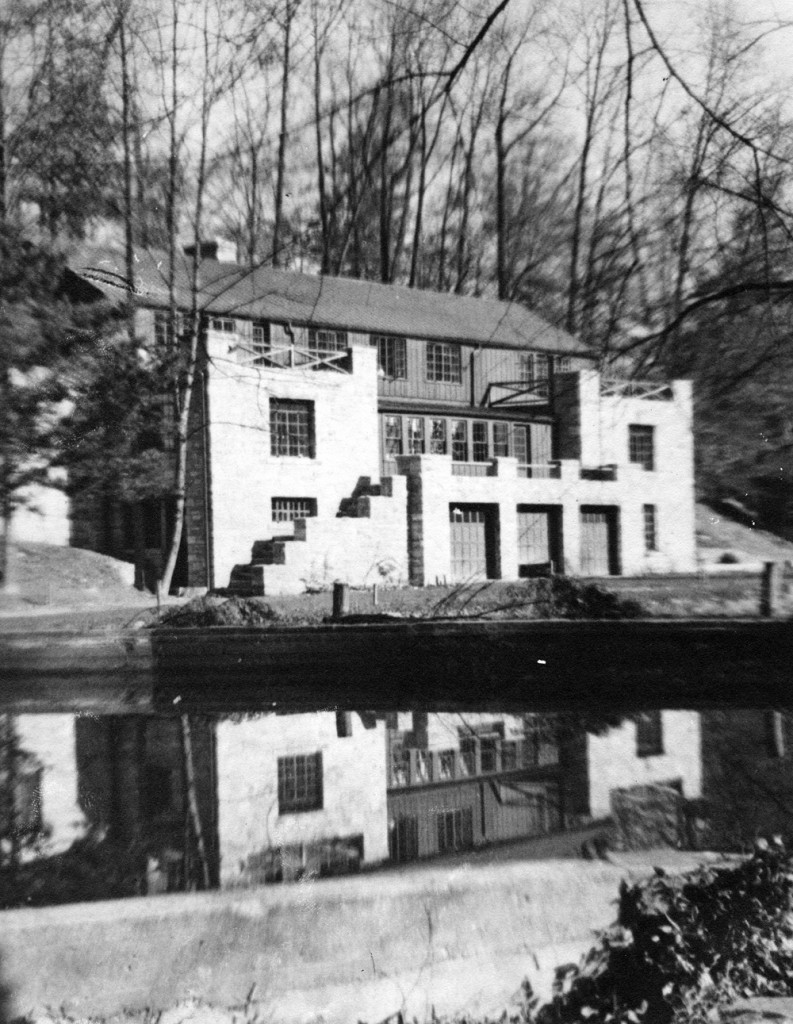
Original appearance of the Jesse Preston Draper Industrial Building, reflected in the swimming pool, c. 1937.[II_6_swimming_draper_boys_239a]
From 1924 to 1929, Mary Rockwell Hook shared an architectural partnership in Kansas City, known as Hook and Remington. Eric Douglas Macwilliam Remington was a graduate of the University of Illinois and, like Hook, was a former student at the Ecole des Beaux-Arts in Paris. During her time with Remington, Hook designed a home for herself, her husband, and her two sons. The Kansas City Hook home was designed in the Italianate style. It was a combination of brick, stone, and antique materials with tiles, frescoes, and leaded pane casement windows. It was a sprawling, comfortable, and elegant structure with eleven bedrooms to accommodate the large visiting family and guests who were always coming and going.
The Inghram D. Hook family owned the Kansas City home for almost half a century until 1972. It was only one of many homes in which the couple and children lived off and on. As the immediate family became smaller, the need for the larger homes became less important. Mary’s mother, Julia, died in 1947, and her father, Rockwell Hook, died on April 15, 1930, at age 85. The children were growing and leaving. Over the years, the family grew smaller as did the scale of their homes. While the homes grew smaller, the interest in building for visitors and friends increased. The shift to Florida signaled a reduction in family but an increase in entertaining friends and visitors. Siesta Keys and the Florida retreats were a shift in lifestyle. Mary began to spend more time in Florida and trains, and cars began to play larger roles in the couple’s lifestyle.
‘THIS AND THAT’ a Memoir dedicated to Burton Rogers of Pine Mountain Settlement
Mary describes in detail her family and the many homes she knew intimately in her memoir, “This and That,” a jaunty read that she dedicated to Burton Rogers, a former Director of Pine Mountain Settlement School. Pine Mountain was, in a sense, her second home. It is where she practiced her talents, stretched her imagination, and fought her hardest professional battles. It was her “creative familiar.” Another home that came to have considerable familiarity was the Rockwell family home in Kansas City. This home, her Kansas City home, is described in an article in the Kansas City Star from 2015. And, at the end of life, her complex of homes in Siesta Keys became a tourist attraction.
The two homes in Kansas, the parents’ home and Mary’s own home, signaled the opulence and wealth that came to the family from banking and commodities. The wealthy lifestyle was often in direct contrast to the rustic life and summer “cabin” at Pine Mountain and another mountain home near Estes Park, Colorado, that “grew” out of the mountain environment. Both the Colorado home and the Pine Mountain location were integral to Mary’s great affection for joining site and buildings within their native surroundings. The two lifestyles appeared to be quite different, but Mary seemed to live comfortably in both. What the two architectural styles and her disparate sensitivities drew from was Mary’s penchant for recycling culled materials from the environment to build the structures. But, like the inscriptions above the doors in her Kansas City home, “Fortune favors the bold,” she never stopped innovating in many directions.
SIESTA KEY AND SARASOTA EXPERIMENTAL ARCHITECTURE
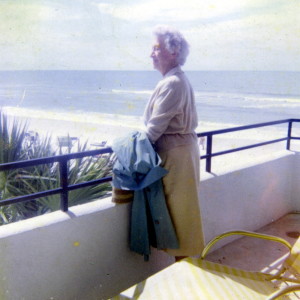
Mary Rockwell Hook in Florida, c. 1935. [X_099_workers_2466b_mod.jpg]
Mrs. Hook continued designing buildings into her late 70s, but her geography and interests changed dramatically in 1935, when she purchased 55 acres on Siesta Key, a barrier island off the central western coast of Florida and on the Gulf of Mexico. On the island, she set aside land on part of the Siesta Key property for use by architects who wished to experiment with new designs. Her structures in this new era reflect a myriad of contemporary innovations and interests and are slowly being resurrected today. Perhaps the most telling Kentucky connection to her more contemporary design interests is the plans she contributed to West Wind, the proposed girls’ dormitory at Pine Mountain Settlement.
Mary also developed a residential area at Sandy Hook, a neighborhood on Siesta Key Island, where she included an octagon-shaped third home for her family. It was in this home that she entertained many of her Pine Mountain friends who came to visit, as well as a long list of celebrities and dignitaries. She enjoyed entertaining and generously shared her Siesta Key and her Kansas City homes with her many friends and colleagues, including Pine Mountain staff and students. Her welcoming spirit is reminiscent of the favored mountain invitation, “Now, y’all come and visit… spend the night.” And, many did.
MARY ROCKWELL HOOK: Her Memoir, “This and That”
Mary Rockwell Hook never forgot her Pine Mountain experience and the remote serenity, peace, and old-time ways that she found there. When, late in her life, she was urged to write her autobiography by Burton Rogers, a former Director at Pine Mountain Settlement School, she took on the task and produced a small autobiography, which she called “This and That.” She said that Burton suggested she “…begin when you laid out the Pine Mountain Settlement School in 1913.” Other friends suggested other places she might focus, but Mary found her own journey and knew it best. She said:
This was all good advice, but a period covering ninety-two years is too difficult to keep in order, to recite to a tape recorder. I felt I must begin with the earliest recorded history of my parents’ families, and this is what I have done.
Her memoir covering ninety-two years of her active one-hundred-one, was not a tome, nor was it a biography, but was a modest booklet entitled “This and That” published in May of 1970 and dedicated to Burton Rogers, a Pine Mountain Settlement School Director and teacher. It is a tale of ancestry, as promised, but it is also a story of adventure and joy, and its scale is no measure of her very full to overflowing life and the generosity and wisdom of a woman whose full life remains in the beauty she left at Pine Mountain Settlement.
Mary remained a member of the School’s Board of Trustees well into her 90s. She died at the age of 101 years on September 8, 1978, the same date as her birthday.
MARY ROCKWELL HOOK: Recognition
The American Institute of Architects, which earlier had denied her membership, presented her with a plaque for distinguished service on her 100th birthday. In the fall of 1991, the newsletter (no. 3) for the International Archive of Women in Architecture is noted the following:
Today, as the materials in the International Archive of Women in Architecture (IAWA) indicate, Mary Rockwell Hook will be remembered, not because she was a woman working in a ‘man’s field’, but because she was a successful designer who made her mark in the field of architecture.
While her male architectural colleagues were slow to give her the recognition she long deserved, women have always been drawn to such tenacity and talent. She was always ahead of her time. The Settlement Movement was rich with strong women. Pine Mountain Settlement and its community were rich and filled with strong ideas like those found in the mountain women and men whose innovations and talents can no longer be ignored. Mary’s death in 1978 at the age of 101 is remarkable for its length, but it is also a remarkable testimony to her tenacity, her keen eye for art, and her successful search for the joy of life.
ADMIRERS
Bainbridge Bunting (1913-1981), a Harvard-educated architectural historian whose work at the University of New Mexico was focused on the measured and drawn plans of New Mexico architecture and Zuni Pueblo structures, knew Mary as a family member. As a close family friend and an architect, he asks us to look at Hook’s careful inner and outer eye. He long admired Mary and learned from her work. He was one of her most vocal admirers and friends.
Another admirer of note is the architect John Gaw Meem, who benefited from many of the architectural ideas of Hook. His focus on the architecture of place and regionalism reflects his close attention and understanding of the work of Mary, whom he knew well and followed. There were doubtless many others, men and women, who were inspired and who admired the extraordinary talents and versatility of Mary Rockwell Hook. But Mary Rockwell Hook, it seems, was more interested in building a life than she was in building a legacy.
As a child, this writer knew her. She was a vivid and romantic vision of so much I aspired to. She was a friend of my parents, William Hayes and Fern Hayes, who graduated from and worked at the School. Mary’s many visits to Pine Mountain were always looked forward to. Her autobiography is a short but vibrant reflection of a life well lived and shared with many folk. Her aura was large, and she certainly had an aura. She was always stirring up joy, sharing debate, visiting, and giving. Today, in a world consumed with destruction instead of building, we need to be listening and remembering the good lessons. I remember her good lessons well. I remember her fireside chats. I remember her kindness. I remember her Open House with its translucent Mexican blue glass. I remember her laughter. I believe her joy of living, her open embrace of new adventures, and her tenacity of will are still fundamental to the joy of designing better futures for the people and places we continue to share with each other.
**********
The Hook family’s friendships and travels through decades brought Mary Rockwell Hook into contact with an enormous variety of people, ideas, influences, and architectural history and design. Her paper trail at Pine Mountain Settlement School is large and lengthy and reveals traces of her personal and professional evolution. Research has only just begun on this early and important American woman architect. Pine Mountain welcomes information regarding her work, particularly at Pine Mountain Settlement School, and we are pleased to share our resources with those who wish to explore the many facets of her remarkable life. Please contact our main Office if you will be publishing, in any format, material from this online resource. There is no charge, but we do track the use of our resources. Please contact the main PMSS Office for information and if you are inspired — we are always pleased 😌 to accept donations.
office@pinemountainsettlementschool.com or (606) 558-3571
See Also:
MARY ROCKWELL HOOK Autobiography 1970 “This and That”
MARY ROCKWELL HOOK Guide to Correspondence
MARY ROCKWELL HOOK Photo Album I
MARY ROCKWELL HOOK Photo Album II Part I
MARY ROCKWELL HOOK Photo Album II Part 2
MARY ROCKWELL HOOK Correspondence 1940 Architectural Planning PMSS
MARY ROCKWELL HOOK Correspondence 1940 II Box 19: 2-85
NOTES – 2013, Spring, p. 11-12
NOTES – 2019, Winter, pp. 6-7
MARY ROCKWELL HOOK ARCHITECTURAL DRAWINGS & PLANNING:
BUILT ENVIRONMENT Architectural Planning Guide
REFLECTIONS: SUMMARY OF THE ARCHITECTURAL PLAN
MARY ROCKWELL HOOK Talk 1920 Architectural Planning at PMSS
DRAWING OF MASTER BUILDING PLAN FOR PINE MOUNTAIN c. 1913
LAND USE Plan for Pine Mountain Mid-1930s
DRAWINGS FOR SCHOOL BUILDINGS IN SITU
To review Mary Rockwell Hook’s architecture at Pine Mountain Settlement School, see also BUILT ENVIRONMENT for specific details of the buildings.
For more information, see also the following:
BIG LOG PLANNING
LAUREL HOUSE I PLANNING
LAUREL HOUSE II PLANNING
WEST WIND PLANNING
| Title | Mary Rockwell Hook |
| Alt. Title | Mary Rockwell |
| Identifier | https://pinemountainsettlement.net/?page_id=2042 |
| Creator | Pine Mountain Settlement School, Pine Mountain, KY |
| Alt. Creator | Ann Angel Eberhardt; Helen Hayes Wykle ; |
| Subject Keyword | Mary Rockwell ; Mary Rockwell Hook ; Pine Mountain Settlement School ; Wellesley College ; women architects ; Katherine Pettit ; Ethel de Long ; Art Institute of Chicago ; Ecole des Beaux-Arts ; Marcel Arburtin ; gender bias ; American Institute of Architects ; Kansas City, MO ; Howe, Holt, and Cutler ; Old Log ; Big Log ; Laurel House ; PMSS Board of Trustees ; Inghram D. Hook ; National Register of Historic Places ; Kansas City Landmarks Commission ; Hook and Remington ; Eric Douglas MacWilliam Remington ; Siesta Key, FL ; Sandy Hook, FL ; International Archive of Women in Architecture ; Mary Rockwell Hook Papers : Western Historical Manuscript Collection : University of Missouri ; Kansas City Public Library ; Burton Rogers ; Pine Mountain, KY ; Harlan County, KY ; Junction City, KS ; Wellesley, MA ; Chicago, IL ; Paris, France ; Kansas City, MO ; California ; Massachusetts ; Colorado ; Europe ; East Asia ; |
| Subject LCSH | Hook, Mary Rockwell, — 1877 – 1978. Feminism and the arts. Women — Missouri — Kansas City — Biography. Women architects — United States — Biography. Pine Mountain Settlement School (Pine Mountain, Ky.) — History. Rural schools — Kentucky — History. Rural schools — Appalachian Region, Southern. Schools — Appalachian Region. |
| Date digital | 2007-09-14 ; 2013-10-27 |
| Publisher | Pine Mountain Settlement School, Pine Mountain, KY |
| Contributor | n/a |
| Type | Text ; image ; |
| Format | Original and copies of documents, correspondence in file folders in filing cabinet; photograph album ; |
| Source | Series 02: GOVERNANCE – Board of Trustees; Series 09: BIOGRAPHY ; |
| Language | English |
| Relation | Mary Rockwell Hook Photography Album; Line Fork Architectural Planning for Second Cabin; This and That, Mary Rockwell Hook autobiography; Becker, Linda F. “From the Survey,” in Historic Kansas City Foundation Gazette, March-April 1987, v. 11, no. 2, 6 pages; Conrads, David. “Ahead of Her Time: Mary Rockwell Hook,” Kansas City Live!, April 1991, v. 2, no. 7, pp. 46-51; “Mary Rockwell Hook, Pioneer Architect, Dies,” Kansas City Star, September 9, 1978, p. 10B:1; Conrads, David. “Mary Rockwell Hook.” Missouri Magazine, Fall 1993, v. 20, no. 3, pp. 28-33; Katherine Pettit; Ethel de Long Zande; Blacksburg, VA ; |
| Coverage Temporal | 1887 – 1978 |
| Coverage Spatial | Pine Mountain, KY ; Harlan County, KY ; Junction City, KS ; Wellesley, MA ; Chicago, IL ; Paris, France ; Kansas City, MO ; Siesta Key, FL ; Sandy Hook, FL ; California ; Massachusetts ; Colorado ; Europe ; East Asia ; Blacksburg, VA ; |
| Rights | Any display, publication, or public use must credit the Pine Mountain Settlement School, Pine Mountain, KY. Copyright retained by the creators of certain items in the collection, or their descendants, as stipulated by United States copyright law. |
| Donor | n/a |
| Description | Core documents, correspondence, writings, and administrative papers created by or addressed to Mary Rockwell Hook; clippings, photographs, publications by or about Mary Rockwell Hook |
| Acquisition | n/d |
| Citation | “[Identification of Item],” [Collection Name] [Series Number, if applicable]. Pine Mountain Settlement School Institutional Papers. Pine Mountain Settlement School, Pine Mountain, KY. |
| Processed by | Helen Hayes Wykle ; Ann Angel Eberhardt ; |
| Last updated | 2007-00-14 hhw ; 2009-10-08 aae, hhw ; 2013-09-23 hhw ; 2013-10-27 hhw ; 2014-06-06 hhw ; 2014-10-25 hhw ; 2015-03-25 hhw ; 2016-02-05 hhw ; 2018-03-09 hhw ; 2024-09-01 aae ; 2025-02-03 aae ; 2026-01-07 hhw ; 2026-01-30 aae ; |
| Bibliography | By Mary Rockwell Hook Hook, Mary R. “This and That.” Kansas City, Mo., 1970. Deposited in the Mary Rockwell Hook Papers, Western Historical Manuscript Collection, University of Missouri, Kansas City, and the Kansas City Public Library. A copy is held in the Pine Mountain Settlement School archive. An autobiographical account of the architect’s life that contains many of her designs for Kansas City homes, including her early family home at 54 East 53rd Terrace, designed by Hook in 1908. She dedicated the autobiography to Burton Rogers, lifelong friend and longtime Director of Pine Mountain Settlement School. |
| Biographical Sources | |
| Allaback, Sarah. The First American Women Architects. Champaign-Urbana, IL: University of Illinois Press, 2008. Print. | |
| Conrads, David. “Ahead of Her Time: Mary Rockwell Hook.” Kansas City Live! 2 (April 1991): 33. Collection of the Kansas City Public Library. Print. | |
| “IAWA Spotlight: Mary Rockwell Hook.” International Archive of Women in Architecture. 3 (Fall 1991). http://spec.lib.vt.edu/IAWA/news/news3.html (accessed 2009-10-05). Internet resource. | |
| Coleman, Daniel. “Biography of Mary Rockwell Hook, Architect.” Kansas City, MO: Kansas City Public Library, Missouri Valley Special Collections, 2007. http://www.kchistory.orgcdm4item_viewer.php?CISOROOT=/Biographies&CISOPTR=181 (accessed 2009-10-05). Internet resource. | |
| Landmarks Commission of Kansas City, Missouri, USDI/NPS National Register of Historical Places Inventory Nomination Form. National Park Service. (1997). http://dnr.mo.gov/shpo/nps-nr/64000399.pdf (accessed 05-10-2009). Internet resource. | |
| National Register of Historical Places. “Residential Structures by Mary Rockwell Hook TR.” (1983). http://nrhp.focus.nps.gov/natreghome.do?searchtype=natreghome (accessed 2009-10-05). Internet resource. | |
| About Mary Rockwell Hook | |
| Becker, Linda F. “From the Survey.” Historic Kansas City Foundation Gazette. 11 (March-April 1987): 6 pages. Print. A brief article on the houses in Kansas City, MO, that were designed by Mary Rockwell Hook, including the Sunset Hill residential district and the early family home at 1004 West 52nd Street (1908 – 1909). | |
| Conrads, David. “Ahead of Her Time: Mary Rockwell Hook.” Kansas City Live! 2 (April 1991): 46-51. Print. This biographical article describes many of Mary Rockwell Hook’s works as well as her use of recycled materials from previous structures and natural materials for insulation and lighting. | |
| Conrads, David. “Mary Rockwell Hook.” Missouri Magazine. 20 (Fall 1993): 28-33. Print. The nomination of nine of Hook’s homes for the National Register of Historic Places and local landmarks of the Kansas City Landmarks Commission is covered by Conrads. The Landmarks Commission, which prepared the nomination, describes her “[a]s a woman and a practicing architect … a pioneer, opening a path for other women to follow and thus making a significant contribution to the history of American Architecture.”
Elliott, Jeff. “The House That Mary Built,” in Santa Rosa History. com BLOG Nov. 11, 2013, “The James R. Edwards are now comfortably installed in their handsome new residence on Mendocino Avenue. They certainly have good reason to be proud of their new home, and the friends who have been privileged with an inspection of the interior furnishing and arrangement cannot say too much in compliment of the taste displayed.” – “Society Gossip”, Press Democrat, November 22, 1908″ http://santarosahistory.com/wordpress/2013/11/the-house-that-mary-built/ |
|
| Flynn, Jane Fifield. Kansas City Women of Independent Minds. Kansas City, Mo: Fifield Pub. Co, 1992. Print. Chapter 49, titled “Mary Rockwell Hook,” is devoted to a biographical sketch of Hook and her early work as an innovative architect. Print. | |
| Historic Kansas City Foundation. “Mary Rockwell Hook Homes Tour.” manuscript papers produced by the Historic Kansas City Foundation, (September 11, 1977):10-11, 15-16, etc. Prin. Located at the Kansas City Public Library, the archive includes descriptions of homes in Kansas City, particularly the following: residence at 1004 West 52nd Street; residences at 5012 and 4940 Summit Street; residence at 54 East 53rd Terrace; residences at 6435 Indian Lane (the Malcolm Lowry residence includes a den in which Ernest Hemingway wrote), and 2015 Drury Lane; architecture of the Oak Hill Farm in Raytown, MO. | |
| Hodges, Jessie, and Jean Austin. “Kansas City’s Wellesley Club Garden Pilgrimage.” American Home. 17 (May 1937): 148-152. Print. Describes the Wellesley Club Annual Garden Tours in Kansas City, MO, that were founded by Mrs. C.R. Woodworth to provide scholarships to Wellesley College, Hook’s alma mater.
Johnston, Madeleine. “Pe Point Portraits of Kansas City Women,” Kansas City Star, 27 October 1929, sec. D. p, 19. |
|
| Jones, Betty. “A Woman Ahead of Her Time.” City. 1 (May 1978): 31-32. Print. This collection of the Kansas City Public Library contains biographical information and many photographs of her work, focusing on her work in Kansas City, MO. | |
| L’Heureux, Mary Alice. “Well Connected.” Urban Planning & Architecture. 8 (May 2006): 78-83. Print. This illustrated article provides extensive information on Mary Rockwell Hook, particularly her work at the Pine Mountain Settlement School in Kentucky. | |
| “Mary Rockwell Hook, Pioneer Architect, Dies.” Kansas City Star. (September 9, 1978): 10B:1. Print. Obituary of her death on Friday on the anniversary of her 101st birthday. She was living in her home on Siesta Key, an island off the coast of Sarasota, FL. | |
| Millstein, Cydney E., and Carol Grove, “Mary Rockwell Hook Residence.” Houses of Missouri, 1870-1940. New York: Acanthus Press, 2008. Print. | |
| Piland, Sherry. “Mary Rockwell Hook: Pioneer Architect.” Helicon Nine. 1 (Spring-Summer 1979): 14-19. Print. | |
| Piland, Sherry. “Mary Rockwell Hook: An Architect and Lady Who Left Her Mark in Kansas City.” Town Squire. 14 (May 1982): 50-59. Print. Biographical information and description of Hook’s Kansas City work. | |
| Piland, Sherry, and Elaine Ryder. “Residential Structures by Mary Rockwell Hook TR.” National Park Service. (June 29, 1983). Print. | |
| Sandy, Wilda. “Biography of Mary Rockwell Hook.” Kansas City Public Library “Biographies.” Print. | |
| Schmidtlein, Sarah. “Mary Rockwell Hook: The Hook Style.” Historic Kansas City News. 2 (October 1977): 6-7. Print. Through photographs and narrative, this article describes the contributions of Hook to Kansas City. The style of Hook is described in this article as derived from “Gothic and Moorish arches, the Spanish casa types, the Italian palazzos, California cottage style, Italian and Spanish motifs,” and more. | |
| Smith, Peggy, and Sherry Lamb Schirmer. “Mary Rockwell Hook.” Interview for the Kansas City Public Library collections. (July 10, 1975). Print. “Currently in the Vertical Files of the library and comprised of typed cover letters, interview questions, and handwritten responses.” | |
| Wilding, Jennifer. “Southtown History: Where They Lived.” Southtown News Magazine. 1 (August 1985): 12-13. Print. Contains biographical information on Hook and a description of her early architectural work in Kansas City, MO. | |
| Locations of Hook’s papers, articles, images, reports, etc. | |
| International Archive of Women in Architecture, Blacksburg, VA | |
| Kansas City Public Library, Missouri Valley Special Collection | |
| Pine Mountain Settlement School Archives, Pine Mountain, KY | |
| Western Historical Manuscript Collection, University of Missouri, Kansas City | |
| **Note: The nine Kansas City residences mentioned above were listed on the National Register of Historic Places in 1983. (Pine Mountain Settlement School was added in 1978.) On the National Register application form, the Kansas City Landmarks Commission had written: | |
| …[Mary Rockwell Hook] managed to meld the practice of architecture with marriage, motherhood, active participation in civic affairs, and a busy social life. As a woman and a practicing architect, [she] was a pioneer, opening a path for other women to follow and thus making a significant contribution to the history of American architecture. | |
| Related material | |
| Bunting, Bainbridge (1983). John Gaw Meem: Southwestern Architect. Albuquerque: University of New Mexico Press. ISBN 0-8263-0251-3 |
Related:
GOVERNANCE
GOVERNANCE Guide
Return To:
BIOGRAPHY – A-Z
GOVERNANCE BOT Alphabetical Guide
GOVERNANCE BOT Chronological Guide