This growing digital record of the Pine Mountain Settlement School Collections is derived from the extensive materials held at the School in Harlan County, Kentucky. The collections of stories, letters, photographs, administrative records, and more, represented by this site, provide only a brief view into the archival record of the School, its surrounding Appalachian communities, and the important individuals who shaped the School’s history. While the history of the School spans over 113 years, the digital record is focused on the formative years of the School and the educational models that have defined and sustained it. It also includes more recent programs that point to directions influenced by our contemporary world.
Founded in 1913 by Katherine Pettit, Ethel de Long [Zande], and William Creech, with the generous support of other local families, the School is located in the southeastern corner of Kentucky, in Harlan County. The remote institution was created to serve the educational and medical needs of the impoverished and scattered local population. The Pine Mountain Settlement followed a modified rural version of the earlier urban Settlement Movement. Over the years, the programs at Pine Mountain Settlement evolved to meet not only the unique rural needs but also a range of external evolving needs. Industrial training, educational outreach programs, medical clinics, Environmental Education programs for visiting schools, adult social service assistance, Mountain Top Removal protests, arts education programs, and farm and garden assistance are just a few of the community-focused programs the School has engaged.
While Pine Mountain Settlement’s programming has adapted to meet the changing times, the central focus throughout the years has been on educational programming and service to the community. Through the years, the thoughtful engagement with a broader population and with more diverse programming has been met with mixed results and many intermittent special needs, interests, and adjustments. While experimental in programming, the various strong leaders have given keen attention to the founding principles and the institution. The founding guidelines of the institution are sound and flexible, and with the guidance and vision of strong leaders, it has managed to maintain a long and relatively consistent history that echoes the founder’s vision.
Currently, popular requests for Chapel weddings, hosting conferences and musical events, blacksmithing, fly fishing, weaving, pottery workshops, and annual wild-flower and autumn retreats offer a broader educational landscape at the School. No longer focused solely on local education and health care, the contemporary diverse programming aims to stay in tune with the broader reach of educational and recreational programming ideas. Community is now more than the local, and the educational dialog now reaches far beyond the local “Settlement.” Modeling for the future requires the attention of us all to our multitude.
THE DIGITAL ARCHIVE
Beginning in 2010, the large digital archive of the Pine Mountain Settlement School provides historical access to much of the long programming history and the many institutional shifts to accommodate cultural change. The digital archive now comprises over 2,900 + pages. It continues to pull resources from the large on-site physical archive at the School. The physical archive is a loosely organized storage room that holds cartons of historical records gathered by the various administrators of the School and loosely organized. These boxes and file cabinets hold the history of the School’s evolution over 113 years of growth and change. Attempts at archival arrangement have generally failed due to limited staffing and restricted access to the diverse records management. Further, the entire School, buildings, forests, and farm, is the Archive. With limited staffing, direct access to the physical records storage area is available only by appointment and staff availability.
Included in the archive are student records, worker biographies, visitor records, publications, photographs, arts, crafts, books, institutional ledgers, live turtles and snakes, and other critters in the Environmental Studies labs. A large weaving room offers hands-on experiences for educational and craft programming as well as a rich body of weaving resources and examples. The Native American artifacts collection is well documented, and insect collections are both “creepy” and astounding. An Industrial Kitchen offers space for classes in cooking, natural dyes, and an extensive seed study collection from the regional self-taught Botanist E.J. Carr. These varied archival records, the physical artifacts, the buildings, and the grounds, in fact, the whole physical institution with its remote natural beauty, form a living and lively learning environment and supplemental archive for the visitor.
THE PHYSICAL ARCHIVE
The in-depth archival records of students, staff, and visitors encompass the years from the School’s founding in 1913 to the present. Object collections of handmade furniture, pottery, medicinal plant collections, seed collections, farm tools, and experimental science and agricultural projects are well documented in the archival record, and many are accessible for scholars online. Access to some original archival objects and records, and the documents and photograph collections requires prior permission to view. Serious scholars may make arrangements to use the archive of records and photographs with the School’s Office. (606) 558-3571
PHOTOGRAPHS
The long history of the School and the region is captured in its voluminous photograph collections. The digital photograph files are not comprehensive, and are large and growing. They are remarkable and invite serious in-depth research. The important photographic holdings have largely been placed online; however, only a fraction of the document material from the 1950s forward has been processed. Many of these collections hold photographic materials. Personal papers are particularly rich in photographic memory materials. Unprocessed materials are restricted until processed.
The extensive Photograph Collections (well over 70,000 photographs) provide a rich visual journey through the School’s history (1913-2025). The Boarding School Years from 1913 to 1949 comprise the bulk of online photographic materials. Multiple copies of photographs account for the large number of photographs, but have been useful for identifying and preserving the quality of the early photographs. Our current digitization efforts continue to be strongly focused on the Boarding School years (1913-1949), while selectively drawing from the later (1950-present) educational programming. The more recent photographic collections are particularly rich in materials that visually describe the development of the ground-breaking Environmental Education Program that began in the early 1970s, and that continues today. The recently donated E. J. Carr Collection contains thousands of slides and photographs of regional flora that document the region’s rich biodiversity.
BUILT ENVIRONMENT
Recognized by the National Register of Historic Places, the school’s physical buildings and site are a part of the archive. A full inventory of the built environment and its associated collection of architectural plans and archival holdings is underway. Currently, the online archive has selectively focused on important segments of the institution’s architectural history and its physical built environment. Much more work remains in this area. Online records feature the institution’s principal architect, Mary Rockwell Hook, her full autobiography, and an extensive correspondence. One of the earliest women architects in the United States, her digital record is extensive and rich with details regarding women and their early foray into the field of architecture.
BIOGRAPHY A-Z
The extensive biographical records in the archive describe Pine Mountain Settlement School at its most intimate level —- through the voices of those who imagined it, built it, went to school there, worked there, and/or helped it evolve into this twenty-first century. The biographies include students, staff, community, visitors, and associated persons. Most of the digital biographies are provided in full text and with image access to photographs of individuals, families, associated documents, autobiographies, bibliographies, craft histories, building plans, writing, poetry, and much, much more.
E.J. CARR PLANT CENTER
The E.J. Carr Plant Center, a large botanical collection, includes Carr’s library. The gathered materials of the self-taught botanist explore edible and medicinal plants in Appalachia and their identification and relation to their environment. Carr, while self-taught, brings a fresh and approachable journey through the flora of the Southeast. His meticulous records of details, his well documented slides, including the distribution of plant species in the region, are invaluable for tracking the changing botanical landscape of the region.
EDUCATION
Of note is the early childhood education program developed by Millie Mahoney for the Community. Her groundbreaking rural education work contributed directly to planning for the National Head Start program. The deep commitment to environmental education by Mary Rogers led to one of the earliest (1970) ENVIRONMENTAL EDUCATION (EE) programs in the Southeast. It was ground-breaking and is well documented by a large body of archival resources that are continually growing as the School continues its environmental education programs offered to school children and adults.
INDEX
Currently, over 2,900 records and images are in the
PINE MOUNTAIN SETTLEMENT SCHOOL COLLECTIONS.
The Collections offer the researcher and our surrounding communities one of the earliest and largest on-site collections of history related to the rural Settlement School Movement in Appalachia. The Collections provide a digital opportunity to explore a unique record of the rural settlement movement’s continuing history. The in-situ archive, the physical campus, a Historic Register site, and the unique surrounding Appalachian community, all together, provide an in-depth record of the evolving importance of the rural Settlement Movement and the many valuable lessons rural America offers to us all. Contributions to an understanding of rural America and the ethos of life in a particular corner of rural America shine through in this unique body of work.
The record of Pine Mountain Settlement School as it worked and works to integrate the expanding demands of the urban-beyond, reveals remarkable ways to bring urban and rural together. The exploratory range of unique programs and communities of interest contained in the archival record carries valuable lessons for us all. As the current Kentucky Governor Beshear likes to remind the people of his State, “We are all in this together”.
The Pine Mountain Settlement School Collections are pleased to offer this record to the communities that built the archive and to offer it to those communities that can learn from its many lessons. We strongly support the pride shown by the population of the Pine Mountain valley and its surrounding territories. In this remarkable geography, diverse humanity, and learning place, there are lessons for us all. Today, we struggle to find ways to grapple with rapid change seen in all our communities of interest. It is hoped that you will welcome the lessons of the sustainable and slow, and the focused pace of Pine Mountain Settlement captured in the long and sincere effort to grow a place and to search out the best in community living.
Sincere effort is comprised of many lessons, good and not so good, that educate us for the processes of community living. We hope to foreground the GOOD history throughout the United States — indeed, the world. Those who live and who have lived, or who have passed through this Appalachian community, have much to offer about GOOD living. The sense of community, the practical wisdom, the smart sustainability, the personal sharing, the religious devotion, and much more may be found in the long, unique, and exemplary archival record of Pine Mountain Settlement School.
OUR ARCHIVAL MISSION STATEMENT
The Vision of the Pine Mountain Settlement School’s digital Archive is to create and provide a voice that will encourage and facilitate transformations in individual relationships of people and place within the broader culture of the Appalachian region and beyond. By providing easy access to a unique and extensive body of archival material about the region and its people, the Pine Mountain Settlement School offers an opportunity for an in-depth exploration of one of the earliest rural settlement schools within the rural Southeast. As expressed and acknowledged in the Kentucky Educational Television program, The Rural Settlement School Movement, the essence of the Kentucky rural settlement movement was prescient and unique.
The transformation of the people of Eastern Kentucky and the Southern Appalachians is a dynamic and continuously unfolding story. It’s a story that has sometimes been misrepresented, inscribed by its violence, and romanticized, but is only partially understood and described. By providing full-text documents and photographs in this digital archive, we envision a deep, vibrant, and vital resource that will encourage further exploration. This is a collaborative dialogue about the hidden and sometimes contested history of Appalachia and the rural settlement school and its integral contributions to the Appalachian milieu and to the broader United States. We envision a digital dissemination of educational research materials across all public, private, and federal sectors interested in Appalachian cultures and lives. more …
The Pine Mountain Settlement School archival mission supports and draws from the institutional Pine Mountain Settlement School Mission Statement. The School operates under the watchful eye of representative Trustees, many associated with the regional institution of Berea College. The Pine Mountain Settlement School Board of Trustees, along with the School’s Director, guides the School’s strategic planning goals. This is a model that has persisted with only a few adjustments since the founding of the institution in 1913. The President of Berea College has been a member of the Board of Trustees since 1949.
The Pine Mountain Settlement School’s MISSION remains true to its long 112-year history and is focused on educational and social enrichment programs that draw on the local community but serve the broader Appalachian region and beyond. Once a boarding school with a progressive curriculum, Pine Mountain Settlement School’s recent educational programming has moved from a residential educational model to multi-faceted offerings of short-term environmental, cultural, medical, social, agricultural, arts and crafts, and other workshops and programs for all ages and interests. For the duration of its existence, the archive has not moved away from, nor will it move away from, a commitment to Pine Mountain as place and people. more …
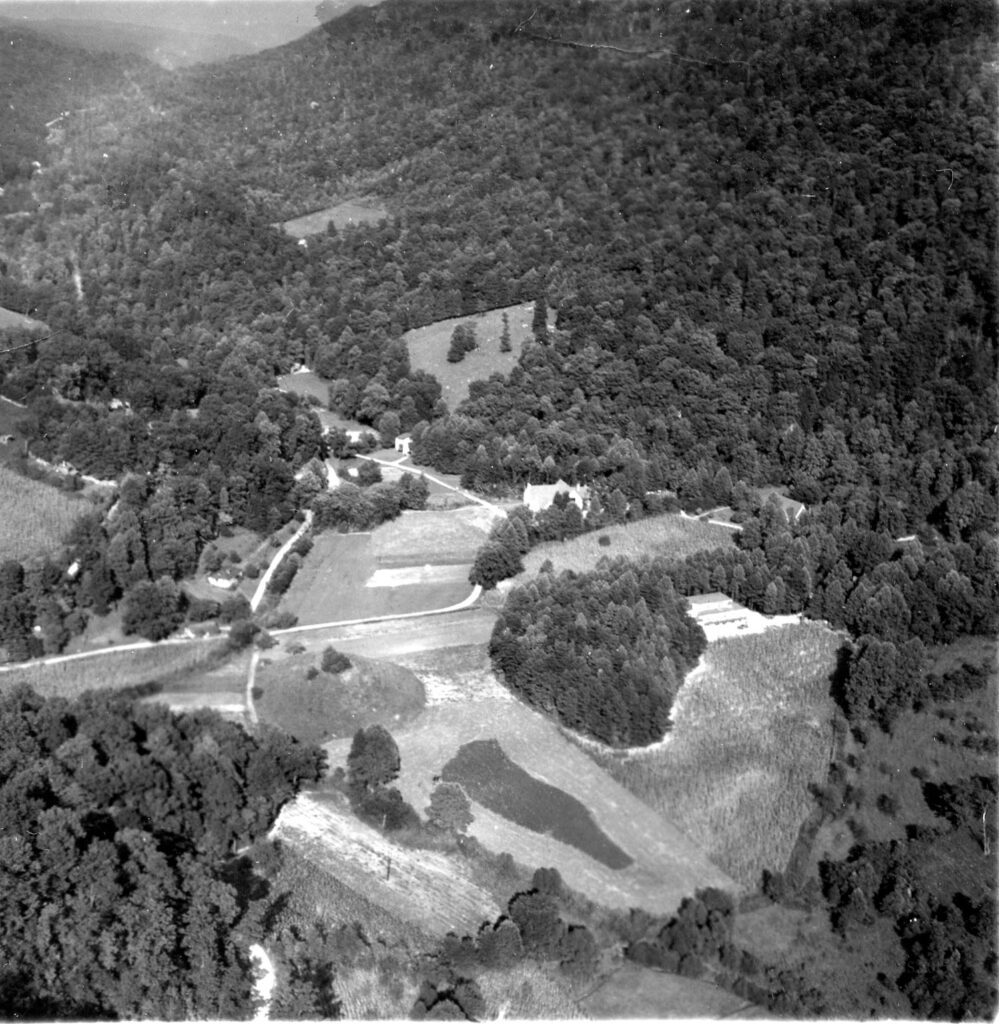
035-Copy. Aerial view of PMSS campus, 1941. [garner_035-Copy]
SIA – SETTLEMENT INSTITUTIONS OF APPALACHIA
The on-site and digital collections at Pine Mountain are complemented by the Settlement Institutions of Appalachia (SIA) materials held by the Berea College Archive, Berea, KY. The SIA selective microform collection of the early Pine Mountain Settlement School Collections covers the years 1913 to 1983. The Berea microform collection duplicates many materials found in this Pine Mountain Settlement School Collection, but it is only a fraction of the onsite PMSS holdings. (Search Loren Kramer for additional information.) If deep research is desired, scholars would be advised to schedule an on-site visit to gain access to the full PMSS archival collections. Full access includes the physical facilities that may be enjoyed by a visit to the School and a walk about campus, and is supported by the documentation included in the National Register of Historic Buildings.
Since 1949, Berea Presidents and faculty have served on the Pine Mountain Settlement School Board of Trustees as trusted advisors. Recently, the School reached out to the Berea College Special Collections and Archives to integrate the Pine Mountain and the Berea SIA microform archival materials in a more coordinated and accessible manner to interested users. Efforts are ongoing to join the collections. Visit the Berea College Special Collections for more information about this evolving partnership.
NOTES
NOTES , is a bi-annual publication of the School, is an essential tool for tracing the history of the Pine Mountain Settlement School. Each year, the School sends mailings to our interested communities and friends. “NOTES” presents an overview of events at the School. We are close to providing full copies of the Pine Mountain Settlement School NOTES online. Do you want to follow along and learn about the institutional history through its annual NOTES?
Subscribe: (606) 558-3571
NOTES 1919 was the first issue produced by the School. See: NOTES Index.
DEAR FRIENDS LETTERS INDEX
Similar to NOTES, the DEAR FRIEND LETTERS (1911- present) were written by the Pine Mountain School Directors and mailed to friends of Pine Mountain. They carry chatty reports of the institutional activities, staff, and programs at the school and in the community. The LETTERS often contain as much information about the writer-DIRECTOR as about the School and region. The 1-2 page letters abound with historical information about the School, the Community, and Friends of the institution. The LETTERS are important to anyone interested in learning more about PMSS’s growth and change. NOTES and the DEAR FRIEND LETTERS are excellent starting places for researchers wishing to get a sense of the School’s history across time and a sense of the ebb and flow of life in Harlan County and the Central Appalachians.
GOOGLE search box
INDEX TO SERIES AND GUIDES
STILL NOT FINDING WHAT YOU WERE LOOKING FOR? Alternatively, you can utilize the GOOGLE search box above to look up specific topics. The use of an enhanced AI search engine for locating PMSS materials will also quickly lead to PMSS related information throughout the expanding Web.
REQUESTING PERMISSION FOR THE USE OF MATERIALS
Work with the materials in the Pine Mountain Settlement School’s physical collections is ongoing, and new material is frequently added as it is scanned. Any for-profit use of archival material requires permission from the Pine Mountain Settlement School. If visiting in person, research scholars will need to arrange for their visit before arrival at the School [(606) 558-3571]. Appropriate citation of the research material is requested. See the following USE AGREEMENTS, citation guidelines, and details for USE and for requesting permissions.
If you wish to DONATE material, please see our DONOR AGREEMENT AND DEEDS OF GIFT or contact the School directly (606) 558-3571.
COLLECTION USE AGREEMENTS AND ACCESS GUIDELINES
PUBLIC USE OF MATERIAL FROM THIS ARCHIVE (Non-Commercial)
COMMERCIAL USE OF MATERIAL FROM THIS ARCHIVE
ORAL HISTORY RELEASE AGREEMENT
ORAL HISTORY ASSOCIATION – PRINCIPLES AND BEST PRACTICES
CITATION
Any PUBLIC use of material must properly cite Pine Mountain Settlement School. Suggested: “[Identification of Item],” [Collection Name] [Series Number, if applicable]. [date], Pine Mountain Settlement School, Bledsoe, KY. [date accessed]
COLLECTION DONATIONS
If you have material related to Pine Mountain Settlement School and wish to donate the materials to the school, please get in touch with our office to discuss your donation and the DONOR AGREEMENT. We are, of course, always delighted to accept monetary donations in support of the collections.
office@pinemountainsettlementschool.com or (606) 558-3571
UPCOMING EVENTS AND WORKSHOPS AT
PINE MOUNTAIN SETTLEMENT SCHOOL
VISITING OR STAYING AT PINE MOUNTAIN?
To learn more about the School’s current workshops, community interaction, annual events, and overnight stays, go to PINE MOUNTAIN SETTLEMENT SCHOOL Main Page, where you will find information about visiting the campus, lodgings, current programs, and donating to the School.
RECENT ARCHIVAL ADDITIONS
HISTORIES PMSS 1899 A Novel Excursion by Maria McVay
This early and important record, “A Novel Excursion” 1899, is a glimpse into a very early history of eastern Kentucky and its adoption of rural settlement institutions. The excursion from Berea to eastern Kentucky, recorded by McVay and led by Henry Mixter Penniman, sparked the development of both Hindman Settlement School and Pine Mountain Settlement School. This early recorded journey of Katherine Pettit and her interesting traveling companions sheds light on Pettit’s circle of influence and the growing contemporary interest and rationale in the creation of rural settlement schools. In 1902, Pettit and May Stone founded the Knott County Hindman Settlement School, and in 1913, Pettit founded Pine Mountain Settlement School. Maria McVay, a budding reporter, recorded the 1899 excursion for a Cincinnati newspaper, which reveals the traveling companions of Pettit and the adventures of their journey. Among the traveling company was Ellen Churchill Semple, a well-known international geographer. In 1901, she published one of the most debated and interesting studies of Appalachia: “The Anglo Saxons of the Kentucky Mountains: A Study in Anthropogeography.”[LC copy] Pettit, Semple, and their traveling companions helped to open the geography and the culture of the region to the broader world. Their adventures are worth the read.
GRACE M. ROOD – STORIES of “AMAZING GRACE”
The stories of Grace M. Rood are adventures of a different sort. They describe the working life of a nurse at Pine Mountain Settlement School in the 1930s and 40s. The “Amazing Grace” GRACE M. ROOD entertains, vents, and reflects in these stories. Tune into her years of adventure serving the Kentucky rural communities and the PMSS School. As an early graduate of the Johns Hopkins nurse-training program, she first served as a nurse in rural India, where she learned to be self-sufficient. Her early training was well-suited to the many challenges she faced in her long career in the Appalachian mountains. She is a legend, and the stories of her nursing life are truly AMAZING.
**********
WHAT’S NEW Latest Digital Additions – Lists of pages that have been recently updated or newly published on the PINE MOUNTAIN SETTLEMENT SCHOOL COLLECTIONS website.
For pages that have been updated or newly published in former months and years, go to:
ARCHIVE 2020-2021 Past Digital Additions
ARCHIVE 2022 Past Digital Additions
ARCHIVE 2023 Past Digital Additions
ARCHIVE 2024 Past Digital Additions
ARCHIVE 2025 Past Digital Additions
FORMER WHAT’S NEW – Archive of earlier posts and promotional descriptions of pages, 2015-2021.
COMMENTS and CONTACT
Comments and feedback are not enabled directly on the website. Users may contact the editors through the Pine Mountain Settlement School Office with their comments and requests. office@pinemountainsettlementschool.com or (606) 558-3571.
We welcome your identification of people and activities on our site and, particularly, corrections to the record. Further, we always welcome the addition of materials relevant to the history of the School and the region.
ABOUT OCR TEXT
Some of the texts included in this site have been automatically generated using Optical Character Recognition (OCR) software. In some cases, these texts have not been manually reviewed or corrected. OCR enables the searching of large quantities of full-text data, but it is not 100% accurate. The level of accuracy depends on the print quality of the original publication and its condition at the time of creation. Publications with poor-quality paper, small print, mixed fonts, multiple-column layouts, or damaged pages may have poor OCR accuracy.
STATEMENT REGARDING PRIVACY
Please read OUR PRIVACY POLICY and contact the PMSS office if you believe we have violated your right to privacy in our online archival resources.
office@pinemountainsettlementschool.com or (606) 558-3571
The manuscript collections and archival records in the Pine Mountain Settlement School Collections may contain sensitive and/or confidential information derived from historical archives that may be protected under federal and state right-to-privacy laws and regulations. Researchers who wish to publish and users who may share material from the Pine Mountain Settlement School Collections are advised by this notice that the disclosure of certain information about identifiable living individuals represented in some collections within the Pine Mountain Settlement School Collections without the consent of those individuals may have legal ramifications (e.g. may be a cause of action under common law for invasion of privacy if facts concerning an individual’s private life are published that would be deemed highly offensive to a reasonable person for which Pine Mountain Settlement School assumes no responsibility.