DANCING IN THE CABBAGE PATCH
It’s a Dog’s Life
January 2024
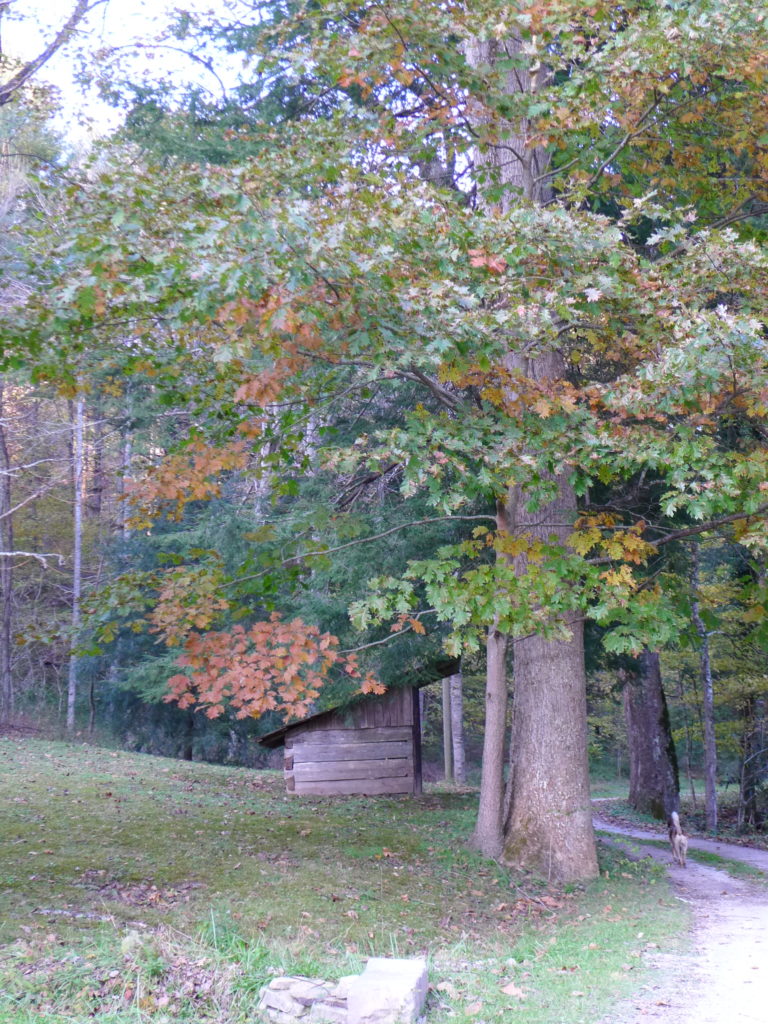
Sheep shed with “Lady” headed for Big Log. Photo: Helen Wykle 2018. [
P1150808-e1555820379540.jpg]
IT’S A DOG’S LIFE
Over time, many dogs have found a home at Pine Mountain Settlement School, and many dogs have resided in the homes of community families. Whether an adopted dog, a gift dog, a pup from an older family dog, a stray, or “another”, these four-legged companions have mostly charmed the families, owners, visitors, and head-scratchers — all … or, at least most. The occasional stray dog has even been known to charm themselves into the campus community and also into the homes of the surrounding Community. These four-legged friends sometimes belong to no one and everyone — even many visitors have claimed temporary ownership. This writer is one of those.
Dogs seem to know how to negotiate mutual relationships surrounded by their two-legged ear-scratchers and when to avoid those relationships. Instinctively, they seem to know when to stay and when times are tough, they instinctively move on and find their way into the homes and hearts of another family or person, or place. People live and thrive — or not, in relationships and communities. Dogs do this, and often better.
There have been many dogs at Pine Mountain and the surrounding community, and a myriad of stories to go along with these canine companions. Names such as Franklin, Jonah, Waggie, Pug, Flossie, No-No, Bothwell, Amos, Megan, Stefan, Russell, and more have, over the years, melted into their forgotten times. Various Collie dogs, mongrels, Red-setters, and most recently the small Russell terrier, and especially the larger herding greeter, “Lady”. As the current self-appointed chaperon of visitors to the campus, guardian of the playground, and night watchwoman, Lady is one of the most accomplished of Pine Mountain’s ambassadors
As the all-around Ambassador, Lady often can be found on the doorstep of the guest houses. At night, she can be heard chasing coyotes away from the sheep and goats, and when School groups arrive, she can be found escorting hikers up the Summit Trail and guarding the playground. Many full nights of guarding for bears and other night-explorers have made her voice well known.
Dogs at Pine Mountain often show up in family pictures. On campus and in the surrounding community, dogs are of every sort. One of this author’s favorite canine portraits is that of the giant hound on the porch of the Shell family, who lived near the School early in the twentieth century. The stoic and solemn portrait of the hound’s owners matches the dignity of the solemn but guarded look of their dog, who looks remarkably like “Lady”. This portrait is difficult to forget, once seen. As the couple sits on their hickory-cane chairs, they stare intently and with a solemn but guarded expressions. Their dog carries their same intensity or “guarded” stare and the moment seems charged by it’s intensity. All three sit before a doorway that reminds those of us who were born in the area, that the past is never far from memories such as this one. The open doorway and front-porch sitting, reminiscent of Aunt Sal’s Cabin, used to be an open invitation of “Come sit a spell.” Their doorbell — their dog. Their intensity, an extension of their deep sensitivity, and their “reading” of strangers.
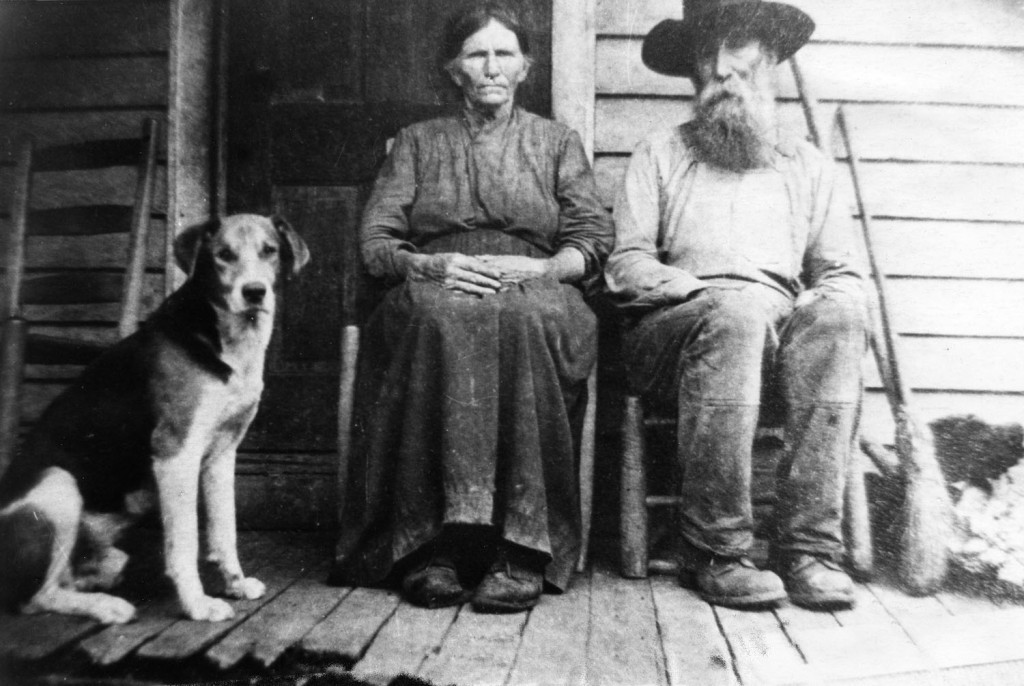
Woman, bearded man, and large dog, seated on porch, [misc_exhibit_021.jpg]
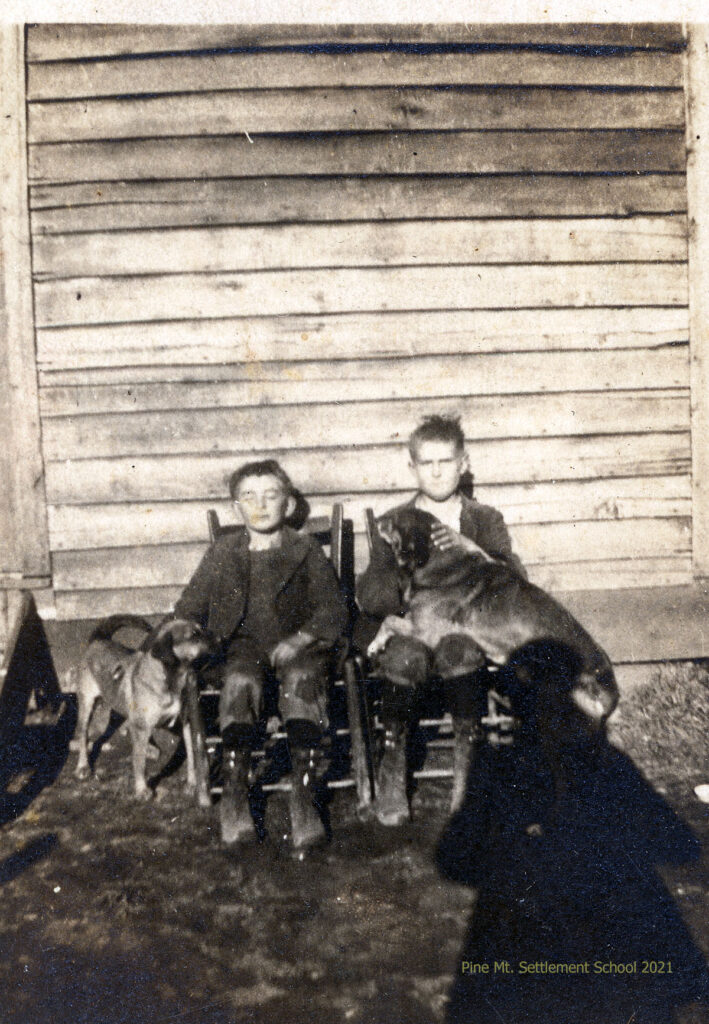 HOUNDS 418 Boy and young man seated with two hunting dogs. Ship-lap wall behind them.
TALL TAILS and TALES
Perhaps the most famous and fantastical “bear-runner” hunting-dog story, is the one that Ben Begley, the legendary Environmental Education teacher at Pine Mountain, often shared with the school groups that came for Pine Mountain’s environmental education sessions. Ben captivated his audiences, young and old, with tall tales that at first seemed to be plausible but then became more folklore and often finally arrived at fantasy. Ben’s story about a treasured hunting dog was certainly captivating and memorable. Perhaps more memorable than the story were the expressions of the visiting children as they listened to master story-teller Ben’s tall tales.
One tale ran something like this-
A man had a treasured hunting hound who was used as a bear-hunting companion. The man and the dog one day encountered a bear that fiercely “went at” (attacked) the dog, and the two animals had a violent and gory battle. Ben spared no detail of the bloody battle between the bear and the dog. He described how the dog’s body was ripped and sliced into two halves and how the distraught hunter gathered the two pieces of the dog and quickly wrapped them tightly together, hoping to save his dog. together. Ben’s audience became very quiet, tense, with all ears and eyes focused on the storyteller.
Ben then described how the hunter and the badly injured dog headed for home. Finally, at home with his dog, the hunter proceeded to sew his dog together. Completing the gory job, the hunter again wrapped his dog tightly in the hope that he had saved the dog’s life. After a while, the man was happy to see that the dog was responding to the repair. The dog was a fighter. A few weeks later, the man unwrapped the dog to remove the stitches. On inspection, the stitches looked good. The hunter’s quick work had saved the dog but as the hunter fully unwrapped his dog he made a startling discovery.
There was a problem — the hunter didn’t realize that he had sewn one-half of the dog’s body upside-down and the other right-side-up. One set of legs was up in the air and one set of legs firmly down on the ground. The owner had saved the life of the hound that had tangled with the bear, but now he had a problem as two feet were in the air and two were on the ground! The dog was alive but it looked like the end of the hunting days for the dog. The eyes of the young audience widened. One can imagine the unique mental picture of a dog with two legs up and two legs down. Now what?! How could this new dog possibly remain the hunter’s companion, Ben asked? A few children laughed uncomfortably. Ben continued with his story. He reported that the hunter soon found that he had a very unique hunting companion. His dog could now run on two legs! And, even more important, the dog could flip, and when he was tired, he could run on the other two fresh legs!
It was a fantastic story, in the same vein as the Jack Tales of Richard Chase, Leonard Roberts, and other tall-tale tellers found in Appalachia. The fantastic pictures Ben could draw in the minds of his young audiences never failed to capture a room full of imaginations and to teach lessons in storytelling.
[I only wish I could remember Ben’s story in greater detail … or not!. I suspect that I have “sewn” it together badly! But, just imagine a room full of kids hanging on every part of the tale and then exploding when they realize they had been “snookered.”]
Ben Begley, former Director of the Environmental Education Program at PMSS was one of the most magnificent of the many storytellers who visited or worked at the School. He always had a room full of pre-teens trying to “piece together this gory tale and to imagine how the dog negotiated the world. Ben’s tall tales were often improbable tales, but he had mastered the art of suspense in storytelling. Ben’s command of tales is similar to the many such fantastic stories that get embellished by “mountain tall-tale-tellers”. Their tall tales can bring laughter, or sadness to an audience — even audiences that are “snookered” find it hard to erase the picture of that unique hunting hound from their visual memory, or the fun of sharing such an improbable tale. To read more about Appalachian tall tales, visit the work of author Richard Chase, a sometime staff-member and storyteller who often visited Pine Mountain and entertained children and staff with his “tall tales.”
EARLY CANINES
Two of the earliest dogs on the Pine Mountain Settlement School campus included one owned by Ethel de Long who later married the stone-mason, Luigi Zande, and another dog owned by the early school staff member, Marguerite Butler. The de Long dog, a long-haired and pert-eared companion, shows up in several photographs taken during the founding years of the School. The name of Ethel Zande’s dog is sure to surface at some point, but it is not known by this author.
The second canine, identified as an early campus dog, belonged to staff member Marguerite Butler. The dog, a Dalmatian hound, was named”Franklin”. He or she has been identified as a faithful companion of Butler, and the name has been recorded.
Early photographs have captured Ethel and her dog companion and Marguerite Butler and her sleek companion, “Franklin,” in the very early days of the School in 1914 or 1915.
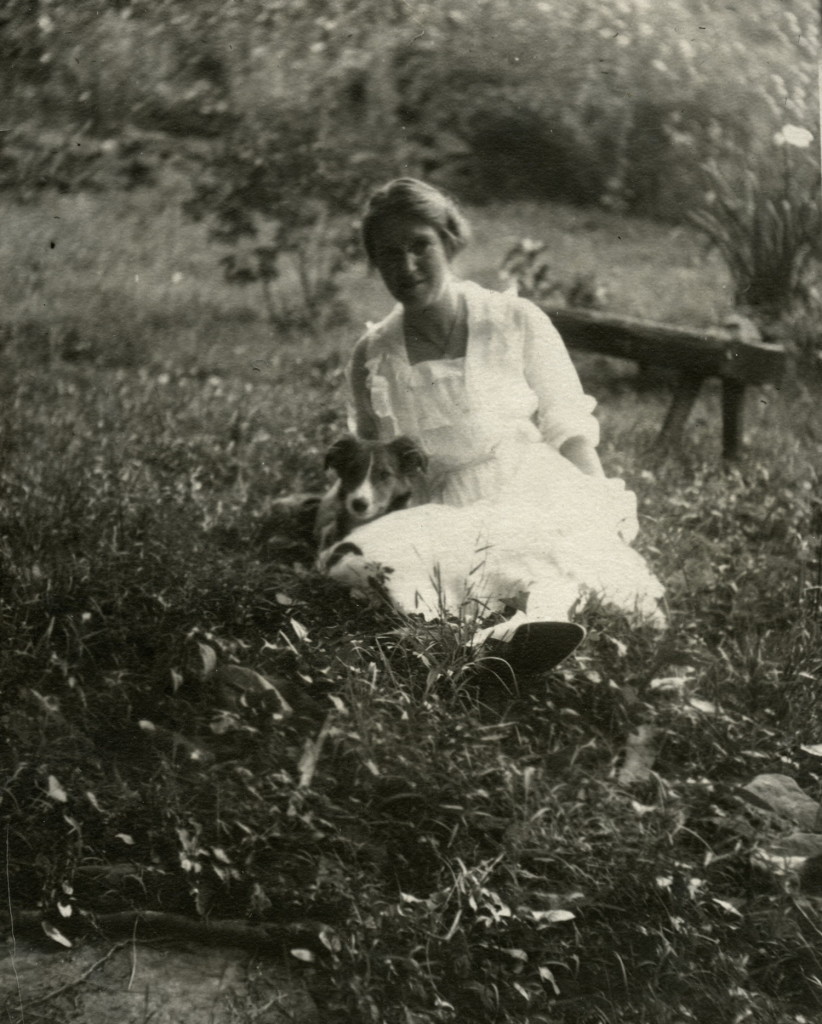
Ethel de Long with her dog. X_099_workers_2527r_mod.jpg
Like a familiar face the little Zande dog can be easily identified (sort-of) and shows up in several early photographs. It is fun to encounter a photograph and to recognize “Ethel’s dog,” like a familiar friend’s face.
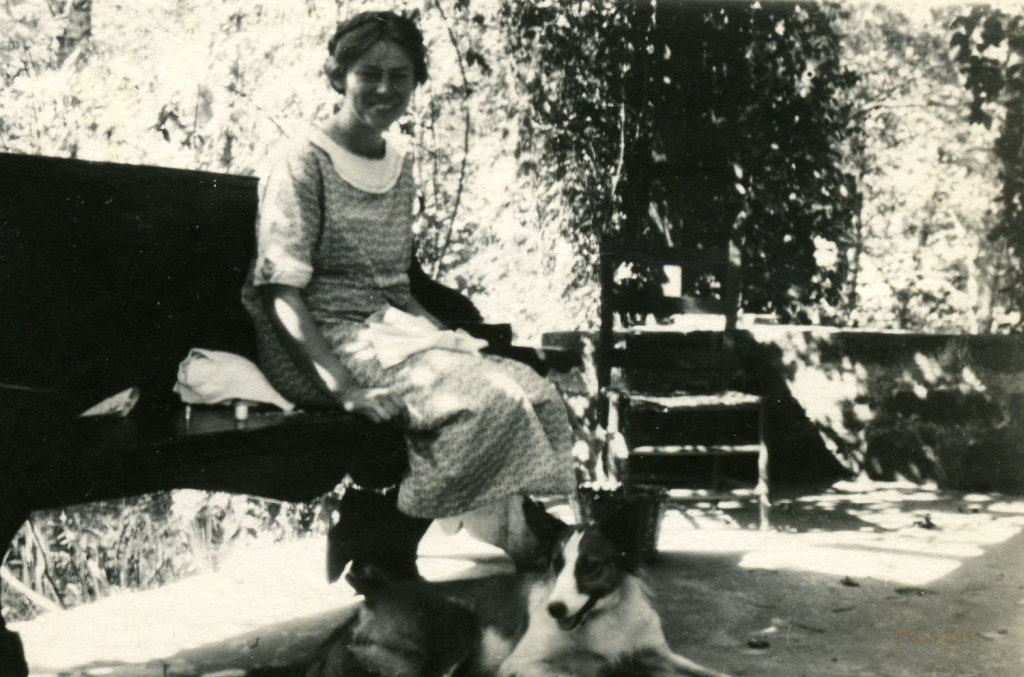
Woman [Ethel de Long ?] seated with dog at her feet. norton_048.jpg
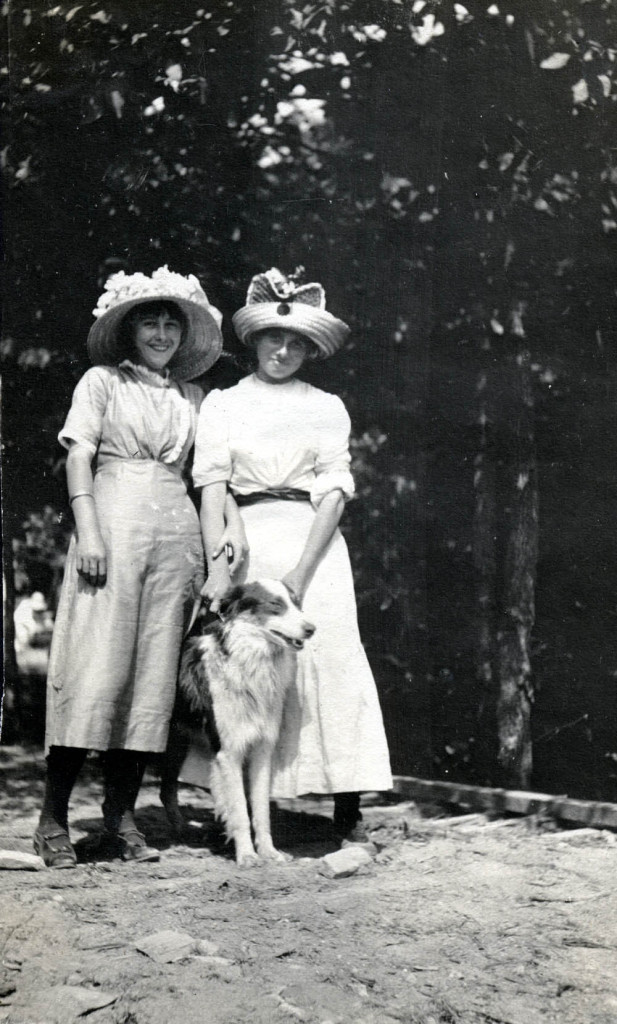
Two young ladies wearing hats and with a shepherd dog, or the Zande dog between them. FN Vl_35_1142a FN Vl_35_1142a
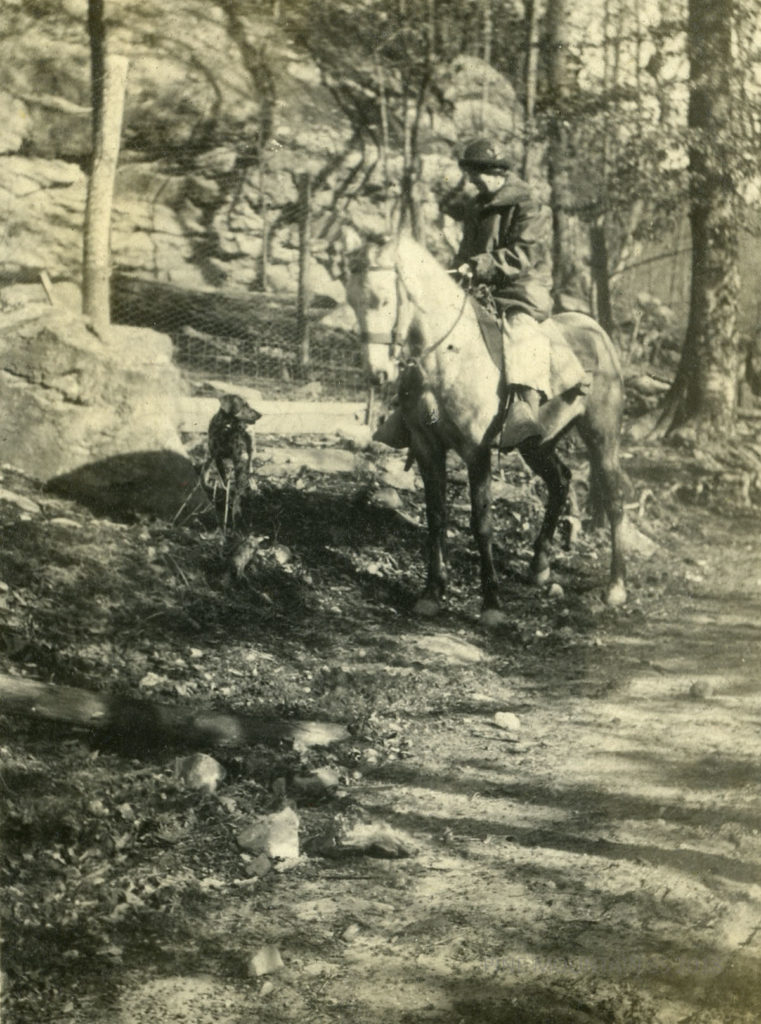
025c. M.B. [Marguerite Butler] on Queen with Franklin, a Dalmatian hound at their side, . mccullough_I_025c
Several sources note the name “Franklin” given to Dalmatians has a high incidence. In fact it is quite common that Dalmatians find “Franklin” as their moniker, but, in fact, it is a favorite across breeds and also is found frequently in cat names. This all seems to be based on the “personality” associated with the name. For example, Franklin suggests strength, loyalty, trustworthiness, and a wise and gentle nature, so say many of the sources. “Franklin,” many say is derived from the Old French word “franc” which means sincere, genuine, and free, and in Old Eng. “frank”. One online source suggested it is a favorite name because “… In the US, Franklin is the 63rd most popular name for dogs, with over 4,000 r, —Benjamin Franklin. The dignified name suggests a “dignified dog” … certainly a pedigree? with which to identify. But let’s get the facts straight. The influence and personality of Benjamin Franklin rarely pan out. Just because we might admire Groucho Marx does not call for naming our dog “Groucho” — though I have known dogs that qualify. Well, so much for our National confusion/stupidity … it seems to be rampant today but I have never met a dog named “Dumbo”! Perhaps that is where AI [Artificial Intelligence] can come in handy. It is an interesting journey to ask for AI help in naming your pet. Give “Franklin” a try.
It is not known if Katherine Pettit had a dog. No reference to a Pettit dog has yet surfaced in the literature of the School or in the many letters of Pettit and her colleagues. Yet, in reading through the related material in the Pine Mountain Archive, it seems, to this writer, that Katherine, an agrarian at heart, loved farm life but kept any affection for animals partitioned or separated from any deep “petting” attention. Her concerns for children and their daily care and education were the center of most of her recorded reflections and animals were animals. Perhaps her possible disaffection for dogs was tied to her early life. As the oldest child, life on her father’s farm included many farm responsibilities, including caring for many animals. The farm responsibilities in addition to the demands of the farm’s animals gave her a wealth of knowledge and caring for children but probably not so much empathy with animals. Her younger siblings fell to her care following the death of her mother early in her life. She had little time for pets.
PETS & DOG SUBSTITUTES
While Katherine Pettit may not have been a pet lover, many in the Community had pets. It was and still is common to find pets that were as important to the family as children and the pets were not necessarily seen as “dogs”. Groundhogs seem to be the favorite dog substitutes. In the photo below, a young girl shows off her two groundhog pets …. a common garden raider that burrows beneath the ground much like prairie dogs, but once tamed can be coaxed to be dependent on a human.
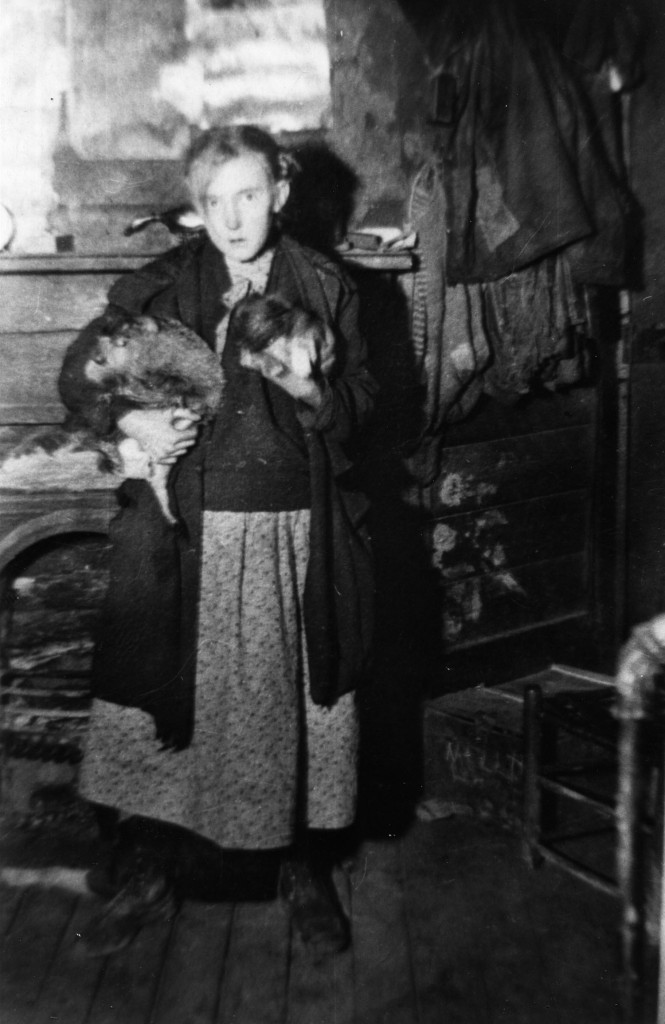
Young Girl Holding Two Groundhogs [?] Pets.[misc_exhibit_038.jpg]
The two children seen below hold “pets” they have tamed. One pet, a groundhog, and the other a lamb. These were not uncommon pets of mountain children. When entering a home in the valley it was not uncommon to be introduced to four-legged family members. Grey squirrels, rabbits, flying squirrels, toad frogs, snakes, crows, box turtles, lambs, goats, —- a regular zoo in some instances, could be found in many of the rural community homes.
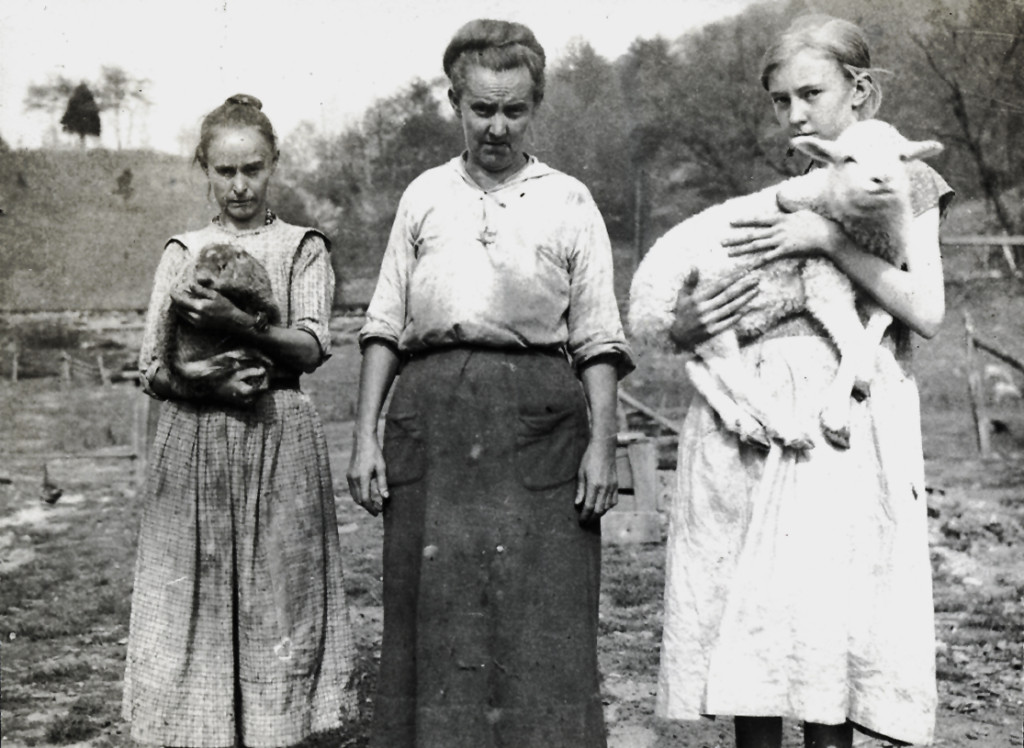
Mellie Day family with pets.[nace_1_070a.jpg]
In the photograph below, a young boy holds his favorite pet/hunting dog. The two are center stage. There is no mistaking the expression of pride in the boy’s face. He proudly shares his companion, stares defiantly straight at the camera, and is surrounded by admiring younger children.
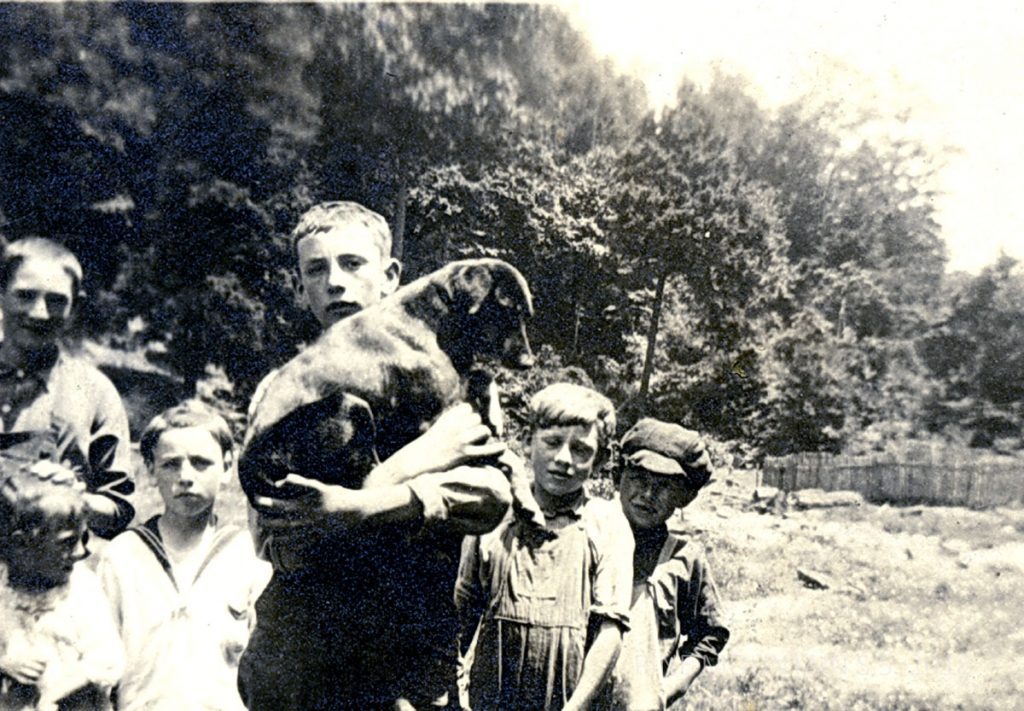
1254 “Browning? 1920″Young boy and a dog. [VI_39_1254_mod.jpg]
A second era of dogs at Pine Mountain Settlement appeared with Glyn Morris, who became the Director of the School in 1935. Dogs began to play an important role in the Settlement School campus life when Glyn Morris and his wife Gladys came to the School with two Cairn terriers.
Glyn Morris, of Welch and Scots-ancestry was familiar with the Cairn terrier breed. There is no doubt that Morris loved dogs, but he favored not just any dog. His dogs were pedigreed — no mongrel breed dogs for this city man. Glyn and his wife Gladys’s and two cairn terriers were an instant hit with the students and the workers, pedigree or not.
The Cairn breed, highly popular in Scotland, is known for its tenacious hunting instincts. The dog breed gets it’s name from the cairns (human stacks of rocks or rocky mounds of rocks on land formations) of Scotland and in the rugged and rocky farmlands of Wales. Morris was Welch and Wales was the ancestral home of the Morris family. Also, if one is privileged to hold a Cairn terrier, it is a bit like holding a stack of rocks with a warm heart and a wet tongue. Perhaps that is why this writer has such a preference for terriers, especially Cairns.
As favored additions to the farms of Great Britain, Cairn terriers are small and fiercely loyal working dogs. They were used for keeping the small vermin populations under control on small farms in Wales. As their reputations grew as defenders of small farm operations in the agricultural sections of not only Wales but also Scotland and England, they grew to become a favorite breed for small farms across Europe. The Cairns introduced by the Glyn and Gladys Morris showed the same spirited farmyard hunting ferocity at Pine Mountain. In the barnyard and on the hiking trails, the little dogs were ferocious and dogged hunters and protectors. The breed easily ferrets out small rodents, voles, snakes, and, at Pine Mountain, unfortunately, chipmunks and squirrels. In short, small critters don’t stand a chance against these fast and fierce little terriers. On a snake trail, they are, however, invaluable.
The two Morris Cairn terriers soon had pups, and these were spread around to various staff at Pine Mountain. A May Day photograph shows off a new 1945 litter of Cairn puppies as they are held by staff children on the May Day Green. This author is second from the left, holding a newborn puppy. Stefan was the name of our family cairn dog pet, but Stefan was not the puppy held by the children, below. “Uncle Stefan” was at home, as he was a descendant of the Morris couple’s cairn. Our family’s first “child” or firstborn was Stefan, our family pet, at the time of the picture below, he was already five years old . The puppies held by the children are Scotty pups recently delivered by a Scotty couple owned by the Arthur Dodd family on campus. A proud Arthur Dodd is the photographer here. The goat on a leash held by Steven Hayes is to the far right.
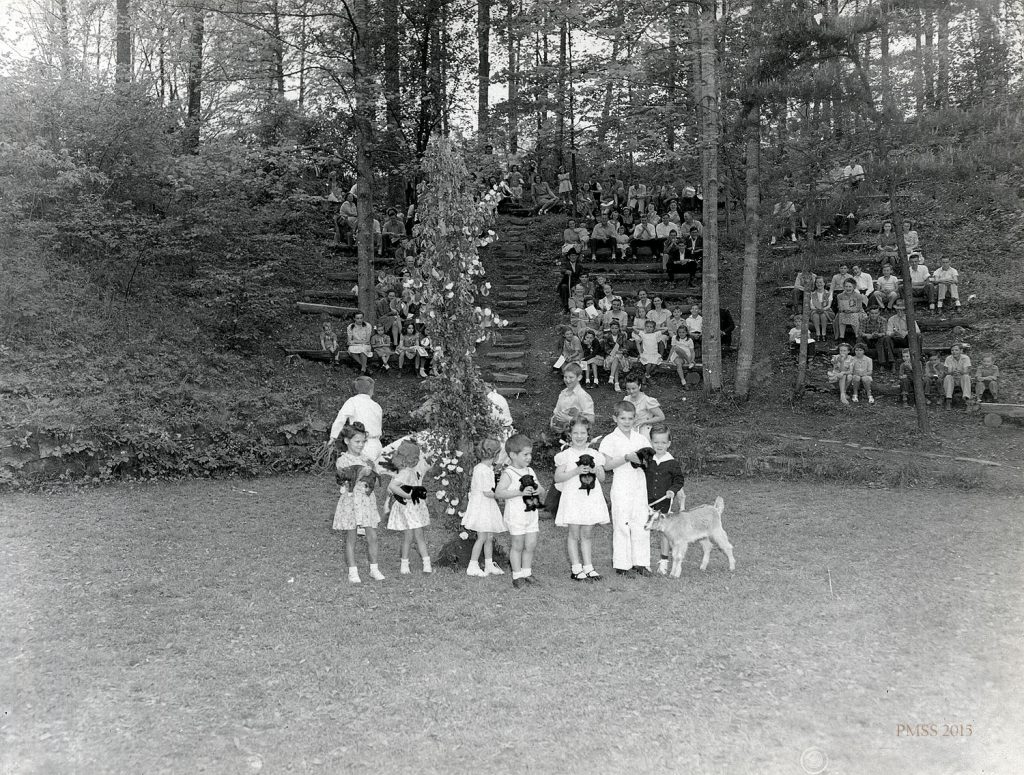
May Day on the Dancing Green, staff children, 1945. [dodd_A_049_mod]
An account of Stefan’s origins is found in the student newsletter:
PUPS “SHOW OFF” FOR SENIORS
Yelping sounds attracted the attention of the seniors at their Sunday night gathering at Zande House. Curiosity led to the showing off of the three puppies. No, no. Bothwell and Stefan.
Even Sears and Roebuck had had the privilege to become acquainted with the pups. For on February 3rd they were presented with a pen, a “baby crib”, in fact, Flossy is rather fond of her children, but is always willing to lend them to visitors.
The Pine Cone Feb. 1941 .
Stefan was quickly adopted by this writer’s parents, and ten months later, I arrived and grew up with Stefan by my side — always looking out for snakes and other unpleasant critters in my constant woods-roaming. He trained me well. Stefan left me with a lifelong affection for dog companions, especially in deep forests.
IT’S A DOG’S LIFE
“It’s a Dog’s Life” is a phrase that is often used to describe a sub-standard course of life. But, at Pine Mountain, “it’s a dog’s life” is paradise regained for most canines. It has been rare the case at Pine Mountain that dogs be subjected to the isolation of “It’s a dog’s life”. Further, the Settlement School must have looked like Paradise to many of the dogs who had been privileged to live there. Unless they were too temperamental or chicken-stealers, most of the campus dogs were allowed to run free and to greet friends and visitors alike. Some, however, never warmed to the responsibility of being part of a community. Those dogs did not last long at the institution. Nor did dogs last long if they could not share their space with other dogs.
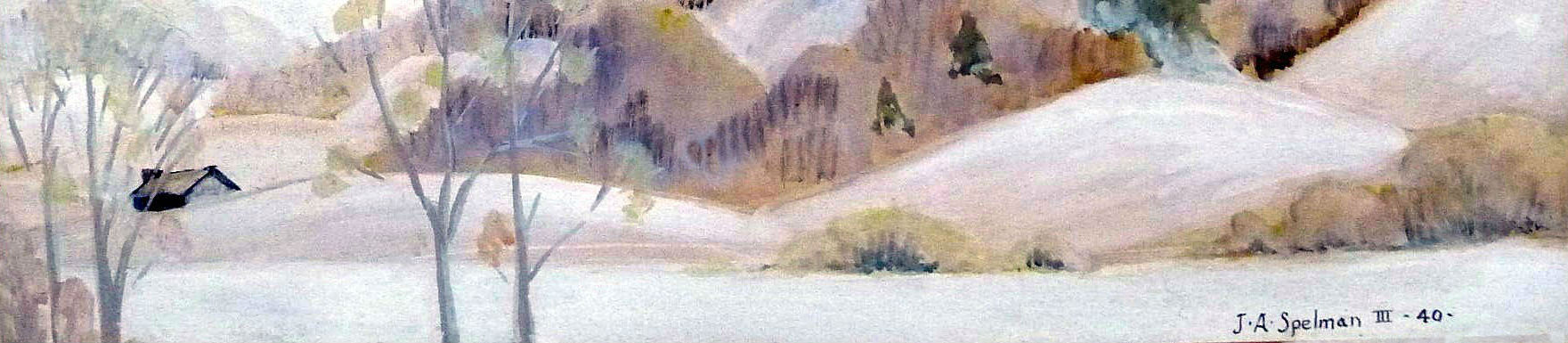
There is ample evidence that dogs were required to share multiple spaces on the campus and that they generally understood this amicable shared space. Miss Wilbur (Barbara Wilbur Spelman) with her dog “Jonah” is shown below in a picnic scene at the “Lean-To”, a favorite place on campus for community cook-outs. Jonah was also shared with Barbara’s brother John A. Spelman III, the art teacher at the School. The leftovers must have been quite good for Jonah at this cookout.
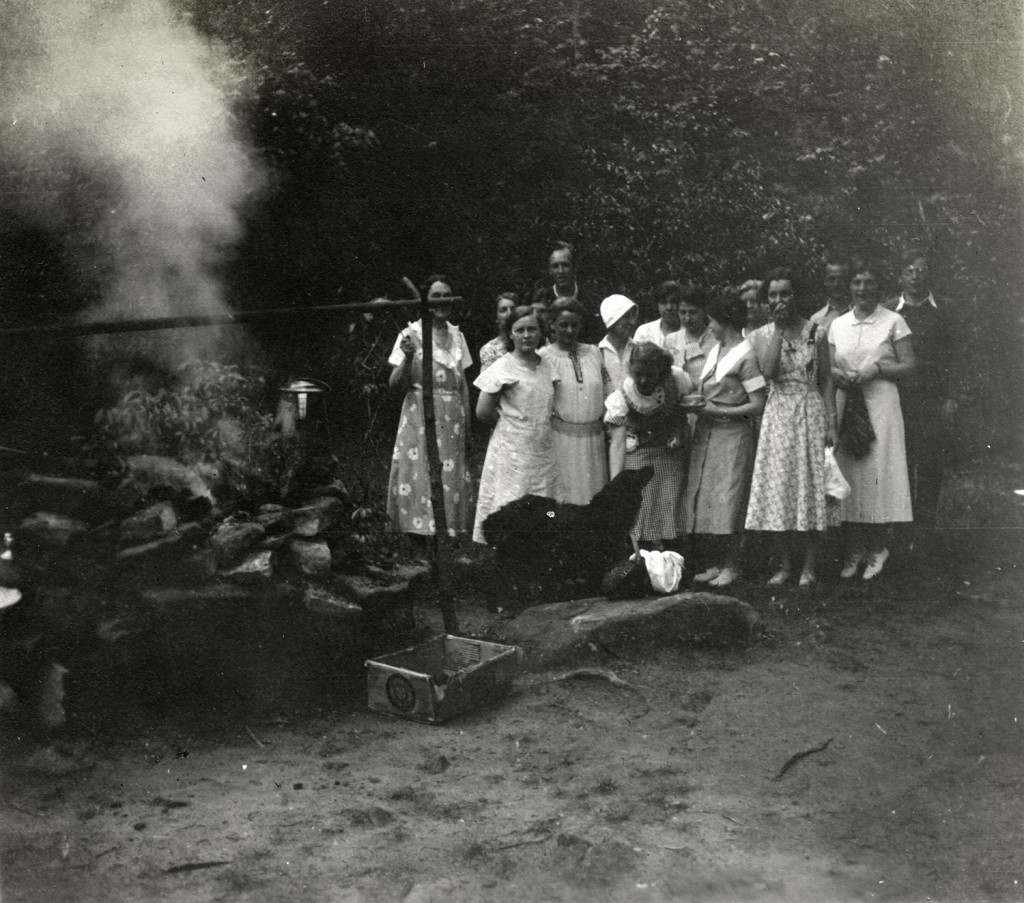
Picnic at the Lean-To. [Late 1930’s] Miss Wallace; Miss Jones; Miss Ross; Miss Bartlett; Miss Wilbur (with her dog Jonah); Alice Cobb; Lexine Baird; Oradelle Malan; Marian Kingman; Oscar Kneller; Glyn Morris. [X_100_workers_2574_mod.jpg]
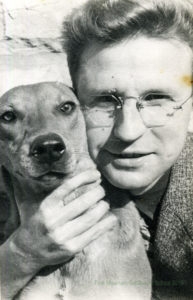
100 Arthur Dodd. Principal at PMSS with his dog,”Brennan”. [burk_people_100.jpg]
To the left is Arthur Dodd, the PMSS School Principal [early 1940s], and his companion, “Brennan” a later addition to the Dodd family after the Dodd children’s Scotty [name not remembered] had aged out.
In 1944 as the Board of Trustees planned for the upcoming BOT meeting, a letter arrived from Mary Rockwell Hook, the School’s Architect, who was making plans to come to the Spring meeting. In 1944, Mary Hook, at 77 years old, was still trying to personally attend board meetings at Pine Mountain. As she wrote to arrange for accommodations for the April meeting, she noted, “I have to apologize for bringing my dog, “Tommy”, along but I have no one to leave him with while I am in Florida.” She was driving from Kansas City to Florida by way of the meeting at Pine Mountain. It was not uncommon to find a dog in tow when Mary came to stay in the exquisite house — “Open House” she built adjoining the campus. Dogs and children were high on her companion list when she came to the School.
THE FARM DOG – STEFAN DOG
Stefan, the William Hayes dog, died at the age of 15, in 1949 and following his passing, the Hayes children looked for other substitutes. Chipmunks, flying squirrels, box turtles, a talking crow, … but the death of Stefan dog was catastrophic to the Hayes children. Then, a small stray dog entered the life of the Hayes family. “Rusty” found the farm manager, William Hayes, and worked his way into the life of the family. Unfortunately, Rusty had a short life. Adopted at Pine Mountain “Rusty” had been only a short time at the Settlement School when he joined the Hayes family as they re-located to the Forestry Station at Putney — across the mountain from PMSS. “Rusty” dog was a “mutt” with Beagle origins whose joints were brown and who looked to be “rusting” even in his youth but never stopped running like a streak. Like Waggy, Amos, and other dogs on the campus, Rusty had campus routines but like many Beagle derivatives, Rusty ran — and ran. He was not a “please pet me character.” Rusty ran and my brother and I chased him. He was the exercise master for his owners, including this author.
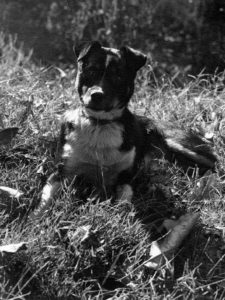
The Hayes’ “Rusty” dog. [burkh_032.jpg]
The loss of a pet is like a death in the family. This is true of dogs that have grown up with a family with children.
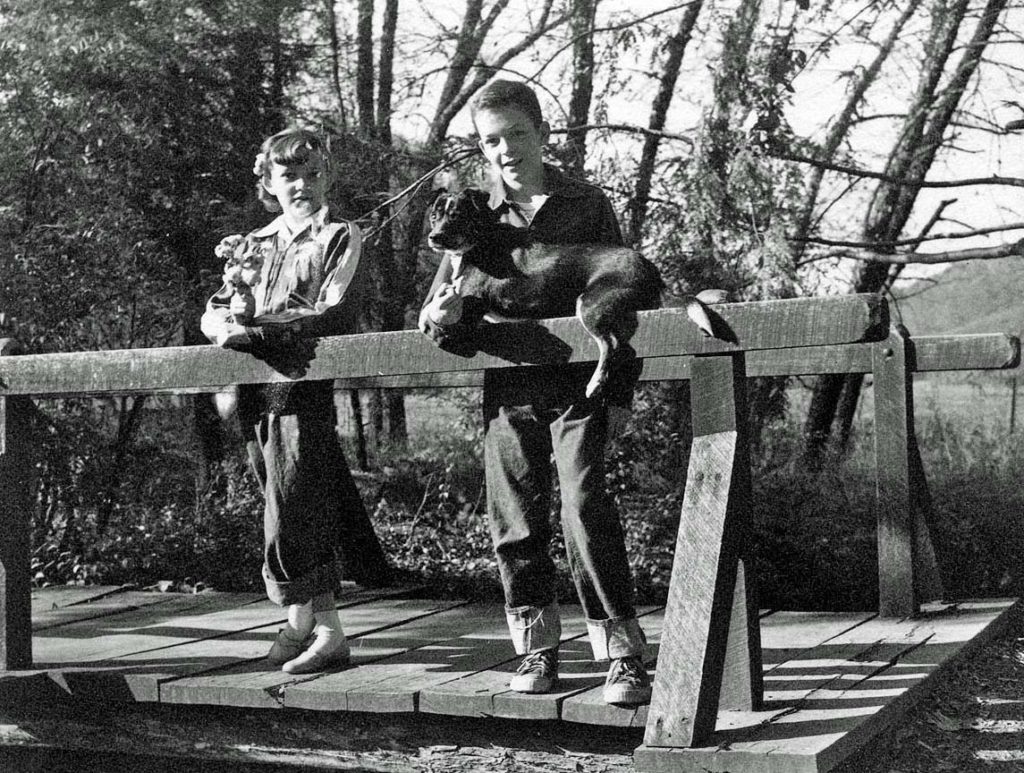
Helen and Steven Hayes, with “Rusty” dog on the Isaac’s Creek bridge at PMSS. c. 1953 [burkh_033.jpg]
More recently, a small terrier dog, showed up one day at Pine Mountain. He was called “Russell” for a short time. It was 2021 or early 22. He quickly became a close companion of the most favorite of recent dogs at the School — “Lady”. This little terrier’s life, like that of Rusty, was also a short one. In this case, he vanished into thin air. Perhaps his previous owners found him, or, perhaps new owners saw a delightful companion. We can only hope his home is a good one. Lady misses him, as do those at the School. He was marked by the “perfect mustache” on his rump.
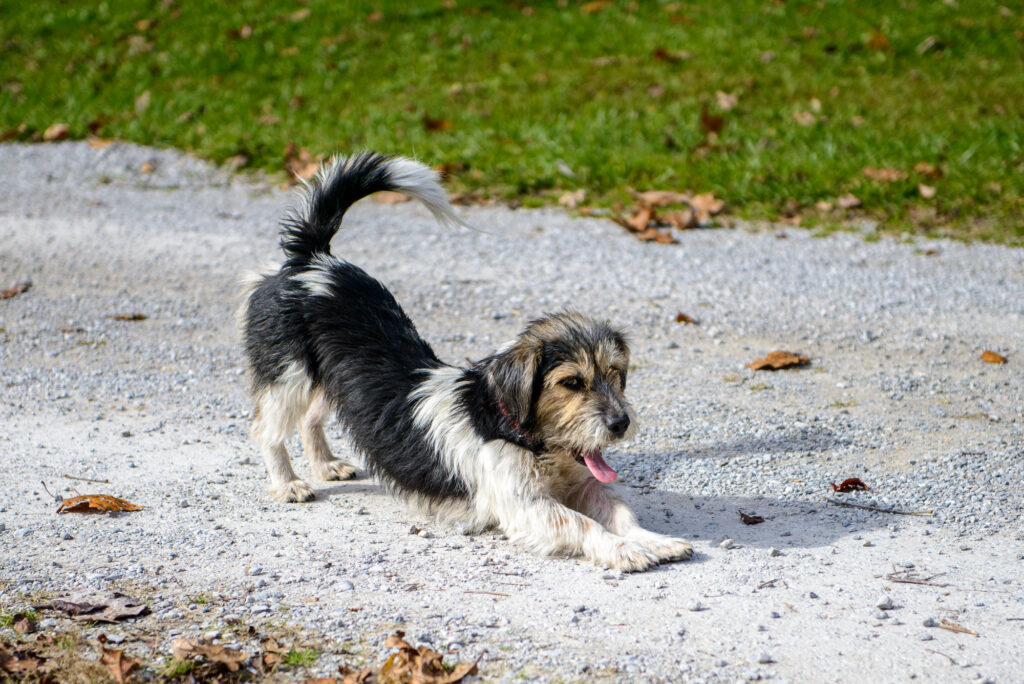
“Russell” 2022 A short-term terrier visitor/boarder and friend of “Lady” Probably a “drop-off” and ultimately a disappeared dog. Information on his whereabouts is requested if known. [Photo: Eric Tomberlin, UNCA 2022]
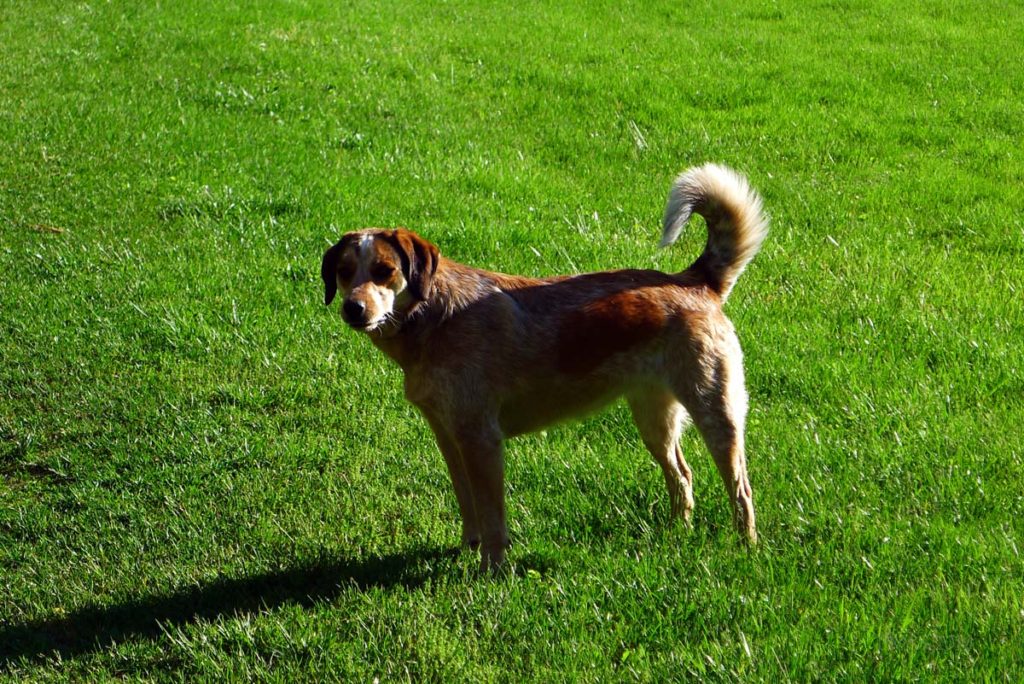
AND THEN CAME “LADY”
This beautiful, talented, and dignified dog now resides on the campus. She is certainly the next dog legend of Pine Mountain Settlement School. She is a constant companion of children on the playground and a guard dog of residents when they visit. She has known three Directors, and from the beginning, she “owned” the campus. A friend and official greeter of all newcomers, the “monitor” of the playground, Lady “owns” the campus, and monitors its use or abuse. She often accompanies visitors on trails, keeps watch over the sheep, and the goats, and is often an escort from building to building. She is, in every sense, the School’s ambassador. We hope you will visit and meet her.
While writing this essay, an article caught my eye and signaled the opening of a new world where future dogs may no longer be warm and fuzzy, but are robotic … No more dog food …no poop… no barking …. no whining, …. companionship? …..best friend? Come and meet Lady … no contest.