Pine Mountain Settlement School
DANCING IN THE CABBAGE FIELDS
Weaving and Natural Dyes and Natural Talents – Becky Huff
DANCING IN THE CABBAGE FIELDS
Weaving, Natural Talents, and Natural Dyes – Becky Huff
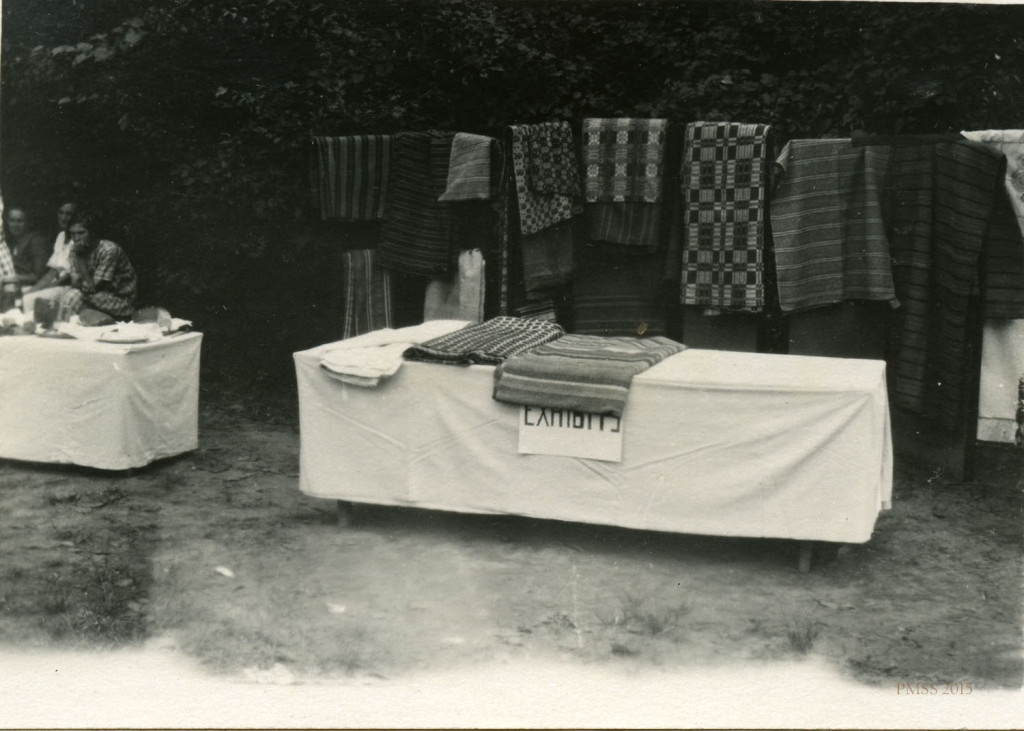
Exhibit of weaving and woven craft. [norton_021.jpg]
By 1930, shortly before Katherine Pettit’s retirement, she {Pettit} tried to recruit Becky back to Pine Mountain as one of Pine Mountain’s most talented weavers. She had been trained by Pettit and others and was an expert weaver, dancer, and institutional historian. Pettit wanted her to come back to the school and mainly resurrect the weaving program but there were other assignments. The letter, a full pleading page from Katherine Pettit, lays out the generous terms of employment if “Beckie” [Becky] would return to Pine Mountain to develop a weaving program, teach a few dance classes, and possibly perform several other tasks as required, she would be housed, salaried, and back among friends.
It is uncertain where the plea originated, but clearly it points to Katherine Pettit trying at the end of her life to bring back the craft on which she founded the School headed by one of her favorite students. But it was also more than that. Becky had been there with her as a child in her first years at the School in 1914 and forward. Becky, while remembering those Pine Mountain first years to her family noted that as a child she was charged with bringing Pettit her breakfast each morning. Pettit and many others also remember Becky as the sister of Almon Huff. Almon was one of the students killed when the new School House caught fire and burned to the ground, killing Almon, three other students, and one teacher. Miss Pettit and Becky shared many memories.
Pettit’s letter was written as she was preparing for retirement and her final days with the School. Pettit continued to center weaving at the height of the Depression — at the center of a era unlikely to want to spend precious dollars on craft. Her actions are difficult to asses — to explain her belief in a market that could balance the full throttle of Depression with craft sales and a School charging ahead into a new educational mode that did not place craft on the front line. In some ways Pettit’s plea captures the tension, desperation, and confusion of the 1930s across the country.— The Great Depression is still bearing down on the country following the 1929 crash, unemployment is rising and unstable, the Smoot-Hawley Tariff passes, the Dust Bowl is ravaging the agricultural centers of the country, and poverty is everywhere, and Pettit wants to teach weaving.
The country was desperately searching for solutions as Americans desperately searched for work. The new discovery of the planet Pluto diverts attention for a brief time as the newly abandoned populace looks to the planet and wishes they could escape there. But there are no easy answers. Somehow, this all sounds all too familiar.
The Smoot-Hawley Tarriff initiated during the early years of the Depression — the economic down-turn was a disaster. It raised import duties on over 20,000 goods by roughly 20% to 50–100% in some cases. While it aimed to protect agriculture, the farmers of America and related industries tanked, and the Great Depression ravaged the country as so well described by Steinbeck in The Grapes of Wrath. As a result of Smoot-Hawley the country’s trade partners retaliated, and the trade battles caused a 66% decline in world trade for nearly five years and the retaliatory tarriff on the USA — on Harlan County and its coal. The tariffs set off the Great Depression, and in an area that could little afford further declines in its near-poverty living standards.
Did Katherine Pettit win Becky back to Pine Mountain? Was this the end of the weaving program? Read on. See BECKY MAY HUFF Student Staff
THE LETTER (Katherine Pettit to Beckie Huff)
April 2, 1930
My dear Beckie [Becky].
I have been wondering what you’re going to do about your job next winter? Miss Gaines [RUTH B. GAINES] says that you are expecting to come here. Although I have not received any word in reply to my last letter. Asking you definitely about it. Now, won’t you tell me very definitely? if you would like to come to take charge of the [weaving] department. Although I will not be here. Miss Gaines will be here to carry the ideals and standards that we have set. I should like to know if you are interested in our plans for this department and if you will help me to carry them out. Will you fill out the enclosed questionnaire that I may have it for our files as we require it of all our workers.
Did you know that, Mrs. Wilmer Stone is just getting published her [Katherinde Pettit book ] book on vegetable dyes. I saw an exhibition of her weaving. In Knoxville last week, where there were many very beautiful things, and hers was the most beautiful. Again, she told me if you could do so next year, she would be so glad to have you come to North Carolina and teach you all she knows about vegetable dyes as many people think she is wonderful at that. It seems to me it would be a great chance for you. Miss Ruth B. Gaines thought that you would also be interested in helping out with the country dancing, gymnastics, and singing games. Mrs. [John C.] Campbell, and Miss Butler have offered to take any people who worked in the mountains there for 10 days and let them have special instructions from their [John C. Campbell’s] Danish gymn teacher, and if you go to Miss Stone in Saluda, NC. would you not like to go to Mrs. Campbell’s [John C. Campbell Folk School] while you are there, for those special lessons?
We have a chance to get a wonderful weaving teacher — 35 years old. She would like to have a permanent job, and if you know positively you do not want to take this job, we shall certainly take her, for we are so anxious to get it [weaving] on a permanent basis. Run year by year by the same person. Now, Beckie May, if you are likely to get married within a year or so, as most young girls do, we want to tell us very frankly so that we may know how to plan for the future of this department. Miss Gaines is so eager to have you come and I think you could have an awful good time living at Laurel House with her and Emily.
Saturday is Aunt Sal’s Day, and all her family and friends are coming here for dinner with us in her little cabin and to see her great-granddaughter weave on her loom the same kind of a blanket that her great-grandmother taught her. Now I wish you could be here for such an interesting occasion.
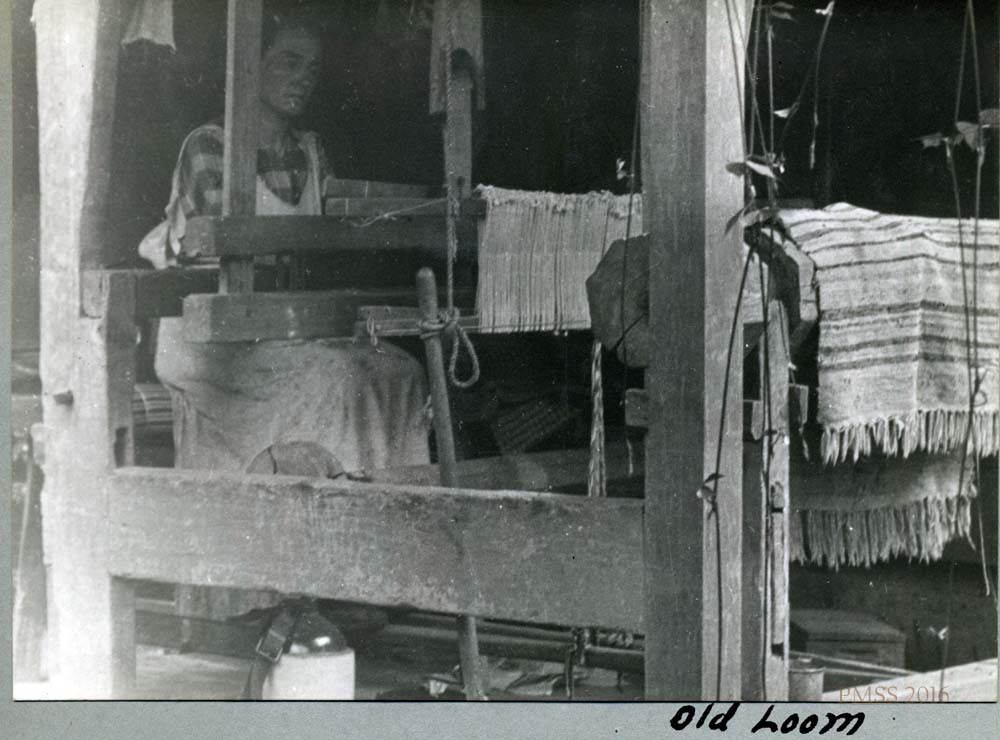
Woman weaving at “Old Loom.” [nace_II_album_020.jpg]
p.2
… and will you be here for our Mayday and pageant of olden days? Miss Bolles is coming soon, and I wish you could be here all the Spring with us as we dance.
Yours sincerely.
Miss Becky May Huff
Methodist School
Olive Hill, KY
KP/B
1930 saw the initiation of the high-school boarding program just one year before the arrival of Glyn Morris and his Progressive Educational agenda that set a new course for the School from 1932- 1940 and just two years following the death of Ethel de Long Zande on 1928 from cancer.
Pettit’s letter captures the void left by Ethel de Long’s death and the uncertainty of the world between the Wars, the Coal Wars raging on the other side of the mountain, and the slowly healing Great Depression. It was one of the most fragile times at the School as it struggled to find its educational direction.