
Pine Mountain Settlement School
Series: DANCING IN THE CABBAGE PATCH
The “Harmful Settlement Schools” Debate
Series 17: Publications Related to PMSS
The “Harmful Settlement Schools” Debate
HARRY ROBIE “Resolved: That on Balance the Settlement Schools Were Harmful to the Culture of the Southern Mountains.”
Jane Bishop Hobgood Response to Harry Robie
John Deaton Response to Harry Robie
Vivian Sexton Flannery-Dees Response to Harry Robie
TAGS: Jane Bishop Hobgood; Harry Robie; John H. Deaton; Vivian Sexton Flannery-Dees; Pine Mountain Settlement School; settlement schools; Settlement Movement; Settlement Schools Southern Appalachians; rural education; Hindman Settlement; Red Bird Mission; Sidney Saylor Farr; Stuart Robinson; Glyn Morris; progressive education; Alonzo Turner; Katherine Pettit; Martha Burns; Arthur Dodd; ballads; environmentalism; Burton Rogers; Ann Cobb; cultural pluralism;
In 1991, Harry Robie, a faculty member of the English Department at Berea College, Kentucky (1985-1992), wrote an article about his research regarding the adoption and, to his mind, failure of elements of the Settlement Movement adopted for educational programs the Southern Appalachians. [Published : Robie, Harry. “Resolved: That on Balance the Settlement Schools Were Harmful to the Culture of the Southern Mountains.” [Appalachian Heritage 19.1 (1991): 6-10.] His article was soon followed by a second article published in the same journal that took issue with Robie’s assessment of the Settlement School ethos as perceived by students educated within the unique Settlement School experiences.
The two opposing positions opened mixed responses, that continue to be assessed by educators, the educational institutions, and students who participated in the educational experiences. The scholar’s view and that of the opposing students became more than personal perspectives and rebuttals. The article captured the essence of educational experiments and the “harmful culture” that often accompanies the adventures of educators and student, alike. The educator stood his academic ground and the settlement school students waged a much more personal rebuttal. Their immediate angry and palpable emotional rebuttals of the Robie analysis brought important and continuing attention to how rural education often evokes change in the larger educational picture and particular genre of rural education. The dialogues constitute one of the most informative views of cultural perspectives within the growing uniform educational mandates across the country. Pine Mountain Settlement School and its students were well suited to raise of the counter-arguments to the Robie “harmful culture” thesis. There are lessons to be learned on both sides.
The Appalachian Heritage articles created mixed responses among scholars as some believed it was evident that Robie had purposefully started a firestorm to try to drive home what he identified as a fragile romanticism associated with education within the rural settlement movement. But, the settlement schools and their students, particularly Red Bird Mission, Pine Mountain and to a degree, Hindman Settlement, pushed back against this Robie thesis.
HARMFUL CULTURE
Not only students responded. Many of the administrators, teachers and particularly the former students of the Settlement School institutions responded swiftly to what Robie identified as the Romantic “harmful culture” thesis and, overwhelmingly, the response to Robie was oppositional. Robie appears to be pleased by his firestorm. Most of the respondents fiercely declared their experiences were not as described by Robie in his articles. The resistance to the idea that the Settlement School education was “harmful to the culture” of the southern Appalachians was particularly fierce from the Pine Mountain Settlement School students and staff.
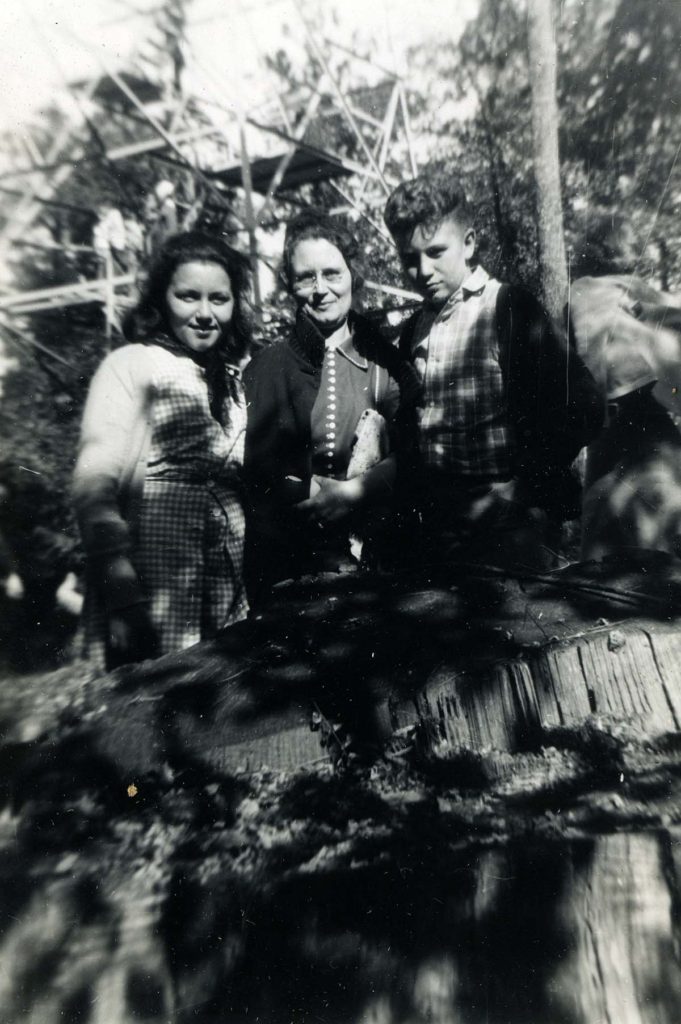
“Me and kids.” Birdena Bishop and Jane and Jim Bishop. [bishop_06_005.jpg]
Three students, Jane Bishop Hobgood, John H. Deaton, [Pine Mountain] and Vivian Sexton Flannery-Dees [Hindman], were all educated within Robie’s perceived “harmful” environments. And, as they read and reread Robie’s thesis, they refused to position themselves within the framework that Robie described as “culturally harmful.” For them, the settlement school was a way of life that was enriching, nurturing and well-integrated with the Appalachian cultural elements they had experienced growing up and that had been integrated into the settlement schools.
Finding harmful elements in the sea of opportunities offered by the settlement schools was for the three students, an alien idea and a futile search.
The clash of the former student perceptions with those of Harry Robie, was explosive with its language of anger and rebuttal, but it was also tempered with a nostalgic sadness and reflection on a culture that was slowly slipping away as roads, communication and educational consolidation began to explode in rural America.
The students nudged many to query, “Whose culture was it, anyway?” The cultural appropriation and/or clash that was described as a debate was not unique to just this southern Appalachian educational instance. While the argument resonated deeply with the students who had been schooled at Pine Mountain Settlement and Hindman Settlement in particular, it also touched the nerve of the other cultural appropriation debates that were taking place in the 1990’s. Appropriation, if it can be called that, is a human response to natural hazards that threaten a perceived way of life. This appropriation was and is not new, and today perceived human hazards, or appropriations, and strong diverse human responses continue at an even more rapid pace in the charged environment of Presidential election and other political elections.
Fueled by new social media and technological innovation, appropriation comes at us with a ferocity not just from our rapidly changing local environments, but from all corners of a changing world. Cultural isolation is near impossible for the “wired” and technological savvy of the twenty-first century and is primed to become even more disruptive and cultures form outside the boundaries of nation states.
The idea of “Cultural studies” was a late-comer to the long tale and tail of the academic community. In England, for example, the work of Richard Hoggart and Raymond Williams, both of whom had working class origins, began to attract attention in the late nineteen-fifties and early nineteen sixties with their exploration of cultural studies. The authors moved away from the traditional educational cannon believing that the new popular culture and the growing mass communication technologies were changing the relationship of the masses to power and authority and also to one another. They founded the Center for Contemporary Cultural Studies, which in the nineteen-seventies was directed by Stuart Hall, a Jamaican who has been characterized by some as the “God-Father” of multiculturalism.
STEWART HALL
 Stuart Hall was a disrupter, and one much more radical and far-reaching than Glyn Morris, the Director at Pine Mountain [1931-1941], who was arguably the most far-reaching and Progressive Director of Pine Mountain Settlement. Yet, Hall was not radical or far-reaching in the manner of disruptive dialogs found within and without many of the administrations that have filled our government since the 1940s or, the two current Trump administrations.
Hall was someone who, like Morris, was more interested in “being alive during disruptive times,” than in doing battle or taking sides in a power struggle. This appears to have been similar to the same approach taken by Harry Robie. The multi-cultural Stuart Hall saw the social changes surrounding him as a newly forming culture trying to “grasp at these changes, to wrap one’s head around what is newly possible….” And, Pine Mountain under the Morris administration, was adept at shifting cultures as seen at Pine Mountain and later in his educational ventures in New York State and in the Harlan County educational environment.
Like Morris and other leaders who passed through the Pine Mountain Settlement School, leadership, Hall’s writing in 1973 considered the idea of “culture” as a “site for ‘negotiation,'” [Hua Hsu, “Stuart Hall and the Rise of Cultural Studies,” New Yorker, July 17, 2017]. Like his predecessors, Hoggart, and especially Raymond Williams, Stuart Hall spoke to similar cultural longing that one senses in the passionate letters of Jane Bishop Hobgood, John Deaton, and Vivian Sexton Flannery-Dees, the Settlement School students writing in the early 1980s. Hall in many ways captured the essence of the arguements that are at the heart of the Robie challenge.
A PINE MOUNTAIN RESPONSE
Jane Bishop Hobgood in her response did not create a threnody, (described as a wailing ode or hymn of mourning composed as a memorial to an idea), as suggested in its analogy to the mountain ballad . Jane Bishop Hobgood did not seem to believe that the “culture” she experienced was dying nor dead nor even harmed, but she believed she saw it as under attack. Though much of Pine Mountain’s culture had borrowed extensively from across the centuries while isolated deep in the difficult geography of the Appalachians, she responded with an informed exploration of what she believed was a powerful and driving life experience during her educational years at the Pine Mountain Settlement School. Her experience was, she believed, shared in large part with the other Settlement School student respondents. This seems to have given her argument the strength of a mutually supported conviction that lingers even now in the descendants of the trio — Hobgood, Deaton and Flannery-Dees, as well as other students who participated in the mountain educational system.
HARD LANGUAGE
For most of the students who experienced Pine Mountain Settlement School, it would be near impossible to distance themselves from their life-changing experience or to be introspective without emotion as the experience with the school was often so integral to the shape of their later lives. The response of many students to Robie was often not captured in writing, but, like Jane’s, John’s, and Virginia’s responses, other settlement school students were known to speak out strongly in opposition to many of his views with an equal amount of sincerity and anger. How could Harry Robie presume to declare that settlement schools harmed the Appalachian culture? He had not experienced the schools as a student? He did not grow up in hard-scrabble Appalachia. How could any student who experienced the hard scrabble of Appalachian life and then the Settlement School be anything but deeply reflective and reflexive? Jane and John and Virginia refused to accept Robie’s view of intrusive settlement work. But, the question still remains. Did these former students really speak for a majority of those who attended the institutions?
A TURBULENT TIME
1937 was a difficult and turbulent time for Pine Mountain Settlement and for Glyn Morris, the Director of the PMSS School. With a progressive staff, Morris initiated a questionnaire to be sent to students who had attended Pine Mountain during its first three decades. Compiled by Everett K. Wilson, a teacher and counselor schooled at Antioch College in Ohio, and eventually an internationally recognized sociologist, Wilson’s questionnaire pried loose some of the answers that the School was searching for. One student, a member of the local Tolliver family, responded curtly to the survey. Tolliver’s response and other similar responses, suggests that memories do not always form one voice or reflect one reality. Tolliver wrote back to Wilson that the heart of the issue at Pine Mountain was that the School “hired too many old maids.” Old Maids may not have been the exact aspersion, but it is close. This was an early shot over the feminist bow at what has become familiar to the gender debates we continue to engage in the twenty-first century.
A HEARTFELT BALLAD of “ORIGINALITY
In light of other student responses, Jane Bishop Hobgood’s heartfelt ballad to Pine Mountain is not a piece of cynical fatalism, but a word-song that many former students could identify with. It pays tribute to an institution that allowed its students to explore what it might mean to recreate self in a safe and supportive environment. She points out that while many of the “cultural tools” used at the School were English and European in origin, they were not narrowly defining. They played to the strengths of the shared familial heritages of the area and tugged at much of the familiar and pervasive regional religion and ethos. Though Jane Bishop, daughter of a staff member, was not born in the greater Community, her education was shared collectively. Yet, her “on-campus” origin and students of staff, like herself, were sometime self assigned an elevated specialness because of their perceived common heritages. their educational experience was shared. This “sense of place” is something that some scholars have called an “internal colony, ” and can be associated with many institutions where children of staffing do not share “originality”. In many ways she became a vocal advocate for staff and student.
Her offering is, clearly an emotional and heartfelt response to Robie’s perceived lack of understanding of “community”. Jane details how the settlement workers did not lock the students into the same rigid social trajectories that culture sometimes imposes on peoples throughout the world — as “insiders” and “outsiders”. She underscores the benign and positive influences of a multicultural education and gives no hint of cultural omission or domination or suppression in describing her settlement school experience and her extended relationship to the institution.
CULTURAL CLASH
Today, the massive migrations of peoples across the face of the earth have left trails of angst and scars from cultural clashes that dwarf pros and cons of the Appalachian Settlement School experiences. As migrations and immigration increases so does the call to look more closely at the role of education in building emotional and educational bridges to future success. Schools are sanctuaries of culture, harbingers of futures, and rooms of private dreams. There has never been a unified viewpoint to regional or cultural studies and the trail of anger and misunderstanding stirred up by politics, religion, status, and other perceptions. Solemn pronouncements in the 1940s (the war years) were long and emotional and shared. Today the toxic trail of anger and misunderstanding is longer, louder and more disparate and damaging. The pervasive and perceived assault on a way of life is daily in today’s news. In the 1930’s and 1940s communication was a salve at the settlement schools during war-time. The forced boarding schools for Native Americans, the lack of schools in immigration camps, and the current generations who will never have the support system to even think about an “education”, is the other difficult side of those disturbed years. Years, hard to imagine at this distance.
THE “WAY OF LIFE”
When a way of life is threatened or demeaned it can evoke and stoke strong emotions in the identified self. When Robie made his pronouncement that the settlement schools were agents of “harm” it was perceived as a threat to a way of life and a rebuke to the school’s efforts and that of the teachers and their students. Robie’s “harm” appeared to negate the perceived inherent cultural gifts and well-intentioned exchanges that gave brighter futures to students from the settlement schools. Robie, according to some was not about promotion of a particular point of view, but abut opening a word of many views. He generated one of the most valuable debates in the history of rural settlement schools and provided a future dialog regarding the Settlement School ethos. The kernels of wisdom and perception found in the student responses paints a vibrant multicultural canvas of how education can shift cultural perceptions and sometimes, destiny.
On February 15, 1917 Cecil Sharp the noted English ballad collector, in an address to the prestigious Pen & Plate Club gathered in Asheville, North Carolina, said of his visit to Appalachia and his experience with the “… mountaineers of this section [Appalachia] …”, said
I was deeply impressed with the native courtesy and chivalry or the Mountaineers. Their culture is hereditary, I found no such thing as ‘arrested development’; rather I should say I found arrested degeneration.
While this may seem at first to be a somewhat back-handed compliment, what Sharp was alluding to was his profound racist belief in the superiority of the “Anglo-Saxon” stock. But he was also commenting on the cultural and social deterioration of cultures not supported by their host countries. The British had many opportunities to review the sometimes brutish arrogance of culture bashing in their homeland. But that long history when transplanted is not without multiple gifts. Culture, in the view of this author, continues to be unstable in this country. It continues to shift and wax and wane and is not full-blown here. The most severe instability is often tied to the dreams of the leaders and the courtesy and chivalry that was found at the settlement schools during the experimental Settlement School years. There is in the debate at Pine Mountain, and the other “settlements” a rich foundation and a hopeful trope that shows up in the many assessments of the Appalachian region when important questions demand responses: Did imported cultures help or harm the people of Appalachia?
CULTURAL DEBATE
The many perceived threats, cultural, racial, social, educational, etc., perceived in Robie’s pronouncement were personal. They hit a nerve. To Jane Bishop and to many of her fellow students, and those at similar settlement schools, challenging educational direction can be an affront to the “perpetrators”, the settlement schools themselves — or not. The three students described experiences that screamed at the limited framing Robie appeared to give to a collective historical and cultural and personal experience that continues to beg the questions surrounding what constitutes a “good education”.
Robie, the resulting contestations and perceptions of the three students and the settlement schools as institutions, all reflect how individuals and institutions and the shared experience can yet transcend the pervasive stereotypes of identified cultures. The “harms” were not a part of the student’s shared perspectives and attitudes and the declared sense of place the schools shared with one another and with the students and the students with each other, but, continues to be both a tight and an open cultural bond. In fact, in the minds of some, Robie was waging a battle for even a corner of Eden — a non-reality — a constructed educational paradise that would engage and use knowledge for a better world.
Whether the “harm” was to a utopian perception or to Robie’s own lost culture, or a smoke-screen for debate, is difficult to untangle. But, the journey to arrive at a civil cultural discussion came at a time when “cultural pluralism” was being discussed in academe and where we challenged our held-fast ideas as they were being pulled apart in lively debates. The right of each side to hold close their perception of “authentic” culture and the belief that the authentic culture has its own unique vision with its own scale of values, is understood by many Appalachian scholars to be an almost sacred right that in Appalachia continues to have a religious fervor.
STEPPING BACK FROM THE CULTURAL ECO-SYSTEM
But, did Robie actually believe what he wrote or was he “baiting” an audience that he saw as endangered by culture changes ? Was he aiming to “save the culture” of Appalachia? Or, not? Culture is in constant flux and changes as rapidly as do visions and values. People are at once both subject and object in the fast moving stream of culture. The act of sharing is a political act and political acts are rarely balanced in the resulting sea of cultural pluralism. And, these seas are themselves often fragile seas that flow together with unpredictable tides of intolerance and anger against a dominant system — or, even an entire ecosystem. We have no difficulty in finding examples in today’s culture.
Sensing, perhaps, the brewing controversy surrounding cultural pluralism, Sidney Saylor Farr, then editor of Appalachian Heritage, called for responses to the Robie article in the journal. She did not have to wait long. The anticipated push-back came in the three essays from the former settlement school students. Sidney Saylor Farr, herself an Eastern Kentuckian and a former student at Red Bird Mission School published the settlement school student rebuttals in issue #3 of the same Appalachia Heritage volume, “Those Settlement Schools: Harmful or Benign? Three Responses to Harry Robie,” in Appalachian Heritage 19.3 (1991): 45-52. The publication launched a broader round of debate, discourse, applause, and anger.
PUSH BACK – A REFLEXION ON THE RESPONSES
Of the three contrarian student responses, Pine Mountain Settlement School’s Jane Bishop Hobgood‘s refutation stands out as one of the most articulate, deeply felt and vivid voices against Robie’s “harmful culture” thesis. Her role on the Pine Mountain Settlement School Advisory Council was particularly important as her settlement school perspective was both internal and external and extended over years and across related institutions (Hindman, Berea College and Warren Wilson College). She had been an integral part of tracking the progress of the School through her many years of association as a student, as a daughter of a Pine Mountain Settlement School worker [Birdena Bishop], as a Berea College graduate, and as a member of the Pine Mountain Settlement School Advisory Board. Her response, which she sent to Pine Mountain as well as to Appalachian Heritage magazine, was placed in the archive at Pine Mountain Settlement School and is reproduced and transcribed in full, in Jane Bishop Hobgood’s Response to Harry Robie.
Jane Bishop Hobgood’s response was soon accompanied by that of John H. Deaton, also a Pine Mountain Settlement School graduate and by that of Vivian S. Flannery-Dees a graduate of Hindman Settlement School.
The fires of the debate surrounding Robie’s cultural survey and the “harmful” settlement schools thesis still smolders but has been eclipsed by the current and growing national cultural debates that have unleashed current angers on a much less reasoned dialogue than that of Jane Bishop Hobgood and the other settlement school students. Further, the increasing tensions surrounding our current national identity is proving to be an extensive firestorm of debate and one that threatens the very constitutional fabric of the United States, not just the culture of the Appalachian region.
Cultural brawls today have erupted on a multitude of national and international borders, within our systems of worship, in our democratic institutions and in the major media channels and social media. Throughout the centuries in our multi-cultural nation “Cultural pluralism” has had a host of critics and many of those critics have now taken up a chant against cultural pluralism or for their own new —“ism —the “tribalism” of many names — their chosen identity. The language of criticism has evolved and new words have crept in, but the debates sound familiar. Today our cultural debate is rending the fabric of society at all levels and in all regions. It has spilled into all corners of our educational systems, work-place, communication networks, social networks, or, more noticeably the communication networks have spilled into all corners of our lives with their fractured and factionalized and frequently fictionalized debates.
Debates such as that surrounding the harmful influence of settlement schools have escaped the boundaries once imposed by local historical anthropology and have become the essence of life and death struggles of economic classes, political zealots, and wanana-be dictators, in many areas of the world. The Jane Bishop Hobgood Response to Harry Robie has served to remind us again of the fragility of this “Crooked Timber of Humanity” as Isaiah Berlin called it. He was paraphrasing Emanuel Kant who first said, “Out of timber so crooked as that from which man is made nothing entirely straight can be built.”
Today’s culture wars are still being waged in the academic sector, the federal government, the press and in the publication of culturally contentious works such as J.D. Vance’s book, Hillbilly Elegy (2016), Nancy Isenberg’s White Trash (2016), and other much-debated monographs, such as Elizabeth Catte’s What You Are Getting Wrong About Appalachia, (2018) and the thoughtful work of Stephen Stoll in Ramp Hollow: The Ordeal of Appalachia ( 2017). Not to mention all the earlier excellent work by authors who early-one identified a multitude of contentious directions.
Cultural opposition proliferates in electronic blogs and other social media. “Regionalism,” whatever that is or was, has given way to what many describe as fractals that spin away from the Appalachian experience with a curiosity and ferocity heightened by AI and other forms of collective information. Labels such as “regional colonialism” and “internal colony” and labels such as “tribalism,” whatever that is or was, … abound.
Today other imagined geographies and borders and their collective perceptions continue to proliferate. The arguments are now reshaping our political and judicial maps and in the process, we are creating new cultural landscapes that few seem to feel quite fit their personal understanding of “their” space. Gerrymandering, gentrification and “mediated media were, in the past viewed as inevitable harbingers of cultural shifts that could prompt defensive political responses. Today the knee-jerk reaction is more frequently the offensive verbal weapons designed in the eras of Postmodernism and its spin-offs, — the cultural war of “other”. What is ‘pure Anglo-Saxon” stock? What happens when a newscaster in New York refers to the “indigenous” people of South Carolina who hide behind their “culture”? Who are these “indigenous people”? What is this uniform culture the newscaster believes exists in South Carolina? In Louisiana? Appalachia? What was once a culture is now tangled in the political thickets of economic class, race relations, immigration, and ethnic and religious preference. What perception is to be understood as THE culture of a region? Of a people? The artist Blake has warned us
Robin Red-Breast in a cage
Puts all of Heaven in a rage
Harry Robie retired from Berea in 1992 and died in the small college town of Berea in 2009 at age 75. His passing was marked by the many sympathies and tributes received from his former students at Southwestern High School in Jamestown, NY, where he taught for many years and at Berea College where his students still cite his subtle journeys into our inner psyche. He was a man who stimulated ideas. He shook the tree of complacency and set many to thinking about their fragile relationship to their “culture,” and to their commonly held ideas and beliefs.
Jane Bishop Hobgood continued to live in Urbana, IL and following her brief and gracious gift on the Board of the School, slowly reduced her longer visits to the School as she struggled with dementia. On Jane’s last visit to Pine Mountain, this editor, also educated at Pine Mountain Settlement School, promised Jane that her vision and that of others who believe and believed in the value of settlement schools to help shape the future of the Appalachian region and beyond, would not be silenced nor distracted by criticism and in-fighting. Nor would Pine Mountain Settlement be seduced or distracted by cultural wars such as that waged in the late eighties and nineties, and today by our political divides.
An informed debate, a sense of place, passionate beliefs and clear thinking all have a place in our race toward prosperity and peace — those values were taught at Pine Mountain — and they continue. As Uncle William Creech said in a letter written in 1915, now commonly referred to as “An Old Man’s Hopes for the Children of the Kentucky Mountains,” Creech captures a universal dream for the people of the world. The land he deeded to found Pine Mountain Settlement School over one-hundred years ago, was to be used to pave the way for education, the door to opportunity.
| “I don’t look after wealth for them. I look after the prosperity of our nation. I want all our young uns taught to serve the livin’ God. Of course, they won’t all do that but they can have good and evil laid before them and they can choose which they will. I have heart and cravin’ that our people may grow better. I have deeded my land to the Pine Mountain Settlement School to be used for school purposes as long as the Constitution of the United States stands. Hopin’ it may make a bright and intelligent people after I’m dead and gone.” |
Pine Mountian has over 100 years of success in strengthening not just Appalachian culture (if viewed as a single entity) — or THE culture, and ALL cultures. Uncle William also said that he hoped that the settlement school would serve not just the local populations but would also influence “the people here and across the seas.”
The Pine Mountain Settlement School realized early on that culture today, has few boundaries and borders. Pine Mountain and other settlement schools had much to offer in the past and a deep dive into the missions of these institutions now reveals that they have even more to offer in today’s fragmented world. Pine Mountain is a school where access to a folk culture that educates and uplifts will continue to be promoted as an integral part of both the legacy and the future of the School. Rural settlement schools have always had a deep commitment to place, to the land and to the people of the Southern Appalachians. They are deeply committed to environmentalism and the responsible stewardship of land and resources including people. Those who experienced the rich education of the settlement school will always be mindful of the “world beyond the seas’ —- just as Uncle William and Katherine Pettit would have wanted it and the settlement school experience will continue to be there as mountain doorways open every day to new ways to meet life’s challenges.
BIBLIOGRAPHY
Robie, Harry. “Resolved: That on Balance the Settlement Schools Were Harmful to the Culture of the Southern Mountains. “ Appalachian Heritage 19.1 (1991): 6 – 10.]
Deaton, John H, Vivian S. Flannery-Dees, and Jane B. Hobgood. “Those Settlement Schools: Harmful or Benign? Three Responses to Harry Robie.” Appalachian Heritage. 19.3 (1991): 45-52. Print.
Cobb, Ann. Kinfolks & Other Selected Poems. Hindman, Ky: Hindman Settlement School, 2003. Print.
Hobgood, Jane B. “Walter Crane.” Children’s Literature Association Quarterly. 6.4 (1981): 30-32. Print.
Isenberg, Nancy. White Trash: The 400-Year Untold History of Class in America: with a New Preface. New York, N.Y: Penguin, 2017. Print.
Morris, Glyn. Less Travelled Roads. New York: Vantage Press, 1977. Print. Chapter 11, Part 1
Ritchie, Jean. (1955). Singing Family of the Cumberlands. Illustrated by Maurice Sendak. [Reminiscences.]. Pp. vi. 282. Oxford University Press: New York.
Vance, J D. Hillbilly Elegy. , 2016. Print.
Wells, Evelyn K. The Ballad Tree: A Study of British and American Ballads, Their Folklore, Verse, and Music, Together with Sixty Traditional Ballads and Their Tunes. London: Methuen, 1950. Print. Chapter 13
Whisnant, David E. All That Is Native & Fine: The Politics of Culture in an American Region. Chapel Hill: University of North Carolina Press, 2009. Print.
SEE ALSO:
JOHN H. DEATON Unlicensed Dreamers
GLYN MORRIS Is There Any Further Need for a School Like Pine Mountain?