
Pine Mountain Settlement School
Series 17: PUBLICATIONS PMSS
Notes 1947
November

Laurel House II, interior view of dining room. Arthur W. Dodd Album. [dodd_A_017_mod.jpg]
TAGS: Notes 1947 November, Notes from the Pine Mountain Settlement School, publications by PMSS, Berea, Red Horse Branch, superstitions, Virginia P. Matthias, Uncle William, William Green, Rosa Lee, Mr. Arthur Dodd, Charles N. Manning, E.S. Dabney
NOTES 1947
“Notes from the Pine Mountain Settlement School”
November
GALLERY
The Board takes deep satisfaction in the fact that Mr. E. S. Dabney, Mr. Manning’s successor in the Security Trust Company of Lexington, has consented to serve as our treasurer.
-
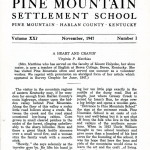
- NOTES – 1947 November, page 1. [PMSS_notes_1947_nov_001.jpg]
-
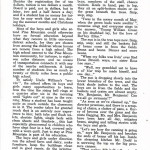
- NOTES – 1947 November, page 2.[PMSS_notes_1947_nov_002.jpg]
-
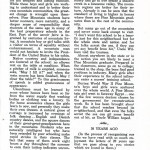
- NOTES – 1947 November, page 3.[PMSS_notes_1947_nov_003.jpg]
-
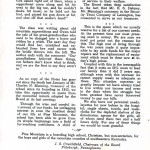
- NOTES – 1947 November, page 4.[PMSS_notes_1947_nov_004.jpg]
TRANSCRIPTION: NOTES – 1947 November
P. 1
NOTES FROM THE
PINE MOUNTAIN
SETTLEMENT SCHOOL
PINE MOUNTAIN * HARLAN COUNTY * KENTUCKY
Volume XXI NOVEMBER, 1947 Number I
A HEART AND CRAVIN’
Virginia P. Matthias
(Mrs. Matthias who has served on the faculty of Mount Holyoke, her alma mater, is now a teacher of English at Berea College, Berea, Kentucky. She has visited Pine Mountain often and served one summer as a volunteer worker. We reprint with permission an abridged form of her article which appeared in Survey Graphic for June, 1947.)
____________________
The visitor in the mountain regions of eastern Kentucky may, if he wanders far enough from Harlan County’s main highways, chance upon the hidden valley behind Pine Mountain. Along the floor of this valley a rocky little road follows along a creek. Between the creek and the road stand occasional low-hung cabins. Corn grows in small cleared patches in the midst of the forest, clinging unbelievably to the sharp hillsides. Here and there a great black kettle simmers over a small wood fire, and a woman stirs the family wash with a smooth stick.
“Howdy,” she says solemnly as the traveler goes by. He lifts his hand in salute. “Howdy,” he answers. He moves warily, not to disturb the three belled cows idling tentatively along before him, nor the flock of serious geese around the next corner, nor the fat black and white sow feeding her ten little pigs exactly in the middle of the dusty road. But at length, just where Greasy Creek is joined by Isaac’s Run, he steps over a log bridge and opens a wooden gate.
“Entrance to Pine Mountain School” the sign at the entrance reads. Pine Mountain School is an oasis of culture and well-being but it is not shut off from the folk who live in the hills and valleys of the southern mountains. When in 1913 Uncle William brought in two school teachers and gave more than a hundred of his best acres for the founding of the school, it was his hope that here the boys and girls of the mountains would come to learn the art and the craft of living.
“I have a heart and cravin’ that our people may grow better, ,” he said. And today the influence of Pine Mountain School reaches out for many miles along the roads and creeks and paths of the Southern Appalachians,…
P. 2
…and beyond the mountains too.
A boarding school on the high school level for boys and girls from hill farms and coal camps, Pine Mountain offers education at so low a cost that it is within the reach of any child, from however poor a family. Besides the registration fee of ten dollars, tuition is ten dollars a month. Board is paid, not in dollars, but in labor, two and a half hours a day; and if a student has no money for tuition he may work that out too, during the summer months and Christmas holidays.
Most of the boys and girls who attend Pine Mountain could otherwise have no formal education beyond what they receive in little one-room district schools, for they are chosen from among the children whose homes are remote from a high school. The high school nearest to the Pine Mountain community, for instance, is eighteen miles distance; and no means of transportation connects it with any of the nearby settlements. A large number of students live as much as twenty or thirty miles from a public high school.
To satisfy Uncle William [Creech]‘s “cravin'”, the school offers its boys and girls many opportunities to learn, from the time the rising bell rings at a quarter after six in the morning until “lights out” at nine in the evening. Many a student has been taught quite as much outside the classroom as in it. The reader takes for granted much that is an entirely new experience to him; bath tubs and flush toilets, electric lights, single beds with clean sheets and blankets, this last especially phenomenal to children who have slept four in a bed, covered only with a worn quilt. Just to stay at Pine Mountain is part of his education.
The boys and girls under direction run the school farm and dairy, make furniture, keep the buildings clean and in good repair, do the printing. and mimeographing, act as nurses’ aides in the school infirmary, prepare and serve excellent meals, and can vegetables for winter use.
Three thousand quarts of beans! In the early July morning a dozen boys take great baskets into the green fields and soon start bringing in the beans. Behind the Laurel House kitchen after the breakfast dishes are put away, people begin to gather girls and boys, members of the staff, chance visitors. Knife in hand, pan in lap, they sit on split-bottom chairs or on the grass beneath the trees. Snip, snip, snip.
“Twas in the merry month of May, when the green buds were swellin'” someone sings and everyone sings in the answer, “Young William Green on his deathbed lay, for the love of Bar’bry Ellen.”
The sun is in the tree tops now. Snip, snip, snip; and still the baskets full of beans come in from the fields. Beans and beans. Dinner and more beans.
“When my folks was livin’ over Red Horse Branch ways, my sister Rosa Lee says…”
“Well, my granddad ust to have a ol’ b’ar trap he made hisself, and one day…”
The sun is dropping slowly into the lower branches of the trees, and the thick shade inches to the east. The boys are in from the fields and the baskets and crates are almost empty. “Mr. Benjamin, Mr. Benjamin! Can we-all go swimmin’?”
“As soon as we’ve cleaned up,” the director promises, and there is a scraping of chairs, a clatter of pans, a flurry of brooms over the grass and the stone flagging. Mr. and Mrs. [H.R.S.] Benjamin have been here all day, snipping beans, singing and telling stories with the boys and girls.
“Let’s see how the canning is going on,” says Mr. Benjamin and brushes the ends of beans off his lap. Inside the steaming kitchen Mr. [Arthur W.] Dodd is is screwing the top on the big pressure canner.
“That makes 350 half-gallon jars,” he tells the director. Mr. Dodd, a graduate of Berea College, is the academic head of the school. The people in charge of the school apply to themselves…
P. 3
…the precept of Uncle William Creech that work is good for folk’s char-ac-ters.
Daily life in a place where differences of opinion resolved without force and without rancor is of especial value in a section of the country noted for hot tempers and lasting enmities. While these boys and girls are working to understand and to better their own mountain communities, the greatest change is wrought upon themselves. Pine Mountain students have better manners, more maturity, and a deeper sense of responsibility than students of the same age in many of the best preparatory schools in the East. Part of the savoir faire is ingrained by centuries of mountain living. A mountain boy or girl talks with a visitor on terms of equality without embarrassment. A mountain man would not hesitate to invite the President of the United States to his cabin.
Native courtesy and independence are fostered at the school: no elbows rest on the table at mealtime. When a pitcher of milk is emptied, someone asks, “May I fill it?” and when the main course has been finished, “May I clear the table?” To this graciousness of speech is added graciousness of appearance.
Cleanliness must be learned by some whose homes have been so far from the water supply that washing bodies or clothing was a luxury. In the home economics classes the girls learn to sew, and presently they make their own dresses. A natural grace of carriage is increased by evenings of folk dancing — English and Danish country dances, and the square dances of their great-great-grandparents here in the mountains. Students who are naturally intelligent but who have been retarded by poor schooling make rapid strides in their classes. The fact that many of them work eight hours a day throughout the summer to earn their tuition indicates uncommon eagerness to learn. A visitor at Pine Mountain School has the impression of a group of boys and girls unusally attractive, unusually well-bred, unusually mature.
Some of them stay in the mountains after they have been graduated. A few boys return home, take a job in the mine or the lumber camp, build a small cabin and buy a cow, two pigs, and a few chickens. Some of the girls marry and go to live beside a shallow creek in a lonesome valley. The mountain regions are better for their return. Already it can be seen that the standard of living is higher in homes where there are Pine Mountain graduates than in the rest of the community.
But many go out of the mountains and never come back except to visit. “I don’t want this school to be a benefit just for this neighborhood but for the whole state and nation and for the folks acrost the sea, if they can get any benefit from hit,” Uncle William told the trustees.
Almost anywhere in the state or in the nation you are likely to meet a Pine Mountain graduate. Prepared in the classroom, some go on to college; trained in the shop, the boys find good positions in industry. Many girls after their experience in the school infirmary enter a nurses’ training school.
During World War II Pine Mountain boys and girls were scattered over the whole world. A Pine Mountain girl went to faraway Egypt — one of the few women doctors chosen by the government for reconstruction work. So it has been brought about that the school reaches beyond its neighborhood, and that even the folks acrost the sea can git some benefit out of hit, as Uncle William hoped.
* * *
20 YEARS AGO
(In the process of reorganizing our files we have read with so much enjoyment the letters of 20 years ago that we pass along to you stories which we found in them.)
The brother of the hero told us this story of pioneer times as we walked through the mountains with him the other day. “Yes, I’ve knowed…
P. 4
…people to be bit by pizen snakes. My brother Sol’s been bit three times, twice by a copperhead and once by a rattler. One time he was a-goin’ through the mountains to hunt up some cattle of his and salt them, wearing a pair of old shoes with two toes naked right out of them, when a copperhead come along and bit his next to the big toe, and he couldn’t shake hit loose; so he held out his foot, and pinted his gun down at hit, and shot off that snake’s head!”
* * *
The class was writing about old mountain superstitions and Owen told the tale of his great-grandmother who used to be changed into a horse and ridden by a witch. The next day they would find her, scratched and exhausted from her mad career with the bridle thrown into the loft. The author ends with the comment: “Our grandfathers believed these things, our fathers don’t know what to think, and we are the first to say they aren’t so.”
* * *
As no copy of the Notes has gone out since the death last January of Mr. Charles N. Manning, treasurer of the school since its founding in 1913, we take this opportunity to quote from the memorial minute adopted by the Board at its last meeting;
Through his wise and careful investment of our funds, his unflagging interest in even the smallest detail of our life at Pine Mountain, the school has been able to grow from its simple beginnings into a field of far-reaching usefulness. A child of the Kentucky mountains himself, Mr. Manning knew the talents, abilities and the sterling qualities of the mountain people. Understanding their lack of opportunity for education, medical facilities and improved farming methods, he devoted a lifetime of service to their welfare.
The Board takes deep satisfaction in the fact that Mr. E. S. Dabney, Mr. Manning’s successor in the Security Trust Company of Lexington, has consented to serve as our treasurer.
* * *
This is the space which we usually reserve for a list of our current needs. At the present time our most pressing need is money. We are sure we need not point out the reasons for this. The high cost of living through the war years made it quite impossible to lay aside funds for the major repairs and the replacement of equipment which must be done now at today’s high prices.
Coupled with this is the inescapable fact that it costs us 50% more to feed our family than it did 2 years ago, although even with this increase we cannot supply meals as adequate as those. This situation concerns greatly because we have always tried to live within our income and even in the days when the struggle has been greatest have never borrowed money to pay our bills.
We also have our perennial needs: layettes for new babies in the hospital; single sheets, towels, and washcloths for the depleted shelves of the dormitories; aprons for the girls, all of whom need them two and a half hours daily. For any of these things we would be most grateful.
* * *
Pine Mountain is a boarding high school, Christian, but non-sectarian, for the boys and girls of the mountain counties of southeastern Kentucky.
J. S. Crutchfield, Chairman of the Board
Pittsburgh, Pennsylvania
E. S. Dabney, Treasurer
Lexington, Kentucky
H. R. S. Benjamin, Resident Director
(Set up and printed by students of the Pine Mountain Settlement School.)
Previous:
NOTES – 1946
Next:
NOTES – 1948
See Also:
ADMIN GENERAL Rules and Regulations Table Etiquette and Dining Room Rules
EDUCATION Student Government Rules 1930s-1940s
Return To:
NOTES Index