Pine Mountain Settlement School
Series 09: BIOGRAPHY
Series 13: EDUCATION
Endorsement of PMSS Little School, 1964
By Rebecca Caudill Ayars (1899-1985)
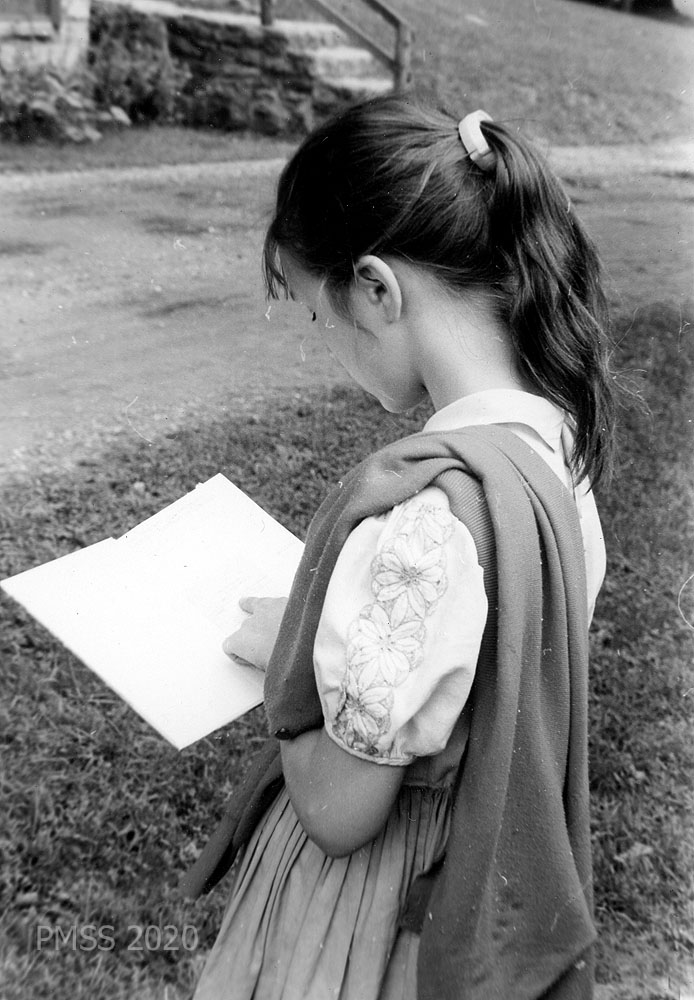
Barbara Callahan, reading. [089_LW_school_library_s_003f.jpg]
TAGS: Rebecca early childhood education, Rebecca Caudill Ayars, Rebecca Caudill, Little School, reading programs, Mary Rogers, Milly Mahoney, libraries, Young Readers Book Award, endorsement of reading programs, Harlan County KY authors
REBECCA CAUDILL (AYARS) PMSS Little School Endorsement, 1964
TRANSCRIPTION
Page 1
Impressions of Little School: 1964
I am writing my impressions of Little School almost a month after my visit there. With the passage of time, certain values and qualities have risen to the top, like cream on milk.
Presumably I should write first about the children since this is their school, the project designed for their development, the scheme of which they are the center. But in my reflections I am drawn to speak first of the teachers — Milly [Mahoney], Jerry [Workman], Charlie [Whitaker], Mary [Rogers], and the Haraps, Elena and Ehleen.
As I think of the dedication of these teachers to their work, I find myself wishing that every child in the world might have early access to the wisdom, the strength, and the devotion such as these teachers possess. I wish they might have access to the unique teaching skills such as these teachers have developed; to their understanding of children, of the ways that children grow mentally and physically, and of the learning process; to their appreciation of personality and of character; to their ability to use in their teaching whatever is at hand; to their enthusiastic cooperation in the carrying out of an educational program; and to their continual striving for individual development on the part of every child.
Certain individual qualities and contributions stand out: Milly’s ability to map long-range plans and to inspire those working with her to travel the long, often discouraging, often difficult road to the fullest possible development of each child; Jerry’s genius in bringing out through various art forms latent abilities in the children; Charlie’s easy skill — so easy as almost to be taken for granted — in drawing children out through play and exercise, and in making them aware of the truth and the beauty and wonder about them through nature walks; Mary’s many and enchanting ways of introducing children to one of man’s richest heritages — books, and particularly her marvelous way of telling stories; Elena’s alertness to the sound of music in nature so abundantly at hand and her devotion to bringing music into the lives of the children; and Eileen’s willingness and ability to fit in anywhere help was needed, from offering healing companionship to a defiant child to coaxing children away from their fear of the swimming pool. Over all, and infusing all, were Burton [Rogers]‘ deep appreciation of each member of the staff, his confidence in them, and the attention he gave daily to the program of the School in addition to his many other duties. I do not expect to see the like of this staff again soon.
To this group I want to add Ruth Boggs, the indispensable “woman in the kitchen” who behind the scenes planned the hot lunch served each day to the children, supervised and helped in its preparation, stood in the serving line with serving spoon in hand and a motherly welcome for each child in the quiet smile on her face. I have been wondering since what magic she used with the two or three Volunteers assigned to kitchen duty who each day peeled potatoes, shucked sweet corn, set tables, washed dishes, tidied up. They not only did these menial jobs well. They liked doing them.
To think of the children is to think of them as individuals — Roy and Sue, Evelyn, Flora, Vicki, Larry, Donny, the two Tonys, and so on, But school is an aggregate collection, and it must be in the aggregate that my impressions are recorded,
Page 2
I was with the children six full school days, at the middle of the six weeks of school. During these six days I saw marked improvement in the children’s skills, in their awareness, and in their cooperation, and an increase in their joy in participation. Naturally there were good days and days not so good. Children who cooperated beautifully some days went on a rampage on other days and influenced other children to do likewise, But I saw enough improvement in them to know that when they enter the real and more demanding school in the fall, they will be ready.
The volunteers constituted another important group of Little School — boys and girls mainly who had finished seventh grade at Pine Mountain Settlement School. They came eagerly to help, they stayed untiringly on the job assigned to them, they turned in performances that ranged from average to excellent, depending mainly, I think, on their own personalities and their bents. I saw no really poor performances, and certainly nothing that approximated half-heartedness or loafing on the job. Some of the volunteers handled the children like veterans, with great skill and patience and understanding. And the children responded to them, with exceptions, of course, as to someone just a bit bigger and older who seemed quite a lot like a hero.
The employment of these young people in the school is perhaps a unique contribution of Little School to the special problems of the jobless and of youth with time on its hands. It provided a practical and valuable outlet for young people with little to do and gave them great satisfaction to know that they were being useful. I think this aspect of the Little School program could serve as a pattern for providing meaningful work experiences for young people in other communities.
Though it is difficult to estimate the extent of the value of Little School, it is easy to see that the values are real and important and lasting. Harry Caudill in his book “Night Comes to the Cumberlands,” states that in tests given to the high school graduates of the United States, the graduates of the mountain counties of Kentucky averaged three and a half years behind the national average.
The children attending Pine Mountain Little School have a head start on mountain children for whom this luxury is not available. They are wisely prepared for real school. It is not too much to hope and expect that in due time they will help to bring up the average of high school graduates from the mountain counties, so that it more nearly approximates the national average. What is of greater importance is that in their tender years they are learning to walk alone toward the goal of integrated, capable, creative personalities in a society where character and ability are greatly needed.
GALLERY: REBECCA CAUDILL (AYARS) PMSS Little School Endorsement
-
- Rebecca Caudill Ayers’ endorsement of PMSS Little School, page 1. [ayars_rebecca_c_little_school_001.jpg]
-
- Rebecca Caudill Ayers’ endorsement of PMSS Little School, page 2. [ayars_rebecca_c_little_school_002.jpg]
See Also:
EDUCATION Guide
REBECCA CAUDILL AYARS Visitor – Biography
EDUCATION Little School