
Pine Mountain Settlement School
Series 18: PUBLICATIONS RELATED
Merton Oyler
Population Trends in the Southern Appalachians
Presented to the Faculty [Berea College]
December 13, 1940
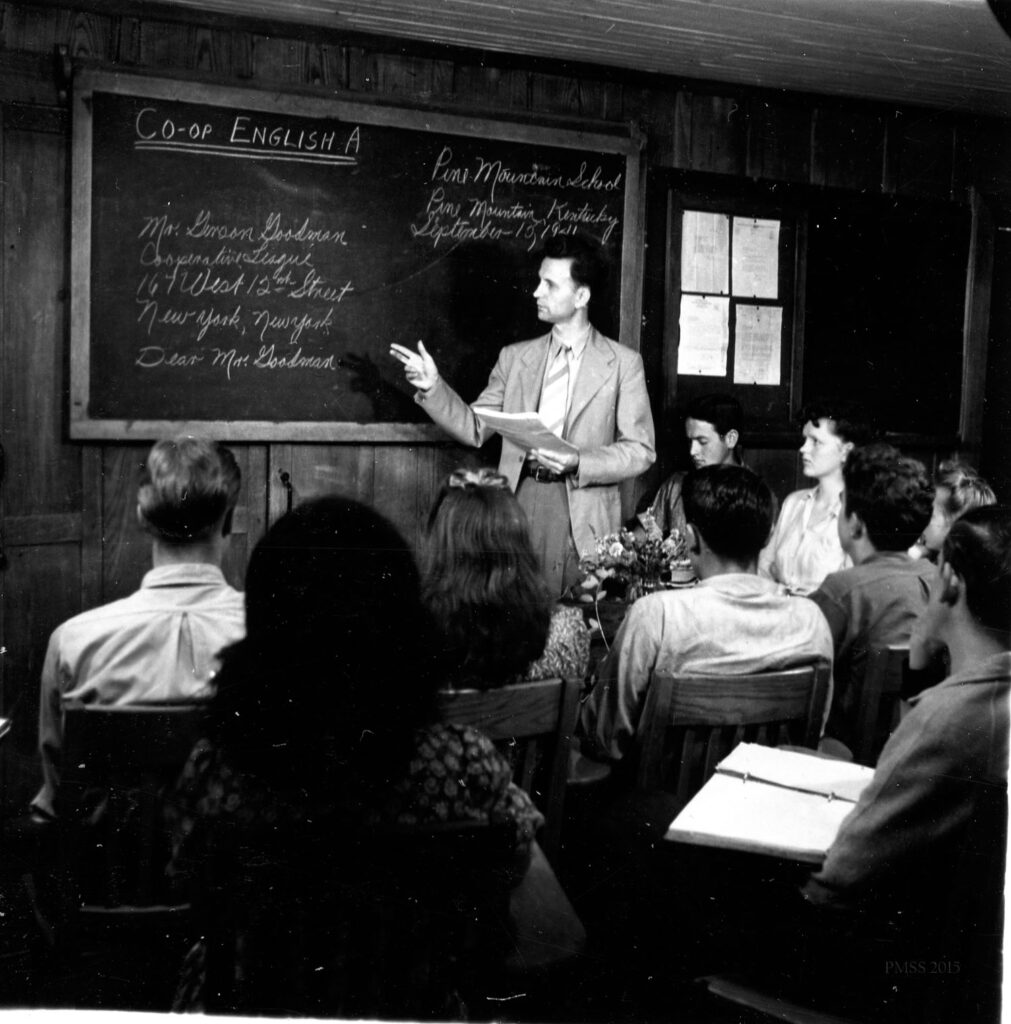
128 Arthur Dodd, Principal, in classroom at Pine Mountain Settlement. 1941 [garner_ray-128]
In 1940 Merton Oyler, who, at the time, was teaching at the University of Kentucky, presented a paper to the faculty at Berea College on the topic of “Population Trends in the Southern Appalachians.” His paper addressed the contemporary concerns of academic institutions to map their academic programs to the increasing trends of a mobile population. At the time, Eastern Kentucky was experiencing a dramatic increase in the mobility of its population. The coal industry had ratcheted up their production to meet the demands of War and as the demand fluctuated, Eastern Kentuckians regularly moved between the coal fields and the industrial Northern cities in search of employment.
The popular novel and, later, the film, The Dollmaker by Harriette Simpson Arnow, captured the eb and flow of migration and the dramatic social differences in life in rural and urban settings during the late 1930s and early 1940s. It is a picture that Oyler’s 1940s statistical comparisons outline, and that added depth to the changes and planning of educational programs of the day. While Oyler was particularly interested in the history related to the education of African Americans, his analysis of eastern Kentucky migration and educational patterns runs throughout his academic work. While there were few African American families or recent immigrant families in the Pine Mountain Valley where the School was located, coal mining had quickly diversified the population of Harlan and the surrounding counties in the 1930s and 1940s.
The particular importance of Oyler’s paper is his discussion of anticipated changes in education due to the growing, diverse population of families who had descended from immigrants in the Eastern Kentucky counties due to the increase in coal mining families. The demand for coal during the war years had greatly expanded the population. The mining activity in the region during the 1940s had also greatly diversified the population of the county and the county and region’s economic balance.
Oyler suggests in his paper that the growing eastern Kentucky population was increasingly impacting higher education enrollment, and new course demands were looming in the near future. The population growth and economic shift particularly impacted secondary education programs and the settlement school institutions in the region. Pine Mountain Settlement was remarkably ahead of its time in its educational programming but was strongly impacted by the rapid population growth and the demand for a review of educational offerings.
In his brief paper, Oyler presents a succinct argument for close attention to the evident regional population growth and the mobility of the diverse populations of Eastern Kentucky. He cautions on the diverse population’s impact on the future of educational programming in rural Appalachia. His discussion centers on College resources and the immediate community needs within the college service area. His analysis is strongly tied to the work of Samuel A. Stouffer and that found in Oscar F. Galloway’s study, Higher Education for Negroes in Kentucky (1934)*. Galloway’s 1932 analysis was one of the first studies to review the availability and the efficiency of higher education for African Americans in Kentucky. The four Kentucky schools studied by Galloway were Kentucky State Industrial College in Frankfort; Lincoln Institute at Lincoln Ridge (founded one year before Pine Mountain Settlement), Louisville Municipal College for Negroes, Louisville, and West Kentucky Industrial College, Paducah. Oyler was more focused on the changes in agriculture and the value of trained educational resources. This focus was consistent with the interests and the focus of Katherine Pettit when founding Pine Mountain Settlement.
While Galloway, in his study, argues for an increased effort at racial integration, he acknowledges the growing reality of mobility and the limited circulation patterns that appear to shape educational institutions and their enrollments. Oyler’s paper focuses on the mobility patterns and educational outcomes during the 1940s, a period when Pine Mountain reconsidered its educational mission and, faced with economic uncertainty, closed its agricultural programs and its boarding school.
* Bulletin of the Bureau of School Service, v.5, no.1, September 1932, pp.1-133.
POPULATION TRENDS
IN THE SOUTHERN APPALACHIANS
[Presented to the Faculty [Berea]
It is my intention to discuss population as it is today and as it can be anticipated to change in the future in this region [Eastern Kentucky]. Because you are considering this subject as it relates to this institution [Berea], I shall select the data that appear to be most significant for your purpose.
Leslie County, Kentucky, has the highest birth rate of any county in the United States. It has about the same rate of natural increase that prevailed in the American colonies and that continued almost undiminished up to the Civil War days. In general, we can say that the more a county continues to retain the neighborhood isolation and self-sufficiency of the colonial period, the longer will the high birth-rate characteristic of that era be maintained. The slight decline in the birth rate has probably been offset by the decline in infant mortality during the last century.
Variations in birth rates within the Southern Appalachian Region correspond with this general pattern of neighborhood isolation and self-sufficiency. Cities of 10,000 and over in the region as a whole have birth rates too low to maintain their population permanently. But in eastern Kentucky, where the birth rate is higher than for the rest of the Southern Appalachian Region, the birth rate in each of the Kentucky cities is likewise higher than for the other cities in the Region. In each Eastern Kentucky city, the natural increase is above the maintenance level. The Cumberland Plateau as a whole is rearing twice the number of children required to maintain the population. Leslie and Knott counties are rearing two and one-half times the required number.
In their monograph on rural migration in the United States, Lively and Taeuber rank the 99 Appalachian-Ozark counties having the highest net rural migration outward during the decade 1920 to 1930, and ninety-six of the 99 counties had net outward migration from their rural population. The range was from a net outmigration of 41 percent to a net immigration of 10 percent, the median county having a net outmigration of 21.5 percent from its rural population. The median county had a fertility ratio of 842. Using a ratio of 440 as sufficient for maintenance, these 99 counties are producing nearly twice the number of children needed for maintenance.
To be meaningful, the death rate must be considered for specific ages. In general, the reduction of infant mortality has had the greatest effect on increasing the length of life. In rural Kentucky, the rate during the past five years has averaged 59 per 1000 live births, almost twice that of New Zealand, which has the lowest in the World, a rate of 31 per 1000 live births. The rate for the 18 Cumberland Plateau counties was 60, and for Leslie County, it was 53 per thousand live births. If the infant mortality could be reduced by one-third to approximate that of New Zealand, it would be the equivalent of increasing the birth rate about 2 percent. Clearly, infant mortality is not a significant factor in population growth in Eastern Kentucky. However, infant mortality concerns us for another reason. Many students of society consider infant mortality one of the most reliable barometers of the standard of
page 2
living of a people. What is the rate of human wastage at its source? When considered in this light, we can rank along with it the abortion rate, because people indeed feel the burdens of child rearing when this rate is observed to be rising. Evidently, Eastern Kentucky, and for that matter, all the Southern Appalachian region, ranks as a life-conserving region as measured by either its abortion rate or its infant mortality rate. Abortion, infanticide, delayed marriage, and voluntary parenthood, all measures of conscious effort on the part of a people to regulate its numbers, are strangely absent from the Southern Appalachians. As world history goes, this is a region of youth. It is a young culture, as indeed all the Caucasian culture on this continent is a young culture that has not had a long period of equilibrium in relation to its environment. We can confidently expect certain forms of control of population growth to appear in Southern Appalachia within the next generation. What forms will predominate? In India and certain other Oriental countries, infanticide became the practice, in Southern Ireland, delayed marriage is the conventional method; among the 20th-century Germans, abortion was the mounting factor of adjustment until the National Socialist Party incorporated an opposition program in which the state assumed more of the cost of child support. What will be the method of adjustment between people and natural resources to obtain a rising level of physical comfort or to even maintain the present level of physical consumption in Eastern KY? If high school attendance becomes more universal (more will be said about this later), then delayed marriage will doubtless be a significant factor; but whether or not age of marriage continues to remain where it is now, we can expect voluntary parenthood to become the more universal practice. What are the implications of this major population adjustment for those who are concerned with college destinies?
Migration: I have already referred to the fact that the median county in the Appalachian-Ozark area lost 21.5 percent from its rural population during the decade 1920 to 1930. The thirty counties of Eastern Kentucky ranged from a loss of 38 percent to a gain of 40 percent in their rural population during their decade. Only 4 of the 38 counties had net in migration during the decade. Those were Harlan, Perry, Letcher, and Floyd Counties, the more recently developed coal counties.
During the decade just ended 6 of the 18 Cumberland Plateau counties had small net in-migration, but for the area as a whole, the net out-migration was 5.3 percent, four of the counties losing more than 10 percent each. The twenty counties of the Highland Rim and Cumberland Plateau margin had similar migration losses, 6 of them losing more than 10 percent. But the outstanding exception was Jackson County. It evidently came into its own as an area of truck mines during this decade. It gained 56 percent in population, about half by migration and half by natural increase.
Let us briefly compare natural increase in migration as two component factors in the population growth of Eastern Kentucky. For the 19 counties of the Cumberland Plateau, the natural increase during this past decade was 22.6. Percent of the 1930 population. Of those, 5.6 percent were lost from the area by migration, and the other 17.3 percent was the increase in population. For the 24 counties of the Highland Rim and Cumberland Plateau margin, the natural increase since 1930 was 18.2percent; 7 percent was lost from the area by migration, and the other 11.2 percent was the growth in population. Thus, the rate of excess
page 3
of births over deaths in the Cumberland Plateau was a fourth larger than the population increase, a half larger than in the Highland Rim and Cumberland Plateau margin. For the two areas together, the 43 counties are rearing annually about 18,000 more youth than have house space at present, and about 5,000 of these are leaving the two areas annually. How many of these 5,000 use college training as a preparatory stage in their migration journey? It should be kept in mind that those 5,000 represent net migration figures and that like most migrations, they are a balance between a much larger number moving in both directions.
School enrollment: Let us examine the high school enrollment, for this is the base upon which college enrollment rests. In the school year of 1937-38, the high school enrollment in Kentucky was just one-fourth as large as the elementary school enrollment. Probably a complete enrollment in high school would be 45 percent, certainly not over 50 percent as large as the elementary school enrollment. In Eastern Kentucky, the median county increased from a ratio of under 5 percent a decade ago to a ratio of 13 percent in the school year 1937- 38. Knowing what we do about the relation between high school education and the rise in consumption wants and the decline in the birth rate, we can look forward to some significant changes in Eastern Kentucky within the next generation. A recent tabulation of data published by the State Planning Board discovered that on the Cumberland Plateau in the 1933-34 school years, 1.2 percent of the youth 15 – 28 years of age were enrolled in Kentucky’s state-supported colleges and universities, and that 2.2 percent of the youth from the Highlands Rim and Cumberland Plateau were so enrolled. The statewide figure was 2.1 percent. What was the percentage of enrollment in other colleges, both in and out of Kentucky?
In this connection, we will review the theories and data on population mobility in relation to distance. Galloway, in his study of Higher Education for Negroes in Kentucky, reviews the findings as follows:
” Studies of the residents of students at various colleges and universities throughout the United States show that institutions of higher education are largely dependent for their students upon relatively nearby territory, and that the typical college draws approximately one-half of its student body from within 50 miles of the institution.* As a rule, it is either the institution with something to offer which is not available at many other colleges, or the one with a long and well-known history which goes much beyond the fifty-mile circle of any considerable part of its student body. “
(* Floys W Reeves and John Dale Russell, College Organization and Administration. Board of Education, Disciples of Christ, Indianapolis, 1929, p. 45.)
A study made about 1920 by the General Education Board revealed the same general conclusions. These experiences of colleges are reviewed to relate them to a general theory of population migration. In a review of rural migration data, Lively, has more recently stated the theory as the law of limited circulation.
page 4
Lively summarizes the data as follows:
” That distance is a factor in migration is indicated by the fact that the bulk of the migration to any center of supposed opportunity is relatively local. That opportunity as a factor is indicated by the tendency of migrants to concentrate in certain nearby communities. For purposes of this discussion, however, the most significant fact is that the mobility about the local area of polarization involves short distances, primarily, and falls away from the polar center after the manner of a hyperbolic surface, with occasional radiating inequalities which indicate favored routes of migration. I believe this phenomenon to be sufficiently general in its occurrence to warrant designating it as the “Law of Limited Circulation of Population”.
“It should be clear to the reader that this principle of limited circulation of population may be applied only within limits. It applies particularly to the circulation of the total population with respect to a given local area. It does not necessarily apply to special groups, such as professional persons, where the range of territorial mobility is much wider than for most occupational groups. In like manner, the principle can scarcely be said to apply to those population groups migrating directly to some distant colony or frontier, or to the movements of that class of chronic movers, commonly known as transients. However, only a small proportion of the population may be included in such groups.”
In connection with this problem of distance as related to migration, Stouffer has recently offered a significant modification, as a result of this analysis of migration within the Cleveland Metropolitan District:
” Theory here proposed and studied empirically assumes that there is no necessary relationship between mobility and distance. Instead, it introduces the concept of intervening opportunities. It proposes that the number of persons going the given distance is directly proportional to the number of opportunities at that distance. And inversely proportional to the number of intervening opportunities. Another way of stating the same hypothesis is that the number of persons going a given distance is directly proportional to the percentage increase in opportunities at that distance……..
” It may be found that there are certain types of mobility which cannot be subsumed under the present theory – for example, the importation of a train load of Mexicans from southern Texas. To a northern industry. At the same time, it may be found that other sociological phenomena common, such as the relationship of spatial propinquity [?] to the selection of marriage mates, and the relationship between certain types of crime and the residence of criminals, the choice of colleges, in the utilization of leisure time in vacation travel may be illuminated by application of the general theory.”*
page 5
(*Stouffer, Samuel A., “Intervening Opportunities: A Theory Relating Mobility and Distance”, American Sociological Review, December, 1940, pp. 846, 867.)
It is [in] the relating of general findings of population mobility and of college student mobility that we can fruitfully approach the question, what is the service area of a particular college or university? In this connection, I quote from a recent report of the Greenville County, South Carolina Council for Community Betterment:
“ Competent observers of educational practice declare that the life of the smaller colleges is limited unless they do two things: Relate their resources to their immediate communities and begin to carry out their declared contributions of individualized service to students. Few of the hundreds of small institutions scattered across the United States have made a significant social or educational contribution to their communities commensurate with their resources. Individualized student service in terms of continuous education and vocational guidance is practically unknown on the smaller campus in spite of the fact that most small colleges advertise this as one of their major reasons for existence. ” (p. 9)**
(** Developing Communities”, p.9. Greenville, South Carolina, 1940.)
END
Merton Dale Oyler was born in Columbus, Franklin County, OH on September 8, 1902. He died on January 14, 1994, at the age of 91 years.
PUBLICATIONS
A prolific writer, Merton Oyler’s published work was collaborative and often in the form of a bulletin. Most of the Bulletin’s may be found through Hathi Trust.
Merton Oyler. Social and Economic Effects of Land Speculation on Farm Families in Central Kentucky, 1930. (Hathi Trust)
Merton Oyler. Cost of Living and Population Trends in Laurel County, Kentucky, Lexington : Kentucky Agricultural Experiment Station, University of Kentucky, 1930. (Hathi Trust)
Merton Oyler. Social and Economic Effects of Land Speculation on Farm Families in Central Kentucky, 1930. (Hathi Trust)
Merton Oyler. The Standard of Living of Farm Families in Grayson County, Kentucky, 1931.Kentucky Agricultural Experiment Station, University of Kentucky. (Hathi Trust)
Merton Oyler. Human Aspects of Unemployment and Relief. By James Mickel Williams, Chapel Hill: The University of North Carolina Press, 1933. xvi + 235 pp. Oxford
Fred Boyd, Merton Oyler, and W.D. Nicholls. Rural Organization Contacts in Three Kentucky Communities. 1934. (Hathi Trust)
Merton Oyler. Part-time Farming in Four Representative Areas of Kentucky / [by Merton Oyler and W.W. Rose]. 1935. (Hathi Trust)
Merton Oyler. Part-time Farming by Negroes Near Lexington, Kentucky / [by Merton Oyler, W.W. Rose and W.D. Nicholls]. Bulletin No. 365. 1936. (Hathi Trust)
Merton Oyler, Fred Boyd, and W.D. Nicholls. Factors in the Success of Rural Organizations. Bulletin No. 364, 1936. (Hathi Trust)
Merton Oyler. Community and Neighborhood Groupings in Knott County. 1936. https://archive.org/details/CAT90247887366
Merton Oyler. Natural Increase and Migration of Kentucky Population: 1920 to 1935. 1939. (Hathi Trust)
Merton Oyler. Fertility Rates and Migration of Kentucky Population, 1920 to 1940 : as Related to Communication, Income and Education, 1944. (Hathi Trust)
Merton Oyler. Neighborhood standing and population changes in Johnson and Robertson counties, Kentucky, Volume 523, 1948. (Hathi Trust)
-
- Merton Oyler oyler_merton 001
-

- Merton Oyler oyler_merton 002
-

- Merton Oyler oyler_merton 003
-

- Merton Oyler oyler_merton 004
-
- Merton Oyler oyler_merton 005
________________________________________________________________
See